REVIEW 1 major objections 5 minor 48 references
Liquid-crystal enabled electrophoresis: Scenarios for driving and reconfigurable assembling of colloids
T0 review · 1 major / 5 minor · reviewed 2026-08-14 · deepseek-v4-flash
Pith's one-line read This paper claims that colloids dispersed in nematic liquid crystals can be driven by AC electric fields via nonlinear electrophoresis and steered by photoaligned director patterns, enabling reconfigurable assembly.
desk verdict A competent review of the authors' own prior work; the abstract overstates it as a new demonstration, but the science is sound and it works as a proceedings summary. read the letter →
The pith
A machine-rendered reading of the paper's core claim, the machinery that carries it, and where it could break.
The reading
What carries the argument
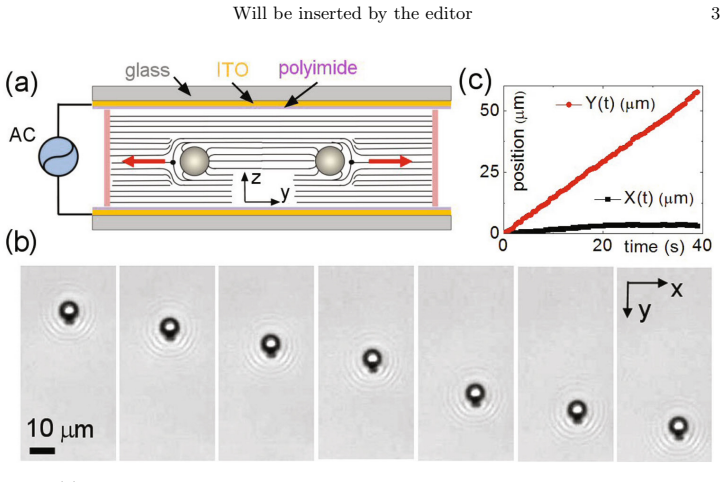
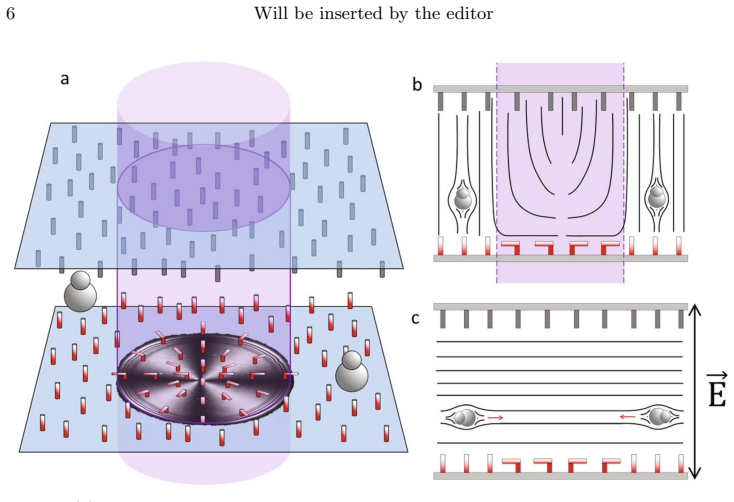
Two physical objects carry the argument. The first is the hyperbolic hedgehog point defect that forms around a homeotropic spherical inclusion in a nematic: this defect gives the colloid a dipolar elastic symmetry, so an oscillatory electric field induces a nonzero time-averaged electrophoretic velocity perpendicular to the field (liquid-crystal enabled electrophoresis, LCEEP), in contrast to symmetric Saturn-ring or double-boojum defects which stay stationary. The second is a photosensitive azosilane self-assembled monolayer on one cell plate, which can be switched between homeotropic (trans) and planar (cis) anchoring by blue and UV light, respectively; photopatterned radial or spiral director textures then act as elastic landscapes that steer particles along director lines into asters or rotating mills. The negative-dielectric-anisotropy nematic MLC-7029 and pear-shaped particles with distorted quadrupolar defect arrangements complete the experimental setup.
What would settle it
Using the described cell, a 6.5 µm water droplet under a 0.7 V/µm, 10 Hz AC field must move at about 1.7 µm/s toward its hedgehog point defect, and erasing the UV-imprinted radial pattern with blue light while the field is on must disperse or reconfigure the assembled aster; failure of either observation would falsify the driving or steering claim.
Extended reading notes
Core claim
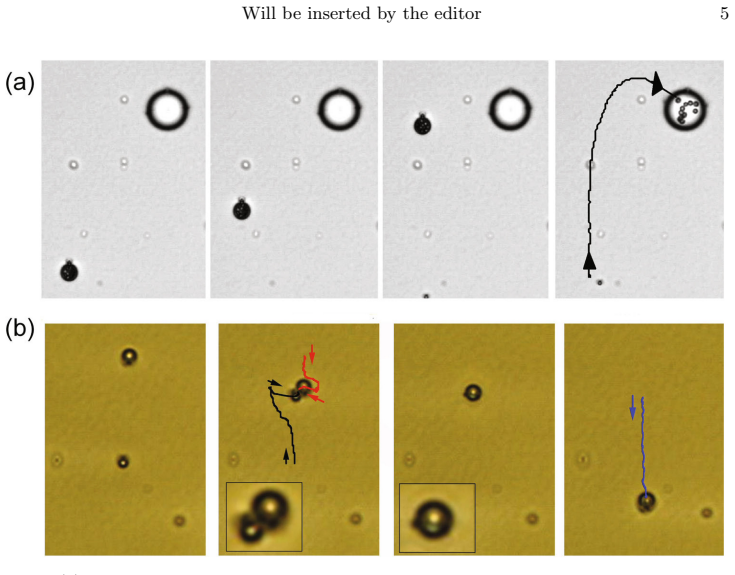
The paper's central claim is that in a nematic liquid crystal with negative dielectric anisotropy, a sinusoidal AC field produces net translation of colloids whose defect structure breaks fore-aft symmetry, and that light-controlled anchoring can redirect that motion. Concretely, a 6.5 µm water droplet with a dipolar hedgehog defect moves at about 1.7 µm/s under 0.7 V/µm, 10 Hz AC field, with velocity quadratic in the field and peaked at tens of hertz; droplets loaded with cargo can be driven to coalesce with a stationary target droplet and release their payload, and two droplets carrying different reagents can be made to collide and react. For steering, the authors use a photosensitive azosilane monolayer that switches between homeotropic and planar anchoring, imprinting radial or spiral director patterns into the bulk nematic; under the same AC field, colloids then migrate along the director field lines and jam into either a static aster or a rotating mill-like swarm, and the two modes can be reversibly interconverted by new irradiation patterns, with clusters relocatable across the cell.
Load-bearing premise
The whole summary inherits the validity of the data and mechanism reported in the authors' two earlier papers — the asymmetric hedgehog defect must be what propels droplets, and the light-imprinted director patterns must be what steers particles — and if either measurement or interpretation is wrong, the central claims collapse.
Editorial extensions
If this is right
- If the paper's claims hold, microdroplets can act as remotely addressable microreactors that transport sub-micrometre cargo and deliver it by controlled coalescence.
- Colloidal swarms can be assembled, disassembled, switched between static and rotating modes, and relocated anywhere in the cell by writing new illumination patterns.
- The separation of driving (AC field) from steering (light pattern) means a single experimental platform can independently transport and position many clusters.
- Because the velocity scales quadratically with field amplitude, increasing field strength should speed up transport while preserving direction, and raising frequency beyond about 50 Hz should halt LCEEP without disturbing the assembled cluster.
- The mechanism should work for any inclusion, charged or not, whose defect structure breaks fore-aft symmetry, extending electrophoretic control to dielectric particles.
Reading between the lines
- Inference: the same photoalignment strategy could create reconfigurable microfluidic circuits — printed paths that route individual droplets or swarms to chosen outputs — by imprinting a sequence of radial traps along a track, something the paper describes as possible but does not demonstrate in quantitative routing terms.
- Inference: if the mechanism is general, sorting colloids by defect symmetry becomes feasible: particles with Saturn-ring defects should remain stationary while hedgehog-bearing ones translate, providing a size- or anchoring-dependent separation.
- Inference: the aster-to-mill switch is a directly controllable transition between a static and a circulating active-matter state, so this system could serve as a testbed for models of jamming, flocking, and the onset of vortical order in externally driven colloids.
- Inference: since the direction of motion is set by which side the hedgehog lies, using liquid crystals with opposite sign of dielectric anisotropy or reversing anchoring could reverse the transport direction, a testable prediction the paper does not explicitly make.
Signed reviews
Editorial analysis
A structured set of objections, weighed in public.
Referee Report
Summary. This manuscript is a review/proceedings contribution from the authors of earlier experimental papers. It presents two scenarios for controlling colloids dispersed in nematic liquid crystals: (i) liquid-crystal enabled electrophoresis (LCEEP) of water microdroplets under AC electric fields, driven by the dipolar asymmetry of the hedgehog defect, with demonstrations of cargo release and mixing of reactants; and (ii) reconfigurable assembly of pear-shaped polystyrene particles into static asters or rotating mills, steered by photoaligned director patterns produced by UV/blue-light illumination of an azosilane monolayer, including the collective relocation of a particle swarm. All quantitative results, figures, and experimental details are explicitly attributed to the authors' prior publications, Hernández-Navarro et al. [44] (Soft Matter 2013) and [46] (Angew. Chem. Int. Ed. 2014), with figure captions crediting the original sources and noting that a complete account is found in those papers.
Significance. If the results of the underlying papers are correct, this review provides a useful and readable synthesis of an original mechanism (nonlinear LCEEP mediated by defect asymmetry) and of a method to combine it with photoaligned anchoring for reconfigurable colloidal assembly. The paper is well organized, places the work in the context of active matter and lab-on-a-chip applications, and is transparent about the provenance of all data. Its main strength is that it summarizes and connects two distinct experimental achievements in a coherent framework, with figures reproduced with permission. It does not present new data or derivations, but as a review this is not itself a defect; the main issue is the mismatch between the abstract's 'we demonstrate' phrasing and the manuscript's explicitly review nature.
major comments (1)
- [Abstract; Sections 4 and 5] The abstract states 'We demonstrate several examples of driving and steering of colloids when dispersed in nematic liquid crystals.' However, the body explicitly identifies the manuscript as a review: Section 4 says the system is 'thoroughly described in Hernández-Navarro et al. [44],' and Section 5 says 'A complete account of these experiments can be found in Hernández-Navarro et al. [46].' All figures are reproduced from those prior papers, and no new experimental data, control experiments, error bars, or derivations are provided in this manuscript. The first-person 'we demonstrate' is therefore not supported by the content of this paper and misleads the reader into expecting original results. Please revise the abstract and any similar statements (e.g., the sentence in Section 3 about 'experimentally robust realizations') to make clear that this contribution reviews previously published work, for example by changing 'we demonstrate' to 'we review' or 'we illustrate with previously reported experiments.'
minor comments (5)
- [Section 5, Fig. 6] The applied field is written as '0.74Vµm1' which should be '0.74 V µm−1', and the text states 'translated 600 m' which should be '600 µm'.
- [Section 5, last paragraph] There are typographical errors: 'empasizing' should be 'emphasizing' and 'photoativation' should be 'photoactivation'.
- [Section 2, paragraph 2] The word 'acception' (in 'under whatever acception') is unusual; 'acceptation' or 'sense' would be clearer.
- [Section 5, paragraph 4] 'proceding around the central defect' should be 'proceeding around the central defect'.
- [References] Reference [43] (Guzowski et al., Soft Matter 8, 7269) appears in the reference list but is not cited anywhere in the text. Please either cite it where relevant or remove it.
Circularity Check
Review article with demonstrations inherited from prior experimental papers; no circular derivation because all evidence is externally published and independently reproducible.
full rationale
This manuscript is a proceedings-style review of the authors' earlier experimental work on liquid-crystal-enabled electrophoresis. The abstract's 'We demonstrate...' is a summary of results originally reported in Hernández-Navarro et al., Soft Matter 9, 7999 (2013) [44] and Angew. Chem. Int. Ed. 53, 10696 (2014) [46]; the body explicitly says 'Our experimental system, thoroughly described in Hernández-Navarro et al. [44]' and 'A complete account of these experiments can be found in Hernández-Navarro et al. [46].' All quantitative demonstrations (1.7 µm/s droplet at 0.7 V/µm and 10 Hz, droplet coalescence/reaction, aster/mill interconversion at 0.87 V/µm, 600 µm swarm relocation) are reproduced from or credited to those prior reports. No equation is derived, no parameter is fitted, and no prediction is generated from inputs within this manuscript. The self-citations are load-bearing in the sense that the review's content comes from them, but they are independent, peer-reviewed experimental reports that are externally falsifiable and are not themselves derived from the present text. There is no definitional equivalence, no fitted input renamed as prediction, no uniqueness theorem imported from the authors, and no ansatz smuggled in by citation. The use of first person in the abstract is a stylistic framing of reviewed results, not a circular derivation. Therefore the circularity score is 0.
Assumptions & free parameters
assumptions (3)
- domain assumption The experimental results and trajectories in [44] and [46] are accurate and correctly interpreted.
- domain assumption The electrostatic analogy between elastic director distortions and electric multipoles is a valid basis for understanding defect symmetry and LCEEP.
- domain assumption The azosilane photoalignment layer reversibly switches anchoring and the imprinted director textures persist long enough to steer particles.
Cite this review
Pith. "Pith review of Liquid-crystal enabled electrophoresis: Scenarios for driving and reconfigurable assembling of colloids." pith.science (2026). https://pith.science/paper/ZU6VRRAF
@misc{pith2026190806150,
  author       = {Pith},
  title        = {Pith review of: Liquid-crystal enabled electrophoresis: Scenarios for driving and reconfigurable assembling of colloids},
  year         = {2026},
  howpublished = {\url{https://pith.science/paper/ZU6VRRAF}},
  note         = {Machine review of arXiv:1908.06150}
}
read the original abstract
We demonstrate several examples of driving and steering of colloids when dispersed in nematic liquid crystals. The driving mechanism is based on the principle of nonlinear electrophoresis which is mediated by the asymmetry in the structure of the defects that the inclusions generate in the host elastic matrix. The steering mechanism originates in the photoactivation of the anchoring conditions of the nematic liquid crystal on one of the enclosing plates. As experimental realizations we first review a scenario of water microdroplets being phoretically transported for cargo release and chemical reaction. Steering is illustrated in terms of the reconfigurable assembly of colloidal particles, either in the form of asters or rotating-mills, commanded by predesigned patterns of illumination.
Figures

Figures from the paper (3 more)


Reference graph
Works this paper leans on
-
[44]
Hern` andez-Navarro, et al., Soft Matter9, 7999 (2013)
S. Hern` andez-Navarro, et al., Soft Matter9, 7999 (2013)
work page 2013
-
[46]
Hern` andez-Navarro, et al., Angew
S. Hern` andez-Navarro, et al., Angew. Chem. Int. Ed. 53, 10696 (2014)
work page 2014
- [1]
- [2]
-
[3]
T. A. Wood, et al., Science 334, 79 (2011)
work page 2011
- [4]
- [5]
- [6]
Show all 48 references
-
[7]
Lapointe, et al., Science 303, 652 (2004)
C. Lapointe, et al., Science 303, 652 (2004)
2004
-
[8]
Yada, et al., Phys
M. Yada, et al., Phys. Rev. Lett. 92, 185501 (2004)
2004
-
[9]
Musevic, et al., Science 313, 954 (2006)
I. Musevic, et al., Science 313, 954 (2006)
2006
-
[10]
Pishnyak, et al., Phys
O.P. Pishnyak, et al., Phys. Rev. Lett. 99, 127802 (2007)
2007
-
[11]
Lapointe, et al., Science 326, 1083 (2009)
C.P. Lapointe, et al., Science 326, 1083 (2009)
2009
-
[12]
Koening, et al., Proc
G.M. Koening, et al., Proc. Natl. Acad. Sci. USA 107, 3998 (2010)
2010
-
[13]
Tkalec, et al., Science 333, 62 (2011)
U. Tkalec, et al., Science 333, 62 (2011)
2011
-
[14]
R. P. Trivedi, et al., Proc. Natl. Acad. Sci. USA 109, 4744 (2012)
2012
-
[15]
Qi, et al., Adv
H. Qi, et al., Adv. Funct. Mat. 18, 212 (2008)
2008
-
[16]
Acharya, et al., Adv
S. Acharya, et al., Adv. Mat. 21, 989 (2009)
2009
-
[17]
Zhou, et al., Proc
S. Zhou, et al., Proc. Natl. Acad. Sci. USA 111, 1265 (2014)
2014
-
[18]
Mushenheim, et al., Soft Matter 10, 88 (2014) Will be inserted by the editor 11
P.C. Mushenheim, et al., Soft Matter 10, 88 (2014) Will be inserted by the editor 11
2014
-
[19]
Oswald, et al., Nematic and cholesteric liquid crystals: Concepts and physical prop- erties illustrated by experiments (Taylor and Francis, Boca Raton, 2005)
P. Oswald, et al., Nematic and cholesteric liquid crystals: Concepts and physical prop- erties illustrated by experiments (Taylor and Francis, Boca Raton, 2005)
2005
-
[20]
Poulin, et al., Phys
P. Poulin, et al., Phys. Rev. E 57, 626 (1998)
1998
-
[21]
Lubensky, et al., Phys
T.C. Lubensky, et al., Phys. Rev. E 57, 610 (1998)
1998
-
[22]
Gu, et al., Phys
Y. Gu, et al., Phys. Rev. Lett. 85, 4719 (2000)
2000
-
[23]
Lavrentovich, et al., Nature 467, 947 (2010)
O.D. Lavrentovich, et al., Nature 467, 947 (2010)
2010
-
[24]
Squires, et al., J
T.M. Squires, et al., J. Fluid. Mech. 509, 217 (2004)
2004
-
[25]
Lavrentovich, et al., Soft Matter 10, 1264 (2014)
O.D. Lavrentovich, et al., Soft Matter 10, 1264 (2014)
2014
-
[26]
Murtsokvin, et al., Colloid J
V.A. Murtsokvin, et al., Colloid J. 52, 933 (1990)
1990
-
[27]
Gangwal, et al., Phys
S. Gangwal, et al., Phys. Rev. Lett. 100, 058302 (2008)
2008
-
[28]
Marchetti, et al., Rev
M.C. Marchetti, et al., Rev. Mod. Phys. 85, 1143 (2013)
2013
-
[29]
Schaller, et al., Nature 467, 73 (2010)
V. Schaller, et al., Nature 467, 73 (2010)
2010
-
[30]
Sumino, et al., Nature 483, 448 (2012)
Y. Sumino, et al., Nature 483, 448 (2012)
2012
-
[31]
Sanchez, et al., Nature 491, 431 (2012)
T. Sanchez, et al., Nature 491, 431 (2012)
2012
-
[32]
Yethiraj, et al., Adv
A. Yethiraj, et al., Adv. Mat. 16, 596 (2004)
2004
-
[33]
Terray, et al., Science 296, 1841 (2002)
A. Terray, et al., Science 296, 1841 (2002)
2002
-
[34]
Dreaden, et al., Chem
E.C. Dreaden, et al., Chem. Soc. Rev. 41, 2740 (2012)
2012
-
[35]
Whitesides, et al., Science 295, 2418 (2002)
G.M. Whitesides, et al., Science 295, 2418 (2002)
2002
-
[36]
Zheludev, et al., Nat
N.I. Zheludev, et al., Nat. Mat. 11, 917 (2012)
2012
-
[37]
Grier, Nature 424, 810 (2003)
D.G. Grier, Nature 424, 810 (2003)
2003
-
[38]
Paxton, et al., J
W.F. Paxton, et al., J. Am. Chem. Soc. 126, 13424 (2004)
2004
-
[39]
Howse, et al., Phys
J.R. Howse, et al., Phys. Rev. Lett. 99, 048102 (2007)
2007
-
[40]
Buttinoni, et al., Phys
I. Buttinoni, et al., Phys. Rev. Lett. 110, 238301 (2013)
2013
-
[41]
Palacci, et al., Science 339, 936 (2013)
J. Palacci, et al., Science 339, 936 (2013)
2013
-
[42]
Bricard, et al., Nature 503, 95 (2013)
A. Bricard, et al., Nature 503, 95 (2013)
2013
-
[43]
Guzowski, et al., Soft Matter 8, 7269 (2012)
J. Guzowski, et al., Soft Matter 8, 7269 (2012)
2012
-
[45]
Stark, Eur
H. Stark, Eur. Phys. J. B 10, 311 (1999)
1999
-
[47]
Ign´ es-Mullol, et al., Langmuir21, 2948 (2005)
J. Ign´ es-Mullol, et al., Langmuir21, 2948 (2005)
2005
-
[48]
Nagatani, et al., J
T. Nagatani, et al., J. Phys. Soc. Jpn. 59, 3447 (1990)
1990
Reviewed August 14, 2026 · model on record in the stance chip above.
Discussion (0). Continue with ORCID to comment.