Revisiting "A universal model for the Lorenz curve with novel applications''
Pith reviewed 2026-06-30 04:33 UTC · model grok-4.3
The pith
The four functional forms proposed for a universal Lorenz curve model fail to meet the required validity conditions.
A machine-rendered reading of the paper's core claim, the machinery that carries it, and where it could break.
Core claim
The four functional forms introduced by SH (2023) do not satisfy the necessary and sufficient conditions for a valid Lorenz curve. Corrected versions of the curves are proposed and analytical expressions for some measures of inequality are derived.
What carries the argument
The necessary and sufficient conditions for a Lorenz curve (non-decreasing, L(0)=0, L(1)=1, and convex) applied as a verification test to the proposed functional forms.
If this is right
- The corrected functional forms can be used as mathematically valid Lorenz curves.
- Analytical expressions for inequality measures such as the Gini index follow directly from the corrected models.
- Prior empirical applications that relied on the original forms require re-examination for consistency with the conditions.
- New modeling exercises can substitute the corrected forms and obtain explicit inequality calculations without numerical integration.
Where Pith is reading between the lines
- Empirical studies that fitted the original forms may have produced inequality estimates based on non-convex or boundary-violating curves.
- The corrected forms could be compared for flexibility against other established Lorenz curve families using real income data.
- Similar condition checks should be applied to other recently proposed universal Lorenz models before widespread adoption.
- The emphasis on analytical expressions suggests that future work could extend the corrections to additional inequality indices beyond those derived here.
Load-bearing premise
The standard conditions of non-decreasing convexity with fixed endpoints are the appropriate test for Lorenz curve validity.
What would settle it
A direct calculation showing that any one of the original four forms has a non-negative second derivative on (0,1) while also satisfying L(0)=0 and L(1)=1 would disprove the central claim.
Figures


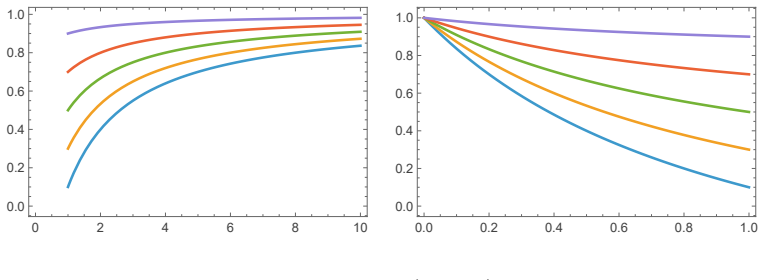
read the original abstract
This research reviews several crucial aspects of the universal model for the Lorenz curve proposed by Sitthiyot and Holasut (2023) (hereafter, SH (2023)). A first issue concerns the mathematical definition of the proposed curves. The four functional forms introduced by SH (2023) do not satisfy the necessary and sufficient conditions for a valid Lorenz curve. We propose corrected versions of the previous curves and derive analytical expressions for some measures of inequality.
Editorial analysis
A structured set of objections, weighed in public.
Referee Report
Summary. The paper reviews the four functional forms for a 'universal' Lorenz curve proposed by Sitthiyot and Holasut (2023). It asserts that none of these forms satisfy the standard necessary and sufficient conditions for a valid Lorenz curve (L(0)=0, L(1)=1, non-decreasing, and convex), supplies corrected versions of the forms, and derives closed-form expressions for inequality measures (such as the Gini coefficient) from the corrected curves.
Significance. If the claimed violations are correctly identified and the corrections are valid, the work supplies usable parametric Lorenz curves together with explicit inequality indices. This is a direct, falsifiable correction to an existing proposal rather than a new derivation, and the provision of analytical inequality expressions is a concrete contribution to the applied literature on Lorenz-curve modeling.
major comments (2)
- [Abstract / Introduction] Abstract and opening paragraphs: the central claim that each of the four SH(2023) forms violates at least one Lorenz condition is stated without exhibiting the explicit differentiation or boundary checks that establish the violation. Because this verification is load-bearing for the subsequent corrections, the manuscript should include, for each form, the specific condition that fails and the algebraic step that demonstrates the failure.
- [Section on corrected curves] The corrected functional forms are introduced without an accompanying table or appendix that lists, for each original and corrected pair, the four Lorenz conditions and the verification that the corrected version now satisfies them. This omission makes it impossible for a reader to confirm that the corrections are minimal and sufficient.
minor comments (2)
- Notation for the original SH(2023) parameters should be kept distinct (e.g., via subscripts) from the parameters of the corrected forms to avoid confusion when the inequality measures are later derived.
- [Abstract] The abstract states that 'analytical expressions for some measures of inequality' are derived; the manuscript should clarify which measures (Gini, Theil, etc.) are obtained and whether they are obtained in closed form for all four corrected curves.
Simulated Author's Rebuttal
We thank the referee for the constructive comments. We agree that explicit algebraic verifications will improve the manuscript's clarity and have revised it to incorporate the requested details for both major comments.
read point-by-point responses
-
Referee: [Abstract / Introduction] Abstract and opening paragraphs: the central claim that each of the four SH(2023) forms violates at least one Lorenz condition is stated without exhibiting the explicit differentiation or boundary checks that establish the violation. Because this verification is load-bearing for the subsequent corrections, the manuscript should include, for each form, the specific condition that fails and the algebraic step that demonstrates the failure.
Authors: We accept the point. The revised Introduction now includes, for each of the four forms, the specific violated condition together with the explicit differentiation (for monotonicity and convexity) or boundary evaluation that demonstrates the violation. revision: yes
-
Referee: [Section on corrected curves] The corrected functional forms are introduced without an accompanying table or appendix that lists, for each original and corrected pair, the four Lorenz conditions and the verification that the corrected version now satisfies them. This omission makes it impossible for a reader to confirm that the corrections are minimal and sufficient.
Authors: We agree that a systematic presentation aids verification. The revised manuscript adds an Appendix containing a table for each original-corrected pair that lists the four Lorenz conditions and confirms satisfaction for the corrected forms. revision: yes
Circularity Check
No significant circularity
full rationale
The paper is a direct verification and correction exercise that applies the standard necessary-and-sufficient conditions for Lorenz curves (L(0)=0, L(1)=1, non-decreasing, convex) to the four functional forms in SH (2023). These conditions are external mathematical requirements drawn from the established literature, not derived from or fitted to the paper's own outputs. No predictions, ansatzes, or uniqueness theorems are introduced that reduce to self-citations or internal definitions; the central claim rests on explicit checking against accepted axioms, with corrected forms then used to derive inequality measures. The argument chain is therefore self-contained against external benchmarks and contains no load-bearing self-referential steps.
Axiom & Free-Parameter Ledger
Reference graph
Works this paper leans on
-
[1]
On optimum stratification with proportional allocation for a class of Pareto distributions.Commun
Aggarwal, V., Singh, R. On optimum stratification with proportional allocation for a class of Pareto distributions.Commun. Stat. Theory Methods13, 3107–3116 (1984)
1984
-
[2]
A class of hyperbolic Lorenz curves.Sankhy¯ a: Indian J
Arnold, B.C. A class of hyperbolic Lorenz curves.Sankhy¯ a: Indian J. Stat. Ser. B, 427–436 (1986). 14
1986
-
[3]
Springer Nature, 2018
Arnold, B.C., Sarabia, J.M.Majorization and the Lorenz order with applications in applied mathematics and economics. Springer Nature, 2018
2018
-
[4]
Measuring inequality be- yond the Gini coefficient may clarify conflicting findings.Nat
Blesch, K., Hauser, O.P., Jachimowicz, J.M. Measuring inequality be- yond the Gini coefficient may clarify conflicting findings.Nat. Hum. Behav.6, 1525–1536 (2022)
2022
-
[5]
Voting procedures.Handbook of social choice and welfare6, 173–236 (2002)
Brams, Steven J., Fishburn, Peter C. Voting procedures.Handbook of social choice and welfare6, 173–236 (2002)
2002
-
[6]
A comparison of alternative functional forms for the Lorenz curve.Econom
Chotikapanich, D. A comparison of alternative functional forms for the Lorenz curve.Econom. Lett.41, 129–138 (1993)
1993
-
[7]
A single-parameter generalization of the Gini index of inequality.J
Donaldson, D., Weymark, J.A. A single-parameter generalization of the Gini index of inequality.J. Econom. Theory22, 67–86 (1980)
1980
-
[8]
A general definition of the Lorenz curve.Econometrica 39, 1037–1039 (1971)
Gastwirth, J.L. A general definition of the Lorenz curve.Econometrica 39, 1037–1039 (1971)
1971
-
[9]
Inequality measurement with grouped data: Parametric and non-parametric methods.J
Jordá, V., Sarabia, J.M., Jäntti, M. Inequality measurement with grouped data: Parametric and non-parametric methods.J. R. Stat. Soc. A184, 964–984 (2021)
2021
-
[10]
On the estimation of Lorenz curves from grouped observations.Int
Kakwani, N.C., Podder, N. On the estimation of Lorenz curves from grouped observations.Int. Econ. Rev., 278–292 (1973)
1973
-
[11]
On a class of poverty measures.Econometrica48, 437– 446 (1980)
Kakwani, N.C. On a class of poverty measures.Econometrica48, 437– 446 (1980)
1980
-
[12]
Power laws, Pareto distributions and Zipf’s law.Con- temp
Newman, M.E.J. Power laws, Pareto distributions and Zipf’s law.Con- temp. Phys.46, 323–351 (2005)
2005
-
[13]
A new functional form for estimating Lorenz curves.Rev
Ortega, P., Martín, G., Fernández, A., Ladoux, M., García, A. A new functional form for estimating Lorenz curves.Rev. Income Wealth37, 447–452 (1991)
1991
-
[14]
University of Western Australia, Department of Mathematics (1995)
Pakes, A.G.On income distributions and their Lorenz curves. University of Western Australia, Department of Mathematics (1995)
1995
-
[15]
& Obst, N
Rasche, R.H., Gaffney, J., Koo, A.Y.C. & Obst, N. Functional forms for estimating the Lorenz curve.Econometrica48, 1061–1062 (1980). 15
1980
-
[16]
A hierarchy of Lorenz curves based on the generalized tukey’s lambda distribution.Econometric Reviews,16, 305–320 (1997)
Sarabia, J.M. A hierarchy of Lorenz curves based on the generalized tukey’s lambda distribution.Econometric Reviews,16, 305–320 (1997)
1997
-
[17]
An ordered family of Lorenz curves.J
Sarabia, J.M., Castillo, E., Slottje, D.J. An ordered family of Lorenz curves.J. Econom.91, 43–60 (1999)
1999
-
[18]
Beyond the Beta Lorenz curve: A new parametric family for poverty and inequality estimation
Sarabia, J.M., Jordá, V., Gómez-Déniz, E. Beyond the Beta Lorenz curve: A new parametric family for poverty and inequality estimation. arXiv2604.00772 (2026)
-
[19]
A universal model for the Lorenz curve with novel applications for datasets containing zeros and/or exhibiting ex- treme inequality.Sci
Sitthiyot, T., Holasut, K. A universal model for the Lorenz curve with novel applications for datasets containing zeros and/or exhibiting ex- treme inequality.Sci. Rep.13, 4729 (2023)
2023
-
[20]
Elliptical Lorenz curves.J
Villaseñor, J.A., Arnold, B.C. Elliptical Lorenz curves.J. Econom.40, 327–338 (1989)
1989
-
[21]
On an extension of the Gini inequality index.Internat
Yitzhaki, S. On an extension of the Gini inequality index.Internat. Econom. Rev.24, 617–628 (1983). 16
1983
discussion (0)
Sign in with ORCID, Apple, or X to comment. Anyone can read and Pith papers without signing in.