REVIEW 58 references
Towards a generic implementation of matrix-element maximisation as a classifier in particle physics
T0 review · reviewed 2026-08-14 · deepseek-v4-flash
Pith's one-line read This paper claims that replacing the phase-space integration of the matrix-element method with a maximisation over invisible momenta classifies fully-leptonic ttH events at up to two orders of magnitude lower CPU cost, with discovery…
desk verdict A useful benchmark showing matrix-element maximisation is far cheaper than integration for ttH at a moderate, likely in-sample-inflated significance loss. read the letter →
The pith
A machine-rendered reading of the paper's core claim, the machinery that carries it, and where it could break.
The reading
What carries the argument
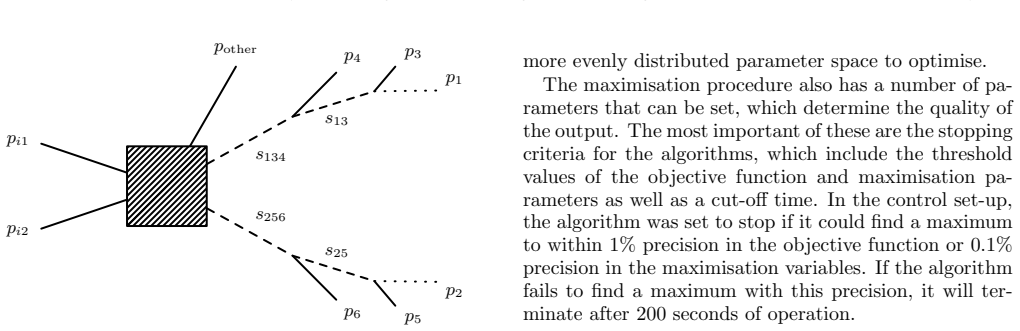
The object that carries the argument is the maximisation weight $w_\alpha(x) = \max_{y\in\Phi} |M_\alpha|^2(y)\, W(x,y)$, where $W(x,y)$ is a transfer function that penalises moving the four b-jet energies away from their measured values (a product of Gaussians with 15% resolution). To make the objective peak, the four free parameters left after momentum conservation are re-expressed as the invariant masses of the top and W propagators -- the 'Main Block D' kinematic template -- and each variable is then mapped to the unit interval through the cumulative distribution function of its Breit-Wigner or Gaussian model. The classifier is the log-ratio $\chi = \log w_s / \log w_b$, and the scan over local and global derivative-free algorithms is what produces the speed-versus-significance tradeoff. The same machinery is generic: it needs only the squared matrix element, a transfer function, and a choice of maximisation variables that peak near the true solution.
What would settle it
Run the same 2000-event test set through a high-precision reference maximiser, for example a dense grid or many random restarts over the four free parameters with the same transfer function, and compare each algorithm's reported maximum. If the best algorithm's discovery significance falls outside the paper's 60-85% band relative to that reference, or if the maximised weights frequently miss the reference maximum by more than the stated 1% stopping precision, the central claim that maximisation approximates the MEM classifier is undercut.
Extended reading notes
Core claim
The central claim is that the maximisation weight $w_\alpha(x) = \max_{y\in\Phi} \{ |M_\alpha|^2(y)\, W(x,y)\}$ can replace the integrated MEM probability in a signal-vs-background discriminant $\chi(x)=\log w_s(x)/\log w_b(x)$, and that for fully-leptonic $t\bar{t}h$ with $h\to b\bar{b}$ it does so at a fraction of the cost. Scanning sixteen derivative-free optimisation algorithms, the paper finds that the fastest ones reduce the average time per event to a few seconds, while global algorithms such as GN DIRECT L RAND give the best balance of speed and separation power. The cost is a loss in classifier quality: the best maximisation-based discovery significance is about 15% below the traditional MEM, and across algorithms the significance ranges from about 60% to 85% of the MEM value. A second claim is that the maximising phase-space point provides a four-momentum estimate for each neutrino; these are biased (neutrino $p_T$ about 70% too high on average, $p_Z$ close on average but with a huge spread) because the optimum sits at the Breit-Wigner pole masses of the top and W propagators, so the estimates should be most trustworthy when the resonances are narrow.
Load-bearing premise
The load-bearing premise is that the numerical maximum returned by the optimiser is close enough to the true highest value of the matrix-element weight to serve as a reliable classifier score; if optimisation frequently fails or stops early, both the reported significance and the speed ranking could change.
Editorial extensions
If this is right
- Replacing integration with maximisation makes MEM-style classification feasible for final states with several invisible particles; the cost per event drops to seconds for the fastest algorithms, so large LHC datasets become tractable.
- Users can choose an operating point on the speed-significance curve: fast local algorithms for quick scans, global algorithms for maximum separation, and a balanced default between the two.
- Every maximised event comes with a concrete four-momentum assignment for the invisible particles, which can be passed to more detailed reconstruction tools or used as a starting point for further MEM calculations.
- For processes dominated by narrow-width resonances, the maximised invisible momenta should be close to the true values, because the objective naturally peaks at the pole masses; this offers a cheap way to approximate missing momenta in complicated decay chains.
- The method inherits the MEM's advantage over machine-learning classifiers: no training on generated pseudo-data is required, since the weights come from first-principle matrix elements.
Reading between the lines
- The 60-85% significance gap may be partly an artifact of the stopping criteria and transfer function; using the maximiser's reconstructed momenta as a warm start for a short local integration or a second-stage refinement could recover most of the lost significance while keeping the speed gain.
- The bias toward pole masses suggests a calibration route: on signal Monte Carlo, a response map from true to reconstructed neutrino momenta could be built and applied as a correction, turning the method into a quantitative missing-momentum estimator rather than just a classifier.
- Because the algorithm scan is process-dependent, other final states will likely need their own scan; the transferable recipe is the peaked-variable reparameterisation and unit-cube mapping, not any single optimiser choice.
- The nonzero failure rates (6-13% of events for local algorithms) could be mitigated in practice by restarting the optimiser or falling back to a global algorithm on failure, still likely far cheaper than full phase-space integration.
Editorial analysis
A structured set of objections, weighed in public.
Circularity Check
No significant circularity: the maximisation benchmark is measured against the independent MadWeight MEM and external cross sections/PDFs, and no fitted parameter is repackaged as a prediction.
full rationale
The paper's central quantitative claims—that maximising |M|^2 W is faster than integrating it and retains 60–85% of the MEM significance—are established by an explicit numerical benchmark, not by definition. The classifier weight in Eq. (1) is the maximum of the matrix-element times a transfer function; this is an algorithmic approximation to the MEM integral, and its performance is measured against MadWeight, an independent implementation of the traditional MEM. Cross sections are taken from the LHC Higgs Cross Section Working Group and PDFs from NNPDF, i.e. external inputs. The 15% b-jet energy resolution used in the transfer function is calibrated to ATLAS simulation, but that calibration is an input to the comparison, not the result being claimed. Ref. [26], co-authored by two of the present authors, introduced the maximisation idea and is cited as the starting point, but the current paper does not rely on that citation as evidence for its performance claims; the significance and CPU-time results are computed here. The one statistical caveat—the cut chi0 and the preferred algorithm are chosen on the same 2000-event sample that is used to compute the significance—is an in-sample selection/optimism effect, not a logical circularity: the reported Z is not definitionally equal to the fitted cut or to any fitted parameter, and the authors explicitly describe the significance as an estimate for comparing algorithms. No equation in the paper reduces a prediction to its input by construction.
Assumptions & free parameters
free parameters (3)
- b-jet transfer function resolution R =
0.15 (15%)
- Optimisation stopping criteria (objective tolerance, variable tolerance, timeout) =
1% objective, 0.1% variables, 200 s
- Reconstruction efficiencies for signal and background =
2.5% each
assumptions (4)
- domain assumption The maximum of |M|^2 W over invisible-particle phase space is a sufficient statistic for signal/background discrimination.
- domain assumption The four remaining degrees of freedom after momentum conservation can be parameterised by the four invariant masses s13, s134, s25, s256 (Main Block D) for both hypotheses.
- domain assumption Leading-order matrix elements with Gaussian transfer functions, without parton shower or full detector simulation, are adequate for comparing classifier performance.
- domain assumption The Poisson significance Z = Ns/sqrt(Ns+Nb) without systematic uncertainties is a valid metric for ranking classification algorithms.
Cite this review
Pith. "Pith review of Towards a generic implementation of matrix-element maximisation as a classifier in particle physics." pith.science (2026). https://pith.science/paper/ZVBNMFB3
@misc{pith2026190805286,
  author       = {Pith},
  title        = {Pith review of: Towards a generic implementation of matrix-element maximisation as a classifier in particle physics},
  year         = {2026},
  howpublished = {\url{https://pith.science/paper/ZVBNMFB3}},
  note         = {Machine review of arXiv:1908.05286}
}
abstract
The so-called matrix-element method (MEM) has long been used successfully as a classification tool in particle physics searches. In the presence of invisible final state particles, the traditional MEM typically assigns probabilities to an event -- based on whether it is more signal or background-like -- through a phase space integration over all degrees of freedom of the invisible particles in the process(es). One inherent shortcoming of the traditional MEM is that the phase space integration can be slow, and therefore impractical for high multiplicity final states and/or large data sets. The recent alternative of matrix-element maximisation has recently been introduced to circumvent this problem, since maximising a highly-dimensional function can be a far more CPU-efficient task than that of integration. In this work, matrix-element maximisation is applied to the process of fully-leptonic top associated Higgs production, where the Higgs boson decays to two $b$-quarks. A variety of optimisation algorithms are tested in terms of their performance and speed, and it is explicitly found that the maximisation technique is far more CPU-efficient than the traditional MEM at the cost of a slight reduction in performance. An interesting consequence of using matrix-element maximisation is that the result of the procedure gives an estimate of the four-momenta for the invisible particles in the event. As a result, the idea of using these estimates as input information for more complicated tools is discussed with potential prospects for future developments of the method.
Figures


Figures from the paper (3 more)


Reference graph
Works this paper leans on
-
[1]
K. Kondo, “Dynamical Likelihood Method for Reconstruction of Events With Missing Momentum. 1: Method and Toy Models,” J. Phys. Soc. Jap. 57 (1988) 4126–4140
work page 1988
-
[2]
A precision measurement of the mass of the top quark,
D0 Collaboration, V. M. Abazov et al., “A precision measurement of the mass of the top quark,” Nature 429 (2004) 638–642, arXiv:hep-ex/0406031 [hep-ex]
arXiv 2004
-
[3]
Automation of the matrix element reweighting method,
P. Artoisenet, V. Lemaitre, F. Maltoni, and O. Mattelaer, “Automation of the matrix element reweighting method,” JHEP 12 (2010) 068, arXiv:1007.3300 [hep-ph]
arXiv 2010
-
[4]
Machine Learning in High Energy Physics Community White Paper,
K. Albertsson et al., “Machine Learning in High Energy Physics Community White Paper,” J. Phys. Conf. Ser. 1085 no. 2, (2018) 022008, arXiv:1807.02876 [physics.comp-ph]
arXiv 2018
-
[5]
MadMiner: Machine learning-based inference for particle physics,
J. Brehmer, F. Kling, I. Espejo, and K. Cranmer, “MadMiner: Machine learning-based inference for particle physics,” arXiv:1907.10621 [hep-ph]
arXiv 1907
- [6]
-
[7]
Maximum significance at the LHC and Higgs decays to muons,
K. Cranmer and T. Plehn, “Maximum significance at the LHC and Higgs decays to muons,” Eur. Phys. J. C51 (2007) 415–420, arXiv:hep-ph/0605268 [hep-ph]
arXiv 2007
-
[8]
The Matrix Element Method and QCD Radiation,
J. Alwall, A. Freitas, and O. Mattelaer, “The Matrix Element Method and QCD Radiation,” Phys. Rev. D83 (2011) 074010, arXiv:1010.2263 [hep-ph]
arXiv 2011
Show all 58 references
-
[9]
Measuring Sparticles with the Matrix Element,
J. Alwall, A. Freitas, and O. Mattelaer, “Measuring Sparticles with the Matrix Element,” AIP Conf. Proc. 1200 (2010) 442–445, arXiv:0910.2522 [hep-ph]
2010 arXiv
-
[10]
Extracting precise Higgs couplings by using the matrix element method,
J. R. Andersen, C. Englert, and M. Spannowsky, “Extracting precise Higgs couplings by using the matrix element method,” Phys. Rev. D87 no. 1, (2013) 015019, arXiv:1211.3011 [hep-ph]
2013 arXiv
-
[11]
Unravelling tth via the Matrix Element Method,
P. Artoisenet, P. de Aquino, F. Maltoni, and O. Mattelaer, “Unravelling tth via the Matrix Element Method,” Phys. Rev. Lett. 111 no. 9, (2013) 091802, arXiv:1304.6414 [hep-ph]
2013 arXiv
-
[12]
Measuring the mass, width, and couplings of semi-invisible resonances with the Matrix 11 Element Method,
A. Betancur, D. Debnath, J. S. Gainer, K. T. Matchev, and P. Shyamsundar, “Measuring the mass, width, and couplings of semi-invisible resonances with the Matrix 11 Element Method,” arXiv:1708.07641 [hep-ph]
-
[13]
Finding physics signals with shower deconstruction,
D. E. Soper and M. Spannowsky, “Finding physics signals with shower deconstruction,” Phys. Rev. D84 (2011) 074002, arXiv:1102.3480 [hep-ph]
2011 arXiv
-
[14]
Finding top quarks with shower deconstruction,
D. E. Soper and M. Spannowsky, “Finding top quarks with shower deconstruction,” Phys. Rev. D87 (2013) 054012, arXiv:1211.3140 [hep-ph]
2013 arXiv
-
[15]
Standard model Higgs boson pair production in the ( bb )( bb ) final state,
D. E. Ferreira de Lima, A. Papaefstathiou, and M. Spannowsky, “Standard model Higgs boson pair production in the ( bb )( bb ) final state,” JHEP 08 (2014) 030, arXiv:1404.7139 [hep-ph]
2014 arXiv
-
[16]
Quark-Gluon tagging with Shower Deconstruction: Unearthing dark matter and Higgs couplings,
D. Ferreira de Lima, P. Petrov, D. Soper, and M. Spannowsky, “Quark-Gluon tagging with Shower Deconstruction: Unearthing dark matter and Higgs couplings,” Phys. Rev. D95 no. 3, (2017) 034001, arXiv:1607.06031 [hep-ph]
2017 arXiv
-
[17]
The Matrix Element Method at Next-to-Leading Order,
J. M. Campbell, W. T. Giele, and C. Williams, “The Matrix Element Method at Next-to-Leading Order,” JHEP 11 (2012) 043, arXiv:1204.4424 [hep-ph]
2012 arXiv
-
[18]
Finding the Higgs boson in decays to Zγ using the matrix element method at Next-to-Leading Order,
J. M. Campbell, R. K. Ellis, W. T. Giele, and C. Williams, “Finding the Higgs boson in decays to Zγ using the matrix element method at Next-to-Leading Order,” Phys. Rev. D87 no. 7, (2013) 073005, arXiv:1301.7086 [hep-ph]
2013 arXiv
-
[19]
Extending the Matrix Element Method beyond the Born approximation: Calculating event weights at next-to-leading order accuracy,
T. Martini and P. Uwer, “Extending the Matrix Element Method beyond the Born approximation: Calculating event weights at next-to-leading order accuracy,” JHEP 09 (2015) 083, arXiv:1506.08798 [hep-ph]
2015 arXiv
-
[20]
Constraining anomalous Higgs boson couplings to the heavy flavor fermions using matrix element techniques,
A. V. Gritsan, R. Rntsch, M. Schulze, and M. Xiao, “Constraining anomalous Higgs boson couplings to the heavy flavor fermions using matrix element techniques,” Phys. Rev. D94 no. 5, (2016) 055023, arXiv:1606.03107 [hep-ph]
2016 arXiv
-
[21]
The Matrix Element Method at next-to-leading order QCD for hadronic collisions: Single top-quark production at the LHC as an example application,
T. Martini and P. Uwer, “The Matrix Element Method at next-to-leading order QCD for hadronic collisions: Single top-quark production at the LHC as an example application,” arXiv:1712.04527 [hep-ph]
-
[22]
Predicting event weights at next-to-leading order QCD for jet events defined by 2→ 1 jet algorithms,
M. Kraus, T. Martini, and P. Uwer, “Predicting event weights at next-to-leading order QCD for jet events defined by 2→ 1 jet algorithms,” arXiv:1901.08008 [hep-ph]
1901 arXiv
-
[23]
Finding physics signals with event deconstruction,
D. E. Soper and M. Spannowsky, “Finding physics signals with event deconstruction,” Phys. Rev. D89 no. 9, (2014) 094005, arXiv:1402.1189 [hep-ph]
2014 arXiv
-
[24]
Measuring the Higgs-bottom coupling in weak boson fusion,
C. Englert, O. Mattelaer, and M. Spannowsky, “Measuring the Higgs-bottom coupling in weak boson fusion,” Phys. Lett. B756 (2016) 103–108, arXiv:1512.03429 [hep-ph]
2016 arXiv
-
[25]
HYTREES: Combining Matrix Elements and Parton Shower for Hypothesis Testing,
S. Prestel and M. Spannowsky, “HYTREES: Combining Matrix Elements and Parton Shower for Hypothesis Testing,” arXiv:1901.11035 [hep-ph]
1901 arXiv
-
[26]
Searching for processes with invisible particles using a matrix element-based method,
D. E. Ferreira de Lima, O. Mattelaer, and M. Spannowsky, “Searching for processes with invisible particles using a matrix element-based method,” Phys. Lett. B787 (2018) 100–104, arXiv:1712.03266 [hep-ph]
2018 arXiv
-
[27]
The automated computation of tree-level and next-to-leading order differential cross sections, and their matching to parton shower simulations,
J. Alwall, R. Frederix, S. Frixione, V. Hirschi, F. Maltoni, O. Mattelaer, H. S. Shao, T. Stelzer, P. Torrielli, and M. Zaro, “The automated computation of tree-level and next-to-leading order differential cross sections, and their matching to parton shower simulations,” JHEP 0...
2014 arXiv
-
[28]
No free lunch theorems for optimization,
D. H. Wolpert and W. G. Macready, “No free lunch theorems for optimization,” IEEE Transactions on Evolutionary Computation 1 no. 1, (April, 1997) 67–82
1997
-
[29]
The NLopt nonlinear-optimization package
Steven G. Johnson, “The NLopt nonlinear-optimization package.” http://github.com/stevengj/nlopt
-
[30]
A controlled random search procedure for global optimisation,
W. L. Price, “A controlled random search procedure for global optimisation,” The Computer Journal 20 no. 4, (01, 1977) 367–370. https://doi.org/10.1093/comjnl/20.4.367
1977 doi
-
[31]
Global optimization by controlled random search,
W. L. Price, “Global optimization by controlled random search,” Journal of Optimization Theory and Applications 40 no. 3, (Jul, 1983) 333–348. https://doi.org/10.1007/BF00933504
1983 doi
-
[32]
Some variants of the controlled random search algorithm for global optimization,
P. Kaelo and M. M. Ali, “Some variants of the controlled random search algorithm for global optimization,” Journal of Optimization Theory and Applications 130 no. 2, (Aug, 2006) 253–264. https://doi.org/10.1007/s10957-006-9101-0
2006 doi
-
[33]
Lipschitzian optimization without the lipschitz constant,
D. R. Jones, C. D. Perttunen, and B. E. Stuckman, “Lipschitzian optimization without the lipschitz constant,” Journal of Optimization Theory and Applications 79 no. 1, (Oct, 1993) 157–181. https://doi.org/10.1007/BF00941892
1993 doi
-
[34]
A locally-biased form of the direct algorithm,
J. Gablonsky and C. Kelley, “A locally-biased form of the direct algorithm,” Journal of Global Optimization 21 no. 1, (Sep, 2001) 27–37. https://doi.org/10.1023/A:1017930332101
2001 doi
-
[35]
Stochastic global optimization methods part i: Clustering methods,
A. H. G. Rinnooy Kan and G. T. Timmer, “Stochastic global optimization methods part i: Clustering methods,” Mathematical Programming 39 no. 1, (Sep,
-
[36]
Stochastic global optimization methods part ii: Multi level methods,
A. H. G. Rinnooy Kan and G. T. Timmer, “Stochastic global optimization methods part ii: Multi level methods,” Mathematical Programming 39 no. 1, (Sep,
-
[37]
Application of deterministic low-discrepancy sequences in global optimization,
S. Kucherenko and Y. Sytsko, “Application of deterministic low-discrepancy sequences in global optimization,” Computational Optimization and Applications 30 no. 3, (Mar, 2005) 297–318. https://doi.org/10.1007/s10589-005-4615-1
2005 doi
- [38]
-
[39]
Search biases in constrained evolutionary optimization,
T. P. Runarsson and Xin Yao, “Search biases in constrained evolutionary optimization,” IEEE Transactions on Systems, Man, and Cybernetics, Part C (Applications and Reviews) 35 no. 2, (May, 2005) 233–243
2005
-
[40]
Stochastic ranking for constrained evolutionary optimization,
T. P. Runarsson and Xin Yao, “Stochastic ranking for constrained evolutionary optimization,” IEEE Transactions on Evolutionary Computation 4 no. 3, (Sep., 2000) 284–294
2000
-
[41]
Designing novel photonic devices by bio-inspired computing,
C. H. da Silva Santos, M. S. Goncalves, and H. E. Hernandez-Figueroa, “Designing novel photonic devices by bio-inspired computing,” IEEE Photonics Technology Letters 22 no. 15, (Aug, 2010) 1177–1179
2010
-
[42]
Evolution strategies – a comprehensive introduction,
H.-G. Beyer and H.-P. Schwefel, “Evolution strategies – a comprehensive introduction,” Natural Computing 1 no. 1, (Mar, 2002) 3–52. https://doi.org/10.1023/A:1015059928466
2002 doi
-
[43]
Improving ultimate convergence of an augmented lagrangian method,
E. Birgin and J. Martnez, “Improving ultimate convergence of an augmented lagrangian method,” Optimization Methods and Software 23 no. 2, (2008) 177–195, https://doi.org/10.1080/10556780701577730. https://doi.org/10.1080/10556780701577730
2008 doi
-
[44]
A globally convergent augmented lagrangian algorithm for optimization with general constraints and simple bounds,
A. Conn, N. Gould, and P. Toint, “A globally convergent augmented lagrangian algorithm for optimization with general constraints and simple bounds,” SIAM Journal on Numerical Analysis 28 no. 2, (1991) 545–572, https://doi.org/10.1137/0728030. https://doi.org/10.1137/0728030. 12
1991 doi
-
[45]
M. J. D. Powell, A Direct Search Optimization Method That Models the Objective and Constraint Functions by Linear Interpolation, pp. 51–67. Springer Netherlands, Dordrecht, 1994. https://doi.org/10.1007/978-94-015-8330-5_4
1994 doi
-
[46]
The bobyqa algorithm for bound constrained optimization without derivatives,
M. J. Powell, “The bobyqa algorithm for bound constrained optimization without derivatives,” Tech. Rep. NA2009/06, Department of Applied Mathematics and Theoretical Physics, Cambridge, 2009
2009
-
[47]
A New Method of Constrained Optimization and a Comparison With Other Methods,
M. J. Box, “A New Method of Constrained Optimization and a Comparison With Other Methods,” The Computer Journal 8 no. 1, (04, 1965) 42–52. https://doi.org/10.1093/comjnl/8.1.42
1965 doi
-
[48]
A Simplex Method for Function Minimization,
J. A. Nelder and R. Mead, “A Simplex Method for Function Minimization,” The Computer Journal 7 no. 4, (01, 1965) 308–313. https://doi.org/10.1093/comjnl/7.4.308
1965 doi
-
[49]
Brent, Algorithms for Minimization without Derivatives
R. Brent, Algorithms for Minimization without Derivatives. Prentice-Hall, 1972
1972
-
[50]
M. J. D. Powell, The NEWUOA software for unconstrained optimization without derivatives , pp. 255–297. Springer US, Boston, MA, 2006. https://doi.org/10.1007/0-387-30065-1_16
2006 doi
-
[51]
Search for the standard model Higgs boson produced in association with top quarks and decaying into a b¯b pair in pp collisions at√s = 13 TeV with the ATLAS detector,
ATLAS Collaboration, M. Aaboud et al., “Search for the standard model Higgs boson produced in association with top quarks and decaying into a b¯b pair in pp collisions at√s = 13 TeV with the ATLAS detector,” Phys. Rev. D97 no. 7, (2018) 072016, arXiv:1712.08895 [hep-ex]
2018 arXiv
-
[52]
Functional stability analysis of numerical algorithms,
T. H. Rowan, “Functional stability analysis of numerical algorithms,” tech. rep., 1990
1990
-
[53]
Parton distributions with QED corrections,
NNPDF Collaboration, R. D. Ball, V. Bertone, S. Carrazza, L. Del Debbio, S. Forte, A. Guffanti, N. P. Hartland, and J. Rojo, “Parton distributions with QED corrections,” Nucl. Phys. B877 (2013) 290–320, arXiv:1308.0598 [hep-ph]
2013 arXiv
-
[54]
Search for ttH production in the H → bb decay channel with leptonic tt decays in proton-proton collisions at√s = 13 TeV,
CMS Collaboration, A. M. Sirunyan et al., “Search for ttH production in the H → bb decay channel with leptonic tt decays in proton-proton collisions at√s = 13 TeV,” JHEP 03 (2019) 026, arXiv:1804.03682 [hep-ex]
2019 arXiv
-
[55]
Observation of H→b¯b decays and VH production with the ATLAS detector,
ATLAS Collaboration, M. Aaboud et al., “Observation of H→b¯b decays and VH production with the ATLAS detector,” Phys. Lett. B786 (2018) 59–86, arXiv:1808.08238 [hep-ex]
2018 arXiv
-
[56]
LHAPDF6: parton density access in the LHC precision era,
A. Buckley, J. Ferrando, S. Lloyd, K. Nordstroem, B. Page, M. Ruefenacht, M. Schoenherr, and G. Watt, “LHAPDF6: parton density access in the LHC precision era,” Eur. Phys. J. C75 (2015) 132, arXiv:1412.7420 [hep-ph]
2015 arXiv
-
[58]
Handbook of LHC Higgs Cross Sections: 4. Deciphering the Nature of the Higgs Sector,
LHC Higgs Cross Section Working Group Collaboration, D. de Florian et al., “Handbook of LHC Higgs Cross Sections: 4. Deciphering the Nature of the Higgs Sector,” arXiv:1610.07922 [hep-ph]
- [1987]
Reviewed August 14, 2026 · model on record in the stance chip above.
Discussion (0). Continue with ORCID to comment.