REVIEW 3 major objections 3 minor 8 references
Dark Matter search with H.E.S.S. towards ultra-faint dwarf nearby DES satellites of the Milky Way
T0 review · 3 major / 3 minor · reviewed 2026-08-14 · deepseek-v4-flash
Pith's one-line read H.E.S.S. finds no very-high-energy gamma-ray excess in five DES dwarf satellites and sets the first imaging-atmospheric-Cherenkov-telescope constraints on dark matter annihilation in these systems.
desk verdict First IACT constraints on five DES ultrafaint dwarfs, with a credible no-excess claim whose headline combined limit depends on predicted J-factors for three targets. read the letter →
The pith
A machine-rendered reading of the paper's core claim, the machinery that carries it, and where it could break.
The reading
What carries the argument
The analysis is carried by the J-factor, the integral of the square of the dark-matter density along the line of sight and over the observation solid angle, which sets the expected annihilation flux. For targets with measured stellar kinematics, such as Reticulum II and Tucana II, the J-factor comes from Jeans-equation modeling; for the others it is predicted. The expected flux is computed from $\mathrm{d}\Phi_\gamma/\mathrm{d}E_\gamma = \frac{\langle\sigma v\rangle}{8\pi m_{\mathrm{DM}}^2}\sum_f \mathrm{BR}_f \frac{\mathrm{d}N_f}{\mathrm{d}E_\gamma} J(\Delta\Omega)$. Events are counted in an ON region and multiple OFF regions, and a two-dimensional binned Poisson likelihood compares the measured counts with the background-plus-signal expectation in energy and spatial bins. Upper limits are set with a log-likelihood ratio test statistic following the procedure in Ref. [2], with $\mathrm{TS}=2.71$ defining the 95% one-sided limit, and the target datasets are combined at the likelihood level.
What would settle it
Measure stellar line-of-sight velocities for Tucana III, Tucana IV, and Grus II, recompute their J-factors from Jeans modelling, and re-derive the combined limits; if the measured J-factors are lower than the predicted values used here, the quoted annihilation cross-section limits weaken accordingly.
Extended reading notes
Core claim
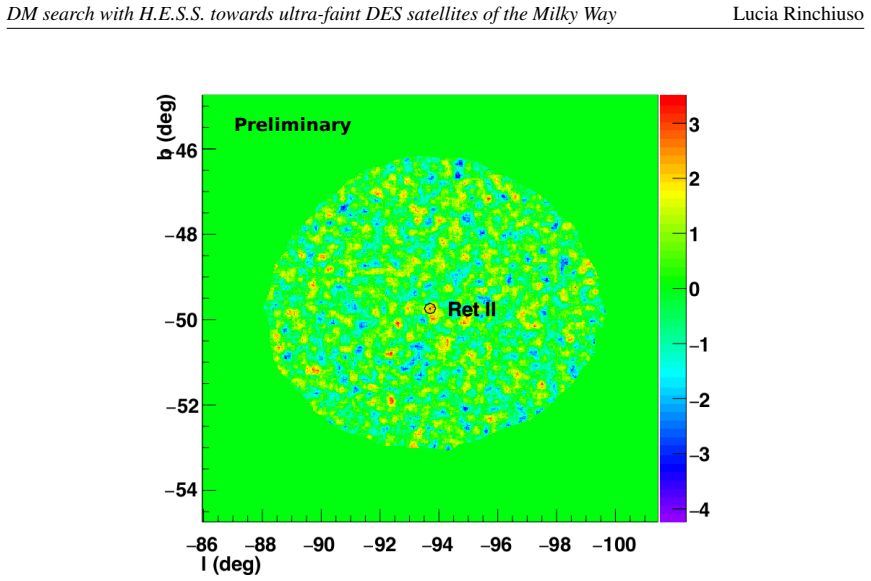
The paper reports a search for dark-matter annihilation signals in very-high-energy gamma rays from five ultra-faint dwarf galaxies discovered by the Dark Energy Survey: Reticulum II, Tucana II, Tucana III, Tucana IV, and Grus II. Using about 80 hours of H.E.S.S. observations from 2017 and 2018, it finds no significant excess above the residual background in any target, either individually or in a combined likelihood analysis. From the absence of signal, it derives 95% confidence upper limits on the velocity-weighted annihilation cross section $\langle \sigma v \rangle$ as a function of dark-matter mass for several annihilation channels. The strongest combined limits reach a few $10^{-24}$ cm$^3$ s$^{-1}$ in the TeV mass range, with the combined limit at 1 TeV in the $W^+W^-$ channel reaching $3\times10^{-24}$ cm$^3$ s$^{-1}$, driven mainly by Reticulum II and Tucana III. These are described as the first imaging atmospheric Cherenkov telescope constraints derived toward DES dwarf galaxy satellites, complementing lower-mass limits from Fermi-LAT.
Load-bearing premise
The limits assume that the predicted dark-matter content of Tucana III, Tucana IV, and Grus II is correct, even though those three dwarfs lack the spectroscopic stellar-velocity measurements needed to determine it, and the quoted limits do not include J-factor statistical uncertainties.
Editorial extensions
If this is right
- No very-high-energy gamma-ray excess is present in any of the five targets after about 80 hours of observations.
- Dark-matter annihilation cross sections above roughly $3\times10^{-24}$ cm$^3$ s$^{-1}$ for 1 TeV mass in the $W^+W^-$ channel are excluded at 95% confidence by the combined analysis.
- The combined limit is driven mainly by Reticulum II and Tucana III, so further observations of these two objects offer the clearest path to stronger constraints.
- These results provide the first imaging atmospheric Cherenkov telescope constraints on DES-discovered dwarf galaxies and complement Fermi-LAT limits obtained at lower dark-matter masses.
Reading between the lines
- A consequence the paper leaves implicit is that if future spectroscopy measures lower J-factors for Tucana III, Tucana IV, or Grus II, the corresponding limits would move upward, weakening the combined result; if higher, they would strengthen it.
- The same 80-hour datasets could be re-analysed for gamma-ray line signals or for annihilation into other final states beyond the channels shown, potentially extending coverage at little additional observation time.
- Because the limits are already within an order of magnitude of the thermal-relic cross section at TeV masses, stacking these observations with those from more sensitive future gamma-ray observatories could plausibly reach the canonical WIMP cross section for these dwarfs.
Signed reviews
Editorial analysis
A structured set of objections, weighed in public.
Referee Report
Summary. The manuscript reports a search for dark-matter annihilation in very-high-energy gamma rays from five ultra-faint dwarf galaxies discovered by the Dark Energy Survey, using about 80 hours of H.E.S.S. observations. The analysis uses a multiple-OFF background-measurement procedure and a binned Poisson likelihood with energy and spatial information. No significant excess is claimed in any target. Upper limits on the velocity-weighted annihilation cross section are derived for several channels; in the W+W− channel the observed combined 95% C.L. limit reaches 3×10^-24 cm^3 s^-1 at 1 TeV, and the strongest individual limit for Reticulum II is 6×10^-24 cm^3 s^-1 at 1 TeV.
Significance. If the result holds, these are the first IACT constraints on DES-discovered dwarf spheroidal galaxies and are competitive with existing TeV-mass limits. The analysis framework is standard for IACT dark-matter searches, and the no-excess statement is credible given the described ON/OFF and likelihood procedure. The paper is also transparent in deriving expected limits from background-only Poisson realizations and in presenting individual and combined limits. The main weakness is that the central quantitative claim depends on J-factors that are either treated without their statistical uncertainties or, for three of the five targets, predicted rather than measured; this reduces the robustness of the quoted few-10^-24 cm^3 s^-1 range.
major comments (3)
- [Section 2, Table 1] The distinction between measured and predicted J-factors is internally inconsistent. Table 1 lists Tucana III with an asterisk indicating no spectroscopic measurement and cites Ref. [7], yet Section 2 states that the J-factors for Tuc III, Tuc IV and Gru II are obtained from predictions because high-quality spectroscopic measurements are not available. If Ref. [7] provides a measured J-factor, the text is inaccurate; if it does not, the citation is misleading. This matters because Tuc III is stated in Section 4 to be one of the two main contributors to the combined limit. Please clarify the status of each J-factor and correct the text or table accordingly.
- [Section 4, Figures 3 and 4] The quoted upper limits do not include any statistical uncertainty on the J-factors, as acknowledged in the figure captions. Reticulum II has a quoted 1σ J-factor uncertainty of 0.85 dex, and the predicted J-factors for the other targets carry comparable or larger uncertainties. Since the cross-section limit scales as 1/J, a 1σ downward fluctuation of the J-factor can change the limits by roughly an order of magnitude. The paper should either include a J-factor systematic band on the limits or clearly state that the limits are conditional on the adopted J values and quantify the scaling; without this, the combined 3×10^-24 cm^3 s^-1 value is not robust.
- [Section 3 and Table 1] The relation between the J-factors quoted for an integration angle of 0.5° and the J-factor actually used in the likelihood for the ON region (0.2° radius for targets with measured J-factors and 0.125° for point-like targets) is not specified. If the 0.5° J-factor is used to normalize the expected signal inside a smaller ON region, the limits would be biased; if the J-factor integrated over the ON region is used instead, that should be stated explicitly. This point is load-bearing for the numerical limits and should be clarified.
minor comments (3)
- [Section 5] The summary contains the typo 'campagain' for 'campaign'; please correct it.
- [Section 3] The phrase 'filed of view' should read 'field of view', and the reference to 'Fig.fig:Bckdetemination' appears malformed and should be replaced with a proper figure reference.
- [Section 3] The manuscript states that NON and NOFF/α are compared for each target, but it does not report the observed counts or the numerical significances for the individual targets; providing these values would make the no-excess claim more reproducible.
Circularity Check
No significant circularity: the H.E.S.S. upper limits are derived from standard likelihood fits to ON/OFF counts with externally sourced J-factors, and no fitted parameter is recycled as a prediction.
full rationale
The paper's derivation chain is standard and self-contained: the DM flux is parametrized by Eq. (1.1) in terms of the annihilation cross section, the particle physics spectra, and the J-factor. The J-factors in Table 1 are taken from external references [5]–[8], not fitted to the H.E.S.S. observations. The limits are then obtained from a 2D-binned Poisson maximum-likelihood analysis comparing ON and OFF counts, with the test statistic from Cowan et al. [2]. No parameter is fitted to the observed counts and then renamed as a prediction; the 'expected limits' are explicitly generated from Poisson realizations of the measured counts. The caveat that J-factors for Tucana III, Tucana IV, and Grus II are predictions, and the statement that J-factor statistical uncertainties are not included, concern the robustness or interpretation of the limits, not circularity: using an externally derived astrophysical input in a standard limit-setting formula is not equivalent to deriving the output from itself. The references cited are external works, not self-citations by the authors, and no uniqueness theorem or ansatz is imported from prior work by the same authors. The core observational claim, absence of significant gamma-ray excess, is a direct data result, and the cross-section limits follow from a standard, non-circular likelihood procedure.
Assumptions & free parameters
assumptions (4)
- domain assumption The gamma-ray flux from DM annihilation is given by Eq. 1.1: dPhi/dE = <sigma v>/(8 pi m_DM^2) * sum_f BR_f dN_f/dE * J(DeltaOmega).
- domain assumption For Tucana III, Tucana IV, and Grus II, dark matter J-factors are adopted from predictions rather than from stellar kinematic measurements.
- standard math A one-sided 95% confidence upper limit corresponds to a log-likelihood ratio test statistic TS = 2.71, following Cowan et al. Ref [2].
- domain assumption The residual background in OFF regions, selected on a ring at the same offset as the ON region with an exclusion disk of twice the ON radius, is representative of the background in the ON region.
Cite this review
Pith. "Pith review of Dark Matter search with H.E.S.S. towards ultra-faint dwarf nearby DES satellites of the Milky Way." pith.science (2026). https://pith.science/paper/ZVBWU3NO
@misc{pith2026190804311,
  author       = {Pith},
  title        = {Pith review of: Dark Matter search with H.E.S.S. towards ultra-faint dwarf nearby DES satellites of the Milky Way},
  year         = {2026},
  howpublished = {\url{https://pith.science/paper/ZVBWU3NO}},
  note         = {Machine review of arXiv:1908.04311}
}
abstract
Several nearby ultra-faint satellites of the Milky Way discovered by the Dark Energy Survey (DES) during the last few years are promising targets for indirect dark matter (DM) searches with very-high-energy (VHE, E$\gtrsim$100 GeV) gamma rays. The H.E.S.S. experiment has carried out an observational campaign in 2017 and 2018 towards a selection of the most promising DES dwarf satellites, accumulating a total observation time of about 80 hours. The individual datasets have been used to look for a DM signal in several annihilation channels. No significant VHE gamma-ray excess above the background is found in any of the targets. Constraints are derived on the thermally-averaged velocity-weighted annihilation cross section $\langle \sigma v \rangle$ of the DM particles versus their mass. A combined analysis of the datasets has been performed. The strongest 95% C.L. upper limits reach a $\langle \sigma v \rangle$ value of a few $10^{-24}$ cm$^3$ s$^{-1}$ for the DM continuum signals in the TeV DM mass range. They are the first constraints derived from imaging atmospheric Cherenkov telescope observations towards DES dwarf galaxy satellites. These limits are among the most constraining so far in the TeV DM mass range towards dwarf satellites of the Milky Way.
Figures


Figures from the paper (1 more)

Reference graph
Works this paper leans on
-
[7]
J. D. Simon et al. [DES Collaboration], Astrophys. J. 838, no. 1, 11 (2017) doi:10.3847/1538-4357/aa5be7 [arXiv:1610.05301 [astro-ph.GA]]
arXiv 2017
-
[1]
towards ultra-faint DES satellites of the Milky Way Lucia Rinchiuso Preliminary Figure 4: 95% C.L
http://www.darkenergysurvey.org 5 DM search with H.E.S.S. towards ultra-faint DES satellites of the Milky Way Lucia Rinchiuso Preliminary Figure 4: 95% C.L. observed upper limits on the annihilation cross section ⟨σ v⟩ for the individual and combined datasets of the target in the W +W− annihilation channel. No statistical uncertainty on the J factor is ta...
- [2]
-
[3]
A. Geringer-Sameth, S. M. Koushiappas and M. Walker, Astrophys. J. 801, no. 2, 74 (2015) doi:10.1088/0004-637X/801/2/74 [arXiv:1408.0002 [astro-ph.CO]]
arXiv 2015
-
[4]
K. Bechtol et al. [DES Collaboration], Astrophys. J. 807, no. 1, 50 (2015) doi:10.1088/0004-637X/807/1/50 [arXiv:1503.02584 [astro-ph.GA]]
arXiv 2015
-
[5]
Dark matter annihilation and decay profiles for the Reticulum II dwarf spheroidal galaxy
V . Bonnivard et al., Astrophys. J. 808, no. 2, L36 (2015) doi:10.1088/2041-8205/808/2/L36 [arXiv:1504.03309 [astro-ph.HE]]
work page Pith review arXiv 2015
-
[6]
M. G. Walker et al., Astrophys. J. 819, no. 1, 53 (2016) doi:10.3847/0004-637X/819/1/53 [arXiv:1511.06296 [astro-ph.GA]]
work page Pith review arXiv 2016
-
[8]
A. Albert et al. [Fermi-LAT and DES Collaborations], Astrophys. J. 834, no. 2, 110 (2017) doi:10.3847/1538-4357/834/2/110 [arXiv:1611.03184 [astro-ph.HE]]. 6
arXiv 2017
Reviewed August 14, 2026 · model on record in the stance chip above.
Discussion (0). Continue with ORCID to comment.