REVIEW 3 major objections 5 minor 45 references
Control of Mobile Robots Using Barrier Functions Under Temporal Logic Specifications
T0 review · 3 major / 5 minor · reviewed 2026-08-14 · deepseek-v4-flash
Pith's one-line read Temporal logic robot tasks become a provably correct QP sequence
desk verdict Worth reading for the LTL-to-CBF-QP pipeline, but the headline infeasibility result is wrong as stated and the main theorem's feasibility assumptions are uncharacterized. read the letter →
The pith
A machine-rendered reading of the paper's core claim, the machinery that carries it, and where it could break.
The reading
What carries the argument
The load-bearing object is the lasso-type constrained reachability sequence (Definition 7), a prefix-suffix string of reachability tasks $R(\Sigma_j,\Gamma_j)$ with compatibility $\Gamma_j \subseteq \Sigma_{j+1}$; it converts a temporal-logic specification into a list of set-reaching chores that barrier functions can certify. The active mechanism is the control-barrier-function quadratic program: zeroing control barrier functions render each $\Sigma_j$ forward invariant, finite-time convergence control barrier functions force finite-time arrival at each $\Gamma_j$, and Theorem 1's composite constraint allows the sum of weighted barrier derivatives to grow even when individual barrier functions dip, which enlarges the feasible set. Algorithm 2 repeatedly solves these QPs and switches objectives when $x \in \Gamma_j$.
What would settle it
Take a control-affine robot whose single goal region is surrounded by an obstacle so that the safety ZCBF and the reachability FCBF conflict, and run Algorithm 2 with the hard QP (7); if the solver returns infeasible at any state before the goal is reached, the unconditional claim that Algorithm 2 synthesizes a satisfying trajectory is false. The same experiment applied to the relaxed QP (19) can show a trace that violates a required safety proposition, exactly the failure the paper notes after Theorem 2.
Extended reading notes
Core claim
The paper's central claim is that an LTL_robotic specification of the form $\phi = \phi_{\mathrm{globe}} \wedge \phi_{\mathrm{reach}} \wedge \phi_{\mathrm{rec}} \wedge \phi_{\mathrm{act}}$ can be turned into a lasso-type constrained reachability sequence $R_{\mathrm{lasso}}$, where each $R_j = R(\Sigma_j,\Gamma_j)$ asks the robot to reach $\Gamma_j$ in finite time while staying inside $\Sigma_j$, with the compatibility condition $\Gamma_j \subseteq \Sigma_{j+1}$ linking consecutive steps. Algorithm 1 builds this sequence from the specification and a chosen enumeration of the reachability and recurrence index sets; Algorithm 2 solves the corresponding quadratic programs online, switching to the next objective when the state enters the current target set. The proof of Theorem 2 runs through the notion of a descendant of the lasso template: any trace respecting the safety sets and visiting the prescribed goals in finite time satisfies the specification (Proposition 3), and the barrier-function constraints enforce exactly those conditions whenever the QPs remain feasible. The paper also claims Theorem 1, a composite finite-time control barrier function condition that guarantees finite-time reachability of the intersection $\Gamma$ using a weighted sum of derivatives of bounded barrier functions plus individual constraints for the remaining ones, and Corollary 1 says the resulting feasible control set is a superset of the separate-constraint approach.
Load-bearing premise
The guarantee is conditional on the quadratic program staying feasible at every state until each target set is reached; the paper derives no condition on the dynamics or the specification that ensures this, and it concedes that the relaxed QP (19) may violate the specification when its slack variables are nonzero.
Editorial extensions
If this is right
- A robot can execute an LTL_robotic task by solving only a sequence of small quadratic programs, with no automaton or grid abstraction of the workspace.
- Theorem 1 implies that multiple finite-time reachability goals can be pursued in one QP constraint, so a robot may temporarily move away from one goal to satisfy safety or connectivity before reaching all goals.
- When safety constraints conflict with reachability, the relaxed QP (19) keeps the FCBF constraints hard and relaxes ZCBFs by weighted slack, so the robot still reaches its goal while minimally violating lower-priority safety.
- Because each QP is strongly convex, per-step computation remains on the millisecond scale, making the approach suitable for on-board real-time control of mobile robots.
Reading between the lines
- If a cheap offline check of QP feasibility along expected trajectories could be added, Theorem 2 would become a practical certificate rather than a conditional guarantee; the paper leaves this check open.
- The compatibility condition $\Gamma_j \subseteq \Sigma_{j+1}$ is never verified by Algorithm 1, so a natural diagnostic is to compute these set inclusions symbolically; violations would show the lasso template was chosen inconsistently.
- The lasso template enumeration is arbitrary, so ordering goals by workspace proximity could reduce switching events and the risk of crossing an infeasible region.
- Because recurrence and persistence are included, the same framework could extend to reactive tasks of the form always(A implies eventually B) if time-varying barrier functions were introduced, a direction the paper does not pursue.
Signed reviews
Editorial analysis
A structured set of objections, weighed in public.
Referee Report
Summary. The paper proposes a control framework for mobile robots under a fragment of linear temporal logic (LTL_robotic) using control barrier functions (CBFs) encoded as quadratic program (QP) constraints. The authors introduce composite finite-time convergence barrier functions (FCBFs) to enlarge the feasible set relative to encoding each FCBF separately, and a prioritization scheme for zeroing CBFs (ZCBFs) when safety constraints conflict. They give algorithms that translate an LTL_robotic specification into a lasso-type constrained reachability sequence and then into a sequence of QPs, and they prove that, if the QPs are feasible, the generated trajectory satisfies the specification. A multi-robot case study with simulations and experiments is included. The central guarantee is conditional on QP feasibility and on the lasso sequence satisfying the compatibility condition of Definition 7, and the paper explicitly notes that the relaxed QP may no longer guarantee the specification.
Significance. If the main results were correct, the abstraction-free, CBF-based synthesis pipeline for this LTL fragment would be a useful contribution to the robotics and formal-methods literature, and the simulation/experimental validation on the Robotarium is valuable evidence of practical implementability. The paper also gives direct proofs rather than merely citing prior work, and the overall architecture from LTL specification to QP constraints is clearly described. However, the key claimed contribution that composition of FCBFs yields a larger feasible set is false as stated for the FCBFs defined in the paper, and the main correctness theorem rests on compatibility and feasibility assumptions that Algorithm 1 does not verify. These issues are load-bearing for the paper's stated contributions.
major comments (3)
- [Section IV-A, Eqs. (16)-(17), Corollary 1] The feasible-set comparison in Corollary 1 is made against the wrong constraint and is false for the FCBFs defined in the paper. Definition 2 and the motivating QP (12) require the term γ sign(h_i)|h_i|^ρ, but the set U(x) defined in (16) drops the factor |h_i|^ρ. These constraints are not equivalent: for -1 < h_i < 0 the exponentiated bound is weaker than γ, while for h_i < -1 it is stronger. The proof of Corollary 1 uses the no-exponent bound to conclude that (13) holds; with the actual exponentiated constraint the available lower bound is γ|h_i|^ρ, and the inclusion U_ind ⊆ U_comp does not follow. A concrete counterexample is ẋ = u, h1 = h2 = -x, ρ = 0.5, γ = 1, α1 = α2 = 1, x = 0.01. The individual FCBF constraints are satisfied by u = -0.15, since -u - 0.1 = 0.05 ≥ 0, but the composite constraint (13) evaluates to 0.3 - 1 = -0.7 < 0. Thus the stated primary contribution of a 'larger feasible set' for finite-time reachability is not established for the FCBFs actually defined in the paper.
- [Section V, Definition 7, Algorithm 1, Theorem 2] Theorem 2 depends on the lasso-type constrained reachability sequence satisfying the compatibility condition Γ_j ⊆ Σ_{j+1} for all j, but Algorithm 1 constructs R_lasso without checking this inclusion. The proof of Theorem 2 invokes the conditions of Definition 9 without verifying that R_lasso is a valid lasso-type sequence under Definition 7. If Γ_j is not a subset of Σ_{j+1}, a trajectory that reaches Γ_j at the switching instant may leave Σ_{j+1}, and the ZCBF forward-invariance argument for the next reachability objective has no valid initial condition. Algorithm 1 should either check this compatibility explicitly or be accompanied by a proof that the LTL_robotic fragment and the proposed construction always produce such a sequence; otherwise a feasible run of Algorithm 2 need not yield a valid lasso-type sequence.
- [Section V, Theorem 2 and the remark after its proof] The central guarantee is conditional on QP (7) being feasible at every state along the trajectory until each target is reached, but no conditions on the dynamics, specification, or barrier functions are derived that imply this property. The relaxed QP (19) is not a remedy because, as the paper itself states, nonzero slack variables ε can violate the corresponding safety propositions and then Theorem 2 no longer applies. For a framework aimed at guaranteeing feasibility of the controller, the authors should either give sufficient conditions for persistent feasibility of (7), or state precisely the class of instances for which the guarantee applies and how violations of this premise are to be detected online.
minor comments (5)
- [Section V-B, Algorithm 1] The notation J1 and J4 is used in the pseudocode before these sets are formally defined; please define Jψ1K and Jψ4K directly at the start of the algorithm description.
- [Section II-B, after Eq. (8)] The literal notation π_i = ¬π_i is difficult to parse; please use a consistent overline or bar notation throughout, including in Definition 9 and Algorithm 1.
- [Section IV-B, Remark 2] There is a typo in 'then then the ith ZCBF has higher priority' that should be corrected.
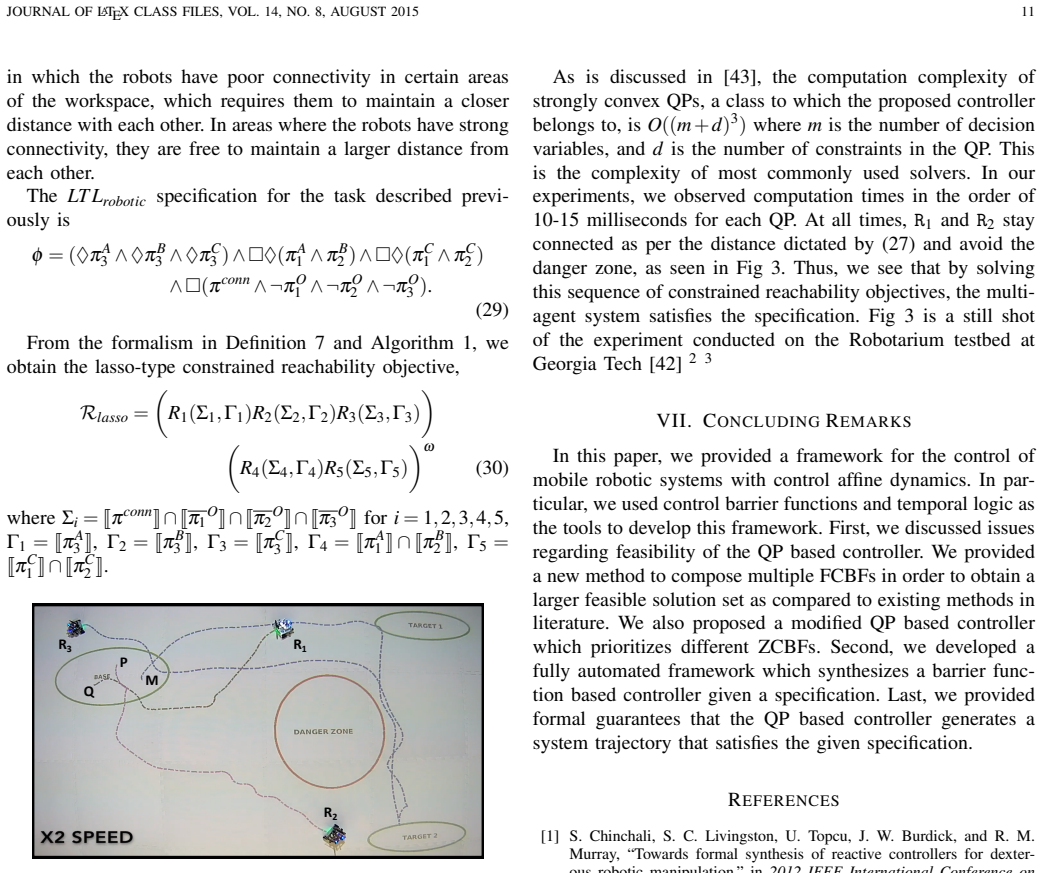
- [Section VI, Fig. 3 caption] The phrase 'moves temporarily away from target 1 temporarily' repeats the adverb; please rephrase.
- [Section VI, Eq. (30)] The lasso sequence in the case study is stated without explicitly verifying the compatibility inclusions Γ_i ⊆ Σ_{i+1}; if these hold for this example, a one-line verification would help the reader.
Circularity Check
No material circularity: the main correctness claims are proved in-paper from external CBF results; the known feasibility gap and the Corollary 1 comparison issue are correctness concerns, not circular reductions.
full rationale
The paper's derivation chain is not circular. Propositions 1 and 2 import ZCBF invariance and FCBF finite-time convergence from [9] and [12]; these are external, parameter-free results with stated assumptions, and they do not presuppose the target specification. Theorem 1 (composite FCBF) is proved directly in the text: assuming (13)-(14), the proof integrates the weighted sum and uses boundedness of the bounded h_i to contradict non-reachability; no fitted parameter or self-citation carries the argument. Corollary 1 attempts to show U-bar subset U using comparison with (16); even if the comparison is mathematically inaccurate because (16) omits the |h_i|^rho term present in the paper's own Definition 2, that is an internal correctness issue, not a circular definition or a prediction that equals its input. The lasso construction (Definition 7, Algorithm 1, Proposition 3) is a compositional certificate: Algorithm 1 builds a sequence from the specification's J sets, Definition 9's descendant conditions are matched to the semantics, and Proposition 3 verifies each LTL conjunct case by case; Theorem 2 then transfers CBF reachability/invariance guarantees to those conditions. This is a standard certificate-style proof, not self-definitional circularity. The paper explicitly conditions Theorem 2 on feasibility of Algorithm 2 and warns that relaxed QP (19) may violate the specification when slacks are nonzero, so no feasibility guarantee is smuggled in. The only self-citation, [13], is for the preliminary composite-FCBF idea, but Theorem 1 is restated and proven here, making the citation non-load-bearing. Score 0.
Assumptions & free parameters
free parameters (4)
- gamma (γ) and rho (ρ) for FCBFs =
not reported
- extended class K functions αi =
not reported
- priority weight matrix W =
not reported
- connectivity constants δ1, δ2 =
not reported
assumptions (5)
- domain assumption System dynamics are control-affine with locally Lipschitz f and g (Eq. 1)
- domain assumption For each atomic proposition π there is a C^1 h_π with JπK = {x | h_π(x) ≥ 0} and L_g h_π(x) ≠ 0 for all x (Section III)
- standard math ZCBFs guarantee forward invariance (Prop. 1, from [9]) and FCBFs guarantee finite-time convergence with bound (Prop. 2, from [12])
- domain assumption The QP (7) is feasible at every state encountered along the trajectory (Theorem 2)
- ad hoc to paper The composite barrier functions h_i are bounded above by M_i (Theorem 1)
Cite this review
Pith. "Pith review of Control of Mobile Robots Using Barrier Functions Under Temporal Logic Specifications." pith.science (2026). https://pith.science/paper/ZVEQRKOU
@misc{pith2026190804903,
  author       = {Pith},
  title        = {Pith review of: Control of Mobile Robots Using Barrier Functions Under Temporal Logic Specifications},
  year         = {2026},
  howpublished = {\url{https://pith.science/paper/ZVEQRKOU}},
  note         = {Machine review of arXiv:1908.04903}
}
read the original abstract
In this paper, we propose a framework for the control of mobile robots subject to temporal logic specifications using barrier functions. Complex task specifications can be conveniently encoded using linear temporal logic. In particular, we consider a fragment of linear temporal logic which encompasses a large class of motion planning specifications for a robotic system. Control barrier functions have recently emerged as a convenient tool to guarantee reachability and safety for a system. In addition, they can be encoded as affine constraints in a quadratic program. In this paper, a fully automatic framework which translates a user defined specification in temporal logic to a sequence of barrier function based quadratic programs is presented. In addition, with the aim of alleviating infeasibility scenarios, we propose methods for composition of barrier functions as well as a prioritization based control method to guarantee feasibility of the controller. We prove that the resulting system trajectory synthesized by the proposed controller satisfies the given specification. Robotic simulation and experimental results are provided in addition to the theoretical framework.
Figures


Reference graph
Works this paper leans on
-
[1]
Towards formal synthesis of reactive controllers for dexter- ous robotic manipulation,
S. Chinchali, S. C. Livingston, U. Topcu, J. W. Burdick, and R. M. Murray, “Towards formal synthesis of reactive controllers for dexter- ous robotic manipulation,” in 2012 IEEE International Conference on Robotics and Automation , May 2012, pp. 5183–5189
work page 2012
-
[2]
Hierarchical task and motion planning in the now,
L. P. Kaelbling and T. Lozano-P ´erez, “Hierarchical task and motion planning in the now,” in 2011 IEEE International Conference on Robotics and Automation , May 2011, pp. 1470–1477
work page 2011
-
[3]
Safe certificate-based ma- neuvers for teams of quadrotors using differential flatness,
L. Wang, A. D. Ames, and M. Egerstedt, “Safe certificate-based ma- neuvers for teams of quadrotors using differential flatness,” in 2017 IEEE International Conference on Robotics and Automation (ICRA) , May 2017, pp. 3293–3298
work page 2017
-
[4]
Trustworthy cyber infrastructure for the power grid (tcip-g),
“Trustworthy cyber infrastructure for the power grid (tcip-g),” Mar
-
[5]
Your first look inside amazon’s robot warehouse of tomorrow,
M. Simon, “Your first look inside amazon’s robot warehouse of tomorrow,” Jun 2019. [Online]. Available: https://www.wired.com/story/ amazon-warehouse-robots/
work page 2019
-
[6]
Available: https://www.dhs.gov/cisa/ critical-infrastructure-sectors
[Online]. Available: https://www.dhs.gov/cisa/ critical-infrastructure-sectors
-
[7]
Interior methods for nonlinear optimization,
A. Forsgren, P. E. Gill, and M. H. Wright, “Interior methods for nonlinear optimization,” SIAM review, vol. 44, no. 4, pp. 525–597, 2002
2002
-
[8]
Control barrier function based quadratic programs with application to adaptive cruise control,
A. D. Ames, J. W. Grizzle, and P. Tabuada, “Control barrier function based quadratic programs with application to adaptive cruise control,” in 53rd IEEE Conference on Decision and Control , Dec 2014, pp. 6271– 6278
work page 2014
Show all 45 references
-
[9]
Robustness of control barrier functions for safety critical control,
X. Xu, P. Tabuada, J. W. Grizzle, and A. D. Ames, “Robustness of control barrier functions for safety critical control,” arXiv preprint arXiv:1612.01554, 2016
2016 arXiv
-
[10]
Safety barrier certificates for collisions-free multirobot systems,
L. Wang, A. D. Ames, and M. Egerstedt, “Safety barrier certificates for collisions-free multirobot systems,” IEEE Transactions on Robotics , vol. 33, no. 3, pp. 661–674, June 2017. 2Video of Robotarium experiment -https://youtu.be/EK1Zxcg-eSE 3Code for Robotarium experiment- ht...
2017
-
[11]
Safety barrier certificates for het- erogeneous multi-robot systems,
L. Wang, A. Ames, and M. Egerstedt, “Safety barrier certificates for het- erogeneous multi-robot systems,” in 2016 American Control Conference (ACC), July 2016, pp. 5213–5218
2016
-
[12]
Formally correct composition of coordinated behaviors using control barrier certificates,
A. Li, L. Wang, P. Pierpaoli, and M. Egerstedt, “Formally correct composition of coordinated behaviors using control barrier certificates,” in 2018 IEEE/RSJ International Conference on Intelligent Robots and Systems (IROS). IEEE, 2018, pp. 3723–3729
2018
-
[13]
Control of multi-agent systems with finite time control barrier certificates and temporal logic,
M. Srinivasan, S. Coogan, and M. Egerstedt, “Control of multi-agent systems with finite time control barrier certificates and temporal logic,” in 2018 IEEE Conference on Decision and Control (CDC) , Dec 2018, pp. 1991–1996
2018
-
[14]
Barrier function certificates for forward invariance in hybrid inclusions,
M. Maghenem and R. G. Sanfelice, “Barrier function certificates for forward invariance in hybrid inclusions,” in 2018 IEEE Conference on Decision and Control (CDC) , Dec 2018, pp. 759–764
2018
-
[15]
Baier and J.-P
C. Baier and J.-P. Katoen, Principles of model checking , 2008
2008
-
[16]
Discrete abstractions of hybrid systems,
R. Alur, T. A. Henzinger, G. Lafferriere, and G. J. Pappas, “Discrete abstractions of hybrid systems,” Proceedings of the IEEE, vol. 88, no. 7, pp. 971–984, July 2000
2000
-
[17]
Controlling a class of nonlin- ear systems on rectangles,
C. Belta and L. C. G. J. M. Habets, “Controlling a class of nonlin- ear systems on rectangles,” IEEE Transactions on Automatic Control , vol. 51, no. 11, pp. 1749–1759, Nov 2006
2006
-
[18]
A fully automated framework for control of linear systems from temporal logic specifications,
M. Kloetzer and C. Belta, “A fully automated framework for control of linear systems from temporal logic specifications,” IEEE Transactions on Automatic Control , vol. 53, no. 1, pp. 287–297, Feb 2008
2008
-
[19]
Receding horizon temporal logic planning,
T. Wongpiromsarn, U. Topcu, and R. M. Murray, “Receding horizon temporal logic planning,” IEEE Transactions on Automatic Control , vol. 57, no. 11, pp. 2817–2830, Nov 2012
2012
-
[20]
Motion planning with complex goals,
A. Bhatia, M. R. Maly, L. E. Kavraki, and M. Y . Vardi, “Motion planning with complex goals,” IEEE Robotics Automation Magazine , vol. 18, no. 3, pp. 55–64, Sep. 2011
2011
-
[21]
Temporal logic motion planning for dynamic robots,
G. E. Fainekos, A. Girard, H. Kress-Gazit, and G. J. Pappas, “Temporal logic motion planning for dynamic robots,” Automatica, vol. 45, no. 2, pp. 343–352, 2009
2009
-
[22]
Control barrier functions for signal temporal logic tasks,
L. Lindemann and D. V . Dimarogonas, “Control barrier functions for signal temporal logic tasks,” IEEE control systems letters , vol. 3, no. 1, pp. 96–101, 2019
2019
-
[23]
Decentralized control barrier functions for coupled multi-agent systems under signal temporal logic tasks,
L. Lindemann and D. V . Dimarogonas, “Decentralized control barrier functions for coupled multi-agent systems under signal temporal logic tasks,” in 2019 18th European Control Conference (ECC) , June 2019, pp. 89–94
2019
-
[24]
Model predictive control with signal temporal logic specifications,
V . Raman, A. Donz ´e, M. Maasoumy, R. M. Murray, A. Sangiovanni- Vincentelli, and S. A. Seshia, “Model predictive control with signal temporal logic specifications,” in 53rd IEEE Conference on Decision and Control, Dec 2014, pp. 81–87
2014
-
[25]
Formal methods for control synthesis: An optimization perspective,
C. Belta and S. Sadraddini, “Formal methods for control synthesis: An optimization perspective,” Annual Review of Control, Robotics, and Autonomous Systems, 2019
2019
-
[26]
Distributed communication- aware motion planning for multi-agent systems from stl and spatel specifications,
Z. Liu, B. Wu, J. Dai, and H. Lin, “Distributed communication- aware motion planning for multi-agent systems from stl and spatel specifications,” in 2017 IEEE 56th Annual Conference on Decision and Control (CDC), Dec 2017, pp. 4452–4457
2017
-
[27]
Shrinking horizon model predictive control with chance-constrained signal temporal logic specifications,
S. S. Farahani, R. Majumdar, V . S. Prabhu, and S. E. Z. Soudjani, “Shrinking horizon model predictive control with chance-constrained signal temporal logic specifications,” in 2017 American Control Confer- ence (ACC), May 2017, pp. 1740–1746
2017
-
[28]
Q-learning for robust satisfaction of signal temporal logic specifications,
D. Aksaray, A. Jones, Z. Kong, M. Schwager, and C. Belta, “Q-learning for robust satisfaction of signal temporal logic specifications,” in 2016 IEEE 55th Conference on Decision and Control (CDC) , Dec 2016, pp. 6565–6570
2016
-
[29]
Enforcing signal temporal logic specifications in multi-agent adversarial environments: A deep q-learning approach,
D. Muniraj, K. G. Vamvoudakis, and M. Farhood, “Enforcing signal temporal logic specifications in multi-agent adversarial environments: A deep q-learning approach,” in 2018 IEEE Conference on Decision and Control (CDC). IEEE, 2018, pp. 4141–4146
2018
-
[30]
Prescribed performance control guided policy improvement for satisfying signal temporal logic tasks,
P. V ´arnai and D. V . Dimarogonas, “Prescribed performance control guided policy improvement for satisfying signal temporal logic tasks,” CoRR, vol. abs/1903.04340, 2019. [Online]. Available: http: //arxiv.org/abs/1903.04340
1903 arXiv
-
[31]
Decentralized robust control of coupled multi-agent systems under local signal temporal logic tasks,
L. Lindemann and D. V . Dimarogonas, “Decentralized robust control of coupled multi-agent systems under local signal temporal logic tasks,” in 2018 Annual American Control Conference (ACC) . IEEE, 2018, pp. 1567–1573
2018
-
[32]
Fly-by-logic: Control of multi-drone fleets with temporal logic objectives,
Y . V . Pant, H. Abbas, R. A. Quaye, and R. Mangharam, “Fly-by-logic: Control of multi-drone fleets with temporal logic objectives,” in 2018 ACM/IEEE 9th International Conference on Cyber-Physical Systems (ICCPS), April 2018, pp. 186–197
2018
-
[33]
Exponential control barrier functions for enforcing high relative-degree safety-critical constraints,
Q. Nguyen and K. Sreenath, “Exponential control barrier functions for enforcing high relative-degree safety-critical constraints,” in 2016 American Control Conference (ACC) , July 2016, pp. 322–328
2016
-
[34]
Control barrier functions for systems with high relative degree,
W. Xiao and C. Belta, “Control barrier functions for systems with high relative degree,” 2019
2019
-
[35]
An optimal task allocation strategy for heterogeneous multi-robot systems,
G. Notomista, S. Mayya, S. Hutchinson, and M. Egerstedt, “An optimal task allocation strategy for heterogeneous multi-robot systems,” arXiv preprint arXiv:1903.08641, 2019
1903 arXiv
-
[36]
H. K. Khalil, Nonlinear systems, vol. 3
-
[37]
Revising motion planning under linear temporal logic specifications in partially known workspaces,
Meng Guo, K. H. Johansson, and D. V . Dimarogonas, “Revising motion planning under linear temporal logic specifications in partially known workspaces,” in 2013 IEEE International Conference on Robotics and Automation, May 2013, pp. 5025–5032
2013
-
[38]
Efficient reactive controller synthesis for a fragment of linear temporal logic,
E. M. Wolff, U. Topcu, and R. M. Murray, “Efficient reactive controller synthesis for a fragment of linear temporal logic,” in 2013 IEEE International Conference on Robotics and Automation , May 2013, pp. 5033–5040
2013
-
[39]
Temporal-logic-based reactive mission and motion planning,
H. Kress-Gazit, G. E. Fainekos, and G. J. Pappas, “Temporal-logic-based reactive mission and motion planning,” IEEE Transactions on Robotics, vol. 25, no. 6, pp. 1370–1381, Dec 2009
2009
-
[40]
Automata theory meets barrier certificates: Temporal logic verification of nonlinear sys- tems,
T. Wongpiromsarn, U. Topcu, and A. Lamperski, “Automata theory meets barrier certificates: Temporal logic verification of nonlinear sys- tems,” IEEE Transactions on Automatic Control , vol. 61, no. 11, pp. 3344–3355, 2016
2016
-
[41]
Control barrier function based quadratic programs for safety critical systems,
A. D. Ames, X. Xu, J. W. Grizzle, and P. Tabuada, “Control barrier function based quadratic programs for safety critical systems,” IEEE Transactions on Automatic Control, vol. 62, no. 8, pp. 3861–3876, Aug 2017
2017
-
[42]
The robotarium: A remotely accessible swarm robotics research testbed,
D. Pickem, P. Glotfelter, L. Wang, M. Mote, A. Ames, E. Feron, and M. Egerstedt, “The robotarium: A remotely accessible swarm robotics research testbed,” in 2017 IEEE International Conference on Robotics and Automation (ICRA) , May 2017, pp. 1699–1706
2017
-
[43]
Hybrid nonsmooth barrier functions with applications to provably safe and composable collision avoidance for robotic systems,
P. Glotfelter, I. Buckley, and M. Egerstedt, “Hybrid nonsmooth barrier functions with applications to provably safe and composable collision avoidance for robotic systems,” IEEE Robotics and Automation Letters , vol. 4, no. 2, pp. 1303–1310, April 2019
2019
-
[44]
Near-identity diffeomorphisms and exponential ε- tracking and ε-stabilization of first-order nonholonomic SE(2) vehicles,
R. Olfati-Saber, “Near-identity diffeomorphisms and exponential ε- tracking and ε-stabilization of first-order nonholonomic SE(2) vehicles,” in Proceedings of the 2002 American Control Conference (IEEE Cat. No.CH37301), vol. 6, May 2002, pp. 4690–4695 vol.6. Mohit Srinivasan is...
2002
-
[2019]
Available: https://www.dhs.gov/science-and-technology/ trustworthy-cyber-infrastructure-power-grid-tcip-g
[Online]. Available: https://www.dhs.gov/science-and-technology/ trustworthy-cyber-infrastructure-power-grid-tcip-g
Reviewed August 14, 2026 · model on record in the stance chip above.
Discussion (0). Continue with ORCID to comment.