REVIEW 2 major objections 5 minor 1 cited by
On Foundation Models for Dynamical Systems from Purely Synthetic Data
T0 review · 2 major / 5 minor · reviewed 2026-08-12 · deepseek-v4-flash
Pith's one-line read A transformer trained only on synthetic smooth dynamics transfers to real cart-pole and Furuta states, and fine-tunes from little data.
desk verdict A plausible feasibility study of pretraining a transformer on purely synthetic RKHS dynamics, but the central pretraining-vs-capacity comparison is confounded and needs a matched-capacity baseline before the foundation-model claims hold. read the letter →
The pith
A machine-rendered reading of the paper's core claim, the machinery that carries it, and where it could break.
The reading
What carries the argument
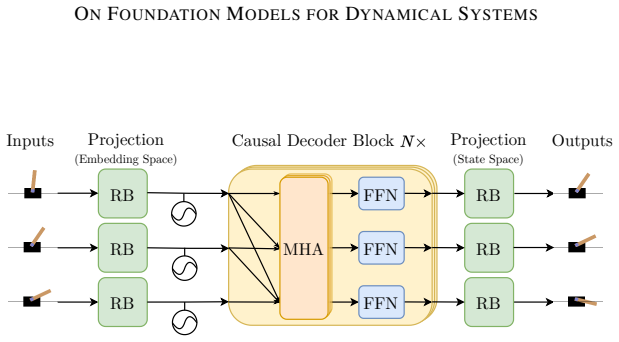
The load-bearing mechanism is the synthetic pretraining prior: dynamics functions are drawn from a reproducing kernel Hilbert space with an RBF kernel, with random supporting points and coefficients, norm-scaled to a uniformly chosen target, discretized by Euler's method, and filtered by total variation so the input and output halves of each trajectory have comparable complexity and no single behavior dominates. The second mechanism is the decoder-only transformer, which embeds state-action pairs through residual blocks, applies causal multi-head self-attention, and predicts future states under random masking and output patching. It is trained to map a context window plus future-action placeholders to future states, so the same network can be evaluated zero-shot or fine-tuned on a target system.
What would settle it
Train the same pipeline and evaluate it zero-shot on a dynamical system with genuinely non-smooth dynamics, such as a bouncing ball or an oscillator with Coulomb friction, comparing prediction error to the reported cart-pole results; if errors are orders of magnitude larger and small-data fine-tuning cannot recover, the RKHS synthetic prior is not representative of the target class.
Extended reading notes
Core claim
The core discovery is that the missing dataset problem for dynamical systems can be circumvented by sampling dynamics functions from an RKHS with an RBF kernel, scaling each function's norm, converting it to a continuous-time vector field, and discretizing with Euler's method. The resulting trajectories are filtered and binned by total variation to keep the pretraining distribution balanced. After pretraining, a 3.4-million-parameter transformer predicts future states of unseen systems in simulation and on hardware, and fine-tuning it with small data subsets improves accuracy beyond that of a linear regression baseline, a feedforward network, and a smaller transformer trained from scratch. The paper frames this as demonstrating generalization, data efficiency, and lower-variance performance across repeated runs.
Load-bearing premise
The central assumption is that random smooth RKHS functions, discretized with Euler's method and filtered by total variation, cover the behavior of real dynamical systems well enough that a transformer trained on them transfers to cart-pole and Furuta pendulums; if the prior misses the target class, the zero-shot and fine-tuning advantages disappear.
Editorial extensions
If this is right
- A pretrained dynamics model can predict future states of a cart-pole system it has never seen, matching or beating linear regression and a feedforward net in low-data regimes in simulation.
- Fine-tuning the pretrained model on as little as 2% of a target system's trajectories yields lower prediction error than training a specialist model from scratch on the same data.
- The fine-tuned model shows less run-to-run variance across 20 training repetitions than the baselines, including on hardware cart-pole and Furuta pendulum data.
- Zero-shot performance degrades when control actions are present, because pretraining used zero action, but fine-tuning closes most of that gap on hardware.
Reading between the lines
- If this transfer holds, the same recipe could initialize state estimators and model-predictive controllers across many hardware systems, replacing per-system identification with a short fine-tuning step.
- The zero-action pretraining prior is likely the main reason zero-shot performance drops on action-driven hardware; a direct testable extension is to include nonzero control inputs in the synthetic data generation.
- Comparing the same pipeline with other synthetic function families, such as trigonometric or polynomial vector fields, would reveal whether smoothness alone or the specific RBF-kernel structure carries the transfer.
Signed reviews
Editorial analysis
A structured set of objections, weighed in public.
Referee Report
Summary. The paper proposes training a transformer-based foundation model for state prediction in dynamical systems, using purely synthetic data generated by sampling dynamics functions from an RKHS, discretizing with Euler's method, and filtering by total variation. The resulting model is evaluated zero-shot and after fine-tuning on simulated cart-pole systems and on hardware cart-pole and Furuta pendulum data. The authors claim that this approach yields the typical foundation-model benefits: generalization across unseen systems, data efficiency in fine-tuning, and robustness across runs. The paper includes comparisons against linear regression, a feedforward network, and a smaller non-pretrained transformer.
Significance. If substantiated, the result would be a meaningful step toward foundation models for low-level control, addressing the lack of Internet-scale dynamical-systems data by using a synthetic pretraining distribution. The paper is clearly written and includes hardware validation, repeated runs, and a concrete data-generation pipeline. However, the central attribution of the reported gains to pretraining is weakened by the fact that the only transformer baseline has about 17 times fewer parameters than the proposed model, so capacity and pretraining are confounded. The paper also explicitly concedes that zero-shot performance is not competitive on action-driven hardware systems, which narrows the scope of the generalization claim. The code is not yet released, limiting reproducibility.
major comments (2)
- [§6.1, §6.3] The comparison between the fine-tuned model (Ft) and the smaller transformer (ST) cannot be used to isolate the effect of pretraining. Ft has 20 layers and approximately 3.4 million parameters, while ST has 8 layers and approximately 200k parameters; the paper states that ST is "not pretrained and thus shows the impact of pretraining," but any performance difference could instead be due to model capacity, optimization, or the larger pretraining corpus. This confound is load-bearing for the paper's central claims (P1)–(P3) because those claims are about the benefits of synthetic-data pretraining. The observation in §6.3 that the best ST run slightly outperforms Ft on the full hardware cart-pole dataset is consistent with capacity rather than pretraining driving part of the advantage. Please add a matched-capacity from-scratch transformer baseline (same architecture size, trained only on the task data), or otherwise control for capacity, before attributing the fine-tuning gains to pretraining.
- [§4, §6.3] The pretraining distribution is restricted to systems without control inputs (u ≡ 0 and zero placeholder actions in Eq. (4)), yet the problem formulation and the downstream evaluation include action-driven dynamics. The paper concedes in §6.3 that zero-shot performance on the hardware systems is "not competitive" because pretraining considered zero action. This is a substantive scope limitation: the claimed generalization across dynamical systems is demonstrated only for autonomous systems, while action-driven systems require fine-tuning. The paper should state this limitation prominently and temper the claim that the model generalizes across dynamical systems generally, or add experiments that include actions in the pretraining distribution.
minor comments (5)
- [Abstract] There is a typo in the abstract: "large-scale pretaining" should be "large-scale pretraining."
- [§1] In the sentence "models the capture the inherent 'dynamics' of the problem," "models the capture" should be "models that capture."
- [§3, §6.1] The paper defines robustness in §3 as consistency of MSE across runs, but the introduction lists robustness under distribution shifts, adversarial inputs, and noisy data. The evaluation only measures variance across initializations and data subsets; please clarify that the robustness claim is about run-to-run consistency, not the broader robustness properties listed in (P3).
- [§5] The indexing in the model description is slightly confusing: after giving the input sequence in Eq. (4), the text says the model generates {x̂_2,...,x̂_{c+m+1}} but only {x̂_{c+1},...,x̂_{c+m}} are used as valid predictions. Rewording or a small figure would help the reader verify the alignment of context and prediction windows.
- [§6] The paper states "The code will be released upon acceptance." Since the reproducibility of the experiments is part of the contribution, please consider releasing the code and data at submission time or providing a detailed appendix with hyperparameters and training details.
Circularity Check
No significant circularity: the pretrained model is evaluated on held-out systems and trajectories, fine-tuning uses task data before evaluation, and self-citations are background rather than load-bearing.
full rationale
No step in the derivation reduces to its own input. The pretraining distribution (Section 4) is a stated modeling choice—RKHS functions with RBF kernel, Euler discretization, and total-variation filtering—and is not fitted to the downstream cart-pole or Furuta data. Zero-shot evaluations (Pre) and fine-tuning evaluations (Ft) are run on task data not used for pretraining, and the paper reports that zero-shot is not competitive on action-driven hardware (Section 6.3: 'pretraining considered zero action (u ≡ 0)'), which is a negative empirical result inconsistent with a self-fulfilling construction. The main weaknesses are empirical-validity concerns rather than circularity. First, the sole transformer baseline ST has 8 layers / ~200k parameters versus 20 layers / ~3.4M for the proposed model (Section 6.1), so the Ft-vs-ST comparison cannot isolate pretraining; the paper even notes the best ST run slightly outperforms Ft on the full hardware cart-pole dataset (Section 6.3). This undermines attribution, not the independence of the evaluation. Second, whether RKHS-sampled functions cover real action-driven dynamics is an assumption about distributional coverage, not an equation-level reduction. Self-citations (Fiedler et al. 2021; Hose et al. 2024; Geist and Trimpe 2020) support background methods or hardware parameters and are not load-bearing for the central foundation-model claims. The footnote that code will be released upon acceptance is a reproducibility limitation, not evidence of circular reasoning. Hence no circularity score above 0 is warranted.
Assumptions & free parameters
free parameters (9)
- RKHS kernel variance sigma^2 =
not reported
- RKHS kernel lengthscale l =
not reported
- Coefficient variance sigma_alpha^2 =
not reported
- State bounds xmin, xmax =
not reported
- Target RKHS norm range [normmin, normmax] =
not reported
- Euler discretization step dt =
not reported
- Total variation bounds TVmin, TVmax and delta =
not reported
- Data augmentation ranges alpha, beta =
not reported
- Fine-tuning noise sigma^2 =
not reported
assumptions (5)
- domain assumption RKHS functions with an RBF kernel, after norm scaling and Euler discretization, are representative of the dynamics of real systems like cart-pole and Furuta pendulums.
- ad hoc to paper Total variation filtering and binning do not remove the types of dynamical behavior needed for downstream transfer.
- domain assumption Zero-action pretraining is a sufficient base for models that later see actions, provided fine-tuning is applied.
- domain assumption State prediction over a fixed horizon is the right surrogate for control-relevant model quality.
- domain assumption The TimesFM decoder-only architecture, including residual blocks, patching, and masking, is an appropriate inductive bias for multi-step dynamics prediction.
Cite this review
Pith. "Pith review of On Foundation Models for Dynamical Systems from Purely Synthetic Data." pith.science (2026). https://pith.science/paper/ZVJF373N
@misc{pith2026241200395,
  author       = {Pith},
  title        = {Pith review of: On Foundation Models for Dynamical Systems from Purely Synthetic Data},
  year         = {2026},
  howpublished = {\url{https://pith.science/paper/ZVJF373N}},
  note         = {Machine review of arXiv:2412.00395}
}
read the original abstract
Foundation models have demonstrated remarkable generalization, data efficiency, and robustness properties across various domains. In this paper, we explore the feasibility of foundation models for applications in the control domain. The success of these models is enabled by large-scale pretaining on Internet-scale datasets. These are available in fields like natural language processing and computer vision, but do not exist for dynamical systems. We address this challenge by pretraining a transformer-based foundation model exclusively on synthetic data and propose to sample dynamics functions from a reproducing kernel Hilbert space. Our pretrained model generalizes for prediction tasks across different dynamical systems, which we validate in simulation and hardware experiments, including cart-pole and Furuta pendulum setups. Additionally, the model can be fine-tuned effectively to new systems to increase performance even further. Our results demonstrate the feasibility of foundation models for dynamical systems that outperform specialist models in terms of generalization, data efficiency, and robustness.
Figures


Figures from the paper (3 more)


Forward citations
Cited by 1 Pith paper
-
Sailing Towards Zero-Shot State Estimation using Foundation Models Combined with a UKF
A transformer dynamics model plugged into an unscented Kalman filter gives zero-shot state estimates on unseen simulated container ships and outperforms classical baselines when velocity sensors are missing.
Reference graph
Works this paper leans on
-
[2]
URL https://www.quanser.com/products/qube-servo-2/. Accessed: 2024-10-04. Rishi Bommasani, Drew A. Hudson, Ehsan Adeli, Russ Altman, Simran Arora, Sydney von Arx, Michael S. Bernstein, Jeannette Bohg, Antoine Bosselut, Emma Brunskill, Erik Brynjolfsson, Shyamal Buch, Dallas Card, Rodrigo Castellon, Niladri Chatterji, Annie Chen, Kathleen Creel, Jared Quin...
arXiv 2024
-
[3]
Rt- 2: Vision-language-action models transfer web knowledge to robotic control
Anthony Brohan, Noah Brown, Justice Carbajal, Yevgen Chebotar, Xi Chen, Krzysztof Choro- manski, Tianli Ding, Danny Driess, Avinava Dubey, Chelsea Finn, Pete Florence, Chuyuan Fu, Montse Gonzalez Arenas, Keerthana Gopalakrishnan, Kehang Han, Karol Hausman, Alex Her- zog, Jasmine Hsu, Brian Ichter, Alex Irpan, Nikhil Joshi, Ryan Julian, Dmitry Kalashnikov,...
-
[6]
Gaus- sian processes and kernel methods: A review on connections and equivalences
Motonobu Kanagawa, Philipp Hennig, Dino Sejdinovic, and Bharath K Sriperumbudur. Gaus- sian processes and kernel methods: A review on connections and equivalences. arXiv preprint arXiv:1807.02582,
-
[9]
A generalist dynamics model for control
Ingmar Schubert, Jingwei Zhang, Jake Bruce, Sarah Bechtle, Emilio Parisotto, Martin Riedmiller, Jost Tobias Springenberg, Arunkumar Byravan, Leonard Hasenclever, and Nicolas Heess. A generalist dynamics model for control. arXiv preprint arXiv:2305.10912,
-
[10]
Foundational inference models for dynamical systems
Patrick Seifner, Kostadin Cvejoski, Antonia K¨orner, and Rams´es J S´anchez. Foundational inference models for dynamical systems. arXiv preprint arXiv:2402.07594,
-
[11]
Zezheng Song, Jiaxin Yuan, and Haizhao Yang. Fmint: Bridging human designed and data pre- trained models for differential equation foundation model. arXiv preprint arXiv:2404.14688 ,
-
[13]
Fanlong Zeng, Wensheng Gan, Yongheng Wang, Ning Liu, and Philip S. Yu. Large language models for robotics: A survey. arXiv preprint arXiv:2311.07226,
-
[2010]
It’s not just size that matters: Small language models are also few-shot learners
Timo Schick and Hinrich Sch ¨utze. It’s not just size that matters: Small language models are also few-shot learners. arXiv preprint arXiv:2009.07118,
arXiv 2009
Show all 13 references
-
[2017]
Open x-embodiment: Robotic learning datasets and rt-x models
Quan Vuong, Sergey Levine, Homer Rich Walke, Karl Pertsch, Anikait Singh, Ria Doshi, Charles Xu, Jianlan Luo, Liam Tan, Dhruv Shah, et al. Open x-embodiment: Robotic learning datasets and rt-x models. In Towards Generalist Robots: Learning Paradigms for Scalable Skill Acquisi-...
2023
-
[2020]
Reproducing kernel hilbert space, mercer’s theorem, eigenfunctions, nystr ¨om method, and use of kernels in machine learn- ing: Tutorial and survey
Benyamin Ghojogh, Ali Ghodsi, Fakhri Karray, and Mark Crowley. Reproducing kernel hilbert space, mercer’s theorem, eigenfunctions, nystr ¨om method, and use of kernels in machine learn- ing: Tutorial and survey. arXiv preprint arXiv:2106.08443,
-
[2022]
Rt-1: Robotics transformer for real-world control at scale
Anthony Brohan, Noah Brown, Justice Carbajal, Yevgen Chebotar, Joseph Dabis, Chelsea Finn, Keerthana Gopalakrishnan, Karol Hausman, Alexander Herzog, Jasmine Hsu, Julian Ibarz, Brian Ichter, Alex Irpan, Tomas Jackson, Sally Jesmonth, Nikhil Joshi, Ryan Julian, Dmitry Kalash- n...
-
[2023]
Few-shot adaptation of multi-modal foundation models: A survey
Fan Liu, Tianshu Zhang, Wenwen Dai, Chuanyi Zhang, Wenwen Cai, Xiaocong Zhou, and Delong Chen. Few-shot adaptation of multi-modal foundation models: A survey. Artificial Intelligence Review, 57(10):268, 2024a. Shilong Liu, Zhaoyang Zeng, Tianhe Ren, Feng Li, Hao Zhang, Jie Yan...
-
[2024]
Timegpt-1
Azul Garza and Max Mergenthaler-Canseco. Timegpt-1. arXiv preprint arXiv:2310.03589,
Reviewed August 12, 2026 · model on record in the stance chip above.
Discussion (0). Continue with ORCID to comment.