REVIEW 3 major objections 3 minor 15 references
Interaction of Stars Hosting Planets with Sgr A* Black hole
T0 review · 3 major / 3 minor · reviewed 2026-08-14 · deepseek-v4-flash
Pith's one-line read Simulations of S-stars with planetary systems show that inner planets remain bound to their hosts during close encounters with Sgr A*, while outer planets are preferentially stripped.
desk verdict A modest but genuine first step: simulated multi-planet survival around S-stars, whose main trend is plausible but rests on a single realization per configuration. read the letter →
The pith
A machine-rendered reading of the paper's core claim, the machinery that carries it, and where it could break.
The reading
What carries the argument
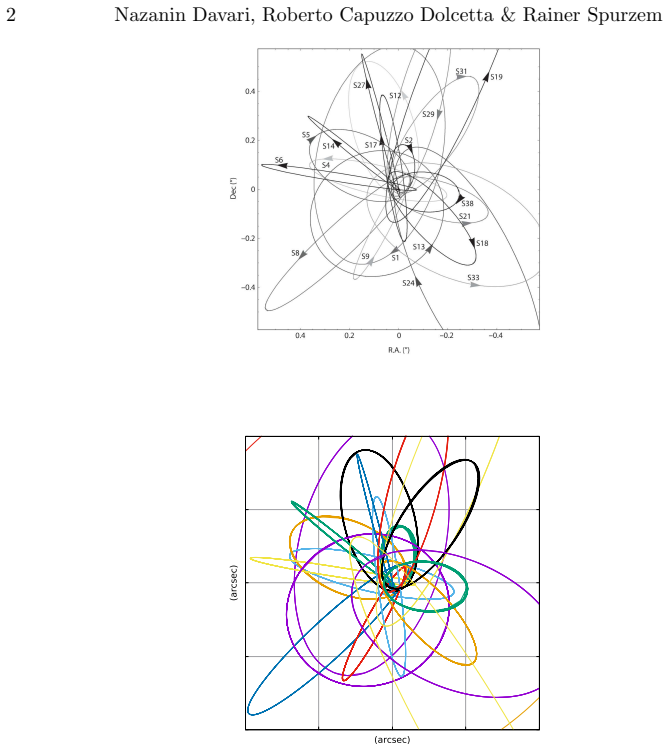
The load-bearing mechanism is a regularized N-body integrator with post-Newtonian corrections up to order 2.5, which lets the simulation follow close encounters with the black hole without numerical singularities. The 40 S-stars are initialized on their observed orbits, and each host star is assigned a planetary system patterned on the Solar System: seven planets for late-type stars and the three outer planets for early-type stars. The planetary system is inclined relative to the stellar orbit by angles from 0 to 180 degrees, and the quantity that carries the argument is the fraction of planets still bound to their host stars at the end of the simulation.
What would settle it
A transit or radial-velocity survey sensitive to close-in planets around S-stars that finds none would undercut the premise that planetary systems are present, though it would not by itself disprove the dynamics. A direct numerical check is to rerun the same 40-star simulation with randomly sampled planetary mean anomalies and mutual inclinations; if the Mercury-type bound fraction drops well below the reported 100%, the result depends on the chosen initial conditions rather than on the encounter dynamics.
Extended reading notes
Core claim
The paper claims that during close encounters with Sgr A*, the innermost planets of a solar-like system are preferentially retained. In its simulations, Mercury-type planets around late-type S-stars remain bound in every case, Venus- and Earth-type planets in 72.5% of cases, and Mars-type in 61.85%; for early-type stars, which start with only Jupiter, Saturn, and Uranus analogues, the bound fractions are 75.62%, 47.5%, and 35.31%, respectively. The paper also reports that some early-type stars escape the Galactic Center and that their planetary systems can be swapped to a nearby star during the encounter.
Load-bearing premise
The whole exercise assumes that the S-stars were born elsewhere, migrated to the Galactic Center, and kept their planetary systems during the trip; if S-stars arrived planet-free, the survival rates describe a hypothetical rather than an actual population.
Editorial extensions
If this is right
- Planetary systems around S-stars, if present, should arrive at the Galactic Center heavily truncated: inner planets survive, outer planets are stripped.
- The stripped outer planets become free-floating planets wandering in the Galactic Center region.
- Early-type S-stars are expected to lose most or all of their planetary systems, and some may exchange planets with other stars during close encounters.
- Observational searches for planets around S-stars should concentrate on close-in orbits, where the survival probability is highest.
- The simulated bound fractions give a quantitative prior for interpreting future detections or non-detections of planets in the S-star cluster.
Reading between the lines
- The simulations do not include planet-planet scattering, stellar evolution, or the mechanism that originally placed planets around these stars; any of these could change the retention fractions, so the 100% Mercury survival should be read as a dynamical statement, not a formation statement.
- A natural testable extension is to vary the planetary architecture, for example using hot Jupiters on eccentric orbits or multiple planets with mutual inclinations, and check whether inner-planet survival remains the robust pattern.
- If the swap of planetary systems during encounters is common, the Galactic Center may be a place where planets change host stars, producing systems with no analog in the field.
- The survival hierarchy inner > outer suggests that any planetary system discovered around an S-star is likely a compact, multi-planet system with its outermost planets missing.
Signed reviews
Editorial analysis
A structured set of objections, weighed in public.
Referee Report
Summary. The paper hypothesizes that the S-stars in the Galactic Center may host planetary systems and investigates their dynamical fate under repeated close encounters with Sgr A*. Using a regularized N-body code with post-Newtonian corrections to order 2.5 and the observed orbital elements of about 40 S-stars, the authors attach a solar-like planetary system to each star (7 planets for late-type stars, 3 outer planets for early-type stars) and vary the inclination of the planetary orbital plane relative to the stellar orbit from 0 to 180 degrees. They report preliminary bound fractions in Table 2, concluding that inner planets (Mercury through Mars) remain bound at higher rates than outer planets (Jupiter through Uranus) for late-type hosts, and that some early-type stars escape the Galactic Center with their planetary systems swapped by a nearby star. The paper is explicitly a preliminary proceedings contribution.
Significance. If the central claim holds, this is a first estimate of the survival probability of putative planetary systems around S-stars, with direct relevance to the possibility of planets in the Galactic Center. The strengths of the work are that the simulations use a well-tested regularized N-body code with PN corrections, adopt observed S-star orbits as initial conditions, and contain no parameter fitted to the survival fractions—the bound rates emerge from the assumed initial conditions. However, the result is conditional on a speculative planetary architecture and on the migration premise, and the reported rates lack ensemble statistics and sensitivity tests. The paper therefore constitutes an interesting preliminary finding rather than a fully established result.
major comments (3)
- [Section 3, Table 2] The central claim that inner planets remain bound at higher rates (61–100% vs 16–49%) rests on a single realization per star per inclination: each of the ~40 S-stars is seeded with an identical copy of the Solar System with fixed orbital phases, eccentricities, and mutual inclinations, and the inclination of the planetary plane is the only varied parameter. Because the tidal perturbation from Sgr A* depends on planetary phase at pericenter, the reported dichotomy could be an artifact of the chosen initial phases rather than a generic dynamical property. Please rerun the simulations for an ensemble of random mean anomalies and small eccentricities for each star and inclination, and report mean bound fractions with standard deviations or confidence intervals. Without such averaging, the numbers in Table 2 overstate the precision (e.g., '61.85%' from a small sample) and the qualitative conclusion is not yet robust.
- [Section 2] The simulated planetary systems are all exact solar twins, with planet masses, semi-major axes, and eccentricities fixed to Solar System values, and for early-type stars an ad-hoc choice to include only Jupiter, Saturn, and Uranus ('Since it is less likely that massive early-type stars could harbor planets so close'). This architecture directly determines the columns of Table 2. The paper should test sensitivity to plausible alternative architectures (e.g., different planet multiplicities, semi-major axis distributions, or an extra ice-giant belt) and to the uncertain stellar masses (8–14 M⊙ and 0.5–2 M⊙) before claiming a general result for S-star planetary systems.
- [Abstract and Section 1] The premise that S-stars 'probably still keep their planetary systems throughout their voyage' is asserted without support. Given that the preferred migration scenario is binary disruption (Hills 1988), the retained companion may be ejected with a kick that could strip or destabilize its planets; the simulations instead start with the planets already in place around their host on the observed S-star orbits. Please either add a justification or test of planetary survival during the migration event, or explicitly reframe the conclusion as applying to a hypothetical population of stars that arrived with their planetary systems intact. This also affects the physical interpretation of the bound fractions in Table 2.
minor comments (3)
- [Section 3] The sentence 'Our simulations shows that the innermost planets i.e, Mercury, Venus, Earth and Mars...' contains a subject-verb agreement error ('simulations shows') and a punctuation error ('i.e,' should be 'i.e.,').
- [Table 2 caption] The caption states 'the inclinations in the range of 0° − 90°' while the text (Section 2) says the inclination is varied over 0° − 180°; clarify whether Table 2 is a subset of the runs and why the 90°–180° results are omitted.
- [Figure 2] Figure 2 is described only by the caption; the text should state what each plotted curve represents and how the statement 'six out of seven planets remain bound to the star S89' is inferred from the plotted orbital elements. The current description is too vague for the reader to verify the result.
Circularity Check
No significant circularity: the simulated bound fractions are genuine outputs of N-body integrations, not fits to themselves.
full rationale
The paper's central claim is the survival fraction of planets around S-stars, reported in Table 2. These fractions are computed by direct N-body simulation using ARGdfcode from assumed initial conditions: each S-star is assigned a copy of the Solar System with specified masses, eccentricities, and semi-major axes, and the planetary inclinations are varied from 0 to 180 degrees. No parameter is fitted to make Mercury survive more often, and the simulation outcomes are not fed back into the initial conditions. The use of ARGdfcode (Arca-Sedda & Capuzzo-Dolcetta 2019) is a tool citation: the paper does not rely on that code's results as evidence for the astrophysical claim. The premise that S-stars migrated from elsewhere and may carry planetary systems is an assumption stated in the abstract and introduction, but an assumption is not a circular step because the survival fractions do not presuppose the conclusion that inner planets are more likely to remain bound. There is no equation in which the output is defined in terms of itself, no fitted parameter renamed as a prediction, and no uniqueness argument imported from the authors' prior work. The stronger statement that the inner-planet survival advantage is a robust physical property would benefit from an ensemble of randomized planetary phases and eccentricities, but that is a robustness concern, not circularity.
Assumptions & free parameters
free parameters (2)
- early_type_star_mass_preliminary =
12 M_sun
- late_type_star_mass_preliminary =
1.5 M_sun
assumptions (5)
- domain assumption S-stars migrated from elsewhere and still carry their planetary systems.
- domain assumption Planetary systems initially resemble the Solar System in mass, eccentricity, and semi-major axis.
- domain assumption Orbital parameters of the 40 S-stars from Gillessen et al. (2009, 2017) are reliable initial conditions.
- domain assumption Post-Newtonian corrections to order 2.5 are sufficient to model close encounters with Sgr A*.
- domain assumption Mass estimates for early-type stars can be extrapolated by magnitude to stars not directly measured by Habibi et al. (2017).
Cite this review
Pith. "Pith review of Interaction of Stars Hosting Planets with Sgr A* Black hole." pith.science (2026). https://pith.science/paper/ZVPRAQ4U
@misc{pith2026190806298,
  author       = {Pith},
  title        = {Pith review of: Interaction of Stars Hosting Planets with Sgr A* Black hole},
  year         = {2026},
  howpublished = {\url{https://pith.science/paper/ZVPRAQ4U}},
  note         = {Machine review of arXiv:1908.06298}
}
read the original abstract
We present some preliminary results of our ongoing project about planetary systems around S-stars in the vicinity of Sgr A* black hole. Since S-stars might have migrated in the Galactic Centre (GC) from elsewhere, they probably still keep their planetary systems throughout their voyage. In this work, we study the destiny of their putative planetary systems after close interaction with the central black hole of our galaxy.
Figures

Reference graph
Works this paper leans on
-
[1]
2009, ApJ, 692, 1075
Gillessen, S., Eisenhauer, F., Trippe, S., et al. 2009, ApJ, 692, 1075
2009
-
[2]
2017, ApJ, 847, 120
Habibi, M., Gillessen, S., Martins, F., et al. 2017, ApJ, 847, 120
2017
-
[3]
Habibi, M., Gillessen, S., Pfuhl, O., et al. 2019, ApJL, 872, L15
work page 2019
-
[4]
1993, ApJ, 408, 496
Morris, M. 1993, ApJ, 408, 496
1993
-
[5]
Hills, J. G. 1988, Nature, 331, 687
1988
- [6]
-
[7]
M., Duchˆ ene, G., Matthews, K., et al
Ghez, A. M., Duchˆ ene, G., Matthews, K., et al. 2003, ApJL, 586, L127
work page 2003
-
[8]
M., Eisenhauer, F., et al
Gillessen, S., Plewa, P. M., Eisenhauer, F., et al. 2017, ApJ, 837, 30
2017
Show all 15 references
-
[9]
A., Mapelli, M., Spera, M., & Bressan, A
Trani, A. A., Mapelli, M., Spera, M., & Bressan, A. 2016, ApJ, 831, 61
2016
-
[10]
C., & Lin, D
Spurzem, R., Giersz, M., Heggie, D. C., & Lin, D. N. C. 2009, ApJ, 697, 458
2009
-
[11]
X., Kouwenhoven, M
Cai, M. X., Kouwenhoven, M. B. N., Portegies Zwart, S. F., & Sp urzem, R. 2017, MNRAS, 470, 4337
2017
-
[12]
2019, MNRAS, 483, 152
Arca-Sedda, M., & Capuzzo-Dolcetta, R. 2019, MNRAS, 483, 152
2019
-
[13]
1999, MNRAS, 310, 745
Mikkola, S., & Tanikawa, K. 1999, MNRAS, 310, 745
1999
-
[14]
2008, AJ, 135, 2398
Mikkola, S., & Merritt, D. 2008, AJ, 135, 2398
2008
-
[15]
2013, Dynamics and Evolution of Galactic Nuclei
Merritt, D. 2013, Dynamics and Evolution of Galactic Nuclei
2013
Reviewed August 14, 2026 · model on record in the stance chip above.
Discussion (0). Continue with ORCID to comment.