REVIEW 2 major objections 4 minor 78 references
Aperture-aware Dispersion 5-D Light-field Imaging Spectrometer
T0 review · 2 major / 4 minor · reviewed 2026-07-11 · grok-4.5
Pith's one-line read A quartz phase plate on the aperture recovers full-resolution 5D spectral light fields by superimposing every viewpoint onto every pixel.
desk verdict Solid single-detector 5D-SLF system with a real quartz prototype and full-spatial-resolution claim that holds for the demonstrated 3×3 case; the generalization stress-test is real but does not erase the contribution. read the letter →
The pith
A machine-rendered reading of the paper's core claim, the machinery that carries it, and where it could break.
The reading
What carries the argument
The birefringent coding model (BCM): a thickness-map phase plate whose angle- and wavelength-dependent filter function is fully differentiable, allowing the plate design and the Restormer decoder to be co-optimized end-to-end from RealSLF data.
What would settle it
Fabricate the optimized 3 imes3 thickness map, capture the two analyzer frames on a calibrated scene with known full-resolution spectral light field, and check whether reconstructed spatial PSNR, spectral SAM, and disparity correlation match the simulation numbers within the paper’s reported noise margins; a large residual gap falsifies the transfer claim.
Extended reading notes
Core claim
Aperture-multiplexed birefringent encoding recovers high-performance 5D spectral light fields at the sensor’s full native spatial resolution: a thickness-patterned quartz phase plate at the collimated aperture superimposes all viewpoints onto every pixel, and an end-to-end framework jointly designs that thickness map and the reconstruction network so that two analyzer frames invert the measurements into accurate full-resolution cubes.
Load-bearing premise
That the differentiable thickness-to-measurement model plus noise-augmented training transfers cleanly enough to a real quartz plate and real optics that two analyzer frames still invert the heavily multiplexed measurements into accurate full-resolution 5D cubes.
Editorial extensions
If this is right
- Single-detector systems can reach 100 percent spatial-information efficiency for 5D spectral light fields instead of the sub-1 percent figures of typical microlens designs.
- Angular resolution can be scaled beyond 3 imes3 by re-optimizing the same quartz plate for larger viewpoint arrays supported by existing datasets.
- Polarized multi-frame capture inherently preserves highlight and shadow detail, enabling high-dynamic-range spectral light-field imaging.
- The same aperture-encoding principle can be extended to add polarization as a sixth dimension for compact plenoptic sensing.
Reading between the lines
- If the thickness map remains manufacturable at higher spatial frequencies, the same hardware could support denser angular sampling without redesigning the rest of the optical train.
- The edge-aware loss that improves disparity may be portable to other coded-aperture problems where viewpoint separation lives mainly at high-frequency edges.
- A single fixed plate plus two analyzer rotations is already competitive; replacing the mechanical rotation with a liquid-crystal analyzer would turn the system into a true snapshot device.
Editorial analysis
A structured set of objections, weighed in public.
Referee Report
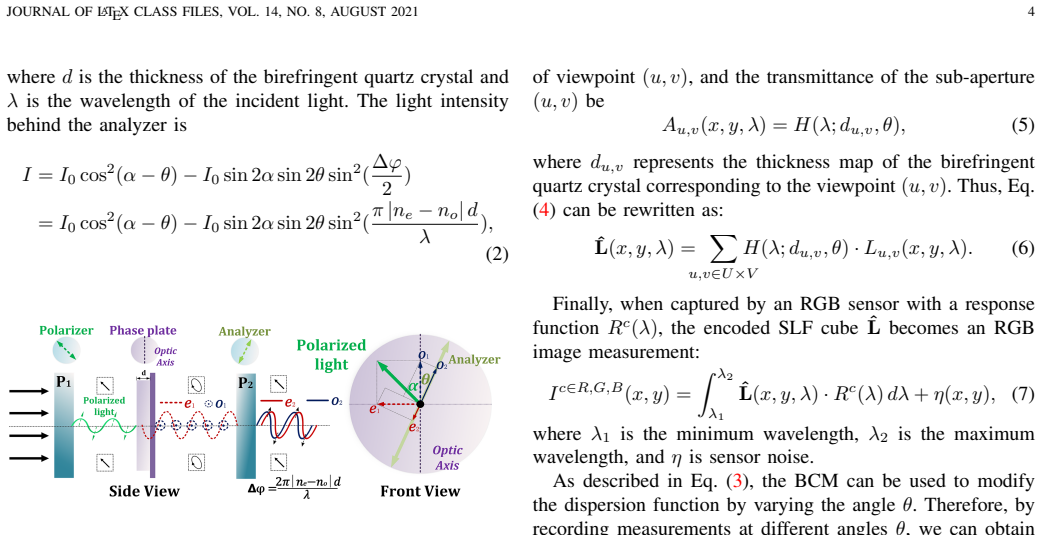
Summary. The paper introduces ADLIS, a compact single-sensor system for acquiring 5D spectral light fields (x,y,u,v,λ) via a birefringent quartz phase plate placed at the collimated aperture. The plate's thickness map produces angle-dependent spectral filtering (Eqs. 1–3), so that all viewpoints are multiplexed onto every sensor pixel rather than spatially partitioned as in MLA designs (Eqs. 4–8, Fig. 12). An end-to-end ADLI framework jointly optimizes the differentiable thickness map (Eqs. 9–12) and a Restormer decoder on the RealSLF dataset; multi-frame analyzer rotations further enrich the encoding. Simulations report clear gains over a CFA baseline (Table I: 2-frame learnable PSNR 41.36 vs 35.07) and robustness across ten reconstruction networks (Table IV). A fabricated 3 imes3 prototype recovers 2448 imes2048 imes3 imes3 imes25 cubes whose spectra match a probe spectrometer at selected points and whose disparity maps appear plausible (Sec. V, Fig. 11). The authors claim 100% Spatial Information Efficiency and full native spatial resolution (Table V).
Significance. If the full-resolution recovery claim holds under the demonstrated encoding, the work offers a practical, low-cost route to high-dimensional imaging that avoids both camera arrays and the spatial-angular trade-off of microlens systems. The physics model is standard, the thickness map is manufacturable and differentiable, and the multi-decoder ablation (Table IV) plus real hardware validation with spectrometer cross-checks are genuine strengths. The first reported E2E deep-optics treatment of 5D-SLF is a useful contribution to computational imaging. Even a configuration-limited (3 imes3) demonstration would still be of interest for compact material-aware vision applications.
major comments (2)
- [Sec. VI, Table V, Fig. 12] Sec. VI, Table V and Fig. 12: The central differentiator—that aperture multiplexing yields 100% SIE and full native spatial resolution—is demonstrated only for a 3 imes3 aperture. RealSLF supports up to 7 imes5 viewpoints and the text asserts that larger arrays can be obtained by re-optimizing the plate, yet no simulation or analysis is supplied of how reconstruction metrics (PSNR/SSIM, edge fidelity, or effective spatial bandwidth) degrade as the number of superimposed angular-spectral channels per pixel increases. Without such evidence the paradigm-shift claim remains configuration-specific rather than general.
- [Sec. V.B, Fig. 11] Sec. V.B and Fig. 11: Real-world validation consists of qualitative band-wise images, three spectral curves matched to a spectrometer, and a single disparity map. Given the acknowledged residual sim-to-real gap, imperfect measurements and visible noise, quantitative spatial and spectral fidelity metrics on calibrated targets (or at least RMSE/SAM over a denser set of points) are needed to substantiate the claim of “robust high-performance 5D-SLF imaging while maintaining full spatial resolution.”
minor comments (4)
- [Throughout] Several typos and awkward phrases appear throughout: “rencently” (Sec. II.C), “ligh-field” (Sec. III.B), “taile d for” (contribution list), “mut-dimensional” (Introduction). A careful proof-read is required.
- [Sec. III.B, Eqs. 9–12] Notation for the thickness map alternates between d, d_u,v and w_d without a single consistent definition; Eq. (12) would be clearer if the intermediate variable were introduced earlier.
- [Sec. IV.B] The CFA baseline (Sec. IV.B) uses idealized Gaussian filters; a short note on how closely this approximates published color-coded apertures would strengthen the comparison fairness claim.
- [Figs. 1, 11] Fig. 1 and Fig. 11 captions are dense; splitting spectral and angular results into separate panels would improve readability.
Circularity Check
Minor self-dataset dependence: thickness maps and decoder are E2E-optimized on RealSLF (overlapping authors), so optical design is partly fitted to that distribution; physics forward model and spectrometer-validated real hardware remain independent.
-
self citation load bearing
[Sec. IV.A Implementation Details; citation [38]; also Sec. VI]
"We adopt the recently published 5D-SLF dataset, RealSLF [38], for simulations. The dataset contains 7×5 viewpoints with 36 spectral bands... The thickness map of the phase plate and the reconstruction network are trained in an E2E pipeline. ... Notably, the RealSLF dataset supports the E2E optimization of SLF encoders with up to 7×5 viewpoints"
RealSLF is co-authored by overlapping authors (Li, Lv, Huang, Cao). Thickness maps d_u,v and decoder weights are optimized by back-propagation against RealSLF training loss (Eqs. 13–17). Reported simulation metrics (Tables I–IV) and the claim that larger angular arrays “can be enhanced by re-optimizing” therefore rest partly on a self-cited data distribution rather than purely external evidence. The dependence is not fully load-bearing because the birefringent forward model is independent physics and real-hardware spectrometer comparisons supply external validation.
-
fitted input called prediction
[Sec. III.B Differentiable thickness-to-measurement; Sec. IV.B Table I; final thicknesses in Sec. V]
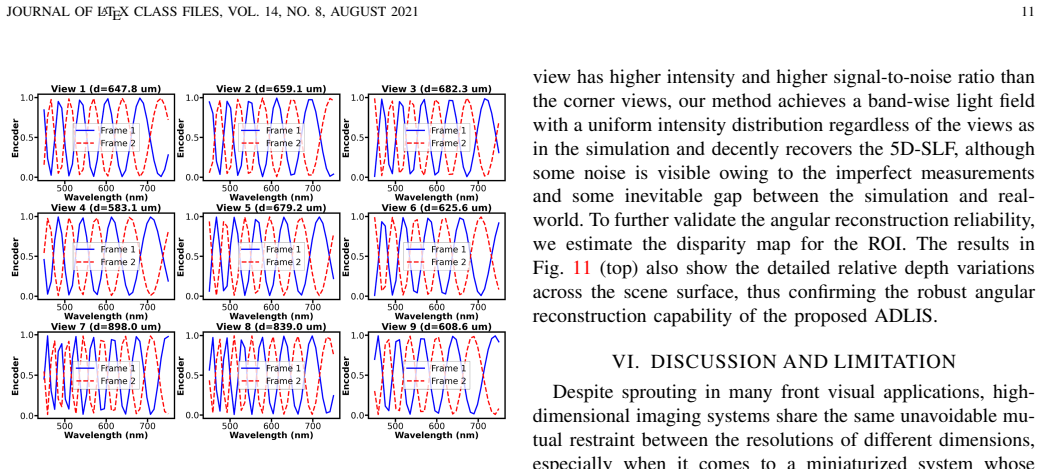
"the generation of measurement I can be formulated... I = F(I_raw; d)... d = d_min + σ(w_d)·(d_max − d_min)... the ADLI model with learnable parameters achieves a better performance, validating the effectiveness of the proposed E2E joint optimization design. ... the thickness maps for views(1,1) to view(3,3) are ultimately converged to 647.8, 659.1, ... µm"
Learnable thickness parameters are fitted by gradient descent on RealSLF reconstruction loss; the same fitted values are then used to claim superior PSNR/SSIM/SAM over fixed-thickness and CFA baselines on the RealSLF test split (same distribution). The “optimized aperture” performance is therefore statistically forced by the fit rather than an independent first-principles prediction. Real fabrication and spectrometer checks mitigate but do not eliminate the circularity of the simulation claims.
full rationale
The core image-formation chain (Eqs. 1–8) is standard birefringence physics (phase retardation Δφ = 2πdΔn/λ, analyzer intensity, angle-dependent thickness map) and is not defined in terms of the reconstruction target. Differentiable thickness-to-measurement (Eqs. 9–12) plus Restormer decoder are jointly optimized on RealSLF training patches; the resulting learnable d_u,v and high PSNR/SSIM/SAM on the held-out RealSLF test split are therefore partly a fit to that distribution. RealSLF itself is a self-citation ([38], co-authored by Lv, Huang, Cao et al.). This is ordinary deep-optics practice and is not load-bearing for the central architectural claim (aperture multiplexing yields full native spatial resolution / 100 % SIE by construction of the encoding, Table V, Fig. 12). Independent external checks exist: fabricated quartz plate, real multi-frame captures, and point-spectrometer spectral curves (Sec. V). No self-definitional identity, no uniqueness theorem imported from prior author work, no ansatz smuggled via citation, and no renaming of a known empirical pattern. Score 2 reflects only the minor, non-load-bearing self-dataset dependence; the derivation is otherwise self-contained.
Assumptions & free parameters
free parameters (5)
- phase-plate thickness map d_u,v (9 values for 3×3) =
optimized ~583–898 µm (2-frame prototype)
- analyzer angles θ_i =
45°/135°/195° (sim); 2-frame opposite pair (proto)
- edge-loss weight γ =
0.001
- d_min, d_max manufacturable bounds =
500–1000 µm
- encoder/decoder learning rates and schedule =
lr 0.002/0.0001, 200 epochs
assumptions (5)
- domain assumption Birefringent phase difference Δφ = 2π|ne−no|d/λ and intensity after analyzer follow Eq. (1)–(3).
- domain assumption Collimated aperture mapping assigns each viewpoint (u,v) a single thickness d_u,v with filter H(λ;d_u,v,θ) independent of (x,y) within the model.
- domain assumption RealSLF multi-view spectral cubes are adequate physical constraints for learning invertible 5D recovery from multiplexed RGB measurements.
- ad hoc to paper Sigmoid-constrained thickness remains manufacturable and the fabricated plate matches the optimized map closely enough for the decoder.
- domain assumption Standard deep-learning optimization (Adam, Restormer) yields a decoder that generalizes from simulated measurements to real captures with noise augmentation.
invented entities (3)
-
ADLIS / BCM aperture-aware birefringent coding module
independent evidence
-
ADLI end-to-end framework (thickness + Restormer)
independent evidence
-
Spatial Information Efficiency (SIE) metric
Cite this review
Pith. "Pith review of Aperture-aware Dispersion 5-D Light-field Imaging Spectrometer." pith.science (2026). https://pith.science/paper/ZVUOMVID
@misc{pith2026260704635,
  author       = {Pith},
  title        = {Pith review of: Aperture-aware Dispersion 5-D Light-field Imaging Spectrometer},
  year         = {2026},
  howpublished = {\url{https://pith.science/paper/ZVUOMVID}},
  note         = {Machine review of arXiv:2607.04635}
}
read the original abstract
Enhancing perceptual dimensions while miniaturizing imaging systems presents significant challenges for high-dimensional visual sensing. Conventionally, the acquisition of the 5D (x,y,u,v,{\lambda}) spectral light field (5D-SLF) data cube relies on bulky and expensive camera arrays, which are impractical for widespread application. Existing single-detector systems are fundamentally limited by a trade-off between the resolutions of different dimensions owing to insufficient coding capabilities. Here we introduce an Aperture-aware Dispersion Light-field Imaging Spectrometer (ADLIS), that targets a synergy between compactness and resolution through aperture-multiplexed modulation, leveraging the inherent spectral-filtering properties of birefringent material. Using only a manufacturing-friendly and cost-effective phase plate made of birefringent quartz crystal, the aperture of the proposed ADLIS enables compact angular-spectral encoding that is highly sensitive to both the incident angle and spectrum of incoming light. In contrast to the viewpoint-separation approach of microlens arrays, ADLIS employs aperture encoding to superimpose all viewpoints onto each sensor pixel. This shifts the design paradigm from spatial division to encoding integration, aiming to achieve full-resolution light field recovery. Thus, we develop the Aperture-aware Dispersion Light-field Imaging (ADLI) framework, which optimizes the aperture design and 5D-SLF reconstruction in an end-to-end (E2E) manner. Trained by simulation data and validated through real-world experiments, our system achieves robust high-performance 5D-SLF imaging while maintaining full spatial resolution.
Figures


Figures from the paper (9 more)




Reference graph
Works this paper leans on
-
[1]
Acquisition system for dense lightfield of large scenes,
M. Ziegler, R. op het Veld, J. Keinert, and F. Zilly, “Acquisition system for dense lightfield of large scenes,” in2017 3DTV Conference: the true vision-capture, transmission and display of 3D Video (3DTV-CON). IEEE, 2017, pp. 1–4
2017
-
[2]
Stanford light field archive,
Stanford, “Stanford light field archive,” 2008, accessed: 2024-10-04. [Online]. Available: http://lightfield.stanford.edu/
2008
-
[3]
Light field photography with a hand-held plenoptic camera,
R. Ng, M. Levoy, M. Br ´edif, G. Duval, M. Horowitz, and P. Hanrahan, “Light field photography with a hand-held plenoptic camera,” Ph.D. dissertation, Stanford university, 2005
2005
-
[4]
Light field image processing: An overview,
G. Wu, B. Masia, A. Jarabo, Y . Zhang, L. Wang, Q. Dai, T. Chai, and Y . Liu, “Light field image processing: An overview,”IEEE Journal of Selected Topics in Signal Processing, vol. 11, no. 7, pp. 926–954, 2017
2017
-
[5]
Single disperser design for coded aperture snapshot spectral imaging,
A. Wagadarikar, R. John, R. Willett, and D. Brady, “Single disperser design for coded aperture snapshot spectral imaging,”Applied optics, vol. 47, no. 10, pp. B44–B51, 2008
2008
-
[6]
Compressive coded aperture spectral imaging: An introduction,
G. R. Arce, D. J. Brady, L. Carin, H. Arguello, and D. S. Kittle, “Compressive coded aperture spectral imaging: An introduction,”IEEE Signal Processing Magazine, vol. 31, no. 1, pp. 105–115, 2013
2013
-
[7]
A prism-mask system for multispectral video acquisition,
X. Cao, H. Du, X. Tong, Q. Dai, and S. Lin, “A prism-mask system for multispectral video acquisition,”IEEE transactions on pattern analysis and machine intelligence, vol. 33, no. 12, pp. 2423–2435, 2011
2011
-
[8]
Computational snapshot multispectral cameras: Toward dynamic capture of the spectral world,
X. Cao, T. Yue, X. Lin, S. Lin, X. Yuan, Q. Dai, L. Carin, and D. J. Brady, “Computational snapshot multispectral cameras: Toward dynamic capture of the spectral world,”IEEE Signal Processing Magazine, vol. 33, no. 5, pp. 95–108, 2016
2016
Show all 78 references
-
[9]
Prior image guided snapshot high-resolution spectral imaging in near infrared,
Z. Shi, Z. Xu, L. Cai, H. Ye, L. Chen, Q. Shen, and X. Cao, “Prior image guided snapshot high-resolution spectral imaging in near infrared,”IEEE Transactions on Image Processing, 2025
2025
-
[10]
Compact snapshot multispectral-depth imaging system with shared-modal multi-bandpass lenslet array (smla),
Z. Deng, Z. Shi, C. Huang, S. Li, and X. Cao, “Compact snapshot multispectral-depth imaging system with shared-modal multi-bandpass lenslet array (smla),”Optics Letters, vol. 50, no. 11, pp. 3568–3571, 2025
2025
-
[11]
Shared-modality multi- bandpass filtering for plug-and-play multispectral depth imaging,
Z. Deng, Z. Shi, S. Li, C. Huang, and X. Cao, “Shared-modality multi- bandpass filtering for plug-and-play multispectral depth imaging,”Optics Express, vol. 33, no. 14, pp. 29 895–29 911, 2025
2025
-
[12]
A notch- mask and dual-prism system for snapshot spectral imaging,
L. Chen, L. Cai, E. Huang, Y . Zhou, T. Yue, and X. Cao, “A notch- mask and dual-prism system for snapshot spectral imaging,”Optics and Lasers in Engineering, vol. 165, p. 107544, 2023
2023
-
[13]
Low-latency automotive vision with event cameras,
D. Gehrig and D. Scaramuzza, “Low-latency automotive vision with event cameras,”Nature, vol. 629, no. 8014, pp. 1034–1040, 2024
2024
-
[14]
Deep learning- based robust positioning for all-weather autonomous driving,
Y . Almalioglu, M. Turan, N. Trigoni, and A. Markham, “Deep learning- based robust positioning for all-weather autonomous driving,”Nature machine intelligence, vol. 4, no. 9, pp. 749–760, 2022
2022
-
[15]
Heterogeneous camera array for multispectral light field imaging,
Y . Zhao, T. Yue, L. Chen, H. Wang, Z. Ma, D. J. Brady, and X. Cao, “Heterogeneous camera array for multispectral light field imaging,” Optics Express, vol. 25, no. 13, pp. 14 008–14 022, 2017
2017
-
[16]
High speed, high density intraoperative 3d optical topographical imaging with efficient registration to mri and ct for craniospinal surgical navigation,
R. Jakubovic, D. Guha, S. Gupta, M. Lu, J. Jivraj, B. A. Standish, M. K. Leung, A. Mariampillai, K. Lee, P. Siegleret al., “High speed, high density intraoperative 3d optical topographical imaging with efficient registration to mri and ct for craniospinal surgical navigation,”...
2018
-
[17]
Accurate surgical navigation with real-time tumor tracking in cancer surgery,
E. N. Kok, R. Eppenga, K. F. Kuhlmann, H. C. Groen, R. van Veen, J. M. van Dieren, T. R. de Wijkerslooth, M. van Leerdam, D. M. Lambregts, W. J. Heerinket al., “Accurate surgical navigation with real-time tumor tracking in cancer surgery,”NPJ precision oncology, vol. 4, no. 1,...
2020
-
[18]
Sonification as a reliable alternative to conventional visual surgical navigation,
S. Matinfar, M. Salehi, D. Suter, M. Seibold, S. Dehghani, N. Navab, F. Wanivenhaus, P. F¨urnstahl, M. Farshad, and N. Navab, “Sonification as a reliable alternative to conventional visual surgical navigation,” Scientific Reports, vol. 13, no. 1, p. 5930, 2023
2023
-
[19]
Polarized blazar x-rays imply particle acceleration in shocks,
I. Liodakis, A. P. Marscher, I. Agudo, A. V . Berdyugin, M. I. Bernardos, G. Bonnoli, G. A. Borman, C. Casadio, V . Casanova, E. Cavazzutiet al., “Polarized blazar x-rays imply particle acceleration in shocks,”Nature, vol. 611, no. 7937, pp. 677–681, 2022
2022
-
[20]
Rapid spectral variability of a giant flare from a magnetar in ngc 253,
O. Roberts, P. Veres, M. Baring, M. Briggs, C. Kouveliotou, E. Bissaldi, G. Younes, S. Chastain, J. DeLaunay, D. Huppenkothenet al., “Rapid spectral variability of a giant flare from a magnetar in ngc 253,”Nature, vol. 589, no. 7841, pp. 207–210, 2021
2021
-
[21]
Coastal phytoplankton blooms expand and intensify in the 21st century,
Y . Dai, S. Yang, D. Zhao, C. Hu, W. Xu, D. M. Anderson, Y . Li, X.-P. Song, D. G. Boyce, L. Gibsonet al., “Coastal phytoplankton blooms expand and intensify in the 21st century,”Nature, vol. 615, no. 7951, pp. 280–284, 2023
2023
-
[22]
Hydice system: Implementation and performance,
R. W. Basedow, D. C. Carmer, and M. E. Anderson, “Hydice system: Implementation and performance,” inImaging Spectrometry, vol. 2480. SPIE, 1995, pp. 258–267. JOURNAL OF LATEX CLASS FILES, VOL. 14, NO. 8, AUGUST 2021 14
1995
-
[23]
Line-scanning hyperspectral imaging based on structured illumination optical sectioning,
Y . J. Hsu, C.-C. Chen, C.-H. Huang, C.-H. Yeh, L.-Y . Liu, and S.- Y . Chen, “Line-scanning hyperspectral imaging based on structured illumination optical sectioning,”Biomedical Optics Express, vol. 8, no. 6, pp. 3005–3016, 2017
2017
-
[24]
Spatial scanning hyperspectral imaging combining a rotating slit with a dove prism,
M. Abdo, V . Badilita, and J. Korvink, “Spatial scanning hyperspectral imaging combining a rotating slit with a dove prism,”Optics Express, vol. 27, no. 15, pp. 20 290–20 304, 2019
2019
-
[25]
Hyperspectral light field stereo matching,
K. Zhu, Y . Xue, Q. Fu, S. B. Kang, X. Chen, and J. Yu, “Hyperspectral light field stereo matching,”IEEE transactions on pattern analysis and machine intelligence, vol. 41, no. 5, pp. 1131–1143, 2018
2018
-
[26]
Gen- eralized assorted camera arrays: Robust cross-channel registration and applications,
J. Holloway, K. Mitra, S. J. Koppal, and A. N. Veeraraghavan, “Gen- eralized assorted camera arrays: Robust cross-channel registration and applications,”IEEE Transactions on Image Processing, vol. 24, no. 3, pp. 823–835, 2014
2014
-
[27]
Snapshot hyperspectral light field imaging,
Z. Xiong, L. Wang, H. Li, D. Liu, and F. Wu, “Snapshot hyperspectral light field imaging,” inProceedings of the IEEE Conference on Com- puter Vision and Pattern Recognition, 2017, pp. 3270–3278
2017
-
[28]
Complete plenoptic imaging using a single detector,
S. Zhu, L. Gao, Y . Zhang, J. Lin, and P. Jin, “Complete plenoptic imaging using a single detector,”Optics Express, vol. 26, no. 20, pp. 26 495–26 510, 2018
2018
-
[29]
Snapshot com- pressive spectral light field tensor imaging,
M. Marquez, H. Rueda, E. Vera, and H. Arguello, “Snapshot com- pressive spectral light field tensor imaging,” inComputational Optical Sensing and Imaging. Optica Publishing Group, 2019, pp. CTu2A–6
2019
-
[30]
Snapshot spectral polarimetric light field imaging using a single detector,
X. Lv, Y . Li, S. Zhu, X. Guo, J. Zhang, J. Lin, and P. Jin, “Snapshot spectral polarimetric light field imaging using a single detector,”Optics letters, vol. 45, no. 23, pp. 6522–6525, 2020
2020
-
[31]
Snapshot hyperspectral light field imaging using image mapping spectrometry,
Q. Cui, J. Park, R. Theodore Smith, and L. Gao, “Snapshot hyperspectral light field imaging using image mapping spectrometry,”Optics letters, vol. 45, no. 3, pp. 772–775, 2020
2020
-
[32]
Compressive spectral light field image reconstruction via online tensor representation,
M. Marquez, H. Rueda-Chacon, and H. Arguello, “Compressive spectral light field image reconstruction via online tensor representation,”IEEE Transactions on Image Processing, vol. 29, pp. 3558–3568, 2020
2020
-
[33]
Compact multispectral light field camera based on an inkjet-printed microlens array and color filter array,
Q. Zhang, M. Schambach, Q. Jin, M. Heizmann, and U. Lemmer, “Compact multispectral light field camera based on an inkjet-printed microlens array and color filter array,”Optics Express, vol. 32, no. 13, pp. 23 510–23 523, 2024
2024
-
[34]
Catadioptric hyperspectral light field imaging,
Y . Xue, K. Zhu, Q. Fu, X. Chen, and J. Yu, “Catadioptric hyperspectral light field imaging,” inProceedings of the IEEE International Confer- ence on Computer Vision, 2017, pp. 985–993
2017
-
[35]
Ultra-compact snapshot spectral light-field imaging,
X. Hua, Y . Wang, S. Wang, X. Zou, Y . Zhou, L. Li, F. Yan, X. Cao, S. Xiao, D. P. Tsaiet al., “Ultra-compact snapshot spectral light-field imaging,”Nature communications, vol. 13, no. 1, p. 2732, 2022
2022
-
[36]
Snapshot hyperspectral light field tomography,
Q. Cui, J. Park, Y . Ma, and L. Gao, “Snapshot hyperspectral light field tomography,”Optica, vol. 8, no. 12, pp. 1552–1558, 2021
2021
-
[37]
Coded aperture snapshot hyperspectral light field tomography,
R. Zhao, Q. Cui, Z. Wang, and L. Gao, “Coded aperture snapshot hyperspectral light field tomography,”Optics Express, vol. 31, no. 22, pp. 37 336–37 347, 2023
2023
-
[38]
Realslf and flexidim: towards practical spectral light field imaging,
S. Li, T. Lv, C. Huang, H. Ye, Z. Deng, L. Hu, Q. Li, C. Zi, L. Chen, and X. Cao, “Realslf and flexidim: towards practical spectral light field imaging,”Optics Express, vol. 33, no. 21, pp. 45 049–45 065, 2025
2025
-
[39]
Passive snapshot coded aperture dual-pixel rgb- d imaging,
B. Ghanekar, S. S. Khan, P. Sharma, S. Singh, V . Boominathan, K. Mitra, and A. Veeraraghavan, “Passive snapshot coded aperture dual-pixel rgb- d imaging,” inProceedings of the IEEE/CVF Conference on Computer Vision and Pattern Recognition, 2024, pp. 25 348–25 357
2024
-
[40]
Gap-net for snapshot compressive imaging,
Z. Meng, S. Jalali, and X. Yuan, “Gap-net for snapshot compressive imaging,”arXiv preprint arXiv:2012.08364, 2020
2012 arXiv
-
[41]
Deep learning for video compressive sensing,
M. Qiao, Z. Meng, J. Ma, and X. Yuan, “Deep learning for video compressive sensing,”Apl Photonics, vol. 5, no. 3, 2020
2020
-
[42]
Dispersion-assisted high-dimensional photode- tector,
Y . Fan, W. Huang, F. Zhu, X. Liu, C. Jin, C. Guo, Y . An, Y . Kivshar, C.-W. Qiu, and W. Li, “Dispersion-assisted high-dimensional photode- tector,”Nature, pp. 1–7, 2024
2024
-
[43]
Miniaturized high-efficiency snapshot polarimetric stereoscopic imaging,
B. Fu, X. Zhou, T. Li, H. Zhu, Z. Liu, S. Zheng, Y . Zhou, Y . Yu, X. Cao, S. Wanget al., “Miniaturized high-efficiency snapshot polarimetric stereoscopic imaging,”Optica, vol. 12, no. 3, pp. 391–398, 2025
2025
-
[44]
Depth estimation from a single optical encoded image using a learned colored-coded aperture,
J. Lopez, E. Vargas, and H. Arguello, “Depth estimation from a single optical encoded image using a learned colored-coded aperture,”IEEE Transactions on Computational Imaging, vol. 10, pp. 752–761, 2024
2024
-
[45]
Aperture diffraction for compact snapshot spectral imaging,
T. Lv, H. Ye, Q. Yuan, Z. Shi, Y . Wang, S. Wang, and X. Cao, “Aperture diffraction for compact snapshot spectral imaging,” inProceedings of the IEEE/CVF International Conference on Computer Vision, 2023, pp. 10 574–10 584
2023
-
[46]
Compact self-adaptive coding for spectral compressive sensing,
Z. Shi, H. Ye, T. Lv, Y . Wang, and X. Cao, “Compact self-adaptive coding for spectral compressive sensing,” in2023 IEEE International Conference on Computational Photography (ICCP). IEEE, 2023, pp. 1–12
2023
-
[47]
Efficient snapshot spectral imaging: Calibration-free parallel structure with aperture diffraction fusion,
T. Lv, L. Hu, S. Li, C. Huang, and X. Cao, “Efficient snapshot spectral imaging: Calibration-free parallel structure with aperture diffraction fusion,” inEuropean Conference on Computer Vision. Springer, 2024, pp. 93–110
2024
-
[48]
Exploring video denoising in thermal infrared imaging: Physics-inspired noise generator, dataset, and model,
L. Cai, X. Dong, K. Zhou, and X. Cao, “Exploring video denoising in thermal infrared imaging: Physics-inspired noise generator, dataset, and model,”IEEE Transactions on Image Processing, vol. 33, pp. 3839– 3854, 2024
2024
-
[49]
End-to-end optimization of optics and image processing for achromatic extended depth of field and super- resolution imaging,
V . Sitzmann, S. Diamond, Y . Peng, X. Dun, S. Boyd, W. Heidrich, F. Heide, and G. Wetzstein, “End-to-end optimization of optics and image processing for achromatic extended depth of field and super- resolution imaging,”ACM Transactions on Graphics (TOG), vol. 37, no. 4, pp. 1...
2018
-
[50]
Deep optics for monocular depth estimation and 3d object detection,
J. Chang and G. Wetzstein, “Deep optics for monocular depth estimation and 3d object detection,” inProceedings of the IEEE/CVF International Conference on Computer Vision, 2019, pp. 10 193–10 202
2019
-
[51]
Depth from defocus with learned optics for imaging and occlusion- aware depth estimation,
H. Ikoma, C. M. Nguyen, C. A. Metzler, Y . Peng, and G. Wetzstein, “Depth from defocus with learned optics for imaging and occlusion- aware depth estimation,” in2021 IEEE International Conference on Computational Photography (ICCP). IEEE, 2021, pp. 1–12
2021
-
[52]
Split-aperture 2-in-1 computational cam- eras,
Z. Shi, I. Chugunov, M. Bijelic, G. C ˆot´e, J. Yeom, Q. Fu, H. Amata, W. Heidrich, and F. Heide, “Split-aperture 2-in-1 computational cam- eras,”ACM Transactions on Graphics (TOG), vol. 43, no. 4, pp. 1–19, 2024
2024
-
[53]
Herosnet: Hyper- spectral explicable reconstruction and optimal sampling deep network for snapshot compressive imaging,
X. Zhang, Y . Zhang, R. Xiong, Q. Sun, and J. Zhang, “Herosnet: Hyper- spectral explicable reconstruction and optimal sampling deep network for snapshot compressive imaging,” inProceedings of the IEEE/CVF Conference on Computer Vision and Pattern Recognition, 2022, pp. 17 532–17 541
2022
-
[54]
Hscnn+: Advanced cnn-based hyperspectral recovery from rgb images,
Z. Shi, C. Chen, Z. Xiong, D. Liu, and F. Wu, “Hscnn+: Advanced cnn-based hyperspectral recovery from rgb images,” inProceedings of the IEEE Conference on Computer Vision and Pattern Recognition Workshops, 2018, pp. 939–947
2018
-
[55]
Quantization-aware deep optics for diffractive snapshot hyperspectral imaging,
L. Li, L. Wang, W. Song, L. Zhang, Z. Xiong, and H. Huang, “Quantization-aware deep optics for diffractive snapshot hyperspectral imaging,” inProceedings of the IEEE/CVF Conference on Computer Vision and Pattern Recognition, 2022, pp. 19 780–19 789
2022
-
[56]
Multicolor localization microscopy and point-spread-function engineering by deep learning,
E. Hershko, L. E. Weiss, T. Michaeli, and Y . Shechtman, “Multicolor localization microscopy and point-spread-function engineering by deep learning,”Optics express, vol. 27, no. 5, pp. 6158–6183, 2019
2019
-
[57]
Convolutional neural networks that teach microscopes how to image,
R. Horstmeyer, R. Y . Chen, B. Kappes, and B. Judkewitz, “Convolutional neural networks that teach microscopes how to image,”arXiv preprint arXiv:1709.07223, 2017
2017 arXiv
-
[58]
Deepstorm3d: dense 3d localization microscopy and psf design by deep learning,
E. Nehme, D. Freedman, R. Gordon, B. Ferdman, L. E. Weiss, O. Alalouf, T. Naor, R. Orange, T. Michaeli, and Y . Shechtman, “Deepstorm3d: dense 3d localization microscopy and psf design by deep learning,”Nature methods, vol. 17, no. 7, pp. 734–740, 2020
2020
-
[59]
Deeptof: off-the-shelf real-time correction of multipath interference in time-of-flight imaging,
J. Marco, Q. Hernandez, A. Munoz, Y . Dong, A. Jarabo, M. H. Kim, X. Tong, and D. Gutierrez, “Deeptof: off-the-shelf real-time correction of multipath interference in time-of-flight imaging,”ACM Transactions on Graphics (ToG), vol. 36, no. 6, pp. 1–12, 2017
2017
-
[60]
Deep end-to-end time- of-flight imaging,
S. Su, F. Heide, G. Wetzstein, and W. Heidrich, “Deep end-to-end time- of-flight imaging,” inProceedings of the IEEE Conference on Computer Vision and Pattern Recognition, 2018, pp. 6383–6392
2018
-
[61]
Light scattering control with neural networks in transmission and reflection,
A. Turpin, I. Vishniakou, and J. D. Seelig, “Light scattering control with neural networks in transmission and reflection,”Arxiv: 180505602 [Cs], 2018
2018
-
[62]
End-to-end hybrid refractive-diffractive lens design with differentiable ray-wave model,
X. Yang, M. Souza, K. Wang, P. Chakravarthula, Q. Fu, and W. Heidrich, “End-to-end hybrid refractive-diffractive lens design with differentiable ray-wave model,” inSIGGRAPH Asia 2024 Conference Papers, 2024, pp. 1–11
2024
-
[63]
End-to- end snapshot compressed super-resolution imaging with deep optics,
B. Zhang, X. Yuan, C. Deng, Z. Zhang, J. Suo, and Q. Dai, “End-to- end snapshot compressed super-resolution imaging with deep optics,” Optica, vol. 9, no. 4, pp. 451–454, 2022
2022
-
[64]
Single-shot hyperspectral-depth imaging with learned diffractive optics,
S.-H. Baek, H. Ikoma, D. S. Jeon, Y . Li, W. Heidrich, G. Wetzstein, and M. H. Kim, “Single-shot hyperspectral-depth imaging with learned diffractive optics,” inProceedings of the IEEE/CVF International Con- ference on Computer Vision, 2021, pp. 2651–2660
2021
-
[65]
Close the design-to-manufacturing gap in computational optics with a’real2sim’learned two-photon neural lithography simulator,
C. Zheng, G. Zhao, and P. So, “Close the design-to-manufacturing gap in computational optics with a’real2sim’learned two-photon neural lithography simulator,” inSIGGRAPH Asia 2023 Conference Papers, 2023, pp. 1–9
2023
-
[66]
Restormer: Efficient transformer for high-resolution image restoration,
S. W. Zamir, A. Arora, S. Khan, M. Hayat, F. S. Khan, and M.-H. Yang, “Restormer: Efficient transformer for high-resolution image restoration,” inProceedings of the IEEE/CVF conference on computer vision and pattern recognition, 2022, pp. 5728–5739. JOURNAL OF LATEX CLASS FILE...
2022
-
[67]
The cie colorimetric standards and their use,
T. Smith and J. Guild, “The cie colorimetric standards and their use,” Transactions of the optical society, vol. 33, no. 3, p. 73, 1931
1931
-
[68]
The spectral image processing system (sips)—interactive visualization and analysis of imaging spec- trometer data,
F. A. Kruse, A. B. Lefkoff, J. W. Boardman, K. B. Heidebrecht, A. Shapiro, P. Barloon, and A. F. Goetz, “The spectral image processing system (sips)—interactive visualization and analysis of imaging spec- trometer data,”Remote sensing of environment, vol. 44, no. 2-3, pp. 145–...
1993
-
[69]
Spectral diffusercam: lensless snapshot hyperspectral imaging with a spectral filter array,
K. Monakhova, K. Yanny, N. Aggarwal, and L. Waller, “Spectral diffusercam: lensless snapshot hyperspectral imaging with a spectral filter array,”Optica, vol. 7, no. 10, pp. 1298–1307, 2020
2020
-
[70]
TV-L1 Optical Flow Estimation,
J. S ´anchez P´erez, E. Meinhardt-Llopis, and G. Facciolo, “TV-L1 Optical Flow Estimation,”Image Processing On Line, vol. 3, pp. 137–150, 2013, https://doi.org/10.5201/ipol.2013.26
2013 doi
-
[71]
Deep unfolding for snapshot com- pressive imaging,
Z. Meng, X. Yuan, and S. Jalali, “Deep unfolding for snapshot com- pressive imaging,”International Journal of Computer Vision, vol. 131, no. 11, pp. 2933–2958, 2023
2023
-
[72]
U-net: Convolutional networks for biomedical image segmentation,
O. Ronneberger, P. Fischer, and T. Brox, “U-net: Convolutional networks for biomedical image segmentation,” inInternational Conference on Medical image computing and computer-assisted intervention. Springer, 2015, pp. 234–241
2015
-
[73]
Hierarchical regression network for spectral reconstruction from rgb images,
Y . Zhao, L.-M. Po, Q. Yan, W. Liu, and T. Lin, “Hierarchical regression network for spectral reconstruction from rgb images,” inProceedings of the IEEE/CVF Conference on Computer Vision and Pattern Recognition Workshops, 2020, pp. 422–423
2020
-
[74]
Sˆ 2-transformer for mask-aware hyperspectral image reconstruction,
J. Wang, K. Li, Y . Zhang, X. Yuan, and Z. Tao, “Sˆ 2-transformer for mask-aware hyperspectral image reconstruction,”IEEE Transactions on Pattern Analysis and Machine Intelligence, 2025
2025
-
[75]
Hdnet: High-resolution dual-domain learning for spectral compressive imaging,
X. Hu, Y . Cai, J. Lin, H. Wang, X. Yuan, Y . Zhang, R. Timofte, and L. Van Gool, “Hdnet: High-resolution dual-domain learning for spectral compressive imaging,” inProceedings of the IEEE/CVF Conference on Computer Vision and Pattern Recognition, 2022, pp. 17 542–17 551
2022
-
[76]
Enhanced deep residual networks for single image super-resolution,
B. Lim, S. Son, H. Kim, S. Nah, and K. Mu Lee, “Enhanced deep residual networks for single image super-resolution,” inProceedings of the IEEE conference on computer vision and pattern recognition workshops, 2017, pp. 136–144
2017
-
[77]
Learning enriched features for real image restoration and enhancement,
S. W. Zamir, A. Arora, S. Khan, M. Hayat, F. S. Khan, M.-H. Yang, and L. Shao, “Learning enriched features for real image restoration and enhancement,” inEuropean conference on computer vision. Springer, 2020, pp. 492–511
2020
-
[78]
Multi-stage progressive image restoration,
S. W. Zamir, A. Arora, S. Khan, M. Hayat, F. S. Khan, M. Yang, and L. Shao, “Multi-stage progressive image restoration,” inProceedings of the IEEE/CVF conference on computer vision and pattern recognition, 2021, pp. 14 821–14 831. ACKNOWLEDGMENT This research was supported by ...
2021
Reviewed July 11, 2026 · model on record in the stance chip above.
Discussion (0). Continue with ORCID to comment.