REVIEW 2 major objections 5 minor 2 cited by
Disentangling Metallicity Effects in Hot Jupiter Occurrence Across Galactic Birth Radius and Phase-Space Density
T0 review · 2 major / 5 minor · reviewed 2026-08-15 · deepseek-v4-flash
Pith's one-line read This paper argues that the previously reported clustering of hot Jupiters in dense phase-space environments is not an environmental effect; a model that injects planets using only stellar metallicity reproduces the signal, so host-star…
desk verdict A metallicity-only injection cleanly reproduces Winter et al.'s hot Jupiter clustering, but the paper overstates the case by not modeling the known age correlation. read the letter →
The pith
A machine-rendered reading of the paper's core claim, the machinery that carries it, and where it could break.
The reading
What carries the argument
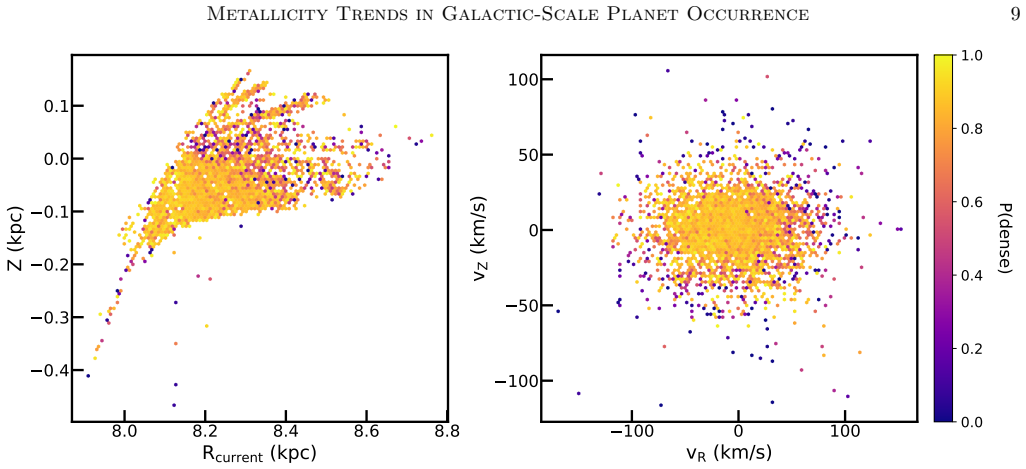
The load-bearing object is a toy planet-injection model built on a single empirical relation: the probability that a star hosts a hot Jupiter scales as $F_{HJ}(\mathrm{[Fe/H]}) = 0.01 \times 10^{\beta \mathrm{[Fe/H]}}$, with $\beta = 1.6$ from a fit to observed hot Jupiters. Every star in the GALAH, APOGEE, and NIHAO samples is tagged as a host or non-host by drawing a random number against this probability, so the only input is the star's measured iron abundance. The argument then runs three machineries over the tagged samples: (1) birth radii inferred from empirical $[\mathrm{Fe/H}]$–$[\alpha/\mathrm{Fe}]$ tracks calibrated on the NIHAO simulation; (2) the phase-space density classifier from the 2020 clustering study, which uses the Mahalanobis distance to the 20th nearest neighbor in 5D/6D phase space and a Gaussian mixture to assign overdense/underdense membership; and (3) a separate by-eye separation of stars into low- and high-$\alpha$ sequence populations. The work of these together is to show that the overdensity classification roughly selects the low-$\alpha$ sequence, and that injecting planets along the metallicity power law alone is enough to push more than 95% of hosts into overdensities.
What would settle it
Construct a paired test in observed data: after matching overdense and underdense stars on $[\mathrm{Fe/H}]$ and $\alpha$-enrichment, check whether the hot Jupiter occurrence rate still differs. If the difference survives the metallicity match, then some other property, most likely age, is driving the signal, and the metallicity-only story is falsified. A complementary calculation would repeat the paper's injection using only the age power law from the same source and ask whether more than 95% of injected planets land in overdensities.
Extended reading notes
Core claim
The central discovery is that the previously reported phase-space clustering of hot Jupiters does not require stimulating cluster environments; it can be generated entirely by the well-known planet–metallicity relation. When stars are assigned hot Jupiters with probability $0.01 \times 10^{1.6[\mathrm{Fe/H}]}$ and are then classified by the same phase-space density algorithm used in the 2020 study, more than 95% of injected planet hosts fall in overdense regions for GALAH and APOGEE (6,078 versus 262 and 5,832 versus 224), reproducing the earlier 92% figure. The mechanism is that phase-space overdensities are preferentially populated by the low-$\alpha$ sequence, which is metal-rich and kinematically cool, while underdensities are preferentially populated by the high-$\alpha$ sequence, which is metal-poor and kinematically hot. Since hot Jupiters favor metal-rich stars, most injected planets end up in the overdense, low-$\alpha$ regions regardless of any dynamical effect of density. As a corollary, the paper finds that occurrence declines by roughly 0.1% per kpc with birth radius from 5 to 14 kpc, tracing the disk's radial metallicity gradient, and that the differing high-$\alpha$ fractions in GALAH (5%), APOGEE (13%), and the NIHAO simulation (30%) explain the survey-to-survey differences at birth radii below 5 kpc. The authors frame this as a null hypothesis: host-star metallicity, not Galactic environment, is the primary driver of hot Jupiter occurrence.
Load-bearing premise
The injection model assumes that a metallicity-only power law fully describes hot Jupiter occurrence, omitting the known correlation between hot Jupiter occurrence and stellar age, which is strongly entangled with $\alpha$-sequence membership and metallicity.
Editorial extensions
If this is right
- Any future inference of hot Jupiter occurrence from phase-space density must first control for stellar metallicity and $\alpha$-sequence membership, because the density signal is reproduced without any environmental effect.
- Observed occurrence trends with birth radius that are shallower than the modeled $\sim$0.1% per kpc beyond 5 kpc would be consistent with metallicity dominating; steeper trends would be evidence for an additional Galactic or environmental driver.
- Survey selection matters quantitatively: samples with a larger fraction of kinematically hot, metal-poor high-$\alpha$ stars (APOGEE, NIHAO) show a turnover in occurrence at about 5 kpc, while a low-$\alpha$-dominated sample (GALAH) shows a monotonic decline.
- Planet demographics studies that ignore the low/high-$\alpha$ distinction risk attributing stellar chemistry effects to the Galactic environment.
Reading between the lines
- The same injection test could be run with an age power law instead of the metallicity power law; because age and $\alpha$-sequence membership are strongly correlated, an age-only injection might reproduce the overdensity signal just as well, which would leave the paper's 'metallicity is the primary driver' conclusion underdetermined.
- A practical control for future surveys would be to compare hot Jupiter occurrence in overdense and underdense regions after exact-matching stars on $[\mathrm{Fe/H}]$, age, and $\alpha$-enrichment; if the occurrence difference vanishes, the environmental explanation is falsified.
- For planet populations whose occurrence depends weakly on metallicity (for example, small planets), the same toy-injection methodology could provide a cleaner test of genuine environmental effects, since chemistry contamination would be weaker.
- The survey-to-survey difference at low birth radius implies that comparing planet occurrence across heterogeneous surveys without modeling selection functions can masquerade as a Galactic-scale trend.
Signed reviews
Editorial analysis
A structured set of objections, weighed in public.
Referee Report
Summary. This paper uses GALAH, APOGEE, and the NIHAO-UHD simulation to study how the known hot Jupiter occurrence-metallicity relation propagates into occurrence as a function of Galactic birth radius (Rbirth) and phase-space density. Hot Jupiters are injected probabilistically into stars using the metallicity power law FHJ([Fe/H]) = 0.01 x 10^1.6[Fe/H] (Eq. 4), and occurrence rates are then computed in Rbirth bins and in the Winter et al. (2020) overdensity/underdensity classification. The authors find that for Rbirth >= 5 kpc occurrence declines by about 0.1% per kpc in all samples, that differences at Rbirth < 5 kpc reflect survey selection and the fraction of high-alpha sequence stars, and that a metallicity-only injection reproduces the Winter et al. (2020) result that more than 92% of hot Jupiters are in phase-space overdensities (here >95% for GALAH and APOGEE). The paper concludes that metallicity, rather than clustered environments, drives the hot Jupiter occurrence trends reported by Winter et al. (2020).
Significance. If the central claim were fully supported, the paper would provide a simple, metallicity-based null hypothesis for interpreting Galactic-scale planet demographics. The phase-space density forward model is a genuinely useful contribution: because the injection uses only [Fe/H] and no clustering information, reproducing the overdense fraction is a meaningful test that a stellar-property selection can generate the observed signal. The Rbirth toy models and the accompanying robustness checks (varying beta, recalibrating Rbirth, rescaling the NIHAO simulation) are transparent and carefully executed. The main limitation is that the injection model does not distinguish metallicity from other stellar properties, particularly age, so the causal attribution in Section 5.4 is stronger than the evidence supports.
major comments (2)
- [Section 5.4 (with Sections 1.2, 3.3, and 6)] The central claim that 'metallicity, rather than clustered environments, drives the hot Jupiter occurrence trends' is not identifiable from the injection model used here. Equation 4 injects planets using only the metallicity power law, but Section 1.2 cites Chen et al. (2023) and Miyazaki & Masuda (2023) as establishing a hot Jupiter occurrence-age correlation independent of metallicity. Age, metallicity, alpha-sequence membership, and kinematic temperature are mutually correlated, so a metallicity-only injection is effectively an injection into the low-alpha sequence and will reproduce the phase-space overdensity signal regardless of whether the causal variable is metallicity, age, or both. The paper's own Sections 1.2 and 6 postpone age to future work, confirming that this alternative is untested. To support the metallicity-specific conclusion, the authors should compare the existing metallicity-only injection with an age-only injection and a joint metallicity-plus-age injection, or relax the conclusion to state that a stellar property correlated with the low-alpha sequence, with metallicity as one candidate, is sufficient to reproduce Winter et al. (2020).
- [Section 5.2 with Equations 1, 2, and 4] The Rbirth occurrence trends do not provide independent evidence about Rbirth as a causal variable, because Rbirth is a deterministic function of [Fe/H] and [alpha/Fe] in Equations 1 and 2, and the injection probability in Equation 4 is a monotonic function of [Fe/H] alone. The predicted decline of 0.1% per kpc for Rbirth >= 5 kpc is therefore a composition of the adopted Rbirth calibration and the metallicity power law, not a falsifiable prediction about the role of birth radius. The sentence in Section 5.2 stating that a sample would 'need to show a steeper decrease than 0.1% per kpc' if Rbirth were the primary driver conflates the constructed correlation with a test of Rbirth's independent effect. I recommend reframing these calculations as explicit demonstrations of how the metallicity power law propagates through a chosen Rbirth calibration, and removing or heavily qualifying the causal language about Rbirth as a competing driver.
minor comments (5)
- [Figure 8 caption] The caption says 'We are able to replicate Winter et al. (2020)'s result,' but the hosts are synthetic injections, not the observed planet host population; please clarify that this is a forward-model reproduction, not a direct replication.
- [Section 4.2] The text reports that 30%, 43%, and 100% of stars are classifiable in GALAH, APOGEE, and NIHAO, but the subsequent overdensity and underdensity percentages (59%, 47%, 35% and 2%, 6%, 33%) do not sum to 100%; please state explicitly that the remainder have intermediate P(dense) values and are excluded from the overdense/underdense comparison.
- [Section 5.1 and Figure 5 caption] There are minor typos: 'raidal' should be 'radial' in Section 5.1, and 'visualizaiton' should be 'visualization' in the Figure 5 caption.
- [Section 2.3] The text says Mills et al. (in prep) infer Rbirth for 125,484 giant stars, then says 'We calculate Rbirth for 252,441 dwarf and subgiant stars from APOGEE DR17'; please clarify the relationship between these two sample sizes and the Mills et al. catalog.
- [Section 3.2] The text says 'we replicate the exact methods described in Winter et al. (2020)' but uses Gaia DR3 rather than Gaia DR2; please note this difference explicitly, since the phase-space density values may not be directly comparable.
Circularity Check
No significant circularity: the metallicity-only injection is a forward model that does not encode the phase-space or Rbirth outputs it claims to reproduce.
full rationale
The paper's derivation chain is a forward toy model: it takes an externally calibrated hot-Jupiter-metallicity power law (Chen et al. 2023, Eq. 4), applies it to the [Fe/H] distributions of GALAH, APOGEE, and the NIHAO simulation, and then reads off the resulting occurrence trends in Rbirth and phase-space density. The injection probability depends only on [Fe/H]; it contains no dependence on Rbirth, phase-space density, or environment. Reproducing the Winter et al. (2020) overdense-host fraction is therefore a genuine, non-tautological test: it demonstrates that the known metallicity relation, combined with the pre-existing metallicity differences between overdense and underdense stars documented in Figure 7, is sufficient to mimic the clustering signal. This is exactly the kind of forward-model check that can falsify an environmental interpretation. The Rbirth occurrence trend is an analytic consequence of propagating the input [Fe/H] power law through the Rbirth([Fe/H],[alpha/Fe]) calibration, but the paper presents it as a toy-model consequence rather than an empirical discovery, and Section 5.5 explicitly shows the main conclusions are robust to renormalizing the Rbirth scale. The known hot-Jupiter-age correlation is omitted, and the manuscript acknowledges this: Section 1.2 says it is 'beyond the scope of this work,' and Section 6 defers age to future work. That is a model-completeness and identifiability limitation, not circularity, because the age effect is an alternative explanation, not an input that is later relabeled as an output. Self-citations to Wang et al. (2024) and Mills et al. (in prep) supply the Rbirth calibration, but that calibration was derived from stellar chemistry and simulations, not from hot-Jupiter occurrence, and the phase-space conclusion is independent of it. No step in the paper reduces by construction to its own inputs.
Assumptions & free parameters
free parameters (4)
- HJ-metallicity power law index beta =
1.6 (from Chen et al. 2023)
- HJ occurrence normalization C =
0.01 (solar-metallicity occurrence, assumed)
- Rbirth calibration coefficients (GALAH, Eq. 1) =
-40, 0.80, 0.4, 8.0
- Rbirth calibration coefficients (APOGEE, Eq. 2) =
-30, 0.80, 0.4, 8.89
assumptions (4)
- domain assumption Hot Jupiter occurrence follows FHJ = 0.01 x 10^(1.6 [Fe/H])
- domain assumption The NIHAO simulation's [Fe/H]-[alpha/Fe]-Rbirth tracks apply to Milky Way stars
- domain assumption Main-sequence and subgiant stars can be assigned Rbirth using a calibration developed for giants
- ad hoc to paper Low and high-alpha sequence populations are separable by an eye-fitted line in the [Fe/H]-[alpha/Fe] plane
Cite this review
Pith. "Pith review of Disentangling Metallicity Effects in Hot Jupiter Occurrence Across Galactic Birth Radius and Phase-Space Density." pith.science (2026). https://pith.science/paper/ZVUYTEUV
@misc{pith2026250616511,
  author       = {Pith},
  title        = {Pith review of: Disentangling Metallicity Effects in Hot Jupiter Occurrence Across Galactic Birth Radius and Phase-Space Density},
  year         = {2026},
  howpublished = {\url{https://pith.science/paper/ZVUYTEUV}},
  note         = {Machine review of arXiv:2506.16511}
}
abstract
We explore how the correlation between host star metallicity and giant planets shapes hot Jupiter occurrence as a function of Galactic birth radius (\rbirth) and phase-space density in the Milky Way disk. Using the GALAH and APOGEE surveys and a galaxy from the NIHAO simulation suite, we inject hot Jupiters around stars based on metallicity power laws, reflecting the trend that giant planets preferentially form around metal-rich stars. For \rbirth\ $\geq 5$ kpc, hot Jupiter occurrence decreases with \rbirth\ by $\sim -0.1%$ per kpc; this is driven by the Galaxy's chemical evolution, where the inner regions of the disk are more metal-rich. Differences in GALAH occurrence rates versus APOGEE's and the simulation's at \rbirth\ $< 5$ kpc arise from survey selection effects. APOGEE and the NIHAO simulation have more high-$\alpha$ sequence stars than GALAH, resulting in average differences in metallicity (0.2--0.4 dex), $\alpha$-process element enrichment (0.2 dex), and vertical velocities (7--14 km/s) at each \rbirth\ bin. Additionally, we replicate the result of \cite{Winter20}, which showed that over 92% of hot Jupiters are associated with stars in phase-space overdensities, or "clustered environments." However, our findings suggest that this clustering effect is primarily driven by chemical and kinematic differences between low and high-$\alpha$ sequence star properties. Our results support stellar characteristics, particularly metallicity, being the primary drivers of hot Jupiter formation, which serves as the "null hypothesis" for interpreting planet demographics. This underscores the need to disentangle planetary and stellar properties from Galactic-scale effects in future planet demographics studies.
Figures


Figures from the paper (5 more)



Forward citations
Cited by 2 Pith papers
-
An Increase in the Galactic Planet Host Fraction Fails to Reproduce the Galactic Height Trend in Planet Occurrence
Time-dependent increases in the planet host fraction cannot reproduce the steep decline in small-planet occurrence with Galactic height seen by Kepler and K2.
-
On Hot Jupiters and Stellar Clustering: The Role of Host Star Demographics
The apparent excess of hot Jupiters in phase-space overdensities is driven by younger, more massive, more metal-rich host stars, not by an intrinsic environmental formation channel.
Reference graph
Works this paper leans on
-
[1]
2022, ApJS, 259, 35, doi: 10.3847/1538-4365/ac4414
Abdurro’uf, Accetta, K., Aerts, C., et al. 2022, ApJS, 259, 35, doi: 10.3847/1538-4365/ac4414
-
[2]
C., Hollenbach, D., Laughlin, G., & Gorti, U
Adams, F. C., Hollenbach, D., Laughlin, G., & Gorti, U. 2004, ApJ, 611, 360, doi: 10.1086/421989
doi:10.1086/421989 2004
-
[3]
2019, Geosciences, 9, 105, doi: 10.3390/geosciences9030105
Adibekyan, V. 2019, Geosciences, 9, 105, doi: 10.3390/geosciences9030105
-
[4]
Adibekyan, V., Santos, N. C., Demangeon, O. D. S., et al. 2021, A&A, 649, A111, doi: 10.1051/0004-6361/202040201
-
[5]
Adibekyan, V. Z., Figueira, P., Santos, N. C., et al. 2013, A&A, 554, A44, doi: 10.1051/0004-6361/201321520
-
[6]
Anguiano, B., Majewski, S. R., Hayes, C. R., et al. 2020, AJ, 160, 43, doi: 10.3847/1538-3881/ab9813
-
[7]
Armitage, P. J. 2011, ARA&A, 49, 195, doi: 10.1146/annurev-astro-081710-102521 Astropy Collaboration, Robitaille, T. P., Tollerud, E. J., et al. 2013, A&A, 558, A33, doi: 10.1051/0004-6361/201322068 Astropy Collaboration, Price-Whelan, A. M., Sip˝ ocz, B. M., et al. 2018, AJ, 156, 123, doi: 10.3847/1538-3881/aabc4f
-
[8]
Aumer, M., & Binney, J. J. 2009, MNRAS, 397, 1286, doi: 10.1111/j.1365-2966.2009.15053.x
arXiv 2009
Show all 89 references
- [9]
-
[10]
Barker, A. J. 2020, MNRAS, 498, 2270, doi: 10.1093/mnras/staa2405
2020 doi
-
[11]
2022, MNRAS, 510, 3449, doi: 10.1093/mnras/stab3596
Bashi, D., & Zucker, S. 2022, MNRAS, 510, 3449, doi: 10.1093/mnras/stab3596
2022 doi
-
[12]
2022, MNRAS, 516, 75, doi: 10.1093/mnras/stac2179
Beleznay, M., & Kunimoto, M. 2022, MNRAS, 516, 75, doi: 10.1093/mnras/stac2179
2022 doi
-
[13]
2003, A&A, 410, 527, doi: 10.1051/0004-6361:20031213
Bensby, T., Feltzing, S., & Lundstr¨ om, I. 2003, A&A, 410, 527, doi: 10.1051/0004-6361:20031213
2003 doi
-
[14]
2020, A&A, 633, A10, doi: 10.1051/0004-6361/201936463
Bitsch, B., & Battistini, C. 2020, A&A, 633, A10, doi: 10.1051/0004-6361/201936463
2020 doi
-
[15]
2016, ARA&A, 54, 529, doi: 10.1146/annurev-astro-081915-023441
Bland-Hawthorn, J., & Gerhard, O. 2016, ARA&A, 54, 529, doi: 10.1146/annurev-astro-081915-023441
2016 doi
-
[16]
A., Parker, R
Blaylock-Squibbs, G. A., Parker, R. J., & Daffern-Powell, E. C. 2024, ApJ, 968, 108, doi: 10.3847/1538-4357/ad4be0
2024 doi
-
[17]
2024, A&A, 686, A167, doi: 10.1051/0004-6361/202449557
Boettner, C., Dayal, P., Trebitsch, M., et al. 2024, A&A, 686, A167, doi: 10.1051/0004-6361/202449557
2024 doi
-
[18]
M., Wang, J., Zinn, J
Boley, K. M., Wang, J., Zinn, J. C., et al. 2021, AJ, 162, 85, doi: 10.3847/1538-3881/ac0e2d
2021 doi
-
[19]
J., Koch, D., Basri, G., et al
Borucki, W. J., Koch, D., Basri, G., et al. 2010, Science, 327, 977, doi: 10.1126/science.1185402
2010 doi
-
[20]
2020, MNRAS, 491, 5435, doi: 10.1093/mnras/stz3289
Buck, T. 2020, MNRAS, 491, 5435, doi: 10.1093/mnras/stz3289
2020 doi
-
[21]
2019a, MNRAS, 483, 1314, doi: 10.1093/mnras/sty2913
Frings, J. 2019a, MNRAS, 483, 1314, doi: 10.1093/mnras/sty2913
-
[22]
V., & Dutton, A
Buck, T., Ness, M., Obreja, A., Macci` o, A. V., & Dutton, A. A. 2019b, ApJ, 874, 67, doi: 10.3847/1538-4357/aaffd0
-
[23]
Dutton, A. A. 2018, ApJ, 861, 88, doi: 10.3847/1538-4357/aac890 20 Rampalli et al
2018 doi
-
[24]
V., et al
Buck, T., Obreja, A., Macci` o, A. V., et al. 2020, MNRAS, 491, 3461, doi: 10.1093/mnras/stz3241
2020 doi
-
[25]
2023, MNRAS, 523, 1565, doi: 10.1093/mnras/stad1503
Buck, T., Obreja, A., Ratcliffe, B., et al. 2023, MNRAS, 523, 1565, doi: 10.1093/mnras/stad1503
2023 doi
-
[26]
2021, MNRAS, 508, 3365, doi: 10.1093/mnras/stab2736
Buck, T., Rybizki, J., Buder, S., et al. 2021, MNRAS, 508, 3365, doi: 10.1093/mnras/stab2736
2021 doi
-
[27]
2021, MNRAS, 506, 150, doi: 10.1093/mnras/stab1242
Buder, S., Sharma, S., Kos, J., et al. 2021, MNRAS, 506, 150, doi: 10.1093/mnras/stab1242
2021 doi
-
[28]
X., Portegies Zwart, S., & van Elteren, A
Cai, M. X., Portegies Zwart, S., & van Elteren, A. 2018, MNRAS, 474, 5114, doi: 10.1093/mnras/stx3064
2018 doi
-
[29]
2021, ApJ, 909, 115, doi: 10.3847/1538-4357/abd5be —
Chen, D.-C., Xie, J.-W., Zhou, J.-L., et al. 2021, ApJ, 909, 115, doi: 10.3847/1538-4357/abd5be —. 2023, Proceedings of the National Academy of Science, 120, e2304179120, doi: 10.1073/pnas.2304179120 Concha-Ram´ ırez, F., Wilhelm, M. J. C., Portegies Zwart, S., & Haworth, T. J...
2021 doi
-
[30]
2021, AJ, 162, 46, doi: 10.3847/1538-3881/ac00ad
Dai, Y.-Z., Liu, H.-G., An, D.-S., & Zhou, J.-L. 2021, AJ, 162, 46, doi: 10.3847/1538-3881/ac00ad
2021 doi
-
[31]
I., & Johnson, J
Dawson, R. I., & Johnson, J. A. 2018, ARA&A, 56, 175, doi: 10.1146/annurev-astro-081817-051853 de Juan Ovelar, M., Kruijssen, J. M. D., Bressert, E., et al. 2012, A&A, 546, L1, doi: 10.1051/0004-6361/201219627 De Silva, G. M., Freeman, K. C., Bland-Hawthorn, J., et al. 2015, M...
2018 doi
-
[32]
Snaith, O. N. 2013, A&A, 553, A102, doi: 10.1051/0004-6361/201220539
2013 doi
- [33]
-
[34]
2019, ApJ, 884, 99, doi: 10.3847/1538-4357/ab4254 Gaia Collaboration, Prusti, T., de Bruijne, J
Frankel, N., Sanders, J., Rix, H.-W., Ting, Y.-S., & Ness, M. 2019, ApJ, 884, 99, doi: 10.3847/1538-4357/ab4254 Gaia Collaboration, Prusti, T., de Bruijne, J. H. J., et al. 2016, A&A, 595, A1, doi: 10.1051/0004-6361/201629272 Gaia Collaboration, Brown, A. G. A., Vallenari, A.,...
2019 doi
-
[35]
1983, MNRAS, 202, 1025, doi: 10.1093/mnras/202.4.1025
Gilmore, G., & Reid, N. 1983, MNRAS, 202, 1025, doi: 10.1093/mnras/202.4.1025
1983 doi
-
[36]
M., Brasseur, C
Ginsburg, A., Sip˝ ocz, B. M., Brasseur, C. E., et al. 2019, AJ, 157, 98, doi: 10.3847/1538-3881/aafc33
2019 doi
-
[37]
1997, MNRAS, 285, 403, doi: 10.1093/mnras/285.2.403
Gonzalez, G. 1997, MNRAS, 285, 403, doi: 10.1093/mnras/285.2.403
1997 doi
-
[38]
1996, in Astronomical Society of the Pacific Conference
Gratton, R., Carretta, E., Matteucci, F., & Sneden, C. 1996, in Astronomical Society of the Pacific Conference
1996
-
[39]
A., Mann, A
Guo, X., Johnson, J. A., Mann, A. W., et al. 2017, ApJ, 838, 25, doi: 10.3847/1538-4357/aa6004
2017 doi
-
[40]
2008, A&A, 486, 951, doi: 10.1051/0004-6361:200809724
Gustafsson, B., Edvardsson, B., Eriksson, K., et al. 2008, A&A, 486, 951, doi: 10.1051/0004-6361:200809724
2008 doi
- [41]
-
[42]
R., Millman, K
Harris, C. R., Millman, K. J., van der Walt, S. J., et al. 2020, Nature, 585, 357, doi: 10.1038/s41586-020-2649-2
2020 doi
-
[43]
2014, ApJ, 788, 62, doi: 10.1088/0004-637X/788/1/62
Hasegawa, Y., & Hirashita, H. 2014, ApJ, 788, 62, doi: 10.1088/0004-637X/788/1/62
2014 doi
-
[44]
2019, A&A, 625, A105, doi: 10.1051/0004-6361/201834155
Khoperskov, S. 2019, A&A, 625, A105, doi: 10.1051/0004-6361/201834155
2019 doi
-
[45]
2020, MNRAS, 497, 933, doi: 10.1093/mnras/staa1934
Hilmi, T., Minchev, I., Buck, T., et al. 2020, MNRAS, 497, 933, doi: 10.1093/mnras/staa1934
2020 doi
-
[46]
Hunter, J. D. 2007, Computing in Science & Engineering, 9, 90, doi: 10.1109/MCSE.2007.55 Jofr´ e, P., Heiter, U., & Soubiran, C. 2019, ARA&A, 57, 571, doi: 10.1146/annurev-astro-091918-104509
2007 doi
-
[47]
A., Aller, K
Johnson, J. A., Aller, K. M., Howard, A. W., & Crepp, J. R. 2010, PASP, 122, 905, doi: 10.1086/655775
2010 doi
- [48]
- [49]
-
[50]
2017, AJ, 153, 75, doi: 10.3847/1538-3881/153/2/75
Kunder, A., Kordopatis, G., Steinmetz, M., et al. 2017, AJ, 153, 75, doi: 10.3847/1538-3881/153/2/75
2017 doi
- [51]
-
[52]
Lu, Y., Buck, T., Minchev, I., & Ness, M. K. 2022a, MNRAS, 515, L34, doi: 10.1093/mnrasl/slac065
- [53]
-
[54]
T., Bovy, J., Leung, H
Mackereth, J. T., Bovy, J., Leung, H. W., et al. 2019, MNRAS, 489, 176, doi: 10.1093/mnras/stz1521
2019 doi
-
[55]
R., Schiavon, R
Majewski, S. R., Schiavon, R. P., Frinchaboy, P. M., et al. 2017, AJ, 154, 94, doi: 10.3847/1538-3881/aa784d
2017 doi
-
[56]
2020, A&A, 644, A68, doi: 10.1051/0004-6361/202039478
Maldonado, J., Micela, G., Baratella, M., et al. 2020, A&A, 644, A68, doi: 10.1051/0004-6361/202039478
2020 doi
-
[57]
B., & Heggie, D
Malmberg, D., Davies, M. B., & Heggie, D. C. 2011, MNRAS, 411, 859, doi: 10.1111/j.1365-2966.2010.17730.x
2011
-
[58]
2010, ApJ, 722, 112, doi: 10.1088/0004-637X/722/1/112
Minchev, I., & Famaey, B. 2010, ApJ, 722, 112, doi: 10.1088/0004-637X/722/1/112
2010 doi
-
[59]
2018, MNRAS, 481, 1645, doi: 10.1093/mnras/sty2033 Metallicity Trends in Galactic-Scale Planet Occurrence 21
Minchev, I., Anders, F., Recio-Blanco, A., et al. 2018, MNRAS, 481, 1645, doi: 10.1093/mnras/sty2033 Metallicity Trends in Galactic-Scale Planet Occurrence 21
2018 doi
-
[60]
2023, AJ, 166, 209, doi: 10.3847/1538-3881/acff71
Miyazaki, S., & Masuda, K. 2023, AJ, 166, 209, doi: 10.3847/1538-3881/acff71
2023 doi
-
[61]
C., Sousa, S., et al
Mortier, A., Santos, N. C., Sousa, S., et al. 2013, A&A, 551, A112, doi: 10.1051/0004-6361/201220707
2013 doi
-
[62]
J., Lambrechts, M., & Davies, M
Mustill, A. J., Lambrechts, M., & Davies, M. B. 2022, A&A, 658, A199, doi: 10.1051/0004-6361/202140921 NASA Exoplanet Archive. 2023, Planetary Systems, Version: 2024-09-23, NExScI-Caltech/IPAC, doi: 10.26133/NEA12
2022 doi
-
[63]
K., Johnston, K
Ness, M. K., Johnston, K. V., Blancato, K., et al. 2019, ApJ, 883, 177, doi: 10.3847/1538-4357/ab3e3c
2019 doi
-
[64]
2023, A&A, 678, A74, doi: 10.1051/0004-6361/202346697
Johansen, A. 2023, A&A, 678, A74, doi: 10.1051/0004-6361/202346697
2023 doi
-
[65]
2020, MNRAS, 491, 4481, doi: 10.1093/mnras/stz3207 pandas development team, T
Osborn, A., & Bayliss, D. 2020, MNRAS, 491, 4481, doi: 10.1093/mnras/stz3207 pandas development team, T. 2020, pandas-dev/pandas: Pandas, latest, Zenodo, doi: 10.5281/zenodo.3509134
2020 doi
-
[66]
2011, Journal of Machine Learning Research, 12, 2825
Pedregosa, F., Varoquaux, G., Gramfort, A., et al. 2011, Journal of Machine Learning Research, 12, 2825
2011
-
[67]
A., Marcy, G
Petigura, E. A., Marcy, G. W., Winn, J. N., et al. 2018, AJ, 155, 89, doi: 10.3847/1538-3881/aaa54c
2018 doi
-
[68]
Piskunov, N., & Valenti, J. A. 2017, A&A, 597, A16, doi: 10.1051/0004-6361/201629124
2017 doi
-
[69]
B., Hubickyj, O., Bodenheimer, P., et al
Pollack, J. B., Hubickyj, O., Bodenheimer, P., et al. 1996, Icarus, 124, 62, doi: 10.1006/icar.1996.0190
1996
-
[70]
A., Tout, C
Rasio, F. A., Tout, C. A., Lubow, S. H., & Livio, M. 1996, ApJ, 470, 1187, doi: 10.1086/177941
1996 doi
-
[71]
2024, A&A, 690, A352, doi: 10.1051/0004-6361/202449268
Ratcliffe, B., Khoperskov, S., Minchev, I., et al. 2024, A&A, 690, A352, doi: 10.1051/0004-6361/202449268
2024 doi
-
[72]
2014, Experimental Astronomy, 38, 249, doi: 10.1007/s10686-014-9383-4
Rauer, H., Catala, C., Aerts, C., et al. 2014, Experimental Astronomy, 38, 249, doi: 10.1007/s10686-014-9383-4
2014 doi
-
[73]
2014, A&A, 567, A5, doi: 10.1051/0004-6361/201322944
Recio-Blanco, A., de Laverny, P., Kordopatis, G., et al. 2014, A&A, 567, A5, doi: 10.1051/0004-6361/201322944
2014 doi
-
[74]
R., Winn, J
Ricker, G. R., Winn, J. N., Vanderspek, R., et al. 2015, Journal of Astronomical Telescopes, Instruments, and Systems, 1, 014003, doi: 10.1117/1.JATIS.1.1.014003 Roˇ skar, R., Debattista, V. P., Quinn, T. R., Stinson, G. S., & Wadsley, J. 2008, ApJL, 684, L79, doi: 10.1086/592231
2015 doi
-
[75]
2021, A&A, 653, A114, doi: 10.1051/0004-6361/202140968
Sabotta, S., Schlecker, M., Chaturvedi, P., et al. 2021, A&A, 653, A114, doi: 10.1051/0004-6361/202140968
2021 doi
-
[76]
C., Israelian, G., & Mayor, M
Santos, N. C., Israelian, G., & Mayor, M. 2004, A&A, 415, 1153, doi: 10.1051/0004-6361:20034469
2004 doi
-
[77]
A., & Binney, J
Sellwood, J. A., & Binney, J. J. 2002, MNRAS, 336, 785, doi: 10.1046/j.1365-8711.2002.05806.x
2002
-
[78]
2018, MNRAS, 473, 2004, doi: 10.1093/mnras/stx2582
Sharma, S., Stello, D., Buder, S., et al. 2018, MNRAS, 473, 2004, doi: 10.1093/mnras/stx2582
2018 doi
- [79]
-
[80]
Taylor, M. B. 2005, in Astronomical Society of the Pacific Conference Series, Vol. 347, Astronomical Data Analysis Software and Systems XIV, ed. P. Shopbell, M. Britton, & R. Ebert, 29
2005
-
[81]
A., & Piskunov, N
Valenti, J. A., & Piskunov, N. 1996, A&AS, 118, 595
1996
-
[82]
E., et al
Virtanen, P., Gommers, R., Oliphant, T. E., et al. 2020, Nature Methods, 17, 261, doi: 10.1038/s41592-019-0686-2
2020 doi
-
[83]
K., & Buck, T
Wang, K., Carrillo, A., Ness, M. K., & Buck, T. 2024, MNRAS, 527, 321, doi: 10.1093/mnras/stad3182
2024 doi
-
[84]
A., Stinson, G
Wang, L., Dutton, A. A., Stinson, G. S., et al. 2015, MNRAS, 454, 83, doi: 10.1093/mnras/stv1937 Wes McKinney. 2010, in Proceedings of the 9th Python in Science Conference, ed. St´ efan van der Walt & Jarrod Millman, 56 – 61, doi: 10.25080/Majora-92bf1922-00a
2015 doi
-
[85]
P., & Cieza, L
Williams, J. P., & Cieza, L. A. 2011, ARA&A, 49, 67, doi: 10.1146/annurev-astro-081710-102548
2011 doi
-
[86]
N., & Fabrycky, D
Winn, J. N., & Fabrycky, D. C. 2015, ARA&A, 53, 409, doi: 10.1146/annurev-astro-082214-122246
2015 doi
-
[87]
2020, Nature, 586, 528, doi: 10.1038/s41586-020-2800-0
Chevance, M. 2020, Nature, 586, 528, doi: 10.1038/s41586-020-2800-0
2020 doi
-
[88]
2012, Research in Astronomy and Astrophysics, 12, 723, doi: 10.1088/1674-4527/12/7/002
Zhao, G., Zhao, Y.-H., Chu, Y.-Q., Jing, Y.-P., & Deng, L.-C. 2012, Research in Astronomy and Astrophysics, 12, 723, doi: 10.1088/1674-4527/12/7/002
2012 doi
-
[89]
K., Hardegree-Ullman, K
Zink, J. K., Hardegree-Ullman, K. K., Christiansen, J. L., et al. 2023, AJ, 165, 262, doi: 10.3847/1538-3881/acd24c
2023 doi
Reviewed August 15, 2026 · model on record in the stance chip above.
Discussion (0). Continue with ORCID to comment.