From Rags to Jeans: Axion Miniclusters from Early matter domination
Pith reviewed 2026-06-26 20:16 UTC · model grok-4.3
The pith
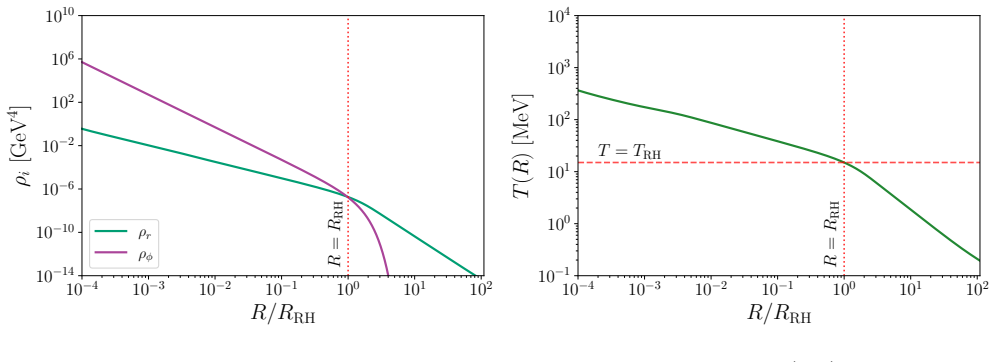
Early matter domination turns radiation temperature fluctuations into axion mass variations that source order-unity density perturbations by equality.
A machine-rendered reading of the paper's core claim, the machinery that carries it, and where it could break.
Core claim
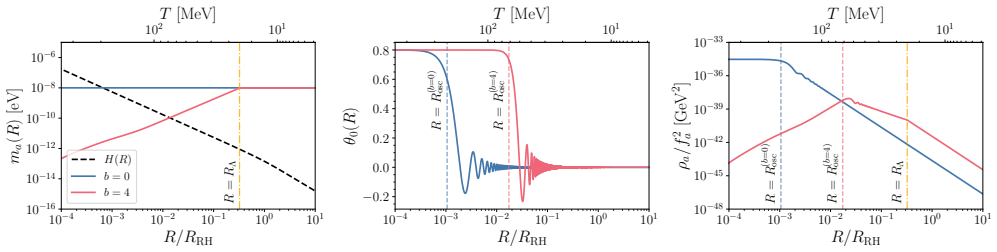
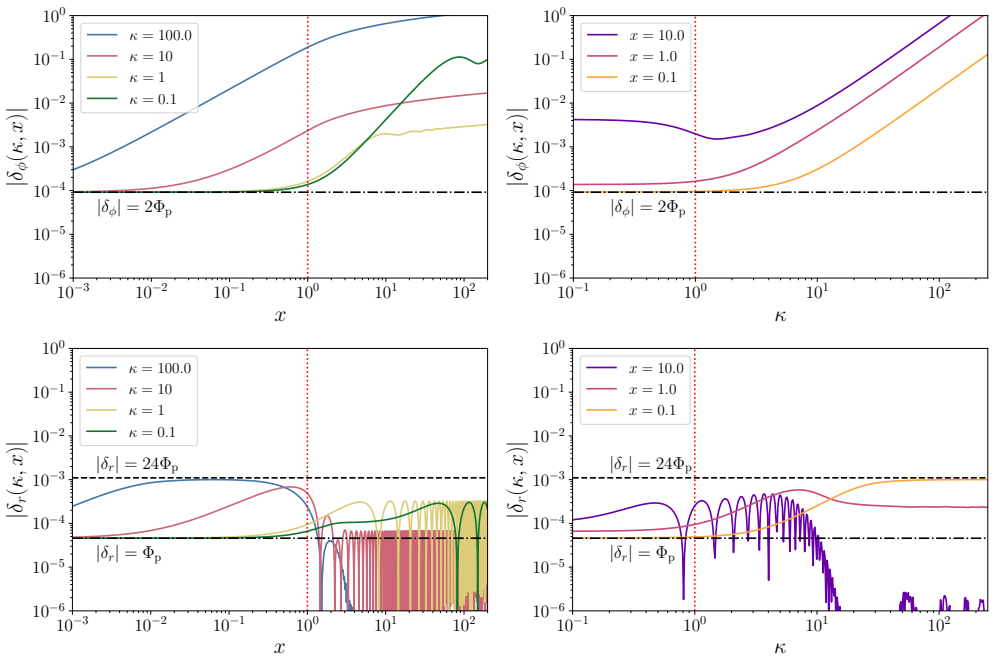
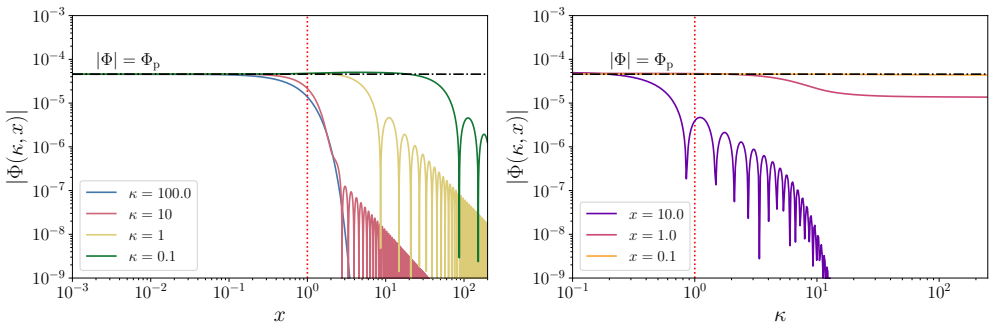
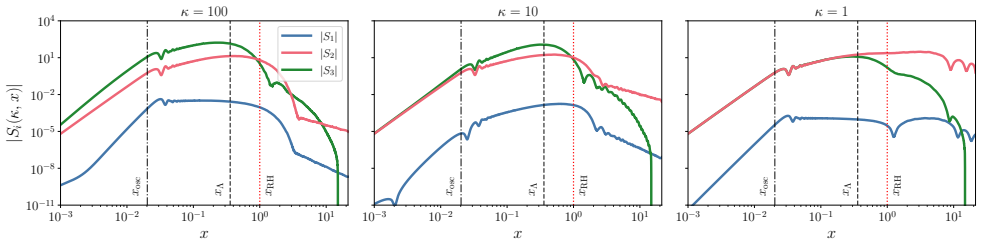
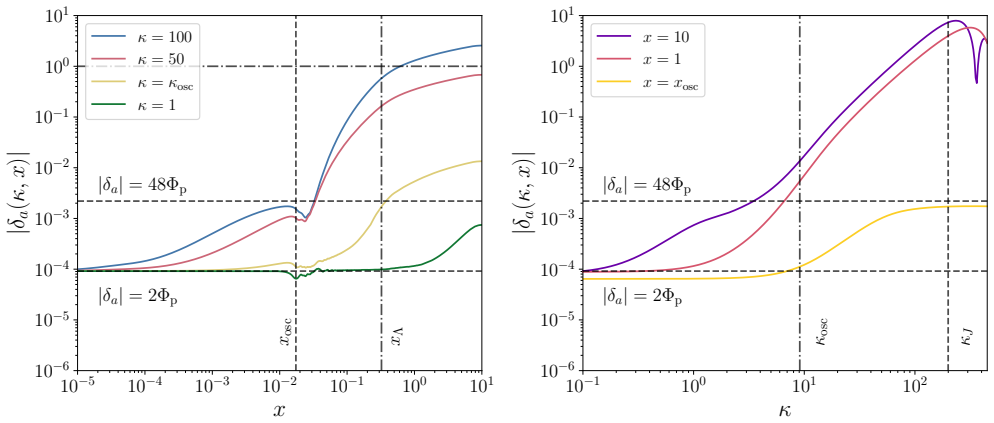
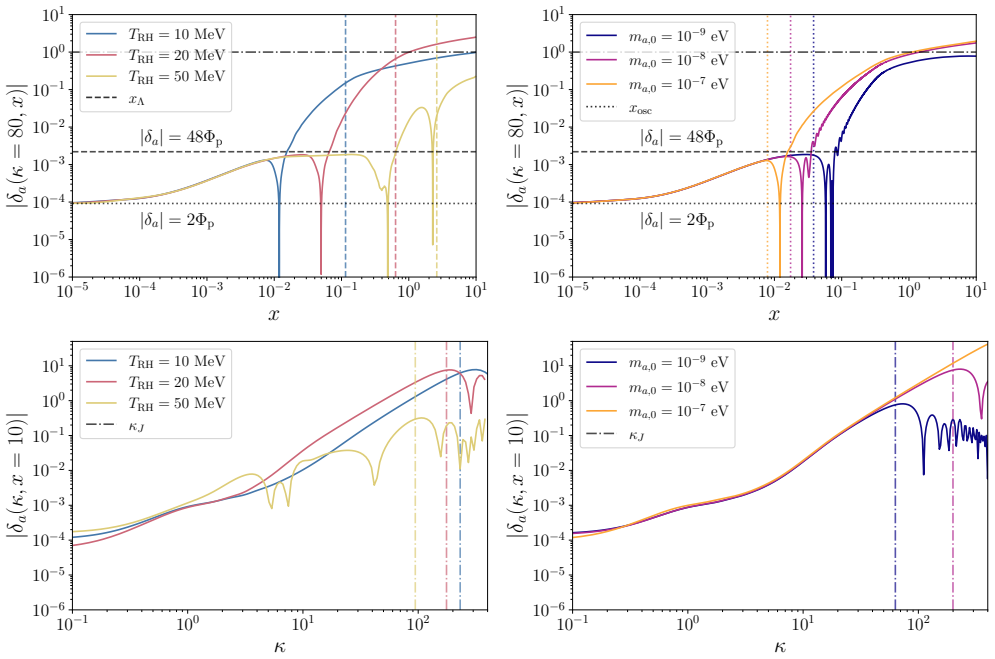
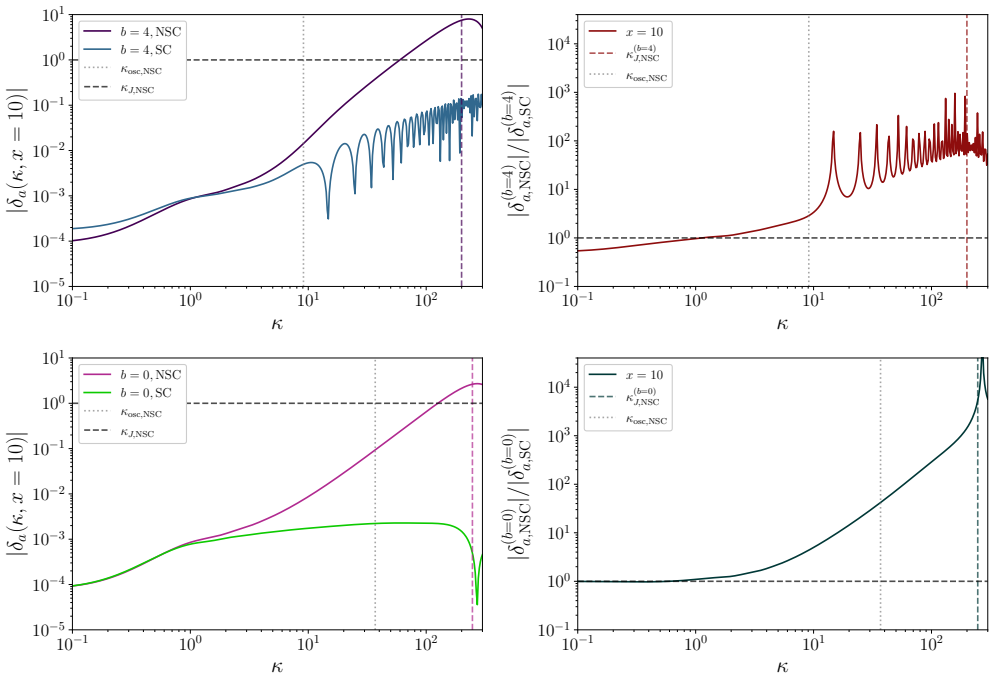
In an early matter-dominated era, density and temperature inhomogeneities of the radiation bath grow more efficiently than in the standard radiation-dominated history. If the axion mass depends on temperature, these inhomogeneities induce spatial fluctuations of the axion mass, providing a new source term for axion density perturbations. This mechanism is most efficient when the reheating temperature lies just below the mass-saturation scale T_Λ, and can drive axion overdensities to order unity by matter-radiation equality. For the QCD axion saturating the observed dark matter abundance, the nonlinear spectrum at equality exhibits two characteristic regions: one associated with the gravitati
What carries the argument
Spatial fluctuations of the temperature-dependent axion mass induced by radiation inhomogeneities, serving as an independent source term for axion density perturbations during early matter domination.
If this is right
- Axion overdensities reach order unity by matter-radiation equality when reheating occurs just below T_Λ.
- The nonlinear spectrum at equality shows two separate regions driven by gravity and by axion-mass temperature dependence.
- Minicluster masses can be estimated from the enhanced spectrum for the QCD axion saturating the dark-matter density.
- Formation of axion miniclusters and axion-star substructure becomes possible under these conditions.
Where Pith is reading between the lines
- The extra source term could increase the fraction of dark matter locked in dense axion structures detectable through gravitational microlensing or pulsar timing.
- Numerical evolution of the coupled perturbation equations with the explicit mass-fluctuation term would quantify the size of the second spectral region.
- Similar mass-fluctuation sourcing could appear in other scalar fields with temperature-dependent potentials in non-standard expansion histories.
- Observational bounds on minicluster abundance in specific mass windows would directly constrain the allowed reheating temperature relative to T_Λ.
Load-bearing premise
Spatial temperature inhomogeneities in the radiation bath translate directly into significant spatial fluctuations of the axion mass that act as an independent source term for density perturbations, without being suppressed by other cosmological effects.
What would settle it
A linear perturbation calculation or N-body simulation that includes the mass-fluctuation source term but finds the resulting axion overdensities remain far below order unity at equality for reheating temperatures near T_Λ.
Figures
read the original abstract
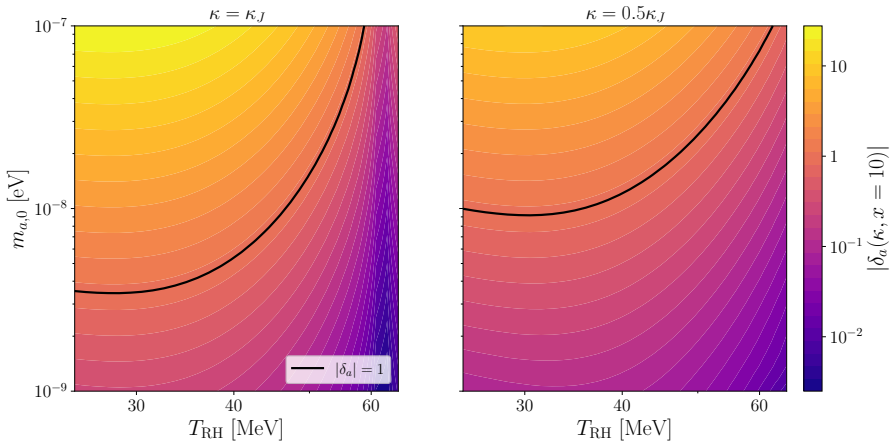
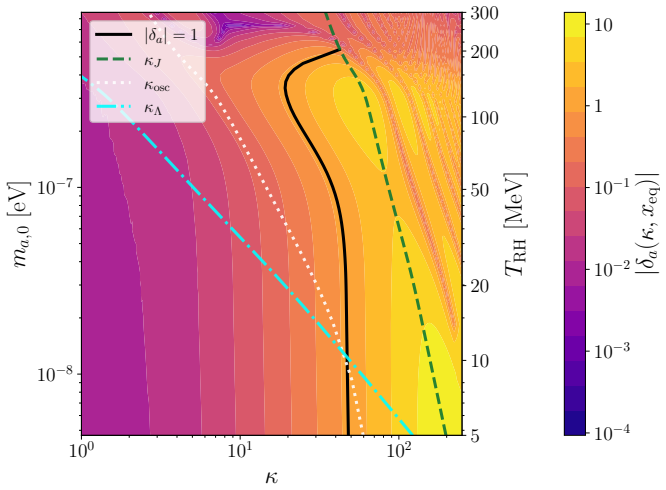
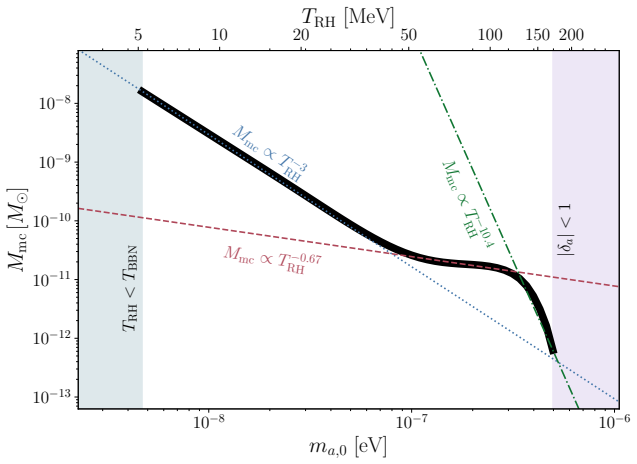
In an early matter-dominated era, density and temperature inhomogeneities of the radiation bath grow more efficiently than in the standard radiation-dominated history. If the axion mass depends on temperature, these inhomogeneities induce spatial fluctuations of the axion mass, providing a new source term for axion density perturbations. We show that this mechanism is most efficient when the reheating temperature lies just below the mass-saturation scale $T_\Lambda$, and can drive axion overdensities to order unity by matter--radiation equality. For the QCD axion saturating the observed dark matter abundance, the nonlinear spectrum at equality exhibits two characteristic regions: one associated with the gravitational enhancement already present in moduli-driven cosmologies, and another produced by the temperature dependence of the axion mass. We estimate the resulting minicluster masses and discuss the possible formation of axion miniclusters and axion-star substructure.
Editorial analysis
A structured set of objections, weighed in public.
Referee Report
Summary. The manuscript proposes that during an early matter-dominated era (EMD), spatial temperature inhomogeneities in the subdominant radiation bath induce fluctuations in the temperature-dependent axion mass m_a(T), providing an additional source term in the axion perturbation equations. This mechanism is stated to be most efficient for reheating temperatures T_rh just below the mass-saturation scale T_Λ and capable of driving axion overdensities to order unity by matter-radiation equality. For the QCD axion accounting for the observed dark matter density, the nonlinear power spectrum at equality is claimed to exhibit two distinct regions—one from standard gravitational EMD enhancement and a second from the mass-temperature dependence—with estimates given for resulting minicluster masses and possible axion-star substructure.
Significance. If the mapping from radiation δT to unsuppressed δm_a fluctuations is shown to remain effective without suppression, the result would identify a new, non-gravitational channel for axion minicluster formation during EMD. This could produce observable differences in the minicluster mass function and substructure compared to purely gravitational scenarios, with potential implications for axion dark matter searches. The two-region spectrum prediction is a concrete, falsifiable claim whose strength depends on the quantitative derivation of the source term.
major comments (2)
- [Section deriving the axion perturbation equations and source term] The central claim that δT inhomogeneities produce an independent, unsuppressed δm_a source term driving δρ_a/ρ_a to O(1) by equality (when T_rh ≲ T_Λ) requires explicit demonstration that Hubble averaging over the axion oscillation timescale, the isocurvature character of radiation perturbations, and the brief duration of the m_a(T) transition near T_Λ do not erase the integrated effect. This assumption is load-bearing for both the order-unity overdensity result and the existence of the second spectral region.
- [Section presenting the nonlinear spectrum at equality] The separation of the nonlinear spectrum into a gravitational EMD region and a distinct mass-fluctuation region at equality needs to be supported by a quantitative calculation showing the new source contributes at a level comparable to or exceeding the gravitational term for the QCD axion case; without this, the claim of two characteristic regions remains unestablished.
minor comments (2)
- Notation for T_Λ and the precise definition of the mass-saturation scale should be introduced with an equation in the main text for clarity, as the abstract uses it without prior definition.
- The discussion of minicluster masses would benefit from explicit comparison to the purely gravitational EMD case to highlight the quantitative impact of the new mechanism.
Simulated Author's Rebuttal
We thank the referee for their careful reading and constructive comments on our manuscript. We address each major comment below and will revise the paper accordingly to strengthen the presentation.
read point-by-point responses
-
Referee: [Section deriving the axion perturbation equations and source term] The central claim that δT inhomogeneities produce an independent, unsuppressed δm_a source term driving δρ_a/ρ_a to O(1) by equality (when T_rh ≲ T_Λ) requires explicit demonstration that Hubble averaging over the axion oscillation timescale, the isocurvature character of radiation perturbations, and the brief duration of the m_a(T) transition near T_Λ do not erase the integrated effect. This assumption is load-bearing for both the order-unity overdensity result and the existence of the second spectral region.
Authors: We agree that an explicit demonstration is required to confirm the source term remains unsuppressed. In the revised manuscript, we will expand the derivation of the axion perturbation equations to include averaged equations over the oscillation timescale, showing that the slow variation of m_a(T) prevents cancellation from Hubble averaging; that the isocurvature nature of the radiation perturbations allows δT fluctuations to directly source δm_a without gravitational suppression; and that the duration of the transition near T_Λ is long enough relative to the Hubble time for the integrated effect to reach O(1) overdensities when T_rh ≲ T_Λ. These additions will directly support the central claims. revision: yes
-
Referee: [Section presenting the nonlinear spectrum at equality] The separation of the nonlinear spectrum into a gravitational EMD region and a distinct mass-fluctuation region at equality needs to be supported by a quantitative calculation showing the new source contributes at a level comparable to or exceeding the gravitational term for the QCD axion case; without this, the claim of two characteristic regions remains unestablished.
Authors: We acknowledge that a quantitative comparison is needed to establish the two-region structure. The revised manuscript will include an explicit calculation of the nonlinear power spectrum at equality for the QCD axion saturating the observed dark matter density. This will compare the amplitude of the gravitational EMD contribution against the mass-fluctuation source term across relevant scales, demonstrating that the new source is comparable to or exceeds the gravitational term in a distinct range of wavenumbers and thereby confirming the separation into two characteristic regions. revision: yes
Circularity Check
No circularity; new source term derived from temperature dependence, not fitted or self-defined
full rationale
The paper introduces spatial axion mass fluctuations δm_a(T(x)) as an additive source in the perturbation equations, arising directly from the known temperature dependence of the axion mass combined with radiation δT inhomogeneities during EMD. This is not obtained by fitting to target overdensities, nor is any central result defined in terms of itself or renamed from a prior fit. No load-bearing self-citations, uniqueness theorems, or ansatze smuggled via prior work are described. The mechanism is presented as an independent physical effect whose efficiency is estimated when T_rh ≲ T_Λ, with the resulting spectrum regions following from solving the equations rather than by construction.
Axiom & Free-Parameter Ledger
axioms (2)
- domain assumption Early matter-dominated era precedes radiation domination
- domain assumption Axion mass depends on temperature
Reference graph
Works this paper leans on
-
[1]
Cosmology of the Invisible Axion,
J. Preskill, M. B. Wise, and F. Wilczek, “Cosmology of the Invisible Axion,”Phys. Lett. B 120(1983) 127–132
1983
-
[2]
The Evolution of Structure in the Universe From Axions,
F. W. Stecker and Q. Shafi, “The Evolution of Structure in the Universe From Axions,” Phys. Rev. Lett.50(1983) 928. 37
1983
-
[3]
The Not So Harmless Axion,
M. Dine and W. Fischler, “The Not So Harmless Axion,”Phys. Lett. B120(1983) 137–141
1983
-
[4]
A Cosmological Bound on the Invisible Axion,
L. Abbott and P. Sikivie, “A Cosmological Bound on the Invisible Axion,”Phys. Lett. B 120(1983) 133–136
1983
-
[5]
A New Light Boson?,
S. Weinberg, “A New Light Boson?,”Phys. Rev. Lett.40(1978) 223–226
1978
-
[6]
Problem of StrongPandTInvariance in the Presence of Instantons,
F. Wilczek, “Problem of StrongPandTInvariance in the Presence of Instantons,”Phys. Rev. Lett.40(1978) 279–282
1978
-
[7]
CP Conservation in the Presence of Instantons,
R. D. Peccei and H. R. Quinn, “CP Conservation in the Presence of Instantons,”Phys. Rev. Lett.38(1977) 1440–1443
1977
-
[8]
Some Aspects of Instantons,
R. D. Peccei and H. R. Quinn, “Some Aspects of Instantons,”Nuovo Cim. A41(1977) 309
1977
-
[9]
Constraints Imposed by CP Conservation in the Presence of Instantons,
R. D. Peccei and H. R. Quinn, “Constraints Imposed by CP Conservation in the Presence of Instantons,”Phys. Rev. D16(1977) 1791–1797
1977
-
[10]
A. Arvanitaki, S. Dimopoulos, S. Dubovsky, N. Kaloper, and J. March-Russell, “String Axiverse,”Phys. Rev. D81(2010) 123530,arXiv:0905.4720 [hep-th]
Pith/arXiv arXiv 2010
-
[11]
P. Arias, D. Cadamuro, M. Goodsell, J. Jaeckel, J. Redondo, and A. Ringwald, “WISPy Cold Dark Matter,”JCAP06(2012) 013,arXiv:1201.5902 [hep-ph]
Pith/arXiv arXiv 2012
-
[12]
Axion Kinetic Misalignment Mechanism,
R. T. Co, L. J. Hall, and K. Harigaya, “Axion Kinetic Misalignment Mechanism,”Phys. Rev. Lett.124no. 25, (2020) 251802,arXiv:1910.14152 [hep-ph]
arXiv 2020
-
[13]
QCD Axion Kinetic Misalignment without Prejudice,
B. Barman, N. Bernal, N. Ramberg, and L. Visinelli, “QCD Axion Kinetic Misalignment without Prejudice,”Universe8no. 12, (2022) 634,arXiv:2111.03677 [hep-ph]
arXiv 2022
-
[14]
Acoustic misalignment mechanism for axion dark matter,
A. Bodas, R. T. Co, A. Ghalsasi, K. Harigaya, and L.-T. Wang, “Acoustic misalignment mechanism for axion dark matter,”JHEP08(2025) 131,arXiv:2503.04888 [hep-ph]
arXiv 2025
-
[15]
Axion dark matter from frictional misalignment,
A. Papageorgiou, P. Qu´ ılez, and K. Schmitz, “Axion dark matter from frictional misalignment,”JHEP01(2023) 169,arXiv:2206.01129 [hep-ph]
arXiv 2023
-
[16]
Dark matter from an even lighter QCD axion: trapped misalignment,
L. Di Luzio, B. Gavela, P. Qu´ ılez, and A. Ringwald, “Dark matter from an even lighter QCD axion: trapped misalignment,”JCAP10(2021) 001,arXiv:2102.01082 [hep-ph]
arXiv 2021
-
[17]
Trapping Effect for QCD Axion Dark Matter,
S. Nakagawa, F. Takahashi, and M. Yamada, “Trapping Effect for QCD Axion Dark Matter,”JCAP05(2021) 062,arXiv:2012.13592 [hep-ph]. 38
arXiv 2021
-
[18]
Resonant production of dark photons from axions without a large coupling,
N. Kitajima and F. Takahashi, “Resonant production of dark photons from axions without a large coupling,”Phys. Rev. D107no. 12, (2023) 123518,arXiv:2303.05492 [hep-ph]
arXiv 2023
-
[19]
Resonant excitation of the axion field during the QCD phase transition,
P. Sikivie and W. Xue, “Resonant excitation of the axion field during the QCD phase transition,”Phys. Rev. D105no. 4, (2022) 043533,arXiv:2110.13157 [hep-ph]
arXiv 2022
-
[20]
New scenario of QCD axion clump formation. Part I. Linear analysis,
N. Kitajima, K. Kogai, and Y. Urakawa, “New scenario of QCD axion clump formation. Part I. Linear analysis,”JCAP03no. 03, (2022) 039,arXiv:2111.05785 [astro-ph.CO]
arXiv 2022
-
[21]
Impact of adiabatic temperature fluctuations on the power spectrum of axion density perturbations,
A. Ayad and D. J. Schwarz, “Impact of adiabatic temperature fluctuations on the power spectrum of axion density perturbations,”JCAP08(2025) 073,arXiv:2503.05532 [astro-ph.CO]
arXiv 2025
-
[22]
Axion Perturbations: A General Analytical Treatment,
I. J. Allali, P. Chakraborty, J. Fan, and M. Reece, “Axion Perturbations: A General Analytical Treatment,”arXiv:2510.07371 [hep-ph]
-
[23]
Axion miniclusters and Bose stars,
E. W. Kolb and I. I. Tkachev, “Axion miniclusters and Bose stars,”Phys. Rev. Lett.71 (1993) 3051–3054,arXiv:hep-ph/9303313
Pith/arXiv arXiv 1993
-
[24]
E. Hardy, “Miniclusters in the Axiverse,”JHEP02(2017) 046,arXiv:1609.00208 [hep-ph]
Pith/arXiv arXiv 2017
-
[25]
Axion Miniclusters in Modified Cosmological Histories,
L. Visinelli and J. Redondo, “Axion Miniclusters in Modified Cosmological Histories,” Phys. Rev. D101no. 2, (2020) 023008,arXiv:1808.01879 [astro-ph.CO]
arXiv 2020
-
[26]
Imprints of the Early Universe on Axion Dark Matter Substructure,
N. Blinov, M. J. Dolan, and P. Draper, “Imprints of the Early Universe on Axion Dark Matter Substructure,”Phys. Rev. D101no. 3, (2020) 035002,arXiv:1911.07853 [astro-ph.CO]
arXiv 2020
-
[27]
Largest temperature of the radiation era and its cosmological implications,
G. F. Giudice, E. W. Kolb, and A. Riotto, “Largest temperature of the radiation era and its cosmological implications,”Phys. Rev. D64(2001) 023508,arXiv:hep-ph/0005123
Pith/arXiv arXiv 2001
-
[28]
Axion cold dark matter in non-standard cosmologies,
L. Visinelli and P. Gondolo, “Axion cold dark matter in non-standard cosmologies,”Phys. Rev. D81(2010) 063508,arXiv:0912.0015 [astro-ph.CO]
arXiv 2010
-
[29]
New opportunities for axion dark matter searches in nonstandard cosmological models,
P. Arias, N. Bernal, D. Karamitros, C. Maldonado, L. Roszkowski, and M. Venegas, “New opportunities for axion dark matter searches in nonstandard cosmological models,”JCAP 11(2021) 003,arXiv:2107.13588 [hep-ph]
arXiv 2021
-
[30]
On Particle Creation by a Time Dependent Scalar Field,
A. D. Dolgov and D. P. Kirilova, “On Particle Creation by a Time Dependent Scalar Field,”Sov. J. Nucl. Phys.51(1990) 172–177. 39
1990
-
[31]
Particle Production During Out-of-equilibrium Phase Transitions,
J. H. Traschen and R. H. Brandenberger, “Particle Production During Out-of-equilibrium Phase Transitions,”Phys. Rev. D42(1990) 2491–2504
1990
-
[32]
L. Kofman, A. D. Linde, and A. A. Starobinsky, “Reheating after inflation,”Phys. Rev. Lett.73(1994) 3195–3198,arXiv:hep-th/9405187
Pith/arXiv arXiv 1994
-
[33]
Towards the theory of reheating after inflation,
L. Kofman, A. D. Linde, and A. A. Starobinsky, “Towards the theory of reheating after inflation,”Phys. Rev. D56(1997) 3258–3295,arXiv:hep-ph/9704452
Pith/arXiv arXiv 1997
-
[34]
The First Three Seconds: a Review of Possible Expansion Histories of the Early Universe,
R. Allahverdiet al., “The First Three Seconds: a Review of Possible Expansion Histories of the Early Universe,”Open J. Astrophys.4(6, 2020) 001,arXiv:2006.16182 [astro-ph.CO]
arXiv 2020
-
[35]
Conversations and deliberations: Non-standard cosmological epochs and expansion histories,
B. Batellet al., “Conversations and deliberations: Non-standard cosmological epochs and expansion histories,”Int. J. Mod. Phys. A40no. 17, (2025) 2530004,arXiv:2411.04780 [astro-ph.CO]
arXiv 2025
-
[36]
Two or three things particle physicists (mis)understand about (pre)heating,
B. Barman, N. Bernal, and J. Rubio, “Two or three things particle physicists (mis)understand about (pre)heating,”Nucl. Phys. B1018(2025) 116996, arXiv:2503.19980 [hep-ph]
arXiv 2025
-
[37]
On the Axion, Dilaton, Polonyi, Gravitino and Shadow Matter Problems in Supergravity and Superstring Models,
J. R. Ellis, D. V. Nanopoulos, and M. Quiros, “On the Axion, Dilaton, Polonyi, Gravitino and Shadow Matter Problems in Supergravity and Superstring Models,”Phys. Lett. B174 (1986) 176–182
1986
-
[38]
Cosmological implications of dynamical supersymmetry breaking,
T. Banks, D. B. Kaplan, and A. E. Nelson, “Cosmological implications of dynamical supersymmetry breaking,”Phys. Rev. D49(1994) 779–787,arXiv:hep-ph/9308292
Pith/arXiv arXiv 1994
-
[39]
Cosmological Moduli and the Post-Inflationary Universe: A Critical Review,
G. Kane, K. Sinha, and S. Watson, “Cosmological Moduli and the Post-Inflationary Universe: A Critical Review,”Int. J. Mod. Phys. D24no. 08, (2015) 1530022, arXiv:1502.07746 [hep-th]
Pith/arXiv arXiv 2015
-
[40]
String cosmology: From the early universe to today,
M. Cicoli, J. P. Conlon, A. Maharana, S. Parameswaran, F. Quevedo, and I. Zavala, “String cosmology: From the early universe to today,”Phys. Rept.1059(2024) 1–155, arXiv:2303.04819 [hep-th]
arXiv 2024
-
[41]
Calculation of the axion mass based on high-temperature lattice quantum chromodynamics,
S. Borsanyiet al., “Calculation of the axion mass based on high-temperature lattice quantum chromodynamics,”Nature539no. 7627, (2016) 69–71,arXiv:1606.07494 [hep-lat]. 40
Pith/arXiv arXiv 2016
-
[42]
Saving the Invisible Axion,
P. J. Steinhardt and M. S. Turner, “Saving the Invisible Axion,”Phys. Lett. B129(1983) 51
1983
-
[43]
Dilution of Cosmological Axions by Entropy Production,
G. Lazarides, R. K. Schaefer, D. Seckel, and Q. Shafi, “Dilution of Cosmological Axions by Entropy Production,”Nucl. Phys. B346(1990) 193–212
1990
-
[44]
Can decaying particles raise the upper bound on the Peccei-Quinn scale?,
M. Kawasaki, T. Moroi, and T. Yanagida, “Can decaying particles raise the upper bound on the Peccei-Quinn scale?,”Phys. Lett. B383(1996) 313–316,arXiv:hep-ph/9510461
Pith/arXiv arXiv 1996
-
[45]
Axion constraints in non-standard thermal histories,
D. Grin, T. L. Smith, and M. Kamionkowski, “Axion constraints in non-standard thermal histories,”Phys. Rev. D77(2008) 085020,arXiv:0711.1352 [astro-ph]
Pith/arXiv arXiv 2008
-
[46]
Axion Cosmology with Early Matter Domination,
A. E. Nelson and H. Xiao, “Axion Cosmology with Early Matter Domination,”Phys. Rev. D98no. 6, (2018) 063516,arXiv:1807.07176 [astro-ph.CO]
Pith/arXiv arXiv 2018
-
[47]
Probing the Early Universe with Axion Physics and Gravitational Waves,
N. Ramberg and L. Visinelli, “Probing the Early Universe with Axion Physics and Gravitational Waves,”Phys. Rev. D99no. 12, (2019) 123513,arXiv:1904.05707 [astro-ph.CO]
Pith/arXiv arXiv 2019
-
[48]
Frozen-in fermionic singlet dark matter in non-standard cosmology with a decaying fluid,
P. Arias, D. Karamitros, and L. Roszkowski, “Frozen-in fermionic singlet dark matter in non-standard cosmology with a decaying fluid,”JCAP05(2021) 041,arXiv:2012.07202 [hep-ph]
arXiv 2021
-
[49]
Thermal axions with multi-eV masses are possible in low-reheating scenarios,
P. Carenza, M. Lattanzi, A. Mirizzi, and F. Forastieri, “Thermal axions with multi-eV masses are possible in low-reheating scenarios,”JCAP07(2021) 031,arXiv:2104.03982 [astro-ph.CO]
arXiv 2021
-
[50]
Relic Density of Axion Dark Matter in Standard and Non-Standard Cosmological Scenarios,
M. Venegas, “Relic Density of Axion Dark Matter in Standard and Non-Standard Cosmological Scenarios,”arXiv:2106.07796 [hep-ph]
-
[51]
Axion Dark Matter in the Time of Primordial Black Holes,
N. Bernal, F. Hajkarim, and Y. Xu, “Axion Dark Matter in the Time of Primordial Black Holes,”Phys. Rev. D104(2021) 075007,arXiv:2107.13575 [hep-ph]
arXiv 2021
-
[52]
ALP dark matter in a primordial black hole dominated universe,
N. Bernal, Y. F. P´ erez-Gonz´ alez, Y. Xu, and´O. Zapata, “ALP dark matter in a primordial black hole dominated universe,”Phys. Rev. D104no. 12, (2021) 123536, arXiv:2110.04312 [hep-ph]
arXiv 2021
-
[53]
Cosmological constraints on late time entropy production,
M. Kawasaki, K. Kohri, and N. Sugiyama, “Cosmological constraints on late time entropy production,”Phys. Rev. Lett.82(1999) 4168,arXiv:astro-ph/9811437. 41
Pith/arXiv arXiv 1999
-
[54]
MeV scale reheating temperature and thermalization of neutrino background,
M. Kawasaki, K. Kohri, and N. Sugiyama, “MeV scale reheating temperature and thermalization of neutrino background,”Phys. Rev. D62(2000) 023506, arXiv:astro-ph/0002127
Pith/arXiv arXiv 2000
-
[55]
Bounds on very low reheating scenarios after Planck,
P. F. de Salas, M. Lattanzi, G. Mangano, G. Miele, S. Pastor, and O. Pisanti, “Bounds on very low reheating scenarios after Planck,”Phys. Rev. D92no. 12, (2015) 123534, arXiv:1511.00672 [astro-ph.CO]
Pith/arXiv arXiv 2015
-
[56]
T. Hasegawa, N. Hiroshima, K. Kohri, R. S. L. Hansen, T. Tram, and S. Hannestad, “MeV-scale reheating temperature and thermalization of oscillating neutrinos by radiative and hadronic decays of massive particles,”JCAP12(2019) 012,arXiv:1908.10189 [hep-ph]. [57]PlanckCollaboration, N. Aghanimet al., “Planck 2018 results. VI. Cosmological parameters,”Astron...
arXiv 2019
-
[57]
Dodelson,Modern Cosmology
S. Dodelson,Modern Cosmology. Academic Press, Amsterdam, 2003
2003
-
[58]
Reheating Effects in the Matter Power Spectrum and Implications for Substructure,
A. L. Erickcek and K. Sigurdson, “Reheating Effects in the Matter Power Spectrum and Implications for Substructure,”Phys. Rev. D84(2011) 083503,arXiv:1106.0536 [astro-ph.CO]
Pith/arXiv arXiv 2011
-
[59]
A. Arvanitaki, S. Dimopoulos, M. Galanis, L. Lehner, J. O. Thompson, and K. Van Tilburg, “Large-misalignment mechanism for the formation of compact axion structures: Signatures from the QCD axion to fuzzy dark matter,”Phys. Rev. D101no. 8, (2020) 083014,arXiv:1909.11665 [astro-ph.CO]
arXiv 2020
-
[60]
Pre-inflationary QCD axion stars after moduli domination,
E. Hardy, N. S´ anchez Gonz´ alez, H. Stubbs, and L. Tranchedone, “Pre-inflationary QCD axion stars after moduli domination,”arXiv:2605.00103 [hep-ph]
-
[61]
Large amplitude isothermal fluctuations and high density dark matter clumps,
E. W. Kolb and I. I. Tkachev, “Large amplitude isothermal fluctuations and high density dark matter clumps,”Phys. Rev. D50(1994) 769–773,arXiv:astro-ph/9403011
Pith/arXiv arXiv 1994
-
[62]
Gravitational instability of scalar fields and formation of primordial black holes,
M. Y. Khlopov, B. A. Malomed, I. B. Zeldovich, and Y. B. Zeldovich, “Gravitational instability of scalar fields and formation of primordial black holes,”Mon. Not. Roy. Astron. Soc.215no. 4, (1985) 575–589
1985
-
[63]
More axion stars from strings,
M. Gorghetto, E. Hardy, and G. Villadoro, “More axion stars from strings,”JHEP08 (2024) 126,arXiv:2405.19389 [hep-ph]. 42
arXiv 2024
-
[64]
Systems of selfgravitating particles in general relativity and the concept of an equation of state,
R. Ruffini and S. Bonazzola, “Systems of selfgravitating particles in general relativity and the concept of an equation of state,”Phys. Rev.187(1969) 1767–1783
1969
-
[65]
Global view of QCD axion stars,
J. Eby, M. Leembruggen, L. Street, P. Suranyi, and L. C. R. Wijewardhana, “Global view of QCD axion stars,”Phys. Rev. D100no. 6, (2019) 063002,arXiv:1905.00981 [hep-ph]
arXiv 2019
-
[66]
Tidal streams from axion miniclusters and direct axion searches,
P. Tinyakov, I. Tkachev, and K. Zioutas, “Tidal streams from axion miniclusters and direct axion searches,”JCAP01(2016) 035,arXiv:1512.02884 [astro-ph.CO]
Pith/arXiv arXiv 2016
-
[67]
Destruction of axion miniclusters in the Galaxy,
V. I. Dokuchaev, Y. N. Eroshenko, and I. I. Tkachev, “Destruction of axion miniclusters in the Galaxy,”J. Exp. Theor. Phys.125no. 3, (2017) 434–442,arXiv:1710.09586 [astro-ph.GA]
Pith/arXiv arXiv 2017
-
[68]
Stellar disruption of axion miniclusters in the Milky Way,
B. J. Kavanagh, T. D. P. Edwards, L. Visinelli, and C. Weniger, “Stellar disruption of axion miniclusters in the Milky Way,”Phys. Rev. D104no. 6, (2021) 063038, arXiv:2011.05377 [astro-ph.GA]
arXiv 2021
-
[69]
X. Shen, H. Xiao, P. F. Hopkins, and K. M. Zurek, “Disruption of Dark Matter Minihalos in the Milky Way Environment: Implications for Axion Miniclusters and Early Matter Domination,”Astrophys. J.962no. 1, (2024) 9,arXiv:2207.11276 [astro-ph.GA]
arXiv 2024
-
[70]
Axion Minicluster Streams in the Solar Neighborhood,
C. A. J. O’Hare, G. Pierobon, and J. Redondo, “Axion Minicluster Streams in the Solar Neighborhood,”Phys. Rev. Lett.133no. 8, (2024) 081001,arXiv:2311.17367 [hep-ph]
arXiv 2024
-
[71]
Astrophysical Effects of Scalar Dark Matter Miniclusters,
K. M. Zurek, C. J. Hogan, and T. R. Quinn, “Astrophysical Effects of Scalar Dark Matter Miniclusters,”Phys. Rev. D75(2007) 043511,arXiv:astro-ph/0607341
Pith/arXiv arXiv 2007
-
[72]
Gravitational Bose-Einstein condensation in the kinetic regime,
D. G. Levkov, A. G. Panin, and I. I. Tkachev, “Gravitational Bose-Einstein condensation in the kinetic regime,”Phys. Rev. Lett.121no. 15, (2018) 151301,arXiv:1804.05857 [astro-ph.CO]
Pith/arXiv arXiv 2018
-
[73]
D. Ellis, D. J. E. Marsh, and C. Behrens, “Axion Miniclusters Made Easy,”Phys. Rev. D 103no. 8, (2021) 083525,arXiv:2006.08637 [astro-ph.CO]
arXiv 2021
-
[74]
Structure of axion miniclusters,
D. Ellis, D. J. E. Marsh, B. Eggemeier, J. Niemeyer, J. Redondo, and K. Dolag, “Structure of axion miniclusters,”Phys. Rev. D106no. 10, (2022) 103514,arXiv:2204.13187 [hep-ph]
arXiv 2022
-
[75]
Radio lines from accreting axion stars,
D. Maseizik, S. Mondal, H. Seong, and G. Sigl, “Radio lines from accreting axion stars,” JCAP05(2025) 033,arXiv:2409.13121 [hep-ph]. 43
arXiv 2025
-
[76]
Detectability of accretion-induced bosenovae in the Milky Way,
D. Maseizik, J. Eby, H. Seong, and G. Sigl, “Detectability of accretion-induced bosenovae in the Milky Way,”Phys. Rev. D111no. 6, (2025) 063017,arXiv:2410.13082 [hep-ph]
arXiv 2025
-
[77]
Enhanced disruption of axion minihalos by multiple stellar encounters in the Milky Way,
I. DSouza, C. Gordon, and J. C. Forbes, “Enhanced disruption of axion minihalos by multiple stellar encounters in the Milky Way,”Phys. Rev. D111no. 12, (2025) 123023, arXiv:2411.16166 [astro-ph.CO]
arXiv 2025
-
[78]
Axion Star Bosenova in Axion Miniclusters,
Z. Wang and Y. Gao, “Axion Star Bosenova in Axion Miniclusters,”arXiv:2508.14535 [hep-ph]
-
[79]
Transient axion streams from disrupted miniclusters,
L. Visinelli and M. Naydenov, “Transient axion streams from disrupted miniclusters,” arXiv:2605.28005 [astro-ph.GA]
-
[80]
First Simulations of Axion Minicluster Halos,
B. Eggemeier, J. Redondo, K. Dolag, J. C. Niemeyer, and A. Vaquero, “First Simulations of Axion Minicluster Halos,”Phys. Rev. Lett.125no. 4, (2020) 041301,arXiv:1911.09417 [astro-ph.CO]
arXiv 2020
discussion (0)
Sign in with ORCID, Apple, or X to comment. Anyone can read and Pith papers without signing in.