Multiple closely spaced transitions and multi-band Hall response in clean ScV₆Sn₆
Pith reviewed 2026-06-30 08:04 UTC · model grok-4.3
The pith
Improved crystals show ScV6Sn6 Hall anomaly comes from multi-band transport with high-mobility pockets, not intrinsic anomalous Hall effect.
A machine-rendered reading of the paper's core claim, the machinery that carries it, and where it could break.
Core claim
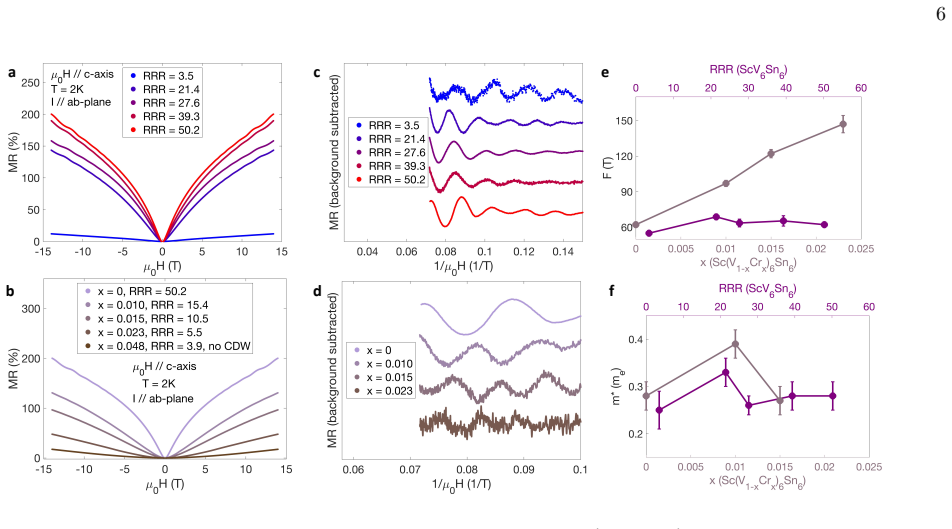
High-quality crystals resolve multiple closely spaced transitions near T_CDW that emerge above RRR approximately 4; the intermediate phase breaks three-fold symmetry. The Hall resistivity across the entire mobility range and in doped samples is quantitatively accounted for by ordinary multi-band transport involving small, high-mobility pockets seen in quantum oscillations, with no need to invoke an intrinsic anomalous Hall effect.
What carries the argument
Mobility-tuned crystals (RRR >50) combined with quantum-oscillation-calibrated multi-band transport model that reproduces the full Hall resistivity data set.
If this is right
- A sequence of closely spaced transitions appears near T_CDW once RRR exceeds approximately 4.
- The intermediate phase breaks three-fold rotational symmetry of the parent structure.
- Hall data remain consistent with multi-band transport even as RRR varies over an order of magnitude and with Cr substitution.
- Systematic mobility tuning distinguishes ordinary multi-band Hall signals from any intrinsic anomalous Hall effect in kagome CDW materials.
Where Pith is reading between the lines
- The same RRR-threshold approach could be used in related kagome compounds to test whether reported anomalous Hall signals survive in the clean limit.
- The symmetry-breaking intermediate phase may correspond to a specific CDW stacking or distortion pattern whose order parameter can now be constrained by the observed transition sequence.
- If the high-mobility pockets dominate transport, similar small Fermi-surface features may control other responses such as thermal conductivity or superconductivity in this family.
Load-bearing premise
A multi-band transport model fitted only to quantum oscillation frequencies and mobilities fully explains the measured Hall resistivity for all RRR values and Cr-doped samples with zero intrinsic anomalous Hall contribution.
What would settle it
A systematic deviation between the measured Hall resistivity and the multi-band model prediction that grows with increasing RRR or appears in additional doping series while quantum oscillation frequencies remain unchanged.
Figures




read the original abstract
The kagome metal ScV$_6$Sn$_6$ has attracted attention as a platform for exploring the interplay between charge density wave (CDW) order and symmetry-breaking phenomena, including a recently reported intermediate phase and a low-field Hall anomaly that has been attributed to an anomalous Hall effect (AHE). The interpretation of both observations has been limited by the modest sample quality achieved by previous growth procedures, which produced crystals with in-plane residual resistivity ratios (RRR) of at most $\approx$9. Here, we report a simple modification of the flux growth procedure that yields ScV$_6$Sn$_6$ single crystals with RRR exceeding 50, more than five times the previous highest reported value, and use this expanded mobility range to revisit both the symmetry and the magnetotransport of the CDW phase. We resolve a sequence of closely spaced transitions in the immediate vicinity of $T_{CDW}$ that emerges above a sharp threshold of RRR $\approx 4$, and demonstrate through elastoresistivity that the intermediate phase breaks the three-fold rotational symmetry of the parent lattice. We examine the Hall response from both the parent samples across the full RRR range as well as Cr-doped samples, and conclude it is quantitatively inconsistent with an intrinsic AHE and is instead explained by ordinary multi-band transport involving small, high-mobility pockets identified through quantum oscillations. These results refine the symmetry-breaking landscape of ScV$_6$Sn$_6$ and establish systematic mobility tuning as a diagnostic for disentangling an intrinsic AHE from multi-band Hall contributions in kagome CDW systems.
Editorial analysis
A structured set of objections, weighed in public.
Referee Report
Summary. The manuscript reports a modified flux growth yielding ScV6Sn6 crystals with RRR>50 (fivefold improvement), resolving a sequence of closely spaced transitions near T_CDW that appear only above RRR≈4, elastoresistivity data establishing that the intermediate phase breaks three-fold rotational symmetry, and a multi-band Drude analysis of Hall resistivity (ρ_xy) across the full RRR range and Cr-doped samples. The central claim is that the observed Hall response is quantitatively accounted for by ordinary multi-band transport from small, high-mobility pockets identified via quantum oscillations, rendering an intrinsic anomalous Hall effect unnecessary.
Significance. If the multi-band model holds, the work refines the CDW symmetry-breaking landscape in ScV6Sn6 and supplies a practical diagnostic (systematic mobility tuning via RRR and doping) for separating multi-band Hall contributions from intrinsic AHE in kagome CDW materials. The high-RRR crystals and elastoresistivity results are clear experimental advances; the transport analysis, if robustly constrained by the QO data, would be a useful methodological contribution.
major comments (1)
- [Hall resistivity analysis] Hall resistivity section (likely §4 or equivalent): the claim of quantitative inconsistency with intrinsic AHE requires that the multi-band Drude model, with carrier densities and mobilities fixed or tightly constrained by the measured QO frequencies, effective masses, and Dingle temperatures, reproduces ρ_xy(B,T) across all RRR values and Cr concentrations with no statistically significant residual that would accommodate a small σ_AHE term. The manuscript should explicitly report the number of free parameters versus data points, the goodness-of-fit metric (e.g., reduced χ²), and a direct test of whether adding a constant AHE conductivity improves the fit beyond the multi-band model alone; without this, the central claim remains vulnerable to the possibility that scattering-rate variations absorb a small AHE contribution.
minor comments (3)
- [Elastoresistivity measurements] Elastoresistivity data: the symmetry-breaking conclusion would be strengthened by showing the raw strain dependence and the extracted coefficients with error bars.
- [Quantum oscillations] Quantum oscillation figures: label the assigned Fermi-surface pockets and their correspondence to the Hall carriers explicitly.
- [Methods] Growth procedure: provide the precise modification to the flux recipe (temperature profile, starting composition) to enable reproduction.
Simulated Author's Rebuttal
We thank the referee for the positive evaluation of the high-RRR crystals, elastoresistivity results, and overall significance, as well as for the constructive critique of the Hall analysis. We address the single major comment below and will incorporate the requested statistical details in a revised manuscript.
read point-by-point responses
-
Referee: [Hall resistivity analysis] Hall resistivity section (likely §4 or equivalent): the claim of quantitative inconsistency with intrinsic AHE requires that the multi-band Drude model, with carrier densities and mobilities fixed or tightly constrained by the measured QO frequencies, effective masses, and Dingle temperatures, reproduces ρ_xy(B,T) across all RRR values and Cr concentrations with no statistically significant residual that would accommodate a small σ_AHE term. The manuscript should explicitly report the number of free parameters versus data points, the goodness-of-fit metric (e.g., reduced χ²), and a direct test of whether adding a constant AHE conductivity improves the fit beyond the multi-band model alone; without this, the central claim remains vulnerable to the possibility that scattering-rate variations absorb a small AHE contribution.
Authors: We agree that explicit reporting of fit statistics is required to make the quantitative claim robust. In the revised manuscript we will add, for each RRR value and Cr concentration: (i) the number of free parameters (carrier densities and mobilities are fixed from the QO frequencies, m*, and Dingle temperatures reported in the supplementary information, with only a global scaling factor per temperature allowed), (ii) the number of data points in the ρ_xy(B) isotherms, and (iii) the reduced χ² of the multi-band Drude fit. We will also perform and report a nested-model comparison in which a single, temperature-independent σ_AHE term is added; the resulting Δχ² and associated p-value (or F-test) will be shown to demonstrate that the improvement is statistically insignificant. These additions will be placed in a new subsection of the Hall analysis and in an expanded supplementary note, directly addressing the concern that scattering-rate variations could mask a small AHE contribution. revision: yes
Circularity Check
No circularity; experimental claims rest on independent QO-calibrated multi-band fits tested against separate Hall data
full rationale
The paper is entirely experimental. Carrier densities and mobilities are extracted from quantum oscillation frequencies, masses and Dingle temperatures; these fixed parameters are then used to compute the expected multi-band Hall resistivity, which is compared to measured ρ_xy(B,T) across RRR and doping series. This is a standard cross-check between two independent transport probes rather than any derivation that reduces to its own inputs by construction. No self-definitional equations, fitted-input-called-prediction steps, or load-bearing self-citations appear in the central claims. The conclusion that the data are inconsistent with intrinsic AHE follows directly from the mismatch between the QO-constrained model and the measured Hall curves.
Axiom & Free-Parameter Ledger
Reference graph
Works this paper leans on
-
[1]
B. R. Ortiz, S. M. L. Teicher, Y. Hu, J. L. Zuo, P. M. Sarte, E. C. Schueller, A. M. M. Abeykoon, M. J. Krogstad, S. Rosenkranz, R. Osborn, R. Seshadri, L. Ba- lents, J. He, and S. D. Wilson, CsV 3Sb5: AZ 2 topolog- ical kagome metal with a superconducting ground state, Phys. Rev. Lett.125, 247002 (2020)
2020
-
[2]
Jiang, J.-X
Y.-X. Jiang, J.-X. Yin, M. M. Denner, N. Shumiya, B. R. Ortiz, G. Xu, Z. Guguchia, J. He, M. S. Hossain, X. Liu, J. Ruff, L. . Kautzsch, M. Z. Hasan, and S. D. Wilson, Unconventional chiral charge order in kagome supercon- ductor KV3Sb5, Nature Materials20, 1353 (2021)
2021
-
[3]
X. Teng, L. Chen, F. Ye, E. Rosenberg, Z. Liu, J.-X. Yin, Y.-X. Jiang, J. S. Oh, M. Z. Hasan, K. J. Neubauer, B. Gao, Y. Xie, M. Hashimoto, D. Lu, C. Jozwiak, A. Bostwick, E. Rotenberg, R. J. Birgeneau, J.-H. Chu, M. Yi, and P. Dai, Discovery of charge density wave in a kagome lattice antiferromagnet, Nature609, 490 (2022)
2022
-
[4]
H. W. S. Arachchige, W. R. Meier, M. Marshall, T. Mat- suoka, R. Xue, M. A. McGuire, R. P. Hermann, H. Cao, and D. Mandrus, Charge Density Wave in Kagome Lat- tice Intermetallic ScV6Sn6, Physical Review Letters129, 216402 (2022)
2022
-
[5]
S. D. Wilson and B. R. Ortiz,AV 3Sb5 kagome supercon- ductors, Nature Reviews Materials9, 420 (2024)
2024
-
[6]
H. Zhao, H. Li, B. R. Ortiz, S. M. L. Teicher, T. Park, M. Ye, Z. Wang, S. D. Wilson, and I. Zeljkovic, Cascade of correlated electron states in the kagome superconduc- tor CsV3Sb5, Nature599, 216 (2021)
2021
-
[7]
Mielke, D
C. Mielke, D. Das, J.-X. Yin, H. Liu, R. Gupta, Y.- X. Jiang, M. Medarde, X. Wu, H. Lei, J. Chang, P. Dai, Q. Si, H. Miao, R. Thomale, T. Neupert, Y. Shi, R. Khasanov, M. Z. Hasan, H. Luetkens, and Z. Guguchia, Time-reversal symmetry-breaking charge order in a kagome superconductor, Nature602, 245 (2022)
2022
-
[8]
Xiang, Q
Y. Xiang, Q. Li, Y. Li, W. p. Xie, H. Yang, Z. Wang, Y. Yao, and H.-H. Wen, Twofold symmetry of c-axis re- sistivity in topological kagome superconductor CsV 3Sb5 with in-plane rotating magnetic field, Nature Communi- cations12, 6727 (2021)
2021
-
[9]
C. Guo, C. Putzke, S. Konyzheva, X. Huang, M. Gutteck, B. Gao, P. Dai, E. Gati, M. S. Mohamed, N. Zuniga- Cespedes, C. Sickinger, S. Johnston, E. Piatti, R. Pas- ritiya, V. Sassi, S.-H. Shin, Q. Zhang, A. Akhmetov, P. Shahi, C. Geibel, R. Moessner, C. W. Hicks, A. P. Mackenzie, and P. J. W. Moll, Switchable chiral trans- port in charge-ordered kagome meta...
2022
-
[10]
Y. Xu, Z. Ni, Y. Liu, B. R. Ortiz, Q. Deng, S. D. Wil- son, B. Yan, L. Balents, and L. Wu, Three-state nematic- ity and magneto-optical kerr effect in the charge density waves in kagome superconductors, Nature Physics18, 1470 (2022)
2022
-
[11]
D. R. Saykin, C. Farhang, E. D. Kountz, D. Chen, B. R. Ortiz, C. Shekhar, C. Felser, S. D. Wilson, R. Thomale, J. Xia, and A. Kapitulnik, High resolution polar kerr ef- fect studies of CsV3Sb5: Tests for time-reversal symmetry breaking below the charge-order transition, Phys. Rev. Lett.131, 016901 (2023)
2023
-
[12]
Farhang, J
C. Farhang, J. Wang, B. R. Ortiz, S. D. Wilson, and J. Xia, Unconventional specular optical rotation in the charge ordered state of kagome metal CsV 3Sb5, Nature Communications14, 5326 (2023)
2023
-
[13]
D. R. Saykin, Q. Jiang, Z. Liu, C. Shekhar, C. Felser, J.- H. Chu, and A. Kapitulnik, High-resolution polar Kerr effect studies of CsV 3Sb5 and ScV 6Sn6 below the charge order transition, Physical Review B113, L241104 (2026)
2026
-
[14]
Z. Liu, Y. Shi, Q. Jiang, E. W. Rosenberg, J. M. DeSte- fano, J. Liu, C. Hu, Y. Zhao, Z. Wang, Y. Yao, D. Graf, P. Dai, J. Yang, X. Xu, and J.-H. Chu, Absence ofE 2g nematic instability and dominantA 1g response in the kagome metal CsV3Sb5, Phys. Rev. X14, 031015 (2024)
2024
-
[15]
Frachet, L
M. Frachet, L. Wang, W. Xia, Y. Guo, M. He, N. Maraytta, R. Heid, A.-A. Haghighirad, M. Merz, C. Meingast, and F. Hardy, Colossalc-axis response and lack of rotational symmetry breaking within the kagome planes of the CsV 3Sb5 superconductor, Phys. Rev. Lett. 132, 186001 (2024)
2024
-
[16]
F. H. Yu, T. Wu, Z. Y. Wang, B. Lei, W. Z. Zhuo, J. J. Ying, and X. H. Chen, Concurrence of anomalous hall ef- fect and charge density wave in a superconducting topo- logical kagome metal, Phys. Rev. B104, L041103 (2021)
2021
-
[17]
S.-Y. Yang, Y. Wang, B. R. Ortiz, D. Liu, J. Gayles, E. Derunova, R. Gonzalez-Hernandez, L. ˇSmejkal, Y. Chen, S. S. P. Parkin, S. D. Wil- son, E. S. Toberer, T. McQueen, and M. N. Ali, Giant, unconventional anomalous hall ef- fect in the metallic frustrated magnet candidate, KV3Sb5, Science Advances6, eabb6003 (2020), https://www.science.org/doi/pdf/10.1...
-
[18]
S. Liu, M. Roppongi, M. Kimata, K. Ishihara, R. Gras- set, M. Konczykowski, B. R. Ortiz, S. D. Wilson, K. Yoshimi, T. Shibauchi, and K. Hashimoto, Impact of Tiny Fermi Pockets with Extremely High Mobility on the Hall Anomaly in the Kagome Metal CsV 3Sb5, Physical Review Letters135, 056502 (2025)
2025
-
[19]
Zhang, J
X. Zhang, J. Hou, W. Xia, Z. Xu, P. Yang, A. Wang, Z. Liu, J. Shen, H. Zhang, X. Dong, Y. Uwatoko, J. Sun, B. Wang, Y. Guo, and J. Cheng, Destabilization of the Charge Density Wave and the Absence of Superconduc- tivity in ScV 6Sn6 under High Pressures up to 11 GPa, Materials15, 7372 (2022)
2022
-
[20]
W. R. Meier, R. P. Madhogaria, S. Mozaffari, M. Mar- shall, D. E. Graf, M. A. McGuire, H. W. S. Arachchige, C. L. Allen, J. Driver, H. Cao, and D. Mandrus, Tiny Sc Allows the Chains to Rattle: Impact of Lu and Y Doping on the Charge-Density Wave in ScV 6Sn6, Journal of the American Chemical Society145, 20943 (2023)
2023
-
[21]
Korshunov, H
A. Korshunov, H. Hu, D. Subires, Y. Jiang, D. C˘ alug˘ aru, X. Feng, A. Rajapitamahuni, C. Yi, S. Roychowdhury, M. G. Vergniory, J. Strempfer, C. Shekhar, E. Vescovo, D. Chernyshov, A. H. Said, A. Bosak, C. Felser, B. A. Bernevig, and S. Blanco-Canosa, Softening of a flat phonon mode in the kagome ScV6Sn6, Nature Communi- cations14, 6646 (2023)
2023
-
[22]
Tan and B
H. Tan and B. Yan, Abundant Lattice Instability in Kagome Metal ScV 6Sn6, Physical Review Letters130, 266402 (2023)
2023
-
[23]
S. Cao, C. Xu, H. Fukui, T. Manjo, Y. Dong, M. Shi, Y. Liu, C. Cao, and Y. Song, Competing charge-density wave instabilities in the kagome metal ScV 6Sn6, Nature Communications14, 7671 (2023). 13
2023
-
[24]
M. Kang, S. Fang, J.-K. Kim, B. R. Ortiz, S. H. Ryu, J. Kim, J. Yoo, G. Sangiovanni, D. Di Sante, B.-G. Park, C. Jozwiak, A. Bostwick, E. Rotenberg, E. Kaxiras, S. D. Wilson, J.-H. Park, and R. Comin, Twofold van Hove sin- gularity and origin of charge order in topological kagome superconductor CsV3Sb5, Nature Physics18, 301 (2022)
2022
-
[25]
Y. Hu, J. Ma, Y. Li, Y. Jiang, D. J. Gawryluk, T. Hu, J. Teyssier, V. Multian, Z. Yin, S. Xu, S. Shin, I. Plokhikh, X. Han, N. C. Plumb, Y. Liu, J.-X. Yin, Z. Guguchia, Y. Zhao, A. P. Schnyder, X. Wu, E. Pom- jakushina, M. Z. Hasan, N. Wang, and M. Shi, Phonon promoted charge density wave in topological kagome metal ScV6Sn6, Nature Communications15, 1658 (2024)
2024
-
[26]
Guguchia, D
Z. Guguchia, D. J. Gawryluk, S. Shin, Z. Hao, C. Mielke III, D. Das, I. Plokhikh, L. Liborio, J. K. Shen- ton, Y. Hu, V. Sazgari, M. Medarde, H. Deng, Y. Cai, C. Chen, Y. Jiang, A. Amato, M. Shi, M. Z. Hasan, J.-X. Yin, R. Khasanov, E. Pomjakushina, and H. Luetkens, Hidden magnetism uncovered in a charge ordered bilayer kagome material ScV 6Sn6, Nature Co...
2023
-
[27]
C. Yi, X. Feng, N. Mao, P. Yanda, S. Roychowdhury, Y. Zhang, C. Felser, and C. Shekhar, Quantum os- cillations revealing topological band in kagome metal ScV6Sn6, Physical Review B109, 035124 (2024)
2024
-
[28]
Farhang, W
C. Farhang, W. R. Meier, W. Lu, J. Li, Y. Wu, S. Mozaf- fari, R. P. Madhogaria, Y. Zhang, D. Mandrus, and J. Xia, Discovery of an intermediate nematic state in a bilayer kagome metal ScV 6Sn6, Nature Communications 16, 7867 (2025)
2025
-
[29]
Mozaffari, W
S. Mozaffari, W. R. Meier, R. P. Madhogaria, N. Peshcherenko, S.-H. Kang, J. W. Villanova, H. W. S. Arachchige, G. Zheng, Y. Zhu, K.-W. Chen, K. Jenk- ins, D. Zhang, A. Chan, L. Li, M. Yoon, Y. Zhang, and D. G. Mandrus, Universal sublinear resistivity in vana- dium kagome materials hosting charge density waves, Physical Review B110, 035135 (2024)
2024
-
[30]
J. M. DeStefano, E. Rosenberg, O. Peek, Y. Lee, Z. Liu, Q. Jiang, L. Ke, and J.-H. Chu, Pseudogap behavior in charge density wave kagome material ScV 6Sn6 revealed by magnetotransport measurements, npj Quantum Ma- terials8, 1 (2023)
2023
-
[31]
M. S. Ikeda, J. A. W. Straquadine, A. T. Hristov, T. Worasaran, J. C. Palmstrom, M. Sorensen, P. Walm- sley, and I. R. Fisher, AC elastocaloric effect as a probe for thermodynamic signatures of continuous phase transi- tions, Review of Scientific Instruments90, 083902 (2019)
2019
-
[32]
S. Lee, C. Won, J. Kim, J. Yoo, S. Park, J. Den- linger, C. Jozwiak, A. Bostwick, E. Rotenberg, R. Comin, M. Kang, and J.-H. Park, Nature of charge density wave in kagome metal ScV 6Sn6, npj Quantum Materials9, 1 (2024)
2024
-
[33]
C. Yi, X. Feng, N. Kumar, C. Felser, and C. Shekhar, Tuning charge density wave of kagome metal ScV 6Sn6, New Journal of Physics26, 052001 (2024)
2024
-
[34]
M. C. Shapiro, A. T. Hristov, J. C. Palmstrom, J.-H. Chu, and I. R. Fisher, Measurement of theB 1g andB 2g components of the elastoresistivity tensor for tetragonal materials via transverse resistivity configurations, Re- view of Scientific Instruments87, 063902 (2016)
2016
-
[35]
Jiang, S
Y.-X. Jiang, S. Shao, W. Xia, M. M. Denner, J. Ingham, M. S. Hossain, Q. Qiu, X. Zheng, H. Chen, Z.-J. Cheng, X. P. Yang, B. Kim, J.-X. Yin, S. Zhang, M. Litskevich, Q. Zhang, T. A. Cochran, Y. Peng, G. Chang, Y. Guo, R. Thomale, T. Neupert, and M. Z. Hasan, Van Hove annihilation and nematic instability on a kagome lattice, Nature Materials23, 1214 (2024)
2024
-
[36]
Zheng, Y
G. Zheng, Y. Zhu, S. Mozaffari, N. Mao, K.-W. Chen, K. Jenkins, D. Zhang, A. Chan, H. W. S. Arachchige, R. P. Madhogaria, M. Cothrine, W. R. Meier, Y. Zhang, D. Mandrus, and L. Li, Quantum oscillations evidence for topological bands in kagome metal ScV 6Sn6, Journal of Physics: Condensed Matter36, 215501 (2024)
2024
-
[37]
S. M. Watts, S. Wirth, S. Von Moln´ ar, A. Barry, and J. M. D. Coey, Evidence for two-band magnetotransport in half-metallic chromium dioxide, Physical Review B61, 9621 (2000)
2000
-
[38]
Symmetry-Selective Stabilization of Charge-Density Wave in ScV$_6$Sn$_6$
A. Korshunov, C.-Y. Lim, J. Corral-Sertal, G. Garbarino, D. Chernyshov, A. Rajapitamahuni, C. Yi, S. Roy- chowdhury, C. Shekhar, C. Felser, V. Pardo, E. M. Schmidt, and S. Blanco-Canosa, Symmetry-Selective Sta- bilization of Charge-Density Wave in ScV 6Sn6 (2026), arXiv:2606.05866 [cond-mat.str-el]
work page internal anchor Pith review Pith/arXiv arXiv 2026
-
[39]
Kuo, J.-H
H.-H. Kuo, J.-H. Chu, J. C. Palmstrom, S. A. Kivel- son, and I. R. Fisher, Ubiquitous signatures of nematic quantum criticality in optimally doped Fe-based super- conductors, Science352, 958 (2016)
2016
discussion (0)
Sign in with ORCID, Apple, or X to comment. Anyone can read and Pith papers without signing in.