REVIEW 4 major objections 8 minor 1 cited by
Perceptual-GS: Scene-adaptive Perceptual Densification for Gaussian Splatting
T0 review · 4 major / 8 minor · reviewed 2026-08-07 · deepseek-v4-flash
Pith's one-line read Perceptual-GS claims that steering Gaussian densification with a learned perceptual-sensitivity branch yields better LPIPS and SSIM using fewer primitives than vanilla 3DGS.
desk verdict A well-engineered 3DGS densification method whose edge-guidance mechanism works, but whose 'perceptual' framing is not yet supported by the experiments. read the letter →
The pith
A machine-rendered reading of the paper's core claim, the machinery that carries it, and where it could break.
The reading
What carries the argument
The carrying mechanism is the dual-branch rendering of a learned per-Gaussian sensitivity parameter. Instead of accumulating pixel statistics over a Gaussian's footprint, the sensitivity branch renders $\sigma(\epsilon_i)$ through the same $\alpha$-blending weights used for color, so each Gaussian is forced to commit to one sensitivity value per viewpoint and the rendered map is compared to a binarized Sobel gradient map with BCE loss. That per-Gaussian $\epsilon_i$ then drives the densification rules: $\epsilon_i > \tau_h$ marks visually critical high-sensitivity Gaussians for splitting, $\tau_l \leq \epsilon_i \leq \tau_h$ marks viewpoint-conflicted medium-sensitivity Gaussians, and a maximum-over-views weight threshold $\omega^{\max}_i$ prevents over-densification. A scene-level sensitivity statistic $\beta$ decides whether clone or split is used, and a scene-adaptive depth reinitialization fires when the fraction of large medium-sensitivity Gaussians $\gamma$ exceeds a threshold; an opacity-decline transform on clones makes redundant primitives easier to prune.
What would settle it
On a held-out scene, compute the paper's binary sensitivity map from ground-truth training views and compare it with human fixation or eye-tracking data on the same views: if the map's high-sensitivity pixels do not agree with fixation densities, or if densifying according to fixation data instead improves LPIPS further, the perceptual proxy is not doing the claimed work. A cheaper test is to render a smooth, low-gradient wall with a faint shadow: the Sobel map marks it low-sensitivity, so Perceptual-GS should leave it sparse; if viewers reliably detect the shadow artifact, the premise that low gradient equals low perceptual need fails.
Extended reading notes
Core claim
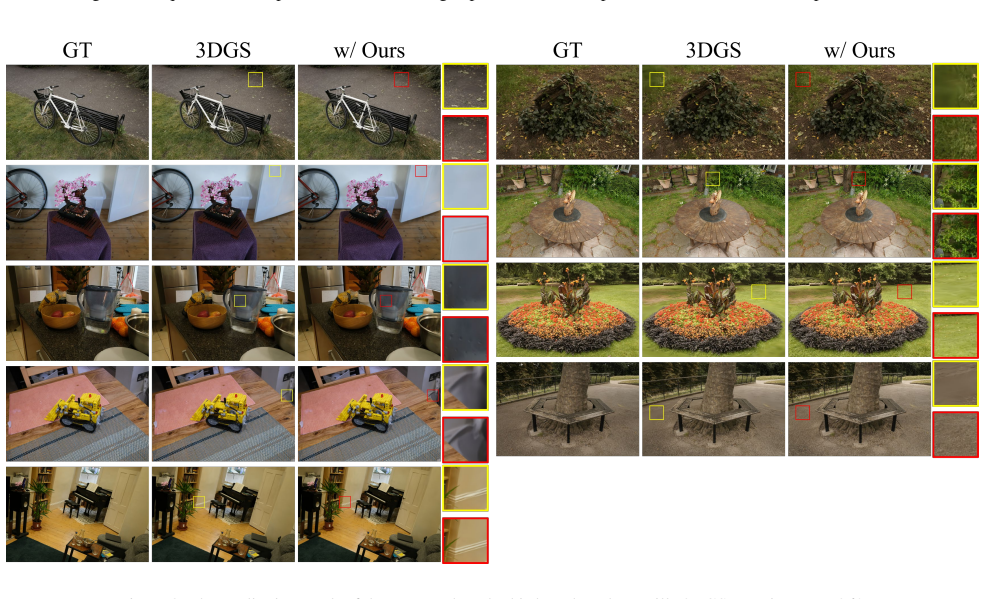
The central discovery claimed is that perceptual sensitivity can be made a first-class training signal in 3DGS without new renderers: each Gaussian carries a scalar sensitivity $\epsilon_i$ that is optimized alongside color and geometry, rendered like an image via the same tile rasterizer, and supervised with binary cross-entropy against a precomputed binary sensitivity map. After warm-up, Gaussians whose learned sensitivity is high are split to add detail, those with intermediate sensitivity are split because a single primitive cannot reconcile conflicting viewpoints, and low-sensitivity regions are left with fewer primitives. The result reported is that on Mip-NeRF 360, Tanks & Temples, Deep Blending, and BungeeNeRF, Perceptual-GS achieves better average SSIM and LPIPS than vanilla 3DGS and the compared densification methods while using substantially fewer Gaussian primitives, and that it can wrap around existing splatting-based methods to improve their metrics.
Load-bearing premise
The load-bearing premise is that a thresholded and smoothed Sobel gradient map of the ground-truth image faithfully says where human viewers need more detail, and that the learned per-Gaussian sensitivities have converged to meaningful 0/1 values by the time densification starts.
Editorial extensions
If this is right
- If the perceptual proxy is right, Gaussian counts can drop by tens of percent with no perceptual loss, which directly cuts memory and streaming costs for radiance-field scenes.
- Densification becomes scene-adaptive: texture-rich regions get more primitives, flat or defocused regions stay sparse, benefiting large-scale outdoor scenes where fixed-gradient densification blows up primitive counts.
- Because the sensitivity branch is a wrapper on the training loss and density control, it can be combined with existing splatting methods to improve their LPIPS while reducing their Gaussian counts.
- The opacity-decline clone rule should make trained models easier to prune and compress, since redundant cloned Gaussians are actively pushed toward low opacity.
Reading between the lines
- Extension: if the Sobel-plus-threshold proxy is a crude stand-in, the method is likely to under-allocate Gaussians to smooth, low-gradient regions that still carry semantic meaning (faces, skies, signage); a perceptual metric weighted by human fixations might reallocate primitives differently.
- Extension: the learned $\epsilon_i$ distribution after warm-up is itself a free saliency prior for the scene; it could be reused for foveated rendering, level-of-detail selection, or compression priority without retraining.
- Extension: a testable improvement is to replace the hand-tuned thresholds $\tau_h$, $\tau_l$, $\tau_\omega$, and $\tau_\beta$ with per-scene calibration or a learned policy, since the paper's ablations show several thresholds trade LPIPS against Gaussian count and the operating point is tunable per application.
Editorial analysis
A structured set of objections, weighed in public.
Referee Report
Summary. The paper proposes Perceptual-GS, a training-time densification strategy for 3D Gaussian Splatting. A per-Gaussian learnable parameter epsilon_i is introduced; it is supervised through a second 'sensitivity' rendering branch whose target is a binarized and smoothed Sobel gradient map of the ground-truth images. The learned sensitivities are then used to select Gaussians for high- and medium-sensitivity densification, supplemented by scene-adaptive depth reinitialization and an opacity-decline mechanism for clone operations. Experiments are reported on Mip-NeRF 360, Tanks & Temples, Deep Blending, and BungeeNeRF, with per-scene tables and integration results with 3DGS, Pixel-GS, and CoR-GS.
Significance. If the reported gains hold, Perceptual-GS offers a simple, training-only modification of 3DGS that improves SSIM and LPIPS while reducing the number of Gaussians, with public code and unusually detailed per-scene tables. The integration experiments with Pixel-GS and CoR-GS are a useful practical contribution. However, the central 'perceptual' attribution is not yet isolated from generic edge-density-guided densification, and the evaluation protocol has several load-bearing gaps: hyperparameters are tuned on the same benchmark used for the headline results, and the BungeeNeRF averages compare different scene subsets. These issues need to be addressed before the state-of-the-art claim is supported.
major comments (4)
- [Section 3.3, Eqs. (5)-(7), Table 4] The 'perceptual' component of the method is under-identified. The perceptual sensitivity map is a binarized and smoothed Sobel gradient magnitude; the only ablation ('w/o PE') replaces the binarization/smoothing with raw Sobel magnitudes. Because LPIPS and SSIM are themselves most sensitive at high-gradient pixels, a non-perceptual binary edge mask with matched density would likely produce similar quality-efficiency gains. To support the central claim, add an ablation that uses a generic binary edge map (e.g., Canny edges or a fixed-percentile gradient threshold) with the same downstream densification rules, and report whether the LPIPS/SSIM improvements persist. If they do, the 'perceptual' wording should be softened; if they do not, that should be stated explicitly.
- [Section 4.1, Appendix D, Tables 1 and 11] All newly introduced hyperparameters (tau_e, tau_s, lambda_S, Iter_h, Iter_m, tau_h, tau_l, tau_omega_h, tau_omega_m, tau_beta, tau_gamma, and k) are tuned on Mip-NeRF 360, and the final results in Tables 2-4 are reported on the same benchmark. This test-set selection makes the reported margins difficult to interpret. Please either reserve a validation split (e.g., a subset of scenes or a separate dataset) for parameter selection and report test results on the remainder, or demonstrate that the conclusions are insensitive to the parameter choices across all datasets.
- [Tables 2 and 3, BungeeNeRF rows] The BungeeNeRF averages for Pixel-GS* and Taming-3DGS are computed over only 7 and 6 of the 8 scenes, respectively, because of CUDA out-of-memory, while 'Ours' is averaged over all 8 scenes. Presenting these numbers in the same averaged row is misleading. Please report averages over the common subset of scenes that all methods can run, or clearly mark the number of scenes contributing to each average; the per-scene tables already provided would allow this.
- [Section 3.4, Eqs. (8)-(10), Figure 13] The densification rules in Eqs. (11)-(12) assume that after the 500-iteration warm-up, the per-Gaussian sensitivity epsilon_i has converged to values close to 0 or 1, so that thresholds tau_h and tau_l are meaningful. The paper shows rendered sensitivity maps but provides no quantitative convergence analysis, such as histograms of epsilon_i over training, final binarization accuracy against the ground-truth sensitivity map, or sensitivity of the downstream densification to the warm-up length. This is especially important for the large-scale BungeeNeRF scenes where the claimed robustness gains are largest.
minor comments (8)
- [Abstract and Section 4.2] The abstract's 'state-of-the-art performance' claim is stronger than the tables support: on Tanks & Temples and Deep Blending, Taming-3DGS reports higher PSNR (24.04 vs 23.90; 30.14 vs 29.94). Please qualify the claim as state-of-the-art on perceptual metrics and efficiency, or rephrase to 'competitive'.
- [Section 3.1 and Section 3.3] The symbol G is used both for the set of Gaussian primitives in Eq. (1) and for the Sobel response map in Eq. (6), which is confusing; please use distinct notation, e.g., M for the response map.
- [Section 3.3] The 'average pooling with threshold tau_s' step is underspecified: the kernel size, stride, and exact binarization rule after pooling are not given. Please specify these details in the appendix.
- [Section 3.1 and Section 3.4] There are typos: 'Gussian primitive' in Section 3.1 and 'Gassians' in Section 3.4 should be 'Gaussian primitive' and 'Gaussians'.
- [Eq. (13) and Table 10] Eq. (13) uses tau_omega without a subscript, while the text and Table 10 use tau_omega_h and tau_omega_m; please define both forms in the equation.
- [Table 6] The caption says 'We present metrics averaged on the dataset and from three single scenes,' but the columns are BungeeNeRF, Pompidou, Chicago, and Amsterdam; please clarify that the first column is the 8-scene average and the other columns are individual scenes.
- [Figure 4] The label 'Ours Taming-3DGS' appears to be a formatting mistake; it should list 'Ours' and 'Taming-3DGS' as separate labels.
- [Eq. (21)] The QEB metric's units and scaling are unclear: please state explicitly that #G is in millions and justify the factor of 100 in the definition.
Circularity Check
No significant circularity: Perceptual-GS is an externally supervised empirical method whose reported metrics are held-out measurements, not fitted outputs.
full rationale
The claimed derivation chain is constructive rather than circular. Perceptual sensitivity maps are extracted from ground-truth training images by Sobel convolution (Eqs. 5-7); per-Gaussian sensitivity parameters epsilon_i are trained with a BCE loss (Eqs. 8-10) to reproduce those maps; and densification decisions are thresholded functions of the fitted epsilon (Eqs. 11-14). None of the reported headline quantities (PSNR, SSIM, LPIPS, #G, FPS) is a fitted constant: quality metrics are computed on held-out viewpoints, and #G and FPS are training and rendering outcomes rather than values forced by the construction of the loss. The perception proxy may be under-identified experimentally (the ablations compare binarized vs raw Sobel maps but do not test a matched-density non-perceptual binary edge mask), and the self-citations (Ni et al. 2016; Shen et al. 2020; Ren et al. 2025) are motivational rather than load-bearing; neither issue makes the central claim reduce to its own inputs. The paper is self-contained against external benchmarks and baselines, so the circularity score is 0.
Assumptions & free parameters
free parameters (13)
- Enhancement threshold tau_e =
0.05
- Smoothing threshold tau_s =
0.3
- Sensitivity loss weight lambda_S =
0.1
- High-sensitivity densification interval Iter_h =
1000
- Medium-sensitivity densification interval Iter_m =
1500
- High-sensitivity threshold tau_h =
0.9
- Low-sensitivity threshold tau_l =
0.3
- Weight threshold for high-sensitivity tau_omega_h =
25
- Weight threshold for medium-sensitivity tau_omega_m =
10
- Scene sensitivity threshold tau_beta =
0.85
- Sparse-point-cloud threshold tau_gamma =
0.55
- Opacity decline exponent k =
1.2
- Per-Gaussian sensitivity epsilon_i =
learned, sigmoid-constrained to [0,1]
assumptions (5)
- domain assumption Binarized Sobel gradient magnitude maps are a valid proxy for human perceptual sensitivity.
- domain assumption Densifying more Gaussians in high-sensitivity regions improves perceptual quality more than densifying elsewhere.
- domain assumption After 500 warm-up iterations the per-Gaussian sensitivity epsilon_i is well learned and can be thresholded to guide densification.
- domain assumption The scene-level thresholds tau_beta and tau_gamma generalize across datasets.
- standard math Alpha-compositing formula A = alpha_hat + (1 - alpha_hat) * alpha_hat.
invented entities (1)
-
Per-Gaussian perceptual sensitivity parameter epsilon_i
Cite this review
Pith. "Pith review of Perceptual-GS: Scene-adaptive Perceptual Densification for Gaussian Splatting." pith.science (2026). https://pith.science/paper/ZWDUAKBA
@misc{pith2026250612400,
  author       = {Pith},
  title        = {Pith review of: Perceptual-GS: Scene-adaptive Perceptual Densification for Gaussian Splatting},
  year         = {2026},
  howpublished = {\url{https://pith.science/paper/ZWDUAKBA}},
  note         = {Machine review of arXiv:2506.12400}
}
read the original abstract
3D Gaussian Splatting (3DGS) has emerged as a powerful technique for novel view synthesis. However, existing methods struggle to adaptively optimize the distribution of Gaussian primitives based on scene characteristics, making it challenging to balance reconstruction quality and efficiency. Inspired by human perception, we propose scene-adaptive perceptual densification for Gaussian Splatting (Perceptual-GS), a novel framework that integrates perceptual sensitivity into the 3DGS training process to address this challenge. We first introduce a perception-aware representation that models human visual sensitivity while constraining the number of Gaussian primitives. Building on this foundation, we develop a perceptual sensitivity-adaptive distribution to allocate finer Gaussian granularity to visually critical regions, enhancing reconstruction quality and robustness. Extensive evaluations on multiple datasets, including BungeeNeRF for large-scale scenes, demonstrate that Perceptual-GS achieves state-of-the-art performance in reconstruction quality, efficiency, and robustness. The code is publicly available at: https://github.com/eezkni/Perceptual-GS
Figures


Figures from the paper (12 more)




Forward citations
Cited by 1 Pith paper
-
You Only Gaussian Once: Controllable 3D Gaussian Splatting for Ultra-Densely Sampled Scenes
YOGO reformulates stochastic 3D Gaussian Splatting into a deterministic budget-aware system and supplies an ultra-dense dataset to enforce physical fidelity over viewpoint interpolation.
Reference graph
Works this paper leans on
-
[1]
write newline
" write newline "" before.all 'output.state := FUNCTION n.dashify 't := "" t empty not t #1 #1 substring "-" = t #1 #2 substring "--" = not "--" * t #2 global.max substring 't := t #1 #1 substring "-" = "-" * t #2 global.max substring 't := while if t #1 #1 substring * t #2 global.max substring 't := if while FUNCTION format.date year duplicate empty "emp...
-
[2]
T., Mildenhall, B., Verbin, D., Srinivasan, P
Barron, J. T., Mildenhall, B., Verbin, D., Srinivasan, P. P., and Hedman, P. Mip-NeRF 360: Unbounded Anti-Aliased Neural Radiance Fields . In Proceedings of the IEEE/CVF Conference on Computer Vision and Pattern Recognition, pp.\ 5470--5479, 2022
work page 2022
-
[3]
Campbell, F. W. and Robson, J. G. Application of Fourier Analysis to The Visibility of Gratings . The Journal of Physiology, 197 0 (3): 0 551, 1968
work page 1968
-
[4]
HAC: Hash-Grid Assisted Context for 3D Gaussian Splatting Compression
Chen, Y., Wu, Q., Lin, W., Harandi, M., and Cai, J. HAC: Hash-Grid Assisted Context for 3D Gaussian Splatting Compression . In Proceedings of the European Conference on Computer Vision, pp.\ 422--438, 2025
work page 2025
-
[5]
Efficient Density Control for 3D Gaussian Splatting
Deng, X., Diao, C., Li, M., Yu, R., and Xu, D. Efficient Density Control for 3D Gaussian Splatting . arXiv preprint arXiv:2411.10133, 2024
arXiv 2024
-
[6]
MVGS: Multi-view-regulated Gaussian Splatting for Novel View Synthesis
Du, X., Wang, Y., and Yu, X. MVGS: Multi-view-regulated Gaussian Splatting for Novel View Synthesis . arXiv preprint arXiv:2410.02103, 2024
arXiv 2024
-
[7]
Fang, G. and Wang, B. Mini-Splatting: Representing Scenes with a Constrained Number of Gaussians . In Proceedings of the European Conference on Computer Vision, pp.\ 165--181, 2024
work page 2024
-
[8]
VR-Splatting: Foveated Radiance Field Rendering via 3D Gaussian Splatting and Neural Points
Franke, L., Fink, L., and Stamminger, M. VR-Splatting: Foveated Radiance Field Rendering via 3D Gaussian Splatting and Neural Points . In Proceedings of the ACM on Computer Graphics and Interactive Techniques, pp.\ 1--21, 2025
work page 2025
Show all 47 references
-
[9]
Saliency-guided Quality Assessment of Screen Content Images
Gu, K., Wang, S., Yang, H., Lin, W., Zhai, G., Yang, X., and Zhang, W. Saliency-guided Quality Assessment of Screen Content Images . IEEE Transactions on Multimedia, 18 0 (6): 0 1098--1110, 2016
2016
-
[10]
Deep Blending for Free-viewpoint Image-based Rendering
Hedman, P., Philip, J., Price, T., Frahm, J.-M., Drettakis, G., and Brostow, G. Deep Blending for Free-viewpoint Image-based Rendering . ACM Transactions on Graphics, 37 0 (6): 0 1--15, 2018
2018
-
[11]
GeoTexDensifier: Geometry-Texture-Aware Densification for High-Quality Photorealistic 3D Gaussian Splatting
Jiang, H., Xiang, X., Sun, H., Li, H., Zhou, L., Zhang, X., and Zhang, G. GeoTexDensifier: Geometry-Texture-Aware Densification for High-Quality Photorealistic 3D Gaussian Splatting . arXiv preprint arXiv:2412.16809, 2024
2024
-
[12]
3D Gaussian Splatting for Real-Time Radiance Field Rendering
Kerbl, B., Kopanas, G., Leimk \"u hler, T., and Drettakis, G. 3D Gaussian Splatting for Real-Time Radiance Field Rendering . ACM Transactions on Graphics , 0 (4): 0 1--14, 2023
2023
-
[13]
Kheradmand, S., Rebain, D., Sharma, G., Sun, W., Tseng, Y.-C., Isack, H., Kar, A., Tagliasacchi, A., and Yi, K. M. 3D Gaussian Splatting as Markov Chain Monte Carlo . In Proceedings of the Annual Conference on Neural Information Processing Systems, pp.\ 80965--80986, 2024
2024
-
[14]
Color-cued Efficient Densification Method for 3D Gaussian Splatting
Kim, S., Lee, K., and Lee, Y. Color-cued Efficient Densification Method for 3D Gaussian Splatting . In Proceedings of the IEEE/CVF Conference on Computer Vision and Pattern Recognition Workshops, pp.\ 775--783, 2024
2024
-
[15]
Tanks and Temples: Benchmarking Large-scale Scene Reconstruction
Knapitsch, A., Park, J., Zhou, Q.-Y., and Koltun, V. Tanks and Temples: Benchmarking Large-scale Scene Reconstruction . ACM Transactions on Graphics, 36 0 (4): 0 1--13, 2017
2017
-
[16]
Deblurring 3D Gaussian Splatting
Lee, B., Lee, H., Sun, X., Ali, U., and Park, E. Deblurring 3D Gaussian Splatting . In Proceedings of the European Conference on Computer Vision, pp.\ 127--143, 2025
2025
-
[17]
F., Yue, Y., Lim, E
Li, Z., Yao, S., Chu, Y., Garcia-Fernandez, A. F., Yue, Y., Lim, E. G., and Zhu, X. MVG-Splatting: Multi-View Guided Gaussian Splatting with Adaptive Quantile-Based Geometric Consistency Densification . arXiv preprint arXiv:2407.11840, 2024
2024 arXiv
-
[18]
MetaSapiens: Real-Time Neural Rendering with Efficiency-Aware Pruning and Accelerated Foveated Rendering
Lin, W., Feng, Y., and Zhu, Y. MetaSapiens: Real-Time Neural Rendering with Efficiency-Aware Pruning and Accelerated Foveated Rendering . In Proceedings of the 30th ACM International Conference on Architectural Support for Programming Languages and Operating Systems, pp.\ 669-...
2025
-
[19]
HQGS: High-quality Novel View Synthesis with Gaussian Splatting in Degraded Scenes
Lin, X., Luo, S., Shan, X., Zhou, X., Ren, C., Qi, L., Yang, M.-H., and Vasconcelos, N. HQGS: High-quality Novel View Synthesis with Gaussian Splatting in Degraded Scenes . In Proceedings of the International Conference on Learning Representations, pp.\ 1--17, 2025 b
2025
-
[20]
LGS: A Light-Weight 4D Gaussian Splatting for Efficient Surgical Scene Reconstruction
Liu, H., Liu, Y., Li, C., Li, W., and Yuan, Y. LGS: A Light-Weight 4D Gaussian Splatting for Efficient Surgical Scene Reconstruction . In Proceedings of the International Conference on Medical Image Computing and Computer Assisted Intervention, pp.\ 660--670, 2024
2024
-
[21]
Efficientgs: Streamlining Gaussian Splatting for Large-scale High-resolution Scene Representation
Liu, W., Guan, T., Zhu, B., Xu, L., Song, Z., Li, D., Wang, Y., and Yang, W. Efficientgs: Streamlining Gaussian Splatting for Large-scale High-resolution Scene Representation . IEEE MultiMedia, 32 0 (1): 0 61--71, 2025
2025
-
[22]
Scaffold-GS: Structured 3D Gaussians for View-Adaptive Rendering
Lu, T., Yu, M., Xu, L., Xiangli, Y., Wang, L., Lin, D., and Dai, B. Scaffold-GS: Structured 3D Gaussians for View-Adaptive Rendering . In Proceedings of the IEEE/CVF Conference on Computer Vision and Pattern Recognition, pp.\ 20654--20664, 2024
2024
-
[23]
A Human Vision System Model for Objective Picture Quality Measurements
Lubin, J. A Human Vision System Model for Objective Picture Quality Measurements . In Proceedings of the International Broadcasting Conference, pp.\ 498--503, 1997
1997
-
[24]
ResGS: Residual Densification of 3D Gaussian for Efficient Detail Recovery
Lyu, Y., Cheng, K., Kang, X., and Chen, X. ResGS: Residual Densification of 3D Gaussian for Efficient Detail Recovery . arXiv preprint arXiv:2412.07494, 2024
2024
-
[25]
S., Goel, R., Kerbl, B., Steinberger, M., Carrasco, F
Mallick, S. S., Goel, R., Kerbl, B., Steinberger, M., Carrasco, F. V., and De La Torre, F. Taming 3DGS: High-Quality Radiance Fields with Limited Resources . In SIGGRAPH Asia 2024 Conference Papers, pp.\ 1--11, 2024
2024
-
[26]
P., Tancik, M., Barron, J
Mildenhall, B., Srinivasan, P. P., Tancik, M., Barron, J. T., Ramamoorthi, R., and Ng, R. NeRF: Representing Scenes as Neural Radiance Fields for View Synthesis . In Proceedings of the European Conference on Computer Vision, pp.\ 405--421, 2020
2020
-
[27]
Gradient Direction for Screen Content Image Quality Assessment
Ni, Z., Ma, L., Zeng, H., Cai, C., and Ma, K.-K. Gradient Direction for Screen Content Image Quality Assessment . IEEE Signal Processing Letters, 23 0 (10): 0 1394--1398, 2016
2016
-
[28]
ColNeRF: Collaboration for Generalizable Sparse Input Neural Radiance Field
Ni, Z., Yang, P., Yang, W., Wang, H., Ma, L., and Kwong, S. ColNeRF: Collaboration for Generalizable Sparse Input Neural Radiance Field . In Proceedings of the AAAI Conference on Artificial Intelligence, pp.\ 4325--4333, 2024
2024
-
[29]
T., and Mildenhall, B
Poole, B., Jain, A., Barron, J. T., and Mildenhall, B. DreamFusion: Text-to-3D using 2D Diffusion . In Proceedings of the International Conference on Learning Representations, pp.\ 1--18, 2023
2023
-
[30]
Octree-GS: Towards Consistent Real-time Rendering with LOD-Structured 3D Gaussians
Ren, K., Jiang, L., Lu, T., Yu, M., Xu, L., Ni, Z., and Dai, B. Octree-GS: Towards Consistent Real-time Rendering with LOD-Structured 3D Gaussians . IEEE Transactions on Pattern Analysis and Machine Intelligence, pp.\ 1--15, 2025
2025
-
[31]
and Speed, H
Ross, J. and Speed, H. D. Contrast Adaptation and Contrast Masking in Human Vision . Proceedings of the Royal Society of London. Series B: Biological Sciences, 246 0 (1315): 0 61--70, 1991
1991
-
[32]
Revising Densification in Gaussian Splatting
Rota Bul \`o , S., Porzi, L., and Kontschieder, P. Revising Densification in Gaussian Splatting . In Proceedings of the European Conference on Computer Vision, pp.\ 347--362, 2025
2025
-
[33]
Just Noticeable Distortion Profile Inference: A Patch-level Structural Visibility Learning Approach
Shen, X., Ni, Z., Yang, W., Zhang, X., Wang, S., and Kwong, S. Just Noticeable Distortion Profile Inference: A Patch-level Structural Visibility Learning Approach . IEEE Transactions on Image Processing, 30: 0 26--38, 2020
2020
-
[34]
Mega-NERF: Scalable Construction of Large-Scale NeRFs for Virtual Fly-Throughs
Turki, H., Ramanan, D., and Satyanarayanan, M. Mega-NERF: Scalable Construction of Large-Scale NeRFs for Virtual Fly-Throughs . In Proceedings of the IEEE/CVF Conference on Computer Vision and Pattern Recognition, pp.\ 12922--12931, 2022
2022
-
[35]
C., Sheikh, H
Wang, Z., Bovik, A. C., Sheikh, H. R., and Simoncelli, E. P. Image Quality Assessment: from Error Visibility to Structural Similarity . IEEE Transactions on Image Processing, 13 0 (4): 0 600--612, 2004
2004
-
[36]
GaussianRoom: Improving 3D Gaussian Splatting with SDF Guidance and Monocular Cues for Indoor Scene Reconstruction
Xiang, H., Li, X., Cheng, K., Lai, X., Zhang, W., Liao, Z., Zeng, L., and Liu, X. GaussianRoom: Improving 3D Gaussian Splatting with SDF Guidance and Monocular Cues for Indoor Scene Reconstruction . arXiv preprint arXiv:2405.19671, 2024
2024 arXiv
-
[37]
BungeeNeRF: Progressive Neural Radiance Field for Extreme Multi-scale Scene Rendering
Xiangli, Y., Xu, L., Pan, X., Zhao, N., Rao, A., Theobalt, C., Dai, B., and Lin, D. BungeeNeRF: Progressive Neural Radiance Field for Extreme Multi-scale Scene Rendering . In Proceedings of the European Conference on Computer Vision, pp.\ 106--122, 2022
2022
-
[38]
CityDreamer: Compositional Generative Model of Unbounded 3D Cities
Xie, H., Chen, Z., Hong, F., and Liu, Z. CityDreamer: Compositional Generative Model of Unbounded 3D Cities . In Proceedings of the IEEE/CVF Conference on Computer Vision and Pattern Recognition, pp.\ 9666--9675, 2024
2024
-
[39]
Pushing Rendering Boundaries: Hard Gaussian Splatting
Xu, Q., Cui, J., Yi, X., Wang, Y., Zhou, Y., Ong, Y.-S., and Zhang, H. Pushing Rendering Boundaries: Hard Gaussian Splatting . arXiv preprint arXiv:2412.04826, 2024
2024 arXiv
-
[40]
Xue, W., Zhang, L., Mou, X., and Bovik, A. C. Gradient Magnitude Similarity Deviation: A Highly Efficient Perceptual Image Quality Index . IEEE Transactions on Image Processing, 23 0 (2): 0 684--695, 2014
2014
-
[41]
GSDF : 3 DGS Meets SDF for Improved Neural Rendering and Reconstruction
Yu, M., Lu, T., Xu, L., Jiang, L., Xiangli, Y., and Dai, B. GSDF : 3 DGS Meets SDF for Improved Neural Rendering and Reconstruction . In Proceedings of the Annual Conference on Neural Information Processing Systems, pp.\ 129507--129530, 2024 a
2024
-
[42]
Mip-Splatting: Alias-free 3D Gaussian Splatting
Yu, Z., Chen, A., Huang, B., Sattler, T., and Geiger, A. Mip-Splatting: Alias-free 3D Gaussian Splatting . In Proceedings of the IEEE/CVF Conference on Computer Vision and Pattern Recognition, pp.\ 19447--19456, 2024 b
2024
-
[43]
CoR-GS: Sparse-view 3D Gaussian Splatting via Co-regularization
Zhang, J., Li, J., Yu, X., Huang, L., Gu, L., Zheng, J., and Bai, X. CoR-GS: Sparse-view 3D Gaussian Splatting via Co-regularization . In Proceedings of the European Conference on Computer Vision, pp.\ 335--352, 2024 a
2024
-
[44]
FreGS: 3D Gaussian Splatting with Progressive Frequency Regularization
Zhang, J., Zhan, F., Xu, M., Lu, S., and Xing, E. FreGS: 3D Gaussian Splatting with Progressive Frequency Regularization . In Proceedings of the IEEE/CVF Conference on Computer Vision and Pattern Recognition, pp.\ 21424--21433, 2024 b
2024
-
[45]
A., Shechtman, E., and Wang, O
Zhang, R., Isola, P., Efros, A. A., Shechtman, E., and Wang, O. The Unreasonable Effectiveness of Deep Features as a Perceptual Metric . In Proceedings of the IEEE Conference on Computer Vision and Pattern Recognition, pp.\ 586--595, 2018
2018
-
[46]
Pixel-GS: Density Control with Pixel-Aware Gradient for 3D Gaussian Splatting
Zhang, Z., Hu, W., Lao, Y., He, T., and Zhao, H. Pixel-GS: Density Control with Pixel-Aware Gradient for 3D Gaussian Splatting . In Proceedings of the European Conference on Computer Vision, pp.\ 326--342, 2025
2025
-
[47]
Feature 3DGS: Supercharging 3D Gaussian Splatting to Enable Distilled Feature Fields
Zhou, S., Chang, H., Jiang, S., Fan, Z., Zhu, Z., Xu, D., Chari, P., You, S., Wang, Z., and Kadambi, A. Feature 3DGS: Supercharging 3D Gaussian Splatting to Enable Distilled Feature Fields . In Proceedings of the IEEE/CVF Conference on Computer Vision and Pattern Recognition, ...
2024
Reviewed August 7, 2026 · model on record in the stance chip above.
Discussion (0). Continue with ORCID to comment.