REVIEW 4 major objections 5 minor 33 references
Scaling Deep Learning Training with MPMD Pipeline Parallelism
T0 review · 4 major / 5 minor · reviewed 2026-08-11 · deepseek-v4-flash
Pith's one-line read JaxPP lets JAX users run arbitrary pipeline schedules, beating SPMD by up to 11%.
desk verdict A credible MPMD pipeline parallelism design for JAX with internally consistent speedups, but no correctness validation and no code make the headline numbers hard to trust. read the letter →
The pith
A machine-rendered reading of the paper's core claim, the machinery that carries it, and where it could break.
The reading
What carries the argument
The load-bearing object is the task graph produced from the gradient accumulation loop: each task is a triple (iteration, forward/backward, stage) assigned to a specific SPMD actor, and the schedule is just the ordered list of these triples per actor. JaxPP's inference pass turns that assignment into a concrete execution plan by walking tasks in topological order and placing asynchronous send and receive pairs immediately after the task that produces the data, which both avoids the deadlock that naive local send/recv ordering can cause and overlaps communication with computation. A buffer liveness pass then schedules deletions, and a loop-commuting rewrite for weight sharing delays the addition of partial gradients until after the loop so that embedding-sized tensors are not repeatedly transmitted. All local schedules are fused into one fused MPMD program per actor, so a training step costs one RPC per actor.
What would settle it
Run a small two-actor experiment where each actor sends two messages to the other in opposite orders across non-adjacent stages (a schedule that is dataflow-valid but whose inferred local send/recv sequence mismatches the remote order); if the run deadlocks or corrupts buffers, the inference rule is not sufficient for arbitrary schedules.
Extended reading notes
Core claim
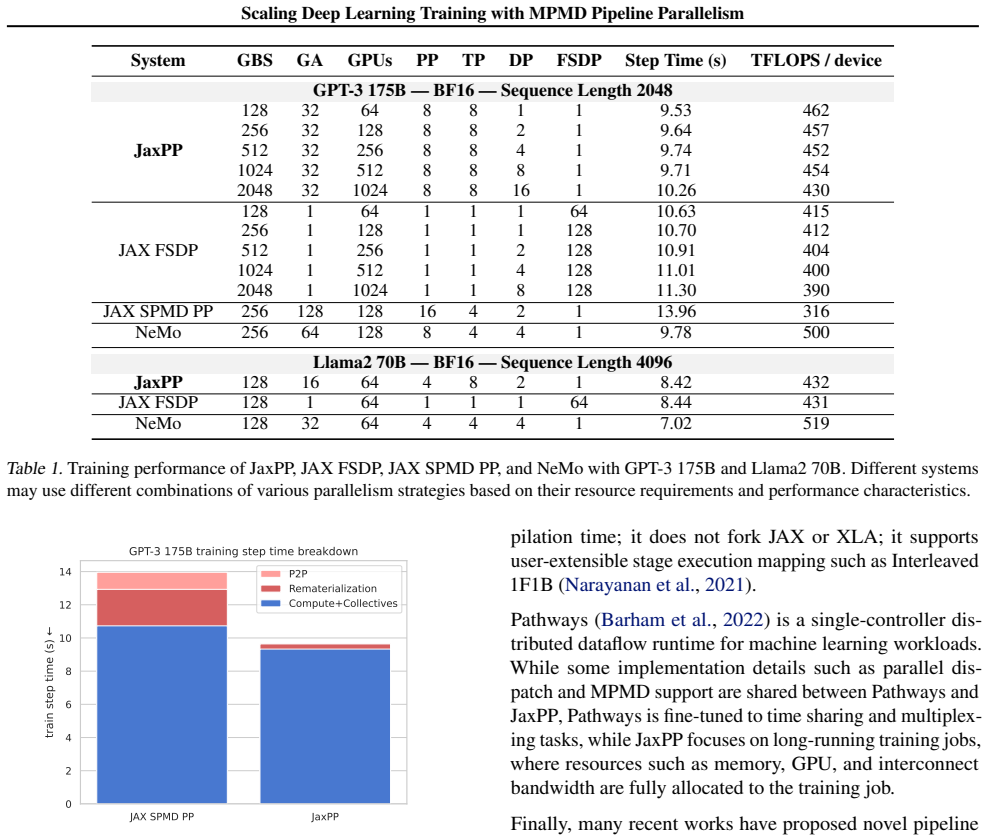
JaxPP establishes that the SPMD encoding of pipeline parallelism is unnecessarily limiting, and that an MPMD task-based runtime on top of GSPMD can express and efficiently execute schedules the SPMD partitioner cannot. The system unrolls the gradient accumulation loop into a task graph, assigns tasks to long-lived SPMD actors according to a user-supplied schedule, and automatically infers the send and receive operations needed between (potentially non-adjacent) stages. It then fuses all task dispatches for a step into a single RPC per actor. On the paper's benchmarks this design delivers 457 TFLOPS/device for GPT-3 175B, a 44.6% step-time reduction over SPMD pipeline parallelism, up to 1.11x hardware utilization versus the best SPMD configuration, and 92.87% weak-scaling efficiency from 64 to 1024 GPUs.
Load-bearing premise
The runtime stays correct only if every user-supplied schedule, expressed as a list of (iteration, forward/backward, stage) tasks, respects the dataflow ordering that JaxPP's send/receive inference assumes; the paper gives an algorithm and an example but no formal proof that all valid schedules avoid deadlock.
Editorial extensions
If this is right
- JAX users can adopt 1F1B and interleaved 1F1B pipelines by adding a few annotations, without writing send/receive code or restructuring models as separate functions.
- The 1.11x utilization gain over the best SPMD configuration implies that SPMD-only training leaves measurable throughput on the table for large models like GPT-3 175B.
- Since weak-scaling efficiency matches a highly optimized FSDP baseline, pipeline parallelism under user schedules is not inherently less scalable.
- Fusing dispatches into one RPC per actor per step keeps control-plane overhead small enough for long-running training loops.
Reading between the lines
- A natural next test is whether novel schedules from the zero-bubble literature can be dropped into this API unchanged; the runtime's task-graph model suggests they would run without new inference or plumbing.
- The 1.11x number is relative to the evaluated SPMD configurations; on models with heterogeneous stages or smaller per-stage compute, the gap could be larger because the SPMD encoding is restricted to homogeneous stages.
- The loop-commuting rewrite for tied weights could be adopted by other pipeline runtimes as a general optimization for any parameter used in multiple stages.
- If schedule validity were formalized, the compiler could reject an invalid user schedule at trace time instead of risking runtime deadlock.
Signed reviews
Editorial analysis
A structured set of objections, weighed in public.
Referee Report
Summary. JaxPP extends JAX's SPMD programming model with user-controlled MPMD pipeline parallelism. The paper introduces a programming model based on accumulate_grads and pipeline_yield, a driver-side task-graph transformation that unrolls the gradient accumulation loop and infers placement and communication, and a single-controller runtime built on Ray and XLA. The evaluation on GPT-3 175B and Llama2 70B reports 457 TFLOPS/device, 44.6% higher throughput than JAX SPMD pipeline parallelism, 1.11x over JAX FSDP, and 92.87% weak scaling efficiency from 64 to 1024 GPUs. The central claim is that pipeline parallelism implemented in JaxPP improves hardware utilization by up to 1.11x with respect to the best performing SPMD configuration.
Significance. If the semantic transformations are sound, JaxPP is a useful contribution: it gives JAX users a model-agnostic way to express 1F1B and interleaved pipeline schedules with asynchronous point-to-point communication, and the reported performance numbers are internally consistent with Table 1 and Figure 8. The paper is clearly written, the design's main pieces (loop unrolling, placement inference, fused task dispatch) are sensible, and the authors report exact configurations and a performance breakdown. However, the significance is currently bounded by the absence of any correctness validation of the Jaxpr transformations and by evaluation conditions that make the headline improvements difficult to attribute; both are fixable in revision. I also credit the authors for comparing against external systems (JAX FSDP, JAX SPMD PP, NeMo) rather than only self-baselines.
major comments (4)
- [Section 3.4 and Section 3.1] The loop-commuting rewrite in Section 3.4, g = sum_i(g1^{(i)} + g2^{(i)} + ...) ⇝ sum_i g1^{(i)} + sum_i g2^{(i)} + ..., is only valid if each partial gradient is used solely in the final addition. The paper does not state this precondition, and Section 3.1 explicitly allows the loop body to return 'additional metrics' whose reference semantics collect a per-iteration loss list. If a user's loop body clips, normalizes, or logs per-microbatch gradients, the rewritten program computes a different result. The evaluation contains no gradient comparison with a reference implementation, no loss curves, and no convergence check, so the reported TFLOPS and speedups are not shown to correspond to the intended training computation.
- [Section 3.2 and Figure 4] pipeline_yield appears inside loss_fn, which is passed to jax.value_and_grad, but the paper never defines how automatic differentiation treats pipeline_yield: there is no custom VJP/JVP rule or marker-propagation rule specified. If pipeline_yield is treated as an identity by autodiff, the backward-pass stage boundaries need not coincide with the forward-pass stage boundaries shown in Figure 3, and the executed schedule may not be the schedule the user specified. This is load-bearing for the system's core claim of supporting user-defined schedules and must be specified and validated.
- [Section 4.2] The runtime accepts an arbitrary list of Task(i, ty, stage) per actor and infers send/receive pairs in topological order, but the paper states only that 'care has to be taken' and gives one example. There is no formal statement of the schedule validity condition, no proof that the inference preserves the dataflow partial order for all schedules expressible through the API, and no deadlock stress test across a space of schedules. Because arbitrary user-defined schedules are a central selling point, the absence of a correctness argument for schedule inference is a substantive gap.
- [Section 5 and Table 1] The headline comparisons vary multiple confounding factors: for GPT-3 175B, JAX SPMD PP uses GA=128 and PP=16 while JaxPP uses GA=32 and PP=8, and JAX FSDP uses GA=1 and GBS=128 while JaxPP uses GA=32 and GBS=128. The claimed 44.6% and 1.11x improvements therefore conflate schedule choice, gradient accumulation count, and system implementation. The paper should either compare at matched global batch size and controlled GA/PP configurations, or decompose the gains. Additionally, all headline numbers appear to be single unrepeated runs; at least a few repetitions or variance estimates are needed, and the absence of released code or benchmark scripts prevents independent verification.
minor comments (5)
- [Section 5.2] The text says 'When training Llama2 70B on 8 DGX H100 nodes (8 GPUs)', but a DGX H100 node has 8 GPUs, so the correct count is 64 GPUs, matching Table 1.
- [Section 5.2] The claim of requiring '1K fewer lines of user code' is not backed by any code-size comparison; please provide concrete line counts or remove the claim.
- [Figure 2] The labels 'SPMD' and 'MPMD' in Figure 2 are not explained in the caption; a reader cannot tell which schedule corresponds to which row without inferring it from the text.
- [Section 3.4] The rewrite rule is typeset inline with a line break; please use display math for readability.
- [Section 2.2.1] The term 'circular repeat' is used without definition before its first use; please define it when introducing Interleaved 1F1B.
Circularity Check
No circularity found: performance claims are external measurements; the loop-commuting rewrite is a semantic-preserving transformation, and the missing correctness validation is a correctness risk, not a circular step.
full rationale
This is a systems and measurement paper; its central claims are empirical comparisons against independently implemented baselines (JAX FSDP, JAX SPMD PP, NeMo) on standard models (GPT-3 175B, Llama2 70B) with reported TFLOPS/device and step times. I examined the derivation chain for circular reductions. The only program transformation with an equation-like statement is the loop-commuting rewrite in Section 3.4, which replaces a sum of per-microbatch partial gradients aggregated in loop-carried state with per-use partial-gradient accumulators plus a final addition; this is a compiler rewrite justified by associativity and commutativity of the accumulation operators, not a fitted parameter and not a prediction derived from the result. The scheduling API (pipeline_yield, accumulate_grads) defines what JaxPP does, but the evaluation does not use the system to predict its own schedule; the 1F1B and interleaved schedules are standard external schedules, and the SPMD baseline is an external system. There are no self-citations by the present authors and no uniqueness theorem imported from prior work. The absence of a correctness or loss-curve validation, noted in the skeptic's attack, is a substantive correctness risk, but it is not circularity: even if the transformed program computed the wrong updates, the throughput numbers would still be measurements of that program rather than quantities forced by the paper's inputs. The selection of JaxPP's own configuration, such as circular repeat size and microbatch size, is a tuning choice that could affect fairness, not a case of fitting a parameter and then predicting the same data. I therefore find no circular step.
Assumptions & free parameters
free parameters (2)
- Circular repeat size =
6
- Microbatch count (GA) and microbatch size =
GPT-3 175B: GA=32, MBS=2; Llama2 70B: GA=16, MBS=2
assumptions (4)
- domain assumption GSPMD/XLA SPMD partitioning correctly handles sharding annotations and inserts all necessary collectives.
- ad hoc to paper A user-specified pipeline schedule is a valid dataflow partial order over stages and iterations, and JaxPP's topological send/receive inference prevents deadlock for such schedules.
- domain assumption Backward computation for a layer is scheduled on the same actor as its forward computation.
- ad hoc to paper The gradient accumulation API restriction (no dependencies from later stages of the current iteration to earlier stages of the previous iteration) is sufficient to make the unrolled task graph schedule-safe.
Cite this review
Pith. "Pith review of Scaling Deep Learning Training with MPMD Pipeline Parallelism." pith.science (2026). https://pith.science/paper/ZWRUDBOA
@misc{pith2026241214374,
  author       = {Pith},
  title        = {Pith review of: Scaling Deep Learning Training with MPMD Pipeline Parallelism},
  year         = {2026},
  howpublished = {\url{https://pith.science/paper/ZWRUDBOA}},
  note         = {Machine review of arXiv:2412.14374}
}
abstract
We present JaxPP, a system for efficiently scaling the training of large deep learning models with flexible pipeline parallelism. We introduce a seamless programming model that allows implementing user-defined pipeline schedules for gradient accumulation. JaxPP automatically distributes tasks, corresponding to pipeline stages, over a cluster of nodes and automatically infers the communication among them. We implement a MPMD runtime for asynchronous execution of SPMD tasks. The pipeline parallelism implementation of JaxPP improves hardware utilization by up to $1.11\times$ with respect to the best performing SPMD configuration.
Figures


Figures from the paper (6 more)


Reference graph
Works this paper leans on
-
[1]
URL https://www.top500.org/system/180239
EOS NVIDIA DGX SuperPod - NVIDIA DGX H100 , 2024. URL https://www.top500.org/system/180239
work page 2024
-
[2]
PartIR: Composing SPMD Partitioning Strategies for Machine Learning
Alabed, S., Chrzaszcz, B., Franco, J., Grewe, D., Maclaurin, D., Molloy, J., Natan, T., Norman, T., Pan, X., Paszke, A., Rink, N. A., Schaarschmidt, M., Sitdikov, T., Swietlik, A., Vytiniotis, D., and Wee, J. PartIR : Composing SPMD Partitioning Strategies for Machine Learning , January 2024. URL http://arxiv.org/abs/2401.11202
work page Pith review arXiv 2024
-
[3]
Barham, P., Chowdhery, A., Dean, J., Ghemawat, S., Hand, S., Hurt, D., Isard, M., Lim, H., Pang, R., Roy, S., Saeta, B., Schuh, P., Sepassi, R., Shafey, L. E., Thekkath, C. A., and Wu, Y. Pathways: Asynchronous Distributed Dataflow for ML . In Proceedings of Machine Learning and Systems 2022, MLSys 2022, Santa Clara , CA , USA , August 29 - September 1, 2...
work page 2022
-
[4]
Bradbury, J., Frostig, R., Hawkins, P., Johnson, M. J., Leary, C., Maclaurin, D., Necula, G., Paszke, A., VanderPlas, J., Wanderman-Milne , S., and Zhang, Q. JAX : Composable transformations of Python + NumPy programs, 2018. URL http://github.com/google/jax
work page 2018
-
[5]
Brown, T., Mann, B., Ryder, N., Subbiah, M., Kaplan, J. D., Dhariwal, P., Neelakantan, A., Shyam, P., Sastry, G., Askell, A., Agarwal, S., Herbert-Voss , A., Krueger, G., Henighan, T., Child, R., Ramesh, A., Ziegler, D., Wu, J., Winter, C., Hesse, C., Chen, M., Sigler, E., Litwin, M., Gray, S., Chess, B., Clark, J., Berner, C., McCandlish, S., Radford, A....
work page 1901
-
[6]
Training deep nets with sublinear memory cost
Chen, T., Xu, B., Zhang, C., and Guestrin, C. Training deep nets with sublinear memory cost. CoRR, abs/1604.06174, 2016. URL http://arxiv.org/abs/1604.06174
arXiv 2016
-
[7]
cudnn: Efficient primitives for deep learning, 2014
Chetlur, S., Woolley, C., Vandermersch, P., Cohen, J., Tran, J., Catanzaro, B., and Shelhamer, E. cudnn: Efficient primitives for deep learning, 2014. URL https://arxiv.org/abs/1410.0759
arXiv 2014
-
[8]
Chowdhery, A., Narang, S., Devlin, J., Bosma, M., Mishra, G., Roberts, A., Barham, P., Chung, H. W., Sutton, C., Gehrmann, S., Schuh, P., Shi, K., Tsvyashchenko, S., Maynez, J., Rao, A., Barnes, P., Tay, Y., Shazeer, N., Prabhakaran, V., Reif, E., Du, N., Hutchinson, B., Pope, R., Bradbury, J., Austin, J., Isard, M., Gur-Ari , G., Yin, P., Duke, T., Levsk...
arXiv 2022
Show all 33 references
-
[9]
An Image is Worth 16x16 Words : Transformers for Image Recognition at Scale
Dosovitskiy, A., Beyer, L., Kolesnikov, A., Weissenborn, D., Zhai, X., Unterthiner, T., Dehghani, M., Minderer, M., Heigold, G., Gelly, S., Uszkoreit, J., and Houlsby, N. An Image is Worth 16x16 Words : Transformers for Image Recognition at Scale . In 9th International Confere...
2021
-
[10]
Dubey, A., Jauhri, A., Pandey, A., Kadian, A., Al-Dahle, A., Letman, A., Mathur, A., Schelten, A., Yang, A., Fan, A., Goyal, A., Hartshorn, A., Yang, A., Mitra, A., Sravankumar, A., Korenev, A., Hinsvark, A., Rao, A., Zhang, A., Rodriguez, A., Gregerson, A., Spataru, A., Rozie...
2024 arXiv
-
[11]
Switch Transformers : Scaling to Trillion Parameter Models with Simple and Efficient Sparsity , June 2022
Fedus, W., Zoph, B., and Shazeer, N. Switch Transformers : Scaling to Trillion Parameter Models with Simple and Efficient Sparsity , June 2022. URL http://arxiv.org/abs/2101.03961
2022 arXiv
-
[12]
NeMo: a toolkit for Conversational AI and Large Language Models
Harper, E., Majumdar, S., Kuchaiev, O., Jason, L., Zhang, Y., Bakhturina, E., Noroozi, V., Subramanian, S., Nithin, K., Jocelyn, H., Jia, F., Balam, J., Yang, X., Livne, M., Dong, Y., Naren, S., and Ginsburg, B. NeMo: a toolkit for Conversational AI and Large Language Models ....
-
[13]
The Hardware Lottery , September 2020
Hooker, S. The Hardware Lottery , September 2020. URL http://arxiv.org/abs/2009.06489
2020 arXiv
-
[14]
DISTMM : Accelerating distributed multimodal model training
Huang, J., Zhang, Z., Zheng, S., Qin, F., and Wang, Y. DISTMM : Accelerating distributed multimodal model training. In 21st USENIX Symposium on Networked Systems Design and Implementation (NSDI 24), pp.\ 1157--1171, Santa Clara, CA, April 2024. USENIX Association. ISBN 978-1-9...
2024
-
[15]
X., Lee, H., Ngiam, J., Le, Q
Huang, Y., Cheng, Y., Bapna, A., Firat, O., Chen, D., Chen, M. X., Lee, H., Ngiam, J., Le, Q. V., Wu, Y., and Chen, Z. GPipe : Efficient Training of Giant Neural Networks using Pipeline Parallelism . In Wallach, H. M., Larochelle, H., Beygelzimer, A., d'Alch \'e -Buc , F., Fox...
2019
-
[16]
Megascale: Scaling large language model training to more than 10,000 gpus
Jiang, Z., Lin, H., Zhong, Y., Huang, Q., Chen, Y., Zhang, Z., Peng, Y., Li, X., Xie, C., Nong, S., Jia, Y., He, S., Chen, H., Bai, Z., Hou, Q., Yan, S., Zhou, D., Sheng, Y., Jiang, Z., Xu, H., Wei, H., Zhang, Z., Nie, P., Zou, L., Zhao, S., Xiang, L., Liu, Z., Li, Z., Jia, X....
2024
-
[17]
Breadth- First Pipeline Parallelism , November 2022
Lamy-Poirier , J. Breadth- First Pipeline Parallelism , November 2022. URL http://arxiv.org/abs/2211.05953
2022 arXiv
-
[18]
Mlir: Scaling compiler infrastructure for domain specific computation
Lattner, C., Amini, M., Bondhugula, U., Cohen, A., Davis, A., Pienaar, J., Riddle, R., Shpeisman, T., Vasilache, N., and Zinenko, O. Mlir: Scaling compiler infrastructure for domain specific computation. In 2021 IEEE/ACM International Symposium on Code Generation and Optimizat...
2021
-
[19]
GShard : Scaling Giant Models with Conditional Computation and Automatic Sharding , June 2020
Lepikhin, D., Lee, H., Xu, Y., Chen, D., Firat, O., Huang, Y., Krikun, M., Shazeer, N., and Chen, Z. GShard : Scaling Giant Models with Conditional Computation and Automatic Sharding , June 2020. URL http://arxiv.org/abs/2006.16668
2020 arXiv
-
[20]
Torchtitan: One-stop pytorch native solution for production ready llm pre-training, 2024
Liang, W., Liu, T., Wright, L., Constable, W., Gu, A., Huang, C.-C., Zhang, I., Feng, W., Huang, H., Wang, J., Purandare, S., Nadathur, G., and Idreos, S. Torchtitan: One-stop pytorch native solution for production ready llm pre-training, 2024. URL https://arxiv.org/abs/2410.06511
2024 arXiv
-
[21]
nnScaler : Constraint-Guided parallelization plan generation for deep learning training
Lin, Z., Miao, Y., Zhang, Q., Yang, F., Zhu, Y., Li, C., Maleki, S., Cao, X., Shang, N., Yang, Y., Xu, W., Yang, M., Zhang, L., and Zhou, L. nnScaler : Constraint-Guided parallelization plan generation for deep learning training. In 18th USENIX Symposium on Operating Systems D...
2024
-
[22]
I., and Stoica, I
Moritz, P., Nishihara, R., Wang, S., Tumanov, A., Liaw, R., Liang, E., Elibol, M., Yang, Z., Paul, W., Jordan, M. I., and Stoica, I. Ray: A distributed framework for emerging AI applications. In 13th USENIX Symposium on Operating Systems Design and Implementation (OSDI 18), pp...
2018
-
[23]
R., Ganger, G
Narayanan, D., Harlap, A., Phanishayee, A., Seshadri, V., Devanur, N. R., Ganger, G. R., Gibbons, P. B., and Zaharia, M. PipeDream : Generalized pipeline parallelism for DNN training. In Proceedings of the 27th ACM Symposium on Operating Systems Principles , pp.\ 1--15, Huntsv...
2019
-
[24]
Efficient large-scale language model training on GPU clusters using megatron- LM
Narayanan, D., Shoeybi, M., Casper, J., LeGresley, P., Patwary, M., Korthikanti, V., Vainbrand, D., Kashinkunti, P., Bernauer, J., Catanzaro, B., Phanishayee, A., and Zaharia, M. Efficient large-scale language model training on GPU clusters using megatron- LM . In Proceedings ...
2021
-
[25]
Efficiently Scaling Transformer Inference , November 2022
Pope, R., Douglas, S., Chowdhery, A., Devlin, J., Bradbury, J., Levskaya, A., Heek, J., Xiao, K., Agrawal, S., and Dean, J. Efficiently Scaling Transformer Inference , November 2022. URL http://arxiv.org/abs/2211.05102
2022 arXiv
-
[26]
Zero bubble (almost) pipeline parallelism
Qi, P., Wan, X., Huang, G., and Lin, M. Zero bubble (almost) pipeline parallelism. In The Twelfth International Conference on Learning Representations, 2024. URL https://openreview.net/forum?id=tuzTN0eIO5
2024
-
[27]
Deepspeed: System optimizations enable training deep learning models with over 100 billion parameters
Rasley, J., Rajbhandari, S., Ruwase, O., and He, Y. Deepspeed: System optimizations enable training deep learning models with over 100 billion parameters. In Proceedings of the 26th ACM SIGKDD International Conference on Knowledge Discovery & Data Mining, KDD '20, pp.\ 3505–35...
2020
-
[28]
Megatron- LM : Training Multi-Billion Parameter Language Models Using Model Parallelism , March 2020
Shoeybi, M., Patwary, M., Puri, R., LeGresley, P., Casper, J., and Catanzaro, B. Megatron- LM : Training Multi-Billion Parameter Language Models Using Model Parallelism , March 2020. URL http://arxiv.org/abs/1909.08053
2020 arXiv
-
[29]
Y., Bernauer, J., Song, X., Shoeybi, M., He, Y., Houston, M., Tiwary, S., and Catanzaro, B
Smith, S., Patwary, M., Norick, B., LeGresley, P., Rajbhandari, S., Casper, J., Liu, Z., Prabhumoye, S., Zerveas, G., Korthikanti, V., Zhang, E., Child, R., Aminabadi, R. Y., Bernauer, J., Song, X., Shoeybi, M., He, Y., Houston, M., Tiwary, S., and Catanzaro, B. Using DeepSpee...
2022 arXiv
-
[30]
Touvron, H., Martin, L., Stone, K., Albert, P., Almahairi, A., Babaei, Y., Bashlykov, N., Batra, S., Bhargava, P., Bhosale, S., Bikel, D., Blecher, L., Ferrer, C. C., Chen, M., Cucurull, G., Esiobu, D., Fernandes, J., Fu, J., Fu, W., Fuller, B., Gao, C., Goswami, V., Goyal, N....
2023 arXiv
-
[31]
GSPMD : General and Scalable Parallelization for ML Computation Graphs , December 2021
Xu, Y., Lee, H., Chen, D., Hechtman, B., Huang, Y., Joshi, R., Krikun, M., Lepikhin, D., Ly, A., Maggioni, M., Pang, R., Shazeer, N., Wang, S., Wang, T., Wu, Y., and Chen, Z. GSPMD : General and Scalable Parallelization for ML Computation Graphs , December 2021. URL http://arx...
2021 arXiv
-
[32]
P., Gonzalez, J
Zheng, L., Li, Z., Zhang, H., Zhuang, Y., Chen, Z., Huang, Y., Wang, Y., Xu, Y., Zhuo, D., Xing, E. P., Gonzalez, J. E., and Stoica, I. Alpa: Automating Inter- and Intra-Operator Parallelism for Distributed Deep Learning . In Aguilera, M. K. and Weatherspoon, H. (eds.), 16th U...
2022
-
[33]
write newline
" write newline "" before.all 'output.state := FUNCTION n.dashify 't := "" t empty not t #1 #1 substring "-" = t #1 #2 substring "--" = not "--" * t #2 global.max substring 't := t #1 #1 substring "-" = "-" * t #2 global.max substring 't := while if t #1 #1 substring * t #2 gl...
Reviewed August 11, 2026 · model on record in the stance chip above.
Discussion (0). Continue with ORCID to comment.