REVIEW 5 major objections 5 minor 2 cited by
IBIS: A Hybrid Inception-BiLSTM and SVM Ensemble for Robust Doppler-based Human Activity Recognition
T0 review · 5 major / 5 minor · reviewed 2026-08-04 · deepseek-v4-flash
Pith's one-line read Adding a BiLSTM branch and an SVM head lifts Wi-Fi activity recognition from 88% to nearly 99% accuracy.
desk verdict Architecture is plausible, but the evaluation is too sloppy to support the headline numbers; needs a proper protocol before it can be trusted. read the letter →
The pith
A machine-rendered reading of the paper's core claim, the machinery that carries it, and where it could break.
The reading
What carries the argument
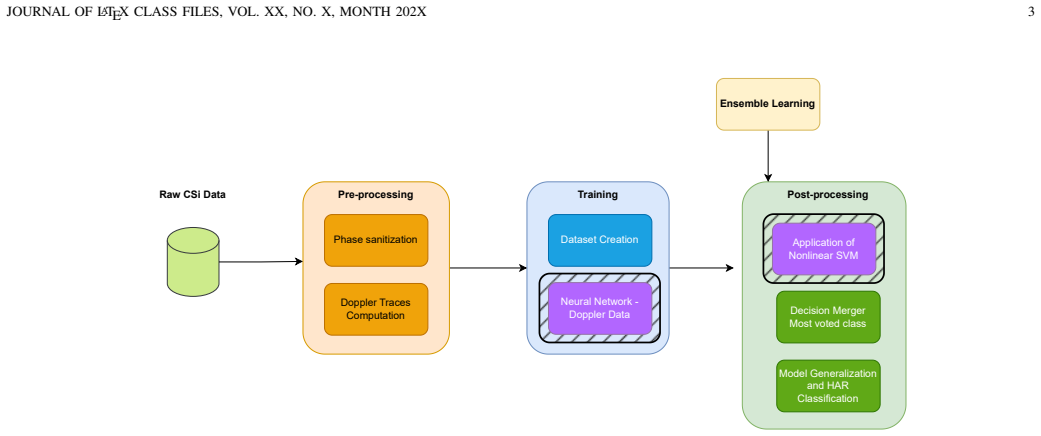
The load-bearing mechanism is the ensemble chain: the Inception module extracts spatial features from sanitized Doppler traces; the BiLSTM reads the feature map in both temporal directions and a self-attention layer weights the time steps; a global pooling step condenses the sequence; and an RBF-kernel SVM replaces the softmax classifier to produce the final label, with antenna-level majority voting as a final fusion. The SVM is the key refiner—applied post-hoc to deep features rather than as the primary classifier—and the paper credits it, along with class balancing and C=1, for the sharper generalization boundaries.
What would settle it
Retrain both IBIS and the Inception baseline on S1–S6 only, select all hyperparameters on a validation split drawn from S1–S6 (never S7), then run a single evaluation on S7; if IBIS's accuracy advantage over the baseline collapses from roughly 11 points to near zero—or falls below the 85.82% transfer baseline—the paper's generalization claim would be refuted.
Extended reading notes
Core claim
On the SHARP Doppler dataset, the authors train an Inception network augmented with a bidirectional LSTM and a self-attention layer, then apply an RBF-kernel SVM (C=1, balanced classes) to the network's learned features instead of the final softmax, and finally fuse decisions across antennas by majority voting. Evaluated on scenario S7, a cluttered laboratory not used in training, the hybrid reaches 98.95% accuracy on five activities and near-unity AUC for all eight activities, compared with 88.12% for the original Inception and 85.82% for a CNN-ABLSTM transfer baseline. The paper attributes the improvement to temporal modeling by the BiLSTM and robust decision boundaries from the SVM, concl
Load-bearing premise
The claim stands or falls on whether scenario S7 was truly untouched during development—no S7 samples used to set the SVM's C, class weights, architecture depth, or any early-stopping criterion—so the 98.95% result reflects real generalization rather than feedback from the test set.
Editorial extensions
If this is right
- If IBIS's reported results hold, Wi-Fi HAR models can be made robust to new environments without retraining on target-domain data, by adding a temporal branch and an SVM head.
- The approach works on both 5-class and 8-class activity sets, with near-unity AUCs on the held-out scenario, suggesting the gain is not limited to easy classes.
- The gain over a transfer-learning baseline (85.82% to 98.95% at 100 epochs) indicates that architectural changes can outperform explicit cross-subject adaptation in this setting.
- The pipeline remains compatible with commodity 802.11 hardware and the existing Doppler preprocessing chain, so it could be adopted incrementally.
- The paper's cost measurements show the hybrid adds training time per epoch but yields stability without early stopping.
Reading between the lines
- A likely testable extension is to evaluate IBIS on a completely different building (not just S7) to see whether the SVM's regularization truly generalizes or merely overfits to lab clutter.
- The absence of a specified train/validation split and SVM hyperparameter search suggests the reported numbers may be optimistic; an honest evaluation should freeze all hyperparameters on a validation set before touching S7.
- If the 98.95% vs 95.40% discrepancy reflects different evaluation protocols, the field would benefit from a standardized cross-scenario benchmark so that architecture comparisons are meaningful.
- Using an SVM to refine deep-feature decisions could transfer to other RF-sensing tasks such as fall detection or gesture recognition, where temporal patterns are prominent.
Editorial analysis
A structured set of objections, weighed in public.
Referee Report
Summary. The paper proposes IBIS, a hybrid architecture combining an Inception-style CNN, a BiLSTM with attention, and an RBF-kernel SVM post-classifier, for human activity recognition from Wi-Fi CSI Doppler traces. It reports evaluations on the SHARP dataset in five- and eight-class settings, comparing against the original SHARP Inception model and a CNN-ABLSTM transfer-learning baseline, and claims cross-scenario accuracy of 98.95% (abstract: 95.40%) on the challenging held-out S7 laboratory scenario. The paper argues that the addition of the BiLSTM and SVM improves generalization and reduces overfitting. The central empirical claim is that IBIS+SVM substantially outperforms both baselines under cross-scenario evaluation.
Significance. If the reported gains were reproducible and properly validated on held-out environments, a modest architectural extension to SHARP with an SVM post-classifier could be a practically useful contribution for Doppler-based HAR. The paper provides a detailed architectural table (Table II) and per-class confusion matrices and ROC curves, which are helpful for understanding the method. However, the manuscript is not yet at the standard required for a journal: the headline accuracy is inconsistent across abstract, body, and conclusion; the evaluation protocol (especially the train/test split and the fitting of the SVM) is unspecified; no external dataset is used despite the abstract's claim; and no repeated runs or error bars are reported. These issues are load-bearing because they prevent the reader from verifying the central generalization claim.
major comments (5)
- [Abstract, §IV.E, §V] The reported headline accuracy is internally inconsistent. The abstract states 95.40% accuracy with a 7.58% performance gain; §IV.E and Table IV report 98.95%; the conclusion states 'nearly 99%' and an improvement of 'approximately 10.94%' over SHARP (whereas 98.95 − 88.12 = 10.83). The claimed 18.62% improvement over the ABLSTM baseline depends on the 98.95% figure, while the abstract's 95.40% would change every relative comparison. The paper never explains which number is the result of which protocol. This is not a typographical slip; it undermines the central quantitative claim and must be resolved with a single, clearly described evaluation protocol.
- [§III.D, §IV.B, §IV.C] The cross-scenario generalization claim requires that the SVM is trained on the training partition and never on S7 data, but the paper never states the train/validation/test split for the 5-class result. §III.D says only 'C was set to 1' and 'class balancing was applied'; it does not say on which embeddings the RBF-SVM was fitted. §IV.B explicitly states that the ROC curves were 'generated using generalization test data without antenna fusion,' which raises the concern that the SVM decision boundary — or the hyperparameters C and class weights — may have been selected using the S7 test data. The 80/10/10 split mentioned in §IV.C is described only as an attempt to improve the original SHARP model, not as the protocol for IBIS. Without this information, the reported 98.95% cannot be interpreted as a held-out generalization result.
- [Abstract, §III.A, §IV] The abstract claims 'Experimental results on multiple datasets' and 'cross-scenario evaluations on external datasets.' The full manuscript, however, uses only the SHARP dataset; S7 is an unseen scenario within that same dataset, not an external dataset. No other dataset is introduced or evaluated. The 'external dataset' claim in the abstract is unsupported and is directly relevant to the paper's generalization thesis. This should be corrected or the corresponding experiments must be performed.
- [§IV.E] The comparison against the CNN-ABLSTM baseline of [8] is not a controlled experiment. IBIS+SVM operates on SHARP Doppler traces after the SHARP sanitization pipeline, while the ABLSTM baseline is said to use raw CSI. The paper then attributes the 18.62% improvement to the proposed architecture ('the inclusion of more attention layers, increased architectural complexity'). This confounds the effect of signal preprocessing with the effect of the model architecture. Furthermore, no implementation details of the ABLSTM pipeline, its training/validation split, or the data it was evaluated on are provided, so the 'same condition of 100 training epochs' is not sufficient to make the comparison meaningful.
- [Tables III and IV, §IV] All reported results are point estimates from a single run (or a single fold) with no standard deviations, confidence intervals, or number of runs. The dataset is small — three volunteers across seven scenarios — and the differences at issue (e.g., per-class accuracies between 97% and 100%, and the ROC curves of Figure 7) are likely to be sensitive to initialization and data partitioning. Without repeated trials or a statistical comparison, the reader cannot assess whether the claimed improvements are robust or the result of chance.
minor comments (5)
- [§III.A] The text says the dataset contains 'eight activities' but then lists only seven: empty, sitting, stand up, walking, running, jumping, and arm gym. The confusion matrices in Figures 6 and 7 include 'Standing' as an eighth class, so the enumeration is incomplete or contains a typo.
- [§V] The conclusion reports an improvement of 'approximately 10.94%' over SHARP. Based on the numbers in Table IV (98.95% vs. 88.12%), the absolute improvement is 10.83 percentage points and the relative improvement is about 12.3%. The value 10.94% appears neither as absolute nor relative improvement; please recompute and state explicitly which quantity is used.
- [§IV.F, Figure 8] The text references Figure 8 for computational cost, but the figure caption and the surrounding text are ambiguous about whether the 'BiLSTM' curve includes the Inception backbone and the attention mechanism. Clarify what exactly is being timed and whether the SVM training time is included.
- [§III.C, Figure 2] The figure caption says the shaded and hatched purple areas highlight 'the novel components,' but the printed figure is grayscale with no purple shading visible. The reader cannot identify which components are claimed as novel. Consider using distinct patterns or textual callouts.
- [General] Several phrases are imprecise, e.g., 'focus on the most relevant time steps' for the attention mechanism, and 'processing both global patterns and temporal sequences' for the BiLSTM. These are acceptable in a summary but should be tightened in the final version. Also, the references [9] and [10] in Table I appear to be cited for specific accuracies that do not match the reported numbers; check the table entries against the cited works.
Circularity Check
No circularity: IBIS's gain is an empirical comparison against external baselines; the unspecified SVM-fitting protocol is a validation risk, not a definitional reduction.
full rationale
The paper's central claim is an empirical accuracy comparison, not a derived result: §IV.E states 'Our proposed IBIS + SVM achieved an accuracy of 98.95% compared to their 85.82%, a remarkable 18.62% improvement under the same condition of 100 training epochs.' The baselines are external works ([7] SHARP and [8] CNN-ABLSTM); none of the references cited for the load-bearing comparison is authored by the present authors, so there is no self-citation chain or imported-uniqueness argument. The architectural components (Inception blocks, BiLSTM, attention, SVM with RBF kernel) are standard and are not defined in terms of the claimed outcome. The SVM hyperparameters are stated as fixed choices — §III.D: 'The penalty parameter C was set to 1' and 'class balancing was applied' — not fitted to the test data in any quoted step, so no fitted input is renamed as a prediction. The paper does omit the exact train/test split and whether the SVM was trained on S7, which is a genuine experimental-protocol gap that could mean the 'generalization' number is in-sample; however, circularity analysis requires exhibiting a specific reduction by the paper's own equations or self-citations, and no such reduction appears. The abstract/body/conclusion accuracy discrepancies (95.40%, 98.95%, 'nearly 99%') are reporting inconsistencies, not circular definitions. Therefore no circular step can be substantiated under the hard-evidence rule.
Assumptions & free parameters
free parameters (5)
- SVM penalty C =
1
- SVM class weights =
balanced
- BiLSTM units =
64
- Dropout rate =
0.5
- Number of training epochs =
100
assumptions (5)
- domain assumption Doppler traces produced by the SHARP sanitization pipeline are sufficient discriminative representations for HAR
- domain assumption Scenario S7 is a fair held-out generalization benchmark unbiased by model selection
- domain assumption The re-implemented baselines (SHARP Inception, ABLSTM) faithfully reproduce the cited methods
- standard math Samples are independent and labels are correct
- domain assumption Attention mechanism and BiLSTM capture temporal dependencies relevant to Doppler HAR
Cite this review
Pith. "Pith review of IBIS: A Hybrid Inception-BiLSTM and SVM Ensemble for Robust Doppler-based Human Activity Recognition." pith.science (2026). https://pith.science/paper/ZXCVHKM2
@misc{pith2026251024936,
  author       = {Pith},
  title        = {Pith review of: IBIS: A Hybrid Inception-BiLSTM and SVM Ensemble for Robust Doppler-based Human Activity Recognition},
  year         = {2026},
  howpublished = {\url{https://pith.science/paper/ZXCVHKM2}},
  note         = {Machine review of arXiv:2510.24936}
}
read the original abstract
Wi-Fi sensing is a leading technology for Human Activity Recognition (HAR), offering a non-intrusive and cost-effective solution for healthcare and smart environments. Despite its potential, existing methods struggle with domain shift issues, often failing to generalize to unseen environments due to overfitting. This paper proposes IBIS, a robust ensemble framework combining Inception-Bidirectional Long Short-Term Memory (BiLSTM) for feature extraction and Support Vector Machine (SVM) for classification of Doppler signatures. The proposed architecture specifically targets generalization capabilities. Experimental results on multiple datasets show that IBIS achieves 95.40% accuracy, delivering a 7.58% performance gain compared to standard architectures in cross-scenario evaluations on external datasets. The analysis confirms that IBIS effectively mitigates environmental dependency in Wi-Fi-based HAR.
Figures


Figures from the paper (5 more)


Forward citations
Cited by 2 Pith papers
-
Zero-Fi: Zero-Shot Wi-Fi-Based Human Activity Recognition via Contrastive Signal-Language Alignment
Zero-Fi aligns Wi-Fi CSI signal embeddings with CLIP text embeddings of LLM-generated activity descriptions, achieving 69.58% zero-shot accuracy on unseen activity classes.
-
WiFuse: An Attention Mechanism for Human Activity Recognition using Fused CSI Amplitude and Delay-Doppler Channel Features
A dual-stream CSI framework fusing amplitude and Delay-Doppler features with a ResNet-TCN attention model reaches 95.28% on XRF55 and 98.20% on Wi-MIR.
Reference graph
Works this paper leans on
-
[8]
A cross-subject transfer learning method for csi-based wireless sensing,
Z. He, M. Bouazizi, G. Gui, and T. Ohtsuki, “A cross-subject transfer learning method for csi-based wireless sensing,”IEEE Internet of Things Journal, vol. 12, no. 13, pp. 23 946–23 960, 2025
2025
-
[1]
Wifi-based human sensing with deep learning: Recent advances, challenges, and opportunities,
I. Ahmad, A. Ullah, and W. Choi, “Wifi-based human sensing with deep learning: Recent advances, challenges, and opportunities,”IEEE Open Journal of the Communications Society, vol. 5, pp. 3595–3623, 2024
2024
-
[2]
Efficientfi: Toward large-scale lightweight wifi sensing via csi compression,
J. Yang, X. Chen, H. Zou, D. Wang, Q. Xu, and L. Xie, “Efficientfi: Toward large-scale lightweight wifi sensing via csi compression,”IEEE Internet of Things Journal, vol. 9, no. 15, pp. 13 086–13 095, 2022
2022
-
[3]
A deep learning based lightweight human activity recognition system using reconstructed wifi csi,
X. Chen, Y . Zou, C. Li, and W. Xiao, “A deep learning based lightweight human activity recognition system using reconstructed wifi csi,”IEEE Transactions on Human-Machine Systems, vol. 54, no. 1, pp. 68–78, 2024
2024
-
[4]
Deep learning of csi for efficient device-free human activity recognition,
D. Khan and I. W.-H. Ho, “Deep learning of csi for efficient device-free human activity recognition,” in2021 IEEE 7th World F orum on Internet of Things (WF-IoT), 2021, pp. 19–24
2021
-
[5]
Going deeper with convolutions,
C. Szegedy, W. Liu, Y . Jia, P. Sermanet, S. Reed, D. Anguelov, D. Erhan, V . Vanhoucke, and A. Rabinovich, “Going deeper with convolutions,” 2014. [Online]. Available: https://arxiv.org/abs/1409.4842
arXiv 2014
-
[6]
Ensemble multifeatured deep learning models and applications: A survey,
S. Abimannan, E.-S. M. El-Alfy, Y .-S. Chang, S. Hussain, S. Shukla, and D. Satheesh, “Ensemble multifeatured deep learning models and applications: A survey,”IEEE Access, vol. 11, pp. 107 194–107 217, 2023
2023
-
[7]
Sharp: Environment and person independent activity recognition with commodity ieee 802.11 access points,
F. Meneghello, D. Garlisi, N. D. Fabbro, I. Tinnirello, and M. Rossi, “Sharp: Environment and person independent activity recognition with commodity ieee 802.11 access points,”IEEE Transactions on Mobile Computing, vol. 22, no. 10, pp. 6160–6175, 2023
2023
Show all 15 references
-
[9]
Channel state information (csi) amplitude coloring scheme for enhancing accuracy of an indoor occupancy detection system using wi-fi sensing,
J. Son and J. Park, “Channel state information (csi) amplitude coloring scheme for enhancing accuracy of an indoor occupancy detection system using wi-fi sensing,”Applied Sciences, vol. 14, no. 17, 2024. [Online]. Available: https://www.mdpi.com/2076-3417/14/17/7850
2024
-
[10]
Device-free single-user activity recognition using diversified deep ensemble learning,
W. Cui, B. Li, L. Zhang, and Z. Chen, “Device-free single-user activity recognition using diversified deep ensemble learning,”Applied Soft Computing, vol. 102, p. 107066, 2021
2021
-
[11]
Non-contact cross-person activity recognition by deep metric ensemble learning,
C. Ye, S. Xu, Z. He, Y . Yin, T. Ohtsuki, and G. Gui, “Non-contact cross-person activity recognition by deep metric ensemble learning,” Bioengineering, vol. 11, no. 11, 2024
2024
-
[12]
Exposing the CSI: A Systematic Investigation of CSI-based Wi-Fi Sensing Capabilities and Limitations ,
M. Cominelli, F. Gringoli, and F. Restuccia, “ Exposing the CSI: A Systematic Investigation of CSI-based Wi-Fi Sensing Capabilities and Limitations ,” in2023 IEEE International Conference on Pervasive Computing and Communications (PerCom), 2023, pp. 81–90
2023
-
[13]
Kolodiazhnyi,Hands-On Machine Learning with C++
K. Kolodiazhnyi,Hands-On Machine Learning with C++. Packt Publishing, 2020, accessed: 2025-05-
2020
-
[14]
Based on radial basis kernel function of support vector machines for speaker recognition,
Z. Ye and H. Li, “Based on radial basis kernel function of support vector machines for speaker recognition,” in2012 5th International Congress on Image and Signal Processing, 2012, pp. 1584–1587
2012
-
[17]
Available: https://www.packtpub.com/product/ hands-on-machine-learning-with-c/9781800203257
[Online]. Available: https://www.packtpub.com/product/ hands-on-machine-learning-with-c/9781800203257
Reviewed August 4, 2026 · model on record in the stance chip above.
Discussion (0). Continue with ORCID to comment.