Charge transfer from ammonia neutralizes propylene oxide cations: Implications for the astrochemistry of chiral molecules
Pith reviewed 2026-06-26 05:56 UTC · model grok-4.3
The pith
Ammonia neutralizes propylene oxide cations through charge transfer at a rate of 1.39×10^{-12} cm³ s^{-1}.
A machine-rendered reading of the paper's core claim, the machinery that carries it, and where it could break.
Core claim
The charge-transfer reaction between PO+ and NH3 proceeds with a pressure-independent rate coefficient of (1.39±0.03)×10^{-12} cm³ s^{-1} to neutralize PO+ and form the radical cation NH3+. This neutralization is necessary to convert the assumed precursor for propylene oxide in space into the observed astrochemical species.
What carries the argument
The charge transfer reaction rate between propylene oxide cation and ammonia
If this is right
- The reaction should be included in astrochemical models for Sagittarius B2.
- The high abundance of NH3 makes the neutralization pathway viable.
- Chiral molecules may exist as cations in the ISM due to low ionization energies.
Where Pith is reading between the lines
- Rates measured at room temperature should be tested at low temperatures to better apply to space conditions.
- Similar reactions could apply to other chiral molecules relevant to origin-of-life theories.
- This mechanism might explain why only certain chiral species are detected in the ISM.
Load-bearing premise
The room-temperature ion trap and glow-discharge conditions produce a rate coefficient that can be directly applied to the low-temperature, low-density environment of Sagittarius B2.
What would settle it
Observing whether including this reaction in models improves the match to the observed abundance of propylene oxide in Sagittarius B2, or measuring the rate coefficient at interstellar temperatures.
Figures
read the original abstract
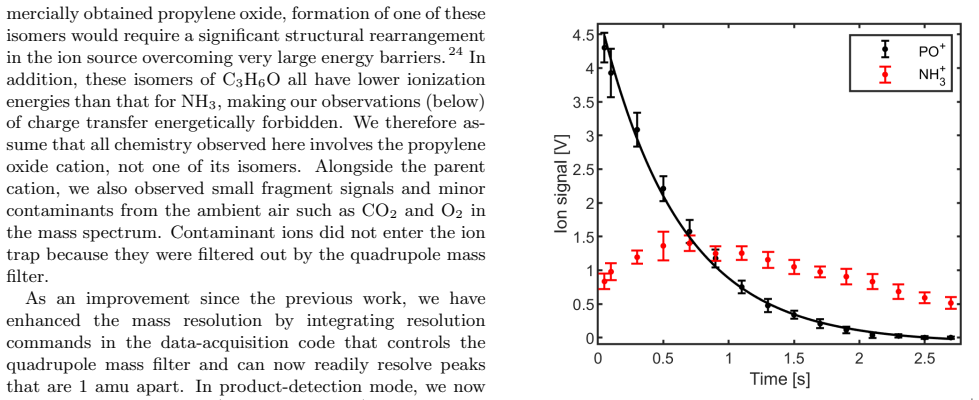
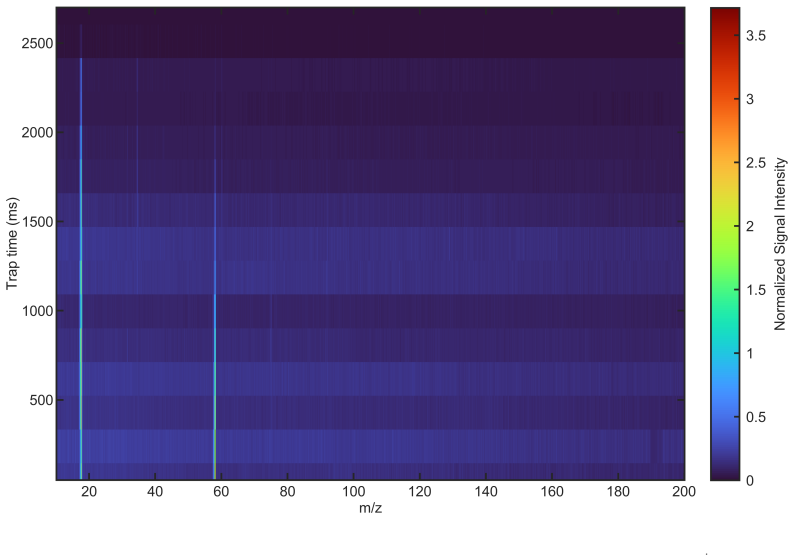
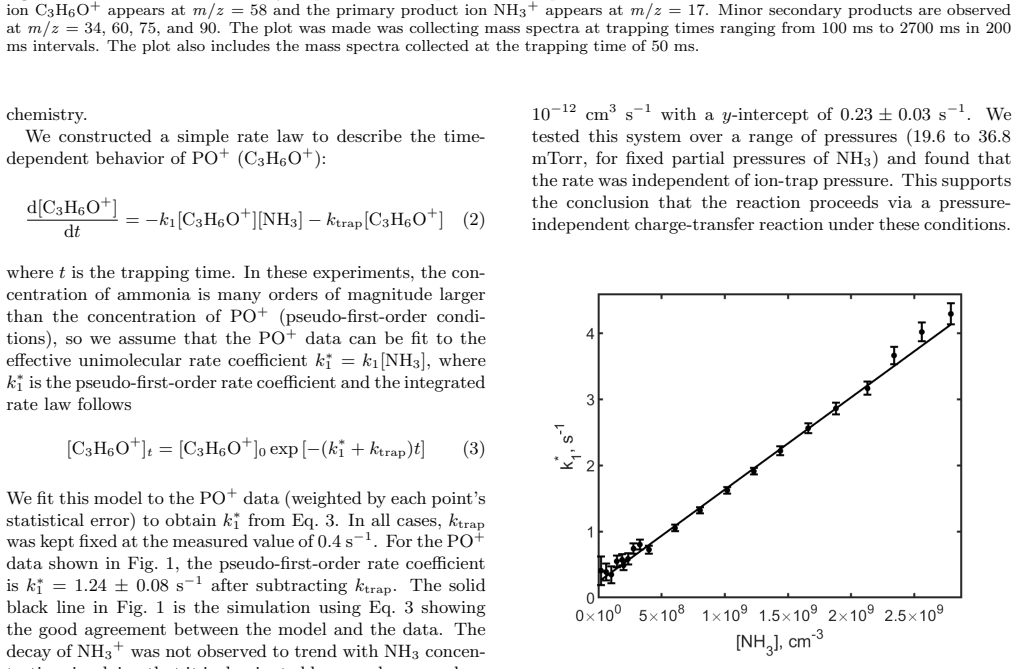
To date only one chiral species, propylene oxide, has been observed in the interstellar medium but little is known about the chemistry that leads to a detectable abundance of this molecule in Sagittarius B2. We used a glow-discharge ion source and a room-temperature ion trap to study the neutralization reactions necessary to convert propylene oxide cation (PO$^+$) -- the assumed precursor for propylene oxide in space -- into the observed astrochemical. We found that the charge-transfer reaction between PO$^+$ and ammonia (NH$_3$) proceeds with a pressure-independent rate coefficient of $(1.39\pm0.03)\times10^{-12}$ cm$^{3}$ s$^{-1}$ to neutralize PO$^+$ and form the radical cation NH$_3$. Although this measured rate coefficient is much slower than that predicted by capture theories, the high abundance of NH$_3$ in Sagittarius B2 motivates the inclusion of this reaction in astrochemical models. We hypothesize that the low ionization energies of many chiral molecules important to origin-of-life theories means these species may exist as cations in the interstellar medium.
Editorial analysis
A structured set of objections, weighed in public.
Referee Report
Summary. The manuscript reports an experimental measurement using a glow-discharge ion source and room-temperature ion trap of the charge-transfer reaction PO+ + NH3, finding a pressure-independent rate coefficient of (1.39 ± 0.03) × 10^{-12} cm³ s^{-1} that neutralizes PO+ while producing NH3+. The authors note that this value is slower than capture-theory predictions yet argue for its inclusion in astrochemical models of Sagittarius B2 owing to the high local abundance of NH3; they further hypothesize that low ionization energies imply many chiral molecules of astrobiological interest exist as cations in the ISM.
Significance. If the reported rate coefficient is robust, the work supplies a concrete, directly measured value for a neutralization channel relevant to the sole detected chiral interstellar molecule. The pressure-independence result and the experimental approach constitute clear strengths. However, the astrochemistry implications rest on untested extrapolation from room temperature to the 10–100 K regime of Sgr B2, limiting the immediate impact on models.
major comments (2)
- [Abstract] Abstract: the central experimental claim is a pressure-independent rate coefficient stated with a specific uncertainty, yet the manuscript supplies neither the full experimental methods, raw data, nor a detailed error-propagation analysis; without these the numerical result cannot be independently verified.
- [Abstract] Abstract and discussion: the astrochemistry motivation for including the reaction in Sgr B2 models requires that the room-temperature rate apply at the low temperatures and densities of the ISM; no variable-temperature data, low-T capture calculations, or explicit argument for temperature independence are presented, leaving the applicability of the measured k as an untested assumption.
minor comments (1)
- [Abstract] Abstract: the phrase 'into the observed astrochemical' appears truncated and should be completed for clarity.
Simulated Author's Rebuttal
We thank the referee for their constructive comments. We address each major comment below and indicate revisions to the manuscript.
read point-by-point responses
-
Referee: [Abstract] Abstract: the central experimental claim is a pressure-independent rate coefficient stated with a specific uncertainty, yet the manuscript supplies neither the full experimental methods, raw data, nor a detailed error-propagation analysis; without these the numerical result cannot be independently verified.
Authors: The full manuscript describes the glow-discharge ion source and room-temperature ion trap apparatus in the experimental section. We agree, however, that additional detail is warranted for independent verification. In the revised manuscript we will expand the methods description, include representative raw data traces, and add a dedicated subsection on data reduction and error propagation (including statistical and systematic contributions). revision: yes
-
Referee: [Abstract] Abstract and discussion: the astrochemistry motivation for including the reaction in Sgr B2 models requires that the room-temperature rate apply at the low temperatures and densities of the ISM; no variable-temperature data, low-T capture calculations, or explicit argument for temperature independence are presented, leaving the applicability of the measured k as an untested assumption.
Authors: We acknowledge that the temperature dependence remains untested experimentally. The present work reports a room-temperature measurement and notes the high NH3 abundance in Sgr B2 as motivation for model inclusion. In revision we will add an explicit caveat stating that applicability to 10–100 K is an assumption, together with a brief literature-based argument that many charge-transfer reactions exhibit only weak temperature dependence below 300 K. We do not claim temperature independence without supporting data. revision: partial
Circularity Check
No circularity: direct experimental measurement with no derivation chain
full rationale
The paper reports a laboratory measurement of the PO+ + NH3 charge-transfer rate coefficient using a glow-discharge source and room-temperature ion trap. The central result k=(1.39±0.03)×10^{-12} cm³ s^{-1} is obtained from time-dependent ion signals, not from any equation, fit, or prior result that is redefined as a prediction. No self-definitional steps, fitted-input predictions, self-citation load-bearing arguments, uniqueness theorems, or ansatz smuggling appear. The astrochemistry implication (inclusion in models due to NH3 abundance) is an application of the measured value, not a reduction of the result to its own inputs. The paper is self-contained against external benchmarks as an experimental report.
Axiom & Free-Parameter Ledger
axioms (1)
- domain assumption Propylene oxide cation (PO+) is the assumed precursor for neutral propylene oxide in the interstellar medium.
Reference graph
Works this paper leans on
-
[1]
R.; Moore, C
Kvenvolden, K.; Lawless, J.; Pering, K.; Peterson, E.; Flores, J.; Ponnamperuma, C.; Kaplan, I. R.; Moore, C. Evidence for Extraterrestrial Amino -acids and Hydrocarbons in the Murchison Meteorite . Nature 1970, 228, 923--926
1970
-
[2]
F.; Rivilla, V
Rodríguez-Almeida, L. F.; Rivilla, V. M.; Jiménez-Serra, I.; Melosso, M.; Colzi, L.; Zeng, S.; Tercero, B.; de Vicente, P.; Martín, S.; Requena-Torres, M. A.; Rico-Villas, F.; Martín-Pintado, J. First detection of C2H5NCO in the ISM and search of other isocyanates towards the G +0.693-0.027 molecular cloud. Astronomy and Astrophysics 2021, 654, L1
2021
-
[3]
E.; Palmer, P.; Zuckerman, B
Morris, M.; Turner, B. E.; Palmer, P.; Zuckerman, B. Cyanoacetylene in dense interstellar clouds. Astrophysical Journal 1976, 205, 82
1976
-
[4]
J.; Baas, F.; Achtermann, J.; Arens, J
Lacy, J.; Carr, J.; Evans, N. J.; Baas, F.; Achtermann, J.; Arens, J. Discovery of interstellar methane-Observations of gaseous and solid CH4 absorption toward young stars in molecular clouds. Astrophysical Journal 1991, 376, 556--560
1991
-
[5]
Circumstellar acetylene in the infrared spectrum of IRC+ 10° 216
Weinberger, D. Circumstellar acetylene in the infrared spectrum of IRC+ 10° 216. Nature 1976, 264, 345--346
1976
-
[6]
Discovery of interstellar methyl formate
Brown, R.; Crofts, J.; Gardner, F.; Godfrey, P.; Robinson, B.; Whiteoak, J. Discovery of interstellar methyl formate. Astrophysical Journal 1975, 197, L29--L31
1975
-
[7]
Rotational spectrum of a chiral amino acid precursor, 2-aminopropionitrile, and searches for it in Sagittarius B2 (N)
M llendal, H.; Margul \`e s, L.; Belloche, A.; Motiyenko, R.; Konovalov, A.; Menten, K.; Guillemin, J.-C. Rotational spectrum of a chiral amino acid precursor, 2-aminopropionitrile, and searches for it in Sagittarius B2 (N). Astronomy & Astrophysics 2012, 538, A51
2012
-
[8]
R.; Cabezas, C.; Hussain, F
Mor \'a n, J. R.; Cabezas, C.; Hussain, F. S.; P \'e rez, C.; Cernicharo, J.; Steber, A. L.; Pena, I. The large PAH sumanene: laboratory rotational spectroscopy and astronomical search. Monthly Notices of the Royal Astronomical Society 2025, 538, 2084--2088
2025
-
[9]
T.; Motiyenko, R
Margul \`e s, L.; Fried, Z. T.; Motiyenko, R. A.; McGuire, B. A.; Sanz-Novo, M.; Rivilla, V. M.; Jim \'e nez-Serra, I.; Guillemin, J.-C. Laboratory Characterization and Interstellar Search for a New Interstellar Candidate: 2, 3-Butadienal. The Journal of Physical Chemistry A 2026, 130, 2893--2902
2026
-
[10]
S.; Fried, Z
Holdren, M. S.; Fried, Z. T.; Stewart, D. A.; Wenzel, G.; Speak, T. H.; McGuire, B. A. Rotational Spectra and Interstellar Search for Chiral and Achiral Butynols and Butenols: 3-Butyn-2-ol, 3-Buten-2-ol, 3-Butyn-1-ol, and 3-Buten-1-ol. ACS Earth and Space Chemistry 2026,
2026
-
[11]
The Astrophysical Journal 2025, 994, 83
Lukov \'a , K.; Kolesnikova, L.; Guillemin, J.-C.; Uhl \' kov \'a , T.; Kouck \`y , J.; Hor \'a k, F.; Hrub c \' k, L.; Vavra, K.; Kania, P.; Urban, S .; others Millimeter-wave Spectrum Analysis and Searches for 2-aminopropenenitrile (H2C=C(NH2)CN) toward the Galactic Center Sources Sgr B2 (N1) and G+ 0.693--0.027. The Astrophysical Journal 2025, 994, 83
2025
-
[12]
Rotational Spectrum and Search for Lactonitrile toward Sgr B2 (N)
Insausti, A.; Alonso, E.; Kolesnikov \'a , L.; Belloche, A.; Le \'o n, I.; Mato, S. Rotational Spectrum and Search for Lactonitrile toward Sgr B2 (N). The Astrophysical Journal 2025, 981, 64
2025
-
[13]
H.; Zeng, L.; Rashidi, A.; Moore, B.; Bern \'e , O.; Remijan, A
Dhariwal, A.; Speak, T. H.; Zeng, L.; Rashidi, A.; Moore, B.; Bern \'e , O.; Remijan, A. J.; Schroetter, I.; McGuire, B. A.; Rivilla, V. M.; Belloche, A.; J rgensen, J. K.; Djuricanin, P.; Takamasa, M.; Cooke, I. R. On the origin of infrared bands attributed to tryptophan in Spitzer observations of IC 348. The Astrophysical Journal Letters 2024, 968, L9
2024
-
[14]
A.; Carroll, P
McGuire, B. A.; Carroll, P. B.; Loomis, R. A.; Finneran, I. A.; Jewell, P. R.; Remijan, A. J.; Blake, G. A. Discovery of the interstellar chiral molecule propylene oxide (CH3CHCH2O). Science 2016, 352, 1449--1452
2016
-
[15]
On the formation of propylene oxide from propylene in space: gas-phase reactions
Bodo, E.; Bovolenta, G.; Simha, C.; Spezia, R. On the formation of propylene oxide from propylene in space: gas-phase reactions. Theor Chem Acc 2019, 138, 97
2019
-
[16]
Theoretical Investigation into a Possibility of Formation of Propylene Oxide Homochirality in Space
Hori, Y.; Nakamura, H.; Sakawa, T.; Watanabe, N.; Kayanuma, M.; Shoji, M.; Umemura, M.; Shigeta, Y. Theoretical Investigation into a Possibility of Formation of Propylene Oxide Homochirality in Space . Astrobiology 2022, 22, 1330--1336
2022
-
[17]
https://webbook.nist.gov/chemistry/, Accessed: 2026-04-26
NIST Chemistry WebBook, NIST Standard Reference Database Number 69. https://webbook.nist.gov/chemistry/, Accessed: 2026-04-26
2026
-
[18]
Cheung, A. C. Detection of NH3 molecules in the Interstellar Medium by their Microwave Emission. Phys. Rev. Lett. 1968, 21, 1701--1705
1968
-
[19]
E.; Johnson, D
Zuckerman, B.; Turner, B. E.; Johnson, D. R.; Clark, F. O.; Lovas, F. J.; Fourikis, N.; Palmer, P.; Morris, M.; Lilley, A. E.; Ball, J. A.; Gottlieb, C. A.; Litvak, M. M.; Penfield, H. Detection of interstellar trans-ethyl alcohol. The Astrophysical Journal 1975, 196, L99--L102
1975
-
[20]
A.; Gottlieb, C
Ball, J. A.; Gottlieb, C. A.; Lilley, A. E.; Radford, H. E. Detection of Methyl Alcohol in Sagittarius . Astrophysical Journal 1970, 162, L203
1970
-
[21]
A multilevel study of ammonia in star-forming regions V
H \"u ttemeister, S.; Wilson, T.; Mauersberger, R. A multilevel study of ammonia in star-forming regions V. The Sgr B2 region. Astronomy & Astrophysics 1992, 276, 445--462
1992
-
[22]
Ionization energy evaluation in NIST chemistry WebBook, in: P.J
Lias, S. Ionization energy evaluation in NIST chemistry WebBook, in: P.J. Linstrom, W.G. Mallard (Eds.), NIST Standard Reference Database number 69, National Institute of Standards and Technology, Gaithersburg, MD, 20899, 2013 (http://webbook. nist. gov). Accessed April 26, 2026
2013
-
[23]
M.; Pedder, R
Kisuryna, D.; Maheshwari, S.; Lorenzi, S.; Palot \'a s, J.; Palko, J.; McLane, N.; Ko c ak, E. M.; Pedder, R. E.; Dodson, L. G. Development of a glow-discharge ion-trap instrument for measuring effective radiative-association rate coefficients. The Journal of Physical Chemistry A 2026, 130, 2277--2286
2026
-
[24]
Isomerization of Propylene Oxide
Dubnikova, F.; Lifshitz, A. Isomerization of Propylene Oxide . Quantum Chemical Calculations and Kinetic Modeling . J. Phys. Chem. A 2000, 104, 4489--4496
2000
-
[25]
Friberg, P.; Hjalmarson, A.; Guelin, M.; Irvine, W. M. Interstellar C3N - Detection in Taurus dark clouds. ApJ 1980, 241, L99
1980
-
[26]
S.; Tsikritea, A.; Loreau, J.; Softley, T
Petralia, L. S.; Tsikritea, A.; Loreau, J.; Softley, T. P.; Heazlewood, B. R. Strong inverse kinetic isotope effect observed in ammonia charge exchange reactions. Nature Communications 2020, 11, 173
2020
-
[27]
A.; Softley, T
Tsikritea, A.; Diprose, J. A.; Softley, T. P.; Heazlewood, B. R. Capture theory models: An overview of their development, experimental verification, and applications to ion–molecule reactions. The Journal of Chemical Physics 2022, 157, 060901
2022
-
[28]
Su, T.; Bowers, M. T. Theory of ion-polar molecule collisions. Comparison with experimental charge transfer reactions of rare gas ions to geometric isomers of difluorobenzene and dichloroethylene. The Journal of Chemical Physics 1973, 58, 3027--3037
1973
-
[29]
Su, T.; Bowers, M. T. Parameterization of the average dipole orientation theory: temperature dependence. International Journal of Mass Spectrometry and ion processes 1975, 17, 211--212
1975
-
[30]
R.; Schwell, M.; Fray, N.; Guillemin, J.-C.; Hochlaf, M.; Zins, E.-L
Hrodmarsson, H. R.; Schwell, M.; Fray, N.; Guillemin, J.-C.; Hochlaf, M.; Zins, E.-L. Vacuum Ultraviolet Single Photon Ionization and Decomposition of 2-Aminopropionitrile in Astrophysical Objects. The Astrophysical Journal 2024, 964, 26 mcitethebibliography
2024
discussion (0)
Sign in with ORCID, Apple, or X to comment. Anyone can read and Pith papers without signing in.