REVIEW 4 major objections 5 minor 1 cited by
DiHuR: Diffusion-Guided Generalizable Human Reconstruction
T0 review · 4 major / 5 minor · reviewed 2026-08-12 · deepseek-v4-flash
Pith's one-line read A generalizable radiance field can reconstruct a detailed 3D clothed human from as few as three minimally overlapping images, trained only on multi-view photos, by anchoring learnable tokens to SMPL body vertices and refining the…
desk verdict Real method, unfair comparison: DiHuR's gains are confounded with test-time SDS finetuning that baselines don't get. read the letter →
The pith
A machine-rendered reading of the paper's core claim, the machinery that carries it, and where it could break.
The reading
What carries the argument
The mechanism is a pipeline built around SMPL, a parametric human body model with a fixed 6,890-vertex mesh. Learnable tokens attached to those vertices act as query tokens in a multi-head cross-view attention module; a softmax over source views yields per-vertex aggregated features that a self-attention layer then correlates across the whole body. For each query point on a camera ray, the K nearest SMPL vertices are interpolated by inverse distance, and the resulting feature is concatenated with the mean and variance of directly projected image features to predict the signed distance value; NeuS-style volume rendering converts the signed distance into density for color accumulation. During the inference finetune, the same field renders normal maps from eight evenly spaced views; those are upsampled 4x and run through a pretrained latent super-resolution diffusion model, and the score distillation loss back-propagates the diffusion model's denoising error into the SDF network, while a fixed low-resolution normal map and a text prompt serve as conditioning. A multi-target training strategy samples patches from the same body segment across several target views at once, so rays from different views intersect and implicitly constrain the surface.
What would settle it
Take a held-out subject in complex clothing with a ground-truth 3D scan, reconstruct it from three views with and without the SDS finetune, and compare each mesh to the scan by Chamfer distance and normal consistency: if enabling SDS systematically lowers the 2D normal-map error while leaving Chamfer distance unchanged or worse, the diffusion prior is adding plausible but ungrounded detail and the paper's central explanation for its gains is wrong.
Extended reading notes
Core claim
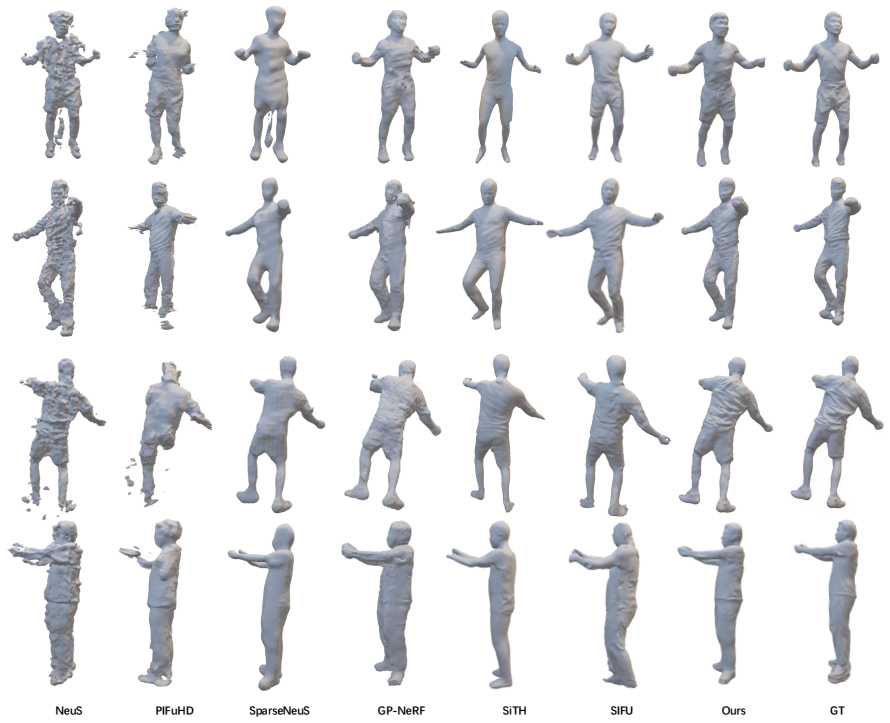
On the paper's own terms, the central claim is that a sparse-view human reconstruction network fails not because there is too little image evidence but because naive feature averaging cannot tell occluded from visible points. DiHuR solves this by making the 6,890 SMPL vertex positions the carriers of correspondence: learned tokens query each source view, self-attention exchanges information among vertices, and KNN interpolation delivers a dense feature field that guides SDF prediction. The second half of the claim is that a super-resolution latent diffusion model, fed an upsampled rendered normal map and the text condition 'Best quality, human, normal map', provides enough geometric gradient via score distillation to add wrinkles and folds in a roughly two-minute per-scene finetune, without 3D supervision. Combined, the two priors achieve Chamfer distance 1.117 and normal consistency 0.779 on THuman, 0.790 and 0.767 on ZJU-MoCap, and 1.23 and 0.753 on zero-shot HuMMan, beating the strongest compared method, SIFU, in every row.
Load-bearing premise
The approach rests on the assumption that the 2D diffusion model, conditioned on a low-resolution normal map and the text prompt 'Best quality, human, normal map', provides honest geometric detail through its score-distillation gradients, rather than inventing wrinkles that look right in 2D but are wrong on the actual 3D body.
Editorial extensions
If this is right
- With three cameras spaced roughly 120 degrees apart, the reported Chamfer distance on THuman falls to 1.117, indicating a minimal capture rig can produce avatar-quality surfaces.
- A single trained network runs zero-shot on HuMMan without retraining, so new subjects can be absorbed from just a handful of views.
- Novel view synthesis improves alongside geometry: the method reports higher PSNR and SSIM than prior generalizable human NeRFs on ZJU-MoCap and THuman, attributed to blending weights that benefit from better geometry.
- Per-scene refinement takes about 150 iterations, roughly two minutes, so adding diffusion guidance remains practical for capture workflows.
- Because no 3D ground truth is required, the same recipe could be applied to any calibrated multi-view capture of articulated subjects.
Reading between the lines
- Beyond the paper, the SMPL-token design is likely portable to other parametric models with consistent vertex semantics, such as articulated hands or animal bodies, though the paper only demonstrates humans.
- A direct audit of the diffusion prior is still open: comparing SDS-refined normals against high-resolution ground-truth scans would show how much of the added detail is recovered geometry versus plausible hallucination, which aggregate Chamfer and normal-consistency numbers cannot separate.
- Because the tokens carry the cross-identity prior through SMPL correspondences, their quality is bounded by SMPL registration accuracy; a poor pose or shape fit would likely corrupt the semantic alignment and spoil the geometry even with diffusion guidance.
- The multi-target patch sampling principle, forcing rays from different views to intersect the same body part, could be adopted by other sparse-view reconstruction methods as a cheap way to impose multi-view consistency.
Signed reviews
Editorial analysis
A structured set of objections, weighed in public.
Referee Report
Summary. DiHuR proposes a generalizable human reconstruction method from sparse, minimally overlapping multi-view images. The method combines learnable tokens attached to SMPL vertices that aggregate sparse-view image features, an SDF-based volume rendering pipeline, and a per-scene inference-time finetuning stage driven by score distillation sampling (SDS) from a pretrained super-resolution diffusion model. The paper claims state-of-the-art results on THuman, ZJU-MoCap, and HuMMan datasets for both 3D reconstruction and novel view synthesis, with all training done using multi-view images only and no 3D supervision. The main architectural components are a learnable SMPL-token cross-view attention module, KNN-based feature interpolation, a multi-target patch sampling strategy, and the diffusion-guided finetuning step.
Significance. If the claims hold, DiHuR would be a practically useful contribution to sparse-view 3D human reconstruction, combining a feed-forward generalizable radiance field with a strong 2D diffusion prior without requiring 3D supervision. The paper is clearly written, the ablations in Table 7 confirm that each proposed component contributes to the reported quality, and the evaluation covers both within-dataset and cross-dataset settings. The main limitation is that the reported headline numbers are obtained after a per-scene inference-time finetuning step that is not applied to most baselines, so the claimed advantage of the generalizable architecture is not cleanly established. No code or repeated-run statistics are provided, which limits the verifiability of the moderate performance margins over prior work.
major comments (4)
- [§3.4–§3.5, Tables 1–3] The comparisons in Tables 1–3 are not apples-to-apples. DiHuR is evaluated after 150 iterations of per-scene finetuning (Sec. 3.4) that includes the SDS loss together with color, Eikonal, and smoothness losses, whereas the baselines SparseNeuS, GP-NeRF, SiTH, and SIFU are evaluated as frozen feed-forward networks. The manuscript never reports the zero-shot output of the pretrained DiHuR network before any finetuning. The 'w/o diffusion guidance' row in Table 7 does not resolve this confound: per Sec. 3.5, the per-scene finetuning stage still includes Lrgb, Leik, and Lsm even when Lsds is removed. Therefore the true contribution of the learnable SMPL tokens and multi-target training to generalization remains unknown, and the reported margins over SIFU (e.g., THuman NC 0.779 vs 0.741) may be substantially produced by the extra per-scene optimization budget.
- [Table 4] The P.S. (per-scene optimization) column in Table 4 is mislabeled for the proposed method. DiHuR performs per-scene finetuning with SDS at inference, so it should be marked as ✓ under the same definition used for NB. Marking Ours as ✗ obscures a key difference between DiHuR and the feed-forward baselines (NHP, MPS-NeRF, GP-NeRF) in the novel-view-synthesis comparison and makes the table misleading as reported.
- [§3.4, Eq. (11)] The diffusion prior is a latent super-resolution model trained on natural RGB images, but it is applied here to rendered normal maps conditioned on a text prompt. The paper provides no independent validation of the geometric correctness of these SDS gradients, e.g., by comparing SDS-refined normals or depth against ground truth. The final CD/NC metrics conflate the diffusion prior's geometric contribution with the per-scene finetuning, so it is unclear whether the diffusion guidance is a reliable geometric prior or a source of hallucinated detail. An experiment that compares SDS-refined normals to ground-truth normals, or an ablation with an equal-budget per-scene optimization without SDS, is needed to substantiate the claim that the diffusion prior improves geometry.
- [Tables 1–3, Table 2] No error bars, standard deviations, or repeated-run statistics are reported. The performance margins over prior methods, such as THuman NC 0.779 vs 0.741 and CD 1.117 vs 1.521, are reported without any measure of variability, making it impossible to assess whether the improvements are statistically significant, especially because each test subject receives an independent per-scene finetuning step.
minor comments (5)
- [Sec. 2] The sentence 'subsequently, generalizable NeRFs are [2,8,25,28] are proposed' contains a duplicated 'are' and should be rephrased for clarity.
- [Sec. 2, reference list] The citation in Sec. 2 appears as '[?, 9, 13]' with an unresolved placeholder, which should be fixed before publication.
- [Eq. (2) and Eq. (9)] Equation (2) is missing a closing parenthesis in the SoftMax expression, and Eq. (9) writes 'i' where the per-point color 'c_i' should appear in the volume rendering accumulation.
- [Table 7] The row label 'w/o leanable code' contains a typo; it should read 'w/o learnable code'.
- [Fig. 2 caption] The caption contains an erroneous space in 'V olume rendering' and should be corrected to 'Volume rendering'.
Circularity Check
No significant circularity: the central claims are empirically validated on held-out external benchmarks, and the diffusion prior is an external pretrained model.
full rationale
This paper is an empirical systems paper whose central claims are validated on held-out test splits of THuman, ZJU-MoCap, and HuMMan. The diffusion prior enters through the SDS loss (Eq. 11) using a pretrained external super-resolution diffusion model; the gradients come from an external noise predictor conditioned on a rendered normal map, so the geometry enhancement is not equivalent to the model's own output by construction. The learnable SMPL tokens are trained with multi-view RGB supervision and tested on unseen identities; no fitted parameter is renamed as a prediction. The only self-citation is reference [3] in the Related Work section, associated with the unresolved '[?]' in the sentence about 3D Gaussian splatting with human template models, and it is not load-bearing for the method. The per-scene SDS finetuning is a possible confound when comparing against frozen baselines, but that is an evaluation attribution concern, not circularity: the reported metrics are on held-out views, and the finetuning does not fit the evaluation targets. No equation reduces a claimed prediction to an input by construction, and no load-bearing argument depends on a self-citation. Thus the derivation chain is self-contained with respect to circularity.
Assumptions & free parameters
free parameters (5)
- SDS timestep range t =
0.52 to 0.98
- Classifier-free guidance weight =
7.5
- Loss weights λrgb, λsds, λeik, λsm =
not reported
- Number of target views L and patch sampling details =
not reported
- K in KNN feature interpolation =
not reported
assumptions (4)
- domain assumption SMPL vertices map to consistent semantic locations across human identities, so learnable tokens trained on one set transfer to novel subjects.
- domain assumption The pretrained super-resolution diffusion model, conditioned on low-res rendered normals and a text prompt, provides valid SDF gradient signals via SDS.
- domain assumption Sampling rays from patches of the same segmentation part in multiple views produces intersecting rays that enforce multi-view SDF consistency.
- standard math NeuS volume rendering and Eikonal regularization correctly convert predicted SDFs to densities and stable surfaces.
invented entities (1)
-
Learnable tokens anchored to each of the 6,890 SMPL vertices
Cite this review
Pith. "Pith review of DiHuR: Diffusion-Guided Generalizable Human Reconstruction." pith.science (2026). https://pith.science/paper/ZXJ4JQ22
@misc{pith2026241111903,
  author       = {Pith},
  title        = {Pith review of: DiHuR: Diffusion-Guided Generalizable Human Reconstruction},
  year         = {2026},
  howpublished = {\url{https://pith.science/paper/ZXJ4JQ22}},
  note         = {Machine review of arXiv:2411.11903}
}
read the original abstract
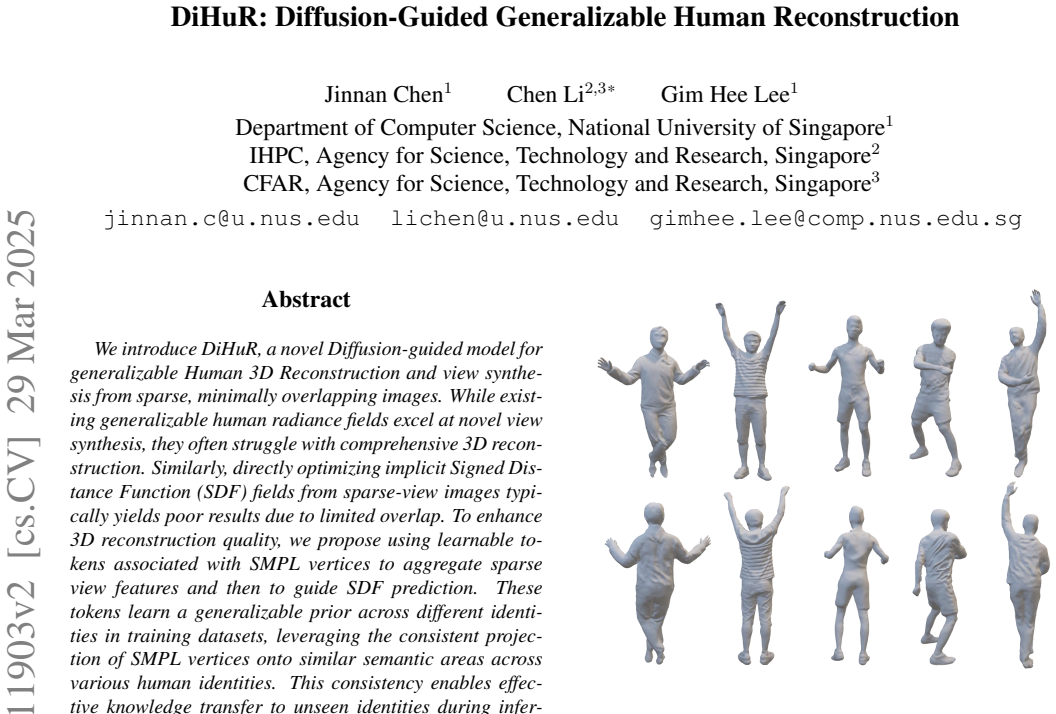
We introduce DiHuR, a novel Diffusion-guided model for generalizable Human 3D Reconstruction and view synthesis from sparse, minimally overlapping images. While existing generalizable human radiance fields excel at novel view synthesis, they often struggle with comprehensive 3D reconstruction. Similarly, directly optimizing implicit Signed Distance Function (SDF) fields from sparse-view images typically yields poor results due to limited overlap. To enhance 3D reconstruction quality, we propose using learnable tokens associated with SMPL vertices to aggregate sparse view features and then to guide SDF prediction. These tokens learn a generalizable prior across different identities in training datasets, leveraging the consistent projection of SMPL vertices onto similar semantic areas across various human identities. This consistency enables effective knowledge transfer to unseen identities during inference. Recognizing SMPL's limitations in capturing clothing details, we incorporate a diffusion model as an additional prior to fill in missing information, particularly for complex clothing geometries. Our method integrates two key priors in a coherent manner: the prior from generalizable feed-forward models and the 2D diffusion prior, and it requires only multi-view image training, without 3D supervision. DiHuR demonstrates superior performance in both within-dataset and cross-dataset generalization settings, as validated on THuman, ZJU-MoCap, and HuMMan datasets compared to existing methods.
Figures


Figures from the paper (4 more)


Forward citations
Cited by 1 Pith paper
-
HumanRAM: Feed-forward Human Reconstruction and Animation Model using Transformers
A feed-forward transformer model that adds SMPL-X neural-texture pose conditioning to LVSM, enabling single-pass human novel-view and novel-pose synthesis that surpasses prior generalizable methods on four benchmarks.
Reference graph
Works this paper leans on
-
[1]
HuMMan: Multi-modal 4d human dataset for versatile sensing and modeling
Zhongang Cai, Daxuan Ren, Ailing Zeng, Zhengyu Lin, Tao Yu, Wenjia Wang, Xiangyu Fan, Yang Gao, Yifan Yu, Liang Pan, Fangzhou Hong, Mingyuan Zhang, Chen Change Loy, Lei Yang, and Ziwei Liu. HuMMan: Multi-modal 4d human dataset for versatile sensing and modeling. In ECCV, 2022. 5, 7
work page 2022
-
[2]
Mvsnerf: Fast general- izable radiance field reconstruction from multi-view stereo
Anpei Chen, Zexiang Xu, Fuqiang Zhao, Xiaoshuai Zhang, Fanbo Xiang, Jingyi Yu, and Hao Su. Mvsnerf: Fast general- izable radiance field reconstruction from multi-view stereo. In CVPR, 2021. 2
work page 2021
-
[3]
Gener- alizable human gaussians from single-view image
Jinnan Chen, Chen Li, Jianfeng Zhang, Lingting Zhu, Buzhen Huang, Hanlin Chen, and Gim Hee Lee. Gener- alizable human gaussians from single-view image. arXiv preprint arXiv:2406.06050, 2024
arXiv 2024
-
[4]
Geometry-guided progressive nerf for generalizable and efficient neural human rendering
Mingfei Chen, Jianfeng Zhang, Xiangyu Xu, Lijuan Liu, Yu- jun Cai, Jiashi Feng, and Shuicheng Yan. Geometry-guided progressive nerf for generalizable and efficient neural human rendering. In ECCV, 2022. 1, 2, 5, 6, 7, 8
work page 2022
-
[5]
Mps-nerf: Generalizable 3d human rendering from multiview images
Xiangjun Gao, Jiaolong Yang, Jongyoo Kim, Sida Peng, Zicheng Liu, and Xin Tong. Mps-nerf: Generalizable 3d human rendering from multiview images. PAMI, 2022. 1, 5, 6, 7
work page 2022
-
[6]
Implicit geometric regularization for learning shapes
Amos Gropp, Lior Yariv, Niv Haim, Matan Atzmon, and Yaron Lipman. Implicit geometric regularization for learning shapes. In ICML, 2020. 5
work page 2020
-
[7]
Sith: Single- view textured human reconstruction with image-conditioned diffusion
Hsuan-I Ho, Jie Song, and Otmar Hilliges. Sith: Single- view textured human reconstruction with image-conditioned diffusion. In CVPR, 2024. 2, 5, 6, 7
work page 2024
-
[8]
Sherf: Generalizable human nerf from a single image
Shoukang Hu, Fangzhou Hong, Liang Pan, Haiyi Mei, Lei Yang, and Ziwei Liu. Sherf: Generalizable human nerf from a single image. arXiv preprint:2303.12791, 2023. 1, 2
arXiv 2023
Show all 30 references
-
[9]
Gauhuman: Articulated gaus- sian splatting from monocular human videos
Shoukang Hu and Ziwei Liu. Gauhuman: Articulated gaus- sian splatting from monocular human videos. arXiv preprint arXiv:2312.02973, 2023. 2
2023 arXiv
-
[10]
TeCH: Text-guided Reconstruction of Lifelike Clothed Humans
Yangyi Huang, Hongwei Yi, Yuliang Xiu, Tingting Liao, Ji- axiang Tang, Deng Cai, and Justus Thies. TeCH: Text-guided Reconstruction of Lifelike Clothed Humans. In 3DV, 2024. 2
2024
-
[11]
Neural human performer: Learning generalizable ra- diance fields for human performance rendering
Youngjoong Kwon, Dahun Kim, Duygu Ceylan, and Henry Fuchs. Neural human performer: Learning generalizable ra- diance fields for human performance rendering. NeurIPS,
-
[12]
Magic3d: High-resolution text-to-3d content creation
Chen-Hsuan Lin, Jun Gao, Luming Tang, Towaki Takikawa, Xiaohui Zeng, Xun Huang, Karsten Kreis, Sanja Fidler, Ming-Yu Liu, and Tsung-Yi Lin. Magic3d: High-resolution text-to-3d content creation. In CVPR, 2023. 2
2023
-
[13]
Humangaus- sian: Text-driven 3d human generation with gaussian splat- ting
Xian Liu, Xiaohang Zhan, Jiaxiang Tang, Ying Shan, Gang Zeng, Dahua Lin, Xihui Liu, and Ziwei Liu. Humangaus- sian: Text-driven 3d human generation with gaussian splat- ting. arXiv preprint arXiv:2311.17061, 2023. 2
2023 arXiv
-
[14]
Sparseneus: Fast generalizable neural sur- face reconstruction from sparse views
Xiaoxiao Long, Cheng Lin, Peng Wang, Taku Komura, and Wenping Wang. Sparseneus: Fast generalizable neural sur- face reconstruction from sparse views. In ECCV, 2022. 5, 6, 7
2022
-
[15]
Matthew Loper, Naureen Mahmood, Javier Romero, Gerard Pons-Moll, and Michael J. Black. Smpl: a skinned multi- person linear model. In ICCV, 2015. 1, 2
2015
-
[16]
Srinivasan, Matthew Tancik, Jonathan T
Ben Mildenhall, Pratul P. Srinivasan, Matthew Tancik, Jonathan T. Barron, Ravi Ramamoorthi, and Ren Ng. Nerf: Representing scenes as neural radiance fields for view syn- thesis. In ECCV, 2020. 1
2020
-
[17]
Ani- matable neural radiance fields for modeling dynamic human bodies
Sida Peng, Junting Dong, Qianqian Wang, Shangzhan Zhang, Qing Shuai, Xiaowei Zhou, and Hujun Bao. Ani- matable neural radiance fields for modeling dynamic human bodies. In ICCV, 2021. 2, 7
2021
-
[18]
Neural body: Implicit neural representations with structured latent codes for novel view synthesis of dynamic humans
Sida Peng, Yuanqing Zhang, Yinghao Xu, Qianqian Wang, Qing Shuai, Hujun Bao, and Xiaowei Zhou. Neural body: Implicit neural representations with structured latent codes for novel view synthesis of dynamic humans. In CVPR,
-
[19]
Barron, and Ben Milden- hall
Ben Poole, Ajay Jain, Jonathan T. Barron, and Ben Milden- hall. Dreamfusion: Text-to-3d using 2d diffusion. In ICLR,
-
[20]
High-resolution image syn- thesis with latent diffusion models
Robin Rombach, Andreas Blattmann, Dominik Lorenz, Patrick Esser, and Bj¨orn Ommer. High-resolution image syn- thesis with latent diffusion models. In CVPR, 2022. 2
2022
-
[21]
Pifu: Pixel-aligned implicit function for high-resolution clothed human digitiza- tion
Shunsuke Saito, Zeng Huang, Ryota Natsume, Shigeo Mor- ishima, Angjoo Kanazawa, and Hao Li. Pifu: Pixel-aligned implicit function for high-resolution clothed human digitiza- tion. In ICCV, 2019. 2
2019
-
[22]
Pifuhd: Multi-level pixel-aligned implicit function for high-resolution 3d human digitization
Shunsuke Saito, Tomas Simon, Jason Saragih, and Hanbyul Joo. Pifuhd: Multi-level pixel-aligned implicit function for high-resolution 3d human digitization. In CVPR, 2020. 2, 5, 6
2020
-
[23]
A-nerf: Articulated neural radiance fields for learn- ing human shape, appearance, and pose
Shih-Yang Su, Frank Yu, Michael Zollh ¨ofer, and Helge Rhodin. A-nerf: Articulated neural radiance fields for learn- ing human shape, appearance, and pose. In NeurIPS, 2021. 1, 2
2021
-
[24]
Neus: Learning neural implicit surfaces by volume rendering for multi-view reconstruction
Peng Wang, Lingjie Liu, Yuan Liu, Christian Theobalt, Taku Komura, and Wenping Wang. Neus: Learning neural implicit surfaces by volume rendering for multi-view reconstruction. In NeurIPS, 2021. 4, 6, 7
2021
-
[25]
Barron, Ricardo Martin- Brualla, Noah Snavely, and Thomas Funkhouser
Qianqian Wang, Zhicheng Wang, Kyle Genova, Pratul Srini- vasan, Howard Zhou, Jonathan T. Barron, Ricardo Martin- Brualla, Noah Snavely, and Thomas Funkhouser. Ibrnet: Learning multi-view image-based rendering. InCVPR, 2021. 2
2021
-
[26]
Arah: Animatable volume rendering of articulated hu- man sdfs
Shaofei Wang, Katja Schwarz, Andreas Geiger, and Siyu Tang. Arah: Animatable volume rendering of articulated hu- man sdfs. In ECCV, 2022. 1
2022
-
[27]
Yuliang Xiu, Jinlong Yang, Xu Cao, Dimitrios Tzionas, and Michael J. Black. Econ: Explicit clothed humans optimized via normal integration. In CVPR, 2023. 2 9
2023
-
[28]
pixelNeRF: Neural radiance fields from one or few images
Alex Yu, Vickie Ye, Matthew Tancik, and Angjoo Kanazawa. pixelNeRF: Neural radiance fields from one or few images. In CVPR, 2021. 2
2021
-
[29]
Sifu: Side- view conditioned implicit function for real-world usable clothed human reconstruction
Zechuan Zhang, Zongxin Yang, and Yi Yang. Sifu: Side- view conditioned implicit function for real-world usable clothed human reconstruction. In CVPR, 2024. 2, 5, 6, 7
2024
-
[30]
Deephuman: 3d human reconstruction from a single image
Zerong Zheng, Tao Yu, Yixuan Wei, Qionghai Dai, and Yebin Liu. Deephuman: 3d human reconstruction from a single image. In ICCV, 2019. 5, 7 10
2019
Reviewed August 12, 2026 · model on record in the stance chip above.
Discussion (0). Continue with ORCID to comment.