Ti-iLSTM: A TinyDL Approach for Logic-Level Anomaly Detection in Industrial Water Treatment Systems
Pith reviewed 2026-05-20 20:33 UTC · model grok-4.3
The pith
A memory-optimized incremental LSTM detects logic-layer anomalies in industrial water treatment by learning sequence patterns in process measurements.
A machine-rendered reading of the paper's core claim, the machinery that carries it, and where it could break.
Core claim
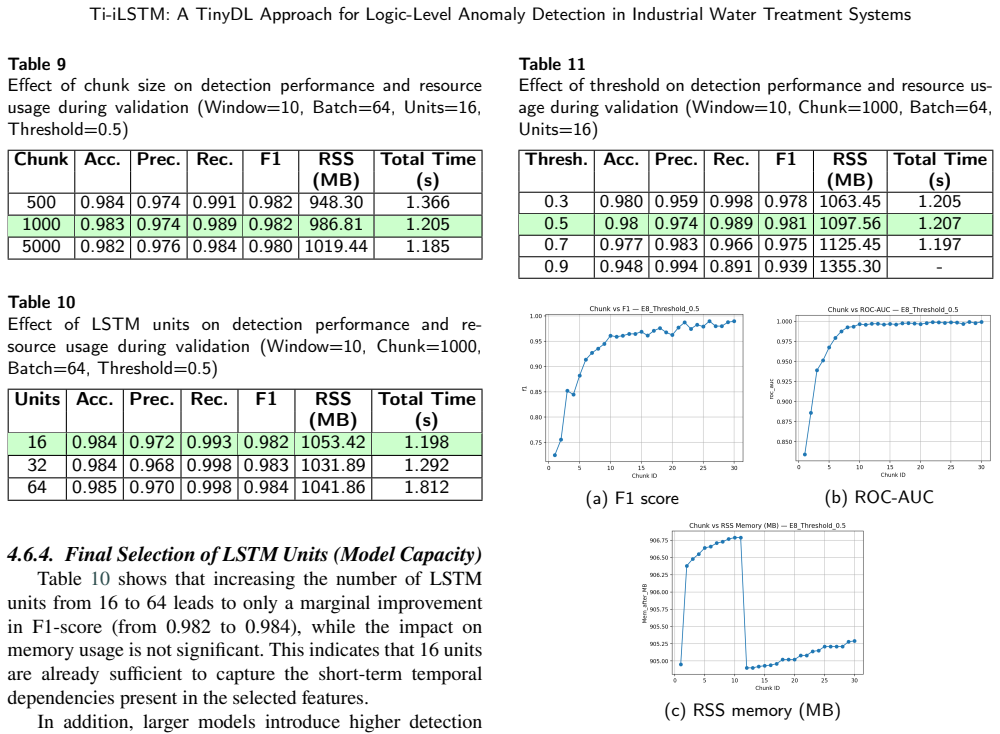
The central claim is that combining logic-aware supervision with a space- and memory-optimized incremental LSTM produces an accurate anomaly detector that fits inside Programmable Logic Controllers. On the SWaT dataset the model reaches F1-score 0.983 and ROC-AUC 0.998; the same architecture, without major redesign, maintains usable performance on the independent WADI dataset.
What carries the argument
Ti-iLSTM, a TinyDL-based incremental LSTM that shrinks the memory and parameter footprint of standard LSTM so the network can run on-device inside PLCs while still learning temporal cause-and-effect violations from raw process measurements.
If this is right
- Anomaly detection becomes feasible inside existing PLC hardware without additional servers or specialized chips.
- Detection no longer requires hand-coded rules for every causal relationship in the process.
- The same trained model transfers to a second industrial water-treatment testbed with only minor retraining.
- Real-time response to stealthy attacks becomes possible at the edge rather than after data leaves the plant.
- Memory and compute savings allow the detector to share the PLC with normal control logic.
Where Pith is reading between the lines
- The same optimization pattern could be applied to other sequence models such as GRUs or transformers to further reduce size for even smaller controllers.
- Adding a small amount of explicit rule information as auxiliary input might raise performance on anomalies that are still missed by pure sequence learning.
- Deployment on actual PLC firmware would reveal whether the reported memory figures survive compilation and real-time scheduling constraints.
- The method may generalize to other cyber-physical domains such as power grids or manufacturing lines that use similar PLC architectures.
Load-bearing premise
Logic-layer deception anomalies that keep measurements numerically plausible can still be spotted by sequence learning on those measurements alone, without any explicit model of the control rules.
What would settle it
A new test dataset containing logic anomalies whose measurement sequences closely mimic normal operation; if the model’s F1-score falls below 0.7 on this set while threshold-based detectors also fail, the sequence-only premise does not hold.
Figures



read the original abstract
Industrial Water Treatment Systems (IWTS) are safety critical cyber-physical infrastructures and due to increased connectivity, these systems are exposed to cyber threats that can manipulate process behaviour without creating obvious devices outliers. In particular, logic-layer deception anomalies can preserve numerically plausible measurements while breaking expected cause-and-effect relationships in the control process. These attacks are difficult to detect using threshold-based monitoring or require heavy server-oriented anomaly detection models. This paper explores the potential of Tiny Deep Learning (TinyDL) to provide lightweight on-device logic-level anomaly detection for resource constrained Programmable Logic Controllers (PLCs). We propose a novel framework, TinyDL-based incremental LSTM (Ti-iLSTM) which optimises the memory and space foot print of Long Short-Term Memory (LSTM), to detect logic-layer inconsistencies in Programmable Logic Controller (PLC) based Industrial Water Treatment Systems (IWTS). Experiments on the publicly available SWaT dataset show that the optimised model achieves high detection performance (F1-score=0.983 and ROC-AUC=0.998). A deployment-style validation on the WADI dataset confirms that the proposed light-weight framework remains applicable beyond a single dataset. The research demonstrates that combining logic-aware supervision with Tiny Deep Learning (TinyDL) sequence learning creates an efficient and accurate anomaly detection suitable for resource constrained Programmable Logic Controllers (PLCs) in industrial environments.
Editorial analysis
A structured set of objections, weighed in public.
Referee Report
Summary. The paper proposes Ti-iLSTM, a Tiny Deep Learning optimized incremental LSTM for lightweight on-device detection of logic-layer deception anomalies in Industrial Water Treatment Systems (IWTS). These anomalies preserve numerically plausible sensor values while violating cause-and-effect relationships enforced by PLC control logic. The model is trained on process variable sequences from the SWaT dataset, achieving F1-score 0.983 and ROC-AUC 0.998, with deployment-style validation on the WADI dataset to demonstrate cross-dataset applicability for resource-constrained PLCs.
Significance. If the central claim holds, the work would demonstrate that TinyDL sequence models can perform logic-level anomaly detection without heavy server infrastructure, addressing a practical gap in securing safety-critical cyber-physical systems against deception attacks that evade threshold-based monitoring.
major comments (2)
- [Section 3] Section 3 (Ti-iLSTM architecture and training): The manuscript claims 'logic-aware supervision' is combined with TinyDL sequence learning, yet provides no description of how PLC control rules (e.g., interlock logic, actuator-state dependencies, or cause-effect constraints) are encoded, injected, or used as supervision signals. Without this mechanism, it remains unclear whether the reported performance reflects detection of logic violations or simply statistical outlier detection on temporal correlations.
- [Experiments] Experimental evaluation (SWaT and WADI results): High F1 and ROC-AUC values are presented, but the paper supplies no ablation studies, baseline comparisons against models that explicitly encode control logic, or error analysis of false positives on deception-style attacks. This leaves open whether the performance is attributable to the claimed logic-level capability or to standard sequence modeling.
minor comments (2)
- [Abstract] The abstract and introduction use the term 'logic-aware supervision' without a concise definition or forward reference to the section where the supervision procedure is specified.
- [Figures/Tables] Figure captions and table headings should explicitly state whether reported metrics are on the test set, validation set, or cross-dataset transfer to avoid ambiguity in the deployment-style validation claim.
Simulated Author's Rebuttal
We thank the referee for their constructive and detailed feedback. The comments identify key areas where additional clarification and experimental support are needed to strengthen the claims regarding logic-aware supervision and the attribution of performance to logic-level detection. We address each major comment below and will revise the manuscript accordingly.
read point-by-point responses
-
Referee: [Section 3] Section 3 (Ti-iLSTM architecture and training): The manuscript claims 'logic-aware supervision' is combined with TinyDL sequence learning, yet provides no description of how PLC control rules (e.g., interlock logic, actuator-state dependencies, or cause-effect constraints) are encoded, injected, or used as supervision signals. Without this mechanism, it remains unclear whether the reported performance reflects detection of logic violations or simply statistical outlier detection on temporal correlations.
Authors: We appreciate the referee highlighting this ambiguity. In the submitted manuscript, logic-aware supervision is implemented implicitly by training exclusively on normal operational sequences from SWaT that respect the underlying PLC control logic's cause-and-effect relationships; the incremental LSTM learns to model these expected temporal patterns, and anomalies are detected as deviations. No explicit rule injection into the architecture or loss function is performed. We agree that the current text does not sufficiently describe the data curation process that enforces these constraints. We will revise Section 3 to add a dedicated subsection explaining how interlock logic and actuator dependencies are used during dataset preparation and sequence construction, making clear that the approach relies on data-driven learning of logic-compliant patterns rather than symbolic rule encoding. revision: yes
-
Referee: [Experiments] Experimental evaluation (SWaT and WADI results): High F1 and ROC-AUC values are presented, but the paper supplies no ablation studies, baseline comparisons against models that explicitly encode control logic, or error analysis of false positives on deception-style attacks. This leaves open whether the performance is attributable to the claimed logic-level capability or to standard sequence modeling.
Authors: We acknowledge that the experimental section would benefit from stronger controls to isolate the contribution of the logic-aware aspect. The reported F1 and AUC are measured on SWaT deception attacks specifically constructed to violate cause-effect logic while preserving plausible values, with cross-dataset validation on WADI. To address the referee's concern, we will add ablation studies (e.g., non-incremental LSTM and non-TinyDL variants) and a baseline comparison against a lightweight rule-based checker that directly verifies actuator-sensor dependencies extracted from system documentation. We will also include a targeted error analysis of false positives on the deception attacks. These results and the corresponding discussion will be incorporated into the revised manuscript. revision: yes
Circularity Check
No significant circularity; results are experimental outcomes on public datasets
full rationale
The paper proposes Ti-iLSTM as an optimized incremental LSTM variant for anomaly detection and reports F1/ROC-AUC metrics from direct experiments on the SWaT and WADI datasets. No equations, derivations, or self-citations appear that reduce the claimed performance to fitted parameters by construction, self-definitional loops, or load-bearing prior work by the same authors. The central claims rest on empirical validation rather than any mathematical reduction to inputs.
Axiom & Free-Parameter Ledger
free parameters (1)
- LSTM optimization hyperparameters
axioms (1)
- domain assumption Logic-layer deception anomalies preserve numerically plausible measurements while breaking expected cause-and-effect relationships
invented entities (1)
-
Ti-iLSTM
no independent evidence
Lean theorems connected to this paper
-
IndisputableMonolith/Cost/FunctionalEquation.leanwashburn_uniqueness_aczel unclear?
unclearRelation between the paper passage and the cited Recognition theorem.
We propose a novel framework, TinyDL-based incremental LSTM (Ti-iLSTM) which optimises the memory and space foot print of Long Short-Term Memory (LSTM), to detect logic-layer inconsistencies in Programmable Logic Controller (PLC) based Industrial Water Treatment Systems (IWTS).
-
IndisputableMonolith/Foundation/ArithmeticFromLogic.leanLogicNat induction and embed unclear?
unclearRelation between the paper passage and the cited Recognition theorem.
anomaly labels are constructed without relying on dataset-provided attack annotations. The labels in this study are derived from interpretable process rules that capture violations of expected cause-and-effect relationships between sensors and actuators
What do these tags mean?
- matches
- The paper's claim is directly supported by a theorem in the formal canon.
- supports
- The theorem supports part of the paper's argument, but the paper may add assumptions or extra steps.
- extends
- The paper goes beyond the formal theorem; the theorem is a base layer rather than the whole result.
- uses
- The paper appears to rely on the theorem as machinery.
- contradicts
- The paper's claim conflicts with a theorem or certificate in the canon.
- unclear
- Pith found a possible connection, but the passage is too broad, indirect, or ambiguous to say the theorem truly supports the claim.
Reference graph
Works this paper leans on
-
[1]
Abraham, D., Erceylan, G., Gkioulos, V., Houmb, S.H., 2025. To- wardsEnhancedCybersecurityinIndustrialControlSystems:ASys- tematic Review of Context-Based Modeling, Digital Twins, and Ma- chineLearningApproaches. InternationalJournalofInformationSe- curity 24, 243.https://dl.acm.org/doi/10.1007/s10207-025-01158-1
-
[2]
Ahmed, C.M., Palleti, V.R., Mathur, A.P., 2017. Wadi: a water distributiontestbedforresearchinthedesignofsecurecyberphysical systems, in: Proceedings of the 3rd international workshop on cyber- physical systems for smart water networks, pp. 25–28.https://doi. org/10.1145/3055366.3055375
-
[3]
Aly, M., Alotaibi, N.M., 2025. Shap enhanced transformer gwo boosting model for transparent and robust anomaly detection in iiot environments. Scientific Reports 15, 41037
work page 2025
-
[4]
Aly, M., Behiry, M.H., 2025. Enhancing anomaly detection in iot-driven factories using logistic boosting, random forest, and svm: A comparative machine learning approach. Scientific Re- ports 15. doi:10.1038/s41598-025-08436-x.https://doi.org/10.1038/ s41598-025-08436-x
work page doi:10.1038/s41598-025-08436-x.https://doi.org/10.1038/ 2025
-
[5]
Cybersecurityof waterscadasystems—parti:Analysisandexperimentationofstealthy deception attacks
Amin,S.,Litrico,X.,Sastry,S.,Bayen,A.M.,2013. Cybersecurityof waterscadasystems—parti:Analysisandexperimentationofstealthy deception attacks. IEEE Transactions on Control Systems Technol- ogy 21, 1963–1970. doi:10.1109/TCST.2012.2211873.https://bayen. berkeley.edu/sites/default/files/cyber_security_of_water_i.pdf
-
[6]
An adaptable and unsupervised tinyml anomaly detection sys- tem for extreme industrial environments
Antonini, M., Pincheira, M., Vecchio, M., Antonelli, F., 2023. An adaptable and unsupervised tinyml anomaly detection sys- tem for extreme industrial environments. Sensors 23, 2344. Https://www.mdpi.com/1424-8220/23/4/2344
work page 2023
-
[7]
Aslam, M.M., De Silva, L.C., Haji Mohd Apong, R.A.A., Tufail, A.,
-
[8]
An optimized anomaly detection framework in industrial con- trolsystemsthroughgreywolfoptimizerandautoencoderintegration. Scientific Reports 15. doi:10.1038/s41598-025-12775-0
-
[9]
Mlino bench: A compre- hensivebenchmarkingtoolforevaluatingmlmodelsonedgedevices
Baciu, V.E., Stiens, J., da Silva, B., 2024. Mlino bench: A compre- hensivebenchmarkingtoolforevaluatingmlmodelsonedgedevices. Journal of Systems Architecture 155, 103262
work page 2024
-
[10]
Bahadoripour, S., MacDonald, E., Karimipour, H., 2023. A deep multi-modal cyber-attack detection in industrial control systems, in: 2023IEEEInternationalConferenceonIndustrialTechnology(ICIT), IEEE. pp. 1–6
work page 2023
-
[11]
Pearson correlation coefficient, in: Noise reduction in speech processing
Benesty, J.,Chen, J.,Huang, Y.,Cohen, I.,2009. Pearson correlation coefficient, in: Noise reduction in speech processing. Springer, pp. 1–4
work page 2009
-
[12]
Anomaly Detection for a Water Treatment System Based on One-Class Neural Network
Boateng, E.A., Bruce, J.W., Talbert, D.A., 2022. Anomaly Detection for a Water Treatment System Based on One-Class Neural Network. IEEE access 10, 115179–115191
work page 2022
-
[13]
Breiman, L., 2001. Random forests. Machine learning 45, 5–32. https://link.springer.com/article/10.1023/A:1010933404324
-
[14]
Smote: synthetic minority over-sampling technique
Chawla, N.V., Bowyer, K.W., Hall, L.O., Kegelmeyer, W.P., 2002. Smote: synthetic minority over-sampling technique. Journal of arti- ficial intelligence research 16, 321–357.https://dl.acm.org/doi/10. 5555/1622407.1622416
-
[15]
Precision and recall - wikipedia
Contributors to Wikimedia projects, 2007. Precision and recall - wikipedia. URL:https://en.wikipedia.org/wiki/Precision_and_ recall
work page 2007
-
[16]
An introduction to ROC analysis
Fawcett, T., 2006. An introduction to ROC analysis. Pattern recognition letters 27, 861–874
work page 2006
-
[17]
Learning to forget: Continual prediction with lstm
Gers, F.A., Schmidhuber, J., Cummins, F., 2000. Learning to forget: Continual prediction with lstm. Neural computation 12, 2451–2471. https://dl.acm.org/doi/10.1162/089976600300015015
-
[18]
Gulzar,Q.,Mustafa,K.,2024. Ananalyticalsurveyofcyber-physical systems in water treatment and distribution: Security challenges, intrusion detection, and future directions. Security and Privacy 7, e440
work page 2024
-
[19]
Gene selection for cancer classification using support vector machines
Guyon, I., Weston, J., Barnhill, S., Vapnik, V., 2002. Gene selection for cancer classification using support vector machines. Machine learning 46, 389–422.https://link.springer.com/article/10.1023/ A:1012487302797
work page 2002
-
[20]
Cybersecurity in water distribution networks: a systematic review of ai-based detection algorithms
Habib,M.A.,Jurcut,A.D.,Ahmed,H.,Wei,W.,Salauddin,M.,2026. Cybersecurity in water distribution networks: a systematic review of ai-based detection algorithms. Water 18, 519
work page 2026
-
[21]
Hindy, H., Brosset, D., Bayne, E., Seeam, A., Bellekens, X., 2018. Improvingsiemforcriticalscadawaterinfrastructuresusingmachine learning,in:InternationalWorkshoponSecurityandPrivacyRequire- ments Engineering, Springer. pp. 3–19.https://link.springer.com/ chapter/10.1007/978-3-030-12786-2_1
-
[22]
Hochreiter, S., Schmidhuber, J., 1997. Long short-term memory. Neural computation 9, 1735–1780.https://ieeexplore.ieee.org/ abstract/document/6795963
-
[23]
Homaei, M., Tarif, M., Rodríguez, P.G., Caro, A., Ávila, M., 2025. Causal digital twins for cyber-physical security in water systems: A framework for robust anomaly detection. Machine Learning with Applications , 100824
work page 2025
-
[24]
De- tecting Stealthy Attacks Against Industrial Control Systems Based on Residual Skewness Analysis
Hu, Y., Li, H., Yang, H., Sun, Y., Sun, L., Wang, Z., 2019. De- tecting Stealthy Attacks Against Industrial Control Systems Based on Residual Skewness Analysis. EURASIP Journal on Wireless Communications and Networking 2019, 74.https://doi.org/10. 1186/s13638-019-1389-1
work page 2019
-
[25]
Inoue, J., Yamagata, Y., Chen, Y., Poskitt, C.M., Sun, J., 2017. Anomaly Detection for a Water Treatment System Using Unsuper- vised Machine Learning, in: 2017 IEEE international conference on data mining workshops (ICDMW), IEEE. pp. 1058–1065.https: //ieeexplore.ieee.org/document/8215783
-
[26]
Jaw, E., Wang, X., 2021. Feature Selection and Ensemble-Based Intrusion Detection System: An Efficient and Comprehensive Ap- proach. Symmetry 13, 1764
work page 2021
-
[27]
Edge conditional node update graph neural network for multivariate time series anomaly detection
Jo, H., Lee, S.W., 2024. Edge conditional node update graph neural network for multivariate time series anomaly detection. Informa- tion Sciences 679, 121062.https://www.sciencedirect.com/science/ article/pii/S0020025524009769
work page 2024
-
[28]
Kang, E., Adepu, S., Jackson, D., Mathur, A.P., 2016. Model-Based Security Analysis of a Water Treatment System, in: Proceedings of the 2nd International Workshop on Software Engineering for Smart Cyber-Physical Systems, pp. 22–28.https://dl.acm.org/doi/10. 1145/2897035.2897041
-
[29]
Leak- age in data mining: Formulation, detection, and avoidance
Kaufman, S., Rosset, S., Perlich, C., Stitelman, O., 2012. Leak- age in data mining: Formulation, detection, and avoidance. ACM Transactions on Knowledge Discovery from Data (TKDD) 6, 1–21. https://dl.acm.org/doi/10.1145/2382577.2382579
-
[30]
Multicollinearity and misleading statistical results
Kim, J.H., 2019. Multicollinearity and misleading statistical results. Koreanjournalofanesthesiology72,558–569.https://pubmed.ncbi. nlm.nih.gov/31304696/
-
[31]
Kohavi, R., et al., 1995. A study of cross-validation and boot- strap for accuracy estimation and model selection, in: Ijcai, Mon- treal,Canada.pp.1137–1145. Https://www.ijcai.org/Proceedings/95- 2/Papers/016.pdf
work page 1995
-
[32]
Cy- berattack detection on swat plant industrial control systems using machine learning
Komol, M.M., Dong, N., Jaradat, S., Elhenawy, M., 2024. Cy- berattack detection on swat plant industrial control systems using machine learning. Artificial Intelligence and Autonomous Sys- tems 1. URL:https://doi.org/10.55092/aias20240006, doi:10.55092/ aias20240006,arXiv:https://doi.org/10.55092/aias20240006
-
[33]
Anomaly Detection Method Considering PLC Control Logic Structure for ICS Cyber Threat Detection
Lee, J.H., Ji, I.H., Jeon, S.H., Seo, J.T., 2025. Anomaly Detection Method Considering PLC Control Logic Structure for ICS Cyber Threat Detection. Applied Sciences 15, 3507
work page 2025
-
[34]
Liu, J., Sha, Y., Zhang, W., Yan, Y., Liu, X., 2024. Anomaly detection method for industrial control system operation data based on time–frequency fusion feature attention encoding. Sensors 24. doi:10.3390/s24186131.https://www.mdpi.com/1424-8220/24/18/6131
work page doi:10.3390/s24186131.https://www.mdpi.com/1424-8220/24/18/6131 2024
-
[35]
Research on anomaly detection in wastewater treatment systems based on a vae-lstm fusion model
Liu, X., Gong, Z., Zhang, X., 2025. Research on anomaly detection in wastewater treatment systems based on a vae-lstm fusion model. Water 17, 2842.https://www.mdpi.com/2073-4441/17/19/2842
work page 2025
-
[36]
Macas, M., Wu, C., 2019. An unsupervised framework for anomaly detection in a water treatment system, in: 2019 18th IEEE international conference on machine learning and applications (ICMLA), IEEE. pp. 1298–1305.https://ieeexplore.ieee.org/ document/8999210. M. Joshi et al.:Preprint submitted to ElsevierPage 13 of 14 Ti-iLSTM: A TinyDL Approach for Logic-...
-
[37]
Mathur, A.P., Tippenhauer, N.O., 2016. SWaT: A Water Treat- ment Testbed for Research and Training on ICS security, in: 2016 international workshop on cyber-physical systems for smart water networks (CySWater), IEEE. pp. 31–36.https://www.computer.org/ csdl/proceedings-article/cyswater/2016/07469060/12OmNAkEU26
work page 2016
-
[38]
Murray, G., Johnstone, M.N., Valli, C., 2017. The convergence of IT and OT in critical infrastructure, in: 15th Australian Information Security Management Conference, p. 149
work page 2017
-
[39]
Fusing design and machine learning foranomalydetectioninwatertreatmentplants
Raman, G., Mathur, A., 2024. Fusing design and machine learning foranomalydetectioninwatertreatmentplants. Electronics13,2267. https://www.mdpi.com/2079-9292/13/12/2267
work page 2024
-
[40]
Rüb, M., Tuchel, P., Sikora, A., Mueller-Gritschneder, D.,
- [41]
-
[42]
ACM Computing Surveys 58, 1–33
Somvanshi, S., Islam, M.M., Chhetri, G., Chakraborty, R., Mimi, M.S.,Shuvo,S.A.,Islam,K.S.,Javed,S.,Rafat,S.A.,Dutta,A.,etal., 2025.FromTinyMachineLearningtoTinyDeepLearning:ASurvey. ACM Computing Surveys 58, 1–33
work page 2025
-
[43]
Characterizingcyber-physicalattacksonwaterdistribution systems
Taormina, R., Galelli, S., Tippenhauer, N.O., Salomons, E., Ostfeld, A.,2017. Characterizingcyber-physicalattacksonwaterdistribution systems. Journal of Water Resources Planning and Management 143, 04017009. doi:10.1061/(ASCE)WR.1943-5452.0000749.http:// www.eladsalomons.com/wp-content/uploads/Taormina_et_al_2017.pdf
work page doi:10.1061/(asce)wr.1943-5452.0000749.http:// 2017
-
[44]
A systematic review of the state of cyber-security in water systems
Tuptuk, N., Hazell, P., Watson, J., Hailes, S., 2021. A systematic review of the state of cyber-security in water systems. Water 13, 81. https://www.mdpi.com/2073-4441/13/1/81
work page 2021
-
[45]
Urbina, D.I., Giraldo, J.A., Cardenas, A.A., Tippenhauer, N.O., Va- lente,J.,Faisal,M.,Ruths,J.,Candell,R.,Sandberg,H.,2016. Limit- ing the Impact of Stealthy Attacks on Industrial Control Systems, in: Proceedings of the 2016 ACM SIGSAC conference on computer and communications security, pp. 1092–1105.https://doi.org/10.1145/ 2976749.2978388
-
[46]
A Survey on Programmable Logic Controller Vulnerabilities, Attacks, Detections, and Forensics
Wang,Z.,Zhang,Y.,Chen,Y.,Liu,H.,Wang,B.,Wang,C.,2023. A Survey on Programmable Logic Controller Vulnerabilities, Attacks, Detections, and Forensics. Processes 11, 918.https://www.mdpi.com/ 2227-9717/11/3/918
work page 2023
-
[47]
Masked graph neural networks for unsupervised anomaly detection in multivariate time series
Xu, K., Li, Y., Li, Y., Xu, L., Li, R., Dong, Z., 2023. Masked graph neural networks for unsupervised anomaly detection in multivariate time series. Sensors 23, 7552.https://www.mdpi.com/1424-8220/23/ 17/7552
work page 2023
-
[48]
Yang, T., Jiang, X., Li, W., Liu, P., Wang, J., Hao, W., Yang, Q.,
-
[49]
PLoS One 20, e0324543.https://journals.plos
Cloud-edge collaborative data anomaly detection in industrial sensor networks. PLoS One 20, e0324543.https://journals.plos. org/plosone/article?id=10.1371/journal.pone.0324543
-
[50]
Zahid, F., Kuo, M.M., Sinha, R., 2025. Light-weight slow-rate attack detection framework for resource-constrained industrial cy- ber–physicalsystems. Computers&Security156,104508. doi:https: //doi.org/10.1016/j.cose.2025.104508
-
[51]
pCAMP: Performance Comparison of Machine Learning Packages on the Edges
Zhang, X., Wang, Y., Shi, W., 2018.{pCAMP}: Perfor- mance comparison of machine learning packages on the edges, in: USENIX workshop on hot topics in edge computing (HotEdge 18). Https://arxiv.org/abs/1906.01878
work page internal anchor Pith review Pith/arXiv arXiv 2018
-
[52]
What is a Programmable Logic Controller (PLC)? Definition from TechTarget
Zola, A., 2024. What is a Programmable Logic Controller (PLC)? Definition from TechTarget. URL:https://www.techtarget. com/whatis/definition/programmed-logic-controller-PLC?. [https://share.google/OPWzkLG5kJjhzN7pt]. M. Joshi et al.:Preprint submitted to ElsevierPage 14 of 14
work page 2024
discussion (0)
Sign in with ORCID, Apple, or X to comment. Anyone can read and Pith papers without signing in.