TopoGeoScore: A Self-Supervised Source-Only Geometric Framework for OOD Checkpoint Selection
Pith reviewed 2026-05-12 01:03 UTC · model grok-4.3
The pith
Source embeddings encode global, local, and topological signals that identify which checkpoints will remain accurate under distribution shift.
A machine-rendered reading of the paper's core claim, the machinery that carries it, and where it could break.
Core claim
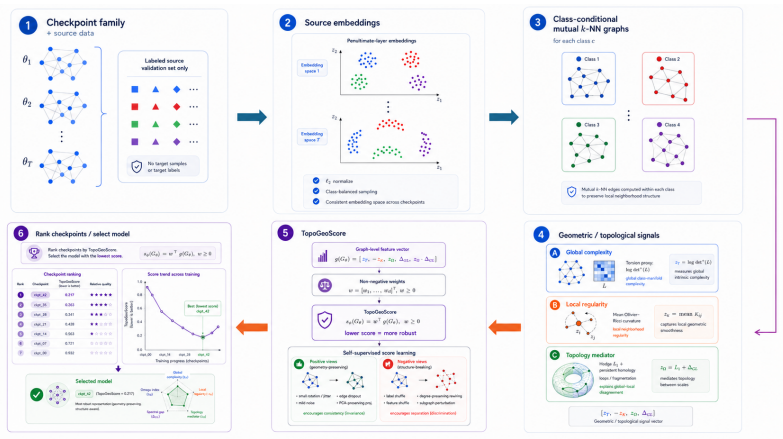
Given a trained checkpoint, class-conditional mutual k-NN graphs constructed from its source embeddings yield three complementary signals: a torsion-inspired reduced Laplacian log-determinant that quantifies global class-manifold complexity, Ollivier-Ricci curvature that quantifies local neighborhood regularity, and persistent-homology summaries that capture fragmented connectivity, loops, and global-local inconsistency. These signals are assembled into an interpretable non-negative linear score whose coefficients are learned by a self-supervised objective enforcing invariance to approximately geometry-preserving embedding views and separation from structure-breaking views. The resulting Top
What carries the argument
TopoGeoScore, a learned non-negative linear combination of global manifold complexity, local curvature, and higher-order topological invariants extracted from class-conditional k-NN graphs on source embeddings.
If this is right
- Checkpoints can be ranked and selected for deployment using only source-domain representations and no target samples or labels.
- The selected checkpoints improve accuracy on CIFAR corruption suites, ImageNet-C, MNLI-to-HANS transfer, and OGBN-Arxiv under distribution shift.
- Global manifold complexity, local curvature, and topological inconsistency together supply measurable evidence of robustness inside source embeddings.
- The scoring procedure remains fully interpretable because each component of the linear combination corresponds to a distinct geometric or topological property.
Where Pith is reading between the lines
- If source geometry reliably signals robustness, then monitoring these same invariants during training could serve as an early-stopping criterion for robustness.
- The same graph-construction and feature-extraction pipeline might be applied to other representation spaces such as language-model hidden states or graph-neural-network embeddings.
- Explicit regularization of the three topological quantities inside the training loss could directly encourage robustness rather than merely detecting it after training.
- The approach suggests that robustness under shift is partly a property of the embedding manifold's intrinsic geometry rather than solely of the decision boundary.
Load-bearing premise
The self-supervised objective that rewards invariance under geometry-preserving embedding views actually selects for genuine OOD robustness rather than some other incidental property of the source embeddings.
What would settle it
A controlled experiment in which TopoGeoScore ranks a set of checkpoints from the same training run yet the highest-scoring checkpoints achieve lower accuracy on multiple held-out corruption and shift benchmarks than lower-scoring ones.
Figures




read the original abstract
Out-of-distribution (OOD) robustness is difficult to diagnose when target-domain labels are unavailable. We consider a more restrictive source-only variant of unsupervised accuracy estimation: selecting robust checkpoints using only source-domain representations, with no target samples or target labels. We propose \textbf{TopoGeoScore}, a source-only geometric scorer for label-free OOD checkpoint selection. Given a trained checkpoint, we construct class-conditional mutual $k$-nearest-neighbour graphs from source embeddings and extract three interpretable signals: a torsion-inspired reduced Laplacian log-determinant for global class-manifold complexity, Ollivier--Ricci curvature for local neighbourhood regularity, and higher-order topological summaries for fragmented connectivity, loops, and global--local inconsistency. Instead of fixing their weights by hand, TopoGeoScore learns a non-negative linear score through a self-supervised objective that enforces invariance under approximately geometry-preserving embedding views and separation from structure-breaking views. The score remains interpretable and uses no target-domain samples or labels. Results across CIFAR-based corruption and distribution-shift benchmarks, ImageNet-C, MNLI$\to$HANS transfer, and OGBN-Arxiv suggest that source representations contain measurable global--local--topological evidence of robustness, supporting practical checkpoint selection before deployment under distribution shift.
Editorial analysis
A structured set of objections, weighed in public.
Referee Report
Summary. The paper proposes TopoGeoScore, a source-only geometric framework for selecting OOD-robust model checkpoints without target samples or labels. It constructs class-conditional mutual kNN graphs from source embeddings, extracts three signals (torsion-inspired reduced Laplacian log-determinant for global manifold complexity, Ollivier-Ricci curvature for local regularity, and higher-order topological summaries for connectivity and loops), and learns non-negative linear weights via a self-supervised objective that enforces invariance under approximately geometry-preserving embedding views while separating from structure-breaking views. Experiments are claimed on CIFAR corruption/shift benchmarks, ImageNet-C, MNLI to HANS, and OGBN-Arxiv.
Significance. If the central claim holds, the work offers a practical, interpretable tool for pre-deployment checkpoint selection under distribution shift using only source data. Strengths include the combination of global-local-topological features and the self-supervised weight learning that avoids hand-tuning or target supervision. This could complement existing OOD methods if the geometric invariants prove predictive of robustness rather than incidental source stability.
major comments (2)
- [Abstract and §3] Abstract and method description: The self-supervised objective enforces invariance only under source-internal, approximately geometry-preserving embedding views. Nothing in the construction ensures these invariants align with the specific manifold distortions induced by the target shifts (CIFAR corruptions, ImageNet-C, MNLI→HANS, OGBN-Arxiv). This is load-bearing for the claim that the score selects for actual OOD robustness; an explicit correlation analysis or ablation linking the learned score to measured OOD accuracy (rather than just selection success) is required.
- [§4] §4 (Experiments): The abstract states that results 'suggest that source representations contain measurable global--local--topological evidence of robustness' across benchmarks, but supplies no quantitative metrics, baselines, error bars, or ablation details on the contribution of each geometric signal. Without these, it is impossible to verify whether the topological summaries are load-bearing or whether the method outperforms simpler alternatives.
minor comments (2)
- [§3.2] Clarify the precise construction of 'approximately geometry-preserving' vs. 'structure-breaking' views in the self-supervised loss (including any hyperparameters such as k in the mutual kNN graph).
- [Figures in §4] Ensure all figures showing graph-based features include axis labels, legends, and statistical significance markers for the reported trends.
Simulated Author's Rebuttal
We thank the referee for their thoughtful and constructive comments on our manuscript. We address each major comment below and will incorporate revisions to strengthen the presentation and empirical support for our claims.
read point-by-point responses
-
Referee: [Abstract and §3] Abstract and method description: The self-supervised objective enforces invariance only under source-internal, approximately geometry-preserving embedding views. Nothing in the construction ensures these invariants align with the specific manifold distortions induced by the target shifts (CIFAR corruptions, ImageNet-C, MNLI→HANS, OGBN-Arxiv). This is load-bearing for the claim that the score selects for actual OOD robustness; an explicit correlation analysis or ablation linking the learned score to measured OOD accuracy (rather than just selection success) is required.
Authors: We agree that an explicit demonstration of alignment between the learned geometric invariants and OOD robustness is important for supporting the central claim. The self-supervised objective is constructed to identify weights that preserve geometric properties under views that approximate plausible shifts, but we acknowledge that this does not automatically guarantee correspondence to the specific distortions in the target benchmarks. In the revised version, we will add to §4 an explicit correlation analysis (e.g., Pearson or Spearman coefficients and scatter plots) between TopoGeoScore values and measured OOD accuracy across checkpoints on each benchmark, together with component-wise ablations that quantify how each geometric signal contributes to the observed selection performance. These additions will directly address whether the score captures robustness-relevant structure rather than source-only stability. revision: yes
-
Referee: [§4] §4 (Experiments): The abstract states that results 'suggest that source representations contain measurable global--local--topological evidence of robustness' across benchmarks, but supplies no quantitative metrics, baselines, error bars, or ablation details on the contribution of each geometric signal. Without these, it is impossible to verify whether the topological summaries are load-bearing or whether the method outperforms simpler alternatives.
Authors: We accept this criticism and agree that the experimental section would benefit from greater quantitative detail and transparency. While the manuscript reports selection performance on the listed benchmarks, we will revise §4 to include full tables of quantitative metrics (selection accuracy, mean OOD accuracy of selected checkpoints), comparisons against explicit baselines (e.g., embedding-norm scoring, single-signal geometric scores, and random selection), error bars obtained from multiple independent runs or seeds, and systematic ablation tables that isolate the contribution of the torsion-inspired Laplacian log-determinant, Ollivier-Ricci curvature, and higher-order topological summaries. These revisions will allow readers to assess whether the topological components are load-bearing and whether TopoGeoScore improves upon simpler alternatives. revision: yes
Circularity Check
No significant circularity; self-supervised weights learned on source data with empirical OOD validation
full rationale
The paper defines TopoGeoScore as a non-negative linear combination of three geometric measures (Laplacian log-det, Ollivier-Ricci curvature, topological summaries) extracted from source embeddings. Weights are obtained via a self-supervised objective that penalizes deviation under source-internal geometry-preserving views. This construction uses only source data and contains no target robustness labels or OOD samples by design. The central claim—that the resulting score selects robust checkpoints—is presented as an empirical hypothesis tested on external benchmarks (CIFAR corruptions, ImageNet-C, MNLI→HANS, OGBN-Arxiv). No step reduces the claimed correlation to a definitional equivalence, fitted input renamed as prediction, or load-bearing self-citation chain. The method is self-contained against external benchmarks and does not invoke uniqueness theorems or ansatzes from prior author work.
Axiom & Free-Parameter Ledger
free parameters (2)
- k in mutual k-nearest-neighbour graph
- non-negative linear weights
axioms (2)
- domain assumption Source-domain class-conditional embeddings contain global-local-topological signals that are predictive of robustness under distribution shift
- domain assumption Approximately geometry-preserving embedding views can be generated without target data
Lean theorems connected to this paper
-
IndisputableMonolith/Foundation/AlexanderDuality.lean, IndisputableMonolith/Cost/FunctionalEquation.leanalexander_duality_circle_linking, washburn_uniqueness_aczel, reality_from_one_distinction unclear?
unclearRelation between the paper passage and the cited Recognition theorem.
construct class-conditional mutual k-nearest-neighbour graphs ... torsion-inspired reduced Laplacian log-determinant ... Ollivier–Ricci curvature ... higher-order topological summaries ... self-supervised objective that enforces invariance under approximately geometry-preserving embedding views
What do these tags mean?
- matches
- The paper's claim is directly supported by a theorem in the formal canon.
- supports
- The theorem supports part of the paper's argument, but the paper may add assumptions or extra steps.
- extends
- The paper goes beyond the formal theorem; the theorem is a base layer rather than the whole result.
- uses
- The paper appears to rely on the theorem as machinery.
- contradicts
- The paper's claim conflicts with a theorem or certificate in the canon.
- unclear
- Pith found a possible connection, but the passage is too broad, indirect, or ambiguous to say the theorem truly supports the claim.
discussion (0)
Sign in with ORCID, Apple, or X to comment. Anyone can read and Pith papers without signing in.