Prior-Anchored Debiasing for Long-Tailed Multi-Organ Pathology Report Generation
Pith reviewed 2026-07-03 21:37 UTC · model grok-4.3
The pith
Anchoring visual prototypes and meta-reports to organ priors mitigates long-tail biases in multi-organ pathology report generation.
A machine-rendered reading of the paper's core claim, the machinery that carries it, and where it could break.
Core claim
The authors establish that the Visual-Prototype Anchored Bottleneck module, which leverages the information bottleneck principle with learnable anchor representations to selectively retain diagnostically relevant visual information while filtering head-biased redundancy, combined with the Meta-Report Anchored Bank module, which constructs an organ-specific meta-report anchored bank and retrieves organ-faithful textual priors, together mitigate the two identified biases and produce superior report generation performance across both head and tail organ categories on a multi-organ pathology dataset.
What carries the argument
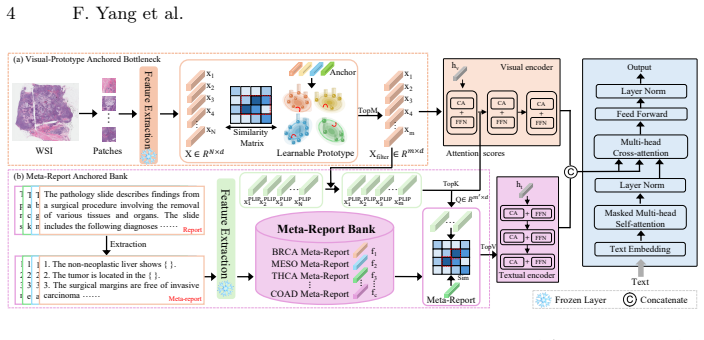
The Prior-anchored multi-Organ pathology report Generation (PriOrGen) framework, whose two modules use learnable anchors to filter visual redundancy via information bottleneck and steer textual output via meta-report retrieval.
If this is right
- The method produces superior report generation performance across both head and tail organ categories compared to state-of-the-art methods.
- It mitigates long-tail biases in both visual encoding and textual decoding stages.
- The framework addresses the gap between single-organ training assumptions and clinical multi-organ scenarios.
Where Pith is reading between the lines
- The anchoring strategy could extend to other imbalanced medical imaging tasks such as lesion detection in radiology.
- Integrating patient metadata into the meta-report bank might further improve fidelity for rare organ cases.
- The approach suggests that explicit prior injection at both encoder and decoder stages may be a general pattern for handling distribution shifts in report generation.
- Testing the modules on external multi-organ datasets with different tail ratios would clarify robustness.
- keywords:[
Load-bearing premise
That the visual representation bias in the encoder and textual decoding bias in the decoder are the dominant causes of poor tail-class performance and that the anchored modules can selectively retain diagnostic information without discarding necessary details or introducing new errors.
What would settle it
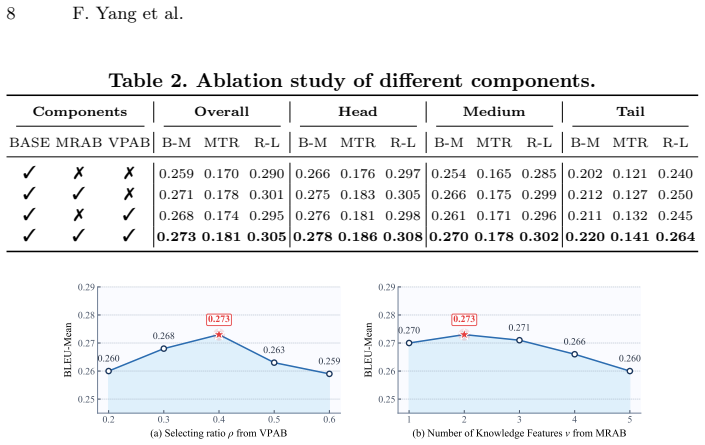
Running the same multi-organ dataset experiments with the proposed modules removed or replaced by standard components and finding no improvement or degradation specifically on tail organ report metrics would falsify the debiasing claim.
Figures
read the original abstract
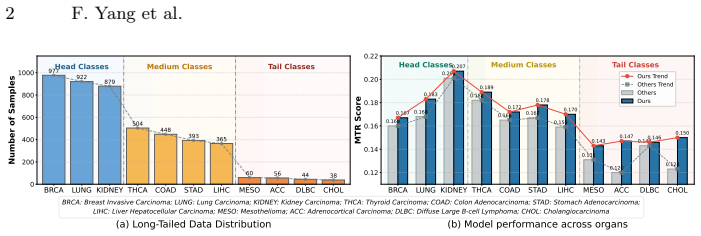
Automated pathology report generation from Whole Slide Images (WSIs) has attracted increasing attention in digital pathology. However, existing methods are predominantly developed under single-organ settings, overlooking the multi-organ scenarios encountered in clinical practice, where organ types typically follow a long-tailed distribution. To address this gap, we identify two critical biases: (1) visual representation bias, where the encoder favors head-class patterns over tail-class discriminative features, and (2) textual decoding bias, where the decoder overfits to head-class narrative patterns, yielding diagnostically unreliable outputs for tail-class organs. To mitigate these two biases, we propose a novel Prior-anchored multi-Organ pathology report Generation framework (PriOrGen). Specifically, a Visual-Prototype Anchored Bottleneck module leverages the information bottleneck principle with learnable anchor representations to selectively retain diagnostically relevant visual information while filtering out head-biased redundancy. Secondly, a Meta-Report Anchored Bank module constructs an organ-specific meta-report anchored bank and retrieves organ-faithful textual priors to steer the decoder away from head-class narrative patterns. Extensive experiments on a multi-organ pathology dataset demonstrate that our method effectively mitigates long-tail biases and achieves superior report generation performance across both head and tail organ categories compared to state-of-the-art methods.
Editorial analysis
A structured set of objections, weighed in public.
Referee Report
Summary. The paper identifies two biases in long-tailed multi-organ pathology report generation from WSIs—visual representation bias in the encoder and textual decoding bias in the decoder—and proposes the PriOrGen framework. This includes a Visual-Prototype Anchored Bottleneck module applying the information bottleneck principle with learnable anchors to retain relevant visual features, and a Meta-Report Anchored Bank module using organ-specific meta-report priors to guide decoding. The authors claim that extensive experiments on a multi-organ pathology dataset demonstrate effective long-tail bias mitigation and superior report generation performance across head and tail organ categories relative to state-of-the-art methods.
Significance. If the empirical claims hold with rigorous validation, the work could meaningfully advance automated multi-organ pathology reporting by addressing a clinically relevant long-tailed setting that single-organ methods overlook. The prior-anchored debiasing strategy might generalize to other medical vision-language tasks facing distribution shifts.
major comments (2)
- [Abstract] Abstract: the central claim that the method 'achieves superior report generation performance across both head and tail organ categories' and 'effectively mitigates long-tail biases' supplies no metrics, baselines, dataset details, or ablation results, rendering the claim impossible to evaluate from the given text.
- [Abstract] Abstract: the assumption that visual representation bias and textual decoding bias are the dominant causes of tail-class failure, and that the anchored modules achieve selective retention of diagnostic information without discarding useful signals or introducing new narrative errors, lacks any direct mechanistic validation such as bias quantification metrics, feature visualizations, or controlled ablations isolating each bias.
Simulated Author's Rebuttal
We thank the referee for highlighting issues with the abstract. We agree that the abstract should be more self-contained with concrete results and will revise it accordingly. We address each comment below.
read point-by-point responses
-
Referee: [Abstract] Abstract: the central claim that the method 'achieves superior report generation performance across both head and tail organ categories' and 'effectively mitigates long-tail biases' supplies no metrics, baselines, dataset details, or ablation results, rendering the claim impossible to evaluate from the given text.
Authors: We agree the abstract is too high-level. In the revision we will add specific metrics (e.g., BLEU-4 and CIDEr gains on head vs. tail organs), the dataset name and size, the main baselines, and a brief reference to the ablation studies that support bias mitigation. revision: yes
-
Referee: [Abstract] Abstract: the assumption that visual representation bias and textual decoding bias are the dominant causes of tail-class failure, and that the anchored modules achieve selective retention of diagnostic information without discarding useful signals or introducing new narrative errors, lacks any direct mechanistic validation such as bias quantification metrics, feature visualizations, or controlled ablations isolating each bias.
Authors: The full paper already contains controlled ablations that isolate the contribution of each module to head/tail performance and qualitative report examples. We acknowledge that explicit bias-quantification metrics and feature visualizations are not currently in the abstract or main text; we will add a new subsection with t-SNE visualizations of visual features before/after the bottleneck and a simple bias-ratio metric to strengthen the mechanistic evidence. revision: partial
Circularity Check
No circularity: method described without equations or self-referential derivations
full rationale
The paper abstract and description introduce two biases and two anchored modules (Visual-Prototype Anchored Bottleneck using information bottleneck with learnable anchors; Meta-Report Anchored Bank) but contain no equations, fitting procedures, or derivation chain. Claims of bias mitigation rest on experimental results rather than any mathematical reduction to inputs. No self-citations, uniqueness theorems, or ansatzes are invoked in the provided text. The derivation is therefore self-contained with no steps that reduce by construction to fitted quantities or prior self-references.
Axiom & Free-Parameter Ledger
Reference graph
Works this paper leans on
-
[1]
Deep Variational Information Bottleneck
Alemi, A.A., Fischer, I., Dillon, J.V., Murphy, K.: Deep variational information bottleneck. arXiv preprint arXiv:1612.00410 (2016)
work page internal anchor Pith review Pith/arXiv arXiv 2016
-
[2]
In: International Con- ference on Medical Image Computing and Computer-Assisted Intervention
Cai, Z., Wei, T., Lin, L., Chen, H., Tang, X.: Bpaco: Balanced parametric con- trastive learning for long-tailed medical image classification. In: International Con- ference on Medical Image Computing and Computer-Assisted Intervention. pp. 383–393. Springer (2024)
2024
-
[3]
Nature medicine25(8), 1301–1309 (2019)
Campanella, G., Hanna, M.G., Geneslaw, L., Miraflor, A., Werneck Krauss Silva, V., Busam, K.J., Brogi, E., Reuter, V.E., Klimstra, D.S., Fuchs, T.J.: Clinical- grade computational pathology using weakly supervised deep learning on whole slide images. Nature medicine25(8), 1301–1309 (2019)
2019
-
[4]
In: In- ternational Conference on Medical Image Computing and Computer-Assisted In- tervention
Chen, P., Li, H., Zhu, C., Zheng, S., Shui, Z., Yang, L.: Wsicaption: Multiple instance generation of pathology reports for gigapixel whole-slide images. In: In- ternational Conference on Medical Image Computing and Computer-Assisted In- tervention. pp. 546–556. Springer (2024)
2024
-
[5]
Nature medicine30(3), 850–862 (2024)
Chen, R.J., Ding, T., Lu, M.Y., Williamson, D.F., Jaume, G., Song, A.H., Chen, B., Zhang, A., Shao, D., Shaban, M., et al.: Towards a general-purpose foundation model for computational pathology. Nature medicine30(3), 850–862 (2024)
2024
-
[6]
Chen, Z., Shen, Y., Song, Y., Wan, X.: Cross-modal memory networks for radiology report generation. In: Proceedings of the 59th annual meeting of the association for computational linguistics and the 11th international joint conference on natural language processing (volume 1: long papers). pp. 5904–5914 (2021)
2021
-
[7]
In: Proceedings of the 2020 conference on empirical methods in natural language processing (EMNLP)
Chen, Z., Song, Y., Chang, T.H., Wan, X.: Generating radiology reports via memory-driven transformer. In: Proceedings of the 2020 conference on empirical methods in natural language processing (EMNLP). pp. 1439–1449 (2020)
2020
-
[8]
Nature protocols20(1), 293–316 (2025) 10 F
El Nahhas, O.S., van Treeck, M., Wölflein, G., Unger, M., Ligero, M., Lenz, T., Wagner, S.J., Hewitt, K.J., Khader, F., Foersch, S., et al.: From whole-slide image to biomarker prediction: end-to-end weakly supervised deep learning in computa- tional pathology. Nature protocols20(1), 293–316 (2025) 10 F. Yang et al
2025
-
[9]
In: International Conference on Medical Image Computing and Computer- Assisted Intervention
Guo, Z., Ma, J., Xu, Y., Wang, Y., Wang, L., Chen, H.: Histgen: Histopathology report generation via local-global feature encoding and cross-modal context inter- action. In: International Conference on Medical Image Computing and Computer- Assisted Intervention. pp. 189–199. Springer (2024)
2024
-
[10]
Nature medicine29(9), 2307–2316 (2023)
Huang, Z., Bianchi, F., Yuksekgonul, M., Montine, T.J., Zou, J.: A visual–language foundation model for pathology image analysis using medical twitter. Nature medicine29(9), 2307–2316 (2023)
2023
-
[11]
arXiv preprint arXiv:2410.02010 (2024)
Ju, L., Yan, S., Zhou, Y., Nan, Y., Xing, X., Duan, P., Ge, Z.: Monica: Benchmark- ing on long-tailed medical image classification. arXiv preprint arXiv:2410.02010 (2024)
-
[12]
In: Proceedings of the 13th international workshop on health text mining and information analysis (LOUHI)
Kanakarajan, K.R., Kundumani, B., Abraham, A., Sankarasubbu, M.: Biosim- cse: Biomedical sentence embeddings using contrastive learning. In: Proceedings of the 13th international workshop on health text mining and information analysis (LOUHI). pp. 81–86 (2022)
2022
-
[13]
arXiv preprint arXiv:1910.09217 (2019)
Kang, B., Xie, S., Rohrbach, M., Yan, Z., Gordo, A., Feng, J., Kalantidis, Y.: Decoupling representation and classifier for long-tailed recognition. arXiv preprint arXiv:1910.09217 (2019)
-
[14]
IEEE Transactions on Artificial Intelligence5(10), 5026–5039 (2024)
Li, M., Cheung, Y.m., Lu, Y., Hu, Z., Lan, W., Huang, H.: Adjusting logit in gaussian form for long-tailed visual recognition. IEEE Transactions on Artificial Intelligence5(10), 5026–5039 (2024)
2024
-
[15]
Nature biomedical engineering5(6), 555–570 (2021)
Lu, M.Y., Williamson, D.F., Chen, T.Y., Chen, R.J., Barbieri, M., Mahmood, F.: Data-efficient and weakly supervised computational pathology on whole-slide images. Nature biomedical engineering5(6), 555–570 (2021)
2021
-
[16]
Miura, Y., Zhang, Y., Tsai, E., Langlotz, C., Jurafsky, D.: Improving factual com- pletenessandconsistencyofimage-to-textradiologyreportgeneration.In:Proceed- ings of the 2021 Conference of the North American Chapter of the Association for Computational Linguistics: Human Language Technologies. pp. 5288–5304 (2021)
2021
-
[17]
In: International Conference on Medical Image Computing and Computer-Assisted Intervention
Pan, L., Zhang, Y., Yang, Q., Li, T., Chen, Z.: Combat long-tails in medical clas- sification with relation-aware consistency and virtual features compensation. In: International Conference on Medical Image Computing and Computer-Assisted Intervention. pp. 14–23. Springer (2023)
2023
-
[18]
Comput- ers in Biology and Medicine188, 109772 (2025)
Pan, L., Zhang, Y., Yang, Q., Li, T., Chen, Z.: Long-tailed medical diagnosis with relation-aware representation learning and iterative classifier calibration. Comput- ers in Biology and Medicine188, 109772 (2025)
2025
-
[19]
In: 2024 IEEE International Symposium on Biomedical Imaging (ISBI)
Sengupta, S., Brown, D.E.: Automatic report generation for histopathology im- ages using pre-trained vision transformers and bert. In: 2024 IEEE International Symposium on Biomedical Imaging (ISBI). pp. 1–5. IEEE (2024)
2024
-
[20]
The information bottleneck method
Tishby, N., Pereira, F.C., Bialek, W.: The information bottleneck method. arXiv preprint physics/0004057 (2000)
work page internal anchor Pith review Pith/arXiv arXiv 2000
-
[21]
Medrxiv pp
Tran, M., Schmidle, P., Wagner, S.J., Koch, V., Lupperger, V., Feuchtinger, A., Böhner, A., Kaczmarczyk, R., Biedermann, T., Eyerich, K., et al.: Generating highly accurate pathology reports from gigapixel whole slide images with histogpt. Medrxiv pp. 2024–03 (2024)
2024
-
[22]
Advances in neural information pro- cessing systems30(2017)
Vaswani,A.,Shazeer,N.,Parmar,N.,Uszkoreit,J.,Jones,L.,Gomez,A.N.,Kaiser, Ł., Polosukhin, I.: Attention is all you need. Advances in neural information pro- cessing systems30(2017)
2017
-
[23]
In: Proceedings of the IEEE conference on computer vision and pattern recognition
Vinyals, O., Toshev, A., Bengio, S., Erhan, D.: Show and tell: A neural image caption generator. In: Proceedings of the IEEE conference on computer vision and pattern recognition. pp. 3156–3164 (2015) PriOrGen 11
2015
-
[24]
In: Proceedings of the 47th international ACM SIGIR conference on research and development in information retrieval
Xiao, S., Liu, Z., Zhang, P., Muennighoff, N., Lian, D., Nie, J.Y.: C-pack: Packed resources for general chinese embeddings. In: Proceedings of the 47th international ACM SIGIR conference on research and development in information retrieval. pp. 641–649 (2024)
2024
-
[25]
In: International conference on machine learning
Xu, K., Ba, J., Kiros, R., Cho, K., Courville, A., Salakhudinov, R., Zemel, R., Bengio, Y.: Show, attend and tell: Neural image caption generation with visual attention. In: International conference on machine learning. pp. 2048–2057. PMLR (2015)
2048
-
[26]
In: International Conference on Medi- cal Image Computing and Computer-Assisted Intervention
Zhang, L., Yun, B., Li, Q., Wang, Y.: Historical report guided bi-modal concurrent learning for pathology report generation. In: International Conference on Medi- cal Image Computing and Computer-Assisted Intervention. pp. 343–352. Springer (2025)
2025
- [27]
discussion (0)
Sign in with ORCID, Apple, or X to comment. Anyone can read and Pith papers without signing in.