REVIEW 4 major objections 5 minor 17 references
Partially Conditioned Patch Parallelism for Accelerated Diffusion Model Inference
T0 review · 4 major / 5 minor · reviewed 2026-08-11 · deepseek-v4-flash
Pith's one-line read PCPP claims that conditioning each image patch on only a fraction of its neighbors' stale activations cuts diffusion inference communication by roughly 70% and delivers 2.36–8.02x speed-up on 4–8 GPUs, at the cost of image quality.
desk verdict A useful incremental extension of DistriFusion that trades quality for speed, but the headline speed-up comparison is not measured on their hardware. read the letter →
The pith
A machine-rendered reading of the paper's core claim, the machinery that carries it, and where it could break.
The reading
What carries the argument
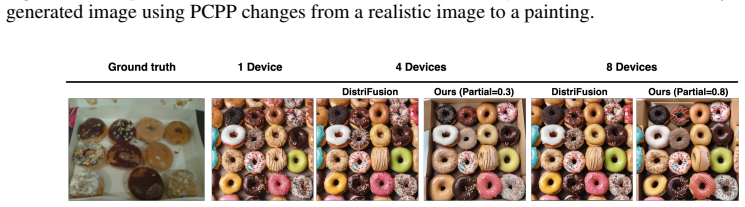
The central mechanism is partially conditioned attention parameterized by the partial value $p \in [0,1]$, the fraction of each neighbor patch's height that is concatenated into the local key and value sets. Combined with replacing AllGather by asynchronous point-to-point sends to the two neighboring ranks, this reduces both the bytes moved and the attention matrix size. The paper sets $p=0.3$ for 4 devices and $p=0.8$ for 8 devices to preserve coherence, and applies the partial conditioning only to self-attention layers because they dominate communication.
What would settle it
Run PCPP with $p=0.3$ on prompts whose content demands global layout (for example, images containing text, mirrored faces, or a single object spanning all patches) and measure PSNR and LPIPS against single-GPU output; if coherence collapses and restoring quality requires $p\approx 1$, the neighbor-only assumption fails and the reported speed-up no longer holds at fixed quality. A second check: inspect standard single-GPU self-attention maps and measure the attention mass landing on keys from non-neighbor patches; if that mass is large, the omitted context is not negligible.
Extended reading notes
Core claim
On the paper's own terms, the discovery is that patch-parallel diffusion inference does not need the full stale feature map as attention context. Each patch $x^{(i)}_t$ is updated using its own activation plus the top or bottom $p$-fraction of neighboring patches from the previous step, written as $N^{(i)}_t(p)$; self-attention consumes only these partial neighbors, and AllGather is replaced by asynchronous point-to-point sends to the two adjacent ranks. The paper reports this lowers communication by about 70% and improves latency over single-GPU inference from 2.36x (4 GPUs, 1024x1024) up to 8.02x (8 GPUs, 3840x3840), compared with the prior patch-parallel baseline's 2.32–6.71x over the same settings, at the cost of lower PSNR and LPIPS.
Load-bearing premise
A patch can be denoised to acceptable quality using only its own content plus a fraction of its immediate neighbors' previous-step activations, without seeing the rest of the image.
Editorial extensions
If this is right
- Using 4 GPUs, PCPP reaches 2.36x speed-up at 1024x1024 and larger speed-ups at higher resolutions; using 8 GPUs it reaches up to 8.02x.
- Communication per forward pass falls from 1.526G to 0.476G bytes at 1024x1024, with similar roughly 70% reductions at 2048 and 3840 resolutions.
- Self-attention is the dominant communication cost, so targeted partial conditioning of attention captures most of the saving; group norm and convolution keep their original collective communication.
- Image quality drops measurably: PSNR falls from 31.9 to 29.2 with 4 GPUs and from 31.1 to 28.8 with 8 GPUs, with LPIPS roughly doubling, so the speed-up is traded for fidelity loss.
- Latency becomes computation-bound rather than communication-bound because point-to-point sends are hidden under attention compute.
Reading between the lines
- A likely extension is to make $p$ adaptive per layer or per prompt, since the paper's own examples show that some prompts need more global context than immediate neighbors provide.
- The speed-up should compound with step-reduction samplers such as DDIM and DPM-Solver, because PCPP attacks per-step cost orthogonally to the number of steps.
- The same neighbor-only conditioning idea may transfer to video diffusion, where spatial patches plus temporal frames define a richer neighborhood, but the paper does not test this.
- The quality loss at 8 GPUs suggests scaling beyond 8 GPUs will require a context window larger than immediate neighbors, effectively a partial value greater than 1.
Editorial analysis
A structured set of objections, weighed in public.
Referee Report
Summary. The paper proposes Partially Conditioned Patch Parallelism (PCPP), a modification of DistriFusion-style patch parallelism for multi-GPU diffusion model inference. PCPP replaces the all-to-all AllGather communication with asynchronous point-to-point communication between neighboring patches and restricts self-attention to use only a fraction (controlled by a partial value p) of the neighboring patches' stale activations. The authors report an approximately 70% reduction in communication amount, a 2.36-8.02x inference speed-up on 4-8 GPUs relative to single-device inference, and a comparison against DistriFusion's reported 2.32-6.71x speed-ups, at the cost of decreased image quality as measured by PSNR, LPIPS, and FID. Experiments use Stable Diffusion XL with a 50-step DDIM sampler on COCO captions and A100 GPUs.
Significance. If the speed-up comparison with DistriFusion were properly controlled, the core idea of using neighbor-only stale context in patch-parallel diffusion inference would be a useful contribution to multi-GPU diffusion acceleration. The paper is commendably transparent about the quality trade-off and about prompt-dependent failures, and it provides implementation details (Appendix A) that would help reproduction. The communication amount analysis in Table 1 gives a concrete sense of where bytes are spent. However, the central empirical claim of faster inference than DistriFusion is not supported by a same-hardware, same-prompt latency comparison, and the quality assessment is too weak to establish the claimed favorable trade-off. These issues are load-bearing and require additional experiments.
major comments (4)
- [Section 4 and Section 5.1, Figure 4] The abstract and Section 1 state that PCPP 'achieves 2.36~8.02x inference speed-up using 4~8 GPUs compared to 2.32~6.71x achieved by DistriFusion,' but the paper reports no DistriFusion wall-clock latencies measured in the same environment. Figure 4 shows only PCPP latencies and speed-ups relative to a single device; no DistriFusion baseline bars or raw latency tables appear. Since GPU type, resolution, warm-up steps, sampler, and CUDA Graph settings affect latency, the comparison to DistriFusion's published speed-up numbers is not a controlled measurement. Please provide DistriFusion runs on the same hardware, with the same prompts, sampler, and measurement procedure, and report the actual speed-up of PCPP relative to that baseline.
- [Section 6 vs. Table 2] The Discussion states that with PCPP 'we can complete the same task in under 15 seconds without any significant decrease in image quality, as shown in Section 5.' This directly contradicts the quantitative results in Table 2, where PCPP shows substantially worse LPIPS (e.g., 0.352 vs. 0.146 for 4 GPUs with ground truth) and FID (e.g., 38.4 vs. 20.8) compared to DistriFusion. The claim of no significant quality decrease needs to be reconciled with these numbers or removed.
- [Section 5.3, Table 2, Figure 5, Appendix B] The quality evaluation has no error bars, no number of seeds, and no aggregate statistics over a random prompt sample. Figure 5 explicitly selects three prompts 'that work relatively well with PCPP,' while Appendix B shows prompt-dependent failures such as style changes and distorted geometry. To support the 'favorable trade-off' conclusion, the authors should report mean and standard deviation over multiple seeds and a random or representative prompt set, and quantify the rate of visible distortions rather than relying on cherry-picked examples.
- [Section 3.3 and Section 5.1] The partial value p is tuned per device count (0.3 for 4 devices, 0.8 for 8 devices) with no sensitivity analysis or principled selection criterion. Since both the achieved speed-up and the image quality depend strongly on p, the reported results are conditional on hand-chosen parameters. Please report results across a range of p values for each device configuration and justify the chosen values, or provide a rule for selecting p.
minor comments (5)
- [Section 1] There is a typo in the method name: 'Parallelsim' should be 'Parallelism.'
- [Section 4] The phrase '2014 HuggingFace version of the Microsoft COCO' is ambiguous; please specify the exact dataset split, the number of prompts, and the sampling procedure.
- [Table 2] Please clarify the column layout (which metrics use 'w/ Orig.' and which use 'w/ G.T.') and add standard deviations or confidence intervals; the current single-point numbers are insufficient to compare methods.
- [Figure 4] Including DistriFusion latency bars or a table of raw latencies would make the comparison in Section 5.1 reproducible and would support the abstract's speed-up comparison.
- [Section 3.3] 'computing muti-head scaled dot product attention' contains a typo: 'muti-head' should be 'multi-head.'
Circularity Check
No significant circularity: all central claims are empirical measurements against external baselines and a hand-tuned hyperparameter, not outputs of the derivation.
full rationale
The paper's central claims are empirical and externally anchored. The 2.36-8.02x speed-ups are measured wall-clock latencies on the authors' own A100 nodes (Section 5.1, Figure 4) divided by single-device latency; the comparison to DistriFusion's 2.32-6.71x is a comparison to published baseline numbers, not a derivation from PCPP's own parameters. The 70% communication reduction in Table 1 follows by arithmetic from the stated byte-count formulas for AllGather versus point-to-point sends; this is a calculation, not a prediction that reduces to an input. Image quality (PSNR/LPIPS/FID) is evaluated against the original single-device model outputs and COCO ground truth, so the quality numbers are externally measured rather than implied by construction. The partial value p is explicitly a hand-tuned hyperparameter chosen by visual cohesion (Section 3.3, Figure 1), and the paper's own Section 5.3 and Appendix B report prompt-dependent quality failures. No load-bearing result is justified solely by a self-citation: DistriFusion is cited as the baseline implementation, not as an authority for PCPP's claims, and the authors do not invoke a uniqueness theorem or ansatz from their own prior work. The possible benchmarking weaknesses (no same-hardware DistriFusion latency table; 8.02x exceeding the 8-GPU ideal) are correctness/measurement concerns, not circularity.
Assumptions & free parameters
free parameters (2)
- partial value p =
0.3 for 4 devices, 0.8 for 8 devices
- warm-up sync steps =
4
assumptions (6)
- domain assumption Activations change only slightly between adjacent denoising steps, so stale activations from step t+1 can stand in for current activations at step t.
- ad hoc to paper Each patch needs context only from its immediate neighbors, and only a fraction of that context.
- domain assumption Group norm layers require global synchronization; only self-attention can tolerate partial context.
- domain assumption The self-attention layer accounts for the majority of communication, so optimizing it yields the headline 70% reduction.
- domain assumption A 1K subset of COCO captions with the reported metric protocol is representative enough to compare methods.
- standard math The ring AllGather cost model bs*(n-1)*2 and the point-to-point cost model bs*2*2 accurately measure communication amount.
Cite this review
Pith. "Pith review of Partially Conditioned Patch Parallelism for Accelerated Diffusion Model Inference." pith.science (2026). https://pith.science/paper/ZY4EJ6IF
@misc{pith2026241202962,
  author       = {Pith},
  title        = {Pith review of: Partially Conditioned Patch Parallelism for Accelerated Diffusion Model Inference},
  year         = {2026},
  howpublished = {\url{https://pith.science/paper/ZY4EJ6IF}},
  note         = {Machine review of arXiv:2412.02962}
}
abstract
Diffusion models have exhibited exciting capabilities in generating images and are also very promising for video creation. However, the inference speed of diffusion models is limited by the slow sampling process, restricting its use cases. The sequential denoising steps required for generating a single sample could take tens or hundreds of iterations and thus have become a significant bottleneck. This limitation is more salient for applications that are interactive in nature or require small latency. To address this challenge, we propose Partially Conditioned Patch Parallelism (PCPP) to accelerate the inference of high-resolution diffusion models. Using the fact that the difference between the images in adjacent diffusion steps is nearly zero, Patch Parallelism (PP) leverages multiple GPUs communicating asynchronously to compute patches of an image in multiple computing devices based on the entire image (all patches) in the previous diffusion step. PCPP develops PP to reduce computation in inference by conditioning only on parts of the neighboring patches in each diffusion step, which also decreases communication among computing devices. As a result, PCPP decreases the communication cost by around $70\%$ compared to DistriFusion (the state of the art implementation of PP) and achieves $2.36\sim 8.02\times$ inference speed-up using $4\sim 8$ GPUs compared to $2.32\sim 6.71\times$ achieved by DistriFusion depending on the computing device configuration and resolution of generation at the cost of a possible decrease in image quality. PCPP demonstrates the potential to strike a favorable trade-off, enabling high-quality image generation with substantially reduced latency.
Figures


Figures from the paper (6 more)




Reference graph
Works this paper leans on
-
[1]
Xinlei Chen, Hao Fang, Tsung-Yi Lin, Ramakrishna Vedantam, Saurabh Gupta, Piotr Doll ´ar, and C. Lawrence Zitnick. Microsoft coco captions: Data collection and evaluation server. ArXiv, abs/1504.00325,
-
[10]
Guocheng Qian, Jinjie Mai, Abdullah Hamdi, Jian Ren, Aliaksandr Siarohin, Bing Li, Hsin-Ying Lee, Ivan Skorokhodov, Peter Wonka, S. Tulyakov, and Bernard Ghanem. Magic123: One image to high-quality 3d object generation using both 2d and 3d diffusion priors.ArXiv, abs/2306.17843,
-
[11]
Blattmann, Dominik Lorenz, Patrick Esser, and Bj¨orn Ommer
Robin Rombach, A. Blattmann, Dominik Lorenz, Patrick Esser, and Bj¨orn Ommer. High-resolution image synthesis with latent diffusion models. 2022 IEEE/CVF Conference on Computer Vision and Pattern Recognition (CVPR), pp. 10674–10685,
work page 2022
-
[12]
U-net: Convolutional networks for biomedi- cal image segmentation
11 Preprint Olaf Ronneberger, Philipp Fischer, and Thomas Brox. U-net: Convolutional networks for biomedi- cal image segmentation. ArXiv, abs/1505.04597,
-
[13]
Chitwan Saharia, William Chan, Saurabh Saxena, Lala Li, Jay Whang, Emily L. Denton, Seyed Kamyar Seyed Ghasemipour, Burcu Karagol Ayan, Seyedeh Sara Mahdavi, Raphael Gontijo Lopes, Tim Salimans, Jonathan Ho, David J. Fleet, and Mohammad Norouzi. Photorealistic text-to-image diffusion models with deep language understanding. ArXiv, abs/2205.11487,
-
[14]
Parallel Sampling of Diffusion Models
Andy Shih, Suneel Belkhale, Stefano Ermon, Dorsa Sadigh, and Nima Anari. Parallel sampling of diffusion models. ArXiv, abs/2305.16317,
-
[15]
Denoising diffusion implicit models
Jiaming Song, Chenlin Meng, and Stefano Ermon. Denoising diffusion implicit models. ArXiv, abs/2010.02502,
arXiv 2010
-
[16]
Adding conditional control to text-to-image diffusion models
Lvmin Zhang, Anyi Rao, and Maneesh Agrawala. Adding conditional control to text-to-image diffusion models. 2023 IEEE/CVF International Conference on Computer Vision (ICCV) , pp. 3813–3824,
work page 2023
Show all 17 references
-
[17]
Efros, Eli Shechtman, and Oliver Wang
Richard Zhang, Phillip Isola, Alexei A. Efros, Eli Shechtman, and Oliver Wang. The unreasonable effectiveness of deep features as a perceptual metric. 2018 IEEE/CVF Conference on Computer Vision and Pattern Recognition, pp. 586–595,
2018
-
[2015]
Diffusion models beat gans on image synthesis
10 Preprint Prafulla Dhariwal and Alex Nichol. Diffusion models beat gans on image synthesis. ArXiv, abs/2105.05233,
-
[2017]
Classifier-free diffusion guidance
Jonathan Ho. Classifier-free diffusion guidance. ArXiv, abs/2207.12598,
-
[2018]
Gan compression: Efficient architectures for interactive conditional gans
Muyang Li, Ji Lin, Yaoyao Ding, Zhijian Liu, Jun-Yan Zhu, and Song Han. Gan compression: Efficient architectures for interactive conditional gans. 2020 IEEE/CVF Conference on Computer Vision and Pattern Recognition (CVPR), pp. 5283–5293,
2020
-
[2020]
Edward Hu, Yelong Shen, Phillip Wallis, Zeyuan Allen-Zhu, Yuanzhi Li, Shean Wang, and Weizhu Chen
J. Edward Hu, Yelong Shen, Phillip Wallis, Zeyuan Allen-Zhu, Yuanzhi Li, Shean Wang, and Weizhu Chen. Lora: Low-rank adaptation of large language models. ArXiv, abs/2106.09685,
-
[2021]
Mdm: Molecular diffusion model for 3d molecule generation
Lei Huang, Hengtong Zhang, Tingyang Xu, and Ka chun Wong. Mdm: Molecular diffusion model for 3d molecule generation. ArXiv, abs/2209.05710,
-
[2022]
Jonathan Ho, Ajay Jain, and P. Abbeel. Denoising diffusion probabilistic models. ArXiv, abs/2006.11239,
2006 arXiv
-
[2023]
Dpm-solver: A fast ode solver for diffusion probabilistic model sampling in around 10 steps
Cheng Lu, Yuhao Zhou, Fan Bao, Jianfei Chen, Chongxuan Li, and Jun Zhu. Dpm-solver: A fast ode solver for diffusion probabilistic model sampling in around 10 steps. ArXiv, abs/2206.00927, 2022a. Cheng Lu, Yuhao Zhou, Fan Bao, Jianfei Chen, Chongxuan Li, and Jun Zhu. Dpm-solver...
-
[2024]
Q-diffusion: Quantizing diffusion models
Xiuyu Li, Long Lian, Yijia Liu, Hua Yang, Zhen Dong, Daniel Kang, Shanghang Zhang, and Kurt Keutzer. Q-diffusion: Quantizing diffusion models. 2023 IEEE/CVF International Conference on Computer Vision (ICCV), pp. 17489–17499,
2023
Reviewed August 11, 2026 · model on record in the stance chip above.
Discussion (0). Continue with ORCID to comment.