REVIEW 3 minor 11 references
Exactness Certificates for Closed-Form CBF Safety-Filter Projections
T0 review · 0 major / 3 minor · reviewed 2026-06-30 · grok-4.3
Pith's one-line read A closed-form correction from violated inequalities equals the exact Euclidean projection onto the CBF feasible set if and only if primal and dual feasibility both hold.
desk verdict The paper supplies a necessary-and-sufficient exactness certificate, based on primal and dual feasibility, for when a simple closed-form correction from violated affine CBF inequalities equals the full Euclidean projection. read the letter →
The pith
A machine-rendered reading of the paper's core claim, the machinery that carries it, and where it could break.
The reading
What carries the argument
the necessary-and-sufficient exactness certificate formed by simultaneous primal feasibility of the violated-set correction and dual feasibility of its Lagrange multipliers with respect to the active affine normals
What would settle it
An explicit numerical example in which the violated-set correction satisfies every inequality yet the vector of Lagrange multipliers for the active set fails to lie in the dual cone spanned by those normals.
Extended reading notes
Core claim
For control-affine systems the CBF inequalities are affine in the input. Given a nominal input, collect the violated inequalities, solve the minimum-norm correction that meets those inequalities with equality, and test whether this correction satisfies every remaining inequality (primal feasibility) and whether the correction vector lies in the cone generated by the active normals (dual feasibility). These two checks are necessary and sufficient for the correction to be the exact Euclidean projection onto the full feasible set. Structural conditions on the geometry of the normals supply further sufficient tests, and an online algorithm implements the checks in real time.
Load-bearing premise
The control barrier function conditions remain affine in the control input.
Editorial extensions
If this is right
- When the certificate holds, the closed-form correction can be used in place of a full CBF-QP solver.
- An online certification routine decides in real time whether the closed-form step is exact.
- When the certificate fails, a finite active-set search recovers the exact projection.
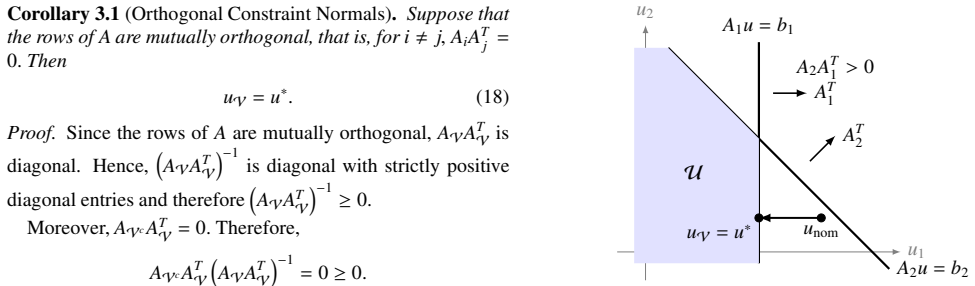
- Simulations confirm that the correction can remain feasible while failing to be the exact projection precisely because of dual infeasibility.
Reading between the lines
- The same certificate structure could be applied to other real-time projection problems whose constraints are affine, such as torque-limit enforcement or collision avoidance in robotics.
- The dual-feasibility check may be relaxed to interval arithmetic or floating-point error bounds for microcontroller implementations.
- If the active normals satisfy the structural angle conditions given in the paper, the certificate becomes a simple dot-product test that avoids solving any linear system.
Signed reviews
Editorial analysis
A structured set of objections, weighed in public.
Referee Report
Summary. The paper claims that for control-affine systems whose CBF inequalities are affine in the control input, the closed-form min-norm correction computed from the set of violated inequalities equals the Euclidean projection onto the full feasible polyhedron if and only if a primal-and-dual feasibility certificate holds; it supplies structural sufficient conditions on the interactions among the normals of the affine inequalities, an online algorithm to test the certificate, and a finite active-set fallback procedure when the certificate fails. Simulations are used to illustrate cases in which the violated-set correction remains feasible yet is not the exact projection (due to dual infeasibility) and to demonstrate computational speedup relative to a standard CBF-QP solver.
Significance. If the central certificate is correct, the work supplies a practical route to faster safety-filter implementations on embedded hardware by substituting a closed-form update whenever the certificate passes, while retaining a reliable fallback. The necessary-and-sufficient character of the primal-dual test, the explicit structural conditions, and the online certification procedure are concrete strengths; the explicit separation of feasibility from exactness is also useful for implementers.
minor comments (3)
- [Introduction] The abstract states that the CBF conditions are affine in u for control-affine systems; the manuscript should explicitly restate this domain restriction at the beginning of the main technical development so that the scope of the exactness certificate is unambiguous.
- [Algorithm section] In the description of the online certification algorithm, the termination criterion and the handling of numerical tolerance for the dual-feasibility check should be stated precisely, as these directly affect practical deployment.
- [Numerical examples] The simulation section would benefit from reporting the fraction of time steps in which the certificate succeeded versus failed, together with the associated solve times, to quantify the claimed speedup more concretely.
Simulated Author's Rebuttal
We thank the referee for the positive assessment of the manuscript, the accurate summary of its contributions on necessary-and-sufficient exactness certificates, structural conditions, and the online certification algorithm, and the recommendation for minor revision. No major comments were provided in the report.
Circularity Check
Derivation is self-contained; no circular steps identified
full rationale
The paper derives a necessary-and-sufficient exactness certificate for when the closed-form min-norm correction over violated affine inequalities equals the Euclidean projection onto the full polyhedral feasible set. This certificate is stated in terms of primal and dual feasibility, which are the standard KKT conditions for the underlying convex projection problem. The subsequent structural sufficient conditions on interactions among inequality normals follow directly from the geometry of half-space intersections and require no additional fitted quantities or external uniqueness theorems. The setting is explicitly restricted to control-affine systems whose CBF inequalities are affine in the input; this is the problem domain, not an unverified hypothesis. No step in the provided abstract or described results reduces by construction to a self-definition, a renamed empirical pattern, or a self-citation chain. The derivation is therefore independent of its own outputs.
Assumptions & free parameters
assumptions (1)
- domain assumption CBF conditions are affine in the control input for control-affine systems
Cite this review
Pith. "Pith review of Exactness Certificates for Closed-Form CBF Safety-Filter Projections." pith.science (2026). https://pith.science/paper/ZYJVJK52
@misc{pith2026260608255,
  author       = {Pith},
  title        = {Pith review of: Exactness Certificates for Closed-Form CBF Safety-Filter Projections},
  year         = {2026},
  howpublished = {\url{https://pith.science/paper/ZYJVJK52}},
  note         = {Machine review of arXiv:2606.08255}
}
read the original abstract
For control-affine systems, standard and high-order control barrier function conditions are affine in the control input and are commonly enforced through quadratic-program-based safety filters. Although convex, these optimization problems may be undesirable in embedded, high-rate, or resource-limited implementations. This letter characterizes when the corresponding Euclidean projection can be recovered from the affine inequalities violated by a nominal control input. Given a nominal input, we form the violated set and compute the minimum-norm correction that enforces the violated inequalities with equality. This violated-set correction is closed form, but it need not equal the exact Euclidean projection onto the full feasible set. The main result gives a necessary and sufficient exactness certificate based on primal and dual feasibility, followed by structural sufficient conditions involving interactions among affine-inequality normals. An online certification algorithm is then presented to determine when the closed-form update is exact. When the certificate fails, a finite active-set search can be used to recover the exact projection. Numerical simulations illustrate that the violated-set correction can remain feasible while failing to be the exact projection due to dual infeasibility, and demonstrate computational speedup relative to a standard CBF-QP solver.
Figures


Figures from the paper (3 more)


Reference graph
Works this paper leans on
-
[1]
Mestres, Pol and Mousavi, Shima Sadat and Ong, Pio and Yang, Lizhi and Da. Explicit Control Barrier Function-Based Safety Filters and their Resource-Aware Computation , journal =
- [2]
-
[3]
Nonnegative matrices in the mathematical sciences , author=. 1994 , publisher=
work page 1994
-
[4]
53rd IEEE conference on decision and control , pages=
Control barrier function based quadratic programs with application to adaptive cruise control , author=. 53rd IEEE conference on decision and control , pages=. 2014 , organization=
work page 2014
-
[5]
IEEE Transactions on Automatic Control , volume=
Control barrier function based quadratic programs for safety critical systems , author=. IEEE Transactions on Automatic Control , volume=. 2017 , publisher=
work page 2017
-
[6]
2019 18th European control conference (ECC) , pages=
Control barrier functions: Theory and applications , author=. 2019 18th European control conference (ECC) , pages=. 2019 , organization=
work page 2019
-
[7]
2019 IEEE 58th conference on decision and control (CDC) , pages=
Control barrier functions for systems with high relative degree , author=. 2019 IEEE 58th conference on decision and control (CDC) , pages=. 2019 , organization=
work page 2019
-
[8]
IEEE Transactions on Automatic Control , volume=
High-order control barrier functions , author=. IEEE Transactions on Automatic Control , volume=. 2021 , publisher=
work page 2021
Show all 11 references
-
[9]
2004 , publisher=
Convex optimization , author=. 2004 , publisher=
2004
-
[10]
2004 , publisher=
Convex Optimization , author=. 2004 , publisher=
2004
-
[11]
Automatica , volume=
A predictive safety filter for learning-based control of constrained nonlinear dynamical systems , author=. Automatica , volume=
Reviewed June 30, 2026 · model on record in the stance chip above.
Discussion (0). Continue with ORCID to comment.