REVIEW 3 major objections 5 minor 46 references
VMatcher: State-Space Semi-Dense Local Feature Matching
T0 review · 3 major / 5 minor · reviewed 2026-08-06 · deepseek-v4-flash
Pith's one-line read VMatcher claims a hybrid Mamba-Transformer design delivers ELoFTR-level matching accuracy at lower runtime.
desk verdict VMatcher is a credible engineering combination that roughly matches ELoFTR accuracy; the speed edge is real but limited to high resolutions, and the accuracy claim is within noise. read the letter →
The pith
A machine-rendered reading of the paper's core claim, the machinery that carries it, and where it could break.
The reading
What carries the argument
The load-bearing object is the hybrid Mamba-Transformer stage: MambaVision blocks (a selective state-space model with a symmetric convolution branch) give linear-time sequence processing, interleaved with gMLP layers and a Downsampled-Transformer module whose self- and cross-attention run on feature maps reduced by bilinear interpolation before being upsampled. The downsampling makes attention cheap enough to keep, while the state-space layers carry long-range context; the paper's ablation study shows removing either branch substantially lowers MegaDepth AUC. A VGG-style backbone supplies coarse and fine feature maps, and an ELoFTR-style two-stage patch refinement converts coarse matches into sub-pixel correspondences.
What would settle it
Rerun the MegaDepth pose evaluation with a single RANSAC inlier threshold shared by all methods, or with thresholds chosen on a validation split rather than the test split, and check whether VMatcher-B keeps its AUC@10° of 72.2 against ELoFTR's 72.1; if the ordering reverses beyond the reported roughly 1.2% spread, the parity claim fails. As a second check, measure end-to-end runtime at 480×640 with the 0.8 ms-per-layer Mamba overhead included; if the gap against ELoFTR nearly vanishes there, the efficiency claim is resolution-dependent.
Extended reading notes
Core claim
On its own terms, the paper's discovery is that a hybrid Mamba-Transformer block is a viable global-context engine for semi-dense matching. MambaVision layers process long flattened feature sequences in linear time, a Downsampled-Transformer computes self- and cross-attention on bilinearly downsampled maps to keep the attention cost low, and gMLP layers provide local mixing; together with a lightweight VGG-style extractor and ELoFTR-style two-stage fine refinement, this reproduces or slightly exceeds the pose-estimation accuracy of ELoFTR while running faster. The paper also reports that a lightweight backbone outperforms a RepVGG backbone in their pipeline, that rotary position embeddings can be dropped from self-attention without accuracy loss, and that bidirectional Mamba scans add runtime without meaningful gains.
Load-bearing premise
The parity claim assumes that tuning the robust-fitting inlier threshold separately for every model on each test set favors all methods equally; if that tuning helped VMatcher, its accuracy showing could shrink.
Editorial extensions
If this is right
- Detector-free matching can run at sparse-like speeds at high resolutions, since Mamba's per-layer overhead is roughly constant while attention cost grows with sequence length.
- The reported MegaDepth numbers imply that a matching pipeline can keep roughly 72% AUC@10° on outdoor pose estimation while cutting inference time by 12–45% relative to ELoFTR.
- Removing the post-attention MLP and rotary position embeddings are reported as safe simplifications, pointing to leaner attention blocks in future matchers.
- The optimized variants' near-sparse runtimes make semi-dense correspondences more plausible for real-time localization and mapping loops.
Reading between the lines
- The accuracy comparison rests on per-model RANSAC threshold tuning on each test set; if that tuning is not equally neutral to all methods, the claimed parity could be weaker than the tables suggest.
- The reported speed advantage is mostly a high-resolution effect: at 480×640 the Mamba overhead of about 0.8 ms per layer leaves VMatcher close to ELoFTR, so low-resolution users may not see the headline gain.
- Because training used only MegaDepth, a direct test would fine-tune on indoor or cross-domain data; the ScanNet results already hint that indoor gains are smaller than outdoor ones.
- A pure-Mamba matcher with attention only at coarse cross-attention might be enough, since the paper's ablation without RoPE suggests positional encoding can be pruned further.
Editorial analysis
A structured set of objections, weighed in public.
Referee Report
Summary. The paper proposes VMatcher, a hybrid Mamba-Transformer architecture for semi-dense local feature matching. The method uses a lightweight VGG-style extractor, MambaVision layers for efficient sequence modeling, a downsampled transformer for self-/cross-attention, and a coarse-to-fine refinement module adapted from ELoFTR. The authors present two configurations (Base and Tiny) plus optimized variants, and evaluate on HPatches, MegaDepth, ScanNet, Aachen v1.1, and InLoc, reporting accuracy and runtime comparisons against sparse and semi-dense baselines. The central claim is that VMatcher variants achieve accuracy on par with or better than semi-dense methods such as ELoFTR while providing runtime advantages, especially at higher resolutions.
Significance. If the empirical claims hold, VMatcher is a useful practical contribution: it combines a linear-complexity state-space model with a downsampled attention mechanism to reduce inference time in semi-dense matching, and the paper includes ablations that support the main architectural choices. The code is released, the training and evaluation details are mostly transparent, and the architecture equations are standard. The practical impact, however, hinges on the robustness of the reported accuracy and runtime comparisons, which are currently undermined by the evaluation protocol and by the resolution-dependent nature of the speed advantage.
major comments (3)
- [§5, Tables 1–3] The evaluation protocol tunes RANSAC's inlier threshold for each model on each test dataset and reports no error bars or threshold-sensitivity analysis. Because the reported accuracy differences between VMatcher and ELoFTR are typically 0.1–0.6 AUC points, they are of the same order as the granularity of this per-model, test-set-dependent tuning, so the claim that VMatcher 'delivers improved performance' (Sec. 5.2) is not distinguished from evaluation noise. The authors should either fix the RANSAC threshold across models, select it on a validation split, or provide error bars and a threshold sweep.
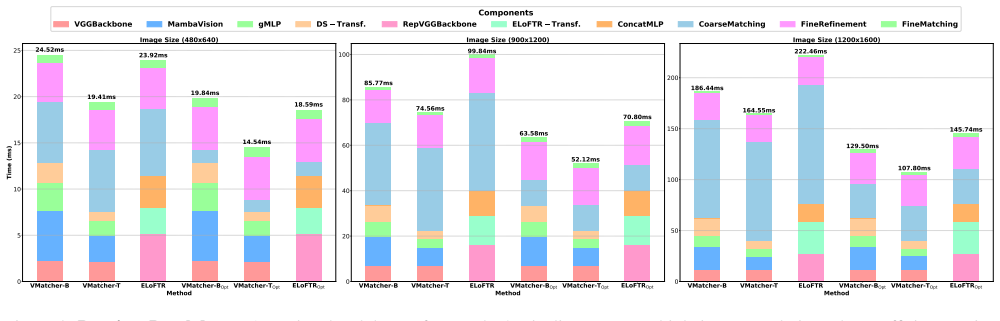
- [§5.2, Table 3, Fig. 4, Appendix H] The runtime advantage is not universal: on ScanNet at 480x640, VMatcher-B takes 24.52 ms versus 23.92 ms for ELoFTR (Table 3), and Appendix H concedes that for small sequences Mamba's runtime is comparable to Transformer-based models. The abstract and Sec. 5.2 state that VMatcher 'delivers improved performance and runtime speed advantages' over semi-dense methods without this qualification. The paper should state the resolution/sequence-length regime in which the efficiency claim holds and characterize the crossover point.
- [§5.2, Table 2] The paper states that VMatcher variants 'outperform all sparse and semi-dense methods' on MegaDepth, but the observed differences in AUC@10° are around 0.3 points (e.g., 72.2 for VMatcher-B vs. 72.1 for ELoFTR) and are well within the noise level expected from single runs without error bars. The claim of 'outperform' should be softened to 'on par' unless statistical significance is demonstrated or multiple seeds are reported.
minor comments (5)
- [Eq. (5)] Equation (5) is garbled: 'yi = LX i=0 C ¯AL−i ¯Bxi' should be a summation over an index with a clear upper limit, and the convolution kernel definition that follows is ambiguous.
- [§5.2, text near Table 3] The sentence 'VMatcher-B runtime is similar to ELoFTR [35]' cites reference [35] (LoFTR), but ELoFTR is reference [41]; the citation should be corrected.
- [§5.1, Table 1] The text says 'VMatcher-B matches ELoFTR in runtime', but Table 1 reports 35.43 ms for VMatcher-B versus 34.48 ms for ELoFTR; 'matches' is imprecise since VMatcher-B is slightly slower.
- [Figure 4 and Appendix A] The runtime breakdown legends include a component named 'ConcatMLP', but this term is never defined in the main text or the appendix; the layer patterns in Appendix A use 'G' for gMLP, so the legend should be aligned with the naming used elsewhere.
- [Appendix D.1 and Sec. 5.4] References [6] and [12] are both cited as 'Mamba' in Sec. 5.4, but [6] is 'Transformers are SSMs' rather than the Mamba paper; only [12] should be attributed to the Mamba architecture.
Circularity Check
No circularity: VMatcher's claims are benchmark-driven and its architecture choices are empirically ablated rather than derived from the target results.
full rationale
VMatcher's central claims—a hybrid Mamba-Transformer architecture, accuracy on par with ELoFTR/LoFTR, and runtime gains—are supported by external benchmarks (HPatches, MegaDepth, ScanNet, Aachen, InLoc) and measured runtimes. No load-bearing step reduces to its inputs by construction. The MambaVision module is adopted from prior external work [15]; the fine-level refinement is explicitly 'Adapted from ELoFTR [41]', an external method; and the DS-Transformer design choices (downsampling, omitting the MLP, removing RoPE) are justified by ablations in Tab. 6 and design experiments in Appendix D, not by the target results. The only questionable evaluation practice is per-model RANSAC threshold tuning on test sets (Sec. 5) without error bars, but this is a benchmark-protocol caveat, not a circular derivation: the reported AUC numbers are not equal to the tuned threshold by construction, and all baselines receive the same treatment. The paper's own Appendix H concedes that Mamba runtime is comparable to Transformer-based models for shorter sequences and favorable for longer sequences, which is an honest limitation of the efficiency claim rather than circular reasoning. There are no self-citations, and no uniqueness theorem is imported. Therefore no circular step is identified.
Assumptions & free parameters
free parameters (4)
- Loss weights alpha and beta =
1.0 and 0.25
- Attention downsampling factor =
4
- RANSAC inlier threshold =
tuned per model per dataset
- Coarse matching threshold tau =
not reported
assumptions (5)
- domain assumption MambaVision is a valid backbone for 2D image feature extraction.
- domain assumption ELoFTR's two-stage fine refinement transfers to VMatcher's features.
- standard math Standard SSM discretization and convolution formulas are correct.
- domain assumption Training only on MegaDepth generalizes to other test datasets.
- domain assumption RoPE can be omitted because Mamba encodes positional information.
Cite this review
Pith. "Pith review of VMatcher: State-Space Semi-Dense Local Feature Matching." pith.science (2026). https://pith.science/paper/ZZ3NKBKQ
@misc{pith2026250723371,
  author       = {Pith},
  title        = {Pith review of: VMatcher: State-Space Semi-Dense Local Feature Matching},
  year         = {2026},
  howpublished = {\url{https://pith.science/paper/ZZ3NKBKQ}},
  note         = {Machine review of arXiv:2507.23371}
}
read the original abstract
This paper introduces VMatcher, a hybrid Mamba-Transformer network for semi-dense feature matching between image pairs. Learning-based feature matching methods, whether detector-based or detector-free, achieve state-of-the-art performance but depend heavily on the Transformer's attention mechanism, which, while effective, incurs high computational costs due to its quadratic complexity. In contrast, Mamba introduces a Selective State-Space Model (SSM) that achieves comparable or superior performance with linear complexity, offering significant efficiency gains. VMatcher leverages a hybrid approach, integrating Mamba's highly efficient long-sequence processing with the Transformer's attention mechanism. Multiple VMatcher configurations are proposed, including hierarchical architectures, demonstrating their effectiveness in setting new benchmarks efficiently while ensuring robustness and practicality for real-time applications where rapid inference is crucial. Source Code is available at: https://github.com/ayoussf/VMatcher
Figures


Figures from the paper (6 more)


Reference graph
Works this paper leans on
-
[1]
Hpatches: A benchmark and evaluation of handcrafted and learned local descriptors
Vassileios Balntas, Karel Lenc, Andrea Vedaldi, and Krys- tian Mikolajczyk. Hpatches: A benchmark and evaluation of handcrafted and learned local descriptors. In CVPR, 2017. 5
work page 2017
-
[2]
Surf: Speeded up robust features
Herbert Bay, Tinne Tuytelaars, and Luc Van Gool. Surf: Speeded up robust features. In Computer Vision – ECCV 2006, pages 404–417, Berlin, Heidelberg, 2006. Springer Berlin Heidelberg. 1, 2
work page 2006
-
[3]
Aspanformer: Detector-free image matching with adaptive span transformer, 2022
Hongkai Chen, Zixin Luo, Lei Zhou, Yurun Tian, Ming- min Zhen, Tian Fang, David Mckinnon, Yanghai Tsin, and Long Quan. Aspanformer: Detector-free image matching with adaptive span transformer, 2022. 2, 3, 4, 5, 6, 7, 11
work page 2022
-
[4]
Chang, Manolis Savva, Maciej Hal- ber, Thomas A
Angela Dai, Angel X. Chang, Manolis Savva, Maciej Hal- ber, Thomas A. Funkhouser, and Matthias Nießner. Scannet: Richly-annotated 3d reconstructions of indoor scenes.CoRR, abs/1702.04405, 2017. 6, 7, 8, 11, 12, 13
arXiv 2017
-
[5]
Flashattention-2: Faster attention with better paral- lelism and work partitioning, 2023
Tri Dao. Flashattention-2: Faster attention with better paral- lelism and work partitioning, 2023. 5, 11
work page 2023
-
[6]
Tri Dao and Albert Gu. Transformers are ssms: General- ized models and efficient algorithms through structured state space duality, 2024. 8
work page 2024
-
[7]
Superpoint: Self-supervised interest point detection and description
Daniel DeTone, Tomasz Malisiewicz, and Andrew Rabi- novich. Superpoint: Self-supervised interest point detection and description. CoRR, abs/1712.07629, 2017. 2, 6, 7
arXiv 2017
-
[8]
Repvgg: Making vgg-style convnets great again, 2021
Xiaohan Ding, Xiangyu Zhang, Ningning Ma, Jungong Han, Guiguang Ding, and Jian Sun. Repvgg: Making vgg-style convnets great again, 2021. 3
work page 2021
Show all 46 references
-
[9]
D2-net: A trainable cnn for joint description and detection of local features
Mihai Dusmanu, Ignacio Rocco, Tomas Pajdla, Marc Polle- feys, Josef Sivic, Akihiko Torii, and Torsten Sattler. D2-net: A trainable cnn for joint description and detection of local features. In 2019 IEEE/CVF Conference on Computer Vision and Pattern Recognition (CVPR), pages 80...
2019
-
[10]
Fischler and Robert C
Martin A. Fischler and Robert C. Bolles. Random sample consensus: a paradigm for model fitting with applications to image analysis and automated cartography. Commun. ACM, 24(6):381–395, 1981. 5
1981
-
[11]
Silk: Sim- ple learned keypoints
Pierre Gleize, Weiyao Wang, and Matt Feiszli. Silk: Sim- ple learned keypoints. In Proceedings of the IEEE/CVF In- ternational Conference on Computer Vision (ICCV) , pages 22499–22508, 2023. 2, 5, 6
2023
-
[12]
Mamba: Linear-time sequence mod- eling with selective state spaces, 2024
Albert Gu and Tri Dao. Mamba: Linear-time sequence mod- eling with selective state spaces, 2024. 1, 2, 3, 4, 8, 11, 12
2024
-
[13]
Combining recurrent, con- volutional, and continuous-time models with linear state- space layers, 2021
Albert Gu, Isys Johnson, Karan Goel, Khaled Saab, Tri Dao, Atri Rudra, and Christopher R ´e. Combining recurrent, con- volutional, and continuous-time models with linear state- space layers, 2021. 3 8
2021
-
[14]
R. I. Hartley and A. Zisserman. Multiple View Geometry in Computer Vision . Cambridge University Press, ISBN: 0521540518, second edition, 2004. 6
2004
-
[15]
Mambavision: A hybrid mamba-transformer vision backbone, 2024
Ali Hatamizadeh and Jan Kautz. Mambavision: A hybrid mamba-transformer vision backbone, 2024. 1, 2, 4, 10, 11
2024
-
[16]
Image Matching across Wide Baselines: From Paper to Practice
Yuhe Jin, Dmytro Mishkin, Anastasiia Mishchuk, Jiri Matas, Pascal Fua, Kwang Moo Yi, and Eduard Trulls. Image Matching across Wide Baselines: From Paper to Practice. International Journal of Computer Vision, 2020. 11
2020
-
[17]
PoseLib - Minimal Solvers for Camera Pose Estimation, 2020
Viktor Larsson and contributors. PoseLib - Minimal Solvers for Camera Pose Estimation, 2020. 5
2020
-
[18]
Megadepth: Learning single-view depth prediction from internet photos
Zhengqi Li and Noah Snavely. Megadepth: Learning single-view depth prediction from internet photos. In 2018 IEEE/CVF Conference on Computer Vision and Pattern Recognition, pages 2041–2050, 2018. 6, 10, 12, 13
2018
-
[19]
Jamba: A hybrid transformer-mamba language model, 2024
Opher Lieber, Barak Lenz, Hofit Bata, Gal Cohen, Jhonathan Osin, Itay Dalmedigos, Erez Safahi, Shaked Meirom, Yonatan Belinkov, Shai Shalev-Shwartz, Omri Abend, Raz Alon, Tomer Asida, Amir Bergman, Roman Glozman, Michael Gokhman, Avashalom Manevich, Nir Ratner, Noam Rozen, Ere...
2024
-
[20]
Lightglue: Local feature matching at light speed, 2023
Philipp Lindenberger, Paul-Edouard Sarlin, and Marc Polle- feys. Lightglue: Local feature matching at light speed, 2023. 2, 4, 5, 6, 7, 11
2023
-
[21]
Vmamba: Visual state space model, 2024
Yue Liu, Yunjie Tian, Yuzhong Zhao, Hongtian Yu, Lingxi Xie, Yaowei Wang, Qixiang Ye, and Yunfan Liu. Vmamba: Visual state space model, 2024. 2
2024
-
[22]
David G. Lowe. Distinctive Image Features from Scale- Invariant Keypoints. International Journal of Computer Vi- sion, 60(2):91–110, 2004. 1, 2
2004
-
[23]
Triton Inference Server: An Opti- mized Cloud and Edge Inferencing Solution., 2020
NVIDIA Corporation. Triton Inference Server: An Opti- mized Cloud and Edge Inferencing Solution., 2020. 12
2020
-
[24]
Yang, Zach DeVito, Mar- tin Raison, Alykhan Tejani, Sasank Chilamkurthy, Benoit Steiner, Lu Fang, Junjie Bai, and Soumith Chintala
Adam Paszke, Sam Gross, Francisco Massa, Adam Lerer, James Bradbury, Gregory Chanan, Trevor Killeen, Zem- ing Lin, Natalia Gimelshein, Luca Antiga, Alban Desmai- son, Andreas K ¨opf, Edward Z. Yang, Zach DeVito, Mar- tin Raison, Alykhan Tejani, Sasank Chilamkurthy, Benoit Stei...
1912 arXiv
-
[25]
Efficientvmamba: Atrous selective scan for light weight visual mamba, 2024
Xiaohuan Pei, Tao Huang, and Chang Xu. Efficientvmamba: Atrous selective scan for light weight visual mamba, 2024. 2
2024
-
[26]
Nascimento
Guilherme Potje, Felipe Cadar, Andre Araujo, Renato Mar- tins, and Erickson R. Nascimento. Xfeat: Accelerated fea- tures for lightweight image matching, 2024. 2
2024
-
[27]
R2d2: Repeatable and reliable detector and descrip- tor
Jerome Revaud, Philippe Weinzaepfel, C ´esar De Souza, Noe Pion, Gabriela Csurka, Yohann Cabon, and Martin Humen- berger. R2d2: Repeatable and reliable detector and descrip- tor. arXiv preprint arXiv:1906.06195, 2019. 2
1906 arXiv
-
[28]
Orb: An efficient alternative to sift or surf
Ethan Rublee, Vincent Rabaud, Kurt Konolige, and Gary Bradski. Orb: An efficient alternative to sift or surf. In 2011 International Conference on Computer Vision, pages 2564– 2571, 2011. 1, 2
2011
-
[29]
From coarse to fine: Robust hierarchical localization at large scale, 2019
Paul-Edouard Sarlin, Cesar Cadena, Roland Siegwart, and Marcin Dymczyk. From coarse to fine: Robust hierarchical localization at large scale, 2019. 7
2019
-
[30]
Superglue: Learning feature matching with graph neural networks, 2020
Paul-Edouard Sarlin, Daniel DeTone, Tomasz Malisiewicz, and Andrew Rabinovich. Superglue: Learning feature matching with graph neural networks, 2020. 2, 5, 6, 7, 11
2020
-
[31]
Benchmarking 6dof outdoor visual localiza- tion in changing conditions, 2018
Torsten Sattler, Will Maddern, Carl Toft, Akihiko Torii, Lars Hammarstrand, Erik Stenborg, Daniel Safari, Masatoshi Okutomi, Marc Pollefeys, Josef Sivic, Fredrik Kahl, and Tomas Pajdla. Benchmarking 6dof outdoor visual localiza- tion in changing conditions, 2018. 7
2018
-
[32]
Structure-from-motion revisited
Johannes Lutz Sch ¨onberger and Jan-Michael Frahm. Structure-from-motion revisited. In Conference on Com- puter Vision and Pattern Recognition (CVPR), 2016. 7, 10
2016
-
[33]
Pixelwise view selection for un- structured multi-view stereo
Johannes Lutz Sch ¨onberger, Enliang Zheng, Marc Pollefeys, and Jan-Michael Frahm. Pixelwise view selection for un- structured multi-view stereo. In European Conference on Computer Vision (ECCV), 2016. 7, 10
2016
-
[34]
Roformer: Enhanced transformer with rotary position embedding, 2023
Jianlin Su, Yu Lu, Shengfeng Pan, Ahmed Murtadha, Bo Wen, and Yunfeng Liu. Roformer: Enhanced transformer with rotary position embedding, 2023. 4, 8
2023
-
[35]
Loftr: Detector-free local feature matching with transformers
Jiaming Sun, Zehong Shen, Yuang Wang, Hujun Bao, and Xiaowei Zhou. Loftr: Detector-free local feature matching with transformers. In 2021 IEEE/CVF Conference on Com- puter Vision and Pattern Recognition (CVPR), pages 8918– 8927, 2021. 2, 3, 4, 5, 6, 7, 11
2021
-
[36]
InLoc: Indoor visual localization with dense matching and view synthesis
Hajime Taira, Masatoshi Okutomi, Torsten Sattler, Mircea Cimpoi, Marc Pollefeys, Josef Sivic, Tomas Pajdla, and Ak- ihiko Torii. InLoc: Indoor visual localization with dense matching and view synthesis. In CVPR, 2018. 7
2018
-
[37]
Quadtree attention for vision transformers, 2022
Shitao Tang, Jiahui Zhang, Siyu Zhu, and Ping Tan. Quadtree attention for vision transformers, 2022. 2, 4, 6
2022
-
[38]
Tyszkiewicz, Pascal Fua, and Eduard Trulls
Michał J. Tyszkiewicz, Pascal Fua, and Eduard Trulls. Disk: Learning local features with policy gradient, 2020. 2, 5, 6, 11
2020
-
[39]
Gomez, Lukasz Kaiser, and Illia Polosukhin
Ashish Vaswani, Noam Shazeer, Niki Parmar, Jakob Uszko- reit, Llion Jones, Aidan N. Gomez, Lukasz Kaiser, and Illia Polosukhin. Attention is all you need, 2023. 1, 2, 11
2023
-
[40]
Matchformer: Interleaving attention in transformers for feature matching, 2022
Qing Wang, Jiaming Zhang, Kailun Yang, Kunyu Peng, and Rainer Stiefelhagen. Matchformer: Interleaving attention in transformers for feature matching, 2022. 2, 3, 4
2022
-
[41]
Efficient loftr: Semi-dense local feature matching with sparse-like speed, 2024
Yifan Wang, Xingyi He, Sida Peng, Dongli Tan, and Xiaowei Zhou. Efficient loftr: Semi-dense local feature matching with sparse-like speed, 2024. 2, 3, 4, 5, 6, 7, 8, 11
2024
-
[42]
Learning to find good correspondences
Kwang Moo Yi, Eduard Trulls, Yuki Ono, Vincent Lepetit, Mathieu Salzmann, and Pascal Fua. Learning to find good correspondences. In 2018 IEEE/CVF Conference on Com- puter Vision and Pattern Recognition , pages 2666–2674,
2018
-
[43]
Xiaoming Zhao, Xingming Wu, Weihai Chen, Peter C. Y . Chen, Qingsong Xu, and Zhengguo Li. Aliked: A lighter keypoint and descriptor extraction network via deformable transformation, 2023. 6
2023
-
[44]
Vision mamba: Efficient visual representation learning with bidirectional state space model, 2024
Lianghui Zhu, Bencheng Liao, Qian Zhang, Xinlong Wang, Wenyu Liu, and Xinggang Wang. Vision mamba: Efficient visual representation learning with bidirectional state space model, 2024. 2, 10 9 Appendix A. VMatcher Model Configurations VMatcher configurations introduced in Sec. ...
2024
-
[45]
was chosen as the variant for VMatcher’s architecture. E. Rotation Invariance DISK’s [38] rotation invariance evaluation was performed on the Image Matching Challenge (IMC) 2020 [16] valida- tion set. For each angle θ, 36 images are randomly selected and matched with their rot...
2020
-
[46]
11 Figure 7
Similarly, MambaVisions-Bi transposes the image, scans both the transposed image and its flipped version, then re- stores both to their original orientation. 11 Figure 7. VMatcher MambaVision layers scan directions visualisation. H. Limitations • The VMatcher model utilises th...
Reviewed August 6, 2026 · model on record in the stance chip above.
Discussion (0). Continue with ORCID to comment.