REVIEW 3 major objections 5 minor 119 references
The Orbital Eccentricity-Radius Relation for Planets Orbiting M Dwarfs
T0 review · 3 major / 5 minor · reviewed 2026-08-06 · deepseek-v4-flash
Pith's one-line read Using transit photometry for 236 planets orbiting M dwarfs, this paper reports a sharp transition from low to high orbital eccentricity at about 3.5 Earth radii, mirroring the relation previously found for planets around Sun-like stars.
desk verdict Plausible extension of the eccentricity-radius relation to M dwarfs, but the headline transition lacks a null-model significance test and rides on a thin high-radius sample. read the letter →
The pith
A machine-rendered reading of the paper's core claim, the machinery that carries it, and where it could break.
The reading
What carries the argument
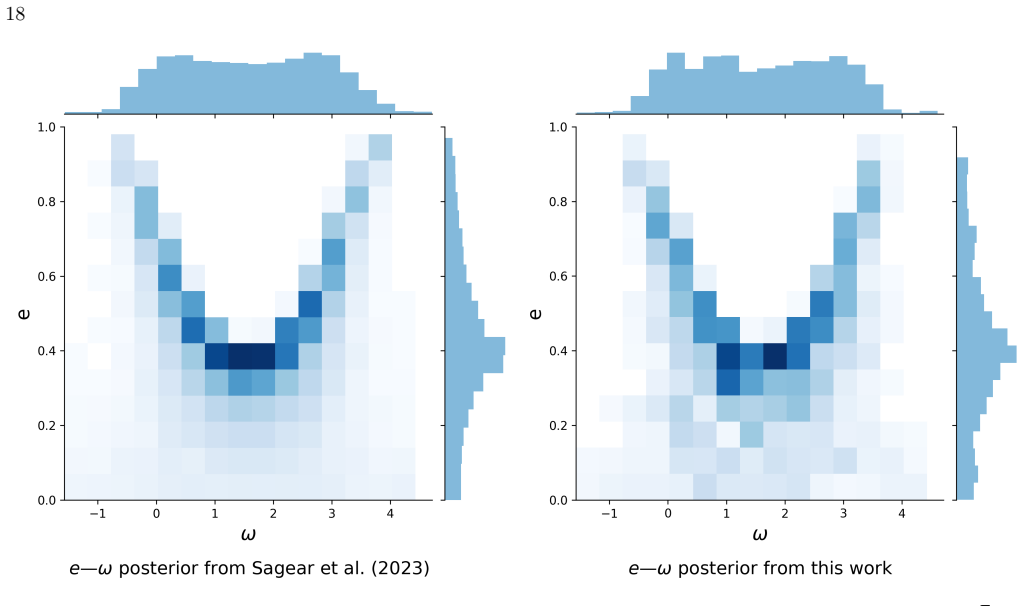
The photoeccentric effect is the load-bearing technique: a planet's transit duration and ingress/egress shape depend on its speed across the stellar disk, which for a known stellar density maps to a joint constraint on eccentricity e and argument of periastron ω. The paper implements it by fitting transit light curves with duration as a free parameter and then importance-sampling the (e, ω) posterior against a stellar-density prior, requiring the density inferred from the transit (assuming a circular orbit) to match the independently known stellar density. Population-level inference is carried out by a hierarchical model that assumes the parent eccentricity distribution in each radius bin is a Beta distribution constrained to peak at e=0 and decrease monotonically (alpha<1, beta>1), reparametrized to avoid prior biases. A logistic sigmoid is then fitted to the binned mean eccentricities to locate and characterize the low-to-high-eccentricity transition.
What would settle it
Re-fit the same 236 planets with a two-component eccentricity model that allows a secondary peak away from e=0 and compare the inferred transition; if the ~3.5 Earth radii step weakens or moves, the reported relation is an artifact of the Beta prior. The observational counterpart is a radial-velocity survey of M dwarf planets straddling 3.5 Earth radii, which would show whether eccentricities really are higher above that radius than below it.
Extended reading notes
Core claim
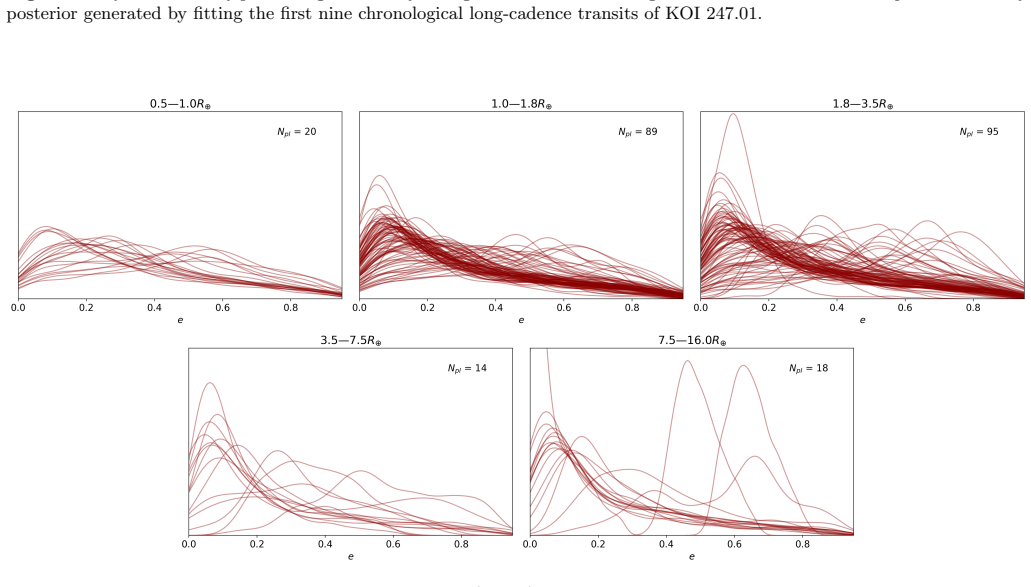
The paper's central claim is that the eccentricity-radius relation for M dwarf planets is a rising step function: small planets orbit on nearly circular paths while planets larger than about 3.5 Earth radii have systematically higher eccentricities. Fitting a logistic sigmoid to the binned mean eccentricities locates the transition at 3.1+1.5/-1.2 Earth radii, with the ratio of high- to low-eccentricity levels at 4.6+5.8/-1.9, consistent within 1σ with the transition measured for planets orbiting FGK dwarfs. The authors further claim that, unlike the FGK case, M dwarf planets near the radius gap show no significant elevation in eccentricity: multi-transit planets stay at low eccentricity at all radii, and the modest excess seen for single-transit planets between 1.9 and 3.0 Earth radii is consistent with a flat line at roughly 1σ. This asymmetry, if physical, is taken as evidence that photoevaporation or core-powered mass loss, rather than giant impacts, dominate atmospheric stripping for M dwarf planets.
Load-bearing premise
The chain of inference assumes that in every radius bin the true eccentricity distribution has exactly one shape—highest at zero eccentricity and falling monotonically—so a population of moderately eccentric planets sitting away from zero would be invisible to the model and could bias the reported average eccentricities and the location of the transition.
Editorial extensions
If this is right
- If the transition is real, planet formation around M dwarfs and FGK dwarfs produces two distinct radius regimes, with the boundary near 3.5 Earth radii, and the dynamical evolution of larger planets leaves them on eccentric orbits regardless of host-star mass.
- The absence of elevated eccentricities at the radius gap for multi-transit M dwarf planets would point to photoevaporation or core-powered mass loss, mechanisms that remove atmospheres without changing orbital dynamics, as the dominant sculptors of the M dwarf radius valley.
- The consistency of the transition radius between M dwarf and FGK dwarf planets (3.1+1.5/-1.2 versus 3.3±0.4 and 4.2±0.9 Earth radii) suggests the boundary between rocky and gas-rich planet formation channels is set by planet properties rather than by host star mass.
- If single-transit M dwarf planets near the radius gap do have modestly elevated eccentricities, giant impacts or planet-planet scattering may still play a role in atmospheric loss for dynamically hot, single-planet systems.
Reading between the lines
- A testable extension would be to run the same hierarchical inference on a larger joint Kepler-TESS sample; if the transition stays pinned near 3.5 Earth radii as the sample grows, the photoevaporation-versus-giant-impact interpretation would gain strength.
- The authors leave implicit that their Beta-distribution model cannot represent a separate high-eccentricity population, so a re-analysis with a two-component mixture would test whether the e_high/e_low ratio and transition location are artifacts of the assumed distributional shape.
- A prediction of their interpretation, not stated in the paper, is that radial-velocity eccentricities of M dwarf planets above roughly 3.5 Earth radii should be systematically higher than those below, and that the single-transit radius-gap excess, if real, should grow with a larger sample.
- Because TESS single-transit systems are likely contaminated by undetected multi-planet systems, the reported single-versus-multi eccentricity contrast could sharpen as longer TESS baselines reveal hidden companions, changing the inferred radius-gap behaviour for singles.
Editorial analysis
A structured set of objections, weighed in public.
Referee Report
Summary. The paper constrains orbital eccentricities for 236 transiting planets orbiting M dwarfs using the photoeccentric effect on TESS and Kepler light curves, then applies a hierarchical Bayesian model with Beta distributions to infer the underlying eccentricity distribution in radius bins. The authors report a transition from low to high eccentricity at approximately 3.5 R_Earth, with e_high/e_low about 4.6, and interpret this as analogous to the FGK-dwarf eccentricity-radius relation found by G25. They also investigate eccentricity near the radius gap, finding only about 1-sigma evidence for elevated eccentricities among single-transit planets and no evidence among multi-transit planets, and discuss implications for photoevaporation versus giant-impact atmospheric loss.
Significance. If the transition is real, this would be the first clear demonstration that the eccentricity-radius relation for M-dwarf planets mirrors that of FGK dwarfs, implying common formation and evolution channels across spectral types. The paper is methodologically careful: it validates the importance-sampling transit fit against the prior Kepler-based analysis (Appendix A), uses an external stellar density prior, and directly compares to G25 with identical binning. The main limitation is that the central transition claim lacks a formal significance test, and the robustness of the result to the assumed Beta distribution shape is not quantified. With a formal null-model comparison and additional robustness checks, this would be a valuable contribution to the demographics of small exoplanets.
major comments (3)
- [Section 4.2, Eq. (10)] The logistic sigmoid fit to the five binned <e> points is presented without any statistical comparison to a null model with constant <e> across radius. The paper only applies a flat-line test to the Gaussian radius-gap peak (Eq. 12), not to the global transition. Given that the two highest-radius bins contain only 14 and 18 planets, respectively (Table 3), and the 7.5-16 R_Earth bin is entirely composed of single-transit TESS planets, a steep sigmoid can easily fit noise. Please add a formal significance test, such as a Delta-chi^2 or Delta-BIC comparison between the sigmoid and a constant model, or a posterior predictive p-value derived from the hierarchical model, and report the resulting significance. As written, the Conclusions statement 'We show marked evidence for a transition' is not quantitatively supported.
- [Section 3.2.1] The assumed Beta distribution with alpha<1 and beta>1 is monotonically decreasing and peaks at e=0; it cannot represent a separate high-eccentricity population or a bump away from zero. The authors acknowledge they 'lack sufficient physical understanding of the true shape' but adopt this form for reproducibility and efficiency. The empirical histogram model in Appendix B is used only for qualitative comparison (Figure 12), and the transition parameters of Eq. (10) are not re-derived from that model. The robustness of the central transition claim to this modeling choice is therefore untested. Please demonstrate that the Beta assumption does not bias the binned <e> values, for example by fitting a two-component mixture or by quantifying the transition with the empirical histogram model and showing that the result is unchanged.
- [Section 4.2, Table 3] The combined-sample transition may be driven by the survey and multiplicity composition of the high-radius bins: the 7.5-16 R_Earth bin contains only single-transit TESS planets, and single-transit systems are known to have higher eccentricities (Section 4.1). The paper compares singles and multis in Figure 3, but does not test whether the sigmoid transition is present within the single-transit subsample alone or after controlling for multiplicity and survey. The physical interpretation in Section 5.1 assumes a radius-driven effect, but a multiplicity-driven selection effect is a competing explanation. Please add a test that isolates the radius effect from the multiplicity effect, such as fitting the sigmoid to the single-transit sample only, or including multiplicity as a covariate in the hierarchical model.
minor comments (5)
- [Section 3.4] The text states that the Beta distribution is modeled with alpha < 1 and beta < 1, which is inconsistent with Section 3.2.1, where beta > 1 is required for a monotonically decreasing distribution peaking at e=0. This appears to be a typo and should be corrected.
- [Section 3.1.1] The 'Gelman-Ruban statistic' should read 'Gelman-Rubin statistic.'
- [Section 3.4] The sentence 'We take the mean of these median values as <e>' is confusing: it is unclear whether the authors take the mean or the median of the posterior draws of the Beta distribution's mean, and the wording conflates the two operations.
- [Section 4.2, Figure 2] The binned <e> values and the sigmoid fit parameters are only presented in figures; a machine-readable table with the numerical values of <e>, their uncertainties, and the sigmoid parameters (B, L, k, x_t) would allow readers to reproduce the test requested in the first major comment.
- [Abstract and Section 6] The abstract and conclusions quote the transition at 3.5 R_Earth, while the fitted transition in Section 4.2 is 3.1(+1.5/-1.2) R_Earth; please clarify that 3.5 R_Earth is the bin edge rather than the fitted transition location, or quote the fitted value consistently throughout.
Circularity Check
No significant circularity: the M-dwarf eccentricity-radius relation is derived from transit posteriors plus external priors, with prior work used only for sample continuity and comparison.
full rationale
The derivation chain is self-contained: individual eccentricity posteriors come from transit light-curve fits via the photoeccentric effect, using an external stellar density prior from Stassun et al. (2019) and Mann et al. empirical relations; the hierarchical Beta-distribution fit is a stated modeling choice justified by an empirical histogram check; and the claimed transition is a description of the logistic sigmoid fit to the resulting binned <e> values, not an out-of-sample prediction. The S23 and G25 citations are used for sample reuse, method validation, and as comparison datasets, but the M-dwarf transition radius of 3.1+1.5/-1.2 Rearth comes from this paper's own fit, not from those prior works. The radius-gap diagonal binning uses the independently authored Ho et al. (2024) relation as an external input, and the Beta(alpha<1, beta>1) shape constraint is an acknowledged modeling assumption rather than an input that already contains the eccentricity-radius trend. The absence of a formal null-model significance test for the global sigmoid is a statistical robustness concern, not a circularity. No equation or fitted parameter reduces the target relation to its own inputs.
Assumptions & free parameters
free parameters (4)
- Beta distribution shape parameters (alpha, beta or mu, tau) per radius bin =
posterior samples; not individually tabulated
- Logistic sigmoid parameters B, L, k, x_t =
x_t = 3.1+1.5/-1.2 Rearth; e_high/e_low = 4.6+5.8/-1.9
- Gaussian peak parameters A, B, x_p, s =
A>0 for 69% of samples for singles and 49% for multis
- Transit model parameters per planet (P, t0, log(T14), log(Rp), b, q1, q2) =
reported in machine-readable Table 2
assumptions (5)
- domain assumption Photoeccentric effect formalism correctly converts transit duration, impact parameter, and stellar density prior into eccentricity constraints.
- domain assumption Underlying eccentricity distribution in every radius bin follows a Beta distribution with alpha<1 and beta>1.
- domain assumption Stellar density prior from the TIC (Stassun et al. 2019) is accurate.
- domain assumption Radius gap boundary from Ho et al. 2024 applies to M dwarfs at the sample median stellar mass.
- standard math Uniform priors on e and omega for importance sampling.
Cite this review
Pith. "Pith review of The Orbital Eccentricity-Radius Relation for Planets Orbiting M Dwarfs." pith.science (2026). https://pith.science/paper/ZZKAXX72
@misc{pith2026250707169,
  author       = {Pith},
  title        = {Pith review of: The Orbital Eccentricity-Radius Relation for Planets Orbiting M Dwarfs},
  year         = {2026},
  howpublished = {\url{https://pith.science/paper/ZZKAXX72}},
  note         = {Machine review of arXiv:2507.07169}
}
read the original abstract
The orbital eccentricity-radius relation for small planets is indicative of the predominant dynamical sculpting processes during late-stage orbital evolution. Previous studies have shown that planets orbiting Sun-like stars exhibit an eccentricity-radius trend such that larger planets have higher orbital eccentricities, and that radius gap planets may have modestly higher orbital eccentricities than planets on either side of the radius gap. In this work, we investigate the trend for a sample of smaller M dwarf stars. For a sample of 236 single- and multi-transit confirmed planets or candidates discovered by the TESS and Kepler missions, we constrain orbital eccentricity for each planet from the transit photometry together with a stellar density prior. We investigate the binned eccentricity-planet radius relation for the combined planet sample and present evidence for a positive eccentricity-radius relationship with elevated eccentricities for planets larger than 3.5 R_earth, similar to the trend for planets orbiting Sun-like stars. We find modest evidence that single-transit M dwarf planets near the radius gap exhibit higher eccentricity, consistent with trends for Sun-like stars. However, we see no evidence for an increased eccentricity near the radius gap among multi-transit M dwarf planets. We discuss implications for these results in the context of predominant atmospheric loss mechanisms: namely, supporting evidence for photoevaporation in M dwarf planets vs. planet-planet collisions or giant impacts in FGK dwarf planets.
Figures


Figures from the paper (9 more)





Reference graph
Works this paper leans on
-
[1]
, " * write output.state after.block = add.period write newline
ENTRY address archivePrefix author booktitle chapter doi edition editor eprint howpublished institution journal key month number organization pages publisher school series title misctitle type volume year version url label extra.label sort.label short.list INTEGERS output.state before.all mid.sentence after.sentence after.block FUNCTION init.state.consts ...
-
[2]
write newline
" write newline "" before.all 'output.state := FUNCTION format.url url empty "" new.block "" url * "" * if FUNCTION format.eprint eprint empty "" archivePrefix empty "" archivePrefix "arXiv" = new.block " " eprint * " " * new.block " " eprint * " " * if if if FUNCTION format.doi doi empty "" " " doi * " " * if FUNCTION format.pid doi empty eprint empty ur...
-
[3]
""""""""
thebibliography [1] 20pt to REFERENCES 6pt =0pt \@twocolumntrue 12pt -12pt 10pt plus 3pt =0pt =0pt =1pt plus 1pt =0pt =0pt -12pt =13pt plus 1pt =20pt =13pt plus 1pt \@M =10000 =-1.0em =0pt =0pt 0pt =0pt =1.0em @enumiv\@empty 10000 10000 `\.\@m \@noitemerr \@latex@warning Empty `thebibliography' environment \@ifnextchar \@reference \@latexerr Missing key o...
2017
-
[4]
Abdurro’uf , Accetta, K., Aerts, C., et al. 2022, title The Seventeenth Data Release of the Sloan Digital Sky Surveys : Complete Release of MaNGA , MaStar , and APOGEE -2 Data , The Astrophysical Journal Supplement Series, 259, 35, 10.3847/1538-4365/ac4414
-
[5]
Almenara, J. M., Bonfils, X., Bryant, E. M., et al. 2024, title TOI -4860 b, a short-period giant planet transiting an M3 .5 dwarf, Astronomy & Astrophysics, 683, A166, 10.1051/0004-6361/202346999
-
[6]
Anderson, S. G., Dittmann, J. A., Ballard, S., & Bedell, M. 2021, title Higher Compact Multiple Occurrence around Metal -poor M -dwarfs and Late - K -dwarfs, The Astronomical Journal, 161, 203, 10.3847/1538-3881/abe70b
-
[7]
G., Delgado-Mena, E., Santos, N
Antoniadis-Karnavas, A., Sousa, S. G., Delgado-Mena, E., Santos, N. C., & Andreasen, D. T. 2024, title ODUSSEAS : Upgraded version with new reference scale and parameter determinations for 82 planet-host M dwarf stars in SWEET - Cat , Astronomy & Astrophysics, 690, A58, 10.1051/0004-6361/202450722
-
[8]
, Bayliss, D., Bento, J., et al
Bakos, G. ., Bayliss, D., Bento, J., et al. 2020, title HATS -71b: A Giant Planet Transiting an M3 Dwarf Star in TESS Sector 1, The Astronomical Journal, 159, 267, 10.3847/1538-3881/ab8ad1
Show all 119 references
-
[9]
2019, title Predicted Number , Multiplicity , and Orbital Dynamics of TESS M -dwarf Exoplanets , The Astronomical Journal, 157, 113, 10.3847/1538-3881/aaf477
Ballard, S. 2019, title Predicted Number , Multiplicity , and Orbital Dynamics of TESS M -dwarf Exoplanets , The Astronomical Journal, 157, 113, 10.3847/1538-3881/aaf477
2019 doi
-
[10]
Ballard, S., & Johnson, J. A. 2016, title THE KEPLER DICHOTOMY AMONG THE M DWARFS : HALF OF SYSTEMS CONTAIN FIVE OR MORE COPLANAR PLANETS , The Astrophysical Journal, 816, 66, 10.3847/0004-637X/816/2/66
2016 doi
-
[11]
Barnes, J. 2007, title Effects of Orbital Eccentricity on Extrasolar Planet Transit Detectability and Light Curves , Publications of the Astronomical Society of the Pacific, 119, 986, 10.1086/522039
2007 doi
-
[12]
2013, title Tidal Venuses : Triggering a Climate Catastrophe via Tidal Heating , Astrobiology, 13, 225, 10.1089/ast.2012.0851
Barnes, R., Mullins, K., Goldblatt, C., et al. 2013, title Tidal Venuses : Triggering a Climate Catastrophe via Tidal Heating , Astrobiology, 13, 225, 10.1089/ast.2012.0851
2013
-
[13]
A., Huber, D., Gaidos, E., & van Saders, J
Berger, T. A., Huber, D., Gaidos, E., & van Saders, J. L. 2018, title Revised Radii of Kepler Stars and Planets Using Gaia Data Release 2, The Astrophysical Journal, 866, 99, 10.3847/1538-4357/aada83
2018 doi
-
[14]
A., Huber, D., Gaidos, E., van Saders, J
Berger, T. A., Huber, D., Gaidos, E., van Saders, J. L., & Weiss, L. M. 2020, title The Gaia - Kepler Stellar Properties Catalog . II . Planet Radius Demographics as a Function of Stellar Mass and Age , The Astronomical Journal, 160, 108, 10.3847/1538-3881/aba18a
2020 doi
- [15]
-
[16]
B., & Schlichting, H
Biersteker, J. B., & Schlichting, H. E. 2019, title Atmospheric mass-loss due to giant impacts: the importance of the thermal component for hydrogen–helium envelopes, Monthly Notices of the Royal Astronomical Society, 485, 4454, 10.1093/mnras/stz738
2019 doi
-
[17]
P., Jankowiak, M., et al
Bingham, E., Chen, J. P., Jankowiak, M., et al. 2019, title Pyro: Deep Universal Probabilistic Programming , Journal of Machine Learning Research, 20, 1. http://jmlr.org/papers/v20/18-403.html
2019
-
[18]
Bluhm, P., Luque, R., Espinoza, N., et al. 2020, title Precise mass and radius of a transiting super- Earth planet orbiting the M dwarf TOI -1235: a planet in the radius gap? Astronomy & Astrophysics, 639, A132, 10.1051/0004-6361/202038160
2020 doi
-
[19]
J., Koch, D., Basri, G., et al
Borucki, W. J., Koch, D., Basri, G., et al. 2010, title Kepler Planet - Detection Mission : Introduction and First Results , Science, 327, 977, 10.1126/science.1185402
2010 doi
-
[20]
M., Wang, S., Fischer, D
Brewer, J. M., Wang, S., Fischer, D. A., & Foreman-Mackey, D. 2018, title Compact Multi -planet Systems are more Common around Metal -poor Hosts , The Astrophysical Journal Letters, 867, L3, 10.3847/2041-8213/aae710
2018 doi
-
[21]
Brown, A. G. A., Vallenari, A., Prusti, T., et al. 2018, title Gaia Data Release 2 - Summary of the contents and survey properties, Astronomy & Astrophysics, 616, A1, 10.1051/0004-6361/201833051
2018 doi
-
[22]
A., Latham, D
Buchhave, L. A., Latham, D. W., Johansen, A., et al. 2012, title An abundance of small exoplanets around stars with a wide range of metallicities, Nature, 486, 375, 10.1038/nature11121
2012 doi
-
[23]
2021, title The GALAH + survey: Third data release, Monthly Notices of the Royal Astronomical Society, 506, 150, 10.1093/mnras/stab1242
Buder, S., Sharma, S., Kos, J., et al. 2021, title The GALAH + survey: Third data release, Monthly Notices of the Royal Astronomical Society, 506, 150, 10.1093/mnras/stab1242
2021 doi
-
[24]
Burke, C. J. 2008, title Impact of Orbital Eccentricity on the Detection of Transiting Extrasolar Planets , The Astrophysical Journal, 679, 1566, 10.1086/587798
2008 doi
-
[25]
A., Andrade, E
Caswell, T. A., Andrade, E. S. d., Lee, A., et al. 2024, title matplotlib/matplotlib: REL : v3.7.5, Zenodo, 10.5281/zenodo.10669804
2024 doi
- [26]
-
[27]
2022, title Signatures of Impact -driven Atmospheric Loss in Large Ensembles of Exoplanets , The Astrophysical Journal, 937, 39, 10.3847/1538-4357/ac8a97
Chance, Q., Ballard, S., & Stassun, K. 2022, title Signatures of Impact -driven Atmospheric Loss in Large Ensembles of Exoplanets , The Astrophysical Journal, 937, 39, 10.3847/1538-4357/ac8a97
2022 doi
-
[28]
Chen, H., & Rogers, L. A. 2016, title EVOLUTIONARY ANALYSIS OF GASEOUS SUB - NEPTUNE - MASS PLANETS WITH MESA , The Astrophysical Journal, 831, 180, 10.3847/0004-637X/831/2/180
2016 doi
-
[29]
A., Price-Whelan, A
Collaboration, T. A., Price-Whelan, A. M., Sipőcz, B. M., et al. 2018, title The Astropy Project : Building an Open -science Project and Status of the v2.0 Core Package *, The Astronomical Journal, 156, 123, 10.3847/1538-3881/aabc4f
2018 doi
-
[30]
A., Price-Whelan, A
Collaboration, T. A., Price-Whelan, A. M., Lim, P. L., et al. 2022, title The Astropy Project : Sustaining and Growing a Community -oriented Open -source Project and the Latest Major Release (v5.0) of the Core Package *, The Astrophysical Journal, 935, 167, 10.3847/1538-4357/ac7c74
2022 doi
-
[31]
Costa-Almeida, E., de Mello, G. F. P., Giribaldi, R. E., Lorenzo-Oliveira, D., & Ubaldo-Melo, M. L. 2021, title M dwarf spectral indices at moderate resolution: accurate Teff and [ Fe / H ] for 178 southern stars, Monthly Notices of the Royal Astronomical Society, 508, 5148, 1...
2021 doi
-
[32]
J., Contardo, G., Sandoval, A., et al
David, T. J., Contardo, G., Sandoval, A., et al. 2021, title Evolution of the Exoplanet Size Distribution : Forming Large Super - Earths Over Billions of Years , The Astronomical Journal, 161, 265, 10.3847/1538-3881/abf439
2021 doi
-
[33]
I., & Johnson, J
Dawson, R. I., & Johnson, J. A. 2012, title THE PHOTOECCENTRIC EFFECT AND PROTO - HOT JUPITERS . I . MEASURING PHOTOMETRIC ECCENTRICITIES OF INDIVIDUAL TRANSITING PLANETS , The Astrophysical Journal, 756, 122, 10.1088/0004-637X/756/2/122
2012 doi
-
[34]
I., & Murray-Clay, R
Dawson, R. I., & Murray-Clay, R. A. 2013, title GIANT PLANETS ORBITING METAL - RICH STARS SHOW SIGNATURES OF PLANET – PLANET INTERACTIONS , The Astrophysical Journal Letters, 767, L24, 10.1088/2041-8205/767/2/L24
2013 doi
-
[35]
R., O’Neil, K
Do Ó, C. R., O’Neil, K. K., Konopacky, Q. M., et al. 2023, title The Orbital Eccentricities of Directly Imaged Companions Using Observable -based Priors : Implications for Population -level Distributions , The Astronomical Journal, 166, 48, 10.3847/1538-3881/acdc9a
2023 doi
-
[36]
D., & Charbonneau, D
Dressing, C. D., & Charbonneau, D. 2013, title THE OCCURRENCE RATE OF SMALL PLANETS AROUND SMALL STARS , The Astrophysical Journal, 767, 95, 10.1088/0004-637X/767/1/95
2013 doi
-
[37]
D., & Charbonneau, D
Dressing, C. D., & Charbonneau, D. 2015, title THE OCCURRENCE OF POTENTIALLY HABITABLE PLANETS ORBITING M DWARFS ESTIMATED FROM THE FULL KEPLER DATASET AND AN EMPIRICAL MEASUREMENT OF THE DETECTION SENSITIVITY , The Astrophysical Journal, 807, 45, 10.1088/0004-637X/807/1/45
2015 doi
-
[38]
C., Lissauer, J
Fabrycky, D. C., Lissauer, J. J., Ragozzine, D., et al. 2014, title ARCHITECTURE OF KEPLER ' S MULTI - TRANSITING SYSTEMS . II . NEW INVESTIGATIONS WITH TWICE AS MANY CANDIDATES , The Astrophysical Journal, 790, 146, 10.1088/0004-637X/790/2/146
2014 doi
- [39]
-
[40]
A., & Valenti, J
Fischer, D. A., & Valenti, J. 2005, title The Planet - Metallicity Correlation *, The Astrophysical Journal, 622, 1102, 10.1086/428383
2005 doi
-
[41]
B., Quinn, S
Ford, E. B., Quinn, S. N., & Veras, D. 2008, title Characterizing the Orbital Eccentricities of Transiting Extrasolar Planets with Photometric Observations , The Astrophysical Journal, 678, 1407, 10.1086/587046
2008 doi
-
[42]
2017, title Fast and Scalable Gaussian Process Modeling with Applications to Astronomical Time Series , The Astronomical Journal, 154, 220, 10.3847/1538-3881/aa9332
Foreman-Mackey, D., Agol, E., Ambikasaran, S., & Angus, R. 2017, title Fast and Scalable Gaussian Process Modeling with Applications to Astronomical Time Series , The Astronomical Journal, 154, 220, 10.3847/1538-3881/aa9332
2017 doi
-
[43]
W., & Morton, T
Foreman-Mackey, D., Hogg, D. W., & Morton, T. D. 2014, title EXOPLANET POPULATION INFERENCE AND THE ABUNDANCE OF EARTH ANALOGS FROM NOISY , INCOMPLETE CATALOGS , The Astrophysical Journal, 795, 64, 10.1088/0004-637X/795/1/64
2014 doi
-
[44]
2021, title `exoplanet`: Gradient -based probabilistic inference for exoplanet data & other astronomical time series, Journal of Open Source Software, 6, 3285, 10.21105/joss.03285
Foreman-Mackey, D., Luger, R., Agol, E., et al. 2021, title `exoplanet`: Gradient -based probabilistic inference for exoplanet data & other astronomical time series, Journal of Open Source Software, 6, 3285, 10.21105/joss.03285
2021 doi
-
[45]
2020, title The High -energy Radiation Environment around a 10 Gyr M Dwarf : Habitable at Last ? The Astronomical Journal, 160, 237, 10.3847/1538-3881/abb465
France, K., Duvvuri, G., Egan, H., et al. 2020, title The High -energy Radiation Environment around a 10 Gyr M Dwarf : Habitable at Last ? The Astronomical Journal, 160, 237, 10.3847/1538-3881/abb465
2020 doi
-
[46]
J., & Petigura, E
Fulton, B. J., & Petigura, E. A. 2018, title The California - Kepler Survey . VII . Precise Planet Radii Leveraging Gaia DR2 Reveal the Stellar Mass Dependence of the Planet Radius Gap , The Astronomical Journal, 156, 264, 10.3847/1538-3881/aae828
2018 doi
-
[47]
J., Petigura, E
Fulton, B. J., Petigura, E. A., Howard, A. W., et al. 2017, title The California - Kepler Survey . III . A Gap in the Radius Distribution of Small Planets *, The Astronomical Journal, 154, 109, 10.3847/1538-3881/aa80eb
2017 doi
-
[48]
L., & Rowe, J
Gaidos, E., Ali, A., Kraus, A. L., & Rowe, J. F. 2024, title The radius distribution of M dwarf-hosted planets and its evolution, Monthly Notices of the Royal Astronomical Society, 534, 3277, 10.1093/mnras/stae2207
2024 doi
-
[49]
A., Wang, S
Gan, T., Theissen, C. A., Wang, S. X., Burgasser, A. J., & Mao, S. 2025, title Metallicity Dependence of Giant Planets around M Dwarfs , The Astrophysical Journal Supplement Series, 276, 47, 10.3847/1538-4365/ad9c65
2025 doi
-
[50]
Gelman, A., & Rubin, D. B. 1992, title Inference from Iterative Simulation Using Multiple Sequences , Statistical Science, 7, 457, 10.1214/ss/1177011136
1992
-
[51]
D., et al
Ghachoui, M., Soubkiou, A., Wells, R. D., et al. 2023, title TESS discovery of a super- Earth orbiting the M -dwarf star TOI -1680, Astronomy & Astrophysics, 677, A31, 10.1051/0004-6361/202347040
2023 doi
-
[52]
J., Petigura, E
Gilbert, G. J., Petigura, E. A., & Entrican, P. M. 2025, title Planets larger than Neptune have elevated eccentricities, Proceedings of the National Academy of Sciences, 122, e2405295122, 10.1073/pnas.2405295122
2025 doi
-
[53]
E., & Sari, R
Ginzburg, S., Schlichting, H. E., & Sari, R. 2016, title SUPER - EARTH ATMOSPHERES : SELF - CONSISTENT GAS ACCRETION AND RETENTION , The Astrophysical Journal, 825, 29, 10.3847/0004-637X/825/1/29
2016 doi
-
[54]
E., & Sari, R
Ginzburg, S., Schlichting, H. E., & Sari, R. 2018, title Core-powered mass-loss and the radius distribution of small exoplanets, Monthly Notices of the Royal Astronomical Society, 476, 759, 10.1093/mnras/sty290
2018 doi
-
[55]
D., et al
Gore, R., Giacalone, S., Dressing, C. D., et al. 2024, title Metallicities and Refined Stellar Parameters for 52 Cool Dwarfs with Transiting Planets and Planet Candidates , The Astrophysical Journal Supplement Series, 271, 48, 10.3847/1538-4365/ad2c0c
2024 doi
-
[56]
M., Seager, S., Huang, C
Guerrero, N. M., Seager, S., Huang, C. X., et al. 2021, title The TESS Objects of Interest Catalog from the TESS Prime Mission , The Astrophysical Journal Supplement Series, 254, 39, 10.3847/1538-4365/abefe1
2021 doi
-
[57]
Gupta, A., & Schlichting, H. E. 2019, title Sculpting the valley in the radius distribution of small exoplanets as a by-product of planet formation: the core-powered mass-loss mechanism, Monthly Notices of the Royal Astronomical Society, 487, 24, 10.1093/mnras/stz1230
2019 doi
-
[58]
Gupta, A., & Schlichting, H. E. 2020, title Signatures of the core-powered mass-loss mechanism in the exoplanet population: dependence on stellar properties and observational predictions, Monthly Notices of the Royal Astronomical Society, 493, 792, 10.1093/mnras/staa315
2020 doi
-
[59]
P., & Burns, J
Hamilton, D. P., & Burns, J. A. 1992, title Orbital stability zones about asteroids: II . The destabilizing effects of eccentric orbits and of solar radiation, Icarus, 96, 43, 10.1016/0019-1035(92)90005-R
1992 doi
-
[60]
K., Cushing, M
Hardegree-Ullman, K. K., Cushing, M. C., Muirhead, P. S., & Christiansen, J. L. 2019, title Kepler Planet Occurrence Rates for Mid - Type M Dwarfs as a Function of Spectral Type , The Astronomical Journal, 158, 75, 10.3847/1538-3881/ab21d2
2019 doi
-
[61]
R., Millman, K
Harris, C. R., Millman, K. J., van der Walt, S. J., et al. 2020, title Array programming with NumPy , Nature, 585, 357, 10.1038/s41586-020-2649-2
2020 doi
-
[62]
2024, title exoplanet-dev/jaxoplanet, exoplanet
Hattori, S., Garcia, L., Murray, C., et al. 2024, title exoplanet-dev/jaxoplanet, exoplanet. https://github.com/exoplanet-dev/jaxoplanet
2024
-
[63]
Y., Ford, E
He, M. Y., Ford, E. B., Ragozzine, D., & Carrera, D. 2020, title Architectures of Exoplanetary Systems . III . Eccentricity and Mutual Inclination Distributions of AMD -stable Planetary Systems , The Astronomical Journal, 160, 276, 10.3847/1538-3881/abba18
2020 doi
-
[64]
2012, title ON THE STABILITY OF SUPER - EARTH ATMOSPHERES , The Astrophysical Journal, 754, 60, 10.1088/0004-637X/754/1/60
Heng, K., & Kopparla, P. 2012, title ON THE STABILITY OF SUPER - EARTH ATMOSPHERES , The Astrophysical Journal, 754, 60, 10.1088/0004-637X/754/1/60
2012 doi
-
[65]
H., et al
Hirano, T., Dai, F., Livingston, J. H., et al. 2023, title An Earth -sized Planet around an M5 Dwarf Star at 22 pc, The Astronomical Journal, 165, 131, 10.3847/1538-3881/acb7e1
2023 doi
-
[66]
Ho, C. S. K., Rogers, J. G., Van Eylen, V., Owen, J. E., & Schlichting, H. E. 2024, title Shallower radius valley around low-mass hosts: evidence for icy planets, collisions, or high-energy radiation scatter, Monthly Notices of the Royal Astronomical Society, 531, 3698, 10.109...
2024 doi
-
[67]
Ho, C. S. K., & Van Eylen, V. 2023, title A deep radius valley revealed by Kepler short cadence observations, Monthly Notices of the Royal Astronomical Society, 519, 4056, 10.1093/mnras/stac3802
2023 doi
-
[68]
D., & Gelman, A
Homan, M. D., & Gelman, A. 2014, title The No - U -turn sampler: adaptively setting path lengths in Hamiltonian Monte Carlo , The Journal of Machine Learning Research, 15, 1593
2014
-
[69]
C., Ford, E
Hsu, D. C., Ford, E. B., & Terrien, R. 2020, title Occurrence rates of planets orbiting M Stars : applying ABC to Kepler DR25 , Gaia DR2 , and 2MASS data, Monthly Notices of the Royal Astronomical Society, 498, 2249, 10.1093/mnras/staa2391
2020 doi
-
[70]
E., Isella, A., et al
Izidoro, A., Schlichting, H. E., Isella, A., et al. 2022, title The Exoplanet Radius Valley from Gas -driven Planet Migration and Breaking of Resonant Chains , The Astrophysical Journal Letters, 939, L19, 10.3847/2041-8213/ac990d
2022 doi
-
[71]
2014, title PLANETARY POPULATION SYNTHESIS COUPLED WITH ATMOSPHERIC ESCAPE : A STATISTICAL VIEW OF EVAPORATION , The Astrophysical Journal, 795, 65, 10.1088/0004-637X/795/1/65
Jin, S., Mordasini, C., Parmentier, V., et al. 2014, title PLANETARY POPULATION SYNTHESIS COUPLED WITH ATMOSPHERIC ESCAPE : A STATISTICAL VIEW OF EVAPORATION , The Astrophysical Journal, 795, 65, 10.1088/0004-637X/795/1/65
2014 doi
-
[72]
A., Prieto, C
Jönsson, H., Holtzman, J. A., Prieto, C. A., et al. 2020, title APOGEE Data and Spectral Analysis from SDSS Data Release 16: Seven Years of Observations Including First Results from APOGEE - South , The Astronomical Journal, 160, 120, 10.3847/1538-3881/aba592
2020 doi
-
[73]
A., et al
Kipping, D., Solano-Oropeza, D., Yahalomi, D. A., et al. 2025, title Near-circular orbits for planets with Earth -like sizes and instellations around M and K dwarf stars, Nature Astronomy, 1, 10.1038/s41550-025-02532-8
2025 doi
-
[74]
Kipping, D. M. 2013, title Efficient, uninformative sampling of limb darkening coefficients for two-parameter laws, Monthly Notices of the Royal Astronomical Society, 435, 2152, 10.1093/mnras/stt1435
2013 doi
-
[75]
Kipping, D. M. 2014, title Bayesian priors for the eccentricity of transiting planets, Monthly Notices of the Royal Astronomical Society, 444, 2263, 10.1093/mnras/stu1561
2014 doi
-
[76]
M., Dunn, W
Kipping, D. M., Dunn, W. R., Jasinski, J. M., & Manthri, V. P. 2012, title A novel method to photometrically constrain orbital eccentricities: Multibody Asterodensity Profiling , Monthly Notices of the Royal Astronomical Society, 421, 1166, 10.1111/j.1365-2966.2011.20376.x
2012
-
[77]
Kopparapu, R. K. 2013, title A REVISED ESTIMATE OF THE OCCURRENCE RATE OF TERRESTRIAL PLANETS IN THE HABITABLE ZONES AROUND KEPLER M - DWARFS , The Astrophysical Journal Letters, 767, L8, 10.1088/2041-8205/767/1/L8
2013 doi
-
[78]
K., del Burgo, C., Pavlenko, Y
Kuznetsov, M. K., del Burgo, C., Pavlenko, Y. V., & Frith, J. 2019, title Characterization of a Sample of Southern M Dwarfs Using Harps and X -shooter Spectra , The Astrophysical Journal, 878, 134, 10.3847/1538-4357/ab1fe9
2019 doi
-
[79]
W., Rowe, J
Latham, D. W., Rowe, J. F., Quinn, S. N., et al. 2011, title A FIRST COMPARISON OF KEPLER PLANET CANDIDATES IN SINGLE AND MULTIPLE SYSTEMS , The Astrophysical Journal Letters, 732, L24, 10.1088/2041-8205/732/2/L24
2011 doi
-
[80]
E., Schutte, M., Hebb, L., et al
Libby-Roberts, J. E., Schutte, M., Hebb, L., et al. 2023, title An In -depth Look at TOI -3884b: A Super - Neptune Transiting an M4Dwarf with Persistent Starspot Crossings , The Astronomical Journal, 165, 249, 10.3847/1538-3881/accc2f
2023 doi
-
[81]
Lightkurve Collaboration , Cardoso, J. V. d. M., Hedges, C., et al. 2018, title Lightkurve: Kepler and TESS time series analysis in Python , Astrophysics Source Code Library, ascl:1812.013. https://ui.adsabs.harvard.edu/abs/2018ascl.soft12013L
2018
-
[82]
J., Fabrycky, D
Lissauer, J. J., Fabrycky, D. C., Ford, E. B., et al. 2011, title A closely packed system of low-mass, low-density planets transiting Kepler -11, Nature, 470, 53, 10.1038/nature09760
2011 doi
-
[83]
J., & Lai, D
Liu, B., Muñoz, D. J., & Lai, D. 2015, title Suppression of extreme orbital evolution in triple systems with short-range forces, Monthly Notices of the Royal Astronomical Society, 447, 747, 10.1093/mnras/stu2396
2015 doi
-
[84]
D., & Fortney, J
Lopez, E. D., & Fortney, J. J. 2013, title THE ROLE OF CORE MASS IN CONTROLLING EVAPORATION : THE KEPLER RADIUS DISTRIBUTION AND THE KEPLER -36 DENSITY DICHOTOMY , The Astrophysical Journal, 776, 2, 10.1088/0004-637X/776/1/2
2013 doi
-
[85]
G., Gilbert, G
MacDougall, M. G., Gilbert, G. J., & Petigura, E. A. 2023 a , title Accurate and Efficient Photoeccentric Transit Modeling , The Astronomical Journal, 166, 61, 10.3847/1538-3881/ace16d
2023 doi
-
[86]
G., Petigura, E
MacDougall, M. G., Petigura, E. A., Gilbert, G. J., et al. 2023 b , title The TESS - Keck Survey . XV . Precise Properties of 108 TESS Planets and Their Host Stars , The Astronomical Journal, 166, 33, 10.3847/1538-3881/acd557
2023 doi
-
[87]
W., Feiden, G
Mann, A. W., Feiden, G. A., Gaidos, E., Boyajian, T., & Braun, K. v. 2015, title HOW TO CONSTRAIN YOUR M DWARF : MEASURING EFFECTIVE TEMPERATURE , BOLOMETRIC LUMINOSITY , MASS , AND RADIUS , The Astrophysical Journal, 804, 64, 10.1088/0004-637X/804/1/64
2015 doi
-
[88]
W., Dupuy, T., Kraus, A
Mann, A. W., Dupuy, T., Kraus, A. L., et al. 2019, title How to Constrain Your M Dwarf . II . The Mass - Luminosity - Metallicity Relation from 0.075 to 0.70 Solar Masses , The Astrophysical Journal, 871, 63, 10.3847/1538-4357/aaf3bc
2019 doi
-
[89]
M., Montes, D., et al
Marfil, E., Tabernero, H. M., Montes, D., et al. 2021, title The CARMENES search for exoplanets around M dwarfs - Stellar atmospheric parameters of target stars with STEPARSYN , Astronomy & Astrophysics, 656, A162, 10.1051/0004-6361/202141980
2021 doi
-
[90]
A., & Hall, O
Masuda, K., Petigura, E. A., & Hall, O. J. 2022, title Inferring the rotation period distribution of stars from their projected rotation velocities and radii: Application to late- F /early- G Kepler stars, Monthly Notices of the Royal Astronomical Society, 510, 5623, 10.1093/m...
2022 doi
-
[91]
C., He, M
Millholland, S. C., He, M. Y., Ford, E. B., et al. 2021, title Evidence for a Nondichotomous Solution to the Kepler Dichotomy : Mutual Inclinations of Kepler Planetary Systems from Transit Duration Variations , The Astronomical Journal, 162, 166, 10.3847/1538-3881/ac0f7a
2021 doi
-
[92]
Moriarty, J., & Ballard, S. 2016, title THE KEPLER DICHOTOMY IN PLANETARY DISKS : LINKING KEPLER OBSERVABLES TO SIMULATIONS OF LATE - STAGE PLANET FORMATION , The Astrophysical Journal, 832, 34, 10.3847/0004-637X/832/1/34
2016 doi
-
[93]
S., Becker, J., Feiden, G
Muirhead, P. S., Becker, J., Feiden, G. A., et al. 2014, title CHARACTERIZING THE COOL KOIs . VI . \ less\ i\ greater\ H \ less\ /i\ greater\ - AND \ less\ i\ greater\ K \ less\ /i\ greater\ - BAND SPECTRA OF \ less\ i\ greater\ KEPLER \ less\ /i\ greater\ M DWARF PLANET - CAN...
2014 doi
-
[94]
D., Pascucci, I., & Apai, D
Mulders, G. D., Pascucci, I., & Apai, D. 2015, title A S ℡ LAR - MASS - DEPENDENT DROP IN PLANET OCCURRENCE RATES , The Astrophysical Journal, 798, 112, 10.1088/0004-637X/798/2/112
2015 doi
-
[95]
P., et al
Nagpal, V., Blunt, S., Bowler, B. P., et al. 2023, title The Impact of Bayesian Hyperpriors on the Population - Level Eccentricity Distribution of Imaged Planets , The Astronomical Journal, 165, 32, 10.3847/1538-3881/ac9fd2
2023 doi
-
[96]
2019, title Kepler Objects of Interest Cumulative Table , IPAC, 10.26133/NEA4
NASA Exoplanet Archive . 2019, title Kepler Objects of Interest Cumulative Table , IPAC, 10.26133/NEA4
2019 doi
-
[97]
A., & Raftery, A
Newton, M. A., & Raftery, A. E. 1994, title Approximate Bayesian Inference with the Weighted Likelihood Bootstrap , Journal of the Royal Statistical Society Series B: Statistical Methodology, 56, 3, 10.1111/j.2517-6161.1994.tb01956.x
1994
-
[98]
E., & Jackson, A
Owen, J. E., & Jackson, A. P. 2012, title Planetary evaporation by UV and X -ray radiation: basic hydrodynamics, Monthly Notices of the Royal Astronomical Society, 425, 2931, 10.1111/j.1365-2966.2012.21481.x
2012
-
[99]
E., & Schlichting, H
Owen, J. E., & Schlichting, H. E. 2024, title Mapping out the parameter space for photoevaporation and core-powered mass-loss, Monthly Notices of the Royal Astronomical Society, 528, 1615, 10.1093/mnras/stad3972
2024 doi
-
[100]
E., & Wu, Y
Owen, J. E., & Wu, Y. 2013, title KEPLER PLANETS : A TALE OF EVAPORATION , The Astrophysical Journal, 775, 105, 10.1088/0004-637X/775/2/105
2013 doi
-
[101]
2019, title Composable Effects for Flexible and Accelerated Probabilistic Programming in NumPyro , 10.48550/arXiv.1912.11554
Phan, D., Pradhan, N., & Jankowiak, M. 2019, title Composable Effects for Flexible and Accelerated Probabilistic Programming in NumPyro , 10.48550/arXiv.1912.11554
-
[102]
2006, title The effect of red noise on planetary transit detection, Monthly Notices of the Royal Astronomical Society, 373, 231, 10.1111/j.1365-2966.2006.11012.x
Pont, F., Zucker, S., & Queloz, D. 2006, title The effect of red noise on planetary transit detection, Monthly Notices of the Royal Astronomical Society, 373, 231, 10.1111/j.1365-2966.2006.11012.x
2006
-
[103]
Prusti, T., Bruijne, J. H. J. d., Brown, A. G. A., et al. 2016, title The Gaia mission, Astronomy & Astrophysics, 595, A1, 10.1051/0004-6361/201629272
2016 doi
- [104]
-
[105]
D., Žerjal, M., Ireland, M
Rains, A. D., Žerjal, M., Ireland, M. J., et al. 2021, title Characterization of 92 southern TESS candidate planet hosts and a new photometric [ Fe / H ] relation for cool dwarfs, Monthly Notices of the Royal Astronomical Society, 504, 5788, 10.1093/mnras/stab1167
2021 doi
-
[106]
P., Tollerud, E
Robitaille, T. P., Tollerud, E. J., Greenfield, P., et al. 2013, title Astropy: A community Python package for astronomy, Astronomy & Astrophysics, 558, A33, 10.1051/0004-6361/201322068
2013 doi
-
[107]
G., Gupta, A., Owen, J
Rogers, J. G., Gupta, A., Owen, J. E., & Schlichting, H. E. 2021, title Photoevaporation versus core-powered mass-loss: model comparison with the 3D radius gap, Monthly Notices of the Royal Astronomical Society, 508, 5886, 10.1093/mnras/stab2897
2021 doi
-
[108]
2023, title The orbital eccentricity distribution of planets orbiting M dwarfs, Proceedings of the National Academy of Sciences, 120, e2217398120, 10.1073/pnas.2217398120
Sagear, S., & Ballard, S. 2023, title The orbital eccentricity distribution of planets orbiting M dwarfs, Proceedings of the National Academy of Sciences, 120, e2217398120, 10.1073/pnas.2217398120
2023 doi
-
[109]
E., & Mukhopadhyay, S
Schlichting, H. E., & Mukhopadhyay, S. 2018, title Atmosphere Impact Losses , Space Science Reviews, 214, 34, 10.1007/s11214-018-0471-z
2018 doi
-
[110]
E., Sari, R., & Yalinewich, A
Schlichting, H. E., Sari, R., & Yalinewich, A. 2015, title Atmospheric mass loss during planet formation: The importance of planetesimal impacts, Icarus, 247, 81, 10.1016/j.icarus.2014.09.053
2015 doi
-
[111]
G., Oelkers, R
Stassun, K. G., Oelkers, R. J., Pepper, J., et al. 2018, title The TESS Input Catalog and Candidate Target List , The Astronomical Journal, 156, 102, 10.3847/1538-3881/aad050
2018 doi
-
[112]
G., Oelkers, R
Stassun, K. G., Oelkers, R. J., Paegert, M., et al. 2019, title The Revised TESS Input Catalog and Candidate Target List , The Astronomical Journal, 158, 138, 10.3847/1538-3881/ab3467
2019 doi
-
[113]
Timmermans, M., Dransfield, G., Gillon, M., et al. 2024, title TOI -4336 A b: A temperate sub- Neptune ripe for atmospheric characterization in a nearby triple M -dwarf system, Astronomy & Astrophysics, 687, A48, 10.1051/0004-6361/202347981
2024 doi
-
[114]
2015, title THE STATISTICAL MECHANICS OF PLANET ORBITS , The Astrophysical Journal, 807, 157, 10.1088/0004-637X/807/2/157
Tremaine, S. 2015, title THE STATISTICAL MECHANICS OF PLANET ORBITS , The Astrophysical Journal, 807, 157, 10.1088/0004-637X/807/2/157
2015 doi
-
[115]
2019, title The Orbital Eccentricity of Small Planet Systems , The Astronomical Journal, 157, 61, 10.3847/1538-3881/aaf22f
Van Eylen, V., Albrecht, S., Huang, X., et al. 2019, title The Orbital Eccentricity of Small Planet Systems , The Astronomical Journal, 157, 61, 10.3847/1538-3881/aaf22f
2019 doi
-
[116]
S., et al
Van Eylen, V., Agentoft, C., Lundkvist, M. S., et al. 2018, title An asteroseismic view of the radius valley: stripped cores, not born rocky, Monthly Notices of the Royal Astronomical Society, 479, 4786, 10.1093/mnras/sty1783
2018 doi
-
[117]
M., Haldemann, J., Ronco, M
Venturini, J., Guilera, O. M., Haldemann, J., Ronco, M. P., & Mordasini, C. 2020, title The nature of the radius valley - Hints from formation and evolution models, Astronomy & Astrophysics, 643, L1, 10.1051/0004-6361/202039141
2020 doi
-
[118]
2016, title Exoplanet orbital eccentricities derived from LAMOST – Kepler analysis, Proceedings of the National Academy of Sciences, 113, 11431, 10.1073/pnas.1604692113
Xie, J.-W., Dong, S., Zhu, Z., et al. 2016, title Exoplanet orbital eccentricities derived from LAMOST – Kepler analysis, Proceedings of the National Academy of Sciences, 113, 11431, 10.1073/pnas.1604692113
2016 doi
-
[119]
C., & Abbot, D
Yang, J., Boué, G., Fabrycky, D. C., & Abbot, D. S. 2014, title STRONG DEPENDENCE OF THE INNER EDGE OF THE HABITABLE ZONE ON PLANETARY ROTATION RATE , The Astrophysical Journal Letters, 787, L2, 10.1088/2041-8205/787/1/L2
2014 doi
Reviewed August 6, 2026 · model on record in the stance chip above.
Discussion (0). Continue with ORCID to comment.