REVIEW 3 major objections 4 minor 3 cited by
FastPose: Towards Real-time Pose Estimation and Tracking via Scale-normalized Multi-task Networks
T0 review · 3 major / 4 minor · reviewed 2026-08-14 · deepseek-v4-flash
Pith's one-line read A single multi-task network can track poses in real time at 29 FPS
desk verdict A genuinely useful pose-estimation system with solid ablations, but the tracking similarity metric in Eq. (2) is written backwards and the headline IDS reduction is not reproducible as published. read the letter →
The pith
A machine-rendered reading of the paper's core claim, the machinery that carries it, and where it could break.
The reading
What carries the argument
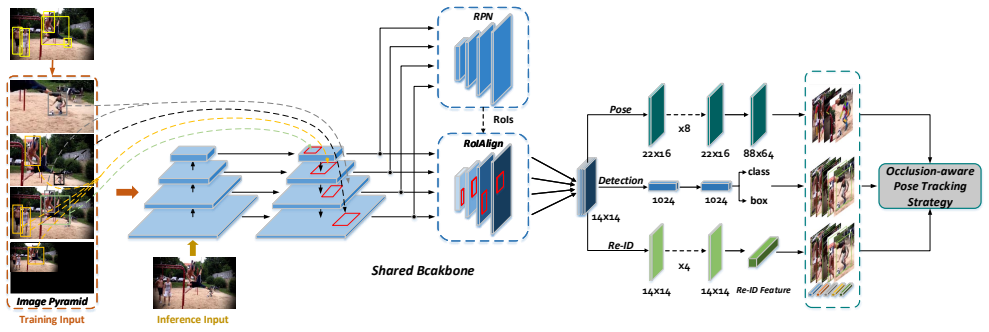
The load-bearing object is SIFP, a scale-normalized image and feature pyramid. It combines an image pyramid whose levels are cropped or padded to one fixed size with a feature pyramid network, and restricts each training object to the pyramid levels where its scale $\sqrt{wh}$ falls in $[16,560]$. This transfers the scale-invariance that two-stage methods get from per-box rescaling back into a unified detector, so single-scale testing no longer causes a domain shift. The second mechanism is occlusion-aware Re-ID gating: a tracklet's appearance embedding is only updated when the detection has more than $\theta_{\mathrm{valid}}=10$ keypoints above confidence $\gamma_{\mathrm{valid}}=0.2$, treating visible keypoints as a proxy for occlusion state; the association metric blends IoU and normalized feature distance with weight $\theta_{\mathrm{pos}}=0.5$.
What would settle it
Rerun the Table 1(c) ablation with the gating thresholds swept (confidence 0.1/0.3, keypoint count 8/12): if identity-switch counts do not stay well below the ungated baseline across these settings, then the reported 37 percent reduction is a threshold artifact rather than evidence that keypoint-count gating detects occlusion.
Extended reading notes
Core claim
The central claim is that the historical accuracy gap between unified and two-stage top-down pose trackers is not architectural but a scale-handling problem, and that fixing it makes the unified approach viable at real time. FastPose builds a multi-task network with three heads on a shared backbone: boxes from an RPN, keypoint heatmaps from a pose head, and 128-dimensional Re-ID embeddings from an identity head. Training with SIFP—which resizes the image into a pyramid, keeps only objects whose scale $\sqrt{wh}$ falls in $[16,560]$ at each level, and lets the feature pyramid assign each object to the right level—raises pose estimation mAP by 2.4 on COCO minival and tracking MOTA by 2.7 on PoseTrack val for a ResNet-50 backbone, at no extra inference cost. For tracking, the paper replaces pure IoU linking with a similarity that averages IoU and normalized Re-ID distance, but only updates a tracklet's appearance feature when at least 10 keypoints exceed confidence 0.2; this occlusion gating is what cuts identity switches from 243.1 to 153.9 (37 percent). The authors state the result as a speed–accuracy operating point: FastPose-18 at 29.4 FPS with 63.1 mAP and 56.8 MOTA, and FastPose-50 at 12.2 FPS with 69.7 mAP and 62.8 MOTA.
Load-bearing premise
The load-bearing premise is that counting the person's confidently detected keypoints tells you whether the person is occluded, so freezing the tracklet's appearance feature until enough keypoints reappear improves identity matching; the paper does not test how much of its 37 percent identity-switch reduction depends on the two chosen thresholds.
Editorial extensions
If this is right
- A unified top-down network can serve as a real-time pose tracker, so real-world applications such as surveillance, human-computer interaction, and action recognition need not choose between speed and accuracy at the level this paper demonstrates.
- SIFP is a training-side fix that costs no extra inference time; the paper's ablations show it improves pose mAP and tracking MOTA across four different backbones, including MobileNet-v2, ResNet-18, ResNet-50, and ResNet-101.
- The paper's 37 percent reduction in identity switches shows that keypoint-confidence gating is an effective lightweight addition to Re-ID-based data association.
- Deeper backbones improve accuracy but with diminishing returns: ResNet-101 adds only 0.8 mAP over ResNet-50 while increasing FLOPs by about a third, so ResNet-50 is presented as the speed-accuracy sweet spot.
- FastPose-50 nearly matches the two-stage FlowTrack-50 on MOTA (62.8 vs 62.9) while running more than 60 times faster, which positions unified top-down methods as a practical candidate for video pose tracking.
Reading between the lines
- A direct sensitivity test the paper does not run: sweep $\gamma_{\mathrm{valid}}$ and $\theta_{\mathrm{valid}}$ on PoseTrack val; if the 37 percent identity-switch reduction survives a wide range of thresholds, the occlusion-gating story is robust, but if it peaks only at exactly 0.2 and 10, the headline number may be threshold-tuned.
- The Re-ID embeddings are trained only on the SSM and PRW person-search datasets; because PoseTrack videos have different camera motion and crowd dynamics, evaluating the same occlusion gating with embeddings fine-tuned on PoseTrack itself would isolate how much of the gain comes from gating versus from feature quality.
- SIFP's cropping and padding recipe is not specific to pose estimation, so instance segmentation and dense-pose tasks that share the same scale-variation bottleneck could adopt SIFP by the same logic; the paper's across-backbone consistency suggests the improvement is systematic.
- Because the tracking module runs at 66.7 FPS independent of the detector, the framework's overall speed is bounded by the multi-task network; architectures lighter than ResNet-18, extrapolating from the MobileNet-v2 result, could push the system toward embedded or mobile deployment at some accuracy cost.
Signed reviews
Editorial analysis
A structured set of objections, weighed in public.
Referee Report
Summary. The paper presents FastPose, a unified multi-task network that jointly performs human detection, pose estimation, and person re-identification, augmented by a scale-normalized image and feature pyramid (SIFP) for scale robustness and an occlusion-aware re-ID tracking strategy. On PoseTrack, FastPose-18 runs at 29.4 FPS with 63.1 mAP and 56.8 MOTA, and the occlusion-aware strategy is reported to cut identity switches by 37% relative to an IoU-only baseline. The paper claims that SIFP steadily improves pose estimation and tracking across MobileNet-V2, ResNet-18/50/101 backbones.
Significance. If the claims are correct, the paper makes a practical contribution by showing that a single end-to-end top-down network can approach the accuracy of two-stage methods at real-time speed. The ablation tables provide consistent evidence that SIFP helps across backbones, and the occlusion-aware gating of Re-ID features is a sensible idea. The strength is the systematic comparison of backbones and the explicit speed-accuracy trade-off. However, the internal inconsistency in Eq. (2) and missing implementation details undermine confidence until corrected.
major comments (3)
- [Sec. 3.3.3, Eq. (2)] The similarity metric S in Eq. (2) is written as S = theta_pos*IoU + (1-theta_pos)*min(dist(fd,ftrack),sigma_max)/sigma_max. Because the second term grows as the Euclidean feature distance increases, maximizing S would prefer dissimilar appearances and minimizing S would penalize spatial overlap; neither is consistent with the stated use of S as a similarity metric for association. The reported 37% IDS reduction in Table 1(c) cannot be derived from Eq. (2) as written. Please correct the equation (e.g., replace min(dist,sigma_max)/sigma_max with 1 - min(dist,sigma_max)/sigma_max), specify whether association maximizes or minimizes S, and assign a value to sigma_max in Sec. 3.4. The update rule for the tracklet appearance feature ftrack is also missing, so the tracking module is not fully reproducible.
- [Sec. 3.3.1 and Table 1(c)] The occlusion-aware strategy depends on two thresholds, gamma_valid (set to 0.2) and theta_valid (Nvalid > 10), yet the paper reports no sensitivity analysis. The headline 37% reduction in ID switches is a single operating point; without evidence that this gain persists over a reasonable range of thresholds, it is unclear whether the improvement is robust or a result of threshold tuning. Please add an ablation over these parameters or at least report performance for a few settings.
- [Sec. 3.4] The training section specifies datasets and the SIFP scale range but omits several parameters essential for reproduction, including the learning rate schedule, loss weights for the detection, pose, and Re-ID branches, number of training epochs/iterations, batch size, optimizer, and how the image pyramid levels are sampled per iteration. Without these, the SIFP gains in Table 1(a)-(b) and the overall results cannot be independently verified. Please provide a complete training recipe or release code.
minor comments (4)
- [Abstract, contribution (4)] The abstract states '29.4 frames per image (FPS)'; the unit should read 'frames per second' or simply 'FPS'.
- [Table 1(b)] The column labeled 'mAP' in Table 1(b) is not defined; clarify that it is the total mAP over all keypoints on PoseTrack val to match Table 2.
- [Sec. 3.3.2] The appearance-feature update rule is described only qualitatively ('updated if the Re-ID feature of matched detection is valid'); specify the actual update formula, e.g., an exponential moving average with a stated momentum.
- [General] No code or trained models are released, and all results appear to be from a single run without error bars or variance estimates; please state this explicitly and, if possible, report mean and standard deviation over multiple runs.
Circularity Check
No circular dependency: FastPose's reported gains are empirical results measured on external benchmarks; self-citations are background only.
full rationale
FastPose is an empirical systems paper; the central claims (real-time speed, pose accuracy, MOTA, and the 37% IDS reduction) are measurements on PoseTrack/COCO and controlled ablations, not derived from an equation whose inputs are the outputs. Table 1(c) fixes FP/FN from the same MTN and isolates the tracking strategy, so the IDS comparison is an ablation, not a fitted quantity renamed as a prediction. SIFP is explicitly acknowledged as a modification of prior external work ('In conclusion, SIFP is a modified version of SNIP') and is ablated against SNIP-style training and multi-scale testing in Table 1(d)-(e). The two self-citations ([31], [59]) occur in literature-review sentences about Re-ID trackers and pose tracking; neither supplies a load-bearing premise, uniqueness theorem, or ansatz. Eq. (1) is a heuristic for estimating occlusion, and its effect is measured, not assumed. The most serious issue is Eq. (2) in Sec. 3.3.3, where the normalized distance term increases with feature distance, so the printed metric would prefer dissimilar appearances; sigma_max is also left unspecified. This is a correctness/reproducibility flaw, not circularity, because the reported IDS reduction does not reduce by construction to that equation—a corrected sign convention must underlie the experiments. Accordingly, no circular step is present.
Assumptions & free parameters
free parameters (5)
- gamma_valid =
0.2
- theta_valid =
10
- theta_pos =
0.5
- sigma_max =
not reported
- scale range and pyramid factors =
[16, 560] and {2.0, 1.5, 1.0, 0.75}
assumptions (5)
- domain assumption Backbones (ResNet, MobileNet-V2), FPN, and RoIAlign behave as described in the cited literature.
- domain assumption Keypoint confidence thresholds separate visible from occluded joints.
- domain assumption Re-ID features trained on SSM and PRW transfer to PoseTrack video frames.
- domain assumption Scale variation is the dominant bottleneck for unified top-down pose estimators.
- domain assumption Image-centric multi-task training with selective loss backpropagation converges to a useful shared representation.
Cite this review
Pith. "Pith review of FastPose: Towards Real-time Pose Estimation and Tracking via Scale-normalized Multi-task Networks." pith.science (2026). https://pith.science/paper/XOUUUEIM
@misc{pith2026190805593,
  author       = {Pith},
  title        = {Pith review of: FastPose: Towards Real-time Pose Estimation and Tracking via Scale-normalized Multi-task Networks},
  year         = {2026},
  howpublished = {\url{https://pith.science/paper/XOUUUEIM}},
  note         = {Machine review of arXiv:1908.05593}
}
read the original abstract
Both accuracy and efficiency are significant for pose estimation and tracking in videos. State-of-the-art performance is dominated by two-stages top-down methods. Despite the leading results, these methods are impractical for real-world applications due to their separated architectures and complicated calculation. This paper addresses the task of articulated multi-person pose estimation and tracking towards real-time speed. An end-to-end multi-task network (MTN) is designed to perform human detection, pose estimation, and person re-identification (Re-ID) tasks simultaneously. To alleviate the performance bottleneck caused by scale variation problem, a paradigm which exploits scale-normalized image and feature pyramids (SIFP) is proposed to boost both performance and speed. Given the results of MTN, we adopt an occlusion-aware Re-ID feature strategy in the pose tracking module, where pose information is utilized to infer the occlusion state to make better use of Re-ID feature. In experiments, we demonstrate that the pose estimation and tracking performance improves steadily utilizing SIFP through different backbones. Using ResNet-18 and ResNet-50 as backbones, the overall pose tracking framework achieves competitive performance with 29.4 FPS and 12.2 FPS, respectively. Additionally, occlusion-aware Re-ID feature decreases the identification switches by 37% in the pose tracking process.
Figures

Forward citations
Cited by 3 Pith papers
-
An End-to-End Framework for Video Multi-Person Pose Estimation
An end-to-end video pose transformer built on PETR with spatio-temporal encoders and an instance consistency loss reaches 83.0 mAP on PoseTrack2017 and appears around 4x faster than DCPose.
-
Optimizing Human Pose Estimation Through Focused Human and Joint Regions
VREMD combines human and keypoint masks with bidirectional deformable cross-attention to reach state-of-the-art mAP on three PoseTrack benchmarks.
-
High Performance Visual Object Tracking with Unified Convolutional Networks
An end-to-end convolutional tracker with a peak-versus-noise model update criterion achieves state-of-the-art accuracy on OTB2013/2015 and VOT2015/2016 while running at 58 FPS.
Reference graph
Works this paper leans on
-
[1]
E. H. Adelson, C. H. Anderson, J. R. Bergen, P. J. Burt, and J. M. Ogden. Pyramid methods in image processing. RCA Engineer, 29(6):33–41, 1984. 3
work page 1984
-
[2]
M. Andriluka, U. Iqbal, A. Milan, E. Insafutdinov, L. Pishchulin, J. Gall, and B. Schiele. Posetrack: A bench- mark for human pose estimation and tracking. In IEEE Con- ference on Computer Vision and Pattern Recognition, pages 5167–5176, 2018. 1, 6, 7, 8
work page 2018
-
[3]
M. Andriluka, L. Pishchulin, P. Gehler, and B. Schiele. 2d human pose estimation: New benchmark and state of the art analysis. In IEEE Conference on Computer Vision and Pat- tern Recognition, pages 3686–3693, 2014. 1, 2, 6
work page 2014
-
[4]
M. Andriluka, S. Roth, and B. Schiele. Pictorial structures revisited: People detection and articulated pose estimation. In IEEE Conference on Computer Vision and Pattern Recog- nition, pages 1014–1021, 2009. 1, 3
work page 2009
-
[5]
S.-H. Bae and K.-J. Yoon. Confidence-based data associa- tion and discriminative deep appearance learning for robust online multi-object tracking. IEEE Transactions on Pattern Analysis and Machine Intelligence, 40(3):595–610, 2018. 2
work page 2018
-
[6]
E. Bochinski, V . Eiselein, and T. Sikora. High-speed tracking-by-detection without using image information. In 2017 14th IEEE International Conference on Advanced Video and Signal Based Surveillance (AVSS) , pages 1–6,
work page 2017
-
[7]
Z. Cai, Q. Fan, R. S. Feris, and N. Vasconcelos. A unified multi-scale deep convolutional neural network for fast ob- ject detection. In European Conference on Computer Vision, pages 354–370, 2016. 3
work page 2016
-
[8]
Z. Cao, T. Simon, S.-E. Wei, and Y . Sheikh. Realtime multi- person 2d pose estimation using part affinity fields. In IEEE Conference on Computer Vision and Pattern Recognition ,
Show all 65 references
-
[9]
R. Caruana. Multitask learning. Machine learning , 28(1):41–75, 1997. 3
1997
-
[10]
L.-C. Chen, G. Papandreou, I. Kokkinos, K. Murphy, and A. L. Yuille. Deeplab: Semantic image segmentation with deep convolutional nets, atrous convolution, and fully con- nected crfs. IEEE Transactions on Pattern Analysis and Ma- chine Intelligence, 40(4):834–848, 2018. 3
2018
-
[11]
T. Chen, M. Li, Y . Li, M. Lin, N. Wang, M. Wang, T. Xiao, B. Xu, C. Zhang, and Z. Zhang. Mxnet: A flexible and effi- cient machine learning library for heterogeneous distributed systems. arXiv preprint arXiv:1512.01274, 2015. 8
2015 arXiv
-
[12]
Y . Chen, Z. Wang, Y . Peng, Z. Zhang, G. Yu, and J. Sun. Cas- caded pyramid network for multi-person pose estimation. In IEEE Conference on Computer Vision and Pattern Recogni- tion, 2018. 1, 2, 3
2018
-
[13]
Collobert and J
R. Collobert and J. Weston. A unified architecture for natural language processing: Deep neural networks with multitask learning. In International Conference on Machine Learning, pages 160–167, 2008. 3
2008
-
[14]
J. Dai, Y . Li, K. He, and J. Sun. R-fcn: Object detection via region-based fully convolutional networks. In Advances in Neural Information Processing Systems , pages 379–387,
-
[15]
L. Deng, G. Hinton, and B. Kingsbury. New types of deep neural network learning for speech recognition and related applications: An overview. In IEEE International Con- ference on Acoustics, Speech and Signal Processing , pages 8599–8603, 2013. 3
2013
-
[16]
Doering, U
A. Doering, U. Iqbal, and J. Gall. Joint flow: Temporal flow fields for multi person tracking. In British Machine Vision Conference, 2018. 1, 3, 7, 8
2018
-
[17]
H.-S. Fang, S. Xie, Y .-W. Tai, and C. Lu. Rmpe: Regional multi-person pose estimation. In IEEE International Confer- ence on Computer Vision, pages 2334–2343, 2017. 8
2017
-
[18]
P. F. Felzenszwalb, R. B. Girshick, D. McAllester, and D. Ra- manan. Object detection with discriminatively trained part- based models. IEEE Transactions on Pattern Analysis and Machine Intelligence, 32(9):1627–1645, 2010. 1, 3
2010
-
[19]
W. Feng, Z. Hu, W. Wu, J. Yan, and W. Ouyang. Multi- object tracking with multiple cues and switcher-aware clas- sification. arXiv preprint arXiv:1901.06129, 2019. 2
1901 arXiv
-
[20]
Ghosn and Y
J. Ghosn and Y . Bengio. Multi-task learning for stock selec- tion. In Advances in Neural Information Processing Systems, pages 946–952, 1997. 3
1997
-
[21]
Girdhar, G
R. Girdhar, G. Gkioxari, L. Torresani, M. Paluri, and D. Tran. Detect-and-track: Efficient pose estimation in videos. In IEEE Conference on Computer Vision and Pattern Recog- nition, pages 350–359, 2018. 1, 2, 3, 5, 6, 7, 8
2018
-
[22]
Girshick
R. Girshick. Fast R-CNN. In IEEE International Conference on Computer Vision, pages 1440–1448, 2015. 3
2015
-
[23]
Z. Hao, Y . Liu, H. Qin, J. Yan, X. Li, and X. Hu. Scale-aware face detection. In IEEE Conference on Computer Vision and Pattern Recognition, pages 6186–6195, 2017. 2
2017
-
[24]
K. He, G. Gkioxari, P. Doll ´ar, and R. Girshick. Mask R- CNN. In IEEE International Conference on Computer Vi- sion, 2017. 1, 2, 3, 6
2017
-
[25]
K. He, X. Zhang, S. Ren, and J. Sun. Deep residual learning for image recognition. In IEEE Conference on Computer Vision and Pattern Recognition, pages 770–778, 2016. 4
2016
-
[26]
Insafutdinov, M
E. Insafutdinov, M. Andriluka, L. Pishchulin, S. Tang, E. Levinkov, B. Andres, and B. Schiele. Arttrack: Articu- lated multi-person tracking in the wild. In IEEE Conference on Computer Vision and Pattern Recognition, 2017. 1, 2, 3
2017
-
[27]
Insafutdinov, L
E. Insafutdinov, L. Pishchulin, B. Andres, M. Andriluka, and B. Schiele. Deepercut: A deeper, stronger, and faster multi- person pose estimation model. In European Conference on Computer Vision, pages 34–50, 2016. 1, 2, 3
2016
-
[28]
Iqbal, A
U. Iqbal, A. Milan, and J. Gall. Posetrack: Joint multi-person pose estimation and tracking. In IEEE Conference on Com- puter Vision and Pattern Recognition, 2017. 1, 2, 3
2017
-
[29]
B. Li, J. Yan, W. Wu, Z. Zhu, and X. Hu. High performance visual tracking with siamese region proposal network. In IEEE Conference on Computer Vision and Pattern Recogni- tion, pages 8971–8980, 2018. 1
2018
-
[30]
H. Li, Z. Lin, X. Shen, J. Brandt, and G. Hua. A convolu- tional neural network cascade for face detection. In IEEE Conference on Computer Vision and Pattern Recognition , pages 5325–5334, 2015. 3
2015
-
[31]
P. Li, J. Zhang, Z. Zhu, Y . Li, L. Jiang, and G. Huang. State- aware re-identification feature for multi-target multi-camera tracking. In IEEE Conference on Computer Vision and Pat- tern Recognition Workshops, 2019. 2
2019
-
[32]
Y . Li, X. Chen, Z. Zhu, L. Xie, G. Huang, D. Du, and X. Wang. Attention-guided unified network for panoptic seg- mentation. arXiv preprint arXiv:1812.03904, 2018. 3
2018 arXiv
-
[33]
T.-Y . Lin, P. Doll´ar, R. Girshick, K. He, B. Hariharan, and S. Belongie. Feature pyramid networks for object detection. In IEEE Conference on Computer Vision and Pattern Recog- nition, pages 2117–2125, 2017. 2, 3, 4, 5
2017
-
[34]
T.-Y . Lin, M. Maire, S. Belongie, J. Hays, P. Perona, D. Ra- manan, P. Doll´ar, and C. L. Zitnick. Microsoft coco: Com- mon objects in context. In European Conference on Com- puter Vision, pages 740–755, 2014. 1, 2, 6
2014
-
[35]
Najibi, P
M. Najibi, P. Samangouei, R. Chellappa, and L. S. Davis. SSH: Single stage headless face detector. In IEEE Inter- national Conference on Computer Vision, pages 4875–4884,
-
[36]
Newell, K
A. Newell, K. Yang, and J. Deng. Stacked hourglass net- works for human pose estimation. In European Conference on Computer Vision, pages 483–499, 2016. 1, 2, 3
2016
-
[37]
Papandreou, T
G. Papandreou, T. Zhu, N. Kanazawa, A. Toshev, J. Tomp- son, C. Bregler, and K. Murphy. Towards accurate multi- person pose estimation in the wild. In IEEE Conference on Computer Vision and Pattern Recognition, 2017. 1, 2, 3
2017
-
[38]
Pishchulin, E
L. Pishchulin, E. Insafutdinov, S. Tang, B. Andres, M. An- driluka, P. V . Gehler, and B. Schiele. Deepcut: Joint subset partition and labeling for multi person pose estimation. In IEEE Conference on Computer Vision and Pattern Recogni- tion, pages 4929–4937, 2016. 1, 2, 3
2016
-
[39]
Pishchulin, A
L. Pishchulin, A. Jain, M. Andriluka, T. Thorm ¨ahlen, and B. Schiele. Articulated people detection and pose estimation: Reshaping the future. In IEEE Conference on Computer Vi- sion and Pattern Recognition, pages 3178–3185, 2012. 1
2012
-
[40]
S. Ren, K. He, R. Girshick, and J. Sun. Faster R-CNN: To- wards real-time object detection with region proposal net- works. In Advances in Neural Information Processing Sys- tems, pages 91–99, 2015. 3
2015
-
[41]
M. R. Ronchi and P. Perona. Benchmarking and error di- agnosis in multi-instance pose estimation. In IEEE Inter- national Conference on Computer Vision , pages 369–378,
-
[42]
S. Ruder. An overview of multi-task learning in deep neural networks. arXiv preprint arXiv:1706.05098, 2017. 3
2017 arXiv
-
[43]
Sandler, A
M. Sandler, A. Howard, M. Zhu, A. Zhmoginov, and L.-C. Chen. Mobilenetv2: Inverted residuals and linear bottle- necks. In IEEE Conference on Computer Vision and Pattern Recognition, pages 4510–4520, 2018. 4
2018
-
[44]
Singh and L
B. Singh and L. S. Davis. An analysis of scale invariance in object detection snip. In IEEE Conference on Computer Vision and Pattern Recognition, pages 3578–3587, 2018. 2, 3, 4, 5, 7
2018
-
[45]
Singh, M
B. Singh, M. Najibi, and L. S. Davis. Sniper: Efficient multi- scale training. InAdvances in Neural Information Processing Systems, pages 9333–9343, 2018. 2, 3
2018
-
[46]
J. J. Tompson, A. Jain, Y . LeCun, and C. Bregler. Joint train- ing of a convolutional network and a graphical model for human pose estimation. In Advances in Neural Information Processing Systems, pages 1799–1807, 2014. 1, 2, 3
2014
-
[47]
Toshev and C
A. Toshev and C. Szegedy. Deeppose: Human pose es- timation via deep neural networks. In IEEE Conference on Computer Vision and Pattern Recognition , pages 1653– 1660, 2014. 1, 2, 3
2014
-
[48]
S.-E. Wei, V . Ramakrishna, T. Kanade, and Y . Sheikh. Con- volutional pose machines. In IEEE Conference on Computer Vision and Pattern Recognition, pages 4724–4732, 2016. 1, 2, 3
2016
-
[49]
Wojke, A
N. Wojke, A. Bewley, and D. Paulus. Simple online and realtime tracking with a deep association metric. In IEEE International Conference on Image Processing, pages 3645– 3649, 2017. 2
2017
-
[50]
B. Xiao, H. Wu, and Y . Wei. Simple baselines for human pose estimation and tracking. In European Conference on Computer Vision, 2018. 1, 2, 3, 7, 8
2018
-
[51]
T. Xiao, S. Li, B. Wang, L. Lin, and X. Wang. End- to-end deep learning for person search. arXiv preprint arXiv:1604.01850, 1(2), 2016. 4, 6
2016 arXiv
-
[52]
T. Xiao, S. Li, B. Wang, L. Lin, and X. Wang. Joint detec- tion and identification feature learning for person search. In IEEE Conference on Computer Vision and Pattern Recogni- tion, pages 3415–3424, 2017. 3
2017
-
[53]
Y . Xiu, J. Li, H. Wang, Y . Fang, and C. Lu. Pose flow: Ef- ficient online pose tracking. In British Machine Vision Con- ference, 2018. 1, 3, 7, 8
2018
-
[54]
F. Yang, W. Choi, and Y . Lin. Exploit all the layers: Fast and accurate cnn object detector with scale dependent pool- ing and cascaded rejection classifiers. In IEEE Conference on Computer Vision and Pattern Recognition , pages 2129– 2137, 2016. 3
2016
-
[55]
S. Yang, Y . Xiong, C. C. Loy, and X. Tang. Face detection through scale-friendly deep convolutional networks. arXiv preprint arXiv:1706.02863, 2017. 3
2017 arXiv
-
[56]
W. Yang, S. Li, W. Ouyang, H. Li, and X. Wang. Learning feature pyramids for human pose estimation. In IEEE Inter- national Conference on Computer Vision, 2017. 1, 2, 3
2017
-
[57]
F. Yu, W. Li, Q. Li, Y . Liu, X. Shi, and J. Yan. Poi: Multiple object tracking with high performance detection and appear- ance feature. In European Conference on Computer Vision, pages 36–42, 2016. 2
2016
-
[58]
Zhang and Z
C. Zhang and Z. Zhang. A survey of recent advances in face detection. 2010. 3
2010
-
[59]
Zhang, Z
R. Zhang, Z. Zhu, P. Li, R. Wu, C. Guo, G. Huang, and H. Xia. Exploiting offset-guided network for pose estima- tion and tracking. arXiv preprint arXiv:1906.01344 , 2019. 1
1906 arXiv
-
[60]
Zhang and Q
Y . Zhang and Q. Yang. A survey on multi-task learning. arXiv preprint arXiv:1707.08114, 2017. 3
2017 arXiv
-
[61]
Zhang, P
Z. Zhang, P. Luo, C. C. Loy, and X. Tang. Facial landmark detection by deep multi-task learning. In European Confer- ence on Computer Vision, pages 94–108, 2014. 3
2014
-
[62]
Zheng, H
L. Zheng, H. Zhang, S. Sun, M. Chandraker, Y . Yang, and Q. Tian. Person re-identification in the wild. In IEEE Con- ference on Computer Vision and Pattern Recognition, pages 1367–1376, 2017. 4, 6
2017
-
[63]
B. Zhou, A. Lapedriza, J. Xiao, A. Torralba, and A. Oliva. Learning deep features for scene recognition using places database. In Advances in Neural Information Processing Sys- tems, pages 487–495, 2014. 1
2014
-
[64]
J. Zhu, H. Yang, N. Liu, M. Kim, W. Zhang, and M.-H. Yang. Online multi-object tracking with dual matching atten- tion networks. In European Conference on Computer Vision, pages 366–382, 2018. 2
2018
-
[65]
Z. Zhu, Q. Wang, B. Li, W. Wu, J. Yan, and W. Hu. Distractor-aware siamese networks for visual object track- ing. In European Conference on Computer Vision (ECCV), pages 101–117, 2018. 1
2018
Reviewed August 14, 2026 · model on record in the stance chip above.
Discussion (0). Continue with ORCID to comment.