Hierarchically Modular Dynamical Neural Network Relaxing in a Warped Space: Basic Model and its Characteristics
Pith reviewed 2026-05-24 10:57 UTC · model grok-4.3
The pith
Neural network state variables relax in a warped space due to cooperation between dynamic and static neurons.
A machine-rendered reading of the paper's core claim, the machinery that carries it, and where it could break.
Core claim
The model offers a framework in which state variables in the network relax in a warped space, due to the cooperation between dynamic and static neurons. In the association mode, the speed of convergence to a goal point greatly varies with the mapping relationship of the previously trained internetwork, and owing to this property, the convergence trajectory in the two-dimensional model with the non-linear mapping internetwork cannot go straight but instead must curve.
What carries the argument
The layered internetwork consisting of forward and backward subnets of static neurons connecting internal and external spaces, with dynamical neurons determining time-course.
If this is right
- The convergence trajectory curves in two-dimensional models with nonlinear mappings.
- An output trajectory is generated in the internal space mapped from the external space according to the inverse of the forward subnet mapping.
- The system operates in learning mode with feedback paths and input ports present, or association mode otherwise.
- Convergence speed to goal points varies with the trained internetwork mapping.
Where Pith is reading between the lines
- Such warping could allow neural models to naturally handle curved paths in tasks like motor control without explicit programming.
- The use of bursting signals for learning mappings might connect to biological rhythm-based learning mechanisms.
- Extending to higher dimensions could produce more complex warped relaxation behaviors for multi-variable problems.
Load-bearing premise
Synaptic weights in the internetwork are modified by strong inputs from repetitive neuronal bursting to produce two-dimensional mappings based on the Lissajous curve principle.
What would settle it
Simulating or implementing the two-dimensional model with a nonlinear mapping and checking if the convergence trajectory from a starting point to the goal curves instead of going straight.
Figures


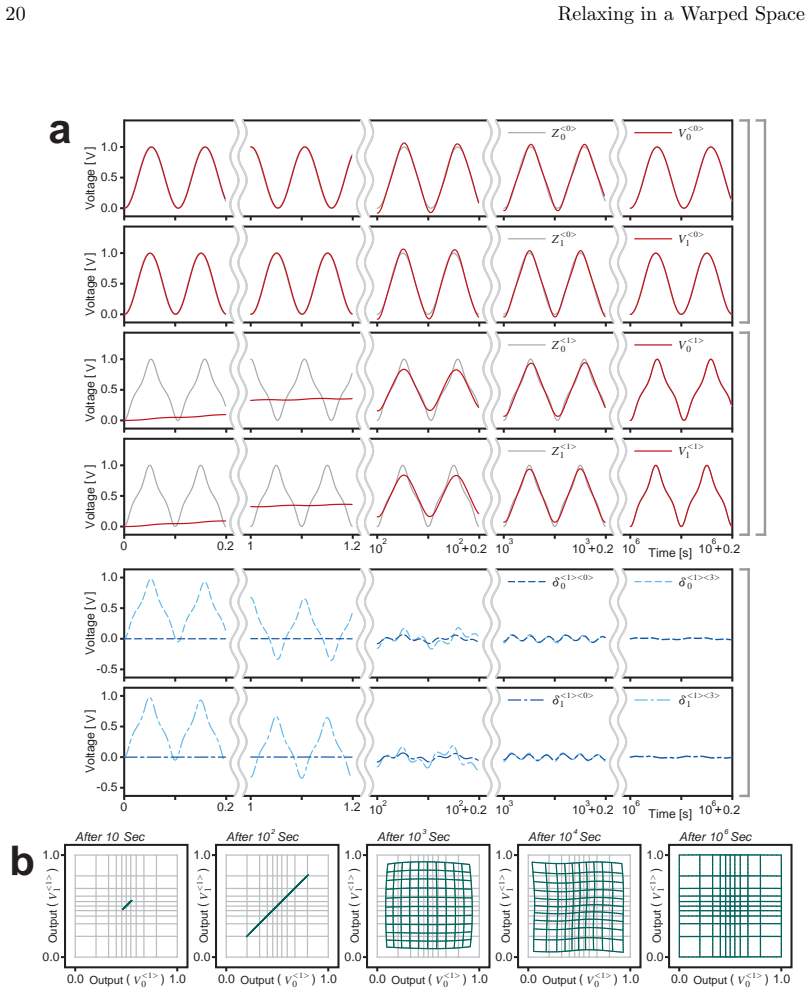


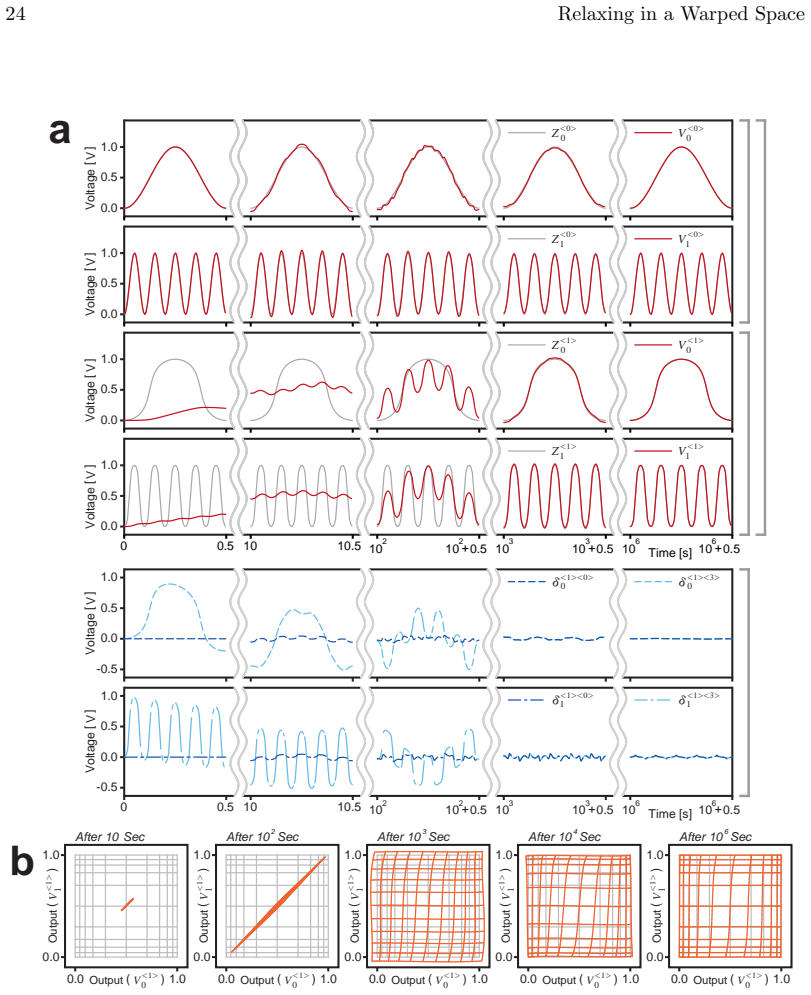


read the original abstract
We propose a hierarchically modular, dynamical neural network model whose architecture minimizes a specifically designed energy function and defines its temporal characteristics. The model has an internal and an external space that are connected with a layered internetwork that consists of a pair of forward and backward subnets composed of static neurons (with an instantaneous time-course). Dynamical neurons with large time constants in the internal space determine the overall time-course. The model offers a framework in which state variables in the network relax in a warped space, due to the cooperation between dynamic and static neurons. We assume that the system operates in either a learning or an association mode, depending on the presence or absence of feedback paths and input ports. In the learning mode, synaptic weights in the internetwork are modified by strong inputs corresponding to repetitive neuronal bursting, which represents sinusoidal or quasi-sinusoidal waves in the short-term average density of nerve impulses or in the membrane potential. A two-dimensional mapping relationship can be formed by employing signals with different frequencies based on the same mechanism as Lissajous curves. In the association mode, the speed of convergence to a goal point greatly varies with the mapping relationship of the previously trained internetwork, and owing to this property, the convergence trajectory in the two-dimensional model with the non-linear mapping internetwork cannot go straight but instead must curve. We further introduce a constrained association mode with a given target trajectory and elucidate that in the internal space, an output trajectory is generated, which is mapped from the external space according to the inverse of the mapping relationship of the forward subnet.
Editorial analysis
A structured set of objections, weighed in public.
Referee Report
Summary. The manuscript proposes a hierarchically modular dynamical neural network whose architecture minimizes a designed energy function. Internal and external spaces are linked by forward/backward subnets of static neurons; dynamical neurons with large time constants govern the time course. The model is claimed to relax state variables in a warped space via cooperation between neuron types. In learning mode, internetwork weights are updated by repetitive bursting inputs (sinusoidal/quasi-sinusoidal) to produce 2-D mappings analogous to Lissajous curves; in association mode the resulting non-linear mapping forces curved convergence trajectories, while a constrained mode generates output trajectories that are inverses of the forward mapping.
Significance. If the missing formal definitions, update rules, and derivations were supplied and the claimed behaviors verified, the framework could supply a concrete mechanism linking bursting-driven learning to warped relaxation and curved trajectories, offering a new modeling approach for associative dynamics in computational neuroscience.
major comments (3)
- [Abstract] Abstract: the claim that 'synaptic weights in the internetwork are modified by strong inputs corresponding to repetitive neuronal bursting' to form a two-dimensional mapping 'based on the same mechanism as Lissajous curves' supplies neither the explicit weight-update rule nor an analytic derivation showing that the resulting forward mapping is non-linear and invertible in the manner required to warp the relaxation paths.
- [Abstract] Abstract: the assertion that 'the convergence trajectory in the two-dimensional model with the non-linear mapping internetwork cannot go straight but instead must curve' is stated without any simulation, numerical example, or proof that the cooperation between dynamical and static neurons under the (undefined) energy function produces this geometry.
- [Abstract] Abstract: no equations are given for the energy function that the architecture is said to minimize, for the time constants of the dynamical neurons, or for the forward/backward subnet mappings, rendering the central 'warped space' relaxation claim unverifiable.
minor comments (1)
- The manuscript would benefit from at least one diagram showing the layered internetwork, the internal/external spaces, and an example of a curved trajectory under the claimed mapping.
Simulated Author's Rebuttal
We thank the referee for the constructive and detailed comments. We address each major comment below, clarifying where the manuscript already provides the requested elements and indicating revisions to improve accessibility and explicitness.
read point-by-point responses
-
Referee: [Abstract] Abstract: the claim that 'synaptic weights in the internetwork are modified by strong inputs corresponding to repetitive neuronal bursting' to form a two-dimensional mapping 'based on the same mechanism as Lissajous curves' supplies neither the explicit weight-update rule nor an analytic derivation showing that the resulting forward mapping is non-linear and invertible in the manner required to warp the relaxation paths.
Authors: The weight-update rule is specified in the learning-mode section of the main text as a correlation-based modification driven by the short-term average impulse density of the bursting inputs. We agree that an explicit analytic derivation of the resulting non-linear mapping and its invertibility would strengthen the abstract's claim and will add a concise derivation (showing the frequency-dependent Lissajous-like composition and the paired forward/backward subnet construction) to the revised manuscript. revision: yes
-
Referee: [Abstract] Abstract: the assertion that 'the convergence trajectory in the two-dimensional model with the non-linear mapping internetwork cannot go straight but instead must curve' is stated without any simulation, numerical example, or proof that the cooperation between dynamical and static neurons under the (undefined) energy function produces this geometry.
Authors: Numerical simulations of the curved trajectories under the non-linear mapping are shown in the Results section, arising directly from the minimization dynamics of the energy function when the static-neuron mapping warps the relaxation path. We will insert a brief reference to these simulations and a short geometric explanation in the revised abstract. revision: partial
-
Referee: [Abstract] Abstract: no equations are given for the energy function that the architecture is said to minimize, for the time constants of the dynamical neurons, or for the forward/backward subnet mappings, rendering the central 'warped space' relaxation claim unverifiable.
Authors: The energy function is defined in Equation (1), the large time constants of the dynamical neurons are stated in Section 2.1, and the forward/backward mappings are given by the linear transformations realized by the static-neuron subnets. We will revise the abstract to include explicit pointers to these equations and definitions so that the warped-space claim is immediately verifiable from the abstract. revision: yes
Circularity Check
No circularity: model behaviors follow from explicit definitions and assumptions without reduction to tautology.
full rationale
The paper defines a custom energy function, layered internetwork architecture, and learning/association modes with explicit assumptions about bursting-driven weight updates and Lissajous-based mappings. Claimed properties such as warped-space relaxation and curved trajectories are direct consequences of these model choices rather than independent predictions that collapse back to fitted inputs or self-citations by construction. No load-bearing derivation step equates a result to its own inputs; the framework is self-contained as a theoretical proposal.
Axiom & Free-Parameter Ledger
free parameters (2)
- time constants of dynamical neurons
- mapping relationship of the internetwork
axioms (2)
- domain assumption The system minimizes a specifically designed energy function that defines its temporal characteristics.
- ad hoc to paper Repetitive neuronal bursting represents sinusoidal or quasi-sinusoidal waves that modify synaptic weights.
invented entities (2)
-
warped space
no independent evidence
-
internal and external spaces connected by layered internetwork
no independent evidence
Forward citations
Cited by 1 Pith paper
-
Relaxing in Warped Spaces: Generalized Hierarchical and Modular Dynamical Neural Network
A new dynamical neural network architecture with hierarchical subspaces and forward-backward internetworks allows state variables to relax in warped spaces, forming mappings from periodic inputs and implying an input-...
Reference graph
Works this paper leans on
-
[1]
Modeling and complexity in neural networks
Aihara, K., and Ichinose, N. Modeling and complexity in neural networks. Artificial Life and Robotics 3 (1999), 148–154
work page 1999
-
[2]
Theory of adaptive pattern classifiers
Amari, S.-I. Theory of adaptive pattern classifiers. IEEE Transactions on Electronic Computers 16 (1967), 299–307. Kazuyoshi Tsutsumi & Ernst Niebur 41
work page 1967
-
[3]
Neural theory of association and concept-formation
Amari, S.-I. Neural theory of association and concept-formation. Biological Cybernetics 26 (1977), 175–185
work page 1977
-
[4]
Block, H. D. The perceptron: A model for brain functioning. I. Reviews of Modern Physics 34 (1962), 123–135
work page 1962
-
[5]
Generating exponentially stable states for a Hopfield Neural Network
Cabrera, E., and Sossa, H. Generating exponentially stable states for a Hopfield Neural Network. Neurocomputing 275 (2018), 358–365
work page 2018
-
[6]
Carpenter, G. A., Cohen, M. A., Grossberg, S.; Kohonen, T., O ja, E.; Palm, G. H. J. J., and Tank, D. W. Technical comments: computing with neural networks. Science 235 (1987), 1226–1229
work page 1987
-
[7]
Metalearning and neuromodulation
Doya, K. Metalearning and neuromodulation. Neural Networks 15 (2002), 495–506
work page 2002
-
[8]
Mathematical models of threshold phenomena in the nerve membran e
FitzHugh, R. Mathematical models of threshold phenomena in the nerve membran e. Bulletin of Mathematical Biophysics 17 (1955), 257–278
work page 1955
-
[9]
The usefulness of useless knowledge
Flexner, A., and Dijkgraaf, R. The usefulness of useless knowledge . Princeton University Press, 2017
work page 2017
-
[10]
Congnitron: A self-organizing multilayered neural network
Fukushima, K. Congnitron: A self-organizing multilayered neural network. Biological Cybernetics 20 (1975), 121–136
work page 1975
-
[11]
Fukushima, K. Neocognitron: A self-organizing neural network model for a mech anism of pattern recognition unaffected by shift in position. Biological Cybernetics 36 (1980), 193–202
work page 1980
-
[12]
A neural network model for selective attention in visual pattern r ecog- nition
Fukushima, K. A neural network model for selective attention in visual pattern r ecog- nition. Biological Cybernetics 55 (1986), 5–15
work page 1986
-
[13]
Artificial vision by multi-layered neural networks: Neocognitron an d its advances
Fukushima, K. Artificial vision by multi-layered neural networks: Neocognitron an d its advances. Neural Networks 37 (2013), 103–119
work page 2013
-
[14]
Neocognitron: A neural network model for a mechanism of visual pattern recognition
Fukushima, K., Miyake, S., and Ito, T. Neocognitron: A neural network model for a mechanism of visual pattern recognition. IEEE Transactions on Systems, Man, and Cybernetics 13 (1983), 826–834
work page 1983
-
[15]
Adaptive pattern classification and universal recoding: I
Grossberg, S. Adaptive pattern classification and universal recoding: I. parallel de- velopment and coding of neural feature detectors. Biological Cybernetics 23 (1976), 121–134
work page 1976
-
[16]
Grossberg, S. Adaptive resonance theory: How a brain learns to consciouly atten d, learn, and recognize a changing world. Neural Networks 37 (2013), 1–47
work page 2013
-
[17]
Learning hierarchical informa- tion flow with recurrent neural modules
Hafner, D., Irpan, A., Davidson, J., and Heess, N. Learning hierarchical informa- tion flow with recurrent neural modules. In Advances in Neural Information Processing Systems (NIPS) (2017), vol. 30
work page 2017
-
[18]
Hebb, D. O. The organization of behavior . New York: Wiley, 1949
work page 1949
-
[19]
Hecht-Nielsen, R. Counterpropagation networks. In Proc. IEEE First International Conference on Neural Networks (1987), vol. 2, pp. 19–32
work page 1987
-
[20]
Neurocomputing: Picking the human brain
Hect-Nielsen, R. Neurocomputing: Picking the human brain. IEEE Spectrum (March 1988), 36–41
work page 1988
-
[21]
Hinton, G. E., Osindero, S., and Teh, Y. A fast learning algorithm for deep belief nets. Neural Computation 18 (2006), 1527–1554. 42 Relaxing in a Warped Space
work page 2006
-
[22]
Hinton, J., and Salakhutdinov, R. R. Reducing the dimensionality of data with neural networks. Science 313 (2006), 504–507
work page 2006
-
[23]
Hodgkin, A. L., and Huxley, A. F. A quantitative description of membrane current and its application to conduction and excitation in nerve. The Journal of Physiology 117 (1952), 500–544
work page 1952
-
[24]
Hopfield, J. J. Neural networks and physical systems with emergent collective co m- putational abilities. In Proc. the National Academy of Sciences, U.S.A. (1982), vol. 79, pp. 2554–2558
work page 1982
-
[25]
Hopfield, J. J. Neurons with graded response have collective computational prop erties like those of two-state neurons. In Proc. the National Academy of Science, U.S.A. (1984), vol. 81, pp. 3088–3092
work page 1984
-
[26]
Hopfield, J. J., and Tank, D. W. “neural” computation of decisions in optimization problems. Biological Cybernetics 52 (1985), 141–152
work page 1985
-
[27]
Hubel, D. H., and Wiesel, T. N. Receptive fields of single neurones in the cat’s striate cortex. The Journal of Physiology 148 (1959), 574–591
work page 1959
-
[28]
Kohonen, T. Correlation matrix memories. IEEE Transactions on Computers C-21 (1972), 353–359
work page 1972
-
[29]
Self-organized formation of topologically correct feature maps
Kohonen, T. Self-organized formation of topologically correct feature maps. Biological Cybernetics 43 (1982), 59–69
work page 1982
-
[30]
Bidirectional associative memories
Kosko, B. Bidirectional associative memories. IEEE Transactions on Systems, Man, and Cybernetics 18 (1988), 49–60
work page 1988
-
[31]
How many computers to identify cat? 16,000
Markoff, J. How many computers to identify cat? 16,000. The New York Times, June 2012
work page 2012
-
[32]
Sustained oscillations generated by mutually inhibiting neurons with adaptation
Matsuoka, K. Sustained oscillations generated by mutually inhibiting neurons with adaptation. Biological Cybernetics 52 (1985), 367–376
work page 1985
-
[33]
McCulloch, W. S., and Pitts, W. A logical calculus of the ideas immanent in nervous activity. Bulletin of Mathematical Biophysics 5 (1943), 115–133
work page 1943
-
[34]
Meunier, D., Lambiotte, R., and Bullmore, E. T. Modular and hierarchically modular organization of brain networks. Frontiers in Neuroscience 4 , Art.200 (2010)
work page 2010
-
[35]
Self-organized criti- cality occurs in non-conservative neuronal networks during ‘up’ s tates
Millman, D., Mihalas, S., Kirkwood, A., and Niebur, E. Self-organized criti- cality occurs in non-conservative neuronal networks during ‘up’ s tates. Nature Physics 6 (2010), 801–805
work page 2010
-
[36]
Minsky, M., and Papert, S. Perceptrons. The MIT Press, Cambridge, MA, U.S.A., 1969
work page 1969
-
[37]
Analysis and simulation of networks of mutually inhibiting neurons
Morishita, I., and Yajima, A. Analysis and simulation of networks of mutually inhibiting neurons. Kybernetik 11 (1972), 154–165
work page 1972
-
[38]
An active pulse transmission line simulating nerve axon
Nagumo, J., Arimoto, S., and Yoshizawa, S. An active pulse transmission line simulating nerve axon. In Proc. IRE (1962), vol. 50, pp. 2061–2070
work page 1962
-
[39]
Associatron - a model of associative memory
Nakano, K. Associatron - a model of associative memory. IEEE Transactions on Systems, Man, and Cybernetics 2 (1972), 380–388
work page 1972
-
[40]
Modular structure of brain functional networks: break- ing the resolution limit by surprise
Nicolini, C., and Bifone, A. Modular structure of brain functional networks: break- ing the resolution limit by surprise. Scientific Reports 6 , Art.19250 (2016). Kazuyoshi Tsutsumi & Ernst Niebur 43
work page 2016
-
[41]
Computer simulation of networks of electrotonic neurons
Niebur, E., and Erdos, P. Computer simulation of networks of electrotonic neurons. In Computer simulation in brain science , R. M. J. Cotterill, Ed. Cambridge University Press, Cambridge, UK, 1988, pp. 148–163
work page 1988
-
[42]
A multitask learning model for online pattern recognition
Ozawa, S., Roy, A., and Roussinov, D. A multitask learning model for online pattern recognition. IEEE Transactions on Neural Networks 20 (2009), 430–445
work page 2009
-
[43]
An artificial modular neural network and its basic dynamical characteristics
Ozawa, S., Tsutsumi, K., and Baba, N. An artificial modular neural network and its basic dynamical characteristics. Biological Cybernetics 78 (1998), 19–36
work page 1998
-
[44]
Plenz, D., and Niebur, E. Criticality in neural systems . Wiley VCH, 2014
work page 2014
-
[45]
The perceptron: A probabilistic model for information storage and organization in the brain
Rosenblatt, F. The perceptron: A probabilistic model for information storage and organization in the brain. Psychological Review 65 (1958), 386–408
work page 1958
-
[46]
Rumelhart, D. E., Hinton, G. E., and Williams, R. J. Learning internal repre- sentation by error propagation. In Parallel distributed processing: Explorations in the microstructures of cognition , D. E. Rumelhart and J. L. McClelland, Eds., vol. 1. The MIT Press, Cambridge, MA, U.S.A., 1986, pp. 318–362
work page 1986
-
[47]
Rumelhart, D. E., Hinton, G. E., and Williams, R. J. Learning representations by back-propogating errors. Nature 323 (1986), 533–536
work page 1986
-
[48]
Steinbuch, K., and Piske, U. A. W. Learning matrices and their applications. IEEE Transactions on Electronic Computers 12 (1963), 846–862
work page 1963
-
[49]
Tank, D. W., and Hopfield, J. J. Simple ‘neural’ optimization networks: An A/D converter, signal decision circuit, and a linear programming circuit. IEEE Transactions on Circuit and Systems 33 (1986), 533–541
work page 1986
-
[50]
Decentralized autonomous control of a quadruped locomotion robot
Tsujita, K., Tsuchiya, K., and Onat, A. Decentralized autonomous control of a quadruped locomotion robot. Artificial Life and Robotics 5 (2003), 152–158
work page 2003
-
[51]
Neural control of 3-dimentional truss structure
Tsutsumi, K. Neural control of 3-dimentional truss structure. Neural Networks 1 , Supl. 1 (1988), 364
work page 1988
-
[52]
A multi-layered neural network composed of back-prop
Tsutsumi, K. A multi-layered neural network composed of back-prop. and Hopfi eld nets and internal space representation. In Proc. International Joint Conference on Neural Networks (1989), pp. 365–371
work page 1989
-
[53]
Cross-Coupled Hopfield Nets via generalized-delta-rule-based inte rnet- works
Tsutsumi, K. Cross-Coupled Hopfield Nets via generalized-delta-rule-based inte rnet- works. In Proc. International Joint Conference on Neural Networks (1990), vol. 2, pp. 259–265
work page 1990
-
[54]
Higher degree error backpropagation in cross-coupled Hopfield ne ts
Tsutsumi, K. Higher degree error backpropagation in cross-coupled Hopfield ne ts. In Proc. International Joint Conference on Neural Networks (1991), vol. 2, pp. 349–355
work page 1991
-
[55]
Tsutsumi, K. On redundancy in neural architecture: dynamics of a simple module- based neural network and initial-state independence. Neural Networks 12 (1999), 1075– 1085
work page 1999
-
[56]
Relaxing in a warped space: An effect due to the cooperation of stat ic and dynamical neurons
Tsutsumi, K. Relaxing in a warped space: An effect due to the cooperation of stat ic and dynamical neurons. In Proc. International Joint Conference on Neural Networks (2003), pp. 897–901
work page 2003
-
[57]
Neural computation for con- trolling the configuration of 2-dimentional truss structure
Tsutsumi, K., Katayama, K., and Matsumoto, H. Neural computation for con- trolling the configuration of 2-dimentional truss structure. In Proc. the IEEE Annual International Conference on Neural Networks (1988), pp. 575–586. 44 Relaxing in a Warped Space
work page 1988
-
[58]
Ring neural network qua a generator of rhythmic oscillation with period control mechanism
Tsutsumi, K., and Matsumoto, H. Ring neural network qua a generator of rhythmic oscillation with period control mechanism. Biological Cybernetics 51 (1984), 181–194
work page 1984
-
[59]
Tsutsumi, K., and Matsumoto, H. A synaptic modification algorithm in consid- eration of the generation of rhythmic oscillation in a ring neural netw ork. Biological Cybernetics 50 (1984), 419–430
work page 1984
-
[60]
Neural computation and learning strategy for manipulator position control
Tsutsumi, K., and Matsumoto, H. Neural computation and learning strategy for manipulator position control. In Proc. the IEEE First Annual International Conference on Neural Networks (1987), vol. 4, pp. 525–534
work page 1987
-
[61]
A synaptic modification algorithm and rhythmic oscillation
Tsutsumi, K., and Matsumoto, H. A synaptic modification algorithm and rhythmic oscillation. In Computer simulation in brain science , R. M. J. Cotterill, Ed. Cambridge University Press, Cambridge, UK, 1988, pp. 268–292
work page 1988
-
[62]
Maximum/minimum detection by a module-based neural network with redundant architecture
Tsutsumi, K., and Nakajima, K. Maximum/minimum detection by a module-based neural network with redundant architecture. In Proc. International Joint Conference on Neural Networks (1999), p. 792: Session: 3.4
work page 1999
-
[63]
Dynamics and local minima of a simple neural network for optimization
Tsutsumi, K., and Nakajima, K. Dynamics and local minima of a simple neural network for optimization. In Proc. International Joint Conference on Neural Networks (2001), pp. 353–358
work page 2001
-
[64]
Werbos, P. J. Beyond regression: New tools for prediction and analysis in the behav- ioral sciences. PhD thesis, Harvard University, 1974
work page 1974
-
[65]
Widrow, B., and Hoff, M. E. Adaptive switching circuits. In IRE WESCON Convention Record (1960), pp. 96–104
work page 1960
-
[66]
Williams, R. J., and Zipser, D. Gradient-based learning algorithms for recurrent connectionist networks. Tech. Rep. Tech. Rep. NU-CCS-90-9, C ollege of Computer Science, Northeastern University, Boston, MA, U.S.A., 1990
work page 1990
-
[67]
Williams, R. J., and Zipser, D. Gradient-based learning algorithms for recurrent networks and their computational complexity. In Back-propagation: theory, architectures and applications , Y. Chauvin and D. E. Rumelhart, Eds. L. Erlbaum Associates Inc., Hillsdale, NJ, U.S.A., 1995, pp. 433–486. Acknowledgements: This work was supported in part by Ryukoku U...
work page 1995
discussion (0)
Sign in with ORCID, Apple, or X to comment. Anyone can read and Pith papers without signing in.