Conceptual Design of a Low-Energy Ion Beam Storage Ring and a Recoil Separator to Study Radiative Neutron Capture by Radioactive Ions
Pith reviewed 2026-05-06 19:26 UTC · model claude-opus-4-7
The pith
A proposed low-energy storage ring plus Wien-filter recoil separator would let neutron radiative capture be measured directly on radioactive ions in inverse kinematics.
A machine-rendered reading of the paper's core claim, the machinery that carries it, and where it could break.
Core claim
The paper presents a conceptual design for a low-energy ion storage ring coupled to an existing radioactive-ion-beam facility, together with a recoil-extraction system built around a Wien filter and a recoil separator. The authors argue, on the basis of ion-optical calculations and particle-tracking simulations, that this combination can store low-energy radioactive ions, intersect them with a dense neutron source, and cleanly separate the heavier neutron-capture recoils from the circulating beam so that (n,γ) reactions on short-lived isotopes become directly measurable in inverse kinematics.
What carries the argument
A low-energy storage ring matched to an existing radioactive-ion-beam injector, intersected by a neutron generator acting as an internal target, with capture recoils extracted through a Wien filter (crossed E and B fields selecting velocity) followed by a recoil separator that exploits the small mass-to-charge difference between the parent beam and the A+1 capture product. Ion-optical calculations and particle tracking carry the feasibility argument.
If this is right
- Direct (n,γ) cross sections on short-lived nuclei relevant to s- and i-process nucleosynthesis become accessible without needing a stable target of the isotope in question.
- Existing low-energy radioactive-beam injectors gain a new physics program by adding a storage ring rather than a higher-energy linac.
- The Wien-filter-plus-separator extraction concept generalizes to other inverse-kinematics reactions on internal gas or neutron targets in low-energy rings.
- Stored-beam cooling and lifetime requirements set concrete design targets for the vacuum, injection, and beam-cooling subsystems of any such ring.
Where Pith is reading between the lines
- The achievable luminosity will likely be dominated by the neutron flux at the interaction point rather than by stored ion current, so the neutron generator design is the real bottleneck the next paper must address.
- Charge-state changes from residual-gas interactions inside the ring may mimic capture recoils kinematically; demonstrating background rejection probably requires a dedicated gamma-ray coincidence tag, not just the Wien filter.
- If the optics tolerate it, the same ring could host inverse-kinematics measurements with a gas-jet target for (p,γ) and (α,γ) reactions, broadening the scientific case.
- Ion lifetimes for the shortest-lived candidates may force a minimum revolution frequency and cooling time that constrain which isotopes are actually reachable, narrowing the practical target list well below the nominal one.
Load-bearing premise
That a neutron source intense enough, a stored beam long-lived enough, and a separator clean enough can all be achieved together to produce a capture-event rate that rises above background — numbers the conceptual design does not yet pin down.
What would settle it
Detailed rate estimates combining a realistic neutron flux at the interaction region, achievable stored-ion intensities and lifetimes for representative short-lived isotopes, and end-to-end transmission and background suppression through the Wien filter and separator. If those numbers yield fewer than a handful of identifiable capture events per day for any astrophysically relevant isotope, the case for building the facility as designed collapses.
Figures




read the original abstract
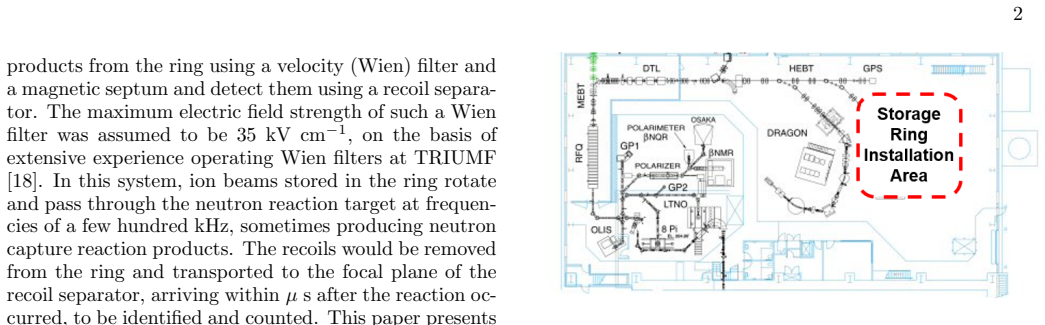
Recently, the TRIUMF Storage Ring (TRISR), a storage ring for the existing Isotope Separator and Accelerator-I (ISAC-I) radioactive ion beam facility at TRIUMF, was proposed. It may be possible to directly measure neutron-induced radiative capture reactions in inverse kinematics by combining the ring with a high-flux neutron generator as the neutron target. Herein, we present the conceptual design of a low-energy ion storage ring as well as a fusion product extraction system with a Wien filter and recoil separator for detecting neutron capture products based on ion optical calculations and particle-tracking simulations.
Editorial analysis
A structured set of objections, weighed in public.
Referee Report
Summary. The manuscript presents a conceptual design for TRISR, a low-energy ion storage ring proposed for the ISAC-I radioactive ion beam facility at TRIUMF, together with a fusion-product extraction system based on a Wien filter and recoil separator. The stated goal is to enable direct measurement of neutron radiative-capture (n,γ) reactions on radioactive ions in inverse kinematics by combining the ring with a high-flux neutron generator as the neutron target. The design is supported by ion-optical calculations and particle-tracking simulations of the lattice and the recoil-extraction line. The abstract frames the work as a conceptual study, not a final technical design.
Significance. Direct (n,γ) cross-section measurements on short-lived radioactive nuclei in the s-/i-/r-process regions are a standing gap in nuclear astrophysics, and storage-ring + neutron-target schemes are one of the few credible routes to address it. A self-consistent lattice for low-energy RIBs at ISAC-I, together with a Wien-filter-based separation of A→A+1 recoils with Δv/v ≈ 1/(2A), would be a useful conceptual contribution to a small but active design literature (cf. proposed CRYRING and HESR schemes, the Riken AAA-type concepts). The work is appropriate in scope for physics.acc-ph if the design study is presented honestly as a feasibility-level concept. Concrete strengths to credit, if borne out by the full text, are: a worked ion-optical lattice, particle-tracking validation, and a specific recoil-separation scheme rather than a hand-waved one.
major comments (5)
- [Feasibility / rate budget] The central claim that the ring 'may directly measure (n,γ) reactions' is load-bearing and depends on a numerical chain not visible at the abstract level: stored ion number N_ion, neutron flux Φ_n at the interaction region, cross section σ, interaction length L_int, revolution frequency f_rev, and beam lifetime τ. The expected yield ~ N_ion · Φ_n · σ · (L_int/circumference) · τ should be presented explicitly as a table for representative cases (e.g., a stable-beam commissioning isotope and at least one short-lived RIB of physics interest). Without this budget the design is internally consistent but the physics-feasibility claim is not substantiated.
- [Beam lifetime / vacuum] At ISAC-I energies (≲150 keV/u) charge-exchange cross sections on residual gas are ~10⁻¹⁵–10⁻¹⁴ cm², so usable storage times require XHV in the 10⁻¹¹ mbar regime. A high-flux neutron generator (D-D/D-T or similar) is typically a gas-loaded, outgassing source operated close to the interaction region. The manuscript should quantify the achievable pressure at the interaction straight with the generator running, the resulting τ, and whether differential pumping or a windowed geometry is assumed — and if windowed, the impact on neutron transmission and recoil straggling.
- [Neutron source spectrum and flux] Compact neutron generators deliver ~10⁸–10¹¹ n/s into 4π with broad keV–MeV spectra. Astrophysical relevance requires Maxwellian-averaged cross sections at kT ≈ 8–30 keV; D-D/D-T spectra are a poor match. The manuscript should specify the assumed generator type, the flux and angular distribution at the ring axis, the moderation/filtering scheme (if any), and how the resulting neutron energy distribution maps onto the astrophysical quantity of interest. This affects both the yield estimate and the physics interpretation of any future measurement.
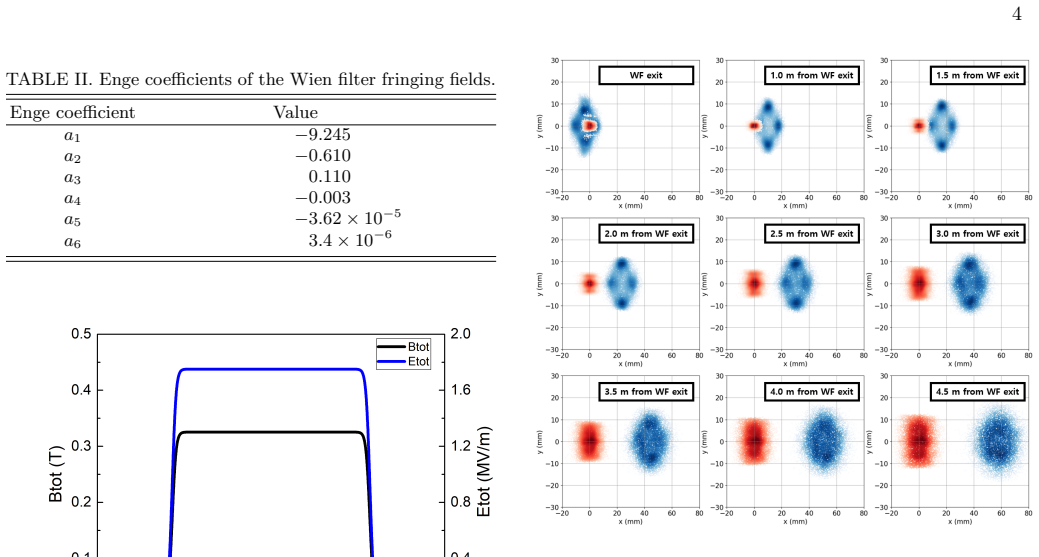
- [Wien filter / recoil separator] The velocity difference between an A and A+1 recoil after thermal/keV neutron capture is Δv/v ≈ 1/(2A) (modulo γ-recoil kinematics). For A ~ 50–130 this is 1–0.4%. The required Wien-filter resolving power, tolerance to the unreacted-beam halo and to charge-state contaminants from residual-gas charge exchange, and the expected suppression factor for the primary beam relative to recoils, should be quantified by the particle-tracking simulations and reported with acceptances and transmission efficiencies.
- [Injection and stacking] RIB intensities at ISAC-I for short-lived species are often modest. The case for usable event rates likely depends on multi-turn injection and/or beam cooling/stacking. The manuscript should state what is assumed for injection efficiency and whether cooling is part of the concept; if not, the steady-state stored intensity and how it was estimated should be made explicit.
minor comments (4)
- [Abstract] The abstract would be substantially strengthened by a single sentence quoting an order-of-magnitude expected event rate for one representative case, even with stated assumptions. As written, a reader cannot tell whether the proposed concept targets ~1 event/day or ~1 event/year per stored species.
- [Terminology] Clarify early whether 'high-flux neutron generator' refers to a D-D, D-T, ⁷Li(p,n), or moderated-reactor-style source; these have very different spectra and flux scaling.
- [Figures (presumed)] Lattice and tracking figures should include aperture, dispersion, and momentum-acceptance curves, and the recoil-separator figure should show acceptance ellipses for both the primary beam and the A+1 recoil so the separation margin is visible at a glance.
- [References] Comparison/contrast with related concepts (CRYRING@ESR low-energy storage of HCI, HESR neutron-target proposals, Riken rare-RI ring) would help locate this design in the existing literature.
Simulated Author's Rebuttal
We thank the referee for a careful and constructive report that correctly identifies the scope of the manuscript as a feasibility-level conceptual design, and for pinpointing the elements that must be strengthened before the physics-feasibility claim in the abstract is fully substantiated. We accept the major-revision recommendation. The present version concentrates on the ion-optical lattice of TRISR and on the Wien-filter/recoil-separator extraction line, both supported by ion-optical calculations and particle tracking. The referee is right that the chain from stored ions and neutron flux to detectable yield is the load-bearing claim and is not currently presented as an explicit budget. In the revision we will (i) add a yield-budget table for representative cases including a stable commissioning beam and at least one short-lived RIB; (ii) add a section on vacuum and beam-lifetime estimates with explicit assumptions about the neutron-generator interface; (iii) specify the assumed neutron generator, its spectrum and flux at the interaction straight, and discuss the mismatch with astrophysical kT; (iv) extend the particle-tracking results for the Wien filter to report resolving power, primary-beam suppression, and transmission/acceptance; and (v) make our injection/stacking and cooling assumptions explicit. We also propose to soften the abstract from "may directly measure" to language that more accurately reflects the conceptual stage, consistent with the referee's framing.
read point-by-point responses
-
Referee: Feasibility / rate budget: explicit yield N_ion · Φ_n · σ · (L_int/C) · τ should be tabulated for representative cases.
Authors: We agree. The current manuscript presents the lattice and the extraction line self-consistently but does not present the yield chain in tabulated form. In the revised version we will add a dedicated subsection with a table giving N_ion, Φ_n at the interaction straight, σ (Maxwellian-averaged where applicable, and at the relevant generator energy), L_int/C, f_rev, and τ, together with the resulting event rate, for at least: (a) a stable commissioning beam where σ is well known, and (b) one short-lived RIB of astrophysical interest in the s-/r-process regime. We will also state which inputs are taken from existing ISAC-I performance and which are design targets, so that the feasibility envelope is transparent. revision: yes
-
Referee: Beam lifetime / vacuum: at ≲150 keV/u, charge-exchange dominates; XHV ~10⁻¹¹ mbar required; quantify pressure and τ at the interaction straight with the generator running, and address differential pumping vs. windowed geometry.
Authors: This is an important point that the conceptual design does not yet treat quantitatively. In the revision we will (i) summarise the relevant single-electron capture and loss cross sections on residual H₂/N₂/H₂O at our energies, (ii) compute τ as a function of average ring pressure, and (iii) discuss the local pressure rise expected at the interaction region from a gas-loaded D-D/D-T generator, together with the differential-pumping scheme assumed. A windowed geometry is not part of our baseline because of the impact on neutron transmission and on recoil straggling that the referee correctly flags; we will state this explicitly and quantify the trade-off. revision: yes
-
Referee: Neutron source spectrum and flux: D-D/D-T spectra are a poor match for kT ≈ 8–30 keV; specify generator type, flux, angular distribution, moderation/filtering, and mapping onto astrophysical observables.
Authors: Agreed. The manuscript currently refers to a generic 'high-flux neutron generator' without sufficient specification. In the revision we will identify the assumed source class (commercial D-D / D-T sealed-tube generator, with reference designs delivering ~10¹⁰–10¹¹ n/s into 4π), give the angular flux at the ring axis, and discuss the energy spectrum. We will be explicit that without moderation the neutron energy is far above the astrophysical kT window, and that any astrophysical interpretation requires either moderation/filtering (with the corresponding flux penalty) or a model-based extrapolation. This caveat will also be reflected in the revised abstract and conclusions. revision: yes
-
Referee: Wien filter / recoil separator: quantify resolving power, tolerance to halo and charge-exchange contaminants, primary-beam suppression and recoil transmission with acceptances.
Authors: Our particle-tracking simulations of the extraction line produce these quantities, but they are not all reported in the present text. In the revision we will tabulate, as a function of A in the range relevant to the science case (A ~ 50–130, Δv/v ≈ 1/(2A)): the Wien-filter resolving power, the recoil acceptance, the transmission efficiency for A+1 recoils, and the suppression factor for the unreacted primary beam. We will also add a discussion of charge-state contaminants produced by residual-gas charge exchange in the straight, since these populate velocity classes overlapping the recoil signal and set a practical floor on suppression. revision: yes
-
Referee: Injection and stacking: state assumed injection efficiency, whether cooling/stacking is included, and how the steady-state stored intensity was estimated.
Authors: The baseline concept reported here is single-turn injection without active cooling, and the stored-ion numbers used implicitly in the design are dominated by τ × (injected current). We will make this assumption explicit in the revised text, give the corresponding steady-state N_ion as a function of τ, and add a paragraph identifying multi-turn injection and electron cooling as the natural upgrade paths needed to reach competitive event rates for the weakest RIBs. We do not propose to add a full cooler design in this paper, but we will discuss what would be required and reference the relevant CRYRING/HESR/Riken concepts cited by the referee. revision: yes
- A fully quantitative end-to-end yield prediction for a specific short-lived RIB (with realistic ISAC-I production yields, achievable XHV with the generator running, and a moderated neutron spectrum matched to astrophysical kT) is beyond what we can defend at the conceptual-design stage; the revised yield table will therefore be presented as a parametric envelope rather than a single guaranteed number.
- We do not yet have a vetted vacuum-engineering solution for coupling a gas-loaded neutron generator to an XHV straight section; the revision will state assumptions and identify this as required follow-up R&D rather than a solved problem.
Circularity Check
Conceptual design study; no circular derivation visible at abstract level.
full rationale
This is a conceptual accelerator/ion-optics design paper. The abstract claims only that the authors "present the conceptual design" of a storage ring plus Wien-filter recoil separator "based on ion optical calculations and particle-tracking simulations." That is a constructive engineering claim, not a derivation that "predicts" a measured quantity from itself. There is no fitted parameter being renamed as a prediction, no uniqueness theorem imported from the authors' prior work, and no self-citation chain doing load-bearing work. The reference to TRISR being "proposed" is contextual, not a logical premise from which a downstream prediction is squeezed. The reader's concern — that the rate/background budget (Φ_n · σ · L · f_rev · N_stored · τ) is not quoted — is a sufficiency / quantitative-feasibility concern, not a circularity concern: the missing numbers would make the feasibility case incomplete, not tautological. Per the rubric, "this is not standard consensus" and "the abstract under-supports the strongest claim" belong under correctness/sufficiency risk, not circularity. With only the abstract available, no specific reduction of the form (Eq. X = Eq. Y by construction) or (fitted input renamed as prediction) can be quoted, and none is suggested by the abstract's structure. Score 0.
Axiom & Free-Parameter Ledger
Forward citations
Cited by 1 Pith paper
-
Direct Neutron Reactions in Storage Rings Utilizing a Supercompact Cyclotron Neutron Target
A design study proposes a cyclotron-driven thermal neutron target integrated with ion storage rings to achieve areal densities of 3.4e6 n/cm2 (upgradable to 1e9) for inverse-kinematics neutron capture studies on radio...
discussion (0)
Sign in with ORCID, Apple, or X to comment. Anyone can read and Pith papers without signing in.