Channels with Markov Synchronization Errors: Information Stability and Capacity Bounds
Pith reviewed 2026-05-24 04:51 UTC · model grok-4.3
The pith
Channels with synchronization errors driven by a stationary ergodic finite-state Markov chain are information-stable and thus have a Shannon capacity.
A machine-rendered reading of the paper's core claim, the machinery that carries it, and where it could break.
Core claim
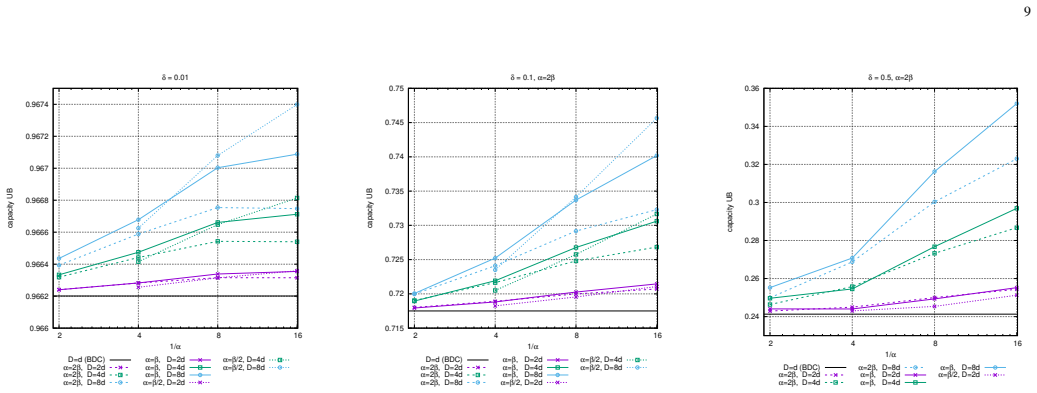
We assume that the synchronization errors are governed by a stationary and ergodic finite state Markov chain and prove that such a channel is information-stable, which implies the existence of the Shannon capacity for a wide range of channels with synchronization errors, with different applications, including DNA storage. We also provide specific examples of deletion channels with Markov memory and numerically evaluate their capacity bounds.
What carries the argument
Information stability of the channel, established via the stationary ergodic finite-state Markov chain governing the synchronization error process.
If this is right
- The Shannon capacity exists and equals the limit of mutual information for these channels.
- Coding schemes exist that achieve this capacity limit.
- The result covers channels relevant to DNA storage and similar applications.
- For Markov deletion channels, capacity is strictly higher than for memoryless deletions at the same probability.
- Capacity bounds can be numerically evaluated for finite-state Markov error models.
Where Pith is reading between the lines
- The stability proof may extend to other dependent error processes beyond finite-state Markov chains.
- Design of practical codes could exploit the memory to achieve higher rates than memoryless designs.
- Numerical capacity comparisons suggest that real-world channels with bursty or correlated errors may outperform independent-error models.
Load-bearing premise
The synchronization error process is a stationary and ergodic finite-state Markov chain.
What would settle it
A specific stationary ergodic Markov deletion channel where the normalized mutual information fails to converge to a limit would falsify the stability claim.
Figures

read the original abstract
Particularly motivated by DNA storage channels, we consider channels with synchronization errors modeled as insertions and deletions, along with substitutions. We focus on the case where the synchronization error process has memory and investigate the information stability of these channels, hence the existence of their Shannon capacity. We assume that the synchronization errors are governed by a stationary and ergodic finite state Markov chain and prove that such a channel is information-stable, which implies the existence of a coding scheme that achieves the limit of mutual information. This result implies the existence of the Shannon capacity for a wide range of channels with synchronization errors, with different applications, including DNA storage. We also provide specific examples of deletion channels with Markov memory and numerically evaluate their capacity bounds, thereby allowing us to quantify the capacity difference between memoryless deletion channels and those with memory with the same deletion probability and reveal that having memory increases the channel capacity.
Editorial analysis
A structured set of objections, weighed in public.
Referee Report
Summary. The paper models synchronization-error channels (insertions, deletions, and substitutions) whose error process is a stationary ergodic finite-state Markov chain. It proves that such channels are information-stable, which implies that the Shannon capacity exists and equals the limit of the normalized mutual information. The result is applied to DNA-storage channels and illustrated with explicit capacity bounds for Markov deletion channels; numerical comparisons show that memory increases capacity relative to the memoryless deletion channel with the same deletion probability.
Significance. If the information-stability proof holds, the work supplies a general sufficient condition for the existence of capacity in a broad class of synchronization-error channels with memory. The numerical evaluation quantifies the capacity gain due to Markov memory, which is directly relevant to applications such as DNA storage. The manuscript ships an explicit proof under the stated modeling assumptions together with reproducible numerical bounds.
minor comments (3)
- §4 (numerical evaluation): the state-space size of the Markov chain used for the capacity-bound computation and the truncation length for the mutual-information estimator should be stated explicitly so that the reported numbers can be reproduced from the given deletion probability and transition matrix.
- Notation: the definition of the output process Y^n in the presence of variable-length synchronization errors should be accompanied by a short diagram or explicit recursion showing how the Markov state evolves with each input symbol.
- References: the citation list omits the classic Dobrushin information-stability criterion and the recent works on deletion channels with memory; adding these would clarify the precise technical advance.
Simulated Author's Rebuttal
We thank the referee for the positive summary, significance assessment, and recommendation of minor revision. No major comments appear in the report, so we have no specific points requiring point-by-point rebuttal or revision.
Circularity Check
No significant circularity identified
full rationale
The paper states an explicit modeling assumption (synchronization errors form a stationary ergodic finite-state Markov chain) and proves information stability as a consequence. No step reduces a claimed prediction or theorem to a fitted parameter, self-citation chain, or definitional tautology; the argument is a standard information-theoretic proof under the given hypothesis and is therefore self-contained.
Axiom & Free-Parameter Ledger
axioms (1)
- domain assumption The synchronization error process is a stationary and ergodic finite-state Markov chain.
Forward citations
Cited by 1 Pith paper
-
Channels with Input-Correlated Synchronization Errors
Derives general capacity theorems for input-correlated synchronization error channels and explicit capacity-achieving codes for multi-trace runlength-dependent deletion channels.
Reference graph
Works this paper leans on
-
[1]
Bit patte rned media with written-in errors: Modelling, detection and theoreti cal limits,
J. Hu, T. M. Duman, E. M. Kurtas, and M. F. Erden, “Bit patte rned media with written-in errors: Modelling, detection and theoreti cal limits,” IEEE Transactions on Magnetics , vol. 43, pp. 3517–3524, 2007
work page 2007
-
[2]
DNA-based storage: Models a nd funda- mental limits,
I. Shomorony and R. Heckel, “DNA-based storage: Models a nd funda- mental limits,” IEEE Transactions on Information Theory , vol. 67, no. 6, pp. 3675–3689, 2021
work page 2021
-
[3]
On optimal k-deletion correcting c odes,
J. Sima and J. Bruck, “On optimal k-deletion correcting c odes,” IEEE Transactions on Information Theory , vol. 67, no. 6, pp. 3360–3375, 2021
work page 2021
-
[4]
Systematic cod es correcting multiple-deletion and multiple-substitution errors,
W. Song, N. Polyanskii, K. Cai, and X. He, “Systematic cod es correcting multiple-deletion and multiple-substitution errors,” IEEE Transactions on Information Theory , vol. 68, no. 10, pp. 6402–6416, 2022
work page 2022
-
[5]
Non-binary two-deletion correcting codes and burst-deletion correcting codes,
W. Song and K. Cai, “Non-binary two-deletion correcting codes and burst-deletion correcting codes,” IEEE Transactions on Information Theory, vol. 69, no. 10, pp. 6470–6484, 2023
work page 2023
-
[6]
Codes for channels with inserti ons, deletions and substitutions,
E. Ratzer and D. Mackay, “Codes for channels with inserti ons, deletions and substitutions,” in 2nd International Symposium of Turbo Codes and Related Topics, 2000
work page 2000
-
[7]
Reliable communication over cha nnels with insertions, deletions, and substitutions,
M. Davey and D. Mackay, “Reliable communication over cha nnels with insertions, deletions, and substitutions,” IEEE Transactions on Information Theory , vol. 47, no. 2, pp. 687–698, 2001
work page 2001
-
[8]
Symbol-level syn chronization and LDPC code design for insertion/deletion channels,
F. Wang, D. Fertonani, and T. M. Duman, “Symbol-level syn chronization and LDPC code design for insertion/deletion channels,” IEEE Transac- tions on Communications , vol. 59, no. 5, pp. 1287–1297, 2011
work page 2011
-
[9]
Shannon’s theorems for channels with s ynchronization errors,
R. L. Dobrushin, “Shannon’s theorems for channels with s ynchronization errors,” Prob. of Information Trans. , vol. 3, no. 4, pp. 18–36, 1967
work page 1967
-
[10]
On lower bounds for the c apacity of deletion channels,
E. Drinea and M. Mitzenmacher, “On lower bounds for the c apacity of deletion channels,” IEEE Transactions on Information Theory , vol. 52, no. 10, pp. 4648–4657, 2006
work page 2006
-
[11]
simple lower bound for t he capacity of the deletion channel,
M. Mitzenmacher and E. Drinea, “simple lower bound for t he capacity of the deletion channel,” IEEE Transactions on Information Theory, vol. 52, no. 10, pp. 4657–4660, 2006
work page 2006
-
[12]
E. Drinea and A. Kirsch, “Directly lower bounding the in formation capacity for channels with i.i.d. deletions and duplicatio ns,” in 2007 IEEE International Symposium on Information Theory , 2007, pp. 1731– 1735
work page 2007
-
[13]
Capacity u pper bounds for deletion channels,
S. Diggavi, M. Mitzenmacher, and H. Pfister, “Capacity u pper bounds for deletion channels,” in 2007 IEEE International Symposium on Information Theory , 2007
work page 2007
-
[14]
Novel bounds on the capaci ty of binary deletion channels,
D. Fertonani and T. M. Duman, “Novel bounds on the capaci ty of binary deletion channels,” IEEE Transactions on Information Theory , vol. 56, no. 6, pp. 2753–2765, 2010
work page 2010
-
[15]
Upper bounds on the capacity of deletion channels using channel fragmentation,
M. Rahmati and T. M. Duman, “Upper bounds on the capacity of deletion channels using channel fragmentation,” IEEE Transactions on Information Theory , vol. 61, no. 1, pp. 146–156, 2015
work page 2015
-
[16]
Optimal coding for the bin ary deletion channel with small deletion probability,
Y . Kanoria and A. Montanari, “Optimal coding for the bin ary deletion channel with small deletion probability,” IEEE Transactions on Infor- mation Theory , vol. 59, no. 10, pp. 6192–6219, 2013
work page 2013
-
[17]
Tight asympto tic bounds for the deletion channel with small deletion probabilities ,
A. Kalai, M. Mitzenmacher, and M. Sudan, “Tight asympto tic bounds for the deletion channel with small deletion probabilities ,” in 2010 IEEE International Symposium on Information Theory , 2010, pp. 997–1001
work page 2010
-
[18]
A survey of results for deletion chan nels and related synchronization channels,
M. Mitzenmacher, “A survey of results for deletion chan nels and related synchronization channels,” Probability Surveys, vol. 6, pp. 1–33, 2009
work page 2009
-
[19]
An overview of capacity r esults for synchronization channels,
M. Cheraghchi and J. Ribeiro, “An overview of capacity r esults for synchronization channels,” IEEE Transactions on Information Theory , vol. 67, no. 6, pp. 3207–3232, 2021
work page 2021
-
[20]
Channel model and decoder with memory for DNA data storage with nanopore sequencing,
B. Hamoum and E. Dupraz, “Channel model and decoder with memory for DNA data storage with nanopore sequencing,” IEEE Access, vol. 11, pp. 52 075–52 087, 2023
work page 2023
-
[21]
Optimized code design for constrained DNA dat a storage with asymmetric errors,
L. Deng, Y . Wang, M. Noor-A-Rahim, Y . L. Guan, Z. Shi, E. G unawan, and C. L. Poh, “Optimized code design for constrained DNA dat a storage with asymmetric errors,” IEEE Access , vol. 7, pp. 84 107–84 121, 2019
work page 2019
-
[22]
Models and informa tion- theoretic bounds for nanopore sequencing,
W. Mao, S. N. Diggavi, and S. Kannan, “Models and informa tion- theoretic bounds for nanopore sequencing,” IEEE Transactions on Information Theory , vol. 64, no. 4, pp. 3216–3236, 2018
work page 2018
-
[23]
Bounds on the capacity of channels with insertions, deletions and substitutions,
D. Fertonani, T. M. Duman, and M. F. Erden, “Bounds on the capacity of channels with insertions, deletions and substitutions,” IEEE Transactions on Communications , vol. 59, no. 1, pp. 2–6, 2011
work page 2011
-
[24]
A mathematical theory of communication,
C. Shannon, “A mathematical theory of communication,” Bell System Technical Journal, vol. 27, pp. 379–423, 623–656, July, October 1948
work page 1948
-
[25]
G. D. Hu, “On Shannon theorem and its converse for sequen ces of communication schemes in the case of abstract random variab les,” in Transactions of the Third Prague Conference on Information Theory, Statistical Decision Functions, Random Processes , 1962, pp. 285–332
work page 1962
-
[26]
A general formula for channel cap acity,
S. V erdu and T. S. Han, “A general formula for channel cap acity,” IEEE Trans. on Information Theory , vol. 40, no. 4, pp. 1147–1157, 1994
work page 1994
-
[27]
A general formulation of the fundamen tal theorem of Shannon in the theory of information,
R. L. Dobrushin, “A general formulation of the fundamen tal theorem of Shannon in the theory of information,” Uspekhi Mat. Nauk , vol. 14, no. 6, pp. 3–104, 1959
work page 1959
-
[28]
Memoryless channels with synchroniza tion errors: the general case,
S. Z. Stambler, “Memoryless channels with synchroniza tion errors: the general case,” Probl. Peredachi Inf., vol. 6, no. 3, pp. 43–49, 1970
work page 1970
-
[29]
R. G. Gallager, Information Theory and Reliable Communication . Wi- ley, 1968
work page 1968
-
[30]
Capacity and coding for th e Gilbert- Elliott channels,
M. Mushkin and I. Bar-David, “Capacity and coding for th e Gilbert- Elliott channels,” IEEE Transactions on Information Theory , vol. 35, no. 6, pp. 1277–1290, 1989
work page 1989
-
[31]
On the capacity of channels with de letions and states,
Y . Li and V . Y . F. Tan, “On the capacity of channels with de letions and states,” IEEE Transactions on Information Theory , vol. 67, no. 5, pp. 2663–2679, 2021
work page 2021
-
[32]
Billingsley, Probability and Measure , ser
P . Billingsley, Probability and Measure , ser. Wiley Series in Probability and Statistics. Wiley, 2012
work page 2012
-
[33]
Some linear and some quadra tic recursion formulas. II,
N. Bruijn, de and P . Erd¨ os, “Some linear and some quadra tic recursion formulas. II,” Proceedings of the Koninklijke Nederlandse Akademie van W etenschappen: Series A: Mathematical Sciences, vol. 14, pp. 152–163, 1952
work page 1952
discussion (0)
Sign in with ORCID, Apple, or X to comment. Anyone can read and Pith papers without signing in.