A tutorial on learning from preferences and choices with Gaussian Processes
Pith reviewed 2026-05-24 03:23 UTC · model grok-4.3
The pith
Tailoring the likelihood function allows Gaussian Process models to incorporate economic rationality principles for preference learning.
A machine-rendered reading of the paper's core claim, the machinery that carries it, and where it could break.
Core claim
By suitably tailoring the likelihood function, this framework enables the construction of preference learning models that encompass random utility models, limits of discernment, and scenarios with multiple conflicting utilities for both object- and label-preference.
What carries the argument
The tailored likelihood function that encodes rationality principles from economics and decision theory inside Gaussian Process preference models.
If this is right
- Random utility models become expressible as GP preference models.
- Limits of discernment can be directly modeled within the same framework.
- Scenarios with multiple conflicting utilities are covered for both objects and labels.
- Standard GP inference and uncertainty quantification remain available after the likelihood change.
- The same construction applies uniformly to object-preference and label-preference tasks.
Where Pith is reading between the lines
- The likelihood-tailoring strategy could be tested on sequential choice data to check whether the resulting posteriors match observed human inconsistency rates.
- If the approach works, it supplies a route to embed other decision-theoretic constraints, such as stochastic dominance, without redesigning the covariance function.
- The framework's uniformity across object and label preferences suggests it may simplify hybrid recommendation systems that mix both types of feedback.
Load-bearing premise
Rationality principles from economics and decision theory can be incorporated into Gaussian Process models simply by tailoring the likelihood function without requiring additional structural changes or losing key GP properties such as uncertainty quantification.
What would settle it
An explicit example of a rationality axiom that cannot be represented by any choice of likelihood while keeping the rest of the GP model unchanged, or a case where uncertainty quantification is demonstrably lost after tailoring the likelihood.
Figures










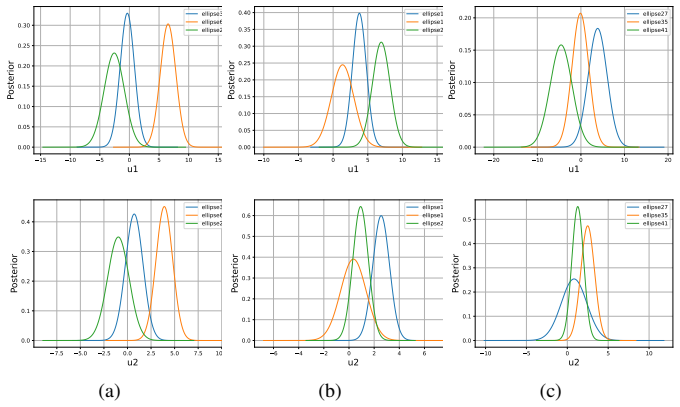
read the original abstract
Preference modelling lies at the intersection of economics, decision theory, machine learning and statistics. By understanding individuals' preferences and how they make choices, we can build products that closely match their expectations, paving the way for more efficient and personalised applications across a wide range of domains. The objective of this tutorial is to present a cohesive and comprehensive framework for preference learning with Gaussian Processes (GPs), demonstrating how to seamlessly incorporate rationality principles (from economics and decision theory) into the learning process. By suitably tailoring the likelihood function, this framework enables the construction of preference learning models that encompass random utility models, limits of discernment, and scenarios with multiple conflicting utilities for both object- and label-preference. This tutorial builds upon established research while simultaneously introducing some novel GP-based models to address specific gaps in the existing literature.
Editorial analysis
A structured set of objections, weighed in public.
Referee Report
Summary. The manuscript is a tutorial on a Gaussian Process framework for preference learning. It claims that tailoring the likelihood function allows incorporation of rationality principles from economics and decision theory, enabling models that recover random utility models, limits of discernment, and multi-utility scenarios for both object- and label-preferences, while building on prior work and introducing some novel GP-based models.
Significance. If the constructions hold, the tutorial offers a unified, likelihood-focused approach to embedding decision-theoretic principles into GPs while retaining uncertainty quantification, which could aid development of personalized systems. Credit is due for its expository synthesis of established literature with targeted novel models addressing literature gaps.
minor comments (2)
- The abstract states that novel GP-based models are introduced to address gaps; the main text should explicitly flag which sections present new derivations versus syntheses of prior work, with clear citations to the latter.
- Ensure that all likelihood constructions are accompanied by explicit statements confirming that standard GP properties (e.g., posterior uncertainty) remain intact after tailoring, to avoid reader uncertainty about the framework's scope.
Simulated Author's Rebuttal
We thank the referee for their careful reading and positive evaluation of the manuscript. We are pleased that the unified likelihood-based framework for embedding decision-theoretic principles into Gaussian process preference models was viewed as a useful expository contribution, and we appreciate the recommendation for minor revision.
Circularity Check
No significant circularity identified
full rationale
The paper is an expository tutorial whose central claim is that preference learning models encompassing random utility models, limits of discernment, and multi-utility scenarios can be obtained by tailoring the likelihood function within a fixed GP prior. This is a standard model-construction technique that does not reduce any prediction or result to a quantity defined by the authors' own inputs or prior self-citations; the derivation chain consists of explicit likelihood choices that recover known models from economics and decision theory without circular redefinition or fitted-input renaming. The work explicitly positions itself as building on established literature while adding some novel models, with no load-bearing uniqueness theorems or ansatzes imported from the authors' own prior work.
Axiom & Free-Parameter Ledger
Forward citations
Cited by 1 Pith paper
-
DT-PBO: an Interpretable Tree-based Surrogate Model for Preferential Bayesian Optimization
DT-PBO is a tree-based surrogate for preferential Bayesian optimization that matches GP performance on benchmarks while remaining inherently interpretable.
Reference graph
Works this paper leans on
-
[1]
Osborne, Sebastian Orbell, Natalia Ares, Krikamol Muandet, and Siu Lun Chau
Masaki Adachi, Brady Planden, David Howey, Michael A. Osborne, Sebastian Orbell, Natalia Ares, Krikamol Muandet, and Siu Lun Chau. Looping in the human: Collaborative and explainable bayesian optimization. In Proceedings of The 27th International Conference on Artificial Intelligence and Statistics, pages 505--513. PMLR, 4 2024. URL https://proceedings.ml...
work page 2024
-
[2]
Lo \" c Adam and S \'e bastien Destercke. Incremental elicitation of preferences: optimist or pessimist? In Algorithmic Decision Theory: 7th International Conference, ADT 2021, Toulouse, France, November 3--5, 2021, Proceedings 7, pages 71--85. Springer, 2021 a
work page 2021
-
[3]
Possibilistic preference elicitation by minimax regret
Lo \" c Adam and S \'e bastien Destercke. Possibilistic preference elicitation by minimax regret. In Uncertainty in artificial intelligence, pages 718--727. PMLR, 2021 b
work page 2021
-
[4]
Arpit Agarwal, Prathamesh Patil, and Shivani Agarwal. Accelerated spectral ranking. In International Conference on Machine Learning, pages 70--79. PMLR, 2018
work page 2018
-
[5]
Charu C. Aggarwal. Recommender Systems. Springer International Publishing, Cham, 2016. ISBN 978-3-319-29657-9. doi:10.1007/978-3-319-29659-3
-
[6]
Learning preferences for multiclass problems
Fabio Aiolli and Alessandro Sperduti. Learning preferences for multiclass problems. Advances in neural information processing systems, 17, 2004
work page 2004
-
[7]
General theory of best variants choice: Some aspects
Mark Aizerman and Andrew Malishevski. General theory of best variants choice: Some aspects. IEEE Transactions on Automatic Control, 26 0 (5): 0 1030--1040, 1981
work page 1981
-
[8]
Gaussian process regression with skewed errors
MT Alodat and Mohammed K Shakhatreh. Gaussian process regression with skewed errors. Journal of Computational and Applied Mathematics, 370: 0 112665, 2020
work page 2020
-
[9]
Statistical methods for ranking data, volume 1341
Mayer Alvo and LH Philip. Statistical methods for ranking data, volume 1341. Springer, 2014
work page 2014
-
[10]
Bayesian conjugacy in probit, tobit, multinomial probit and extensions: A review and new results
Niccol \`o Anceschi, Augusto Fasano, Daniele Durante, and Giacomo Zanella. Bayesian conjugacy in probit, tobit, multinomial probit and extensions: A review and new results. Journal of the American Statistical Association, 118 0 (542): 0 1451--1469, 2023
work page 2023
-
[11]
B Arellano and Adelchi Azzalini
R. B Arellano and Adelchi Azzalini. On the unification of families of skew-normal distributions. Scandinavian Journal of Statistics, 33 0 (3): 0 561--574, 2006
work page 2006
-
[12]
Pareto rationalizability by two single-peaked preferences
Ricardo Arlegi and Miriam Teschl. Pareto rationalizability by two single-peaked preferences. Mathematical Social Sciences, 118: 0 1--11, 2022
work page 2022
-
[13]
Social choice and individual values
Kenneth J Arrow. Social choice and individual values. Yale university press, 1963
work page 1963
-
[14]
Random utility theory for social choice
Hossein Azari, David Parks, and Lirong Xia. Random utility theory for social choice. Advances in Neural Information Processing Systems, 25, 2012
work page 2012
-
[15]
Generalized method-of-moments for rank aggregation
Hossein Azari Soufiani, William Chen, David C Parkes, and Lirong Xia. Generalized method-of-moments for rank aggregation. Advances in Neural Information Processing Systems, 26, 2013
work page 2013
-
[16]
The skew-normal and related families, volume 3
Adelchi Azzalini. The skew-normal and related families, volume 3. Cambridge University Press, 2013
work page 2013
-
[17]
Understanding probabilistic sparse G aussian process approximations
Matthias Bauer, Mark van der Wilk, and Carl Edward Rasmussen. Understanding probabilistic sparse G aussian process approximations. In Advances in neural information processing systems, pages 1533--1541, 2016
work page 2016
-
[18]
prefGP : A python package for preference and choice learning with gaussian processes
Alessio Benavoli and Dario Azzimonti. prefGP : A python package for preference and choice learning with gaussian processes. https://github.com/benavoli/prefGP, 2024
work page 2024
-
[19]
Skew Gaussian Processes for Classification
Alessio Benavoli, Dario Azzimonti, and Dario Piga. Skew Gaussian Processes for Classification . Machine Learning, 109: 0 1877–1902, 2020. doi:10.1007/s10994-020-05906-3. URL https://arxiv.org/abs/2005.12987
-
[20]
Preferential Bayesian optimisation with Skew Gaussian Processes
Alessio Benavoli, Dario Azzimonti, and Dario Piga. Preferential Bayesian optimisation with Skew Gaussian Processes . In 2021 Genetic and Evolutionary Computation Conference Companion (GECCO '21 Companion), July 10--14, 2021, Lille, France, New York, NY, USA, 2021 a . ACM
work page 2021
-
[21]
Alessio Benavoli, Dario Azzimonti, and Dario Piga. A unified framework for closed-form nonparametric regression, classification, preference and mixed problems with Skew Gaussian Processes . Machine Learning, pages 1--39, 2021 b . doi:10.1007/s10994-021-06039-x. URL https://link.springer.com/article/10.1007/s10994-021-06039-x
-
[22]
Preferential bayesian optimisation with skew gaussian processes
Alessio Benavoli, Dario Azzimonti, and Dario Piga. Preferential bayesian optimisation with skew gaussian processes. In Proceedings of the Genetic and Evolutionary Computation Conference Companion, pages 1842--1850, 2021 c
work page 2021
-
[23]
Learning choice functions with gaussian processes
Alessio Benavoli, Dario Azzimonti, and Dario Piga. Learning choice functions with gaussian processes. In Robin J. Evans and Ilya Shpitser, editors, Proceedings of the Thirty-Ninth Conference on Uncertainty in Artificial Intelligence, volume 216 of Proceedings of Machine Learning Research, pages 141--151. PMLR, 2023 a . URL https://proceedings.mlr.press/v2...
work page 2023
-
[24]
Bayesian optimization for choice data
Alessio Benavoli, Dario Azzimonti, and Dario Piga. Bayesian optimization for choice data. In 2023 Genetic and Evolutionary Computation Conference Companion (GECCO '23 Companion), July 15--19, 2023, Lisbon, 2023 b . doi:10.1145/3583133.3596324
-
[25]
A discrete choice model for subset selection
Austin R Benson, Ravi Kumar, and Andrew Tomkins. A discrete choice model for subset selection. In Proceedings of the eleventh ACM international conference on web search and data mining, pages 37--45, 2018
work page 2018
-
[26]
Pandasbiogeme: a short introduction
Michel Bierlaire. Pandasbiogeme: a short introduction. Report TRANSP-OR: Lausanne, Switzerland, 181219, 2018
work page 2018
-
[27]
The normal law under linear restrictions: simulation and estimation via minimax tilting
Zdravko I Botev. The normal law under linear restrictions: simulation and estimation via minimax tilting. Journal of the Royal Statistical Society Series B: Statistical Methodology, 79 0 (1): 0 125--148, 2017
work page 2017
-
[28]
Incremental elicitation of rank-dependent aggregation functions based on bayesian linear regression
Nadjet Bourdache, Patrice Perny, and Olivier Spanjaard. Incremental elicitation of rank-dependent aggregation functions based on bayesian linear regression. In IJCAI-19-Twenty-Eighth International Joint Conference on Artificial Intelligence, pages 2023--2029. International Joint Conferences on Artificial Intelligence Organization, 2019
work page 2023
-
[29]
Craig Boutilier. Computational decision support: Regret-based models for optimization and preference elicitation, 2013
work page 2013
-
[30]
Constraint-based optimization and utility elicitation using the minimax decision criterion
Craig Boutilier, Relu Patrascu, Pascal Poupart, and Dale Schuurmans. Constraint-based optimization and utility elicitation using the minimax decision criterion. Artificial Intelligence, 170 0 (8-9): 0 686--713, 2006
work page 2006
-
[31]
Rank analysis of incomplete block designs: I
Ralph Allan Bradley and Milton E Terry. Rank analysis of incomplete block designs: I. the method of paired comparisons. Biometrika, 39 0 (3/4): 0 324--345, 1952
work page 1952
-
[32]
Asymmetric, closed-form, finite-parameter models of multinomial choice
Timothy Brathwaite and Joan L Walker. Asymmetric, closed-form, finite-parameter models of multinomial choice. Journal of choice modelling, 29: 0 78--112, 2018
work page 2018
-
[33]
Learning to rank using gradient descent
Chris Burges, Tal Shaked, Erin Renshaw, Ari Lazier, Matt Deeds, Nicole Hamilton, and Greg Hullender. Learning to rank using gradient descent. In Proceedings of the 22nd international conference on Machine learning, pages 89--96, 2005
work page 2005
-
[34]
From ranknet to lambdarank to lambdamart: An overview
Christopher JC Burges. From ranknet to lambdarank to lambdamart: An overview. Learning, 11 0 (23-581): 0 81, 2010
work page 2010
-
[35]
Ioannis Caragiannis, Ariel D. Procaccia, and Nisarg Shah. When do noisy votes reveal the truth? ACM Transactions on Economics and Computation, 4 0 (3): 0 1–30, 6 2016. ISSN 2167-8375, 2167-8383. doi:10.1145/2892565
-
[36]
Efficient bayesian inference for generalized bradley--terry models
Francois Caron and Arnaud Doucet. Efficient bayesian inference for generalized bradley--terry models. Journal of Computational and Graphical Statistics, 21 0 (1): 0 174--196, 2012
work page 2012
-
[37]
Learning Inconsistent Preferences with Gaussian Processes
Siu Lun Chau, Javier Gonzalez, and Dino Sejdinovic. Learning Inconsistent Preferences with Gaussian Processes . In Gustau Camps-Valls, Francisco J. R. Ruiz, and Isabel Valera, editors, Proceedings of The 25th International Conference on Artificial Intelligence and Statistics, volume 151 of Proceedings of Machine Learning Research, pages 2266--2281. PMLR, ...
work page 2022
-
[38]
Rational selection of decision functions
Herman Chernoff. Rational selection of decision functions. Econometrica: journal of the Econometric Society, pages 422--443, 1954
work page 1954
-
[39]
Deep reinforcement learning from human preferences
Paul F Christiano, Jan Leike, Tom Brown, Miljan Martic, Shane Legg, and Dario Amodei. Deep reinforcement learning from human preferences. Advances in neural information processing systems, 30, 2017
work page 2017
-
[40]
Preference Learning with Gaussian Processes
Wei Chu and Zoubin Ghahramani. Preference Learning with Gaussian Processes . In Proceedings of the 22nd International Conference on Machine Learning, ICML ’05, page 137–144, New York, NY, USA, 2005. Association for Computing Machinery. ISBN 1595931805. doi:10.1145/1102351.1102369
-
[41]
William W Cohen, Robert E Schapire, and Yoram Singer. Learning to order things. Advances in neural information processing systems, 10, 1997
work page 1997
-
[42]
Douglas E Critchlow and Michael A Fligner. Paired comparison, triple comparison, and ranking experiments as generalized linear models, and their implementation on glim. Psychometrika, 56 0 (3): 0 517--533, 1991
work page 1991
-
[43]
Estimation of random utility models in r: the mlogit package
Yves Croissant. Estimation of random utility models in r: the mlogit package. Journal of Statistical Software, 95: 0 1--41, 2020
work page 2020
-
[44]
Interpreting, axiomatising and representing coherent choice functions in terms of desirability
Jasper De Bock and Gert De Cooman. Interpreting, axiomatising and representing coherent choice functions in terms of desirability. In International Symposium on Imprecise Probabilities: Theories and Applications, pages 125--134. PMLR, 2019
work page 2019
-
[45]
Representation of a preference ordering by a numerical function
Gerard Debreu. Representation of a preference ordering by a numerical function. Decision processes, 3: 0 159--165, 1954
work page 1954
-
[46]
Torch-choice: A pytorch package for large-scale choice modelling with python
Tianyu Du, Ayush Kanodia, and Susan Athey. Torch-choice: A pytorch package for large-scale choice modelling with python. arXiv preprint arXiv:2304.01906, 2023
-
[47]
Conjugate Bayes for probit regression via unified skew-normal distributions
Daniele Durante. Conjugate Bayes for probit regression via unified skew-normal distributions . Biometrika, 106 0 (4): 0 765--779, 08 2019
work page 2019
-
[48]
Indifference or indecisiveness? choice-theoretic foundations of incomplete preferences
Kfir Eliaz and Efe A Ok. Indifference or indecisiveness? choice-theoretic foundations of incomplete preferences. Games and economic behavior, 56 0 (1): 0 61--86, 2006
work page 2006
-
[49]
Active preference learning with discrete choice data
Brochu Eric, Nando Freitas, and Abhijeet Ghosh. Active preference learning with discrete choice data. Advances in neural information processing systems, 20, 2007
work page 2007
-
[50]
Generalized robust conjoint estimation
Theodoros Evgeniou, Constantinos Boussios, and Giorgos Zacharia. Generalized robust conjoint estimation. Marketing Science, 24 0 (3): 0 415--429, 2005
work page 2005
-
[51]
Learning subjective functions with large margins
Claude-Nicolas Fiechter and Seth Rogers. Learning subjective functions with large margins. In ICML, pages 287--294, 2000
work page 2000
- [52]
-
[53]
Posterior probabilities for a consensus ordering
Michael A Fligner and Joseph S Verducci. Posterior probabilities for a consensus ordering. Psychometrika, 55: 0 53--63, 1990
work page 1990
-
[54]
A rank-ordered logit model with unobserved heterogeneity in ranking capabilities
Dennis Fok, Richard Paap, and Bram Van Dijk. A rank-ordered logit model with unobserved heterogeneity in ranking capabilities. Journal of applied econometrics, 27 0 (5): 0 831--846, 2012
work page 2012
-
[55]
Application and interpretation of nested logit models of intercity mode choice
Christopher V Forinash and Frank S Koppelman. Application and interpretation of nested logit models of intercity mode choice. Transportation research record, 0 (1413), 1993
work page 1993
-
[56]
Johannes F \"u rnkranz and Eyke H \"u llermeier. Preference learning. Springer, 2010
work page 2010
-
[57]
R., Pleiss, G., Bindel, D., Weinberger, K
Jacob R. Gardner, Geoff Pleiss, David Bindel, Kilian Q. Weinberger, and Andrew Gordon Wilson. Gpytorch: Blackbox matrix-matrix gaussian process inference with gpu acceleration. Advances in Neural Information Processing Systems, 2018-Decem 0 (NeurIPS): 0 7576–7586, 2018. ISSN 10495258. arXiv: 1809.11165
-
[58]
Integrals over Gaussians under Linear Domain Constraints
Alexandra Gessner, Oindrila Kanjilal, and Philipp Hennig. Integrals over Gaussians under Linear Domain Constraints . In Silvia Chiappa and Roberto Calandra, editors, Proceedings of the Twenty Third International Conference on Artificial Intelligence and Statistics, volume 108, pages 2764--2774. PMLR, 8 2020
work page 2020
-
[59]
Variational Gaussian process classifiers
Mark N Gibbs and David JC MacKay. Variational Gaussian process classifiers . IEEE Transactions on Neural Networks, 11 0 (6): 0 1458--1464, 2000
work page 2000
- [60]
-
[61]
Bayesian inference for plackett-luce ranking models
John Guiver and Edward Snelson. Bayesian inference for plackett-luce ranking models. In proceedings of the 26th annual international conference on machine learning, pages 377--384, 2009
work page 2009
-
[62]
Constraint classification: A new approach to multiclass classification
Sariel Har-Peled, Dan Roth, and Dav Zimak. Constraint classification: A new approach to multiclass classification. In International conference on algorithmic learning theory, pages 365--379. Springer, 2002
work page 2002
-
[63]
F. Maxwell Harper and Joseph A. Konstan. The MovieLens Datasets: History and Context . ACM Transactions on Interactive Intelligent Systems, 5 0 (4): 0 19:1--19:19, 2015. ISSN 2160-6455. doi:10.1145/2827872
- [64]
-
[65]
Learning preference relations for information retrieval
Ralf Herbrich, Thore Graepel, Peter Bollmann-Sdorra, and Klaus Obermayer. Learning preference relations for information retrieval. In ICML-98 Workshop: text categorization and machine learning, pages 80--84, 1998
work page 1998
-
[66]
Scalable gaussian process classification via expectation propagation
Daniel Hernandez-Lobato and Jose Miguel Hernandez-Lobato. Scalable gaussian process classification via expectation propagation. In Proceedings of the 19th International Conference on Artificial Intelligence and Statistics, page 168–176. PMLR, 2016. URL https://proceedings.mlr.press/v51/hernandez-lobato16.html
work page 2016
-
[67]
Stephane Hess and David Palma. Apollo: A flexible, powerful and customisable freeware package for choice model estimation and application. Journal of choice modelling, 32: 0 100170, 2019
work page 2019
-
[68]
Bayesian Active Learning for Classification and Preference Learning
Neil Houlsby, Ferenc Husz \'a r, Zoubin Ghahramani, and M \'a t \'e Lengyel. Bayesian active learning for classification and preference learning. arXiv preprint arXiv:1112.5745, 2011
work page internal anchor Pith review Pith/arXiv arXiv 2011
-
[69]
Explaining preferences with shapley values
Robert Hu, Siu Lun Chau, Jaime Ferrando Huertas, and Dino Sejdinovic. Explaining preferences with shapley values. In S. Koyejo, S. Mohamed, A. Agarwal, D. Belgrave, K. Cho, and A. Oh, editors, Advances in Neural Information Processing Systems, volume 35, pages 27664--27677. Curran Associates, Inc., 2022. URL https://proceedings.neurips.cc/paper_files/pape...
work page 2022
-
[70]
Eyke H \"u llermeier, Johannes F \"u rnkranz, Weiwei Cheng, and Klaus Brinker. Label ranking by learning pairwise preferences. Artificial Intelligence, 172 0 (16-17): 0 1897--1916, 2008
work page 1916
-
[71]
MM algorithms for generalized Bradley-Terry models
David R Hunter. MM algorithms for generalized Bradley-Terry models . The Annals of Statistics, 32 0 (1): 0 384--406, 2004
work page 2004
-
[72]
Gibbs sampling approach for generation of truncated multivariate gaussian random variables
Jayesh H Kotecha and Petar M Djuric. Gibbs sampling approach for generation of truncated multivariate gaussian random variables. In 1999 IEEE International Conference on Acoustics, Speech, and Signal Processing. Proceedings. ICASSP99 (Cat. No. 99CH36258), volume 3, pages 1757--1760. IEEE, 1999
work page 1999
-
[73]
A course in microeconomic theory
David M Kreps et al. A course in microeconomic theory. Princeton university press, 1990
work page 1990
-
[74]
Estimation of discrete choice models with hybrid stochastic adaptive batch size algorithms
Gael Lederrey, Virginie Lurkin, Tim Hillel, and Michel Bierlaire. Estimation of discrete choice models with hybrid stochastic adaptive batch size algorithms. Journal of Choice Modelling, 38: 0 100226, 2021. ISSN 1755-5345
work page 2021
-
[75]
Antithetic and monte carlo kernel estimators for partial rankings
Maria Lomeli, Mark Rowland, Arthur Gretton, and Zoubin Ghahramani. Antithetic and monte carlo kernel estimators for partial rankings. Statistics and Computing, 29: 0 1127--1147, 2019
work page 2019
-
[76]
Semiorders and a theory of utility discrimination
R Duncan Luce. Semiorders and a theory of utility discrimination. Econometrica, Journal of the Econometric Society, pages 178--191, 1956
work page 1956
-
[77]
Individual Choice Behavior: A Theoretical Analysis
R Duncan Luce. Individual Choice Behavior: A Theoretical Analysis . Wiley, New York, 1959
work page 1959
-
[78]
Bayesian methods for backpropagation networks
David JC MacKay. Bayesian methods for backpropagation networks. In Models of neural networks III, pages 211--254. Springer, 1996
work page 1996
-
[79]
Advanced conjoint analysis using feature selection via support vector machines
Sebasti \'a n Maldonado, Ricardo Montoya, and Richard Weber. Advanced conjoint analysis using feature selection via support vector machines. European Journal of Operational Research, 241 0 (2): 0 564--574, 2015
work page 2015
-
[80]
Colin L Mallows. Non-null ranking models. i. Biometrika, 44 0 (1/2): 0 114--130, 1957
work page 1957
discussion (0)
Sign in with ORCID, Apple, or X to comment. Anyone can read and Pith papers without signing in.