REVIEW 4 major objections 6 minor 2 cited by
Framework for developing and evaluating ethical collaboration between expert and machine
T0 review · 4 major / 6 minor · reviewed 2026-08-12 · deepseek-v4-flash
Pith's one-line read This paper claims that clinician expert knowledge, integrated with multimodal AI and patient-specific digital twins, can make precision medicine AI generalizable, explainable, and ethical.
desk verdict Position paper with a useful framework but no validation; the safety-critical digital twin is admitted to be potentially unidentifiable. read the letter →
The pith
A machine-rendered reading of the paper's core claim, the machinery that carries it, and where it could break.
The reading
What carries the argument
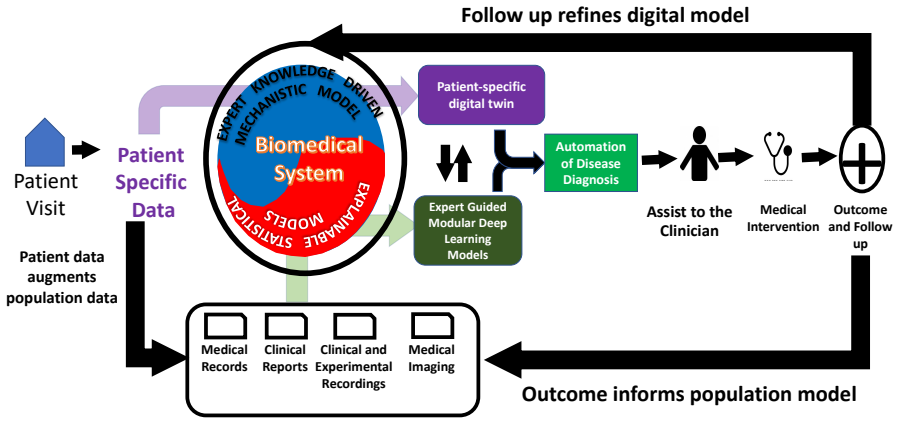
The central machinery is the two-step expert-guided integration loop. First, digital twin learning uses expert-identified learning functions $l_{ij}$, whose structure mirrors the true cross-modality relations $g_{ij}$, to fit multi-modal patient data and recover a clinically meaningful parameter set $\Theta$; second, expert-guided deep learning uses $l_{ij}$ and $\Theta$ as inputs to learn the overall response function $f(x_1,\dots,x_n,\Theta)$. In the Type 1 diabetes case study, the digital twin is a Bergman Minimal Model fitted to CGM and insulin data through a liquid time constant neural network, and the deep model is an embodied LLM that converts user queries into AID usage plans. The safety check is a forward simulation: each proposed plan is run through the twin, and the resulting robustness of a signal temporal logic specification quantifies plan quality, which is fed back to the LLM through RLHF or back-prompting until the plan is safe for clinician approval. This loop is what the framework claims will tie generalization, explainability, and bioethics to concrete clinical parameters.
What would settle it
Run a prospective study in which the digital twin simulates a proposed exercise or pregnancy plan forward and the patient then follows that plan under clinician supervision; if the twin's predicted glucose trace diverges from the measured CGM trace in ways that misclassify hypoglycemia risk or time in range, the safety-evaluation link is falsified.
Extended reading notes
Core claim
The central claim, stated in Section 2, is that integration of expert knowledge acquired by clinicians in the field with data-driven AI can enable generalized, transparent, explainable, and ethical automation. The paper evaluates this hypothesis in the context of personalized automated insulin delivery for Type 1 diabetes, where an LLM generates usage plans for exercise and pregnancy and a patient-specific digital twin acts as a forward safety simulator to judge them. The paper argues that because expert knowledge identifies the right modalities and the right structural learning functions, the learned model inherits both generalization, via multimodal-learning theory, and explainability, because outputs map back to clinically relevant parameters. The intended result is a co-designed human-machine collaboration in which clinicians make the final decision, and the framework is offered as an initial template for other precision medicine challenges.
Load-bearing premise
The load-bearing premise is that a patient-specific digital twin recovered from sparse CGM and insulin data can faithfully simulate glycemic response during rare conditions such as exercise and pregnancy, accurately enough to judge whether a language-model-generated insulin plan is safe.
Editorial extensions
If this is right
- Personalized AID usage plans for exercise and pregnancy could be generated and tested in silico before a patient follows them, reducing reliance on population-level guidelines.
- LLM-generated plans that are unsafe would be penalized by the digital-twin safety score before the plan reaches the clinician, providing a concrete safety gate for language-model outputs.
- Because the clinician gives final approval, the framework preserves human accountability and patient autonomy while using AI for exploration and risk assessment.
- The same three-stage co-design loop could be adapted to epilepsy seizure-onset detection and CAD prediction, with fairness checks such as age- or sex-stratified calibration built into the process.
- Explanations would be expressed in clinically meaningful terms such as projected time in range, hypoglycemic events, and patient-specific model parameters rather than abstract attention weights.
Reading between the lines
- Inference: the framework's practical value rests on the digital twin's fidelity under rare conditions, so the decisive test is a direct comparison of twin-simulated glucose traces against real CGM recordings during exercise and pregnancy.
- Inference: the modular design suggests a transfer test, replace the endocrine model with a cardiac or neural mechanistic model and rerun the same LLM-plus-simulator loop to see if the claimed generalization benefits carry over.
- Inference: because the paper acknowledges expert knowledge can be vague or conflicting, a natural addition is a formal consistency check on expert rules before they are encoded into the LLM or the twin.
- Inference: the ecological-footprint task implies a measurable efficiency claim, a distilled exercise-only model should match the full model's plan-safety performance on embedded hardware, and that parity can be tested directly.
Editorial analysis
A structured set of objections, weighed in public.
Referee Report
Summary. The paper proposes a framework for developing and evaluating expert-guided multi-modal AI (MAI) for precision medicine, structured around three lifecycle stages: conceptualization, development, and calibration. The main hypothesis is that integration of clinician expert knowledge with data-driven AI enables generalized, transparent, explainable, and ethical automation. The framework is illustrated with a case study on Type 1 diabetes (T1D) insulin management, in which an embodied LLM generates insulin-delivery usage plans and a patient-specific digital twin (Bergman Minimal Model fitted by a liquid time constant neural network) acts as a forward safety simulator. The paper claims to evaluate this hypothesis, but the T1D case study is presented as a list of future tasks (A1--A13) with no experimental data, simulation results, or formal proofs. The only theoretical content is a recapitulation of existing multimodal learning theory (reference [23]).
Significance. If validated, the framework would provide a concrete route toward safe, personalized AI for medical decisions, particularly for T1D management during exercise and pregnancy. The paper's strengths are its explicit mapping of bioethics principles (beneficence, non-maleficence, autonomy, justice) to concrete development tasks, its co-design philosophy with clinician oversight, and the sensible use of publicly available datasets (JAEB, T1DEXI, NIH). It also clearly identifies a specific safety mechanism, the digital-twin-based forward simulator, as the arbiter of LLM-generated plans. However, the central hypothesis is asserted, not tested: the manuscript reports no evaluation of any component of the framework. The safety guarantee rests on a digital twin whose fidelity is asserted by reference to prior self-cited work and whose identifiability is admitted to be questionable. As it stands, the paper is a position/vision paper, and its stated claim of evaluation is unsupported.
major comments (4)
- [Abstract and Section 2.1] The paper states (Section 2.1, final paragraph) "In this paper, we evaluate this fundamental hypothesis..." but no evaluation is presented. There are no experiments, no simulations, no quantitative results, and no formal proofs. The T1D case study (Section 2.1.1) is a catalog of planned tasks (A1--A13) with no results for any task. The claim of evaluation is therefore not supported by the manuscript content.
- [Section 2.1.1, tasks A7 and A8, and Figure 2] The safety of LLM-generated plans depends entirely on the forward safety simulator being a high-fidelity digital twin. The manuscript provides no evidence for this fidelity: no identifiability analysis, no held-out validation, and no comparison against clinical data for exercise, pregnancy, or aging scenarios. The only direct statement on this point is in Section 2.2: "Data from normal usage of the system may be insufficient for identifiability of all the parameters." This admission, combined with the absence of validation, leaves open the possibility that unsafe plans pass the safety filter, directly undermining the claimed ethical automation. The calibration task A11, which would test digital twin accuracy, is described only as future work.
- [Section 2, MAI theory recapitulation] The theoretical justification for MAI (from reference [23]) is presented as the basis for the framework, and it is claimed that expert knowledge resolves the drawback of unknown structure of the connecting functions g_ij. This claim is plausible but entirely unverified in the paper. No experiment or simulation demonstrates that expert-selected learning functions actually reduce sample complexity or improve generalization in the T1D domain, so the core theoretical benefit remains an unsupported assertion.
- [Section 2.1.1, Task A4 and references [26], [27], [31]] The proposed digital twin learning and LLM integration are described as extensions of the authors' prior work (references [26], [27], [31]), which are cited as evidence of capability without including any of that prior work's validation data or metrics. Reference [31] is cited for "high-fidelity fast simulation," but no fidelity measures are reported in this manuscript. Thus, the key capability on which the safety mechanism rests is not demonstrated within this paper and is not independently verifiable from the provided references.
minor comments (6)
- [Abstract] The phrase "illustrate this framework with case study" should read "with a case study."
- [Introduction, first paragraph] There is a typo: "Artificial Intelligene" should be "Artificial Intelligence."
- [Figure 2 caption] The caption begins "Figure 2: . LLM planner..." with an unnecessary space before the period; it should be cleaned up.
- [Section 2.1.1, Task A4] The paper refers to "Phi 2 [25]" but reference [25] is the Gemini technical report. The reference numbering appears mismatched; please correct the citation.
- [Section 2.2, Ethical statement] There are typos: "digiti twin" should be "digital twin" and "digitl" should be "digital."
- [Reference list] Several references (e.g., [27]) lack complete venue and publication details, making them difficult to locate and verify.
Circularity Check
No circularity: the paper is a framework/proposal whose theoretical argument is self-contained; its T1D safety-simulator reliance on prior same-author work is a validation gap, not a definitional reduction.
full rationale
The paper does not present a derivation chain in which an output is constructed from its own input. Its central theoretical argument in Section 2.1 is self-contained: it imports the heterogeneity/connection conditions for multimodal learning from Lu [23] and argues that expert knowledge supplies the structure of g_ij, which is an independent logical step rather than a restatement of the hypothesis. The T1D case study cites prior same-author work for component capabilities — [26] for LTC-NN digital-twin recovery and [31] for 'high-fidelity fast simulation' — but these are separate published artifacts with their own empirical content; citing them is conventional use of prior results, not a self-definitional reduction. The paper's own Section 2.2 limitation is substantial for the proposal's validity: 'Data from normal usage of the system may be insufficient for identifiability of all the parameters.' That admission flags a real feasibility/fidelity risk for the forward safety simulator, because an unidentifiable digital twin could let unsafe LLM plans pass the safety filter. But that is a correctness and validation gap, not circularity: the simulator is not fitted to the same safety outcome it is used to predict, and no fitted parameter is renamed as a prediction. No equation in the paper reduces by construction to its inputs, and no uniqueness or ansatz claim is imported from the authors' prior work to force the chosen approach. Heavy self-citation is a credibility and transparency concern, but under the stated rules it does not by itself raise the circularity score.
Assumptions & free parameters
assumptions (4)
- domain assumption Expert clinician knowledge is generalizable across centers, demographics, and comorbidities.
- domain assumption The Bergman Minimal Model (BMM) is an adequate base structure for the patient-specific digital twin for exercise and pregnancy scenarios.
- domain assumption The digital twin recovered via LTC-NN is a high-fidelity forward safety simulator.
- domain assumption LLM-generated plans can be made safe through iterative forward simulation and RLHF.
Cite this review
Pith. "Pith review of Framework for developing and evaluating ethical collaboration between expert and machine." pith.science (2026). https://pith.science/paper/5RCUHVXQ
@misc{pith2026241110983,
  author       = {Pith},
  title        = {Pith review of: Framework for developing and evaluating ethical collaboration between expert and machine},
  year         = {2026},
  howpublished = {\url{https://pith.science/paper/5RCUHVXQ}},
  note         = {Machine review of arXiv:2411.10983}
}
read the original abstract
Precision medicine is a promising approach for accessible disease diagnosis and personalized intervention planning in high-mortality diseases such as coronary artery disease (CAD), drug-resistant epilepsy (DRE), and chronic illnesses like Type 1 diabetes (T1D). By leveraging artificial intelligence (AI), precision medicine tailors diagnosis and treatment solutions to individual patients by explicitly modeling variance in pathophysiology. However, the adoption of AI in medical applications faces significant challenges, including poor generalizability across centers, demographics, and comorbidities, limited explainability in clinical terms, and a lack of trust in ethical decision-making. This paper proposes a framework to develop and ethically evaluate expert-guided multi-modal AI, addressing these challenges in AI integration within precision medicine. We illustrate this framework with case study on insulin management for T1D. To ensure ethical considerations and clinician engagement, we adopt a co-design approach where AI serves an assistive role, with final diagnoses or treatment plans emerging from collaboration between clinicians and AI.
Figures


Forward citations
Cited by 2 Pith papers
-
Generating customized prompts for Zero-Shot Rare Event Medical Image Classification using LLM
CuKPL converts medical images into text descriptions of expert-defined features and asks GPT-4o to classify them as seizure onset zone or not, claiming zero-shot performance that is actually worse than supervised deep...
-
STORM: Strategic Orchestration of Modalities for Rare Event Classification
STORM uses entropy imbalance and decision-tree logic to select informative modalities for rare-event classification, and reports that temporal expert features do not help SOZ detection.
Reference graph
Works this paper leans on
-
[23]
Lu, A theory of multimodal learning, volume 36, 2023, pp
Z. Lu, A theory of multimodal learning, volume 36, 2023, pp. 57244–57255
work page 2023
-
[26]
Machine Learning Meets Differential Equations: From Theory to Applications
A. Banerjee, S. Gupta, Emily: Extracting sparse model from implicit dynamics, in: 1st ECAI Workshop on “Machine Learning Meets Differential Equations: From Theory to Applications”, PMLR, 2024, pp. 1–11
work page 2024
-
[27]
A. Banerjee, A. Maity, P. Kamboj, S. K. Gupta, Cps-llm: Large language model based safe usage plan generator for human-in-the-loop human-in-the-plant cyber-physical system, 2024
work page 2024
-
[31]
A. Banerjee, P. Kamboj, A. Maity, R. Salian, S. Gupta, High fidelity fast simulation of human in the loop human in the plant (hil-hip) systems, in: Proceedings of the International ACM Conference on Modeling, Analysis, and Simulation of Wireless and Mobile Systems, 2023, pp. 199–203
work page 2023
- [1]
- [2]
- [3]
-
[4]
A. Banerjee, P. Kamboj, S. N. Wyckoff, B. L. Sussman, S. K. Gupta, V. L. Boerwinkle, Automated seizure onset zone locator from resting-state functional mri in drug-resistant epilepsy, Frontiers in Neuroimaging 1 (2023) 1007668. doi:10.3389/fnimg.2023.1007668
arXiv 2023
Show all 31 references
-
[5]
L. A. DiMeglio, C. Evans-Molina, R. A. Oram, Type 1 diabetes, The Lancet 391 (2018) 2449–2462
2018
-
[6]
Zhang, Z
L. Zhang, Z. Tong, R. Han, R. Guo, S. Zang, X. Zhang, R. Yuan, Y. Yang, Global, regional, and national burdens of ischemic heart disease attributable to smoking from 1990 to 2019, Journal of the American Heart Association 12 (2023) e028193
2023
-
[7]
P. Kwan, J. Sander, The natural history of epilepsy: an epidemiological view, Journal of Neurology, Neurosurgery & Psychiatry 75 (2004) 1376–1381
2004
-
[8]
P. Kwan, M. J. Brodie, Definition of refractory epilepsy: defining the indefinable?, The Lancet Neurology 9 (2010) 27–29
2010
-
[9]
Wieser, W
H. Wieser, W. Blume, D. Fish, E. Goldensohn, A. Hufnagel, D. King, M. Sperling, H. Luders, Proposal for a new classification of outcome with respect to epileptic seizures following epilepsy surgery., Epilepsia (Series 4) 42 (2001)
2001
-
[10]
Fatkin, H
D. Fatkin, H. Calkins, P. Elliott, C. A. James, S. Peters, J. C. Kovacic, Contemporary and future approaches to precision medicine in inherited cardiomyopathies: Jacc focus seminar 3/5, Journal of the American College of Cardiology 77 (2021) 2551–2572
2021
-
[11]
Food and Drug Administration, Fda approval of minimed, 2020
U.S. Food and Drug Administration, Fda approval of minimed, 2020. URL: https://www.accessdata. fda.gov/scripts/cdrh/cfdocs/cfpma/pma.cfm?id=P160017S076
2020
-
[12]
Kamzin, P
A. Kamzin, P. Paudyal, A. Banerjee, S. K. Gupta, Evaluating the gap between hype and performance of ai systems, in: AAAI workshops on Meta Eval, 2020
2020
-
[13]
Chiang, R
S. Chiang, R. W. Picard, W. Chiong, R. Moss, G. A. Worrell, V. R. Rao, D. M. Goldenholz, Guidelines for conducting ethical artificial intelligence research in neurology, Neurology 97 (2021) 632–640
2021
-
[14]
G. I. Webb, L. K. Lee, B. Goethals, F. Petitjean, Analyzing concept drift and shift from sample data, Data Mining and Knowledge Discovery 32 (2018) 1179–1199
2018
-
[15]
O’Malley, B
G. O’Malley, B. Ozaslan, C. J. Levy, K. Castorino, D. Desjardins, C. Levister, S. McCrady-Spitzer, M. M. Church, R. J. Kaur, C. Reid, et al., Longitudinal observation of insulin use and glucose sensor metrics in pregnant women with type 1 diabetes using continuous glucose moni...
2021
-
[16]
V. L. Boerwinkle, E. G. Cediel, L. Mirea, K. Williams, J. F. Kerrigan, S. Lam, J. S. Raskin, V. R. Desai, A. A. Wilfong, P. D. Adelson, et al., Network targeted approach and postoperative resting state functional mri are associated with seizure outcome, Annals of neurology 86 ...
2019
-
[17]
Schiavon, C
M. Schiavon, C. Dalla Man, Y. C. Kudva, A. Basu, C. Cobelli, Quantitative estimation of insulin sensitivity in type 1 diabetic subjects wearing a sensor-augmented insulin pump, Diabetes care 37 (2014) 1216–1223
2014
-
[18]
Kamboj, A
P. Kamboj, A. Banerjee, S. Gupta, Expert knowledge and entropy-based modality selection for optimal multimodality learning, in: 58th Asilomar Conference on Signals, Systems and Computers, ACSSC 2023, IEEE Computer Society, Pacific Grove, United States, 2024. Accepted
2023
-
[19]
Salian, A
R. Salian, A. Banerjee, P. Kamboj, A. Sriramoju, S. Komandoor, S. Gupta, Expert-guided transform- ers: Advancing cad diagnosis, in: 58th Asilomar Conference on Signals, Systems and Computers, ACSSC 2023, IEEE Computer Society, Pacific Grove, United States, 2024. Accepted
2023
-
[20]
T. Dash, S. Chitlangia, A. Ahuja, A. Srinivasan, A review of some techniques for inclusion of domain-knowledge into deep neural networks, Scientific Reports 12 (2022) 1040
2022
-
[21]
Kamboj, A
P. Kamboj, A. Banerjee, S. K. Gupta, V. L. Boerwinkle, Merging deep learning with expert knowledge for seizure onset zone localization from rs-fmri in pediatric pharmaco resistant epilepsy, arXiv preprint arXiv:2306.05572 (2023)
2023 arXiv
-
[22]
K. C. Stange, R. S. Etz, H. Gullett, S. A. Sweeney, W. L. Miller, C. R. Jaén, B. F. Crabtree, P. A. Nutting, R. E. Glasgow, Metrics for assessing improvements in primary health care, Annual review of public health 35 (2014) 423–442
2014
-
[24]
Touvron, L
H. Touvron, L. Martin, K. Stone, P. Albert, A. Almahairi, Y. Babaei, N. Bashlykov, S. Batra, P. Bhar- gava, S. Bhosale, et al., Llama 2: Open foundation and fine-tuned chat models, arXiv preprint arXiv:2307.09288 (2023)
2023 arXiv
-
[25]
G. Team, R. Anil, S. Borgeaud, J.-B. Alayrac, J. Yu, R. Soricut, J. Schalkwyk, A. M. Dai, A. Hauth, K. Millican, et al., Gemini: a family of highly capable multimodal models, arXiv preprint arXiv:2312.11805 (2023)
2023 arXiv
-
[28]
Ferrario, N
A. Ferrario, N. Biller-Andorno, Large language models in medical ethics: useful but not expert, Journal of Medical Ethics (2024)
2024
-
[29]
Center, Jaeb center dataset, 2021
J. Center, Jaeb center dataset, 2021. URL: https://public.jaeb.org/datasets/diabetes
2021
-
[30]
M. C. Riddell, Z. Li, R. L. Gal, P. Calhoun, P. G. Jacobs, M. A. Clements, C. K. Martin, F. J. Doyle III, S. R. Patton, J. R. Castle, et al., Examining the acute glycemic effects of different types of structured exercise sessions in type 1 diabetes in a real-world setting: The...
2023
Reviewed August 12, 2026 · model on record in the stance chip above.
Discussion (0). Continue with ORCID to comment.