REVIEW 3 major objections 4 minor 4 cited by
Minimum Data Rate Maximization for Uplink Pinching-Antenna Systems
T0 review · 3 major / 4 minor · reviewed 2026-08-11 · deepseek-v4-flash
Pith's one-line read A pinching-antenna uplink design that decouples antenna placement from resource allocation maximizes the worst user's rate, reporting more than 5 dB gain over a fixed-antenna baseline.
desk verdict First uplink pinching-antenna max-min rate formulation with plausible gains, but the advertised convex reformulation breaks at C'8, leaving the main algorithmic guarantee unsupported. read the letter →
The pith
A machine-rendered reading of the paper's core claim, the machinery that carries it, and where it could break.
The reading
What carries the argument
The load-bearing object is the phase-alignment constraint $C8$/$C'8$: for every device $m$ and antenna $n$, the residual $$f(x_n^P,\theta_m)=\tfrac{2\pi}{\$\lambda$}\sqrt{(x_m-x_n^P)^2+$y_m^{2}$+$d^{2}$}-\tfrac{2\pi}{\lambda_g}x_n^P-\theta_m$$ is squared and bounded by a slack variable $z_{mn}$, with the weighted sum $\sum_n w_{mn} z_{mn}\le\epsilon$ controlling phase error while the weights $w_{mn}$ favor small distances. The paper converts the nonconvex rate objective into an auxiliary bound on the sum of reciprocal distances, rewrites the phase bound as a second-order cone constraint, linearizes the reciprocal-distance constraint by a first-order Taylor expansion, and solves the resulting convex program (P1.1.4) with SCA, scanning $\epsilon$. Resource allocation is then solved in closed form from the Lagrangian, giving $q_m^*$ through the Lambert W function.
What would settle it
Fix the paper's parameters ($f_c=28$ GHz, $n_e=1.4$, $d=3$ m) and a device at $(15,0,0)$; for a fixed $\theta_m$ and $z_{mn}$, search for two antenna positions $x_a<x_b$ along the waveguide that both satisfy $f(x,\theta_m)^2\le z_{mn}$ while their midpoint violates it. Since the phase residual $f$ is a convex function that can change sign, such a pair should exist, and its existence would prove the feasible set of $C8$ is nonconvex and the convex-reformulation claim is wrong.
Extended reading notes
Core claim
On its own terms, the paper establishes a max-min fairness formulation for the uplink of a multi-user PA system, where the achievable rate of device $m$ is $R^P_m = q_m \log_2(1+(\eta E_m/(N q_m \sigma^2))|\sum_{n=1}^N e^{j\frac{2\pi}{\lambda}\|\psi_m-\psi_n^P\|-j\frac{2\pi}{\lambda_g}\|\psi_0^P-\psi_n^P\|}/\|\psi_m-\psi_n^P\||^2)$. For fixed equal resource shares, the antenna-position subproblem (P1.1.1) forces the weighted squared phase residual between the free-space path and the waveguide path to stay below $\epsilon$, and the paper claims this subproblem is recast as the convex problem (P1.1.4) via a second-order cone constraint and successive convex approximation. For fixed positions, the resource-allocation subproblem is convex and its optimal solution is the closed-form Lambert-W expression $q_m^*$ in (10). The paper further claims Algorithm 1 always converges and, in simulation, delivers more than 5 dB min-rate gain at $M=N=2$ and about 3 dB at $M=N=3$ over the conventional fixed-antenna system.
Load-bearing premise
The load-bearing premise is that the rewritten phase-error constraint leaves a convex set of antenna positions, a property the paper asserts on the basis of norm-versus-square-root convexity that does not hold in general.
Editorial extensions
If this is right
- For fixed PA positions, the optimal orthogonal multiple access (OMA) resource allocation has a closed form $q_m^*$ via the Lambert W function, so fairness can be enforced with negligible computation.
- Because the antenna-positioning subproblem is solved with SCA at claimed $O(N^3)$ complexity, the same framework can reposition antennas in near-real time for small systems.
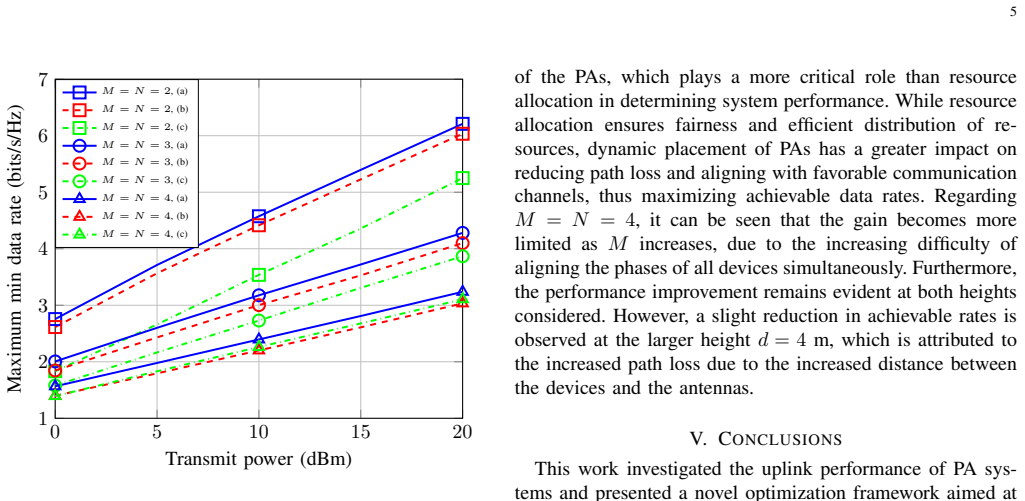
- The numerical comparison implies that antenna placement contributes more than resource allocation: removing the resource-allocation step (scheme b) costs far less than replacing PAs with fixed antennas (scheme c).
- The reported gains shrink as $M=N$ grows to 4, showing that one shared antenna configuration cannot phase-align many devices simultaneously.
- Rates improve with transmit power and degrade slightly when the waveguide is raised from 3 m to 4 m, consistent with the path-loss-dominated LoS model.
Reading between the lines
- The same position-solver structure would carry over to a downlink PA design, since the phase-alignment constraint depends only on geometric distances and is direction-independent.
- A weighted-fairness extension (e.g., weighted max-min or sum-of-logs) would leave the position solver unchanged and alter only the resource-allocation step, which can still be handled by the same Lambert-W water-filling logic.
- The $\epsilon$ scan can be read as a robustness knob: smaller $\epsilon$ forces tighter phase alignment at the cost of possibly worse path loss, so treating $\epsilon$ as a tunable hyperparameter may trade worst-case rate for sensitivity to device-position uncertainty.
Signed reviews
Editorial analysis
A structured set of objections, weighed in public.
Referee Report
Summary. The paper studies the uplink of a multi-user pinching-antenna (PA) system under orthogonal multiple access. The authors formulate a max-min achievable-rate problem over PA positions and resource allocation, and propose to solve it by decoupling the two. For the PA-position subproblem, they introduce a phase-alignment surrogate and claim a convex reformulation, solving it with successive convex approximation (SCA) over a grid of phase-error tolerances. For resource allocation, they claim a closed-form expression based on a Lagrangian/Karush-Kuhn-Tucker analysis. Numerical results show gains over a conventional fixed-antenna system, with reported gains of roughly 5 dB for M=N=2 and 3 dB for M=N=3.
Significance. If the technical claims were correct, the paper would be a useful contribution: it is the first to address uplink optimization for PA systems, it uses a physically motivated waveguide channel model imported from the foundational literature, and the decoupling into position optimization and resource allocation is a sensible design principle. The epsilon-sweep with final evaluation against the true rate is a pragmatic safeguard. However, the central methodological promise—that the antenna-positioning problem is exactly reformulated into a convex program with guaranteed SCA convergence—is not supported by the derivation as written, and the closed-form resource allocation solution suffers from an algebraic sign problem. These issues must be resolved before the contribution can be considered reliable.
major comments (3)
- [Section III-A, P1.1.3/P1.1.4, constraint C'8] The claim that C'8 is convex is false. The inequality is written as ||[f(xP_n, theta_m), sqrt(z_mn)]|| <= sqrt(2 z_mn), which is algebraically equivalent to f(xP_n, theta_m)^2 <= z_mn. The set {(xP_n, theta_m, z_mn) : f^2 <= z_mn} is not generally convex because f in (6) is a sign-changing convex function of xP_n and theta_m. A concrete counterexample is obtained with x_m=15, y_m=0, d=3, n_e=1.4, theta_m=0, where the one-dimensional function h(x)=sqrt((x-15)^2+9)-1.4x satisfies h(14)^2 <= z and h(16)^2 <= z for suitable z, but at the midpoint x=15 the required z would be h(15)^2=324 while the interpolated z is about 320.1, violating the constraint. Thus P1.1.3/P1.1.4 is not a convex program, and the statement in Algorithm 1 that convergence is guaranteed 'since the nature of SCA ensures it' is unsupported. The authors should either provide a valid convexification (for instance by linearizing f itself within an SCA loop, or by introducing a transformation that guarantees convexity) or recast the method as a heuristic and remove the convergence and convexity claims.
- [Section III-B, Eq. (10)] The closed-form resource allocation in (10) is algebraically wrong for the stated definition of the Lambert W function. The expression is q*_m = eta E_m \bar{W} / (N sigma^2 (1+\bar{W}) |sum|^2) with \bar{W} = W(-e^{-1 - lambda_1 ln 2 / lambda_2}). For lambda_1, lambda_2 >= 0, the argument of W lies in [-1/e, 0), so the principal branch satisfies \bar{W} in [-1,0) and 1+\bar{W} >= 0. Hence q*_m as written is non-positive for every feasible multiplier, contradicting constraint C4 (q_m >= delta > 0). The correct expression should involve -\bar{W} or an equivalent sign correction; the Lagrangian derivation leading to (10) should be reworked and the resulting formula verified numerically.
- [Section III-A, P1.1.1-C6] The surrogate used for PA placement is not connected to the true objective by any approximation guarantee. The objective in P1.1.1 replaces the coherent sum magnitude in (5) with the sum of inverse distances, while phase alignment is enforced only through the weighted residual constraint C6: sum_n w_mn f(xP_n, theta_m)^2 <= epsilon. The paper provides no bound relating the magnitude of the phase residual to the difference between the surrogate and the true coherent sum. Consequently, a solution that is optimal for the convexified surrogate may not be near-optimal for the true rate, even though the final epsilon-sweep in Algorithm 1 evaluates the true rate and selects the best trial. This is a limitation of the approach as stated and should be acknowledged explicitly; if the authors wish to claim optimality or a performance guarantee, an error analysis is required.
minor comments (4)
- [Section III-A, P1.1.4] The objective of P1.1.4 is printed as 'min t', but the preceding reformulation P1.1.3 maximizes t, and with constraint C'7 (sum_n v_mn >= t) a minimization would be unbounded below. This should be 'max t'.
- [Section III-B, Eq. (9)] The Lagrangian in (9) contains the symbol t, but the resource allocation subproblem (P1.2.1) uses the auxiliary variable R2; the notation should be made consistent.
- [Section III, P1] In the paragraph following (P1), the text says that 'C2 limits the resource blocks allocated to the M devices', but C2 is the antenna-position bound |xP_n - xP_{n'}| >= Delta, and the resource constraint is C3. This mislabeling should be corrected.
- [Section III, Eq. (7)] The definition of the weights w_mn in (7) is only explicit for the case M=N, with the remark that 'if M != N, (7) must be modified appropriately'. Since the numerical section considers M=N=2,3,4, the general case is never specified; a precise construction for arbitrary M and N would be needed for the framework to be complete.
Circularity Check
No significant circularity: the optimization derivation is self-contained; the questionable convexity claim for C'8 is a correctness issue, not a circular reduction.
full rationale
The paper's derivation chain does not reduce to its own inputs. The PA channel model is imported from [9] and Pozar [10] as a parameter-free waveguide phase model with stated physical assumptions; although Z. Ding is a co-author of [9], that cited model does not include the target max-min-rate result and is not fed back into itself. The resource allocation in (10) is obtained by setting KKT stationarity conditions for the convex problem (P1.2.1) and solving for q*, with the Lagrange multipliers enforcing the sum constraint; no parameter is fitted to reproduce a target rate. The PA-position subproblem is solved via an epsilon-sweep and SCA, and the final candidate is evaluated using the true rate expression (5), so the method acts as an outer heuristic rather than as a fitted quantity renamed as a prediction. No equation in the paper is equal to its inputs by construction, and no self-citation is used to force a uniqueness claim. The assertion that C'8 is convex is mathematically questionable because f in (6) is sign-changing and {f^2 <= z} is not generally convex; however, an incorrect convexity argument is a correctness and convergence-guarantee risk, not a circularity pattern. Accordingly, no circular step is identified.
Assumptions & free parameters
free parameters (4)
- epsilon (phase-alignment tolerance) =
swept in [0.1, 0.5] in simulations
- weights w_mn (phase-error weighting) =
1/||psi_m - psiPbar_n||^3, starting positions above each device
- delta lower bound on q_m =
delta -> 0
- SCA and sweep parameters =
K_SCA, initial points v0_mn, epsilon step: unspecified
assumptions (5)
- domain assumption PA channel model: coherent combination of free-space and waveguide phases, all PAs fed from one feed point (Eqs. (1)-(5), after [9] and Pozar [10]).
- domain assumption Perfect knowledge of device positions at the BS.
- domain assumption Line-of-sight propagation with no small-scale fading or blockage in the model.
- ad hoc to paper Phase-alignment surrogate with bounded squared residual (C6) and max-min inverse-distance proxy (C7-C'7) replace the true max-min rate objective.
- domain assumption PAs can be ordered along the waveguide and the feed-point phase normalized without loss of generality.
Cite this review
Pith. "Pith review of Minimum Data Rate Maximization for Uplink Pinching-Antenna Systems." pith.science (2026). https://pith.science/paper/4KJ3K2WY
@misc{pith2026241213892,
  author       = {Pith},
  title        = {Pith review of: Minimum Data Rate Maximization for Uplink Pinching-Antenna Systems},
  year         = {2026},
  howpublished = {\url{https://pith.science/paper/4KJ3K2WY}},
  note         = {Machine review of arXiv:2412.13892}
}
read the original abstract
This paper addresses, for the first time, the uplink performance optimization of multi-user pinching-antenna (PA) systems, recently developed for next-generation wireless networks. By leveraging the unique capabilities of PAs to dynamically configure wireless channels, we focus on maximizing the minimum achievable data rate between devices to achieve a balanced trade-off between throughput and fairness. An effective approach is proposed that separately optimizes the positions of the PAs and the resource allocation. The antenna positioning problem is reformulated into a convex one, while a closed-form solution is provided for the resource allocation. Simulation results demonstrate the superior performance of the investigated system using the proposed algorithm over corresponding counterparts, emphasizing the significant potential of PA systems for robust and efficient uplink communication in next-generation wireless networks.
Figures


Forward citations
Cited by 4 Pith papers
-
Performance Analysis of Pinching-Antenna Systems
Closed-form outage probability and average rate for pinching-antenna systems with waveguide losses, plus the optimal antenna position along the waveguide.
-
Graph Neural Network Enabled Pinching Antennas
A bipartite graph attention network (BGAT) solves the joint antenna placement and power allocation problem for pinching antennas to maximize downlink energy efficiency.
-
Downlink Beamforming with Pinching-Antenna Assisted MIMO Systems
A fractional-programming and block-coordinate-descent algorithm that jointly optimizes digital precoding and pinching-antenna locations achieves substantially higher multiuser downlink sum-rate than fixed-location ant...
-
Analytical Optimization for Antenna Placement in Pinching-Antenna Systems
For fairness-based OMA, the optimal pinching-antenna location is the mean of users' x-coordinates and does not depend on their distance from the waveguide; for NOMA it moves exponentially toward the user nearest the w...
Reference graph
Works this paper leans on
-
[1]
Multiple access in the era of distributed computing and edge intelligence,
N. G. Evgenidis, N. A. Mitsiou, V . I. Koutsioumpa, S. A. Tegos, P. D. Diamantoulakis, and G. K. Karagiannidis, “Multiple access in the era of distributed computing and edge intelligence,” Proc. IEEE , vol. 112, no. 9, pp. 1497–1526, 2024
work page 2024
-
[2]
Beam focusing for near-field multiuser MIMO communications,
H. Zhang, N. Shlezinger, F. Guidi, D. Dardari, M. F. Imani, and Y . C. Eldar, “Beam focusing for near-field multiuser MIMO communications,” IEEE Trans. Wireless Commun. , vol. 21, no. 9, pp. 7476–7490, 2022
2022
-
[3]
Reconfigurable intelligent surfaces: Principles and opportunities,
Y . Liu, X. Liu, X. Mu, T. Hou, J. Xu, M. Di Renzo, and N. Al-Dhahir, “Reconfigurable intelligent surfaces: Principles and opportunities,” IEEE Commun. Surveys Tuts. , vol. 23, no. 3, pp. 1546–1577, 2021
work page 2021
-
[4]
S. A. Tegos, D. Tyrovolas, P. D. Diamantoulakis, C. K. Liaskos, and G. K. Karagiannidis, “On the distribution of the sum of double- nakagami-m random vectors and application in randomly reconfigurable surfaces,” IEEE Trans. V eh. Technol. , vol. 71, no. 7, pp. 7297–7307, 2022
work page 2022
-
[5]
Zero-energy reconfigurable intelligent surfaces (zeris),
D. Tyrovolas, S. A. Tegos, V . K. Papanikolaou, Y . Xiao, P.-V . Mekikis, P. D. Diamantoulakis, S. Ioannidis, C. K. Liaskos, and G. K. Kara- giannidis, “Zero-energy reconfigurable intelligent surfaces (zeris),” IEEE Trans. Wireless Commun. , vol. 23, no. 7, pp. 7013–7026, 2024
work page 2024
-
[6]
Fluid antenna systems,
K.-K. Wong, A. Shojaeifard, K.-F. Tong, and Y . Zhang, “Fluid antenna systems,” IEEE Trans. Wireless Commun., vol. 20, no. 3, pp. 1950–1962, 2021
1950
-
[7]
Modeling and performance analysis for movable antenna enabled wireless communications,
L. Zhu, W. Ma, and R. Zhang, “Modeling and performance analysis for movable antenna enabled wireless communications,” IEEE Trans. Wireless Commun., vol. 23, no. 6, pp. 6234–6250, 2024
2024
-
[8]
Pinching antenna: Using a dielectric waveguide as an antenna,
H. O. Y . Suzuki and K. Kawai, “Pinching antenna: Using a dielectric waveguide as an antenna,” NTT DOCOMO Technical J. , 2022
2022
Show all 10 references
-
[9]
Flexible-antenna systems: A pinching-antenna perspective,
Z. Ding, R. Schober, and H. V . Poor, “Flexible-antenna systems: A pinching-antenna perspective,” 2024. [Online]. Available: https: //arxiv.org/abs/2412.02376
2024 arXiv
-
[10]
D. M. Pozar, Microwave engineering: theory and techniques . John Wiley & Sons, 2021
2021
Reviewed August 11, 2026 · model on record in the stance chip above.
Discussion (0). Continue with ORCID to comment.