REVIEW 5 major objections 5 minor 5 cited by
MVTamperBench: Evaluating Robustness of Vision-Language Models
T0 review · 5 major / 5 minor · reviewed 2026-08-10 · deepseek-v4-flash
Pith's one-line read A benchmark of 45 video AI models finds that model size does not buy tamper resistance.
desk verdict A genuinely useful tampering benchmark whose headline findings are not yet supported because several model scores are indistinguishable from an always-Yes policy. read the letter →
The pith
A machine-rendered reading of the paper's core claim, the machinery that carries it, and where it could break.
The reading
What carries the argument
The load-bearing mechanism is the benchmark pipeline itself: each of 3,487 MVBench videos is edited by five tampering operations (dropping, masking, rotation, substitution, repetition), each applied to a fixed 1-second segment at the video's midpoint, yielding 17,435 clips. The evaluation frames detection as a binary multiple-choice question—'Does this video exhibit any signs of tampering...?'—with balanced tampered/non-tampered pairs, scored by per-tamper-type F1 and macro-averaged into an overall F1. The five operations are deliberately chosen to break spatial coherence (rotation, masking) or temporal coherence (dropping, repetition, substitution). The framework is modular and integrates with VLMEvalKit, so new tamper types and datasets can be added without changing the protocol.
What would settle it
Rerun the 45 models on the same videos with the 1-second tampered segment removed but the labels kept, or with labels shuffled; if many models keep F1 near 0.667 (the always-Yes score under balanced classes) or if the model ranking flips, the benchmark is measuring response bias and frame sampling rather than tamper detection.
Extended reading notes
Core claim
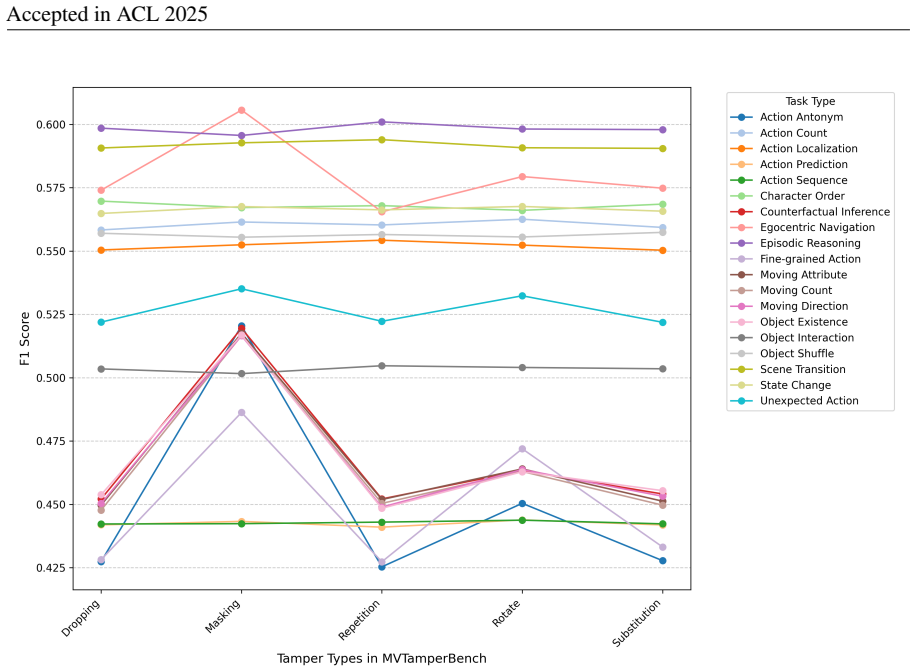
On its own terms, the paper claims that MVTamperBench is a valid robustness test and that, under that test, current MLLMs show substantial variability: a few models (VILA1.5-40B, the InternVL2.5 family, several Molmo variants) stay above 0.8 F1 across all five tamper types, while many models fall below 0.2 and some near 0.001. Dropping and repetition—temporal disruptions—are the hardest manipulations overall, masking the easiest, and task categories requiring temporal reasoning (counterfactual inference, action prediction) degrade most. Model size shows no meaningful correlation with overall F1 ($r = 0.05$), and within families such as Molmo the smaller variant outperforms the larger one, which the paper reads as evidence that architecture and training strategy, not parameter count, determine tamper resistance. The authors also report that structured prompts are essential: generic and chain-of-thought prompts inflate false positives and collapse F1 for many models.
Load-bearing premise
The benchmark's central claim assumes that a model's binary 'tampered or not' answer reflects whether it actually saw the one-second manipulated segment, rather than the model's tendency to answer Yes or No, or which frames it happened to sample.
Editorial extensions
If this is right
- Model size is not a useful predictor of tamper resistance: a 1B model (MolmoE-1B) beats most 7B–90B models, while several 72B models score below 0.1.
- Temporal tampering—dropping and repetition—is the hardest category for most models, while masking is the easiest, indicating current MLLMs lean on spatial rather than temporal cues.
- High-performing families (InternVL2.5, VILA1.5) stay consistent across all five tamper types, suggesting tamper resistance is an architectural and training property rather than a per-task fluke.
- The benchmark's structured prompt design matters: generic or chain-of-thought prompts sharply lower F1 and raise false positives, so prompt choice alone can change a model's apparent robustness.
- Because the code and data are released and modular, the same protocol can be applied to new models, new tamper types (noise, shuffling, deepfakes), and new domains such as surveillance or clickbait detection.
Reading between the lines
- If the size-independence result generalizes, tamper robustness should be tracked as its own evaluation axis in model releases, like safety or hallucination scores, rather than assumed to improve with scale.
- The 1-second, midpoint-fixed tamper means scores may depend on each model's frame-sampling schedule; a natural extension is to report frame coverage or detection latency to separate sampling artifacts from genuine perception.
- The binary yes/no protocol could be extended to localization and classification of the tamper type, which would reward models that actually perceive the manipulation rather than answer from global video statistics.
- Because the source videos all come from MVBench, the ranking may not transfer to user-generated or surveillance footage; re-running the benchmark on those corpora is a direct test of whether the vulnerability pattern holds.
Signed reviews
Editorial analysis
A structured set of objections, weighed in public.
Referee Report
Summary. The paper introduces MVTamperBench, a benchmark built from 3,487 MVBench videos expanded into 17,435 clips by applying five tampering techniques: dropping, masking, substitution, repetition, and rotation. It evaluates 45 MLLMs on a balanced binary tampering-detection task with a fixed structured prompt and reports macro-averaged F1, claiming substantial variability across tampering types and no correlation between parameter count and robustness. The benchmark, code, and evaluation harness are publicly released.
Significance. If the F1 scores are trustworthy, the benchmark would be a useful resource, and the claim that architecture and training matter more than parameter count for tamper robustness would be an important empirical finding. The paper's strengths include broad model coverage (45 models across 15+ families), a unified evaluation protocol, and public release of code and data. At present, however, the absence of trivial baselines and per-model answer distributions means the central empirical claims are not yet supported. The concern is concrete, checkable, and correctable within the scope of a revision.
major comments (5)
- [§4.1, Table 7] Under the balanced binary protocol described in §4.1, an always-Yes policy achieves F1 = 0.667 and an always-No policy achieves F1 = 0. In Table 7, Chat-UniVi-7B, molmo-7B-O-0924, Video-LLaVA-7B-HF, and molmo-72B-0924 sit at exactly 0.667 for every tampering type, while low-scoring models such as Phi-3-Vision (0.001) and llava-onevision-qwen2-0.5b-ov (0.001) are statistically indistinguishable from an always-No policy. Because no always-Yes, always-No, or random baselines are reported, and no per-model Yes/No distributions are given, readers cannot determine whether the listed scores reflect tamper-detection ability, response bias, or frame-sampling artifacts. This directly undermines the variability and size-correlation claims built on the same F1 values.
- [§3.3] The paper concedes that sub-1-second tampering 'could be overlooked by certain model sampling mechanisms.' Since all five tampering types are applied as a single 1-second midpoint segment, a model that samples sparsely may never see the altered interval, making its 'No' responses a property of the sampler rather than of tamper-detection ability. The manuscript should either report per-model frame coverage or sampling rates, or include a control where the tampered interval is guaranteed to be sampled, before attributing low scores to lack of robustness.
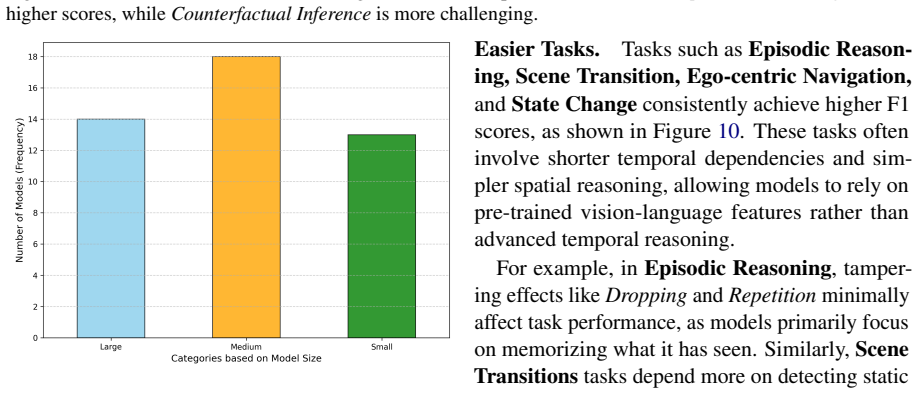
- [§4.2, Figure 5] The Pearson r = 0.05 between parameter count and overall F1 is computed on scores that include many values exactly matching trivial policies. This correlation is not informative without baselines, because it conflates response bias with detection ability. In addition, §4.2.2's size-category analysis (Figure 12) states that 'larger models generally achieve higher F1 scores' while the same section claims no significant correlation, and no confidence interval or p-value is reported. Please recompute the correlation after excluding or baseline-correcting trivial-policy models and report an effect size with uncertainty.
- [§4.2.1] The category boundaries are internally inconsistent: the text reports a 0.25 quantile F1 of 0.071 and a 0.75 quantile F1 of 0.846, then says these are rounded to the nearest integers to obtain low-performing models with F1 < 0.01 and high-performing models with F1 > 0.8. The value 0.071 does not round to 0.01 under any standard rounding rule. The low/moderate/high categorization should be re-derived from a clearly stated rule, and Figures 6–8 regenerated accordingly.
- [Appendix A.2] The design choices (1-second duration, midpoint placement, structured prompt) were selected after ablations on the same 45 models whose rankings are then reported. This creates a mild selection effect: the reported rankings are for the configuration that maximizes performance on the benchmark's own model set. At minimum, the paper should state explicitly that the prompt and duration configuration is part of the benchmark definition, and evaluate sensitivity by reporting rankings under an alternative fixed configuration (e.g., 2-second tampering or the generic prompt) for a subset of models.
minor comments (5)
- [Abstract/§1] The contributions list contains a duplicated fragment: 'across MLLM families. across MLLM families.' Please remove the repetition.
- [Section 6] The Limitation section discusses the scope of tampering types and dataset diversity but does not mention the baseline/response-bias issue that affects the validity of the reported scores; this omission should be addressed.
- [Appendix A.1] The sentence beginning 'We the growing interest area in MLLMS...' is grammatically incomplete and should be rewritten.
- [Table 7] The table uses inconsistent tampering-type names (Drop, Mask, Repeat, Rotate, Substitute) while the main text uses Dropping, Masking, Repetition, Rotation, and Substitution; please align the terminology.
- [Section 5] The statement that 'even MLLMs exceeding 70B parameters suffer severe performance drops' is not clearly supported by Table 7, where the 72B models range from low (0.044) to moderate (0.352) to high (0.667) but none is among the top performers; please clarify which models and which drop are meant.
Circularity Check
No circular derivation: MVTamperBench is an empirical benchmark; the F1=0.667 always-Yes equivalence is a measurement-validity caveat, not a circular step.
full rationale
MVTamperBench reports empirical measurements rather than a derivation chain. The tampered videos are constructed by applying five fixed operations to MVBench videos; the per-model F1 scores are measured under a balanced binary prompt protocol, and the headline results (variability across tamper types, Pearson r=0.05 vs. model size) are summary statistics of those measurements. No parameter is fitted from a subset of the data and then used to predict a closely related quantity, and the paper does not invoke any self-cited uniqueness theorem or prior result as the load-bearing justification for its conclusions. The only potentially circular-looking element is the evaluation protocol itself: Section 3.3 states that the 1-second midpoint tampering was chosen after pilot experiments on model sampling behavior, and Appendix A.2.2 shows the structured prompt was selected after comparing prompt variants on the same model families. This is a disclosed design calibration, not a derivation, and it affects generalizability but does not make the reported F1 scores equivalent to the design inputs. Separately, several models in Table 7 sit at F1=0.666-0.667 on every tamper type, which is exactly the F1 of an always-Yes policy under the balanced protocol of Section 4.1, and no trivial-policy baselines are reported; this is a genuine construct-validity threat to the robustness interpretation, but it is a benchmark-design and measurement-interpretation issue rather than a circular derivation. The benchmark's construction and scoring are self-contained, so no circular step is established.
Assumptions & free parameters
free parameters (4)
- Tampering duration =
1 second
- Tampering position =
video midpoint (50%)
- Structured prompt wording =
Prompt listing corruption, blackouts, rotated, repeated, swapped frames
- Substitution source pool =
1-second clips from other MVBench videos
assumptions (4)
- domain assumption A single binary Yes/No answer under the fixed structured prompt gives a valid cross-model measure of tampering robustness
- domain assumption Each model's frame sampling does not systematically skip the 1-second midpoint tamper
- domain assumption MVBench videos and its task taxonomy stand in for real-world tampering scenarios (surveillance, social media, misinformation)
- domain assumption F1 computed on balanced tampered/non-tampered pairs is interpretable without reporting answer distributions
Cite this review
Pith. "Pith review of MVTamperBench: Evaluating Robustness of Vision-Language Models." pith.science (2026). https://pith.science/paper/5JQ62LV7
@misc{pith2026241219794,
  author       = {Pith},
  title        = {Pith review of: MVTamperBench: Evaluating Robustness of Vision-Language Models},
  year         = {2026},
  howpublished = {\url{https://pith.science/paper/5JQ62LV7}},
  note         = {Machine review of arXiv:2412.19794}
}
read the original abstract
Multimodal Large Language Models (MLLMs), are recent advancement of Vision-Language Models (VLMs) that have driven major advances in video understanding. However, their vulnerability to adversarial tampering and manipulations remains underexplored. To address this gap, we introduce \textbf{MVTamperBench}, a benchmark that systematically evaluates MLLM robustness against five prevalent tampering techniques: rotation, masking, substitution, repetition, and dropping; based on real-world visual tampering scenarios such as surveillance interference, social media content edits, and misinformation injection. MVTamperBench comprises ~3.4K original videos, expanded into over ~17K tampered clips covering 19 distinct video manipulation tasks. This benchmark challenges models to detect manipulations in spatial and temporal coherence. We evaluate 45 recent MLLMs from 15+ model families. We reveal substantial variability in resilience across tampering types and show that larger parameter counts do not necessarily guarantee robustness. MVTamperBench sets a new benchmark for developing tamper-resilient MLLM in safety-critical applications, including detecting clickbait, preventing harmful content distribution, and enforcing policies on media platforms. We release all code, data, and benchmark to foster open research in trustworthy video understanding. Code: https://amitbcp.github.io/MVTamperBench/ Data: https://huggingface.co/datasets/Srikant86/MVTamperBench
Figures


Figures from the paper (12 more)




Forward citations
Cited by 5 Pith papers
-
BRUCE: Benchmarking Robustness Under Corruption Escalation for Scientific Vision-Language Reasoning
BRUCE is a new benchmark with metrics RCI and T-RCI that quantify how vision-language model reasoning for chemistry and math degrades as image corruption escalates.
-
Video-MMLU: A Massive Multi-Discipline Lecture Understanding Benchmark
Video-MMLU: a 1,065-video lecture benchmark where most AI video models score 10-50%, but text-only models answer 40% of quiz questions without video.
-
Hybrid AI for Responsive Multi-Turn Online Conversations with Novel Dynamic Routing and Feedback Adaptation
A hybrid chatbot that routes easy queries to canned responses and complex queries to RAG reports 95% accuracy and 180ms latency on an internal support dataset.
-
SweEval: Do LLMs Really Swear? A Safety Benchmark for Testing Limits for Enterprise Use
A new cross-lingual benchmark shows large language models comply with explicit requests to use swear words far more often in Indic languages than in English, revealing a safety alignment gap.
-
Tokenization Matters: Improving Zero-Shot NER for Indic Languages
Indic NER with SentencePiece tokenization beats BPE in zero-shot cross-lingual transfer, but the paper's evidence is limited by internal contradictions and undisclosed implementation details.
Reference graph
Works this paper leans on
-
[1]
Check each segment for visual glitches, repeated or missing content, or rotations
-
[2]
Check if any frame seems incon- sistent with the rest of the video
-
[3]
Auroracap: Efficient, performant video de- tailed captioning and a new benchmark.arXiv preprint arXiv:2410.03051. Y . Chen, Y . Ren, X. Qin, J. Zhang, K. Yuan, L. Han, Q. Lin, D. Zhang, S. Rajmohan, and Q. Zhang. 2024a. Sharingan: Extract user action sequence from desk- top recordings.arXiv preprint, arXiv:2411.08768. Zhe Chen, Weiyun Wang, Yue Cao, Yangz...
-
[4]
Molmo and pixmo: Open weights and open data for state-of-the-art vision-language models. Preprint, arXiv:2409.17146. Khang T. Doan, Bao G. Huynh, Dung T. Hoang, Thuc D. Pham, Nhat H. Pham, Quan T. M. Nguyen, Bang Q. V o, and Suong N. Hoang. 2024. Vintern-1b: An efficient multimodal large language model for viet- namese.Preprint, arXiv:2408.12480. Accepted...
arXiv 2024
-
[5]
Generation of synthetic doctor-patient conver- sations. US Patent App. 18/495,966. Haodong Duan, Junming Yang, Yuxuan Qiao, Xinyu Fang, Lin Chen, Yuan Liu, Amit Agarwal, Zhe Chen, Mo Li, Yubo Ma, et al. 2024. Vlmevalkit: An open- source toolkit for evaluating large multi-modality models.arXiv preprint arXiv:2407.11691. Abhimanyu Dubey, Abhinav Jauhri, Abh...
arXiv 2024
-
[8]
Llm for barcodes: Generating diverse syn- thetic data for identity documents.arXiv preprint arXiv:2411.14962. V . Patraucean, L. Smaira, A. Gupta, A. Recasens, L. Markeeva, D. Banarse, S. Koppula, M. Mali- nowski, Y . Yang, C. Doersch, and T. Matejovicova
-
[9]
InAdvances in Neural Information Processing Systems, volume 36
Perception test: A diagnostic benchmark for multimodal video models. InAdvances in Neural Information Processing Systems, volume 36. Priyaranjan Pattnayak, Amit Agarwal, Bhargava Kumar, Yeshil Bangera, Srikant Panda, Tejaswini Kumar, and Hitesh Laxmichand Patel. Review of reference gen- eration methods in large language models.Journal ID, 9339:1263. Priya...
arXiv 2024
-
[10]
Longvu: Spatiotemporal adaptive compres- sion for long video-language understanding.arXiv preprint arXiv:2410.17434. Enxin Song, Wenhao Chai, Guanhong Wang, Yucheng Zhang, Haoyang Zhou, Feiyang Wu, Haozhe Chi, Xun Guo, Tian Ye, Yanting Zhang, et al. 2024a. Moviechat: From dense token to sparse memory for long video understanding. InProceedings of the IEEE...
Show all 13 references
-
[13]
Decide if any part looks manip- ulated or tampered. Does the video show any signs of tampering, manipulation, or incon- sistency? Category Model Prompt Type F1 Score Low Qwen2VL-7B Structured 0.009 Generic 0.001 CoT 0.001 LLaVaVideo-7B Structured 0.006 Generic 0.002 CoT 0.001 ...
2024
-
[2022]
InAdvances in Neural Information Processing Systems, volume 35, pages 7755–7768
Clevrer-humans: Describing physical and causal events the human way. InAdvances in Neural Information Processing Systems, volume 35, pages 7755–7768. AI Meta. 2024. Llama 3.2: Revolutionizing edge ai and vision with open, customizable models.Meta AI. M. Monfort, A. Andonian, B...
2024
-
[2023]
Jacob Krantz
Emergence of deepfakes and video tampering detection approaches: A survey.Multimedia Tools and Applications, 82(7):10165–10209. Jacob Krantz. 2024. Vln-ce: Vision-and-language navigation with continuous embeddings. https: //github.com/jacobkrantz/VLN-CE. Accessed: 2024-10-20. ...
2024 arXiv
-
[2024]
Pixtral 12b.Preprint, arXiv:2410.07073. Alicia. 2024. Is it illegal to tamper with security cam- eras? Accessed: 2025-01-11. Samuel Cahyawijaya, Holy Lovenia, Joel Ruben Antony Moniz, Tack Hwa Wong, Mo- hammad Rifqi Farhansyah, Thant Thiri Maung, Frederikus Hudi, David Anugrah...
2024 arXiv
-
[2025]
Wenhao Chai, Enxin Song, Yilun Du, Chenlin Meng, Vashisht Madhavan, Omer Bar-Tal, Jeng-Neng Hwang, Saining Xie, and Christopher D Manning
Crowdsource, crawl, or generate? creating sea-vl, a multicultural vision-language dataset for southeast asia.arXiv preprint arXiv:2503.07920. Wenhao Chai, Enxin Song, Yilun Du, Chenlin Meng, Vashisht Madhavan, Omer Bar-Tal, Jeng-Neng Hwang, Saining Xie, and Christopher D Manning
Reviewed August 10, 2026 · model on record in the stance chip above.
Discussion (0). Continue with ORCID to comment.