REVIEW 3 major objections 5 minor 1 cited by
Model-Driven Deep Neural Network for Enhanced AoA Estimation Using 5G gNB
T0 review · 3 major / 5 minor · reviewed 2026-08-11 · deepseek-v4-flash
Pith's one-line read A model-driven deep network that alternates a 1D-CNN calibrator with a sparse conjugate-gradient solver can automatically correct angular-dependent phase errors and reduce 5G angle-of-arrival estimation error by at least 95 percent in…
desk verdict Useful experimental result on real 5G hardware, but the central SCG derivation doesn't match its stated objective; fix the math and it's a solid engineering paper. read the letter →
The pith
A machine-rendered reading of the paper's core claim, the machinery that carries it, and where it could break.
The reading
What carries the argument
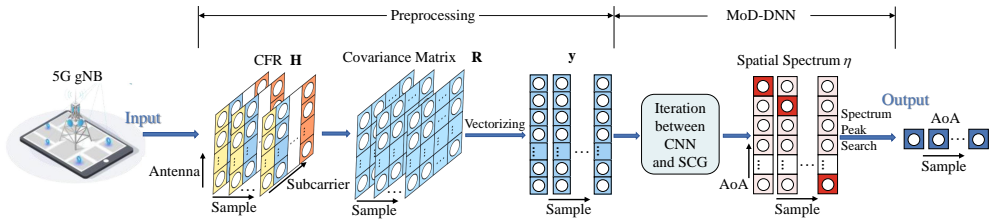
The load-bearing object is the alternating iteration between a CNN-based calibrator $C_w$ and a sparse conjugate-gradient (SCG) solver. The CNN takes the observed coarray spatial spectrum $\hat{\eta}$ and produces a calibrated spectrum $z_i = C_w(\eta_i)$; the SCG solver then updates the estimate by minimizing the regularized objective $\|\mathbf{P}\eta - \eta_i\|_2^2 + \lambda\|\eta - z_i\|^2 + \mu\, s(\eta)$, where $s(\eta)=\log(1+\|\eta\|_1/\epsilon)$ is a reweighted zero-attracting sparsity penalty. The preprocessing step vectorizes the sample covariance matrix into a coarray signal, which is what turns angle finding into a sparse recovery problem. The same network weights are reused at every iteration and the conjugate-gradient updates are closed-form, so the whole loop is trainable end-to-end while still encoding the forward model through the projection matrix $\mathbf{P}$.
What would settle it
Run Algorithm 1 without the CNN on a synthetic sparse spectrum with a known, non-projection matrix $\mathbf{P}$, and compare its converged output with the exact minimizer of the stated regularized problem; if they differ, the optimization loop is not doing what the paper claims.
Extended reading notes
Core claim
The paper's central claim is that angular-dependent phase errors introduced by real antenna hardware can be removed automatically, without explicit array calibration, by solving a sparse inverse problem with a network-unrolled iteration. The authors reformulate AoA estimation as the recovery of a sparse spatial spectrum from the vectorized coarray covariance, then alternate two modules: a shared-weight 1D-CNN maps the distorted spectrum to a calibrated spectrum, and a sparsity-constrained conjugate-gradient algorithm maps the calibrated spectrum back to a model-consistent sparse estimate. Because the CNN weights are shared across iterations and the conjugate-gradient steps have closed-form updates, the loop trains end-to-end on a mean-squared-error loss. The paper reports that the resulting MoD-DNN yields sharper spectral peaks and lower RMSE than MUSIC, DeepMUSIC, and CNN under hardware impairments, with the advantage growing at high SNR and high impairment levels.
Load-bearing premise
The whole method stands or falls on the assumption that the sparse conjugate-gradient iterations actually solve the regularized reconstruction problem they are written for; if they only approximately solve a different problem, the claimed model-driven advantage is not guaranteed.
Editorial extensions
If this is right
- AoA estimation on 5G gNBs can become robust to hardware impairments without per-array manual calibration, removing a key obstacle to using commodity base stations for positioning.
- The reported reduction of the 80th-percentile error from about 3 degrees to 0.15 degrees implies sub-degree positioning accuracy is achievable in line-of-sight conditions with impaired hardware.
- Because CNN weights are shared across iterations and the SCG steps are closed-form, the trained network has fewer trainable parameters and trains faster than DeepMUSIC (15.6 hours versus 30.8 hours in the reported runs).
- In the reported results, the performance gap between MoD-DNN and the plain CNN widens as SNR increases, indicating the model-based layer contributes most when the forward model is reliable.
Reading between the lines
- A natural extension is to apply the same alternating CNN-plus-sparse-solver design to other array-impaired estimation tasks, such as time-difference-of-arrival or joint angle-and-delay estimation, wherever the hardware error acts as an angular-dependent phase corruption of a known manifold.
- A testable prediction follows: the SCG layer should matter most in high-SNR, high-impairment regimes, while in low-SNR or low-impairment cases a plain CNN of equal capacity should nearly match it.
- The choice of the log-based reweighted sparsity penalty is one of several sparse regularizers; replacing it with a standard $\ell_1$ proximal step would reveal whether the specific penalty or the alternating structure carries the gain.
Editorial analysis
A structured set of objections, weighed in public.
Referee Report
Summary. This paper proposes a model-driven deep neural network (MoD-DNN) for angle-of-arrival (AoA) estimation at a 5G gNB under hardware impairments. The approach reformulates AoA estimation as a sparse inverse problem from the coarray spatial spectrum, then alternates between a 1D-CNN that calibrates the spectrum and a sparse conjugate gradient (SCG) module that reconstructs the sparse spectrum. The CNN and SCG are iterated with shared weights, and the whole system is trained end-to-end with an MSE loss. The paper reports simulations and anechoic-chamber experiments with a commodity 5G gNB, comparing against MUSIC, DeepMUSIC, and CNN baselines, and claims substantial reductions in AoA estimation error, including a 'minimum 95% reduction in the 80th percentile' in the chamber experiment.
Significance. The practical setup is a clear strength: the anechoic-chamber experiments with a real 5G gNB and the comparison against several baselines address a relevant problem. If the algorithmic derivation were sound, the proposed architecture would be an interesting contribution to model-driven deep learning for positioning, and the weight-sharing between CNN and SCG layers is a reasonable way to reduce trainable parameters. However, the central mathematical claim—that the SCG algorithm solves the stated sparse inverse problem—is not supported as written, so the significance is conditional on either correcting the algorithm or reframing it as a learned heuristic layer.
major comments (3)
- [SCG Algorithm, Eq. (8), Algorithm 1] The residual g(n) = (P + λI)η − (η_i + λz_i) used in Algorithm 1 is the gradient of (1/2)η^T(P + λI)η − η_i^Tη − λz_i^Tη, not of the stated objective ||Pη − η_i||² + λ||η − z_i||² in Eq. (7b)/(8). The gradient of the stated objective is 2(P^H Pη − P^H η_i + λ(η − z_i)), which coincides with the algorithm's residual only if P is an orthogonal projection satisfying P^H P = P and Pη_i = η_i. In this paper P = A^H A, where A is the M² × L coarray dictionary with L ≫ M², so P is a Gram matrix of an overcomplete dictionary and is not idempotent; the required projection property is never established. Consequently Algorithm 1 does not solve the inverse problem (7b)/(8) as written, and the claim that MoD-DNN is a model-driven solver of that problem is unsupported. The authors should correct the CG updates to the actual objective or explicitly present the SCG layer as a learned heuristic and adjust the claims accordingly.
- [Algorithm 1, lines 3–4] The sparsity modification is not integrated into the conjugate-gradient recursion. Line 3 subtracts ∇ss(η(n)) from the iterate, but lines 4–6 update g and c without any reference to this modification, and line 4 computes g(n+1) from the stale value η(n) rather than from the updated η(n+1). No convergence or descent argument is supplied for this modified iteration, so the claim that the minimization problem (8) is solved by 'an iterative method between CG solutions and sparsity modification' is not supported. At minimum, the algorithm needs a corrected recursion and a proof (or an explicit proximal-gradient interpretation).
- [Iterative Optimization, Eqs. (6)–(7)] The alternating scheme (7a)–(7b) is not derived from the stated problem (6). The data-fidelity term in (7b) is ||Pη − η_i||², whereas the objective in (6) contains ||Pη − \hat{η}||², where \hat{η} is the observed coarray spectrum. The paper does not specify the initialization η_0 or justify replacing the fixed observation \hat{η} by the running estimate η_i. Without this derivation, the relationship between the calibrated spectrum z_i, the reconstructed spectrum η_{i+1}, and the original inverse problem is not established. The authors should either prove the equivalence or state the iteration as a heuristic that is trained end-to-end.
minor comments (5)
- [Experimental Results, Figure 7(a)] The legend in Figure 7(a) uses 'MoD-CNN' instead of 'MoD-DNN', which is inconsistent with the method name used elsewhere.
- [SCG Algorithm, Eqs. (9)–(10)] Equation (10) does not match the derivative of (9): the subgradient of log(1 + ||η||_1/ε) is sgn(η)/(ε + ||η||_1), not sgn(η)/(1 + ε||η||_1) as written. The approximation parameter should be defined consistently.
- [Experimental Results, Simulation Settings] The values of the hyperparameters λ, μ, ε, γ_CG, N_CG_iter_max, and the total number of outer iterations I are not reported, which hinders reproducibility of the proposed method.
- [Numerical Simulations, Figure 5(c)] The text defines the standard deviation of loss relative to the 'convergence value'; please state explicitly what the convergence value is and why this metric is used instead of error-based standard deviation.
- [Experimental Results, Table 2] The DeepMUSIC architecture and training settings are not described in the paper, so the runtime comparison in Table 2 is difficult to interpret without additional implementation details.
Circularity Check
Chamber (and simulation) validation uses the same AoA grid as training, so the reported calibration gain is a fitted lookup for those angles, not an independent prediction of angular-dependent calibration.
-
fitted input called prediction
[Experimental Results > Experiment in an Anechoic Chamber, subsections 'Experimental Settings' and 'CDF of AoA Estimation Error']
"The AoA of UE is rotated from −60◦ to 60◦ by a uniform angle interval of 1◦ during the data acquisition process. For each AoA, 450 SRS symbols are transmitted by the UE. Then, the sounded CSIs are collected by the 5G gNB, yielding 121 × 450 = 54450 groups of CSI data. We extract 121 × 400 = 48400 groups of data for network training and 121 × 50 = 6050 for validation. ... Particularly noteworthy is the MoD-DNN’s capacity to achieve a minimum 95% reduction in the 80th percentile of AoA estimation error, from around 3◦ to 0.15◦."
The validation set is drawn from the same 121-point AoA grid used for training, and the angular-dependent phase error is a fixed per-angle hardware characteristic. The CNN, trained with the spectrum-MSE loss of Eq. (11) on these same angles, can memorize a per-angle calibration lookup. The held-out SRS symbols at the same angles then measure how well that per-angle lookup was fit, not whether calibration generalizes to unseen directions. The claimed 95% reduction in the 80th-percentile AoA error is therefore statistically forced by the training data rather than an independent prediction. No experiment with AoAs omitted from the training grid is reported, despite the central claim that the method 'can automatically calibrate the angular-dependent phase error.'
full rationale
The main circularity is in the evaluation of the calibration claim. In both the numerical simulations (1201 angles at 0.1° spacing, 5 validation symbols per angle) and the anechoic chamber experiment (121 angles at 1° spacing, 50 validation symbols per angle), training and validation share the same discrete AoA grid. Because the hardware phase error is a deterministic function of angle, a network trained on those angles can memorize the per-angle correction; validation on other symbols at the same angles then reports fit quality, not generalization to new angles. Thus the headline '95% reduction in the 80th percentile of AoA estimation error' is a fitted-input result rather than an independent test of the central 'automatically calibrate angular-dependent phase error' claim. Separately, there is a non-circular correctness gap: Algorithm 1's residual g(n) = (P+λI)η − (η_i + λz_i) is not the gradient of the stated objective ||Pη−η_i||² + λ||η−z_i||² unless P is a Hermitian idempotent projection with Pη_i=η_i, which is not established for the overcomplete coarray dictionary; the sparsity subtraction in line 3 is also not integrated into g or c. This is an omitted proof / implementation inconsistency rather than a circular reduction, so it does not by itself raise the circularity score, but it weakens the 'model-driven' characterization. Self-citations to the link-level simulator (Jia et al. 2023) and the CNN baseline (Liu et al. 2023) share authors with this paper, but they serve as a testbed and a baseline, not as load-bearing support for the central derivation, so they do not constitute circularity. Overall, the paper has independent content in the real-hardware experiment and comparisons, but the central calibration-generalization claim is partially circular because the evaluation grid is identical to the training grid.
Assumptions & free parameters
free parameters (5)
- λ (CNN-SCG trade-off regularization coefficient) =
Trainable; reported value not given
- μ (sparsity regularization coefficient) =
Not reported
- ϵ (approximation parameter in reweighted zero attracting function) =
Not reported
- CNN architecture hyperparameters (4 layers, kernel 32x1, channels 4/8/4/1, activations) =
4/8/4/1 channels, 32x1 kernel
- Iteration counts (outer I, inner N_CG_iter_max, threshold γCG) =
Not reported
assumptions (5)
- domain assumption The hardware impairment is modeled as an angular-dependent, frequency-independent phase error matrix Γ that multiplies the ideal steering vectors elementwise (Eq. 3).
- ad hoc to paper The alternating optimization between CNN calibration (7a) and SCG reconstruction (7b) converges to a good solution of the original problem (6).
- ad hoc to paper The SCG update with the added subgradient term descends the objective in (8).
- ad hoc to paper A 4-layer 1D-CNN with channels 4/8/4/1 can represent the mapping from impaired coarray spatial spectra to calibrated spectra.
- domain assumption The link-level simulator (Jia et al. 2023, same group) generates realistic 3GPP TR 38.901 InF LoS channels and impairment realizations representative of deployment.
Cite this review
Pith. "Pith review of Model-Driven Deep Neural Network for Enhanced AoA Estimation Using 5G gNB." pith.science (2026). https://pith.science/paper/2ANP33SD
@misc{pith2026250100009,
  author       = {Pith},
  title        = {Pith review of: Model-Driven Deep Neural Network for Enhanced AoA Estimation Using 5G gNB},
  year         = {2026},
  howpublished = {\url{https://pith.science/paper/2ANP33SD}},
  note         = {Machine review of arXiv:2501.00009}
}
read the original abstract
High-accuracy positioning has become a fundamental enabler for intelligent connected devices. Nevertheless, the present wireless networks still rely on model-driven approaches to achieve positioning functionality, which are susceptible to performance degradation in practical scenarios, primarily due to hardware impairments. Integrating artificial intelligence into the positioning framework presents a promising solution to revolutionize the accuracy and robustness of location-based services. In this study, we address this challenge by reformulating the problem of angle-of-arrival (AoA) estimation into image reconstruction of spatial spectrum. To this end, we design a model-driven deep neural network (MoD-DNN), which can automatically calibrate the angular-dependent phase error. The proposed MoD-DNN approach employs an iterative optimization scheme between a convolutional neural network and a sparse conjugate gradient algorithm. Simulation and experimental results are presented to demonstrate the effectiveness of the proposed method in enhancing spectrum calibration and AoA estimation.
Figures


Figures from the paper (4 more)


Forward citations
Cited by 1 Pith paper
-
Passive AoA Estimation of COTS 5G NR Handsets from Uplink SRS: A Practical USRP-B210 Implementation
Passive angle-of-arrival estimation of unmodified commercial 5G handsets from native uplink SRS is feasible with a two-element USRP B210 and a stock srsRAN gNB; accuracy is gated by SINR and multipath rather than range.
Reference graph
Works this paper leans on
-
[1]
, " * write output.state after.block = add.period write newline
ENTRY address archivePrefix author booktitle chapter edition editor eid eprint howpublished institution isbn journal key month note number organization pages publisher school series title type volume year label extra.label sort.label short.list INTEGERS output.state before.all mid.sentence after.sentence after.block FUNCTION init.state.consts #0 'before.a...
-
[2]
write newline
" write newline "" before.all 'output.state := FUNCTION n.dashify 't := "" t empty not t #1 #1 substring "-" = t #1 #2 substring "--" = not "--" * t #2 global.max substring 't := t #1 #1 substring "-" = "-" * t #2 global.max substring 't := while if t #1 #1 substring * t #2 global.max substring 't := if while FUNCTION word.in bbl.in capitalize " " * FUNCT...
-
[3]
Dai, Z.; He, Y.; Tran, V.; Trigoni, N.; and Markham, A. 2022. DeepAoANet: Learning angle of arrival from software defined radios with deep neural networks. IEEE Access, 10: 3164--3176
work page 2022
-
[4]
Elbir, A. M. 2020. DeepMUSIC: Multiple signal classification via deep learning. IEEE Sens. Lett., 4(4): 7001004
work page 2020
-
[5]
Fan, W.; Liu, S.; Li, C.; and Huang, Y. 2023. Fast direct localization for millimeter wave MIMO systems via deep ADMM unfolding. IEEE Wireless Commun. Lett., 12(4): 748--752
work page 2023
-
[6]
Gehring, C.; Kawaguchi, K.; Huang, J.; and Kaelbling, L. 2021. Understanding end-to-end model-based reinforcement learning methods as implicit parameterization. In Proc. Adv. Neural Inf. Process. Syst. (NeurIPS), 703--714. Online
work page 2021
-
[7]
Ghourchian, N.; Allegue-Martinez, M.; and Precup, D. 2017. Real-time indoor localization in smart homes using semi-supervised learning. In Proc. 31st Annu. AAAI Conf. Artif. Intell. (AAAI), 4670--4677. San Francisco, CA, USA
work page 2017
-
[8]
HasanzadeZonuzy, A.; Kalathil, D.; and Shakkottai, S. 2021. Model-based reinforcement learning for infinite-horizon discounted constrained Markov decision processes. In Proc. 30th Int. Joint Conf. Artif. Intell. (IJCAI), 2519--2525. Online
work page 2021
Show all 29 references
-
[9]
Hou, Y.; Ma, Z.; Liu, C.; and Loy, C. C. 2019. Learning to steer by mimicking features from heterogeneous auxiliary networks. In Proc. 33th Annu. AAAI Conf. Artif. Intell. (AAAI), 8433--8440. Honolulu, HI, USA
2019
-
[10]
Huang, H.; Yang, J.; Huang, H.; Song, Y.; and Gui, G. 2018. Deep learning for super-resolution channel estimation and DOA estimation based massive MIMO system. IEEE Trans. Veh. Technol., 67(9): 8549--8560
2018
-
[11]
Huang, M.; Meng, F.; Liu, S.; Zhang, C.; Huang, Y.; and Lu, Z. 2023. TDoA positioning with data-driven LoS inference in mmWave MIMO communications. In Proc. ACM SenSys Workshop mmWave Sens. Syst. App., 1--7. Istanbul, T\" u rkiye
2023
-
[12]
Jia, X.; Liu, P.; Liu, S.; Li, X.; and Qi, W. 2023. Link-level simulator for 5G localization. IEEE Trans. Wireless Commun., 22(8): 5198--5213
2023
-
[13]
Jiang, B.; Wu, X.; Yu, K.; and Chen, H. 2019. Joint semi-supervised feature selection and classification through Bayesian approach. In Proc. 33th Annu. AAAI Conf. Artif. Intell. (AAAI), 3983--3990. Honolulu, HI, USA
2019
-
[14]
Kotary, J.; Fioretto, F.; Van Hentenryck, P.; and Wilder, B. 2021. End-to-end constrained optimization learning: A survey. In Proc. 30th Int. Joint Conf. Artif. Intell. (IJCAI), 4475--4482. Online
2021
-
[15]
Lee, H.; Kim, Y.; Seol, S.; and Chung, J. 2023. Deep learning-based direction-of-arrival estimation for far-field sources under correlated near-field interferences. ICT Express, 9(4): 741--747
2023
-
[16]
Liu, S.; Wang, H.; Pan, M.; Liu, P.; Ma, Y.; and Huang, Y. 2023. 5G NR monostatic positioning with array impairments: Data-and-model-driven framework and experiment results. In Proc. 29th ACM MobiCom Workshop on Integr. Sens. Commun. Syst., 1--6. Madrid, Spain
2023
-
[17]
P.; Revach, G.; Shlezinger, N.; and van Sloun, R
Merkofer, J. P.; Revach, G.; Shlezinger, N.; and van Sloun, R. J. G. 2022. Deep augmented MUSIC algorithm for data-driven DoA estimation. In Proc. IEEE Int. Conf. Acoust., Speech Signal Process. (ICASSP) , 3598--3602. Singapore
2022
-
[18]
Mo, S.; and Morgado, P. 2023. A unified audio-visual learning framework for localization, separation, and recognition. In Proc. 40th Int. Conf. Mach. Learn. (ICML), 25006--25017. Honolulu, HI, USA
2023
-
[19]
Naseri, M.; Shahid, A.; Gordebeke, G.-J.; Lemey, S.; Boes, M.; Van De Velde, S.; and De Poorter, E. 2022. Machine learning-based angle of arrival estimation for ultra-wide band radios. IEEE Commun. Lett., 26(6): 1273--1277
2022
-
[20]
Pai, M.; and Kumar, A. 2019. Distribution learning of a random spatial field with a location-unaware mobile sensor. In Proc. Adv. Neural Inf. Process. Syst. (NeurIPS), 12447--12455. Vancouver, BC, Canada
2019
-
[21]
Pan, M.; Liu, P.; Liu, S.; Qi, W.; Huang, Y.; You, X.; Jia, X.; and Li, X. 2022. Efficient joint DOA and TOA estimation for indoor positioning with 5G picocell base stations. IEEE Trans. Instrum. Meas., 71: 8005219
2022
-
[22]
Pan, M.; Liu, S.; P. Liu, W. Q.; Huang, Y.; Z. Wang, Q. W.; and Gardill, M. 2023. In situ calibration of antenna arrays for positioning with 5G networks. IEEE Trans. Microwave Theory Tech., 71(10): 4600--4613
2023
-
[23]
Sun, S.; Melamed, D.; and Kitani, K. 2021. IDOL: Inertial deep orientation-estimation and localization. In Proc. 35th Annu. AAAI Conf. Artif. Intell. (AAAI), 6128--6137. Online
2021
-
[24]
X.; Sun, Y.; Dean, C.; Morales, Y
Xuan, T.; Zhu, Y.; Borca-Tasciuc, G.; Liu, M. X.; Sun, Y.; Dean, C.; Morales, Y. C.; Shi, Z.; and Yu, D. 2023. End-to-end pipeline for trigger detection on hit and track graphs. In Proc. 37th Annu. AAAI Conf. Artif. Intell. (AAAI), 15752--15758. Washington, DC, USA
2023
-
[25]
Yang, M.; Ai, B.; He, R.; Huang, C.; Ma, Z.; Zhong, Z.; Wang, J.; Pei, L.; Li, Y.; and Li, J. 2021. Machine-learning-based fast angle-of-arrival recognition for vehicular communications. IEEE Trans. Veh. Technol., 33(1): 1592--1605
2021
-
[26]
You, X.; Huang, Y.; Liu, S.; and et al. 2023. Toward 6G TK extreme connectivity: Architecture, key technologies and experiments. IEEE Wireless Commun., 30(3): 86--95
2023
-
[27]
Zhou, Q.; Li, H.; and Wang, J. 2020. Deep model-based reinforcement learning via estimated uncertainty and conservative policy optimization. 6941--6948. New York City, NY, USA
2020
-
[28]
Zhu, G.; Zhang, M.; Lee, H.; and Zhang, C. 2020. Bridging imagination and reality for model-based deep reinforcement learning. In Proc. Adv. Neural Inf. Process. Syst. (NeurIPS), volume 33, 8993--9006. Online
2020
-
[29]
Zhu, Y.; Xiao, Z.; Fang, Y.; Fu, X.; Xiong, Z.; and Zha, Z. 2022. Efficient model-driven network for shadow removal. In Proc. 36th Annu. AAAI Conf. Artif. Intell. (AAAI), 3635--3643. Online
2022
Reviewed August 11, 2026 · model on record in the stance chip above.
Discussion (0). Continue with ORCID to comment.