REVIEW 3 major objections 5 minor 3 cited by
A ZTF Search for Circumstellar Debris Transits in White Dwarfs: Six New Candidates, one with Gas Disk Emission, identified in a Novel Metric Space
T0 review · 3 major / 5 minor · reviewed 2026-08-08 · deepseek-v4-flash
Pith's one-line read Six white dwarfs with transiting planetary debris are found by ranking photometric variability and confirming metal pollution in follow-up spectra, including one object whose transit reddens the starlight.
desk verdict A useful catalog paper with a promising but under-supported reddening claim; the six candidates mostly hold up, but the WD J1013-0427 color-dependence needs a proper error analysis. read the letter →
The pith
A machine-rendered reading of the paper's core claim, the machinery that carries it, and where it could break.
The reading
What carries the argument
The load-bearing novelty is a two-dimensional metric space built from the von Neumann statistic, $\eta = (\delta/\sigma)^2$, which measures the randomness of a time series, and the Pearson second skew coefficient, $S_P = (e_m - m)/\sigma$, which distinguishes dimming from brightening events. Transiting-debris systems cluster in the third quadrant ($\eta \lesssim 1.8$, $S_P < 0$), which is sparsely populated by other variable white dwarfs, so the quadrant acts as a quick filter before spectroscopy. The candidates are pulled from the top 1% of a combined variability rank $R = V_G + V_{\mathrm{ZTF}}$ computed from Gaia and ZTF photometry after polynomial detrending and median-absolute-deviation normalization. Long-duration dips are fit with an asymmetric hyperbolic secant function, and the color-dependent depths of WD J1013−0427 are interpreted with Mie-scattering radiative transfer models and an optically-thick-disk covering-fraction model.
What would settle it
Continued high-cadence monitoring of the six candidates over several years: a candidate whose dips never recur, or whose Lomb-Scargle analysis later reveals a stable period consistent with binary rotation or pulsation, would fail the transiting-debris classification. For WD J1013−0427 specifically, a second long dip observed simultaneously in $g$ and $r$ with no color difference would falsify the small-grain extinction interpretation.
Extended reading notes
Core claim
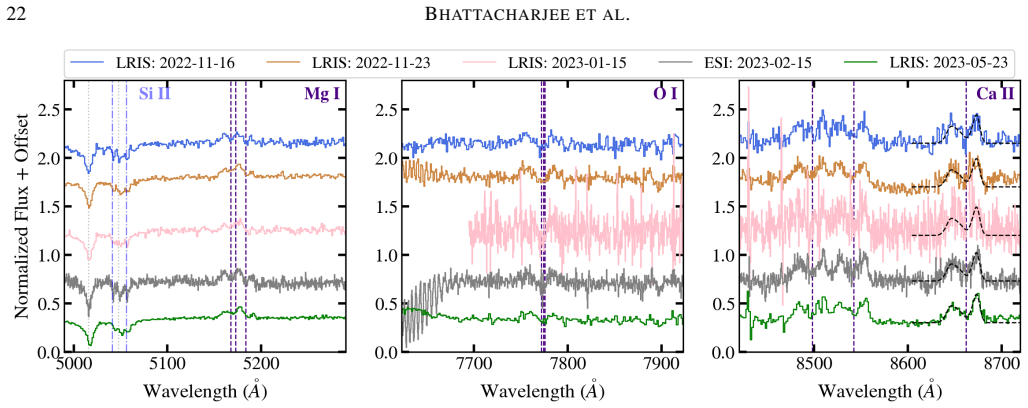
The paper's central claim is that six white dwarfs—WD J0923+7326, WD J1302+1650, WD J1650+1443, WD J1944+4557, WD J1237+5937, and WD J1013−0427—are strong candidates for hosting transiting planetary debris, on the evidence of high photometric variability in ZTF and Gaia light curves combined with metal absorption lines in follow-up spectra. For WD J1013−0427 the variability shows a statistically significant color dependence: the transit depth in the ZTF-$r$ band is shallower than in the $g$ band, which the authors read as the first observed reddening during a debris transit and model as extinction by small dust grains (radius $\lesssim 0.3\,\mu\mathrm{m}$). The same object displays double-peaked Ca II, O I, and Mg I emission lines, which a Keplerian disk model fits with an optically thick, eccentric gas disk extending roughly 0.2 to 0.5 solar radii from the star. As a population statement, the paper finds that transiting-debris systems have higher inferred metal accretion rates than typical metal-polluted white dwarfs.
Load-bearing premise
Candidates are certified as transiting debris on the strength of aperiodic photometric variability plus metal absorption lines, with no debris orbital period measured for any of the six; if the variability of even one object turns out to be rotation, pulsation, or binarity, that object's candidacy collapses.
Editorial extensions
If this is right
- The known census of transiting-debris white dwarfs grows from eight to fourteen systems, roughly doubling the sample available for population studies.
- WD J1013−0427 offers the first empirical handle on the grain-size distribution of the occulting material; if the reddening interpretation holds, grains $\lesssim 0.3\,\mu\mathrm{m}$ must survive at wide orbits where they are not sublimated.
- The $\eta$–$S_P$ quadrant filter is a cheap, survey-ready way to shortlist transiting-debris candidates in large time-domain datasets, a use the authors explicitly expect in future surveys.
- The higher accretion rates of transiting-debris systems, if confirmed, could serve as a selection criterion for finding more such systems in large spectroscopic datasets.
- Four of the six candidates vary on timescales of months to years, suggesting a subclass of long-timescale debris activity that surveys with short temporal baselines would miss.
Reading between the lines
- If the reddening-transit interpretation survives, WD J1013−0427 becomes a testbed for dust survival physics: sub-micron grains normally sublimate quickly near a 21,900 K white dwarf, so their inferred presence requires either a very recent collisional event or a shielding mechanism not discussed in the paper.
- The paper's naive occurrence-rate lower bound of about 0.03% sits more than an order of magnitude below theoretical predictions; closing that gap may require accounting for long dormant phases, which would bias surveys toward catching only the currently active systems.
- The same $\eta$–$S_P$ metric space could be turned around and applied to other variable-star classes—young stellar objects, post-common-envelope binaries, or variable planetary nebulae—wherever dip-shaped or outburst-shaped light curves define the class.
- A second transit of WD J1013−0427, if caught by an all-sky survey with both $g$- and $r$-band coverage, would directly test whether the long dip is a single collisional event or a recurring disk feature with a period of at least 20 years.
Editorial analysis
A structured set of objections, weighed in public.
Referee Report
Summary. The paper reports a systematic search for white dwarfs with transiting circumstellar debris, combining the Gaia eDR3 white dwarf catalog with ZTF DR10 photometry for sources within 500 pc. The authors define a variability rank from Gaia and ZTF metrics, introduce a two-dimensional metric space based on the von Neumann statistic and Pearson skew, select the top 1% most variable objects, visually screen their light curves, and follow up promising candidates with optical spectroscopy and high-speed photometry. They present six new transiting-debris candidates, report that three show short-timescale dips in high-speed light curves, and identify WD J1013-0427 as especially notable because it allegedly shows a color-dependent transit (reddening) and double-peaked metal emission lines from an eccentric optically thick gas disk. They also compare accretion rates of transiting-debris systems to the general metal-polluted white dwarf population and report a serendipitous long-duration outbursting AM CVn system.
Significance. If the results hold, the paper would substantially grow a rare class of objects from eight published systems to fourteen candidates, and WD J1013-0427 would be the first white dwarf debris system showing both a color-dependent transit and a gaseous debris disk. The search methodology, including the eta-S_P metric space and systematic recovery of all previously known systems, is a useful contribution for future surveys. The gas-disk modeling and the accretion-rate comparison are also valuable. However, the most novel physical claim, the first reddening during a debris transit and the inferred small dust grain population, rests on a statistical comparison of transit depths whose uncertainties are not established. The candidate catalog itself remains largely defensible, but the headline discovery needs stronger support.
major comments (3)
- [§4.1.6, §5.1, Figs. 9–10] The claim that WD J1013-0427 shows a statistically significant color-dependent transit is not established. The inferred depths (D_ZTF-g=0.296, D_ATLAS-c=0.218, D_ZTF-r=0.166, D_ATLAS-o=0.166) come from AHS fits to sparse, multi-year ZTF and ATLAS light curves, but the text never states the uncertainty on each depth, how errors are propagated from the fits in Fig. 9, or the significance level of the g-minus-r difference. Figure 10 explicitly says the authors suspect underestimation of the depth errors and therefore show 2-sigma error bars, which contradict the unqualified 'statistically significant' language in §4.1.6. The light curves are likely affected by correlated systematics from forced photometry, weather, and calibration; least-squares fit errors will underestimate the true uncertainty. Because the reddening interpretation, the small-grain radius inference, and the 'first reddening during transit' claim all rest on this single comparison, the authors must provide a robust noise model or resampling-based uncertainty estimate and report the significance quantitatively. If the depth difference is not significant, the headline physical discovery is unsupported, even though the six-candidate catalog would remain intact.
- [§4.1.3 (WD J1650+1443)] The candidate status of WD J1650+1443 is much weaker than the paper's summary suggests. The text states that its variability rank is dominated by the Gaia metric V_G=11.5 while the ZTF metric is only V_ZTF=1.9, which is not strongly variable compared with similar objects, and that no variability is seen in the CHIMERA light curves. Since the selection rationale is 'metal pollution along with high photometric variability,' this object does not currently satisfy the variability criterion. The possible explanation of a quiescent phase in transiting debris systems is plausible, but because Gaia epochal photometry is unavailable, the high V_G could also be an artifact. The paper should either present this object as a lower-confidence candidate or clearly separate the spectroscopic evidence from the currently non-detected photometric variability.
- [§4.1.4 (WD J1944+4557)] For WD J1944+4557, the text reports that the Ca II K absorption cannot be reproduced by photospheric models and that the absorption is likely circumstellar rather than photospheric. This weakens the 'metal pollution' confirmation that is used to classify the object as a transiting-debris candidate. The short-timescale dips and sporadic variability provide independent photometric evidence, but the manuscript should explicitly state that this candidate lacks confirmed photospheric metals and should not be grouped with the other candidates without this caveat. The current wording in §4, which says 'the metal pollution along with the high photometric variability strongly indicates the transiting debris nature of these white dwarfs,' is too strong for this object.
minor comments (5)
- [§5.1, Fig. 10] The caption of Figure 10 says 'Suspecting underestimation of the inferred depth errors' while the main text asserts statistical significance; this contradiction must be resolved in revision, ideally with a quantitative significance statement.
- [Appendix A] The paper acknowledges an incorrect astrometric excess-noise cut that excludes about 5,171 sources, or roughly 4% of the sample. This is honestly disclosed, but the main text should briefly mention this limitation when stating the sample size, since a small number of transiting-debris candidates could have been missed.
- [Throughout] There are several typographical errors that should be corrected, including 'duraration' (§5.1.1), 'Terial restrial' (§4.1.6), 'genarate' (§5.3), 'abundnaces' (§6), and 'V on Neumann' (§2.6).
- [§2.6] The description of the eta-S_P metric space as a 'novel discovery tool' should be tempered, since the third quadrant was identified retrospectively using known transiting-debris systems and then used as a prioritization aid rather than as the sole discovery criterion.
- [Table 5] The accretion rates are reported without statistical errors; the text explains that the true uncertainties may be larger than the abundance uncertainties, but it would be helpful to state this caveat directly in the table caption.
Circularity Check
Candidate discovery is self-contained and independently evidenced; only the eta–SP metric-space validation is mildly self-referential because third-quadrant preference was applied before the metric's discovery power was asserted.
-
other
[Section 2.6, with the selection preference restated in Section 4]
"The transiting debris systems, with irregular dip-like variability, predominantly occupy the third quadrant (lower left) in this space. Figure 2 also includes the new candidates found in this work, details about which shall be discussed later in this paper (§4.1). We see that the quadrant containing the transiting debris candidates is less contaminated by other kinds of variables. This suggests that the η–SP metric space can help with more efficient identification of white dwarfs with transiting debris-like light curves."
The quadrant was defined retrospectively from known transiting-debris systems, and the new candidates were preferentially selected from the same quadrant: “we also checked the position of the object in the η–SP space and gave preference to objects lying in the third quadrant.” Therefore the new candidates' placement in that quadrant, and the assertion that the quadrant is ‘less contaminated’ and that the metric space is validated, is partly constructed by the selection rather than an independent test. This is a mild, non-fatal circularity because the six candidate claims still rest on independent ZTF variability and metal-line spectroscopy; the metric-space preference was only prioritization, not proof.
full rationale
The central claims do not reduce to their inputs. The six candidates were chosen from the top 1% variability rank using Gaia/ZTF metrics, visually inspected for irregular aperiodic variability, and spectroscopically confirmed as metal-polluted white dwarfs; this chain is independent of the target conclusion. The first-reddening claim for WD J1013-0427 is a fitted AHS depth comparison plus a radiative-transfer interpretation, not a prediction built into the input; its weakness is statistical (the paper itself suspects underestimated depth errors) rather than circular. WD J1944+4557's possibly circumstellar Ca II line is an acknowledged interpretation issue, not circularity. The only mildly self-referential element is the eta-SP quadrant: it was calibrated on known systems and then used to prioritize follow-up, so using the new candidates' quadrant positions to validate the metric space is not an independent out-of-sample test. Overall, the search is self-contained against external benchmarks, including recovery of all eight previously known transiting debris systems, so the appropriate finding is minor circularity rather than a fatal reduction.
Assumptions & free parameters
free parameters (6)
- Top 1% variability rank threshold R =
560 sources
- eta-SP quadrant boundary =
eta < 1.9, S_P < 0
- AHS transit model parameters (depth, phi1, phi2) =
e.g., WD J1302+1650 depth about 20%, WD J1237+5937 ingress 25 d and egress 117 d
- Dust grain size parameters (r_max or r_eff) and refractive index choices =
best match r_max around 0.2-0.3 micron (power law), r_eff below 0.15 micron (Hansen); n=1.7+0.03i (Si-like) or 2+2.5i…
- Gas disk model parameters: e, a_in, a_out, phi, log C1, log C2, alpha, i, v_c =
e=0.27, a_in=19 R_WD, a_out=48 R_WD, i=1.38 rad (about 79 deg), alpha=-0.37
- Interstellar reddening E(B-V) =
0.005 to 0.062 mag for the candidates
assumptions (8)
- domain assumption Metal pollution in white dwarfs is produced by accretion of disrupted planetary debris.
- domain assumption Accretion-diffusion equilibrium: accretion rate equals surface diffusion rate for each metal.
- domain assumption Unseen metals are scaled to bulk Earth abundance ratios relative to Ca or Mg.
- ad hoc to paper The variability metrics V_G and V_ZTF, after polynomial detrending and MAD normalization, rank variability independent of magnitude.
- ad hoc to paper The dust is optically thin and uniformly covers the white dwarf disk (Model 1), or the disk is optically thick with power-law optical depth (Model 2).
- ad hoc to paper The gas disk is Keplerian, thin, optically thick for Ca II, with constant calcium column density and photon density proportional to r^-alpha.
- domain assumption Grain size distribution follows a power law with p=3.5 or a Hansen distribution with nu_eff=0.1 micron.
- domain assumption ZTF and Gaia photometric quality cuts remove contaminated sources; manual image inspection completes decontamination.
invented entities (2)
-
Eccentric optically thick gas disk around WD J1013-0427
independent evidence
-
Population of small dust grains (radius below 0.3 micron) in the occulting material around WD J1013-0427
independent evidence
Cite this review
Pith. "Pith review of A ZTF Search for Circumstellar Debris Transits in White Dwarfs: Six New Candidates, one with Gas Disk Emission, identified in a Novel Metric Space." pith.science (2026). https://pith.science/paper/UBA4HML5
@misc{pith2026250205502,
  author       = {Pith},
  title        = {Pith review of: A ZTF Search for Circumstellar Debris Transits in White Dwarfs: Six New Candidates, one with Gas Disk Emission, identified in a Novel Metric Space},
  year         = {2026},
  howpublished = {\url{https://pith.science/paper/UBA4HML5}},
  note         = {Machine review of arXiv:2502.05502}
}
abstract
White dwarfs (WDs) showing transits from orbiting planetary debris provide significant insights into the structure and dynamics of debris disks. This is a rare class of objects with only eight published systems. In this work, we perform a systematic search for such systems within 500 pc in the Gaia-eDR3 catalog of WDs using the light curves from the Zwicky Transient Facility (ZTF) and present six new candidates. Our selection process targets the top 1% most photometrically variable sources identified using a combined variability metric from ZTF and Gaia eDR3 photometry, boosted by a metric space we define using von Neumann statistics and Pearson-Skew as a novel discovery tool to identify these systems. This is followed by optical spectroscopic observations of visually selected variables to confirm metal pollution. Four of the six systems show long-timescale photometric variability spanning several months to years, resulting either from long-term evolution of transit activity or dust and debris clouds at wide orbits. Among them, WD J1013-0427 shows an indication of reddening during the long-duration dip. Interpreting this as dust extinction makes it the first system to indicate an abundance of small dust grains (radius $\lesssim$$0.3~{\rm \mu m}$) in the occulting material. The same object also shows metal emission lines that map an optically thick eccentric gas disk orbiting within the star's Roche limit. For each candidate, we infer the abundances of the photospheric metals and estimate accretion rates. We show that transiting debris systems tend to have higher inferred accretion rates compared to the general population of metal-polluted WDs. Growing the number of these systems will further illuminate such comparative properties in the near future. Separately, we also serendipitously discovered an AM CVn showing a very long-duration outburst $-$ only the fourth such system to be known.
Figures


Figures from the paper (14 more)




Forward citations
Cited by 3 Pith papers
-
A Search for Transiting Exocomets in TESS Sectors 1-26
A TESS primary mission search finds five new exocomet-like transit candidates and estimates a 2.64e-4 per star per year occurrence rate, concluding such transits are rare at 0.1% to 1% depths.
-
Silicate mineralogy and bulk composition of exoplanetary material in polluted white dwarfs
New ultraviolet abundances for two white dwarfs, combined with a re-analysis of eight systems, support a tentative correlation between the Mg/Si ratio of accreted exoplanetary material and whether its dust is olivine-...
-
Bounding destruction timescales of minor planets orbiting white dwarfs with the sesquinary catastrophe
Minor planets orbiting white dwarfs at 1-4 Roche radii can be destroyed by their own returning impact ejecta on timescales of 10^2 to 10^5 years.
Reference graph
Works this paper leans on
-
[1]
All`egre, C., Manh`es, G., & Lewin, ´E. 2001, Earth and Planetary Science Letters, 185, 49, doi: 10.1016/S0012-821X(00)00359-9 Astropy Collaboration, Robitaille, T. P., Tollerud, E. J., et al. 2013, A&A, 558, A33, doi: 10.1051/0004-6361/201322068 Astropy Collaboration, Price-Whelan, A. M., Sip˝ocz, B. M., et al. 2018a, AJ, 156, 123, doi: 10.3847/1538-3881...
-
[2]
Aungwerojwit, A., G¨ansicke, B. T., Dhillon, V . S., et al. 2024, MNRAS, 530, 117, doi: 10.1093/mnras/stae750
-
[3]
Bauer, E. B., & Bildsten, L. 2019, ApJ, 872, 96, doi: 10.3847/1538-4357/ab0028 19 http://vizier.cds.unistra.fr/vizier/sed/ B´edard, A., Bergeron, P., Brassard, P., & Fontaine, G. 2020, ApJ, 901, 93, doi: 10.3847/1538-4357/abafbe
-
[4]
Bellm, E. C., Kulkarni, S. R., Graham, M. J., et al. 2019, PASP, 131, 018002, doi: 10.1088/1538-3873/aaecbe
-
[5]
Bhattacharjee, S., Kulkarni, S. R., Kong, A. K. H., et al. 2025, PASP, 137, 024201, doi: 10.1088/1538-3873/ada702
-
[6]
Brouwers, M. G., Bonsor, A., & Malamud, U. 2022, MNRAS, 509, 2404, doi: 10.1093/mnras/stab3009
-
[7]
2025, Nature Astronomy, doi: 10.1038/s41550-024-02446-x
Budaj, J., Bernhard, K., Jones, D., & Munday, J. 2025, Nature Astronomy, doi: 10.1038/s41550-024-02446-x
-
[8]
Chambers, K. C., Magnier, E. A., Metcalfe, N., et al. 2016, arXiv e-prints, arXiv:1612.05560. https://arxiv.org/abs/1612.05560
arXiv 2016
Show all 123 references
-
[9]
M., Stauffer, J., Baglin, A., et al
Cody, A. M., Stauffer, J., Baglin, A., et al. 2014, AJ, 147, 82, doi: 10.1088/0004-6256/147/4/82 30 BHATTACHARJEE ET AL. Figure 17.Spectral energy distributions of the six new transiting debris candidates. WD J0923+7326 appears to have infrared excess but close inspection show...
2014 doi
-
[10]
2014, ApJ, 786, 100, doi: 10.1088/0004-637X/786/2/100
Croll, B., Rappaport, S., DeV ore, J., et al. 2014, ApJ, 786, 100, doi: 10.1088/0004-637X/786/2/100
2014 doi
-
[11]
2019, MNRAS, 488, 2503, doi: 10.1093/mnras/stz1759
Koester, D. 2019, MNRAS, 488, 2503, doi: 10.1093/mnras/stz1759
2019 doi
-
[12]
H., Kilic, M., Faedi, F., et al
Debes, J. H., Kilic, M., Faedi, F., et al. 2012, ApJ, 754, 59, doi: 10.1088/0004-637X/754/1/59
2012 doi
-
[13]
H., & Sigurdsson, S
Debes, J. H., & Sigurdsson, S. 2002, ApJ, 572, 556, doi: 10.1086/340291
2002 doi
-
[14]
D., Andrews, J
Decleir, M., Gordon, K. D., Andrews, J. E., et al. 2022, ApJ, 930, 15, doi: 10.3847/1538-4357/ac5dbe
2022 doi
-
[15]
Dennihy, E., Farihi, J., Fusillo, N. P. G., & Debes, J. H. 2020a, ApJ, 891, 97, doi: 10.3847/1538-4357/ab7249
-
[16]
2020b, ApJ, 905, 5, doi: 10.3847/1538-4357/abc339
Dennihy, E., Xu, S., Lai, S., et al. 2020b, ApJ, 905, 5, doi: 10.3847/1538-4357/abc339
-
[17]
S., Marsh, T
Dhillon, V . S., Marsh, T. R., Stevenson, M. J., et al. 2007, MNRAS, 378, 825, doi: 10.1111/j.1365-2966.2007.11881.x
2007
-
[18]
J., Djorgovski, S
Drake, A. J., Djorgovski, S. G., Mahabal, A., et al. 2009, ApJ, 696, 870, doi: 10.1088/0004-637X/696/1/870
2009 doi
-
[19]
2017, in Astronomical Society of the Pacific Conference Series, V ol
Dufour, P., Blouin, S., Coutu, S., et al. 2017, in Astronomical Society of the Pacific Conference Series, V ol. 509, 20th European White Dwarf Workshop, ed. P. E. Tremblay, B. Gaensicke, & T. Marsh, 3, doi: 10.48550/arXiv.1610.00986
-
[20]
2010, ApJ, 719, 803, doi: 10.1088/0004-637X/719/1/803
Dufour, P., Kilic, M., Fontaine, G., et al. 2010, ApJ, 719, 803, doi: 10.1088/0004-637X/719/1/803
2010 doi
-
[21]
2016, NewAR, 71, 9, doi: 10.1016/j.newar.2016.03.001
Farihi, J. 2016, NewAR, 71, 9, doi: 10.1016/j.newar.2016.03.001
2016 doi
-
[22]
T., & Koester, D
Farihi, J., G¨ansicke, B. T., & Koester, D. 2013, Science, 342, 218, doi: 10.1126/science.1239447
2013 doi
-
[23]
T., Wyatt, M
Farihi, J., G¨ansicke, B. T., Wyatt, M. C., et al. 2012, MNRAS, 424, 464, doi: 10.1111/j.1365-2966.2012.21215.x
2012
-
[24]
Farihi, J., Zuckerman, B., & Becklin, E. E. 2008, ApJ, 674, 431, doi: 10.1086/521715
2008 doi
-
[25]
J., Marsh, T
Farihi, J., Hermes, J. J., Marsh, T. R., et al. 2022, MNRAS, 511, 1647, doi: 10.1093/mnras/stab3475
2022 doi
-
[26]
Clayton, G. C. 2019, ApJ, 886, 108, doi: 10.3847/1538-4357/ab4c3a
2019 doi
-
[27]
A., Magnier, E
Flewelling, H. A., Magnier, E. A., Chambers, K. C., et al. 2020, ApJS, 251, 7, doi: 10.3847/1538-4365/abb82d
2020 doi
-
[28]
2013, emcee: The MCMC Hammer, Astrophysics Source Code Library, record ascl:1303.002 G¨ansicke, B
Foreman-Mackey, D., Conley, A., Meierjurgen Farr, W., et al. 2013, emcee: The MCMC Hammer, Astrophysics Source Code Library, record ascl:1303.002 G¨ansicke, B. T., Marsh, T. R., Southworth, J., &
2013
-
[29]
2006, Science, 314, 1908, doi: 10.1126/science.1135033
Rebassa-Mansergas, A. 2006, Science, 314, 1908, doi: 10.1126/science.1135033
2006 doi
-
[30]
2019, ApJ, 882, 106, doi: 10.3847/1538-4357/ab379e Gentile Fusillo, N
Genest-Beaulieu, C., & Bergeron, P. 2019, ApJ, 882, 106, doi: 10.3847/1538-4357/ab379e Gentile Fusillo, N. P., Tremblay, P.-E., G¨ansicke, B. T., et al. 2019a, MNRAS, 482, 4570, doi: 10.1093/mnras/sty3016 —. 2019b, MNRAS, 482, 4570, doi: 10.1093/mnras/sty3016 Gentile Fusillo, ...
2019 doi
-
[31]
M., Brasseur, C
Ginsburg, A., Sip˝ocz, B. M., Brasseur, C. E., et al. 2019, AJ, 157, 98, doi: 10.3847/1538-3881/aafc33
2019 doi
-
[32]
A., Kutra, T., & Wu, Y
Goksu, O. A., Kutra, T., & Wu, Y . 2024, AJ, 167, 236, doi: 10.3847/1538-3881/ad3216
2024 doi
-
[33]
D., Cartledge, S., & Clayton, G
Gordon, K. D., Cartledge, S., & Clayton, G. C. 2009, ApJ, 705, 1320, doi: 10.1088/0004-637X/705/2/1320
2009 doi
-
[34]
D., Clayton, G
Gordon, K. D., Clayton, G. C., Decleir, M., et al. 2023, ApJ, 950, 86, doi: 10.3847/1538-4357/accb59 NEWWHITEDWARFS WITHTRANSITINGDEBRIS INZTF 31
2023 doi
-
[35]
D., Misselt, K
Gordon, K. D., Misselt, K. A., Bouwman, J., et al. 2021, ApJ, 916, 33, doi: 10.3847/1538-4357/ac00b7
2021 doi
-
[36]
A., Hermes, J
Guidry, J. A., Hermes, J. J., De, K., et al. 2024b, ApJ, 972, 126, doi: 10.3847/1538-4357/ad5be7
-
[37]
A., Vanderbosch, Z
Guidry, J. A., Vanderbosch, Z. P., Hermes, J. J., et al. 2021, ApJ, 912, 125, doi: 10.3847/1538-4357/abee68
2021 doi
-
[38]
2017, MNRAS, 469, 3213, doi: 10.1093/mnras/stx924
Hallakoun, N., Xu, S., Maoz, D., et al. 2017, MNRAS, 469, 3213, doi: 10.1093/mnras/stx924
2017 doi
-
[39]
Hansen, J. E. 1971, Journal of the Atmospheric Sciences, 28, 1400, doi: 10.1175/1520-0469(1971)028⟨1400:MSOPLI⟩2.0.CO;2
1971 doi
-
[40]
K., Hallinan, G., Milburn, J., et al
Harding, L. K., Hallinan, G., Milburn, J., et al. 2016, MNRAS, 457, 3036, doi: 10.1093/mnras/stw094
2016 doi
-
[41]
R., Millman, K
Harris, C. R., Millman, K. J., van der Walt, S. J., et al. 2020, Nature, 585, 357, doi: 10.1038/s41586-020-2649-2
2020 doi
- [42]
-
[43]
A., Kiker, T
Hillenbrand, L. A., Kiker, T. J., Gee, M., et al. 2022, AJ, 163, 263, doi: 10.3847/1538-3881/ac62d8
2022 doi
-
[44]
T., Harrison, D
Hodgkin, S. T., Harrison, D. L., Breedt, E., et al. 2021, A&A, 652, A76, doi: 10.1051/0004-6361/202140735
2021 doi
-
[45]
Horne, K., & Marsh, T. R. 1986, MNRAS, 218, 761, doi: 10.1093/mnras/218.4.761
1986 doi
-
[46]
Hunter, J. D. 2007, Computing in Science & Engineering, 9, 90, doi: 10.1109/MCSE.2007.55
2007 doi
-
[47]
T., Breedt, E., et al
Inight, K., G¨ansicke, B. T., Breedt, E., et al. 2023, MNRAS, 524, 4867, doi: 10.1093/mnras/stad2018 Ivezi´c, ˇZ., Kahn, S. M., Tyson, J. A., et al. 2019, ApJ, 873, 111, doi: 10.3847/1538-4357/ab042c
2023 doi
-
[48]
T., et al
Izquierdo, P., Rodr´ıguez-Gil, P., G¨ansicke, B. T., et al. 2018, MNRAS, 481, 703, doi: 10.1093/mnras/sty2315
2018 doi
-
[49]
A., Clemens, D
Janes, K. A., Clemens, D. P., Hayes-Gehrke, M. N., et al. 2004, in American Astronomical Society Meeting Abstracts, V ol. 204, American Astronomical Society Meeting Abstracts #204, 10.01 Jim´enez-Esteban, F. M., Torres, S., Rebassa-Mansergas, A., et al. 2018, MNRAS, 480, 4505,...
2004 doi
-
[50]
2003, ApJL, 584, L91, doi: 10.1086/374036
Jura, M. 2003, ApJL, 584, L91, doi: 10.1086/374036
2003 doi
-
[51]
2007, ApJ, 663, 1285, doi: 10.1086/518767
Jura, M., Farihi, J., & Zuckerman, B. 2007, ApJ, 663, 1285, doi: 10.1086/518767
2007 doi
-
[52]
O., & Winget, D
Kanaan, A., Kepler, S. O., & Winget, D. E. 2002, A&A, 389, 896, doi: 10.1051/0004-6361:20020485
2002 doi
-
[53]
2023, Nature, 622, 251, doi: 10.1038/s41586-023-06573-9
Kenworthy, M., Lock, S., Kennedy, G., et al. 2023, Nature, 622, 251, doi: 10.1038/s41586-023-06573-9
2023 doi
-
[54]
G., Bergeron, P., & Conly, A
Kilic, M., Kosakowski, A., Moss, A. G., Bergeron, P., & Conly, A. A. 2021, ApJL, 923, L6, doi: 10.3847/2041-8213/ac3b60
2021 doi
-
[55]
J., Kepler, S
Kleinman, S. J., Kepler, S. O., Koester, D., et al. 2013, ApJS, 204, 5, doi: 10.1088/0067-0049/204/1/5
2013 doi
-
[56]
2010, Memorie della Societa Astronomica Italiana,, 81, 921
Koester, D. 2010, Memorie della Societa Astronomica Italiana,, 81, 921
2010
-
[57]
T., & Farihi, J
Koester, D., G¨ansicke, B. T., & Farihi, J. 2014, A&A, 566, A34, doi: 10.1051/0004-6361/201423691
2014 doi
-
[58]
O., & Irwin, A
Koester, D., Kepler, S. O., & Irwin, A. W. 2020, A&A, 635, A103, doi: 10.1051/0004-6361/202037530
2020 doi
-
[59]
2021, ApJ, 920, 156, doi: 10.3847/1538-4357/ac1354
Lai, S., Dennihy, E., Xu, S., et al. 2021, ApJ, 920, 156, doi: 10.3847/1538-4357/ac1354
2021 doi
- [60]
-
[61]
A., Chambers, K
Magnier, E. A., Chambers, K. C., Flewelling, H. A., et al. 2020, ApJS, 251, 3, doi: 10.3847/1538-4365/abb829
2020 doi
-
[62]
2021, MNRAS, 501, 3806, doi: 10.1093/mnras/staa3940
Malamud, U., Grishin, E., & Brouwers, M. 2021, MNRAS, 501, 3806, doi: 10.1093/mnras/staa3940
2021 doi
-
[63]
S., Fremling, C., & Kasliwal, M
Mandigo-Stoba, M. S., Fremling, C., & Kasliwal, M. 2022a, The Journal of Open Source Software, 7, 3612, doi: 10.21105/joss.03612 —. 2022b, DBSP DRP: A Python package for automated spectroscopic data reduction of DBSP data, v1.0.0, Zenodo, doi: 10.5281/zenodo.6241526
-
[64]
J., G¨ansicke, B
Manser, C. J., G¨ansicke, B. T., Gentile Fusillo, N. P., et al. 2020, MNRAS, 493, 2127, doi: 10.1093/mnras/staa359
2020 doi
-
[65]
J., G¨ansicke, B
Manser, C. J., G¨ansicke, B. T., Marsh, T. R., et al. 2016, MNRAS, 455, 4467, doi: 10.1093/mnras/stv2603
2016 doi
-
[66]
J., Laher, R
Masci, F. J., Laher, R. R., Rusholme, B., et al. 2019, PASP, 131, 018003, doi: 10.1088/1538-3873/aae8ac
2019 doi
-
[67]
S., Rumpl, W., & Nordsieck, K
Mathis, J. S., Rumpl, W., & Nordsieck, K. H. 1977, ApJ, 217, 425, doi: 10.1086/155591
1977 doi
-
[68]
M., Lang, D., & Schlegel, D
Meisner, A. M., Lang, D., & Schlegel, D. J. 2018, AJ, 156, 69, doi: 10.3847/1538-3881/aacbcd
2018 doi
-
[69]
2011, ApJ, 732, 90, doi: 10.1088/0004-637X/732/2/90
Melis, C., Farihi, J., Dufour, P., et al. 2011, ApJ, 732, 90, doi: 10.1088/0004-637X/732/2/90
2011 doi
-
[70]
2010, ApJ, 722, 1078, doi: 10.1088/0004-637X/722/2/1078
Melis, C., Jura, M., Albert, L., Klein, B., & Zuckerman, B. 2010, ApJ, 722, 1078, doi: 10.1088/0004-637X/722/2/1078
2010 doi
-
[71]
T., et al
Mullally, F., Kilic, M., Reach, W. T., et al. 2007, ApJS, 171, 206, doi: 10.1086/511858
2007 doi
-
[72]
1998, MNRAS, 296, 339, doi: 10.1046/j.1365-8711.1998.01314.x
Naylor, T. 1998, MNRAS, 296, 339, doi: 10.1046/j.1365-8711.1998.01314.x
1998
-
[73]
2000, A&AS, 143, 23, doi: 10.1051/aas:2000169
Ochsenbein, F., Bauer, P., & Marcout, J. 2000, A&AS, 143, 23, doi: 10.1051/aas:2000169
2000 doi
- [74]
- [75]
-
[76]
2023, AJ, 166, 5, doi: 10.3847/1538-3881/accc25 32 BHATTACHARJEE ET AL
Owens, D., Xu, S., Manjavacas, E., et al. 2023, AJ, 166, 5, doi: 10.3847/1538-3881/accc25 32 BHATTACHARJEE ET AL
2023 doi
- [77]
-
[78]
Perley, D. A. 2019, PASP, 131, 084503, doi: 10.1088/1538-3873/ab215d
2019 doi
-
[79]
2020a, The Journal of Open Source Software, 5, 2308, doi: 10.21105/joss.02308
Prochaska, J., Hennawi, J., Westfall, K., et al. 2020a, The Journal of Open Source Software, 5, 2308, doi: 10.21105/joss.02308
-
[80]
2020b, pypeit/PypeIt: Release 1.0.0, v1.0.0, Zenodo, doi: 10.5281/zenodo.3743493
Prochaska, J., Hennawi, J., Cooke, R., et al. 2020b, pypeit/PypeIt: Release 1.0.0, v1.0.0, Zenodo, doi: 10.5281/zenodo.3743493
-
[81]
D., & Xu, S
Putirka, K. D., & Xu, S. 2021, Nature Communications, 12, 6168, doi: 10.1038/s41467-021-26403-8
2021 doi
-
[82]
L., Kaye, T., et al
Rappaport, S., Gary, B. L., Kaye, T., et al. 2016, MNRAS, 458, 3904, doi: 10.1093/mnras/stw612
2016 doi
-
[83]
W., et al
Redfield, S., Farihi, J., Cauley, P. W., et al. 2017, ApJ, 839, 42, doi: 10.3847/1538-4357/aa68a0
2017 doi
-
[84]
2021, A&A, 647, A184, doi: 10.1051/0004-6361/202140289
Reindl, N., Schaffenroth, V ., Filiz, S., et al. 2021, A&A, 647, A184, doi: 10.1051/0004-6361/202140289
2021 doi
-
[85]
2023, A&A, 677, A29, doi: 10.1051/0004-6361/202346865
Reindl, N., Islami, R., Werner, K., et al. 2023, A&A, 677, A29, doi: 10.1051/0004-6361/202346865
2023 doi
-
[86]
W., et al
Riello, M., De Angeli, F., Evans, D. W., et al. 2021, A&A, 649, A3, doi: 10.1051/0004-6361/202039587
2021 doi
-
[87]
2018, ztfquery, a python tool to access ZTF data, doi, Zenodo, doi: 10.5281/zenodo.1345222
Rigault, M. 2018, ztfquery, a python tool to access ZTF data, doi, Zenodo, doi: 10.5281/zenodo.1345222
2018 doi
-
[88]
2003, A&A, 404, 301, doi: 10.1051/0004-6361:20030330 Rivera Sandoval, L
Ritter, H., & Kolb, U. 2003, A&A, 404, 301, doi: 10.1051/0004-6361:20030330 Rivera Sandoval, L. E., & Maccarone, T. J. 2019, MNRAS, 483, L6, doi: 10.1093/mnrasl/sly205 Rivera Sandoval, L. E., Maccarone, T. J., Cavecchi, Y ., Britt, C., &
2003 doi
-
[89]
2021, MNRAS, 505, 215, doi: 10.1093/mnras/stab1246 Rivera Sandoval, L
Zurek, D. 2021, MNRAS, 505, 215, doi: 10.1093/mnras/stab1246 Rivera Sandoval, L. E., Maccarone, T. J., & Pichardo Marcano, M. 2020, ApJL, 900, L37, doi: 10.3847/2041-8213/abb130
2021 doi
-
[90]
S., Fremling, C., & Kasliwal, M
Roberson, M. S., Fremling, C., & Kasliwal, M. M. 2021, DBSP DRP: DBSP Data Reduction Pipeline, Astrophysics Source Code Library, record ascl:2108.020. http://ascl.net/2108.020
2021
-
[91]
2024, MNRAS, 533, 1756, doi: 10.1093/mnras/stae1859
Robert, A., Farihi, J., Van Eylen, V ., et al. 2024, MNRAS, 533, 1756, doi: 10.1093/mnras/stae1859
2024 doi
-
[92]
2010, in Society of Photo-Optical Instrumentation Engineers (SPIE) Conference
Rockosi, C., Stover, R., Kibrick, R., et al. 2010, in Society of Photo-Optical Instrumentation Engineers (SPIE) Conference
2010
-
[93]
7735, Ground-based and Airborne Instrumentation for Astronomy III, ed
Series, V ol. 7735, Ground-based and Airborne Instrumentation for Astronomy III, ed. I. S. McLean, S. K. Ramsay, & H. Takami, 77350R, doi: 10.1117/12.856818
-
[94]
C., Mr´oz, P., Kulkarni, S
Rodriguez, A. C., Mr´oz, P., Kulkarni, S. R., et al. 2022, ApJ, 927, 150, doi: 10.3847/1538-4357/ac51cc
2022 doi
-
[95]
K., Bonsor, A., Xu, S., et al
Rogers, L. K., Bonsor, A., Xu, S., et al. 2024, MNRAS, 527, 6038, doi: 10.1093/mnras/stad3557
2024 doi
-
[96]
D., Kepler, S
Romero, A. D., Kepler, S. O., Hermes, J. J., et al. 2022, MNRAS, 511, 1574, doi: 10.1093/mnras/stac093
2022 doi
-
[97]
M., Tucker, M
Rowan, D. M., Tucker, M. A., Shappee, B. J., & Hermes, J. J. 2019, MNRAS, 486, 4574, doi: 10.1093/mnras/stz1116
2019 doi
-
[98]
F., Meisner, A
Schlafly, E. F., Meisner, A. M., & Green, G. M. 2019, ApJS, 240, 30, doi: 10.3847/1538-4365/aafbea
2019 doi
-
[99]
I., Bolte, M., Epps, H
Sheinis, A. I., Bolte, M., Epps, H. W., et al. 2002, PASP, 114, 851, doi: 10.1086/341706
2002 doi
-
[100]
W., Young, D
Shingles, L., Smith, K. W., Young, D. R., et al. 2021, Transient Name Server AstroNote, 7, 1
2021
-
[101]
2021, ApJ, 911, 25, doi: 10.3847/1538-4357/abc262
Steele, A., Debes, J., Xu, S., Yeh, S., & Dufour, P. 2021, ApJ, 911, 25, doi: 10.3847/1538-4357/abc262
2021 doi
-
[102]
2023, MNRAS, 526, 3815, doi: 10.1093/mnras/stad2867
Swan, A., Farihi, J., Melis, C., et al. 2023, MNRAS, 526, 3815, doi: 10.1093/mnras/stad2867
2023 doi
-
[103]
2024, MNRAS, 530, 2076, doi: 10.1093/mnras/stae953
Tran, V ., De, K., & Hillenbrand, L. 2024, MNRAS, 530, 2076, doi: 10.1093/mnras/stae953
2024 doi
-
[104]
E., Ludwig, H
Tremblay, P. E., Ludwig, H. G., Steffen, M., & Freytag, B. 2013, A&A, 559, A104, doi: 10.1051/0004-6361/201322318 van Sluijs, L., & Van Eylen, V . 2018, MNRAS, 474, 4603, doi: 10.1093/mnras/stx3068
2013 doi
-
[105]
2022, zvanderbosch/phot2lc: phot2lc v1.7.0 release, v1.7.0, Zenodo, doi: 10.5281/zenodo.6459216
Vanderbosch, Z. 2022, zvanderbosch/phot2lc: phot2lc v1.7.0 release, v1.7.0, Zenodo, doi: 10.5281/zenodo.6459216
2022 doi
-
[106]
J., Dennihy, E., et al
Vanderbosch, Z., Hermes, J. J., Dennihy, E., et al. 2020, ApJ, 897, 171, doi: 10.3847/1538-4357/ab9649
2020 doi
-
[107]
P., Hermes, J
Vanderbosch, Z. P., Hermes, J. J., Winget, D. E., et al. 2022, ApJ, 927, 158, doi: 10.3847/1538-4357/ac4caf
2022 doi
-
[108]
P., Rappaport, S., Guidry, J
Vanderbosch, Z. P., Rappaport, S., Guidry, J. A., et al. 2021, ApJ, 917, 41, doi: 10.3847/1538-4357/ac0822
2021 doi
-
[109]
A., Rappaport, S., et al
Vanderburg, A., Johnson, J. A., Rappaport, S., et al. 2015, Nature, 526, 546, doi: 10.1038/nature15527
2015 doi
-
[110]
2020, AJ, 160, 252, doi: 10.3847/1538-3881/abbe20
Vincent, O., Bergeron, P., & Lafreni`ere, D. 2020, AJ, 160, 252, doi: 10.3847/1538-3881/abbe20
2020 doi
-
[111]
E., et al
Virtanen, P., Gommers, R., Oliphant, T. E., et al. 2020, Nature Methods, 17, 261, doi: 10.1038/s41592-019-0686-2
2020 doi
-
[112]
2023, ApJ, 944, 23, doi: 10.3847/1538-4357/acaf5a
Wang, L., Zhang, X., Wang, J., et al. 2023, ApJ, 944, 23, doi: 10.3847/1538-4357/acaf5a
2023 doi
-
[113]
G., Farihi, J., G¨ansicke, B
Wilson, T. G., Farihi, J., G¨ansicke, B. T., & Swan, A. 2019, MNRAS, 487, 133, doi: 10.1093/mnras/stz1050
2019 doi
-
[114]
2019a, AJ, 158, 242, doi: 10.3847/1538-3881/ab4cee
Xu, S., Dufour, P., Klein, B., et al. 2019a, AJ, 158, 242, doi: 10.3847/1538-3881/ab4cee
-
[115]
2016, ApJL, 816, L22, doi: 10.3847/2041-8205/816/2/L22
Xu, S., Jura, M., Dufour, P., & Zuckerman, B. 2016, ApJL, 816, L22, doi: 10.3847/2041-8205/816/2/L22
2016 doi
-
[116]
2020, ApJ, 902, 127, doi: 10.3847/1538-4357/abb3fc
Xu, S., Lai, S., & Dennihy, E. 2020, ApJ, 902, 127, doi: 10.3847/1538-4357/abb3fc
2020 doi
-
[117]
2018, MNRAS, 474, 4795, doi: 10.1093/mnras/stx3023
Xu, S., Rappaport, S., van Lieshout, R., et al. 2018, MNRAS, 474, 4795, doi: 10.1093/mnras/stx3023
2018 doi
-
[118]
2019b, AJ, 157, 255, doi: 10.3847/1538-3881/ab1b36
Xu, S., Hallakoun, N., Gary, B., et al. 2019b, AJ, 157, 255, doi: 10.3847/1538-3881/ab1b36
-
[119]
K., et al
Xu, S., Yeh, S., Rogers, L. K., et al. 2024, AJ, 167, 248, doi: 10.3847/1538-3881/ad3737
2024 doi
-
[120]
Zuckerman, B., & Becklin, E. E. 1987, Nature, 330, 138, doi: 10.1038/330138a0 NEWWHITEDWARFS WITHTRANSITINGDEBRIS INZTF 33
1987 doi
-
[121]
M., & Jura, M
Zuckerman, B., Koester, D., Melis, C., Hansen, B. M., & Jura, M. 2007, ApJ, 671, 872, doi: 10.1086/522223
2007 doi
-
[122]
N., & H¨unsch, M
Zuckerman, B., Koester, D., Reid, I. N., & H¨unsch, M. 2003, ApJ, 596, 477, doi: 10.1086/377492
2003 doi
-
[123]
2010, ApJ, 722, 725, doi: 10.1088/0004-637X/722/1/725
Zuckerman, B., Melis, C., Klein, B., Koester, D., & Jura, M. 2010, ApJ, 722, 725, doi: 10.1088/0004-637X/722/1/725
2010 doi
Reviewed August 8, 2026 · model on record in the stance chip above.
Discussion (0). Continue with ORCID to comment.