Near-Term Fermionic Simulation with Subspace Noise Tailored Quantum Error Mitigation
Pith reviewed 2026-05-22 23:53 UTC · model grok-4.3
The pith
Subspace Noise Tailoring combines symmetry verification and probabilistic error cancellation to simulate larger fermionic systems on noisy quantum hardware.
A machine-rendered reading of the paper's core claim, the machinery that carries it, and where it could break.
Core claim
SNT extends the reach of noisy quantum computers for simulating the Fermi-Hubbard model by efficiently combining symmetry verification and probabilistic error cancellation, revealing optimal combinations based on hardware performance, system size, and shot budget, and showing increased capacity for lattice sites and Trotter steps.
What carries the argument
The Subspace Noise Tailoring (SNT) algorithm, which tailors noise by post-selecting on stabilizers defined by fermion-to-qubit encodings and applying probabilistic error cancellation within the subspace.
If this is right
- SNT allows simulation of more fermionic lattice sites on current noisy hardware.
- It supports more Trotter steps in time evolution simulations.
- Optimal QEM-encoding pairs depend on hardware error rates and available shots.
- Beyond certain hardware performance thresholds, noisy devices may compete with classical methods for these simulations.
Where Pith is reading between the lines
- This approach could be adapted to other models where symmetries define useful subspaces.
- The state diagram of optimal methods suggests hardware-specific strategies for near-term quantum advantage in chemistry simulations.
- If the post-selection overhead scales favorably, it may enable larger scale simulations without full error correction.
Load-bearing premise
Post-selection on the stabilizers sufficiently suppresses noise without prohibitive measurement overhead or introducing bias that invalidates performance gains.
What would settle it
An experiment measuring the fidelity or accuracy of the simulated time evolution for increasing numbers of sites or steps, comparing SNT to no mitigation and to classical benchmarks, to check if the claimed extension holds.
Figures


read the original abstract
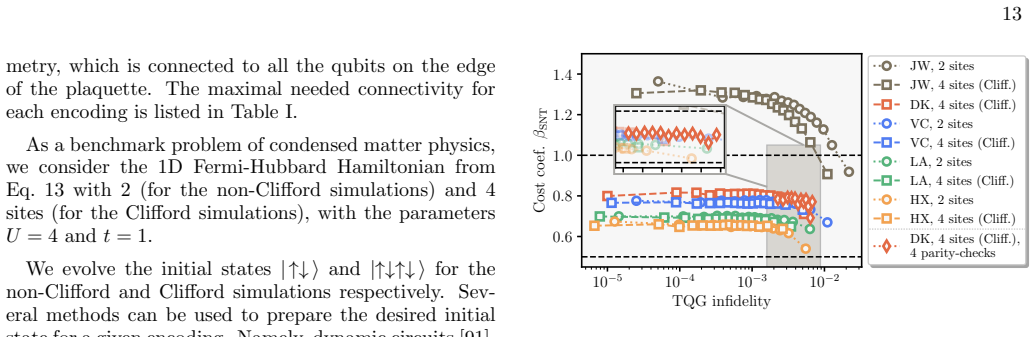
Quantum error mitigation (QEM) has emerged as a powerful tool for the extraction of useful quantum information from quantum devices. Here, we introduce the Subspace Noise Tailoring (SNT) algorithm, which efficiently combines the cheap cost of Symmetry Verification (SV) and low bias of Probabilistic Error Cancellation (PEC) QEM techniques. We study the performance of our method by simulating the Trotterized time evolution of the spin-1/2 Fermi-Hubbard model (FHM) using a variety of local fermion-to-qubit encodings, which define a computational subspace through a set of stabilizers, the measurement of which can be used to post-select noisy quantum data. We study different combinations of QEM and encodings and uncover a rich state diagram of optimal combinations, depending on the hardware performance, system size and available shot budget. We then demonstrate how SNT extends the reach of current noisy quantum computers in terms of the number of fermionic lattice sites and the number of Trotter steps, and quantify the required hardware performance beyond which a noisy device may compete with current state-of-the-art classical computational methods.
Editorial analysis
A structured set of objections, weighed in public.
Referee Report
Summary. The manuscript introduces Subspace Noise Tailoring (SNT), a hybrid QEM protocol that pairs symmetry verification (post-selection on stabilizers from fermion-to-qubit encodings) with probabilistic error cancellation. Applied to Trotterized time evolution of the spin-1/2 Fermi-Hubbard model, the authors map a state diagram of optimal encoding–QEM combinations as a function of hardware error rates, system size, and shot budget. They claim that SNT extends the reachable number of lattice sites and Trotter steps on noisy hardware and supply hardware-performance thresholds at which a quantum device could compete with state-of-the-art classical methods.
Significance. If the numerical results and overhead accounting hold, the work supplies a concrete, encoding-aware route to enlarge the practical reach of near-term fermionic simulations. The state diagram, conditioned on measurable hardware parameters, offers guidance for experimentalists; the hardware-threshold quantification is a useful benchmark even if the precise numbers shift with refined noise models.
major comments (2)
- [Results section (state diagram and hardware-threshold figures)] The central claim that SNT extends device reach (more sites, more Trotter steps) and supplies competition thresholds rests on post-selection via encoding stabilizers suppressing Trotter noise without prohibitive bias or overhead. The manuscript must demonstrate, in the results section presenting the state diagram and the subsequent performance-extension figures, that the energy observable remains unbiased after post-selection + PEC and that the 1/p_success overhead remains tractable across the plotted regimes; correlation between the Trotter error and the chosen stabilizers would invalidate the thresholds.
- [Performance-extension and threshold-quantification paragraphs] The weakest-assumption paragraph notes that overhead scales as 1/p_success and drops with system size and depth. The paper should report, for each encoding and each point in the state diagram, the measured or estimated p_success together with the total shot cost after PEC; without these numbers the assertion that SNT remains practical cannot be evaluated.
minor comments (1)
- [Methods and figure captions] Notation for the stabilizer projectors and the PEC quasiprobabilities should be unified between the methods section and the figure captions.
Simulated Author's Rebuttal
We thank the referee for their constructive and detailed comments, which help clarify the presentation of our results on Subspace Noise Tailoring (SNT). We address each major comment point by point below. Where the comments identify areas for explicit demonstration or additional reporting, we will revise the manuscript accordingly.
read point-by-point responses
-
Referee: [Results section (state diagram and hardware-threshold figures)] The central claim that SNT extends device reach (more sites, more Trotter steps) and supplies competition thresholds rests on post-selection via encoding stabilizers suppressing Trotter noise without prohibitive bias or overhead. The manuscript must demonstrate, in the results section presenting the state diagram and the subsequent performance-extension figures, that the energy observable remains unbiased after post-selection + PEC and that the 1/p_success overhead remains tractable across the plotted regimes; correlation between the Trotter error and the chosen stabilizers would invalidate the thresholds.
Authors: We agree that explicit verification of unbiased observables and tractable overhead is essential for the central claims. Our simulations already employ full density-matrix evolution with exact benchmarks on small systems to confirm that SNT (SV post-selection followed by PEC) yields unbiased energies within sampling error, because the stabilizers enforce the correct fermionic subspace and PEC removes the residual bias. However, to strengthen the results section, we will add dedicated panels or text explicitly showing pre- and post-SNT energy deviations from exact values, together with 1/p_success values across the plotted regimes. On the correlation concern, the stabilizers derive from the encoding symmetries, which are exactly preserved by the ideal Trotter evolution; our noise-model simulations show no invalidating correlation, and we will add a short clarifying paragraph on this point. revision: yes
-
Referee: [Performance-extension and threshold-quantification paragraphs] The weakest-assumption paragraph notes that overhead scales as 1/p_success and drops with system size and depth. The paper should report, for each encoding and each point in the state diagram, the measured or estimated p_success together with the total shot cost after PEC; without these numbers the assertion that SNT remains practical cannot be evaluated.
Authors: We concur that tabulating or plotting the explicit p_success probabilities and resulting total shot costs (post-PEC) for each encoding and state-diagram point would make the practicality assessment fully transparent. In the revised manuscript we will include this information, either as an additional table in the main text or as supplementary figures, covering representative points for all encodings considered. This will directly support the overhead-scaling statements in the weakest-assumption paragraph. revision: yes
Circularity Check
No circularity in SNT performance claims
full rationale
The paper introduces SNT as an explicit algorithmic combination of Symmetry Verification (post-selection on encoding stabilizers) and Probabilistic Error Cancellation, then evaluates its performance via direct numerical simulation of Trotterized Fermi-Hubbard dynamics under a stated noise model. All reported reach extensions, state diagrams, and hardware thresholds are outputs of those simulations on an external model; none reduce by definition, by renaming a fitted parameter as a prediction, or by load-bearing self-citation chains. The derivation chain is therefore self-contained against external benchmarks.
Axiom & Free-Parameter Ledger
Forward citations
Cited by 1 Pith paper
-
Fermionic Averaged Circuit Eigenvalue Sampling
FACES is a new protocol for simultaneous self-consistent learning of averaged error rates across many FLO gates with rigorously shown efficient sampling complexity via Kravchuk transformations.
Reference graph
Works this paper leans on
-
[1]
I. Georgescu, S. Ashhab, and F. Nori, Quantum simula- tion, Reviews of Modern Physics86, 153–185 (2014)
work page 2014
-
[2]
B. Fauseweh, Quantum many-body simulations on digi- tal quantum computers: State-of-the-art and future chal- lenges, Nature Communications15, 2123 (2024)
work page 2024
-
[3]
T. Hoefler, T. Haener, and M. Troyer, Disentangling hype from practicality: On realistically achieving quantum ad- vantage (2023), arXiv:2307.00523 [quant-ph]
-
[4]
A. Kandala, A. Mezzacapo, K. Temme, M. Takita, M. Brink, J. M. Chow, and J. M. Gambetta, Hardware- efficient variational quantum eigensolver for small molecules and quantum magnets, Nature549, 242–246 (2017)
work page 2017
-
[5]
R. Sagastizabal, X. Bonet-Monroig, M. Singh, M. A. Rol, C. C. Bultink, X. Fu, C. H. Price, V. P. Os- troukh, N. Muthusubramanian, A. Bruno, M. Beekman, N. Haider, T. E. O’Brien, and L. DiCarlo, Experimen- tal error mitigation via symmetry verification in a vari- ational quantum eigensolver, Physical Review A100, 10.1103/physreva.100.010302 (2019)
- [6]
-
[7]
F. Arute, K. Arya, R. Babbush, D. Bacon, J. C. Bardin, R. Barends, A. Bengtsson, S. Boixo, M. Broughton, B. B. Buckley, D. A. Buell, B. Burkett, N. Bushnell, Y. Chen, Z. Chen, Y.-A. Chen, B. Chiaro, R. Collins, S. J. Cot- ton, W. Courtney, S. Demura, A. Derk, A. Dunsworth, D. Eppens, T. Eckl, C. Erickson, E. Farhi, A. Fowler, B. Foxen, C. Gidney, M. Giust...
-
[8]
F. Arute, K. Arya, R. Babbush, D. Bacon, J. C. Bardin, R. Barends, S. Boixo, M. Broughton, B. B. Buck- ley, D. A. Buell, B. Burkett, N. Bushnell, Y. Chen, Z. Chen, B. Chiaro, R. Collins, W. Courtney, S. De- mura, A. Dunsworth, E. Farhi, A. Fowler, B. Foxen, 15 C. Gidney, M. Giustina, R. Graff, S. Habegger, M. P. Harrigan, A. Ho, S. Hong, T. Huang, W. J. H...
work page 2020
-
[9]
J. Dborin, V. Wimalaweera, F. Barratt, E. Ostby, T. E. O’Brien, and A. G. Green, Simulating groundstate and dynamical quantum phase transitions on a supercon- ducting quantum computer, Nature Communications13, 10.1038/s41467-022-33737-4 (2022)
-
[11]
T. E. O’Brien, G. Anselmetti, F. Gkritsis, V. E. Elfving, S. Polla, W. J. Huggins, O. Oumarou, K. Kechedzhi, D. Abanin, R. Acharya, I. Aleiner, R. Allen, T. I. An- dersen, K. Anderson, M. Ansmann, F. Arute, K. Arya, A. Asfaw, J. Atalaya, J. C. Bardin, A. Bengtsson, G. Bor- toli, A. Bourassa, J. Bovaird, L. Brill, M. Broughton, B. Buckley, D. A. Buell, T. ...
work page 2023
-
[12]
N. Yoshioka, M. Amico, W. Kirby, P. Jurcevic, A. Dutt, B. Fuller, S. Garion, H. Haas, I. Hamamura, A. Ivrii, R. Majumdar, Z. Minev, M. Motta, B. Pokharel, P. Rivero, K. Sharma, C. J. Wood, A. Javadi-Abhari, and A. Mezzacapo, Diagonalization of large many- body hamiltonians on a quantum processor (2024), arXiv:2407.14431 [quant-ph]
- [13]
-
[14]
R. Nigmatullin, K. Hemery, K. Ghanem, S. Moses, D. Gresh, P. Siegfried, M. Mills, T. Gatterman, N. He- witt, E. Granet, and H. Dreyer, Experimental demon- stration of break-even for the compact fermionic encod- ing (2024), arXiv:2409.06789 [quant-ph]
-
[15]
L. Vilchez-Estevez, R. A. Santos, S. Wang, and F. M. Gambetta, Extracting the spin excitation spectrum of a fermionic system using a quantum processor (2025), arXiv:2501.04649 [quant-ph]
-
[16]
J. Mildenberger, W. Mruczkiewicz, J. C. Halimeh, Z. Jiang, and P. Hauke, Confinement in aZ 2 lattice gauge theory on a quantum computer, Nature Physics 10.1038/s41567-024-02723-6 (2025)
- [17]
-
[18]
S. J. Evered, M. Kalinowski, A. A. Geim, T. Manovitz, D. Bluvstein, S. H. Li, N. Maskara, H. Zhou, S. Ebadi, M. Xu, J. Campo, M. Cain, S. Ostermann, S. F. Yelin, S. Sachdev, M. Greiner, V. Vuleti´ c, and M. D. Lukin, Probing topological matter and fermion dy- namics on a neutral-atom quantum computer (2025), arXiv:2501.18554 [quant-ph]
-
[19]
Y. Kim, A. Eddins, S. Anand, K. X. Wei, E. van den Berg, S. Rosenblatt, H. Nayfeh, Y. Wu, M. Zaletel, K. Temme, and A. Kandala, Evidence for the utility of quantum computing before fault tolerance, Nature618, 500 (2023)
work page 2023
-
[20]
C. Cade, L. Mineh, A. Montanaro, and S. Stanisic, Strategies for solving the fermi-hubbard model on near- term quantum computers, Phys. Rev. B102, 235122 (2020)
work page 2020
-
[21]
L. Clinton, J. Bausch, and T. Cubitt, Hamiltonian simu- lation algorithms for near-term quantum hardware, Na- ture Communications12, 4989 (2021)
work page 2021
-
[22]
M. G. Algaba, P. V. Sriluckshmy, M. Leib, and F. ˇSimkovic IV, Low-depth simulations of fermionic sys- tems on square-grid quantum hardware, Quantum8, 1327 (2024)
work page 2024
-
[23]
A. Jafarizadeh, F. Pollmann, and A. Gammon-Smith, A recipe for local simulation of strongly-correlated fermionic matter on quantum computers: the 2d fermi- hubbard model (2024), arXiv:2408.14543 [quant-ph]
-
[24]
Z. Cai, R. Babbush, S. C. Benjamin, S. Endo, W. J. Hug- gins, Y. Li, J. R. McClean, and T. E. O’Brien, Quantum 16 error mitigation, Rev. Mod. Phys.95, 045005 (2023)
work page 2023
-
[25]
X. Bonet-Monroig, R. Sagastizabal, M. Singh, and T. E. O’Brien, Low-cost error mitigation by symmetry verifi- cation, Phys. Rev. A98, 062339 (2018)
work page 2018
-
[26]
S. McArdle, X. Yuan, and S. Benjamin, Error-mitigated digital quantum simulation, Phys. Rev. Lett.122, 180501 (2019)
work page 2019
-
[27]
J. R. McClean, Z. Jiang, N. C. Rubin, R. Babbush, and H. Neven, Decoding quantum errors with subspace ex- pansions, Nature Communications11, 10.1038/s41467- 020-14341-w (2020)
-
[28]
W. J. Huggins, J. R. McClean, N. C. Rubin, Z. Jiang, N. Wiebe, K. B. Whaley, and R. Babbush, Efficient and noise resilient measurements for quantum chemistry on near-term quantum computers, npj Quantum Informa- tion7, 10.1038/s41534-020-00341-7 (2021)
-
[29]
Z. Cai, Multi-exponential error extrapolation and com- bining error mitigation techniques for nisq applications, npj Quantum Information7, 10.1038/s41534-021-00404- 3 (2021)
-
[30]
B. M. Terhal, Quantum error correction for quantum memories, Reviews of Modern Physics87, 307–346 (2015)
work page 2015
-
[31]
Kitaev, Anyons in an exactly solved model and be- yond, Annals of Physics321, 2–111 (2006)
A. Kitaev, Anyons in an exactly solved model and be- yond, Annals of Physics321, 2–111 (2006)
work page 2006
-
[32]
C. Derby, J. Klassen, J. Bausch, and T. Cubitt, Com- pact fermion to qubit mappings, Physical Review B104, 10.1103/physrevb.104.035118 (2021)
- [33]
- [34]
-
[35]
F. ˇSimkovic IV, M. Leib, and F. R. F. Pereira, Low- weight high-distance error-correcting fermionic encod- ings, Phys. Rev. Res.6, 043123 (2024)
work page 2024
-
[36]
P. Jordan and E. Wigner, ¨Uber das paulische ¨Aquivalenzverbot, Zeitschrift f¨ ur Physik47, 631 (1928)
work page 1928
-
[37]
S. B. Bravyi and A. Y. Kitaev, Fermionic quantum com- putation, Annals of Physics298, 210 (2002)
work page 2002
- [38]
- [39]
-
[40]
Y.-A. Chen, A. V. Gorshkov, and Y. Xu, Error-correcting codes for fermionic quantum simulation, SciPost Physics 16, 033 (2024)
work page 2024
-
[41]
Error mitigation for short-depth quantum circuits
K. Temme, S. Bravyi, and J. M. Gambetta, Error mitiga- tion for short-depth quantum circuits, Physical Review Letters119, 10.1103/physrevlett.119.180509 (2017)
work page internal anchor Pith review doi:10.1103/physrevlett.119.180509 2017
-
[42]
S. Endo, S. C. Benjamin, and Y. Li, Practical quan- tum error mitigation for near-future applications, Physi- cal Review X8, 10.1103/physrevx.8.031027 (2018)
-
[43]
E. van den Berg, Z. K. Minev, A. Kandala, and K. Temme, Probabilistic error cancellation with sparse pauli–lindblad models on noisy quantum processors, Na- ture Physics19, 1116–1121 (2023)
work page 2023
-
[44]
W. Chen, S. Zhang, J. Zhang, X. Su, Y. Lu, K. Zhang, M. Qiao, Y. Li, J.-N. Zhang, and K. Kim, Error- mitigated quantum simulation of interacting fermions with trapped ions, npj Quantum Information9, 10.1038/s41534-023-00784-8 (2023)
-
[45]
F. Verstraete and J. I. Cirac, Mapping local hamiltoni- ans of fermions to local hamiltonians of spins, Journal of Statistical Mechanics: Theory and Experiment2005, P09012 (2005)
work page 2005
- [46]
-
[47]
N. Fruitwala, A. Hashim, A. D. Rajagopala, Y. Xu, J. Hines, R. K. Naik, I. Siddiqi, K. Klymko, G. Huang, and K. Nowrouzi, Hardware-efficient randomized compil- ing (2024), arXiv:2406.13967 [quant-ph]
-
[48]
U. Schollw¨ ock, The density-matrix renormalization group in the age of matrix product states, Annals of Physics 326, 96–192 (2011)
work page 2011
-
[49]
S. Paeckel, T. K¨ ohler, A. Swoboda, S. R. Manmana, U. Schollw¨ ock, and C. Hubig, Time-evolution methods for matrix-product states, Annals of Physics411, 167998 (2019)
work page 2019
- [50]
- [51]
-
[52]
P. V. Sriluckshmy, V. Pina-Canelles, M. Ponce, M. G. Algaba, F. v. IV, and M. Leib, Optimal, hardware native decomposition of parameterized multi-qubit pauli gates, Quantum Science and Technology8, 045029 (2023)
work page 2023
-
[53]
A. Hashim, R. K. Naik, A. Morvan, J.-L. Ville, B. Mitchell, J. M. Kreikebaum, M. Davis, E. Smith, C. Iancu, K. P. O’Brien, I. Hincks, J. J. Wallman, J. Emerson, and I. Siddiqi, Randomized compiling for scalable quantum computing on a noisy superconducting quantum processor, Phys. Rev. X11, 041039 (2021)
work page 2021
-
[54]
J. P. Santos, B. Bar, and R. Uzdin, Pseudo twirling miti- gation of coherent errors in non-clifford gates, npj Quan- tum Information10, 100 (2024)
work page 2024
-
[55]
A. Erhard, J. J. Wallman, L. Postler, M. Meth, R. Stricker, E. A. Martinez, P. Schindler, T. Monz, J. Emerson, and R. Blatt, Characterizing large-scale quantum computers via cycle benchmarking, Na- ture Communications10, 10.1038/s41467-019-13068-7 (2019)
-
[56]
A. Carignan-Dugas, D. Dahlen, I. Hincks, E. Ospadov, S. J. Beale, S. Ferracin, J. Skanes-Norman, J. Emerson, and J. J. Wallman, The error reconstruction and com- piled calibration of quantum computing cycles (2023), arXiv:2303.17714 [quant-ph]
-
[57]
S. T. Flammia, Averaged circuit eigenvalue sampling (Schloss Dagstuhl – Leibniz-Zentrum f¨ ur Informatik, 2022)
work page 2022
-
[58]
A. Calzona, M. Papiˇ c, P. Figueroa-Romero, and A. Auer, Multi-layer cycle benchmarking for high-accuracy error characterization (2024), arXiv:2412.09332 [quant-ph]
-
[59]
E. van den Berg and P. Wocjan, Techniques for learn- ing sparse pauli-lindblad noise models, Quantum8, 1556 (2024). 17
work page 2024
- [60]
- [61]
- [62]
-
[63]
J. D. Guimar˜ aes, J. Lim, M. I. Vasilevskiy, S. F. Huelga, and M. B. Plenio, Noise-assisted digital quantum simu- lation of open systems using partial probabilistic error cancellation, PRX Quantum4, 040329 (2023)
work page 2023
- [64]
-
[65]
S. Chen, Y. Liu, M. Otten, A. Seif, B. Fefferman, and L. Jiang, The learnability of Pauli noise, Nat. Commun. 14, 1 (2023)
work page 2023
- [66]
-
[67]
K. Wintersperger, F. Dommert, T. Ehmer, A. Hour- sanov, J. Klepsch, W. Mauerer, G. Reuber, T. Strohm, M. Yin, and S. Luber, Neutral atom quantum comput- ing hardware: performance and end-user perspective, EPJ Quantum Technology10, 10.1140/epjqt/s40507- 023-00190-1 (2023)
-
[68]
S. Filippov, M. Leahy, M. A. C. Rossi, and G. Garc´ ıa- P´ erez, Scalable tensor-network error mitigation for near-term quantum computing (2023), arXiv:2307.11740 [quant-ph]
-
[69]
T. E. O’Brien, S. Polla, N. C. Rubin, W. J. Huggins, S. McArdle, S. Boixo, J. R. McClean, and R. Bab- bush, Error mitigation via verified phase estimation, PRX Quantum2, 10.1103/prxquantum.2.020317 (2021)
-
[70]
M. Huo and Y. Li, Dual-state purification for practi- cal quantum error mitigation, Physical Review A105, 10.1103/physreva.105.022427 (2022)
-
[71]
Y. Li and S. C. Benjamin, Efficient variational quantum simulator incorporating active error minimization, Phys- ical Review X7, 10.1103/physrevx.7.021050 (2017)
-
[72]
Qubit-efficient exponential suppression of errors,
P. Czarnik, A. Arrasmith, L. Cincio, and P. J. Coles, Qubit-efficient exponential suppression of errors (2021), arXiv:2102.06056 [quant-ph]
-
[73]
W. J. Huggins, S. McArdle, T. E. O’Brien, J. Lee, N. C. Rubin, S. Boixo, K. B. Whaley, R. Babbush, and J. R. McClean, Virtual distillation for quantum error mitiga- tion, Physical Review X11, 10.1103/physrevx.11.041036 (2021)
- [74]
- [75]
-
[76]
S. Bravyi, S. Sheldon, A. Kandala, D. C. Mckay, and J. M. Gambetta, Mitigating measurement errors in multiqubit experiments, Physical Review A103, 10.1103/physreva.103.042605 (2021)
- [77]
-
[78]
Demonstration of logical qubits and repeated error correction with better-than-physical error rates
A. Paetznick, M. P. da Silva, C. Ryan-Anderson, J. M. Bello-Rivas, J. P. C. III, A. Chernoguzov, J. M. Dreil- ing, C. Foltz, F. Frachon, J. P. Gaebler, T. M. Gatter- man, L. Grans-Samuelsson, D. Gresh, D. Hayes, N. He- witt, C. Holliman, C. V. Horst, J. Johansen, D. Luc- chetti, Y. Matsuoka, M. Mills, S. A. Moses, B. Neyen- huis, A. Paz, J. Pino, P. Siegf...
work page internal anchor Pith review Pith/arXiv arXiv 2024
-
[79]
Abanin, Laleh Aghababaie-Beni, Igor Aleiner, Trond I
R. Acharya, D. A. Abanin, L. Aghababaie-Beni, I. Aleiner, T. I. Andersen, M. Ansmann, F. Arute, K. Arya, A. Asfaw, N. Astrakhantsev, J. Atalaya, R. Babbush, D. Bacon, B. Ballard, J. C. Bardin, J. Bausch, A. Bengtsson, A. Bilmes, S. Blackwell, S. Boixo, G. Bortoli, A. Bourassa, J. Bovaird, L. Brill, M. Broughton, D. A. Browne, B. Buchea, B. B. Buck- ley, D...
-
[80]
S. J. Evered, D. Bluvstein, M. Kalinowski, S. Ebadi, T. Manovitz, H. Zhou, S. H. Li, A. A. Geim, T. T. Wang, N. Maskara, H. Levine, G. Semeghini, M. Greiner, V. Vuleti´ c, and M. D. Lukin, High-fidelity parallel entan- gling gates on a neutral-atom quantum computer, Nature 622, 268 (2023)
work page 2023
-
[81]
L. Ding, M. Hays, Y. Sung, B. Kannan, J. An, A. Di Paolo, A. H. Karamlou, T. M. Hazard, K. Azar, D. K. Kim, B. M. Niedzielski, A. Melville, M. E. Schwartz, J. L. Yoder, T. P. Orlando, S. Gustavsson, J. A. Grover, K. Serniak, and W. D. Oliver, High- fidelity, frequency-flexible two-qubit fluxonium gates with a transmon coupler, Phys. Rev. X13, 031035 (2023)
work page 2023
discussion (0)
Sign in with ORCID, Apple, or X to comment. Anyone can read and Pith papers without signing in.