Approximate Excited-State Potential Energy Surfaces for Defects in Solids
Pith reviewed 2026-05-19 09:03 UTC · model grok-4.3
The pith
Excited-state forces evaluated at the ground-state geometry approximate electron-phonon coupling and Huang-Rhys factors for defects in solids.
A machine-rendered reading of the paper's core claim, the machinery that carries it, and where it could break.
Core claim
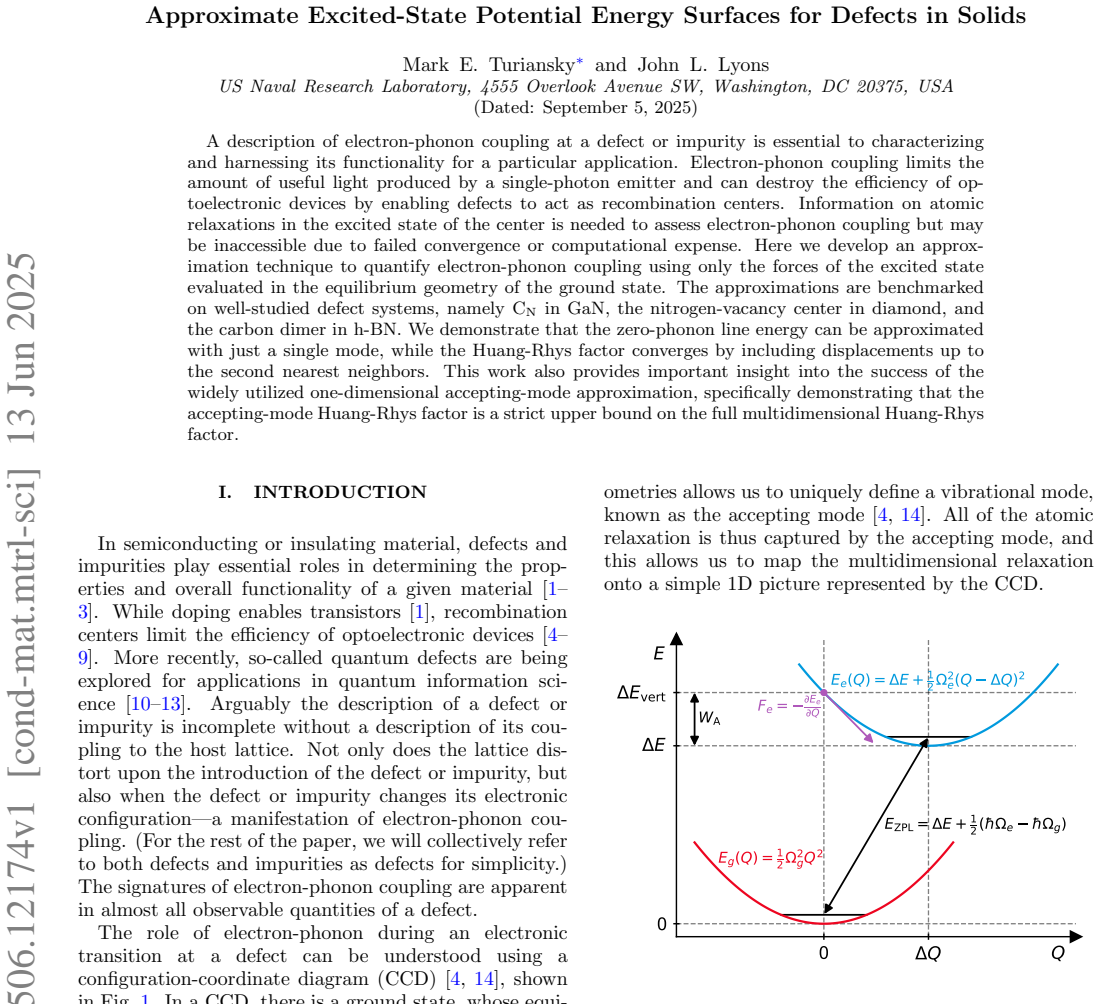
By evaluating the forces in the excited electronic state at the equilibrium geometry of the ground state, an approximate excited-state potential energy surface can be constructed. This surface enables computation of the zero-phonon line and the Huang-Rhys factor without performing an explicit excited-state geometry optimization. The method demonstrates convergence of the Huang-Rhys factor with inclusion of second-nearest-neighbor displacements and proves that the one-dimensional accepting-mode Huang-Rhys factor is an upper bound to the multidimensional result.
What carries the argument
The force-based approximation to the excited-state potential energy surface using ground-state geometry forces.
If this is right
- The zero-phonon line can be approximated with a single mode.
- The Huang-Rhys factor converges with displacements up to second-nearest neighbors.
- The accepting-mode Huang-Rhys factor strictly upper bounds the full multidimensional Huang-Rhys factor.
- The approximation enables assessment of electron-phonon coupling where excited-state optimizations fail to converge.
Where Pith is reading between the lines
- This technique could lower the computational cost for evaluating many potential defect candidates in material screening.
- It suggests that coupling is dominated by local relaxations within the second neighbor shell.
- The upper bound may aid in conservative estimates of coupling strengths from simpler models.
Load-bearing premise
Forces computed in the excited state at the ground-state geometry are sufficient to approximate the excited-state potential energy surface without explicit optimization or anharmonic corrections.
What would settle it
Full excited-state geometry optimization on the nitrogen-vacancy center in diamond producing a Huang-Rhys factor differing substantially from the force approximation would falsify the method's reliability.
Figures




read the original abstract
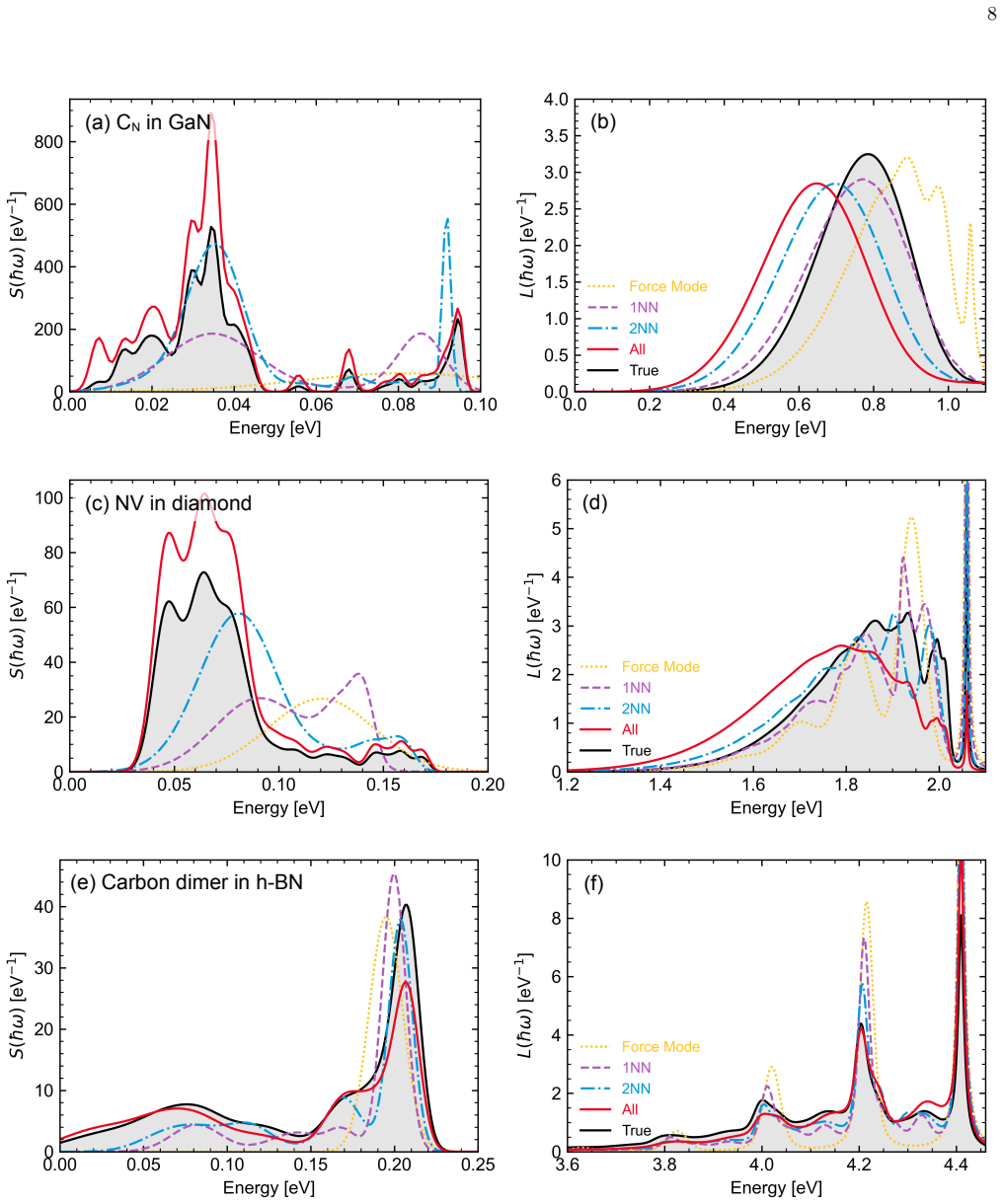
A description of electron-phonon coupling at a defect or impurity is essential to characterizing and harnessing its functionality for a particular application. Electron-phonon coupling limits the amount of useful light produced by a single-photon emitter and can destroy the efficiency of optoelectronic devices by enabling defects to act as recombination centers. Information on atomic relaxations in the excited state of the center is needed to assess electron-phonon coupling but may be inaccessible due to failed convergence or computational expense. Here we develop an approximation technique to quantify electron-phonon coupling using only the forces of the excited state evaluated in the equilibrium geometry of the ground state. The approximations are benchmarked on well-studied defect systems, namely C$_{\rm N}$ in GaN, the nitrogen-vacancy center in diamond, and the carbon dimer in h-BN. We demonstrate that the zero-phonon line energy can be approximated with just a single mode, while the Huang-Rhys factor converges by including displacements up to the second nearest neighbors. This work also provides important insight into the success of the widely utilized one-dimensional accepting-mode approximation, specifically demonstrating that the accepting-mode Huang-Rhys factor is a strict upper bound on the full multidimensional Huang-Rhys factor.
Editorial analysis
A structured set of objections, weighed in public.
Referee Report
Summary. The manuscript develops an approximation for excited-state potential energy surfaces of point defects in solids that relies solely on excited-state forces evaluated at the ground-state geometry. Displacements are obtained by projecting these forces onto ground-state normal modes, yielding estimates of the zero-phonon line (ZPL) energy and the Huang-Rhys (HR) factor without explicit excited-state geometry optimization. The approach is benchmarked on three systems (C_N in GaN, NV center in diamond, carbon dimer in h-BN). Central claims are that a single accepting mode suffices for the ZPL, that the HR factor converges once displacements up to second-nearest neighbors are included, and that the one-dimensional accepting-mode HR factor constitutes a strict upper bound on the full multidimensional HR factor.
Significance. If the linear-force approximation and the upper-bound property hold under the stated conditions, the method would provide a low-cost route to electron-phonon parameters for defects where full excited-state relaxations are prohibitive. The explicit demonstration that the accepting-mode HR factor overestimates the multidimensional sum supplies a concrete rationale for the empirical success of one-dimensional models. The benchmarks on well-studied systems and the reported neighbor-convergence behavior are useful practical results.
major comments (3)
- [§3.2, Eq. (8)] §3.2 and Eq. (8): the claim that the accepting-mode HR factor is a strict upper bound on the multidimensional sum is derived under the linear-force, fixed-Hessian approximation. The skeptic note correctly identifies that any appreciable change in excited-state curvature or anharmonic shift of the minimum would make the bound geometry-dependent rather than general; a short analytic counter-example or additional numerical test with recomputed excited-state force constants is needed to establish robustness.
- [§4.3, Table 2] §4.3 and Table 2: the reported convergence of the HR factor by second-nearest neighbors is shown for the three benchmark systems, yet the neighbor cutoff distance remains a free parameter. The manuscript should quantify the sensitivity of both the bound and the convergence radius to modest variations in this cutoff (e.g., 3.0 Å vs. 3.5 Å) to confirm that the second-neighbor result is not an artifact of post-hoc selection.
- [§2.1] §2.1: the central construction equates the excited-state displacement vector to the projection of the excited-state force onto ground-state modes (implicitly ΔQ ≈ F/ω²). While this is computationally attractive, the manuscript does not report the magnitude of the neglected quadratic and higher force-constant changes; a direct comparison of ground- versus excited-state Hessians for at least one system would strengthen the claim that the linear term dominates.
minor comments (2)
- [Figure 3] Figure 3 caption: the legend for the partial HR factors is difficult to read at the printed size; enlarging the symbols or adding a table of numerical values would improve clarity.
- Notation: the symbol S is used both for the total HR factor and for its one-dimensional projection; a brief clarifying sentence or subscript would eliminate ambiguity.
Simulated Author's Rebuttal
We thank the referee for the careful and constructive review of our manuscript. We appreciate the opportunity to clarify and strengthen our work in response to the major comments. Below we provide point-by-point responses.
read point-by-point responses
-
Referee: [§3.2, Eq. (8)] §3.2 and Eq. (8): the claim that the accepting-mode HR factor is a strict upper bound on the multidimensional sum is derived under the linear-force, fixed-Hessian approximation. The skeptic note correctly identifies that any appreciable change in excited-state curvature or anharmonic shift of the minimum would make the bound geometry-dependent rather than general; a short analytic counter-example or additional numerical test with recomputed excited-state force constants is needed to establish robustness.
Authors: We agree with the referee that the strict upper-bound property is established within the linear-force and fixed-Hessian framework. To address concerns about robustness, we will revise the manuscript to include a brief analytic discussion of the conditions under which the bound remains valid. Additionally, we will perform and report a numerical test for one system by evaluating the excited-state force constants at the displaced geometry to check for significant curvature changes. This addition will be placed in Section 3 or as a supplementary note. revision: yes
-
Referee: [§4.3, Table 2] §4.3 and Table 2: the reported convergence of the HR factor by second-nearest neighbors is shown for the three benchmark systems, yet the neighbor cutoff distance remains a free parameter. The manuscript should quantify the sensitivity of both the bound and the convergence radius to modest variations in this cutoff (e.g., 3.0 Å vs. 3.5 Å) to confirm that the second-neighbor result is not an artifact of post-hoc selection.
Authors: We thank the referee for this suggestion. In the revised manuscript, we will add an analysis of the sensitivity of the HR factor and the upper bound to variations in the neighbor cutoff distance. Specifically, we will report results for cutoffs of 3.0 Å and 3.5 Å across the benchmark systems and demonstrate that the convergence behavior and the bounding property are insensitive to these modest changes. This will be incorporated into Section 4.3 and Table 2 will be updated accordingly. revision: yes
-
Referee: [§2.1] §2.1: the central construction equates the excited-state displacement vector to the projection of the excited-state force onto ground-state modes (implicitly ΔQ ≈ F/ω²). While this is computationally attractive, the manuscript does not report the magnitude of the neglected quadratic and higher force-constant changes; a direct comparison of ground- versus excited-state Hessians for at least one system would strengthen the claim that the linear term dominates.
Authors: We acknowledge that quantifying the neglected higher-order terms would provide additional support for the approximation. In the revised version of the manuscript, we will include a direct comparison of the ground-state and excited-state Hessians for the NV center in diamond as a representative case. This comparison will show the relative magnitude of changes in the force constants, thereby justifying the dominance of the linear term in the displacement calculation. The new data will be presented in Section 2.1 or an appendix. revision: yes
Circularity Check
No significant circularity; derivation remains self-contained
full rationale
The paper constructs an approximation to the excited-state PES from excited-state forces evaluated only at the ground-state geometry, then uses normal-mode projections to obtain displacements and Huang-Rhys factors. The central claim that the accepting-mode Huang-Rhys factor is a strict upper bound on the multidimensional sum follows directly from the vector definition of total relaxation energy versus its projection onto a single effective mode; this is a general mathematical relation under the linear-force approximation and does not reduce to any fitted parameter or prior self-citation. Convergence with second-nearest-neighbor displacements is demonstrated by explicit summation over atoms in the benchmark systems rather than by construction. No load-bearing step equates a derived quantity to its own input via definition or self-referential citation.
Axiom & Free-Parameter Ledger
free parameters (1)
- neighbor cutoff distance
axioms (1)
- domain assumption Excited-state forces at ground-state geometry suffice to approximate the excited-state potential energy surface for electron-phonon coupling quantities
Lean theorems connected to this paper
-
IndisputableMonolith/Cost/FunctionalEquation.leanwashburn_uniqueness_aczel unclear?
unclearRelation between the paper passage and the cited Recognition theorem.
the accepting-mode Huang-Rhys factor is a strict upper bound on the full multidimensional Huang-Rhys factor... Stot ≤ ½ℏ (∑ω_i²Δq_i²)^{1/2}(∑Δq_i²)^{1/2} ≤ S_A (Cauchy-Schwarz)
-
IndisputableMonolith/Foundation/AlphaCoordinateFixation.leancostAlphaLog_high_calibrated_iff unclear?
unclearRelation between the paper passage and the cited Recognition theorem.
Ee({q}) = ΔE + ½ ∑ ω_i² (q_i − Δq_i)² ... Δq_i obtained from excited-state forces at ground-state geometry
What do these tags mean?
- matches
- The paper's claim is directly supported by a theorem in the formal canon.
- supports
- The theorem supports part of the paper's argument, but the paper may add assumptions or extra steps.
- extends
- The paper goes beyond the formal theorem; the theorem is a base layer rather than the whole result.
- uses
- The paper appears to rely on the theorem as machinery.
- contradicts
- The paper's claim conflicts with a theorem or certificate in the canon.
- unclear
- Pith found a possible connection, but the passage is too broad, indirect, or ambiguous to say the theorem truly supports the claim.
Forward citations
Cited by 1 Pith paper
-
Machine Learning Phonon Spectra for Fast and Accurate Optical Lineshapes of Defects
Machine learning interatomic potentials fine-tuned on first-principles relaxation data accurately reproduce phonon spectra and optical lineshapes for defects, matching explicit calculations and experiments.
Reference graph
Works this paper leans on
-
[1]
If onlyE ZPL is required, then the force-mode ap- proximation is sufficient
-
[2]
If information on the coupling to phonons (e.g., SA) or higher accuracy is required, then additional modes can be included
-
[3]
Additional modes can be generated by starting with the force mode and computing unit Cartesian displacements on atoms up to 1NN or 2NN from the defect, followed by an orthogonalization of the modes. V. EXAMPLE APPLICA TION: SPECTRAL DENSITIES AND LUMINESCENCE LINESHAPES We have demonstrated that including additional modes can improve the description of at...
-
[4]
M. D. McCluskey and E. E. Haller,Dopants and Defects in Semiconductors, 2nd ed. (CRC Press, 2018)
work page 2018
-
[5]
A. Alkauskas, M. D. McCluskey, and C. G. Van de Walle, J. Appl. Phys.119, 181101 (2016)
work page 2016
-
[6]
C. Freysoldt, B. Grabowski, T. Hickel, J. Neugebauer, G. Kresse, A. Janotti, and C. G. Van de Walle, Rev. Mod. Phys.86, 253 (2014)
work page 2014
-
[7]
A. M. Stoneham,Theory of Defects in Solids: Electronic Structure of Defects in Insulators and Semiconductors (Clarendon Press, Oxford, 1975)
work page 1975
- [8]
-
[9]
R. N. Hall, Phys. Rev.87, 387 (1952)
work page 1952
-
[10]
A. Alkauskas, Q. Yan, and C. G. Van de Walle, Phys. Rev. B90, 075202 (2014)
work page 2014
-
[11]
S. R. Kavanagh, A. Walsh, and D. O. Scanlon, ACS En- ergy Lett.6, 1392 (2021)
work page 2021
-
[12]
B. Dou, S. Falletta, J. Neugebauer, C. Freysoldt, X. Zhang, and S.-H. Wei, Phys. Rev. Applied19, 054054 (2023)
work page 2023
-
[13]
L. C. Bassett, A. Alkauskas, A. L. Exarhos, and K.-M. C. Fu, Nanophotonics8, 1867 (2019)
work page 2019
-
[14]
G. Wolfowicz, F. J. Heremans, C. P. Anderson, S. Kanai, H. Seo, A. Gali, G. Galli, and D. D. Awschalom, Nat. Rev. Mater.6, 906 (2021)
work page 2021
-
[15]
C. E. Dreyer, A. Alkauskas, J. L. Lyons, A. Janotti, and C. G. Van de Walle, Annu. Rev. Mater. Res.48, 1 (2018)
work page 2018
-
[16]
M. E. Turiansky, K. Parto, G. Moody, and C. G. Van de Walle, APL Photonics9, 066117 (2024)
work page 2024
-
[17]
A. M. Stoneham, Rep. Prog. Phys.44, 1251 (1981)
work page 1981
-
[18]
H. Seo, V. Iv´ ady, and Y. Ping, Appl. Phys. Lett.125, 140501 (2024)
work page 2024
- [19]
-
[20]
A. Alkauskas, B. B. Buckley, D. D. Awschalom, and C. G. Van de Walle, New J. Phys.16, 073026 (2014)
work page 2014
-
[21]
L. Razinkovas, M. W. Doherty, N. B. Manson, C. G. Van de Walle, and A. Alkauskas, Phys. Rev. B104, 045303 (2021)
work page 2021
-
[22]
M. E. Turiansky, A. Alkauskas, M. Engel, G. Kresse, D. Wickramaratne, J.-X. Shen, C. E. Dreyer, and C. G. Van de Walle, Comput. Phys. Commun.267, 108056 (2021)
work page 2021
- [23]
-
[24]
L. R. Nichols, G. Li, Y. Yu, J. Jiang, A. O’Hara, G. D. Barmparis, S. T. Pantelides, and X.-G. Zhang, Phys. Rev. B111, 045201 (2025)
work page 2025
-
[25]
L. Shi, K. Xu, and L.-W. Wang, Phys. Rev. B91, 205315 (2015)
work page 2015
-
[26]
D. Wickramaratne, J.-X. Shen, A. Alkauskas, and C. G. Van de Walle, Phys. Rev. B97, 077301 (2018)
work page 2018
-
[27]
A. Alkauskas, J. L. Lyons, D. Steiauf, and C. G. Van de Walle, Phys. Rev. Lett.109, 267401 (2012)
work page 2012
-
[28]
R. O. Jones and O. Gunnarsson, Rev. Mod. Phys.61, 689 (1989)
work page 1989
-
[29]
M. Mackoit-Sinkeviˇ cien˙ e, M. Maciaszek, C. G. Van de Walle, and A. Alkauskas, Appl. Phys. Lett.115, 212101 (2019)
work page 2019
- [30]
- [31]
-
[32]
Y. Xiong and G. Hautier, ∆SCF in VASP for excited- state defect computations: Tips and pitfalls (2025), arXiv:2505.04748 [cond-mat]
-
[33]
See the appendix of O. Bulancea-Lindvall, J. Davidsson, I. G. Ivanov, A. Gali, V. Iv´ ady, R. Armiento, and I. A. Abrikosov, Phys. Rev. Applied22, 034056 (2024)
work page 2024
-
[34]
J. R. Reimers, A. Sajid, R. Kobayashi, and M. J. Ford, J. Chem. Theory Comput.14, 1602 (2018)
work page 2018
-
[35]
Y. Jin, V. W.-z. Yu, M. Govoni, A. C. Xu, and G. Galli, J. Chem. Theory Comput.19, 8689 (2023)
work page 2023
-
[36]
Y. Jin, M. Govoni, and G. Galli, npj Comput. Mater.8, 238 (2022)
work page 2022
-
[37]
L. Muechler, D. I. Badrtdinov, A. Hampel, J. Cano, M. R¨ osner, and C. E. Dreyer, Phys. Rev. B105, 235104 (2022)
work page 2022
-
[38]
H. Ma, N. Sheng, M. Govoni, and G. Galli, J. Chem. Theory Comput.17, 2116 (2021)
work page 2021
- [39]
-
[40]
Q. Yan, S. Kar, S. Chowdhury, and A. Bansil, Adv. Mater.36, 2303098 (2024)
work page 2024
- [41]
-
[42]
I. Mosquera-Lois, S. R. Kavanagh, A. M. Ganose, and A. Walsh, npj Comput. Mater.10, 1 (2024)
work page 2024
- [43]
-
[44]
J. C. Thomas, W. Chen, Y. Xiong, B. A. Barker, J. Zhou, W. Chen, A. Rossi, N. Kelly, Z. Yu, D. Zhou, S. Ku- mari, E. S. Barnard, J. A. Robinson, M. Terrones, A. Schwartzberg, D. F. Ogletree, E. Rotenberg, M. M. Noack, S. Griffin, A. Raja, D. A. Strubbe, G.-M. Rig- nanese, A. Weber-Bargioni, and G. Hautier, Nat. Com- mun.15, 3556 (2024)
work page 2024
-
[45]
Y. Kumagai, N. Tsunoda, A. Takahashi, and F. Oba, Phys. Rev. Mater.5, 123803 (2021)
work page 2021
-
[46]
J. L. Lyons, A. Janotti, and C. G. Van de Walle, Appl. Phys. Lett.97, 152108 (2010)
work page 2010
-
[47]
J. L. Lyons, A. Janotti, and C. G. Van de Walle, Phys. Rev. B89, 035204 (2014)
work page 2014
-
[48]
D. J. Chadi and K. J. Chang, Phys. Rev. B39, 10063 (1989)
work page 1989
- [49]
-
[50]
X. Zhang, J.-X. Shen, M. E. Turiansky, and C. G. Van de Walle, Nat. Mater.20, 971 (2021)
work page 2021
-
[51]
L. D. Whalley, P. van Gerwen, J. M. Frost, S. Kim, S. N. Hood, and A. Walsh, J. Am. Chem. Soc.143, 9123 (2021)
work page 2021
-
[52]
D. Meggiolaro, S. G. Motti, E. Mosconi, A. J. Barker, J. Ball, C. A. R. Perini, F. Deschler, A. Petrozza, and F. D. Angelis, Energy Environ. Sci.11, 702 (2018)
work page 2018
-
[53]
Since we are interested in excited- state relaxation, we work with the associated quantities
A Huang-Rhys factor can be equivalently defined in the ground state, using Ω g, which is more relevant for lumi- nescence experiments. Since we are interested in excited- state relaxation, we work with the associated quantities. 11 However, we will also assume the phonon frequencies are the same, making the two definitions of the Huang-Rhys factor identic...
-
[54]
J. Zhou, S. Wang, M. Huang, X.-G. Gong, and S. Chen, Phys. Rev. B111, 115202 (2025)
work page 2025
-
[55]
S. Kim, S. N. Hood, and A. Walsh, Phys. Rev. B100, 041202 (2019)
work page 2019
- [56]
-
[57]
T. J. Smart, K. Li, J. Xu, and Y. Ping, npj Comput. Mater.7, 1 (2021)
work page 2021
-
[58]
Y. Jin, J. Park, M. M. McMillan, D. D. Ohm, C. Barnes, B. Pingault, C. Egerstrom, B. Huang, M. Govoni, F. J. Heremans, D. D. Awschalom, and G. Galli, First- Principles Framework for the Prediction of Intersystem Crossing Rates in Spin Defects: The Role of Electron Correlation (2025), arXiv:2502.19658 [cond-mat]
-
[59]
M. Lax, J. Chem. Phys.20, 1752 (1952)
work page 1952
- [60]
-
[61]
F. Zhao, H. Guan, M. E. Turiansky, and C. G. Van de Walle, Appl. Phys. Lett.126, 201106 (2025)
work page 2025
-
[62]
J. M. Steele,The Cauchy-Schwarz Master Class: An In- troduction to the Art of Mathematical Inequalities(Cam- bridge University Press, Cambridge, 2004)
work page 2004
- [63]
- [64]
-
[65]
P. E. Bl¨ ochl, Phys. Rev. B50, 17953 (1994)
work page 1994
-
[66]
J. Heyd, G. E. Scuseria, and M. Ernzerhof, J. Chem. Phys.118, 8207 (2003)
work page 2003
-
[67]
J. Heyd, G. E. Scuseria, and M. Ernzerhof, J. Chem. Phys.124, 219906 (2006)
work page 2006
- [68]
-
[69]
M. E. Turiansky, A. Alkauskas, L. C. Bassett, and C. G. Van de Walle, Phys. Rev. Lett.123, 127401 (2019)
work page 2019
- [70]
- [71]
-
[72]
I. B. Bersuker,The Jahn-Teller Effect(Cambridge Uni- versity Press, Cambridge, 2006). Appendix A: Computational Details We perform density functional theory calculations as implemented in the VASP code [60, 61] version 6.4.3. The projector augmented-wave formalism [62] is used to freeze the core electrons, and the valence electrons are represented in a pl...
work page 2006
discussion (0)
Sign in with ORCID, Apple, or X to comment. Anyone can read and Pith papers without signing in.