Phase-space excluded-volume approach for light clusters in nuclear medium
Pith reviewed 2026-05-19 08:55 UTC · model grok-4.3
The pith
Phase-space excluded-volume approach determines when light clusters can form in nuclear matter by enforcing low total nucleon occupation.
A machine-rendered reading of the paper's core claim, the machinery that carries it, and where it could break.
Core claim
By developing a phase-space excluded-volume approach, the authors establish that light clusters in nuclear matter can only persist under conditions of low total nucleon phase-space occupation including the clusters themselves, with self-consistent distributions determined via Skyrme functionals to compute the Mott momentum and cluster fractions.
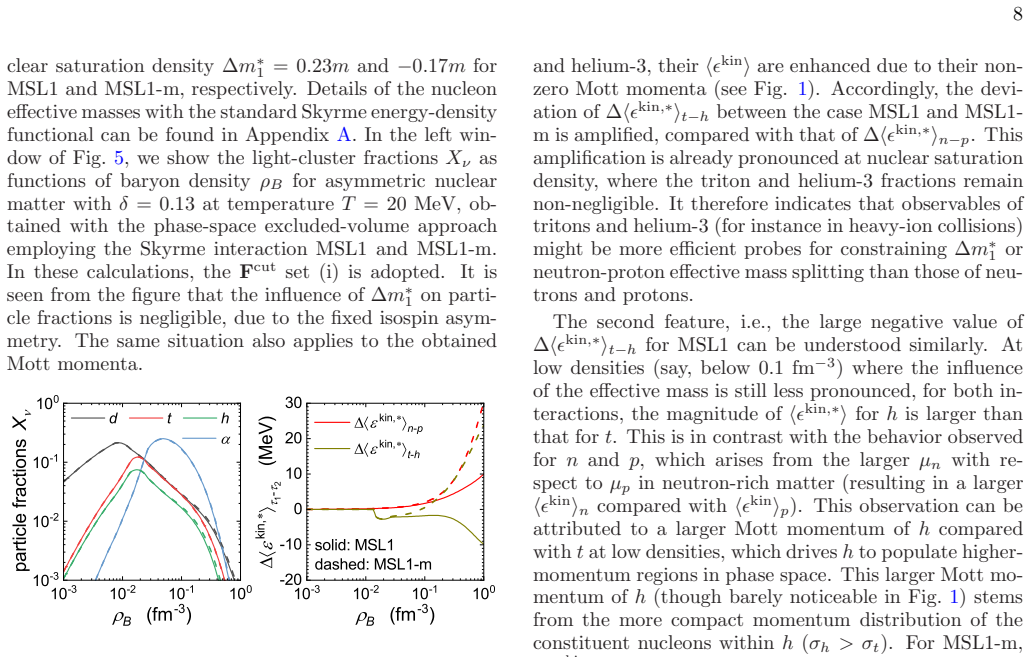
What carries the argument
The phase-space excluded-volume condition that restricts light cluster existence to regions of sufficiently low total nucleon phase-space occupation in the nuclear medium.
If this is right
- The Mott momentum for light clusters can be evaluated in nuclear matter.
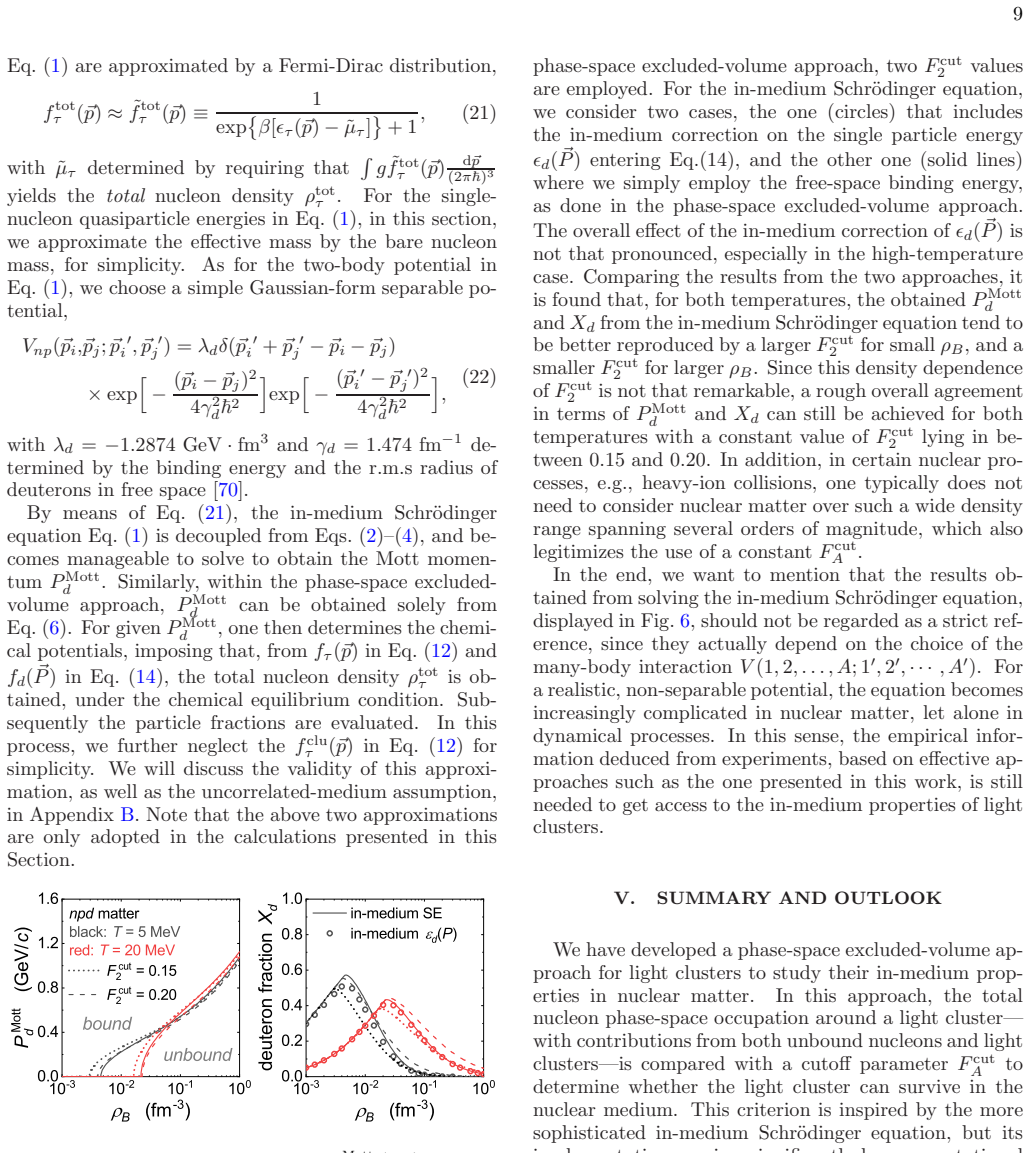
- The fraction of light clusters in nuclear matter can be calculated.
- Nucleon and cluster distribution functions are determined self-consistently.
- The method integrates into dynamical models for studying in-medium effects using heavy-ion collision data.
Where Pith is reading between the lines
- Comparisons of predicted cluster fractions with heavy-ion collision measurements at different densities could test the occupation threshold directly.
- The self-consistent framework may allow extensions to finite nuclei or varying temperatures to explore clustering boundaries.
- Integration with transport simulations could improve modeling of light element production in high-density environments encountered in collisions.
Load-bearing premise
Light clusters can exist only if the total nucleon phase-space occupation of the surrounding nuclear medium, including explicit contributions from light clusters, is sufficiently low.
What would settle it
Experimental data from heavy-ion collisions showing substantial light cluster production in regimes where the total phase-space occupation is calculated to be high would challenge the validity of the excluded-volume condition.
Figures


read the original abstract
A phase-space excluded-volume approach is developed to investigate the in-medium properties of light clusters in nuclear matter. In this approach, light clusters can exist only if the total nucleon phase-space occupation of the surrounding nuclear medium -- including explicit contributions from light clusters -- is sufficiently low. The distribution functions of nucleons and light clusters are determined self-consistently by accounting for the interplay between in-medium effects and thermodynamic properties. By employing standard Skyrme energy-density functionals to model the nuclear mean-field potential, the approach enables the evaluation of the Mott momentum and the fraction of light clusters in nuclear matter. Furthermore, it can be readily integrated into dynamical models, to study in-medium effects on light clusters, based on measured yields in heavy-ion collisions.
Editorial analysis
A structured set of objections, weighed in public.
Referee Report
Summary. The manuscript develops a phase-space excluded-volume approach for light clusters in nuclear matter. Light clusters exist only when the total nucleon phase-space occupation of the surrounding medium, including explicit contributions from the clusters themselves, remains sufficiently low. Nucleon and cluster distribution functions are solved self-consistently, with the nuclear mean-field potential supplied by standard Skyrme energy-density functionals. This framework is used to compute the Mott momentum and the in-medium fractions of light clusters, and the authors note that the method can be incorporated into dynamical models for heavy-ion collisions.
Significance. If the central construction is placed on a firmer microscopic footing, the approach would supply a practical route to embed in-medium cluster suppression inside existing Skyrme-based transport codes, directly linking mean-field potentials to observable cluster yields. The self-consistent treatment of phase-space occupation and the explicit inclusion of cluster contributions to that occupation constitute a clear technical advance over purely phenomenological excluded-volume prescriptions.
major comments (2)
- [§2.1] §2.1 (phase-space occupation condition): The requirement that light clusters exist only when the total nucleon phase-space occupation (nucleons plus explicit cluster contributions) is 'sufficiently low' is introduced as a physical domain assumption rather than derived from the Skyrme functional or from the underlying quantum mechanics. Because this cutoff directly sets the self-consistent distribution functions, the extracted Mott momentum and cluster fractions inherit an uncontrolled sensitivity to the precise numerical value chosen for the threshold.
- [§3] §3 (self-consistent solution): The manner in which composite clusters occupy nucleon phase space—via their momentum distributions or internal structure—is not obtained from the Skyrme energy-density functional but is instead imposed through the excluded-volume construction. Altering this modeling choice while keeping the same Skyrme parametrization changes the reported cluster fractions by amounts comparable to the in-medium suppression itself, undermining the claim that the Skyrme functionals alone enable reliable evaluation.
minor comments (2)
- Notation for the total phase-space occupation variable is introduced without an explicit equation reference in the early sections; adding a numbered definition would improve readability.
- The manuscript would benefit from a short table comparing the present Mott momenta with those obtained in earlier excluded-volume or quantum-statistical approaches using the same Skyrme parametrizations.
Simulated Author's Rebuttal
We thank the referee for the careful reading and constructive comments on our manuscript. We address the two major comments point by point below. Where the comments identify areas needing clarification or additional analysis, we have revised the manuscript accordingly.
read point-by-point responses
-
Referee: [§2.1] The requirement that light clusters exist only when the total nucleon phase-space occupation (nucleons plus explicit cluster contributions) is 'sufficiently low' is introduced as a physical domain assumption rather than derived from the Skyrme functional or from the underlying quantum mechanics. Because this cutoff directly sets the self-consistent distribution functions, the extracted Mott momentum and cluster fractions inherit an uncontrolled sensitivity to the precise numerical value chosen for the threshold.
Authors: We acknowledge that the phase-space occupation threshold is introduced as a modeling assumption grounded in the physical expectation of Pauli blocking preventing cluster formation in densely occupied phase space. It is not derived directly from the Skyrme energy-density functional, which instead supplies the mean-field potentials entering the distribution functions. To address the sensitivity issue, we have added a dedicated discussion and numerical tests varying the threshold between 0.1 and 0.3. These tests demonstrate that while absolute values shift, the qualitative behavior of the Mott momentum and cluster abundances remains robust, consistent with the physical motivation of the cutoff. revision: yes
-
Referee: [§3] The manner in which composite clusters occupy nucleon phase space—via their momentum distributions or internal structure—is not obtained from the Skyrme energy-density functional but is instead imposed through the excluded-volume construction. Altering this modeling choice while keeping the same Skyrme parametrization changes the reported cluster fractions by amounts comparable to the in-medium suppression itself, undermining the claim that the Skyrme functionals alone enable reliable evaluation.
Authors: The Skyrme functionals determine the mean-field potential acting on both nucleons and clusters, which is the central input for the self-consistent solution. The excluded-volume construction provides the practical mechanism to enforce the total phase-space occupation condition, including explicit cluster contributions. The manuscript does not assert that results follow from Skyrme functionals in isolation from all other modeling elements; the advance lies in the self-consistent coupling within a framework usable in transport codes. We have revised the text to clarify this division of roles and to note that variations with different excluded-volume implementations are expected, while the link to standard Skyrme parametrizations remains a key feature. revision: partial
Circularity Check
No significant circularity: modeling assumption is external to the derivation chain
full rationale
The paper introduces a phase-space excluded-volume condition as an explicit physical modeling assumption (light clusters exist only when total nucleon phase-space occupation, including cluster contributions, is sufficiently low). Distribution functions are then solved self-consistently using this assumption together with standard Skyrme energy-density functionals for the mean field. The Mott momentum and cluster fractions follow from solving the resulting equations; neither quantity is obtained by fitting a parameter to a subset of the target observables and then relabeling the fit as a prediction, nor does any load-bearing step reduce to a self-citation whose content is itself unverified. The framework therefore remains self-contained against external benchmarks and does not exhibit the enumerated circularity patterns.
Axiom & Free-Parameter Ledger
axioms (1)
- domain assumption Light clusters can exist only if the total nucleon phase-space occupation of the surrounding nuclear medium, including explicit contributions from light clusters, is sufficiently low.
Lean theorems connected to this paper
-
IndisputableMonolith/Cost/FunctionalEquation.leanwashburn_uniqueness_aczel contradicts?
contradictsCONTRADICTS: the theorem conflicts with this paper passage, or marks a claim that would need revision before publication.
light clusters can exist only if the total nucleon phase-space occupation … is sufficiently low … cutoff value 1/F_cut^A … three sets of Fcut … (0.10,0.15,0.25) etc.
-
IndisputableMonolith/Foundation/RealityFromDistinction.leanreality_from_one_distinction unclear?
unclearRelation between the paper passage and the cited Recognition theorem.
By employing standard Skyrme energy-density functionals to model the nuclear mean-field potential
What do these tags mean?
- matches
- The paper's claim is directly supported by a theorem in the formal canon.
- supports
- The theorem supports part of the paper's argument, but the paper may add assumptions or extra steps.
- extends
- The paper goes beyond the formal theorem; the theorem is a base layer rather than the whole result.
- uses
- The paper appears to rely on the theorem as machinery.
- contradicts
- The paper's claim conflicts with a theorem or certificate in the canon.
- unclear
- Pith found a possible connection, but the passage is too broad, indirect, or ambiguous to say the theorem truly supports the claim.
Forward citations
Cited by 1 Pith paper
-
Alpha clustering in warm and dense nuclear matter from heavy-ion collisions
A kinetic model fitted to FOPI light-nuclei data from central Au+Au collisions at 0.25A-0.6A GeV yields an unexpectedly high alpha-particle fraction in warm dense nuclear matter.
Reference graph
Works this paper leans on
-
[1]
However, within a fully consistent treatment, Eq
can be solved independently. However, within a fully consistent treatment, Eq. ( 1) is coupled with Eqs. ( 2)–(4), and they need to be solved iteratively, which is a significant computational challenge. Due to this difficulty, for nuclear matter, an effective treatment to consider the light-cluster contribution is usually em- ployed, i.e, to approximate f tot...
-
[2]
This uncorrelated-medium assumption decou- ples the in-medium Schr¨ odinger equation from Eqs
by a Fermi- Dirac distribution normalized to the total nucleon densi- ties ρtot τ . This uncorrelated-medium assumption decou- ples the in-medium Schr¨ odinger equation from Eqs. ( 2)– (4), and reduces the computational complexity substan- tially. We evaluate the viability of this assumption in Appendix B, based on the phase-space excluded-volume approach...
-
[3]
In contrast, our aim here is to apply this formalism to equilibrated nu- clear matter
does not necessarily represent (local) equilibrium conditions. In contrast, our aim here is to apply this formalism to equilibrated nu- clear matter. Studying the properties of light clusters in 2 Note that if P Mott ν is sufficiently large, f clu τ (⃗ p) exhibits a peak around P Mott ν /A (see Appendix B), and it is possible that f tot τ (⃗ p) becomes non-...
-
[4]
and ( 4) to calculate f clu τ , follows either the Fermi-Dirac or Bose-Einstein distribution, as it can still be derived from the collision integral of the BUU equa- tion, when one includes many-body scatterings involv- ing light clusters [ 37, 39, 45], e.g., N np ↔ N d. The in- medium effects enter the light-cluster distribution func- tion by means of the...
-
[5]
Their distinction is found to be small in a variational calculation [ 2]
and ( 4) are approxi- mated by their free-space forms, |˜φ ν, ⃗P (⃗ p)|2, for simplic- ity. Their distinction is found to be small in a variational calculation [ 2]. Accordingly, the binding energy (or the mass) of the light clusters, that enters the energy ǫν ( ⃗P ), is taken as its value in free space. In principle, one might introduce ⟨fτ ⟩ν -dependent...
-
[6]
The effective mass of light clusters can be obtained by applying Eq
and ( 13). The effective mass of light clusters can be obtained by applying Eq. ( 16), mν m∗ ν ≡ 1 + mν ⃗P · ∇ ⃗P ǫpot ν ( ⃗P ) P 2 = 1 + mν A2 [ N ⃗ p· ∇ ⃗ pǫpot n (⃗ p) p2 + Z ⃗ p· ∇ ⃗ pǫpot p (⃗ p) p2 ] , (18) with mν being the light-cluster mass in free space and ⃗ p= ⃗P A . Note that Eq. ( 16) also guarantees that the re- lation µ ν = N µn + Zµ z stil...
-
[7]
In the first, ∆ ⟨ǫkin, ∗ ⟩t− h shows greater sensitivity to ∆ m∗ 1 than ∆ ⟨ǫkin, ∗ ⟩n− p
The figure exhibits two inter- esting features. In the first, ∆ ⟨ǫkin, ∗ ⟩t− h shows greater sensitivity to ∆ m∗ 1 than ∆ ⟨ǫkin, ∗ ⟩n− p. Moreover, a large negative value of ∆ ⟨ǫkin, ∗⟩t− h is observed in high-density region in the case of the MSL1. These two phenomena can be understood as follows. The average single-particle effective kinetic energies are r...
-
[8]
For tritons and helium-3, their ⟨ǫkin⟩ are enhanced due to their non- zero Mott momenta (see Fig. 1). Accordingly, the devi- ation of ∆ ⟨ǫkin, ∗⟩t− h between the case MSL1 and MSL1- m is amplified, compared with that of ∆ ⟨ǫkin, ∗⟩n− p. This amplification is already pronounced at nuclear saturation density, where the triton and helium-3 fractions remain non...
-
[9]
For MSL1-m, ∆⟨ǫkin, ∗⟩t− h changes its sign at higher densities due to the negative ∆ m∗
stems from the more compact momentum distribution of the constituent nucleons within h (σh > σ t). For MSL1-m, ∆⟨ǫkin, ∗⟩t− h changes its sign at higher densities due to the negative ∆ m∗
-
[10]
In contrast, for MSL1, because of the positive ∆ m∗ 1, the ∆ ⟨ǫkin, ∗⟩t− h remains negative. The boost of the magnitude of ∆ ⟨ǫkin, ∗ ⟩t− h is again due to the enhanced ⟨ǫkin⟩ν of t and h caused by the Mott ef- fect (recall the rough relation ⟨ǫkin, ∗⟩ ≈ m m∗ ⟨ǫkin⟩). This large negative value of ∆ ⟨ǫkin, ∗⟩t− h obtained with inter- actions featuring a po...
-
[11]
and compare the resulting Mott momentum and deuteron fraction with those obtained from the phase-space excluded-volume ap- proach. When solving the in-medium Schr¨ odinger equa- tion, as usual, the uncorrelated-medium assumption is adopted, i.e., the total nucleon occupations f tot τ (⃗ p) in 9 Eq. ( 1) are approximated by a Fermi-Dirac distribution, f to...
-
[12]
for simplicity. We will discuss the validity of this approxi- mation, as well as the uncorrelated-medium assumption, in Appendix B. Note that the above two approximations are only adopted in the calculations presented in this Section. /s49/s48 /s45 /s51 /s49/s48 /s45 /s50 /s49/s48 /s45 /s49 /s49/s48 /s48 /s48/s46 /s48 /s48/s46 /s52 /s48/s46 /s56 /s49/s46 ...
-
[13]
can be obtained similarly. It can be seen that, for standard Skyrme interactions, the effective mass only depends on the (total) nucleon density and not on the single-particle momentum. More generally, for Skyrme interactions ex- tended to include higher-order derivative terms (relative- momentum terms) [ 71–77], this condition does not hold any more. The ...
work page 1963
-
[14]
( 21), is usually adopted to re- duce computational complexity
with a Fermi-Dirac distri- bution ˜f tot τ (⃗ p) given in Eq. ( 21), is usually adopted to re- duce computational complexity. With the uncorrelated- medium assumption, one can first obtain the Mott mo- menta of light clusters solely from Eq. (
-
[15]
or Eq. ( 7), and then treat the nuclear matter as normal thermal- equilibrium problems with different particle species. In order to examine the validity of this assumption, we employ it in the phase-space excluded-volume approach, i.e., replacing the f tot τ (⃗ p) in Eq. (
-
[16]
with ˜f tot τ (⃗ p), and compare the obtained Mott momenta P Mott ν and frac- tions Xν of light clusters with those from the full calcu- lations presented in Secs. III A and III B. The comparison is shown in Fig. B1 for d, t and α . Calculations are per- /s49/s48 /s45 /s51 /s49/s48 /s45 /s50 /s49/s48 /s45 /s49 /s49/s48 /s48 /s48/s46 /s48 /s48/s46 /s54 /s4...
-
[17]
employed in the uncorrelated- medium assumption (or the nucleon distribution in pure nucleon matter), whose difference from the exact f tot τ (⃗ p) is clearly seen. Since ˜f tot τ (⃗ p) roughly coincides with the exact f tot τ (⃗ p) when they become small, to which the Mott momenta are more relevant, they finally lead to similar Mott momenta and fractions o...
-
[18]
is neglected. the Fermi-Dirac distribution, since in principle the Pauli blocking effect on unbound nucleons from constituent nu- cleons in light clusters should also be taken into account. To determine the nucleon chemical potential µ τ by nor- malizing Eq. (
-
[19]
The presence of the additional term f clu τ (⃗ p) in the nom- inator of Eq
usually involves iteration procedures. The presence of the additional term f clu τ (⃗ p) in the nom- inator of Eq. ( 12) obliges one to calculate the integrals in Eqs. ( 3) and ( 4) for each trial µ τ , causing substan- tial extra computational effort. We therefore examine whether this additional term plays an important role in calculating light-cluster fr...
-
[20]
[imposing a Fermi-Dirac fτ (⃗ p)]. Note the distinction between this Fermi-Dirac fτ (⃗ p) from ˜f tot τ (⃗ p), with the former representing the occupation of unbound nucleons and the latter being an approximation of the total nucleon occupation. Apart from the light- cluster fractions Xν given in the left window of Fig. B3, we show in the right window the...
-
[21]
decreases the magni- tude of fτ (⃗ p). It therefore results in a systematic increase in light-cluster fractions, as can be seen in the left win- dow of Fig. B3. On the other hand, the influence of the correction on the total nucleon occupation f tot τ is negli- gible, mainly due to the particle-number conservation. It therefore means that the Mott momenta ...
-
[22]
S. Typel, Neutron skin thickness of heavy nuclei with α -particle correlations and the slope of the nuclear sym- metry energy, Phys. Rev. C 89, 064321 (2014)
work page 2014
-
[23]
S. Yang, R. Li, and C. Xu, α clustering in nu- clei and its impact on the nuclear symmetry energy, Phys. Rev. C 108, L021303 (2023)
work page 2023
-
[24]
R. Wang, S. Burrello, M. Colonna, and F. Matera, Dy- namics of dilute nuclear matter with light clusters and in-medium effects, Phys. Rev. C 110, L031601 (2024)
work page 2024
-
[25]
K. Sumiyoshi and G. R¨ opke, Appearance of light clus- ters in post-bounce evolution of core-collapse supernovae , Phys. Rev. C 77, 055804 (2008)
work page 2008
-
[26]
A. Arcones, G. Mart ´ ınez-Pinedo, E. O’Connor, A. Schwenk, H.-T. Janka, C. J. Horowitz, and K. Lan- ganke, Influence of light nuclei on neutrino-driven supernova outflows, Phys. Rev. C 78, 015806 (2008)
work page 2008
-
[27]
T. Fischer, S. Typel, G. R¨ opke, N.-U. F. Bastian, and G. Mart ´ ınez-Pinedo, Medium modifications for light and heavy nuclear clusters in simulations of core collapse su- pernovae: Impact on equation of state and weak interac- tions, Phys. Rev. C 102, 055807 (2020)
work page 2020
-
[28]
S. Burrello, F. Gulminelli, F. Aymard, M. Colonna, and Ad. R. Raduta, Heat capacity of the neutron star inner crust within an extended nuclear statistical equilibrium model, Phys. Rev. C 92, 055804 (2015)
work page 2015
-
[29]
H. Shen, H. Toki, K. Oyamatsu, and K. Sumiyoshi, Rela- tivistic equation of state of nuclear matter for supernova and neutron star, Nucl. Phys. A 637, 435 (1998)
work page 1998
-
[30]
J. B. Natowitz, G. R¨ opke, S. Typel, D. Blaschke, A. Bonasera, K. Hagel, T. Kl¨ ahn, S. Kowalski, L. Qin, S. Shlomo, R. Wada, and H. H. Wolter, Symmetry Energy of Dilute Warm Nuclear Matter, Phys. Rev. Lett. 104, 202501 (2010)
work page 2010
- [31]
- [32]
- [33]
-
[34]
F. Gulminelli and Ad. R. Raduta, Unified treatment of subsaturation stellar matter at zero and finite tempera- ture, Phys. Rev. C 92, 055803 (2015)
work page 2015
- [35]
-
[36]
K. Sumiyoshi, T. Kojo, and S. Furusawa, Equation of State in Neutron Stars and Supernovae, in Handbook of Nuclear Physics , edited by I. Tanihata, H. Toki, and 13 T. Kajino (Springer Nature, Singapore, 2020) pp. 1–51
work page 2020
-
[37]
G. R¨ opke, L. M¨ unchow, and H. Schulz, Particle clus- tering and Mott transitions in nuclear matter at fi- nite temperature: (I). Method and general aspects, Nucl. Phys. A 379, 536 (1982)
work page 1982
-
[38]
G. R¨ opke, M. Schmidt, L. M¨ unchow, and H. Schulz, Particle clustering and Mott transition in nuclear matter at finite temperature (II): Self-consistent lad- der Hartree-Fock approximation and model calcula- tions for cluster abundances and the phase diagram, Nucl. Phys. A 399, 587 (1983)
work page 1983
-
[39]
M. Schmidt, G. R¨ opke, and H. Schulz, General- ized beth-uhlenbeck approach for hot nuclear matter, Ann. Phys. 202, 57 (1990)
work page 1990
-
[40]
N. F. Mott, Metal-Insulator Transition, Rev. Mod. Phys. 40, 677 (1968)
work page 1968
-
[41]
M. D. Voskresenskaya and S. Typel, Constraining mean- field models of the nuclear matter equation of state at low densities, Nucl. Phys. A 887, 42 (2012)
work page 2012
-
[42]
G. R¨ opke, Nuclear matter equation of state in- cluding two-, three-, and four-nucleon correlations, Phys. Rev. C 92, 054001 (2015)
work page 2015
-
[43]
Z.-W. Zhang and L.-W. Chen, Low density nuclear mat- ter with light clusters in a generalized nonlinear relativi s- tic mean-field model, Phys. Rev. C 95, 064330 (2017)
work page 2017
-
[44]
H. Pais, F. Gulminelli, C. Providˆ encia, and G. R¨ opke, Full distribution of clusters with universal couplings and in-medium effects, Phys. Rev. C 99, 055806 (2019)
work page 2019
-
[45]
S. Burrello and S. Typel, Embedding short-range corre- lations in relativistic density functionals through quasi - deuterons, Eur. Phys. J. A 58, 120 (2022)
work page 2022
- [46]
-
[47]
B.-N. Lu, N. Li, S. Elhatisari, D. Lee, J. E. Drut, T. A. L¨ ahde, E. Epelbaum, and U.-G. Meißner, Ab Initio Nuclear Thermodynamics, Phys. Rev. Lett. 125, 192502 (2020)
work page 2020
- [48]
-
[49]
Z. Ren, S. Elhatisari, T. A. L¨ ahde, D. Lee, and U.-G. Meißner, Ab initio study of nuclear clustering in hot di- lute nuclear matter, Phys. Lett. B 850, 138463 (2024)
work page 2024
-
[50]
K. Hagel, R. Wada, L. Qin, J. B. Natowitz, S. Shlomo, A. Bonasera, G. R¨ opke, S. Typel, Z. Chen, M. Huang, J. Wang, H. Zheng, S. Kowalski, C. Bottosso, M. Bar- bui, M. R. D. Rodrigues, K. Schmidt, D. Fabris, M. Lunardon, S. Moretto, G. Nebbia, S. Pesente, V. Rizzi, G. Viesti, M. Cinausero, G. Prete, T. Keutgen, Y. El Masri, and Z. Majka, Experimental Det...
work page 2012
-
[51]
L. Qin, K. Hagel, R. Wada, J. B. Natowitz, S. Shlomo, A. Bonasera, G. R¨ opke, S. Typel, Z. Chen, M. Huang, J. Wang, H. Zheng, S. Kowalski, M. Barbui, M. R. D. Rodrigues, K. Schmidt, D. Fabris, M. Lunardon, S. Moretto, G. Nebbia, S. Pesente, V. Rizzi, G. Vi- esti, M. Cinausero, G. Prete, T. Keutgen, Y. El Masri, Z. Majka, and Y. G. Ma, Laboratory Tests of...
work page 2012
-
[52]
R. Bougault, E. Bonnet, B. Borderie, A. Chbihi, J. D. Frankland, E. Galichet, D. Gruyer, M. Henri, M. L. Commara, N. L. Neindre, I. Lombardo, O. Lopez, L. Manduci, M. Parlˆ og, R. Roy, G. Verde, and M. Vigilante, Equilibrium constants of hydro- gen and helium isotopes at low nuclear densities, J. Phys. G: Nucl. Part. Phys. 47, 025103 (2020)
work page 2020
-
[53]
H. Pais, R. Bougault, F. Gulminelli, C. Providˆ encia, E. Bonnet, B. Borderie, A. Chbihi, J. D. Frankland, E. Galichet, D. Gruyer, M. Henri, N. Le Neindre, O. Lopez, L. Manduci, M. Parlˆ og, and G. Verde, Low Density In-Medium Effects on Light Clusters from Heavy-Ion Data, Phys. Rev. Lett. 125, 012701 (2020)
work page 2020
-
[54]
T. Cust´ odio, A. Rebillard-Souli´ e, R. Bougault, D. Gruyer, F. Gulminelli, T. Malik, H. Pais, and C. Providˆ encia, Calibrating the Medium Ef- fects of Light Clusters in Heavy-Ion Collisions, Phys. Rev. Lett. 134, 082304 (2025)
work page 2025
-
[55]
INDRA Collaboration, Light charged clusters emit- ted in 32 MeV/nucleon 136,124Xe + 124,112 Sn reactions: Chemical equilibrium and production of 3He and 6He, Phys. Rev. C 97, 024612 (2018)
work page 2018
-
[56]
FOPI Collaboration, Isospin Tracing: A Probe of Nonequilibrium in Central Heavy-Ion Collisions, Phys. Rev. Lett. 84, 1120 (2000)
work page 2000
- [57]
-
[58]
P. Danielewicz and G. F. Bertsch, Production of deuterons and pions in a transport model of energetic heavy-ion reactions, Nucl. Phys. A 533, 712 (1991)
work page 1991
-
[59]
Ono, Cluster correlations in multifragmentation, J
A. Ono, Cluster correlations in multifragmentation, J. Phys.: Conf. Ser. 420, 012103 (2013)
work page 2013
-
[60]
R. Wang, Y.-G. Ma, L.-W. Chen, C. M. Ko, K.-J. Sun, and Z. Zhang, Kinetic approach of light-nuclei production in intermediate-energy heavy-ion collisions, Phys. Rev. C 108, L031601 (2023)
work page 2023
-
[61]
H.-G. Cheng and Z.-Q. Feng, Novel approach to light-cluster production in heavy-ion collisions, Phys. Rev. C 109, L021602 (2024)
work page 2024
-
[62]
G. F. Bertsch and S. Das Gupta, A guide to micro- scopic models for intermediate energy heavy ion colli- sions, Phys. Rep. 160, 189 (1988)
work page 1988
-
[63]
J. Aichelin, “Quantum” molecular dynamics—a dynami- cal microscopic n-body approach to investigate fragment formation and the nuclear equation of state in heavy ion collisions, Phys. Rep. 202, 233 (1991)
work page 1991
-
[64]
O. Buss, T. Gaitanos, K. Gallmeister, H. van Hees, M. Kaskulov, O. Lalakulich, A. Larionov, T. Leitner, J. Weil, and U. Mosel, Transport-theoretical description of nuclear reactions, Phys. Rep. 512, 1 (2012)
work page 2012
-
[65]
TMEP Collaboration, Transport model comparison studies of intermediate-energy heavy-ion collisions, Prog. Part. Nucl. Phys. 125, 103962 (2022)
work page 2022
- [66]
-
[67]
R¨ opke, Light nuclei quasiparticle en- ergy shifts in hot and dense nuclear matter, Phys
G. R¨ opke, Light nuclei quasiparticle en- ergy shifts in hot and dense nuclear matter, Phys. Rev. C 79, 014002 (2009)
work page 2009
-
[68]
Ono, Dynamics of clusters and fragments in heavy-ion collisions, Prog
A. Ono, Dynamics of clusters and fragments in heavy-ion collisions, Prog. Part. Nucl. Phys. 105, 139 (2019)
work page 2019
-
[69]
D. Oliinychenko, L.-G. Pang, H. Elfner, and V. Koch, Mi- 14 croscopic study of deuteron production in PbPb collisions at √ s = 2 . 76 TeV via hydrodynamics and a hadronic af- terburner, Phys. Rev. C 99, 044907 (2019)
work page 2019
-
[70]
G. Coci, S. Gl¨ aßel, V. Kireyeu, J. Aichelin, C. Blume, E. Bratkovskaya, V. Kolesnikov, and V. Voronyuk, Dy- namical mechanisms for deuteron production at mid- rapidity in relativistic heavy-ion collisions from ener- gies available at the GSI Schwerionensynchrotron to those at the BNL Relativistic Heavy Ion Collider, Phys. Rev. C 108, 014902 (2023)
work page 2023
-
[71]
K.-J. Sun, R. Wang, C. M. Ko, Y.-G. Ma, and C. Shen, Unveiling the dynamics of little-bang nucleosynthesis, Nat. Commun. 15, 1074 (2024)
work page 2024
-
[72]
E. A. Uehling and G. E. Uhlenbeck, Transport Phe- nomena in Einstein-Bose and Fermi-Dirac Gases. I, Phys. Rev. 43, 552 (1933)
work page 1933
-
[73]
E. Chabanat, P. Bonche, P. Haensel, J. Meyer, and R. Schaeffer, A Skyrme parametrization from subnuclear to neutron star densities, Nucl. Phys. A 627, 710 (1997)
work page 1997
-
[74]
E. Chabanat, P. Bonche, P. Haensel, J. Meyer, and R. Schaeffer, A Skyrme parametrization from subnuclear to neutron star densities Part II. Nuclei far from stabili- ties, Nucl. Phys. A 635, 231 (1998)
work page 1998
-
[75]
Z. Zhang and L.-W. Chen, Constraining the sym- metry energy at subsaturation densities using isotope binding energy difference and neutron skin thickness, Phys. Lett. B 726, 234 (2013)
work page 2013
-
[76]
J. M. Pearson and S. Goriely, Isovector effec- tive mass in the Skyrme-Hartree-Fock method, Phys. Rev. C 64, 027301 (2001)
work page 2001
-
[77]
Z. Zhang and L.-W. Chen, Isospin splitting of the nu- cleon effective mass from giant resonances in Pb 208, Phys. Rev. C 93, 034335 (2016)
work page 2016
-
[78]
H.-Y. Kong, J. Xu, L.-W. Chen, B.-A. Li, and Y.-G. Ma, Constraining simultaneously nuclear symmetry en- ergy and neutron-proton effective mass splitting with nucleus giant resonances using a dynamical approach, Phys. Rev. C 95, 034324 (2017)
work page 2017
-
[79]
J. Su, L. Zhu, and C. Guo, Constraints on the effective mass splitting by the isoscalar giant quadrupole reso- nance, Phys. Rev. C 101, 044606 (2020)
work page 2020
-
[80]
Z. Zhang, X.-B. Feng, and L.-W. Chen, Bayesian inference on isospin splitting of nucleon ef- fective mass from giant resonances in 208Pb, Chinese Phys. C 45, 064104 (2021)
work page 2021
discussion (0)
Sign in with ORCID, Apple, or X to comment. Anyone can read and Pith papers without signing in.