REVIEW 3 minor 2 cited by
Exact and approximate maximin share allocations in multi-graphs
T0 review · 0 major / 3 minor · reviewed 2026-05-19 · grok-4.3
Pith's one-line read In graph-based valuations where items are edges valued only by endpoints, exact MMS allocations exist for additive cases but approximations are needed for XOS and subadditive valuations.
desk verdict This extends the 2023 graphical fair division results to multi-graphs and adds PMMS alongside MMS for additive, XOS, and subadditive valuations. read the letter →
The pith
A machine-rendered reading of the paper's core claim, the machinery that carries it, and where it could break.
The reading
What carries the argument
The graphical valuation model, in which each edge-item has non-zero marginal value only for its two incident vertices-agents, reducing the allocation problem to local graph structure.
What would settle it
A concrete multi-graph with subadditive valuations on which no allocation meets the approximation ratio claimed for MMS.
Extended reading notes
Core claim
Under the graphical valuation model, additive valuations always admit an exact MMS allocation, while XOS and subadditive valuations admit constant-factor approximate MMS allocations whose factors are shown to be tight by matching negative examples; analogous positive and negative results hold for approximate PMMS.
Load-bearing premise
Each item has value only to its two endpoint agents and zero value to all other agents.
Editorial extensions
If this is right
- Exact MMS allocations can be produced for any additive instance without approximation.
- For XOS valuations a fixed approximation factor suffices and cannot be improved in the worst case.
- Subadditive valuations require approximation but still guarantee a constant factor for MMS.
- The same approximation landscape applies to pair-wise maximin share fairness.
Reading between the lines
- The model may be used to design local fairness protocols in communication networks where agents value only adjacent links.
- Negative results imply that dense or high-degree graphs may force algorithms to search for allocations rather than use simple greedy methods.
- The framework could be extended to dynamic graphs where edges arrive over time to test whether the same guarantees survive online arrival.
Editorial analysis
A structured set of objections, weighed in public.
Referee Report
Summary. The manuscript studies (approximate) maximin share (MMS) and pairwise maximin share (PMMS) allocations of indivisible items in the graphical valuation model, where the input is a multi-graph with agents as vertices and items as edges that have nonzero marginal value only for their incident vertices. It considers additive, XOS, and subadditive valuations and presents both positive results (existence or algorithmic guarantees for exact or approximate fairness) and negative results (impossibility or lower-bound constructions) for MMS and PMMS.
Significance. If the stated positive and negative results hold, the paper makes a useful contribution by extending the graphical fair-division model of Christodoulou et al. (EC 2023) to multi-graphs and by systematically treating both MMS and PMMS across three standard valuation classes. The combination of existence/approximation algorithms with matching impossibility results helps delineate the feasible fairness guarantees in this structured setting.
minor comments (3)
- [Abstract and §1] The abstract and introduction would benefit from explicitly stating the approximation factors achieved for MMS and PMMS under each valuation class (e.g., 1/2-MMS for additive, etc.), rather than only describing the existence of positive and negative results.
- [§2] Notation for multi-edges is introduced but not always used consistently when stating the valuation functions; a short clarifying paragraph or table in the model section would help readers distinguish the multi-graph case from the simple-graph case of prior work.
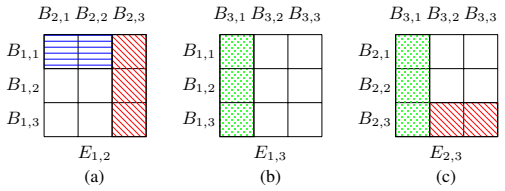
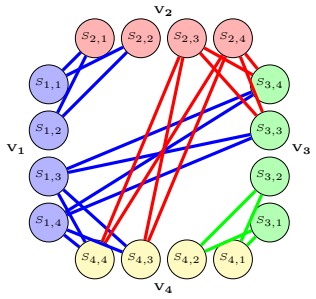
- [Figures 1–3] Several figures illustrating the graph model and sample allocations are present but lack explicit value labels on edges; adding these would make the examples easier to follow without referring back to the text.
Simulated Author's Rebuttal
We thank the referee for the positive summary of our work, the assessment of its significance in extending the graphical fair-division model to multi-graphs, and the recommendation for minor revision. We are pleased that the combination of positive and negative results for MMS and PMMS across valuation classes is viewed as delineating feasible fairness guarantees. Below we provide point-by-point responses; since the report lists no specific major comments under that heading, our responses focus on the overall feedback provided.
Circularity Check
Minor self-citation to model definition; results independent
full rationale
The paper cites prior work by overlapping authors (Christodoulou et al., EC 2023) solely to define the graphical valuation model where items are edges and agents are vertices. This sets up the input without serving as a load-bearing justification for the new positive/negative results on MMS and PMMS fairness under additive, XOS, and subadditive valuations. No equations, reductions, fitted parameters renamed as predictions, or self-referential derivations appear in the abstract or model. The central claims are independent contributions building on the cited setting, making the paper self-contained against external fair-division benchmarks.
Assumptions & free parameters
assumptions (1)
- domain assumption Valuations are monotone and defined only on incident edges in the multi-graph.
Cite this review
Pith. "Pith review of Exact and approximate maximin share allocations in multi-graphs." pith.science (2026). https://pith.science/paper/2506.20317
@misc{pith2026250620317,
  author       = {Pith},
  title        = {Pith review of: Exact and approximate maximin share allocations in multi-graphs},
  year         = {2026},
  howpublished = {\url{https://pith.science/paper/2506.20317}},
  note         = {Machine review of arXiv:2506.20317}
}
read the original abstract
We study the problem of (approximate) maximin share (MMS) allocation of indivisible items among a set of agents. We focus on the graphical valuation model, previously studied by Christodolou, Fiat, Koutsoupias, and Sgouritsa ("Fair allocation in graphs", EC 2023), where the input is given by a graph where edges correspond to items, and vertices correspond to agents. An edge may have non-zero marginal value only for its incident vertices. We study additive, XOS and subadditive valuations and we present positive and negative results for (approximate) MMS fairness, and also for (approximate) pair-wise maximin share (PMMS) fairness.
Figures


Figures from the paper (2 more)

Forward citations
Cited by 2 Pith papers
-
Probing EFX via PMMS: (Non-)Existence Results in Discrete Fair Division
The paper proves a three-agent EFX/PMMS separation and claims PMMS existence for binary-valued and pair-demand valuations, plus EFX for personalized bivalued valuations.
-
From multi-allocations to allocations, with subadditive valuations
A d-multi-allocation with subadditive valuations can be converted to an allocation losing only a factor of about d, yielding an Omega(1/log log n)-MMS guarantee.
Reference graph
Works this paper leans on
-
[1]
EFX allocations and orientations on bipartite multi-graphs: A complete picture
Mahyar Afshinmehr, Alireza Danaei, Mehrafarin Kazemi, Kurt Mehlhorn, and Nidhi Rathi. EFX allocations and orientations on bipartite multi-graphs: A complete picture. CoRR, abs/2410.17002, 2024
-
[2]
Envy-free matchings in bipartite graphs and their applications to fair division
Elad Aigner-Horev and Erel Segal-Halevi. Envy-free matchings in bipartite graphs and their applications to fair division. Inf. Sci., 587:164–187, 2022
work page 2022
-
[3]
Breaking the 3/4 barrier for approximate maximin share
Hannaneh Akrami and Jugal Garg. Breaking the 3/4 barrier for approximate maximin share. CoRR, abs/2307.07304, 2023
-
[4]
Simplification and improvement of MMS approximation
Hannaneh Akrami, Jugal Garg, Eklavya Sharma, and Setareh Taki. Simplification and improvement of MMS approximation. CoRR, abs/2303.16788, 2023
-
[5]
Improving approximation guarantees for maximin share.CoRR, abs/2307.12916, 2023
Hannaneh Akrami, Jugal Garg, and Setareh Taki. Improving approximation guarantees for maximin share.CoRR, abs/2307.12916, 2023
-
[6]
Randomized and determin- istic maximin-share approximations for fractionally subadditive valuations
Hannaneh Akrami, Masoud Seddighin, Kurt Mehlhorn, and Golnoosh Shahkarami. Randomized and determin- istic maximin-share approximations for fractionally subadditive valuations. CoRR, abs/2308.14545, 2023
-
[7]
Georgios Amanatidis, Haris Aziz, Georgios Birmpas, Aris Filos-Ratsikas, Bo Li, Herv ´e Moulin, Alexandros A. V oudouris, and Xiaowei Wu. Fair division of indivisible goods: Recent progress and open questions. Artif. Intell., 322:103965, 2023
work page 2023
-
[8]
Comparing Approximate Relaxations of Envy-Freeness
Georgios Amanatidis, Georgios Birmpas, and Evangelos Markakis. Comparing approximate relaxations of envy- freeness. CoRR, abs/1806.03114, 2018
work page Pith review arXiv 2018
Show all 46 references
-
[9]
Approximation algorithms for computing maximin share allocations
Georgios Amanatidis, Evangelos Markakis, Afshin Nikzad, and Amin Saberi. Approximation algorithms for computing maximin share allocations. ACM Trans. Algorithms, 13(4):52:1–52:28, 2017
2017
-
[10]
Competitive equilibrium with indivisible goods and generic budgets
Moshe Babaioff, Noam Nisan, and Inbal Talgam-Cohen. Competitive equilibrium with indivisible goods and generic budgets. Math. Oper. Res., 46(1):382–403, 2021
2021
-
[11]
Approximation algorithms for maximin fair division.ACM Trans
Siddharth Barman and Sanath Kumar Krishnamurthy. Approximation algorithms for maximin fair division.ACM Trans. Economics and Comput., 8(1):5:1–5:28, 2020
2020
-
[12]
Existence and computation of maximin fair allocations under matroid- rank valuations
Siddharth Barman and Paritosh Verma. Existence and computation of maximin fair allocations under matroid- rank valuations. CoRR, abs/2012.12710, 2020
2012
-
[13]
On fair allocation of indivisible goods to submodular agents
Gilad Ben-Uziahu and Uriel Feige. On fair allocation of indivisible goods to submodular agents. CoRR, abs/2303.12444, 2023
2023
-
[14]
EFX allocations on some multi-graph classes
Umang Bhaskar and Yeshwant Pandit. EFX allocations on some multi-graph classes. CoRR, abs/2412.06513, 2024
2024
-
[15]
The combinatorial assignment problem: Approximate competitive equilibrium from equal incomes
Eric Budish. The combinatorial assignment problem: Approximate competitive equilibrium from equal incomes. Journal of Political Economy, 119(6):1061–1103, 2011
2011
-
[16]
Procaccia, Nisarg Shah, and Junxing Wang
Ioannis Caragiannis, David Kurokawa, Herv ´e Moulin, Ariel D. Procaccia, Nisarg Shah, and Junxing Wang. The unreasonable fairness of maximum nash welfare. ACM Trans. Economics and Comput., 7(3):12:1–12:32, 2019
2019
-
[17]
1/2 approximate MMS allocation for separable piecewise linear concave valuations
Chandra Chekuri, Pooja Kulkarni, Rucha Kulkarni, and Ruta Mehta. 1/2 approximate MMS allocation for separable piecewise linear concave valuations. CoRR, abs/2312.08504, 2023
2023
-
[18]
Fair and truthful allocations under leveled valuations
George Christodoulou and Vasilis Christoforidis. Fair and truthful allocations under leveled valuations. CoRR, abs/2407.05891, 2024. 22
2024
-
[19]
Maximin share guarantees for few agents with subadditive valuations, 2025
George Christodoulou, Vasilis Christoforidis, Symeon Mastrakoulis, and Alkmini Sgouritsa. Maximin share guarantees for few agents with subadditive valuations, 2025
2025
-
[20]
Fair allocation in graphs
George Christodoulou, Amos Fiat, Elias Koutsoupias, and Alkmini Sgouritsa. Fair allocation in graphs. In EC, pages 473–488. ACM, 2023
2023
-
[21]
Truthful allocation in graphs and hyper- graphs
George Christodoulou, Elias Koutsoupias, and Annam ´aria Kov ´acs. Truthful allocation in graphs and hyper- graphs. CoRR, abs/2106.03724, 2021
2021
-
[22]
The existence and efficiency of PMMS allocations
Sijia Dai, Xinru Guo, Huahua Miao, Guichen Gao, Yicheng Xu, and Yong Zhang. The existence and efficiency of PMMS allocations. Theor. Comput. Sci., 989:114388, 2024
2024
-
[23]
Ef1 and efx orientations, 2024
Argyrios Deligkas, Eduard Eiben, Tiger-Lily Goldsmith, and Viktoriia Korchemna. Ef1 and efx orientations, 2024
2024
-
[24]
Graph balancing: A special case of scheduling unrelated parallel machines
Tom ´as Ebenlendr, Marek Krc´al, and Jir´ı Sgall. Graph balancing: A special case of scheduling unrelated parallel machines. Algorithmica, 68(1):62–80, 2014
2014
-
[25]
Fair allocations with subadditive and xos valuations, 2025
Uriel Feige and Vadim Grinberg. Fair allocations with subadditive and xos valuations, 2025
2025
-
[26]
Concentration and maximin fair allocations for subadditive valuations, 2025
Uriel Feige and Shengyu Huang. Concentration and maximin fair allocations for subadditive valuations, 2025
2025
-
[27]
A tight negative example for MMS fair allocations
Uriel Feige, Ariel Sapir, and Laliv Tauber. A tight negative example for MMS fair allocations. CoRR, abs/2104.04977, 2021
2021
-
[28]
An improved approximation algorithm for maximin shares
Jugal Garg and Setareh Taki. An improved approximation algorithm for maximin shares. Artif. Intell. , 300:103547, 2021
2021
-
[29]
Fair allocation of indivisible goods: Improvement
Mohammad Ghodsi, Mohammad Taghi Hajiaghayi, Masoud Seddighin, Saeed Seddighin, and Hadi Yami. Fair allocation of indivisible goods: Improvement. Math. Oper. Res., 46(3):1038–1053, 2021
2021
-
[30]
Fair allocation of indivisible goods: Beyond additive valuations
Mohammad Ghodsi, Mohammad Taghi Hajiaghayi, Masoud Seddighin, Saeed Seddighin, and Hadi Yami. Fair allocation of indivisible goods: Beyond additive valuations. Artif. Intell., 303:103633, 2022
2022
-
[31]
Haxell and Tibor Szab ´o
Penny E. Haxell and Tibor Szab ´o. Odd independent transversals are odd. Comb. Probab. Comput., 15(1-2):193– 211, 2006
2006
-
[32]
Guaranteeing maximin shares: Some agents left behind
Hadi Hosseini and Andrew Searns. Guaranteeing maximin shares: Some agents left behind. CoRR, abs/2105.09383, 2021
2021
-
[33]
Ordinal maximin share approximation for goods
Hadi Hosseini, Andrew Searns, and Erel Segal-Halevi. Ordinal maximin share approximation for goods. J. Artif. Intell. Res., 74, 2022
2022
-
[34]
EFX orientations of multigraphs
Kevin Hsu. EFX orientations of multigraphs. CoRR, abs/2410.12039, 2024
2024
-
[35]
Maximin shares in hereditary set systems
Halvard Hummel. Maximin shares in hereditary set systems. CoRR, abs/2404.11582, 2024
2024
-
[36]
Maximin share allocations for assignment valuations
Pooja Kulkarni, Rucha Kulkarni, and Ruta Mehta. Maximin share allocations for assignment valuations. In AAMAS, pages 2875–2876. ACM, 2023
2023
-
[37]
Fair Division in Game theoretic Settings
David Kurokawa. Fair Division in Game theoretic Settings. PhD thesis, Carnegie Mellon University, 2017
2017
-
[38]
Procaccia, and Junxing Wang
David Kurokawa, Ariel D. Procaccia, and Junxing Wang. Fair enough: Guaranteeing approximate maximin shares. J. ACM, 65(2):8:1–8:27, 2018
2018
-
[39]
Envy-free and efficient allocations for graphical valuations
Neeldhara Misra and Aditi Sethia. Envy-free and efficient allocations for graphical valuations. CoRR, abs/2410.14272, 2024. 23
2024
-
[40]
Improved maximin guarantees for subadditive and fractionally subad- ditive fair allocation problem
Masoud Seddighin and Saeed Seddighin. Improved maximin guarantees for subadditive and fractionally subad- ditive fair allocation problem. Artif. Intell., 327:104049, 2024
2024
-
[41]
On the existence of efx allocations in multigraphs, 2025
Alkmini Sgouritsa and Minas Marios Sotiriou. On the existence of efx allocations in multigraphs, 2025
2025
-
[42]
Extremal problems for transversals in graphs with bounded degree
Tibor Szab ´o and G ´abor Tardos. Extremal problems for transversals in graphs with bounded degree. Comb., 26(3):333–351, 2006
2006
-
[43]
On the configuration-lp for scheduling on unrelated machines
Jos ´e Verschae and Andreas Wiese. On the configuration-lp for scheduling on unrelated machines. CoRR, abs/1011.4957, 2010
2010 arXiv
-
[44]
Wanless and David R
Ian M. Wanless and David R. Wood. A general framework for hypergraph coloring. SIAM Journal on Discrete Mathematics, 36(3):1663–1677, 2022
2022
-
[45]
On the structure of envy-free orientations on graphs
Jinghan A Zeng and Ruta Mehta. On the structure of envy-free orientations on graphs. CoRR, abs/2404.13527, 2024
2024
-
[46]
A complete landscape of EFX allocations on graphs: Goods, chores and mixed manna
Yu Zhou, Tianze Wei, Minming Li, and Bo Li. A complete landscape of EFX allocations on graphs: Goods, chores and mixed manna. In IJCAI, pages 3049–3056. ijcai.org, 2024. 24
2024
Reviewed May 19, 2026 · model on record in the stance chip above.
Discussion (0). Continue with ORCID to comment.