REVIEW 4 major objections 6 minor 2 cited by
Co-Design of Sensing, Communications, and Control for Low-Altitude Wireless Networks
T0 review · 4 major / 6 minor · reviewed 2026-08-06 · deepseek-v4-flash
Pith's one-line read The paper claims that the joint optimization of sensing, communication, and control for multi-UAV low-altitude networks can be reduced to a single weighted objective by deriving a closed-form expression for the optimal LQR control cost…
desk verdict Clean formulation, flawed solver: the DC linearization in Algorithm 1 is wrong as written, and the AO convergence claim rests on it. read the letter →
The pith
A machine-rendered reading of the paper's core claim, the machinery that carries it, and where it could break.
The reading
What carries the argument
The load-bearing object is the rate-LQR cost bound of [27], Eqs. (13)–(14): to keep robot $k$'s LQR cost at or below $b_k$, the received throughput must satisfy $B\sum_m \theta_{m,k}R_{m,k} \ge g_k + \frac{\iota}{2}\log\!\bigl(1 + \frac{\iota(\det N_k M_k)^{1/\iota}}{b_k - (b_k)_{\min}}\bigr)$. Because the right side is monotonically decreasing in $b_k$, the paper can invert the constraint at equality to obtain the closed-form optimal cost $b_k^*$ of Proposition 1, which then carries all control information through the optimization. Sensing enters through the determinant of the Fisher information matrix $\det \Phi_s$ built from the UAV-to-target geometry and power-scaled noise, and finite-blocklength transmission enters through the rate expression $R_{m,k} = \log(1+\Gamma_{m,k}) - \sqrt{V_{m,k}/l_{m,k}}\,Q^{-1}(\epsilon)$ of [32].
What would settle it
Simulate the full closed loop with the optimized associations, powers, and positions, apply the designed finite-blocklength rates to the robot controllers, and measure the empirical infinite-horizon LQR cost; if it exceeds the closed-form $b_k^*$ of Eq. (34) beyond numerical tolerance, the rate-LQR bound is only a necessary condition and the optimized solution is a proxy.
Extended reading notes
Core claim
The paper's central claim is Proposition 1: given any UAV-robot associations $\Theta$, transmit powers $\mathbf{p}$, and UAV positions $\{\mathbf{q}_m\}$, the optimal infinite-horizon LQR cost for robot $k$ is exactly $b_k^* = \iota(\det N_k M_k)^{1/\iota}/(2^{f_k}-1) + (b_k)_{\min}$, with $f_k = (2/\iota)(B\sum_m \theta_{m,k} R_{m,k} - g_k)$. The expression is obtained by taking the rate-LQR cost constraint (33i) at equality, which is valid because the required rate $L_k$ decreases monotonically as $b_k$ rises. Substituting this closed form into the joint problem reduces the non-convex, mixed-integer program (33) to minimizing a weighted sum of the LQR cost and the inverse of the Fisher information determinant $\det \Phi_s$, and the paper claims the alternating-optimization algorithm — DC programming for association, projected gradient descent for power, and successive convex approximation for positions — converges to a near-optimal solution.
Load-bearing premise
The load-bearing premise is that the rate-LQR cost bound (13)–(14) is tight enough that setting the rate constraint at equality in Proposition 1 yields the true optimal control cost, rather than merely a lower bound that real controllers cannot achieve.
Editorial extensions
If this is right
- If the closed-form LQR cost is exact, then the joint SC2 problem (33) is equivalent to a weighted objective in $\Theta$, $\mathbf{p}$, and $\{\mathbf{q}_m\}$ alone, and the alternating algorithm's monotone decrease in that objective is a genuine performance guarantee.
- Longer blocklength $l_{m,k}$ improves throughput and therefore control cost, but the benefit saturates at the unconstrained minimum $(b_k)_{\min}$, so the model predicts a regime where extra communication resources no longer help the control loop.
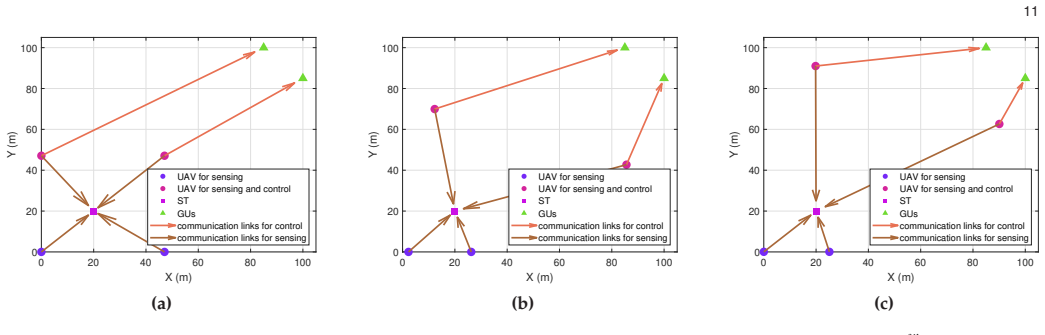
- Varying the weighting factor $\eta$ continuously repositions the UAVs between the robots and the sensing target, with the CRB for target localization changing more sharply than the LQR cost, an asymmetry visible in Fig. 8.
- The closed form also lets the algorithm adapt to different power budgets and observation-noise levels: increasing power reduces LQR cost down to $(b_k)_{\min}$, while worse observation noise raises the floor and cannot be fully compensated by communication power.
Reading between the lines
- Treating blocklength as a fourth design variable is the paper's own flagged future direction; the closed form makes that extension immediate because $b_k^*$ is monotone in $R_{m,k}$, hence in $l_{m,k}$.
- The inversion recipe generalizes: any control cost with a tight rate-cost bound could be substituted for the LQR cost in the same alternating-optimization framework, making the co-design approach a template for other cost functions.
- The assumption that each robot is served by exactly one UAV could be relaxed: the closed form depends on the aggregate rate $\sum_m \theta_{m,k} R_{m,k}$, so cooperative multi-UAV transmission to a single robot fits the same formula with a generalized association constraint.
Signed reviews
Editorial analysis
A structured set of objections, weighed in public.
Referee Report
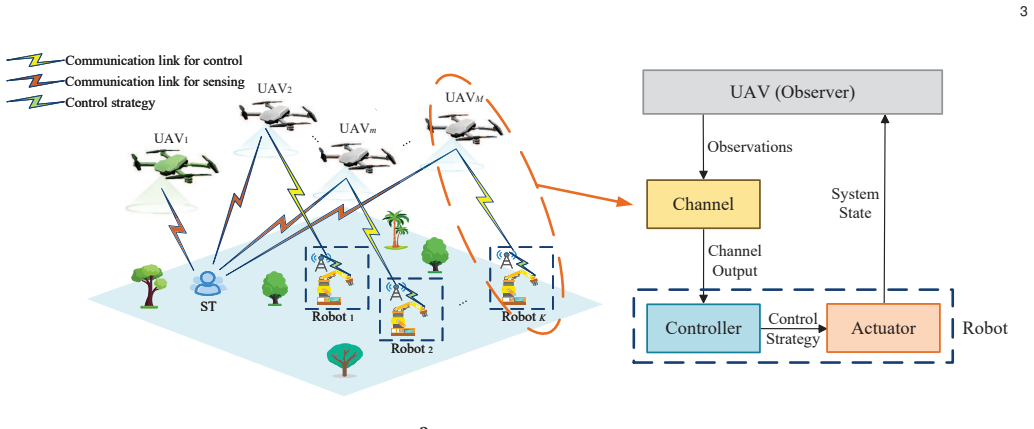
Summary. The manuscript studies co-design of sensing, communication, and control (SC2) in a multi-UAV low-altitude network with finite blocklength transmission. UAVs send observations to robots over ISAC links while also localizing a target. The paper formulates a weighted optimization problem (33) that jointly minimizes a sum of infinite-horizon LQR control costs and maximizes the determinant of the Fisher information matrix for the target, subject to association, power, collision-avoidance, and flight-boundary constraints. A closed-form expression for the LQR cost as a function of the remaining variables is derived in Proposition 1, and the non-convex problem is attacked by alternating optimization: penalty-based DC programming for UAV-robot association (Algorithm 1), projected gradient descent for power allocation (Algorithm 2), and SCA for UAV positions (Algorithm 3). The paper claims monotonic convergence of the AO loop and supports the method with simulations showing trade-offs between control and sensing.
Significance. The problem is timely and relevant: integrating control-loop requirements with ISAC resource allocation under finite blocklength is an important direction for 6G and UAV-enabled IoT. The closed-form LQR-cost derivation in Proposition 1 is algebraically clean, and the FIM-based localization metric follows standard estimation theory. However, the paper's central algorithmic contribution is invalidated by a fundamental error in the DC-programming association step, and the convergence proof relies on assumptions that the proposed algorithms do not guarantee. Because these issues affect the main claim of a near-optimal AO solution, the contribution as submitted cannot be considered sound.
major comments (4)
- [4.1, Eqs. (43)-(46)] The DC penalty method for the association subproblem is internally inconsistent. The intended DC constraint (43c) is Σ(θ_{m,k} - θ_{m,k}^2) ≤ 0. The correct first-order linearization of the concave term -Σθ^2 around θ^(t1) gives Σ[θ_{m,k} - (θ^(t1)_{m,k})^2 - 2θ^(t1)_{m,k}(θ_{m,k} - θ^(t1)_{m,k})] ≤ 0. Equation (44) instead writes Σ[(θ^(t1)_{m,k})^2 + 2θ^(t1)_{m,k}(θ_{m,k} - θ^(t1)_{m,k})] ≤ 0, which drops the necessary Σθ term and has the wrong sign. The statement that 'the LHS of (44) cannot be smaller than 0' is false: for M=K=1, θ^(t1)=0.5 and θ=0, the LHS equals -0.25. Moreover, at the binary point θ=1, the LHS equals 0.75, so the desired binary solution is infeasible for the linearized constraint. Consequently, the penalty term φ(Θ) in (46) is not the standard DC penalty μΣ(θ-θ^2); it can be negative and does not drive Θ to {0,1} while preserving the assignment constraints. Algorithm 1 therefore does not solve problem (38), and the monotonic-descent proof in Eqs. (56)-(59) is unsupported.
- [4.2, Eq. (57) and Algorithm 2] The convergence inequality (57) requires that the power update strictly improves or preserves the objective value: δ1(p(t-1), Θ(t), q(t-1)) ≥ δ2(p(t), Θ(t), q(t-1)). The paper claims problem (47) is 'optimally solved' by projected gradient descent, but the objective ϕ(p) in (48) is non-convex and no convexity property is established. Projected gradient methods for non-convex objectives converge only to stationary points under suitable step-size conditions (e.g., sufficient decrease or Armijo backtracking); the ad-hoc update ρ ← ρ/‖∇ϕp‖ in Algorithm 2 does not guarantee objective decrease at each iteration. Thus the inequality (57), and hence the AO monotonic convergence claim, is not justified.
- [4.3, Eq. (54) and Algorithm 3] The SCA step for UAV positions also lacks a valid surrogate. Equation (54) defines ψ as a first-order Taylor expansion of ϕ({q_m}) at q^(t2)_m. For SCA to guarantee a non-increasing objective, the surrogate must be a global upper bound (or at least satisfy the standard SCA conditions of matching value and gradient and dominating the original function appropriately). For a general non-convex function like ϕ({q_m}), the first-order Taylor approximation is not a global upper bound, and the paper provides no argument that minimizing ψ decreases the original objective. Therefore the inequality (58) and the overall convergence proof are unsupported.
- [3, Eqs. (13)-(14) and Proposition 1] The rate-LQR bound from [27] is a necessary condition: to achieve a desired LQR cost b_k, the received data throughput must satisfy (13), with L_k given in (14). The paper takes this inequality at equality to obtain the closed-form b_k* in Eq. (34), effectively inverting the bound. Since the bound is only necessary and no achievability result is cited or proved, b_k* is a lower bound on the achievable LQR cost rather than an exact expression. The objective of problem (37) therefore optimizes a proxy, and the paper's repeated claims of minimizing the 'optimal LQR cost' should be qualified. This should be stated explicitly, or an achievability argument must be provided.
minor comments (6)
- [Throughout] There are several LaTeX spacing artifacts in the author block and running text, e.g., 'Y uan' instead of 'Yuan'.
- [Fig. 7] The x-axis label in Fig. 7 is 'Power constraint (W)', while the other figures use dBW; the units should be consistent and clarified.
- [Eqs. (33a), (37a)] The normalization constants Ψc and Ψs are introduced as upper bounds of Σ b_k and det Φs, but their actual values (30 and 12 in simulations) appear to be arbitrary; the paper should explain how they are chosen or calibrated.
- [Algorithm 2, step 5] The step-size rule ρ ← ρ/‖∇ϕp‖ is unusual and not a standard line search; as written, it is dimensionally inconsistent and may not yield descent. A proper line search or a fixed step size with a Lipschitz condition would be preferable.
- [Convergence proof, Eq. (56)] The proof assumes that Algorithm 1 returns the global optimum of problem (38). Since Algorithm 1 solves a penalized linearized problem, this assumption is not met even in principle; the inequality in (56) should be justified with respect to the actual output of Algorithm 1.
- [Section 5] The RMSE results in Fig. 7 are from a Monte Carlo simulation with 100 trials, but no error bars or statistical significance information is reported; adding them would improve the credibility of the comparison.
Circularity Check
No significant circularity: Proposition 1 is an algebraic inversion of an external rate-cost bound, and all self-citations are background-only.
full rationale
The paper's central derivation chain is self-contained. Proposition 1 (Eq. (34)) is obtained by taking constraint (33i) at equality and algebraically inverting the external rate-LQR lower bound from Kostina and Hassibi [27]: with f_k defined by Eq. (35), substituting L_k from (14) into B∑θ_{m,k}R_{m,k}=L_k and solving for b_k yields exactly Eq. (34). This is a variable substitution, not a fitted input or a self-definition; the bound is an external information-theoretic result with stated assumptions, and the paper does not fit any parameter to the predicted LQR values. The FIM expressions (27)-(32) follow from standard estimation theory [40]. The AO decomposition and DC/PGD/SCA surrogates are standard and are not justified by self-citations. Self-references ([20], [21], [22], [23], [30], [38]) appear only for background, channel-model conventions, and simulation constants; none carries the load of Proposition 1 or the convergence claim. The issue flagged in the weakest assumption—that treating [27]'s bound as an equality optimizes a proxy rather than the exact LQR cost—is a modeling/tightness concern, not circularity. Likewise, the possible inconsistency in the DC linearization (Eq. (44)) and the convergence proof's reliance on exact subproblem solutions are algorithmic-correctness risks, not cases where a prediction reduces to its input by construction. Hence no circular step is present.
Assumptions & free parameters
free parameters (3)
- ρ (variance scaling constant) =
200
- G_p (signal processing gain) =
0.1 × B = 50,000
- Normalization constants Ψc, Ψs =
30 and 12
assumptions (4)
- domain assumption The rate-LQR bound of Kostina and Hassibi [27] is tight enough that satisfying it with equality yields the true optimal LQR cost.
- domain assumption Assuredly stable regime: B∑_m θ_{m,k} R_{m,k} ≫ g_k for all k.
- domain assumption LoS channels with free-space path loss (5) and two-way radar path loss with h_m = β0/d^4.
- domain assumption Target position s is known for optimization and the robot channel outputs are as modeled.
Cite this review
Pith. "Pith review of Co-Design of Sensing, Communications, and Control for Low-Altitude Wireless Networks." pith.science (2026). https://pith.science/paper/FZBQVO64
@misc{pith2026250620970,
  author       = {Pith},
  title        = {Pith review of: Co-Design of Sensing, Communications, and Control for Low-Altitude Wireless Networks},
  year         = {2026},
  howpublished = {\url{https://pith.science/paper/FZBQVO64}},
  note         = {Machine review of arXiv:2506.20970}
}
abstract
The rapid advancement of Internet of Things (IoT) services and the evolution toward the sixth generation (6G) have positioned unmanned aerial vehicles (UAVs) as critical enablers of low-altitude wireless networks (LAWNs). This work investigates the co-design of integrated sensing, communication, and control ($\mathbf{SC^{2}}$) for multi-UAV cooperative systems with finite blocklength (FBL) transmission. In particular, the UAVs continuously monitor the state of the field robots and transmit their observations to the robot controller to ensure stable control while cooperating to localize an unknown sensing target (ST). To this end, a weighted optimization problem is first formulated by jointly considering the control and localization performance in terms of the linear quadratic regulator (LQR) cost and the determinant of the Fisher information matrix (FIM), respectively. The resultant problem, optimizing resource allocations, the UAVs' deployment positions, and multi-user scheduling, is non-convex. To circumvent this challenge, we first derive a closed-form expression of the LQR cost with respect to other variables. Subsequently, the non-convex optimization problem is decomposed into a series of sub-problems by leveraging the alternating optimization (AO) approach, in which the difference of convex functions (DC) programming and projected gradient descent (PGD) method are employed to obtain an efficient near-optimal solution. Furthermore, the convergence and computational complexity of the proposed algorithm are thoroughly analyzed. Extensive simulation results are presented to validate the effectiveness of our proposed approach compared to the benchmark schemes and reveal the trade-off between control and sensing performance.
Figures

Figures from the paper (4 more)


Forward citations
Cited by 2 Pith papers
-
Lyapunov Stability-Aware Stackelberg Game for Low-Altitude Economy: A Control-Oriented Pruning-Based DRL Approach
Radial excitations of ρ, π, φ, D, D_s, B, B_s, ψ and Υ mesons obey d_{n,1}=β_1 n + N (universal slope, family intercept), claimed here to follow analytically from a local potential.
-
Sensing-Enhanced Handover Criterion for Low-Altitude Wireless Network (LAWNs)
A joint handover criterion that triggers when either RSRP or ISAC-based distance estimates exceed thresholds reduces the handover region length by 75.20% and increases activation probability by 76.31% in the paper's model.
Reference graph
Works this paper leans on
-
[27]
Rate-cost tradeoffs in cont rol,
V . Kostina and B. Hassibi, “Rate-cost tradeoffs in cont rol,” IEEE T rans. Autom. Control, vol. 64, no. 11, pp. 4525–4540, Nov . 2019
work page 2019
-
[1]
N. H. Motlagh, T. Taleb, and O. Arouk, “Low-altitude unmanned aerial vehicles-based internet of things service s: Comprehensive survey and future perspectives,” IEEE Internet Things J. , vol. 3, pp. 899–922, Dec. 2016. [Online]. Available: https://api.semanticscholar.org/CorpusID:17791330
work page 2016
-
[2]
UA V-based IoT plat form: A crowd surveillance use case,
N. H. Motlagh, M. Bagaa, and T. Taleb, “UA V-based IoT plat form: A crowd surveillance use case,” IEEE Commun. Mag., vol. 55, no. 2, pp. 128–134, Feb. 2017
work page 2017
-
[3]
Coverage analys is for low-altitude UA V networks in urban environments,
B. Galkin, J. Kibilda, and L. A. DaSilva, “Coverage analys is for low-altitude UA V networks in urban environments,” in GLOBE- COM 2017-2017 IEEE Global Communications Conference . IEEE, 2017, pp. 1–6
work page 2017
-
[4]
UA V meets integrated sensing and communication: Challenges and futu re directions,
J. Mu, R. Zhang, Y . Cui, N. Gao, and X. Jing, “UA V meets integrated sensing and communication: Challenges and futu re directions,” IEEE Commun. Mag. , vol. 61, no. 5, pp. 62–67, May 2023
work page 2023
-
[5]
Mobile unmanned aerial vehicles (UA Vs) for energy-efficient inter net of things communications,
M. Mozaffari, W. Saad, M. Bennis, and M. Debbah, “Mobile unmanned aerial vehicles (UA Vs) for energy-efficient inter net of things communications,” IEEE T rans. Wireless Commun. , vol. 16, no. 11, pp. 7574–7589, Nov . 2017. 13
work page 2017
-
[6]
UA V-enabled secure communications: Joint trajectory and transmit power optim iza- tion,
X. Zhou, Q. Wu, S. Y an, F. Shu, and J. Li, “UA V-enabled secure communications: Joint trajectory and transmit power optim iza- tion,” IEEE T rans. Veh. T echnol., vol. 68, no. 4, pp. 4069–4073, Apr. 2019
work page 2019
-
[7]
Y . Cai, Z. Wei, R. Li, D. W. K. Ng, and J. Y uan, “Joint trajec tory and resource allocation design for energy-efficient secure UA V communication systems,” IEEE T rans. Commun., vol. 68, no. 7, pp. 4536–4553, Jul. 2020
work page 2020
Show all 46 references
-
[8]
Sensing as a service in 6G perceptive mobile networks: Architecture, advances, and t he road ahead,
F. Dong, F. Liu, Y . Cui, S. Lu, and Y . Li, “Sensing as a service in 6G perceptive mobile networks: Architecture, advances, and t he road ahead,” IEEE Network , vol. 38, no. 2, pp. 87–96, Mar. 2024
2024
-
[9]
The bearing-only ta rget localization via the single UA V: Asymptotically unbiased c losed- form solution and path planning,
L. He, P . Gong, X. Zhang, and Z. Wang, “The bearing-only ta rget localization via the single UA V: Asymptotically unbiased c losed- form solution and path planning,” IEEE Access, vol. 7, pp. 153 592– 153 604, Oct. 2019
2019
-
[10]
Distributed path optimi zation of multiple UA Vs for AOA target localization,
S. Xu, K. Dogançay , and H. Hmam, “Distributed path optimi zation of multiple UA Vs for AOA target localization,” in 2016 IEEE International Conference on Acoustics, Speech and Signal P rocessing (ICASSP), 2016, pp. 3141–3145
2016
-
[11]
Vision-based real-time aeria l object localization and tracking for UA V sensing system,
Y . Wu, Y . Sui, and G. Wang, “Vision-based real-time aeria l object localization and tracking for UA V sensing system,” IEEE Access , vol. 5, pp. 23 969–23 978, Oct. 2017
2017
-
[12]
Integrated sensing and communication: Enablin g techniques, applications, tools and data sets, standardiz ation, and future directions,
J. Wang, N. Varshney , C. Gentile, S. Blandino, J. Chuang, and N. Golmie, “Integrated sensing and communication: Enablin g techniques, applications, tools and data sets, standardiz ation, and future directions,” IEEE Internet Things J. , vol. 9, no. 23, pp. 23 416– 23 440, Dec. 2022
2022
-
[13]
Integrating sensing a nd communications for ubiquitous IoT: Applications, trends, and challenges,
Y . Cui, F. Liu, X. Jing, and J. Mu, “Integrating sensing a nd communications for ubiquitous IoT: Applications, trends, and challenges,” IEEE Network, vol. 35, no. 5, pp. 158–167, Nov . 2021
2021
-
[14]
Tow ard green RF chain design for integrated sensing and communicat ions: Technologies and future directions,
Y . Gong, X. Li, F. Meng, L. Liu, M. Guizani, and Z. Xu, “Tow ard green RF chain design for integrated sensing and communicat ions: Technologies and future directions,” IEEE Commun. Mag. , vol. 62, no. 9, pp. 36–42, Sep. 2024
2024
-
[15]
Sensi ng as a service in 6G perceptive networks: A unified framework fo r ISAC resource allocation,
F. Dong, F. Liu, Y . Cui, W. Wang, K. Han, and Z. Wang, “Sensi ng as a service in 6G perceptive networks: A unified framework fo r ISAC resource allocation,” IEEE T rans. Wireless Commun. , vol. 22, no. 5, pp. 3522–3536, May 2023
2023
-
[16]
Flowing the infor- mation from shannon to fisher: Towards the fundamental trade off in ISAC,
Y . Xiong, F. Liu, Y . Cui, W. Y uan, and T. X. Han, “Flowing the infor- mation from shannon to fisher: Towards the fundamental trade off in ISAC,” in GLOBECOM 2022-2022 IEEE Global Communications Conference. IEEE, 2022, pp. 5601–5606
2022
-
[17]
Cr amér- rao bound optimization for joint radar-communication beam form- ing,
F. Liu, Y .-F. Liu, A. Li, C. Masouros, and Y . C. Eldar, “Cr amér- rao bound optimization for joint radar-communication beam form- ing,” IEEE T rans. Signal Process., vol. 70, pp. 240–253, Dec. 2021
2021
-
[18]
Const rained utility maximization in dual-functional radar-communica tion multi-UA V networks,
X. Wang, Z. Fei, J. A. Zhang, J. Huang, and J. Y uan, “Const rained utility maximization in dual-functional radar-communica tion multi-UA V networks,” IEEE T rans. Commun. , vol. 69, no. 4, pp. 2660–2672, Apr. 2021
2021
-
[19]
UA V trajectory and beamforming optimization for integrated pe riodic sensing and communication,
K. Meng, Q. Wu, S. Ma, W. Chen, and T. Q. S. Quek, “UA V trajectory and beamforming optimization for integrated pe riodic sensing and communication,” IEEE Wireless Commun. Lett., vol. 11, no. 6, pp. 1211–1215, Jun. 2022
2022
-
[20]
ISAC from the sk y: UA V trajectory design for joint communication and target local ization,
X. Jing, F. Liu, C. Masouros, and Y . Zeng, “ISAC from the sk y: UA V trajectory design for joint communication and target local ization,” IEEE T rans. Wireless Commun. , vol. 23, no. 10, pp. 12 857–12 872, Oct. 2024
2024
-
[21]
On the interplay between sens ing and communications for UA V trajectory design,
J. Wu, W. Y uan, and L. Bai, “On the interplay between sens ing and communications for UA V trajectory design,” IEEE Internet Things J., vol. 10, no. 23, pp. 20 383–20 395, Dec. 2023
2023
-
[22]
On the physica l layer of digital twin: An integrated sensing and communicat ions perspective,
Y . Cui, W. Y uan, Z. Zhang, J. Mu, and X. Li, “On the physica l layer of digital twin: An integrated sensing and communicat ions perspective,” IEEE J. Sel. Areas Commun. , vol. 41, no. 11, pp. 3474– 3490, Nov . 2023
2023
-
[23]
Sen sing- assisted high reliable communication: A transformer-base d beam- forming approach,
Y . Cui, J. Nie, X. Cao, T. Y u, J. Zou, J. Mu, and X. Jing, “Sen sing- assisted high reliable communication: A transformer-base d beam- forming approach,” IEEE J. Sel. T op. Signal Process. , vol. 18, no. 5, pp. 782–795, Jul. 2024
2024
-
[24]
Robust LQR and LQR-PI control strategies based on adaptive weighting matrix selection for a UA V position and attitude tracking control,
A. Sir Elkhatem and S. Naci Engin, “Robust LQR and LQR-PI control strategies based on adaptive weighting matrix selection for a UA V position and attitude tracking control,” Alexandria Engineering Journal , vol. 61, no. 8, pp. 6275–6292, Aug. 2022. [Online]. Availabl e: https:...
2022
-
[25]
Contr ol strategies and novel techniques for autonomous rotorcraft un- manned aerial vehicles: A review,
S. I. Abdelmaksoud, M. Mailah, and A. M. Abdallah, “Contr ol strategies and novel techniques for autonomous rotorcraft un- manned aerial vehicles: A review,” IEEE Access, vol. 8, pp. 195 142– 195 169, Oct. 2020
2020
-
[26]
Feed back control under data rate constraints: An overview,
G. N. Nair, F. Fagnani, S. Zampieri, and R. J. Evans, “Feed back control under data rate constraints: An overview,” Proc. IEEE , vol. 95, no. 1, pp. 108–137, Jan. 2007
2007
-
[28]
Control-orien ted power allocation for integrated satellite-UA V networks,
C. Lei, W. Feng, J. Wang, S. Jin, and N. Ge, “Control-orien ted power allocation for integrated satellite-UA V networks,” IEEE Wireless Commun. Lett. , vol. 12, no. 5, pp. 883–887, May 2023
2023
-
[29]
Toward massive, ul trareli- able, and low-latency wireless communication with short pa ck- ets,
G. Durisi, T. Koch, and P . Popovski, “Toward massive, ul trareli- able, and low-latency wireless communication with short pa ck- ets,” Proc. IEEE, vol. 104, no. 9, pp. 1711–1726, Sep. 2016
2016
-
[30]
Joi nt optimization of user scheduling, rate allocation, and beam forming for RSMA finite blocklength transmission,
J. Zhu, H. Jin, Y . He, F. Fang, W. Huang, and Z. Zhang, “Joi nt optimization of user scheduling, rate allocation, and beam forming for RSMA finite blocklength transmission,” IEEE Internet Things J. , vol. 11, no. 17, pp. 27 904–27 915, Sep. 2024
2024
-
[31]
UA V-enabled secur e communications: Joint trajectory and transmit power optim iza- tion,
X. Zhou, Q. Wu, S. Y an, F. Shu, and J. Li, “UA V-enabled secur e communications: Joint trajectory and transmit power optim iza- tion,” IEEE T rans. Veh. T echnol., vol. 68, no. 4, pp. 4069–4073, Apr. 2019
2019
-
[32]
Channel coding rate in the finite blocklength regime,
Y . Polyanskiy , H. V . Poor, and S. V erdu, “Channel coding rate in the finite blocklength regime,” IEEE T rans. Inf. Theory , vol. 56, no. 5, pp. 2307–2359, May 2010
2010
-
[33]
Beamform- ing design for multiuser uRLLC with finite blocklength trans mis- sion,
S. He, Z. An, J. Zhu, J. Zhang, Y . Huang, and Y . Zhang, “Beamform- ing design for multiuser uRLLC with finite blocklength trans mis- sion,” IEEE T rans. Wireless Commun., vol. 20, no. 12, pp. 8096–8109, Dec. 2021
2021
-
[34]
UA V-enabled secure communication with finite blocklength ,
Y . Wang, X. Zhou, Z. Zhuang, L. Sun, Y . Qian, J. Lu, and F. Shu , “UA V-enabled secure communication with finite blocklength ,” IEEE T rans. Veh. T echnol., vol. 69, no. 12, pp. 16 309–16 313, Dec. 2020
2020
-
[35]
Joint infor mation- theoretic secrecy and covertness for UA V-assisted wireles s trans- mission with finite blocklength,
P . Liu, Z. Li, J. Si, N. Al-Dhahir, and Y . Gao, “Joint infor mation- theoretic secrecy and covertness for UA V-assisted wireles s trans- mission with finite blocklength,” IEEE T rans. Veh. T echnol., vol. 72, no. 8, pp. 10 187–10 199, Aug. 2023
2023
-
[36]
Non- linear EH-based UA V-assisted FD IoT networks: Infinite and finite blocklength analysis,
P . Raut, K. Singh, C.-P . Li, M.-S. Alouini, and W.-J. Huang , “Non- linear EH-based UA V-assisted FD IoT networks: Infinite and finite blocklength analysis,” IEEE Internet Things J. , vol. 8, no. 24, pp. 17 655–17 668, Dec. 2021
2021
-
[37]
Energy minimization for wi reless communication with rotary-wing UA V,
Y . Zeng, J. Xu, and R. Zhang, “Energy minimization for wi reless communication with rotary-wing UA V,”IEEE T rans. Wireless Com- mun., vol. 18, no. 4, pp. 2329–2345, Apr. 2019
2019
-
[38]
Radar-assist ed predic- tive beamforming for vehicular links: Communication serve d by sensing,
F. Liu, W. Y uan, C. Masouros, and J. Y uan, “Radar-assist ed predic- tive beamforming for vehicular links: Communication serve d by sensing,” IEEE T rans. Wireless Commun., vol. 19, no. 11, pp. 7704– 7719, Nov . 2020
2020
-
[39]
Ucinski, Optimal Measurement Methods for Distributed Parameter System Identification
D. Ucinski, Optimal Measurement Methods for Distributed Parameter System Identification. Berlin, Germany: Springer, Aug. 2004
2004
-
[40]
Fundamentals of statistical signal processi ng: Estima- tion theory ,
S. M. Kay , “Fundamentals of statistical signal processi ng: Estima- tion theory ,” 1993
1993
-
[41]
DC programming: Overview,
R. Horst and N. V . Thoai, “DC programming: Overview,” J. Optimiz. Theory App. , vol. 103, no. 1, pp. 1–43, Oct. 1999. [Online]. Available: https://doi.org/10.1023/A:1021765131316
1999 doi
-
[42]
Matlab software for disc iplined convex programming, version 1.21,
M. Grant, S. Boyd, and Y . Y . CVX, “Matlab software for disc iplined convex programming, version 1.21,” CVX Research, 2011
2011
-
[43]
Projected gradient methods for linearly constrained problems,
P . H. Calamai and J. J. Moré, “Projected gradient methods for linearly constrained problems,” Math. Program. , vol. 39, pp. 93–116, Sep. 1987. [Online]. Available: https://doi.org/10.1007/BF02592073
1987 doi
-
[44]
Cognitive U A V communication via joint maneuver and power control,
Y . Huang, W. Mei, J. Xu, L. Qiu, and R. Zhang, “Cognitive U A V communication via joint maneuver and power control,” IEEE T rans. Commun., vol. 67, no. 11, pp. 7872–7888, Jul. 2019
2019
-
[45]
A unified MIMO optimization framework relying on the KKT conditions,
S. Gong, C. Xing, Y . Jing, S. Wang, J. Wang, S. Chen, and L. Han zo, “A unified MIMO optimization framework relying on the KKT conditions,” IEEE T rans. Commun., vol. 69, no. 11, pp. 7251–7268, Aug. 2021
2021
-
[46]
Water-filling: A geome tric approach and its application to solve generalized radio res ource allocation problems,
P . He, L. Zhao, S. Zhou, and Z. Niu, “Water-filling: A geome tric approach and its application to solve generalized radio res ource allocation problems,” IEEE T rans. Wireless Commun., vol. 12, no. 7, pp. 3637–3647, Jul. 2013
2013
Reviewed August 6, 2026 · model on record in the stance chip above.
Discussion (0). Continue with ORCID to comment.