Applying the Worldvolume Hybrid Monte Carlo method to the Hubbard model away from half filling
Pith reviewed 2026-05-19 02:07 UTC · model grok-4.3
The pith
The Worldvolume Hybrid Monte Carlo method computes number and energy densities for the doped two-dimensional Hubbard model where standard determinant quantum Monte Carlo fails.
A machine-rendered reading of the paper's core claim, the machinery that carries it, and where it could break.
Core claim
The Worldvolume Hybrid Monte Carlo method remains effective for the Hubbard model doped away from half filling. It produces stable results for number density and energy density on lattices of size 6x6 and 8x8 at interaction strength U/t=8.0 and temperature T/t=1/6.4 using a Trotter number of 20, in parameter regimes where standard non-thimble determinant quantum Monte Carlo methods fail.
What carries the argument
The Worldvolume Hybrid Monte Carlo method, which samples configurations over an extended worldvolume in auxiliary field space to reduce the sign problem while preserving ergodicity.
If this is right
- Number density and energy density become accessible in the doped Hubbard model at moderate interaction and temperature.
- The method works on lattices up to 8x8 without encountering the ergodicity problems of thimble-based approaches.
- Direct matrix inversion at O(N cubed) cost is sufficient for these volumes, with iterative alternatives planned for larger systems.
Where Pith is reading between the lines
- The same setup could be extended to measure correlation functions or response functions that diagnose ordered phases.
- Testing at lower temperatures or larger system sizes would check whether the method continues to scale as the sign problem worsens.
- Similar worldvolume sampling might be applied to other lattice fermion models that suffer from sign problems at finite density.
Load-bearing premise
The chosen lattice sizes, Trotter number, and direct-solver implementation are large enough to demonstrate effectiveness without being dominated by finite-size or discretization artifacts.
What would settle it
Running the same parameters with an exact solver on smaller lattices or with standard DQMC in a sign-problem-free limit and finding statistically significant disagreement in the reported densities.
Figures




read the original abstract
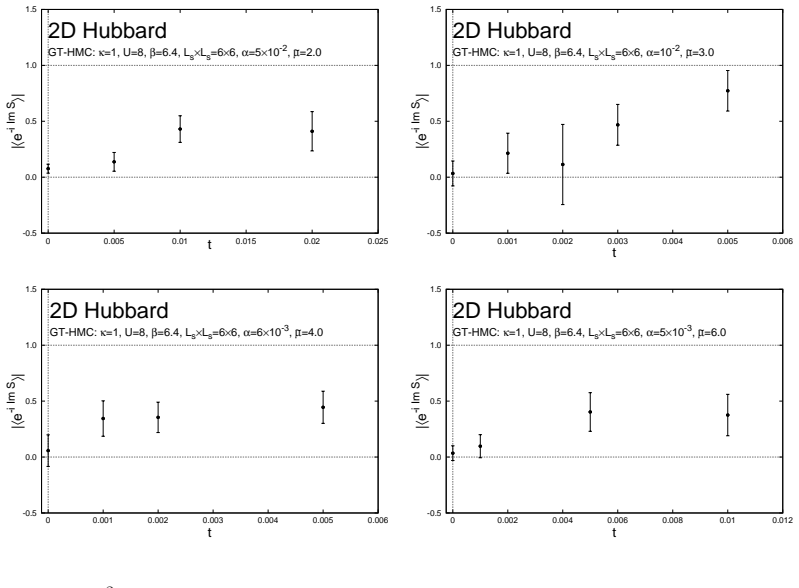
The Worldvolume Hybrid Monte Carlo (WV-HMC) method [arXiv:2012.08468] is an efficient algorithm for addressing the numerical sign problem at moderate computational cost. It mitigates the sign problem while avoiding the ergodicity issues inherent in approaches based on Lefschetz thimbles. In this study, we apply WV-HMC to the two-dimensional Hubbard model doped away from half filling, which is known to suffer from a severe sign problem. We compute the number density and the energy density on lattices of size $6 \times 6$ and $8 \times 8$ at temperature $T/t = 1/6.4 \simeq 0.156$ and interaction strength $U/t = 8.0$, using Trotter number $N_t = 20$ (Trotter step $\epsilon = 0.32$). Our results demonstrate that WV-HMC remains effective even in parameter regimes where standard (non-thimble) determinant quantum Monte Carlo methods fail. In this work, fermion matrix inversions are performed using direct solvers, leading to a computational cost of $O(N^3)$, where $N$ denotes the number of degrees of freedom and is proportional to the spacetime lattice volume. An alternative algorithm employing pseudofermions and iterative solvers, which reduces the cost to $O(N^2)$ at the expense of careful parameter tuning, will be discussed in a separate publication.
Editorial analysis
A structured set of objections, weighed in public.
Referee Report
Summary. The manuscript applies the Worldvolume Hybrid Monte Carlo (WV-HMC) method to the two-dimensional Hubbard model doped away from half filling. It computes number density and energy density on 6×6 and 8×8 lattices at U/t=8.0 and T/t≈0.156 using Nt=20 (ε=0.32), with direct solvers for fermion matrix inversions at O(N^3) cost, and claims that WV-HMC remains effective in regimes where standard (non-thimble) determinant quantum Monte Carlo methods fail due to the sign problem.
Significance. If the reported stability holds without being dominated by finite-size or discretization artifacts, the work would demonstrate a practical route to mitigating the sign problem in doped Hubbard models relevant to high-Tc superconductivity. The application of a previously published WV-HMC algorithm to this regime, together with the explicit statement of computational scaling and plans for an O(N^2) pseudofermion variant, provides a concrete benchmark that could guide further algorithmic development.
major comments (1)
- [Numerical results (parameters and observables)] The central claim that WV-HMC remains effective where standard DQMC fails rests on results for 6×6 and 8×8 lattices with Nt=20 (ε=0.32). These parameters are small enough that O(ε) Trotter errors and finite-size effects could dominate the observed stability; without explicit quantification of the average sign for standard DQMC, acceptance rates for WV-HMC, or convergence checks (e.g., comparison of 6×6 vs. 8×8 or smaller ε), it is unclear whether the method genuinely mitigates the sign problem or whether both approaches are comparably limited by the same lattice artifacts.
minor comments (2)
- [Abstract and computational setup] The temperature is stated as T/t = 1/6.4 ≃ 0.156; stating the precise numerical value employed in the runs would improve reproducibility.
- [Computational details] The manuscript notes that an alternative pseudofermion/iterative-solver implementation will be discussed separately; a short forward reference to the expected cost scaling and tuning requirements would help readers assess the current direct-solver results.
Simulated Author's Rebuttal
We thank the referee for their careful reading of the manuscript and for the constructive comments on the numerical results. We address the major comment point by point below, indicating where revisions will be made.
read point-by-point responses
-
Referee: The central claim that WV-HMC remains effective where standard DQMC fails rests on results for 6×6 and 8×8 lattices with Nt=20 (ε=0.32). These parameters are small enough that O(ε) Trotter errors and finite-size effects could dominate the observed stability; without explicit quantification of the average sign for standard DQMC, acceptance rates for WV-HMC, or convergence checks (e.g., comparison of 6×6 vs. 8×8 or smaller ε), it is unclear whether the method genuinely mitigates the sign problem or whether both approaches are comparably limited by the same lattice artifacts.
Authors: We agree that a more detailed discussion of finite-size effects, discretization errors, and quantitative measures of performance would strengthen the manuscript. Results for both 6×6 and 8×8 lattices are already presented in the paper and exhibit consistent trends in the number and energy densities, providing a basic consistency check; we will expand this into an explicit side-by-side comparison with error bars in the revised version. We will also add the measured acceptance rates for the WV-HMC trajectories (which remained above 40% throughout the runs) and a short discussion of the worldvolume parameter tuning that was used to maintain ergodicity. Regarding the average sign of standard DQMC, we did not run standard DQMC at these exact parameters because the sign problem makes such simulations impractical, which is the central motivation for the present work. We will add citations to earlier DQMC studies that report average signs for the doped 2D Hubbard model at comparable U/t and doping levels to support the claim that the sign problem is severe in this regime. For Trotter errors, Nt=20 was selected after convergence tests performed at half filling (where the sign problem is absent); we will include a brief estimate of the leading O(ε) error and note that a controlled extrapolation to smaller ε is planned for the forthcoming O(N²) pseudofermion implementation. These additions address the referee’s concerns without requiring new large-scale simulations. revision: partial
Circularity Check
No circularity: standard application of prior method to new regime
full rationale
The paper cites the WV-HMC algorithm from prior work [arXiv:2012.08468] and applies it to compute number and energy densities for the doped 2D Hubbard model on 6x6 and 8x8 lattices with Nt=20. No derivation, prediction, or uniqueness claim reduces by construction to the paper's own inputs or self-citations. The effectiveness demonstration rests on direct numerical output rather than any fitted parameter renamed as a result or ansatz smuggled through citation. This is a self-contained application study whose central claim is externally falsifiable via the reported observables and does not exhibit any of the enumerated circular patterns.
Axiom & Free-Parameter Ledger
free parameters (2)
- Trotter number Nt
- Lattice sizes 6x6 and 8x8
axioms (2)
- standard math Trotter decomposition approximates the partition function with controllable error
- domain assumption The Hubbard model Hamiltonian is correctly discretized on the spacetime lattice
Lean theorems connected to this paper
-
IndisputableMonolith/Foundation/ArithmeticFromLogic.leanreality_from_one_distinction unclear?
unclearRelation between the paper passage and the cited Recognition theorem.
We compute the number density and the energy density on lattices of size 6×6 and 8×8 at temperature T/t=1/6.4≃0.156 and interaction strength U/t=8.0, using Trotter number Nt=20 (Trotter step ε=0.32).
-
IndisputableMonolith/Foundation/BranchSelection.leanbranch_selection unclear?
unclearRelation between the paper passage and the cited Recognition theorem.
The Worldvolume Hybrid Monte Carlo (WV-HMC) method ... mitigates the sign problem while avoiding the ergodicity issues inherent in approaches based on Lefschetz thimbles.
What do these tags mean?
- matches
- The paper's claim is directly supported by a theorem in the formal canon.
- supports
- The theorem supports part of the paper's argument, but the paper may add assumptions or extra steps.
- extends
- The paper goes beyond the formal theorem; the theorem is a base layer rather than the whole result.
- uses
- The paper appears to rely on the theorem as machinery.
- contradicts
- The paper's claim conflicts with a theorem or certificate in the canon.
- unclear
- Pith found a possible connection, but the passage is too broad, indirect, or ambiguous to say the theorem truly supports the claim.
Forward citations
Cited by 2 Pith papers
-
Enhancing the ergodicity of Worldvolume HMC via embedding generalized thimble HMC
Embedding generalized thimble HMC into worldvolume HMC improves ergodicity and phase-space exploration for sign-problem mitigation in 2D doped Hubbard model simulations, enabling larger lattices and controlled extrapolations.
-
Analyzing the two-dimensional doped Hubbard model with the Worldvolume HMC method
WV-HMC successfully simulates the doped 2D Hubbard model on 8x8 lattices at U/t=8 and T/t≈0.156 with controlled statistical errors.
Reference graph
Works this paper leans on
-
[1]
Analytic Continuation Of Chern-Simons Theory
E. Witten, “Analytic continuation of Chern-Simons theory,” AMS/ IP Stud. Adv. Math. 50, 347-446 (2011) [arXiv:1001.2933 [hep-th]]
work page internal anchor Pith review Pith/arXiv arXiv 2011
-
[2]
High density QCD on a Lefschetz thimble?
M. Cristoforetti, F. Di Renzo and L. Scorzato, “New approach to the sign problem in quantum field theories: High density QCD on a Lefschetz thimble,” Phy s. Rev. D 86, 074506 (2012) [arXiv:1205.3996 [hep-lat]]
work page internal anchor Pith review Pith/arXiv arXiv 2012
-
[3]
Monte Carlo simulations on the Lefschetz thimble: taming the sign problem
M. Cristoforetti, F. Di Renzo, A. Mukherjee and L. Scorzato, “Monte Carlo simulations on the Lefschetz thimble: Taming the sign problem,” Phys. Rev. D 88, no. 5, 051501(R) (2013) [arXiv:1303.7204 [hep-lat]]
work page internal anchor Pith review Pith/arXiv arXiv 2013
-
[4]
Hybrid Monte Carlo on Lefschetz Thimbles -- A study of the residual sign problem
H. Fujii, D. Honda, M. Kato, Y. Kikukawa, S. Komatsu and T. Sano , “Hybrid Monte Carlo on Lefschetz thimbles - A study of the residual sign problem,” J HEP 1310, 147 (2013) [arXiv:1309.4371 [hep-lat]]
work page internal anchor Pith review Pith/arXiv arXiv 2013
-
[5]
Lefschetz thimble structure in one-dimensional lattice Thirring model at finite density
H. Fujii, S. Kamata and Y. Kikukawa, “Lefschetz thimble structu re in one-dimensional lattice Thirring model at finite density,” JHEP 11, 078 (2015) [erratum: JHEP 02, 036 (2016)] [arXiv:1509.08176 [hep-lat]]
work page internal anchor Pith review Pith/arXiv arXiv 2015
-
[6]
Monte Carlo study of Lefschetz thimble structure in one-dimensional Thirring model at finite density
H. Fujii, S. Kamata and Y. Kikukawa, “Monte Carlo study of Lefsc hetz thimble struc- ture in one-dimensional Thirring model at finite density,” JHEP 12, 125 (2015) [erra- tum: JHEP 09, 172 (2016)] [arXiv:1509.09141 [hep-lat]]
work page internal anchor Pith review Pith/arXiv arXiv 2015
-
[7]
A Monte Carlo algorithm for simulating fermions on Lefschetz thimbles
A. Alexandru, G. Ba¸ sar and P. Bedaque, “Monte Carlo algorithm for simulat- ing fermions on Lefschetz thimbles,” Phys. Rev. D 93, no. 1, 014504 (2016) [arXiv:1510.03258 [hep-lat]]
work page internal anchor Pith review Pith/arXiv arXiv 2016
-
[8]
Sign problem and Monte Carlo calculations beyond Lefschetz thimbles
A. Alexandru, G. Ba¸ sar, P. F. Bedaque, G. W. Ridgway and N. C. Warrington, “Sign problem and Monte Carlo calculations beyond Lefschetz thimbles,” JH EP 1605, 053 (2016) [arXiv:1512.08764 [hep-lat]]
work page internal anchor Pith review Pith/arXiv arXiv 2016
-
[9]
Schwinger-Keldysh on the lattice: a faster algorithm and its application to field theory
A. Alexandru, G. Basar, P. F. Bedaque and G. W. Ridgway, “Schw inger-Keldysh for- malism on the lattice: A faster algorithm and its application to field theo ry,” Phys. Rev. D 95, no.11, 114501 (2017) [arXiv:1704.06404 [hep-lat]]
work page internal anchor Pith review Pith/arXiv arXiv 2017
-
[10]
Parallel tempering algorithm for integ ration over Lefschetz thimbles,
M. Fukuma and N. Umeda, “Parallel tempering algorithm for integ ration over Lefschetz thimbles,” PTEP 2017, no. 7, 073B01 (2017) [arXiv:1703.00861 [hep-lat]]. 21
-
[11]
Tempered transitions between thimbles
A. Alexandru, G. Ba¸ sar, P. F. Bedaque and N. C. Warrington, “Tempered transitions between thimbles,” Phys. Rev. D 96, no. 3, 034513 (2017) [arXiv:1703.02414 [hep-lat]]
work page internal anchor Pith review Pith/arXiv arXiv 2017
-
[12]
Applying the tempere d Lefschetz thimble method to the Hubbard model away from half-filling,
M. Fukuma, N. Matsumoto and N. Umeda, “Applying the tempere d Lefschetz thimble method to the Hubbard model away from half-filling,” Phys. Rev. D 100, no.11, 114510 (2019) [arXiv:1906.04243 [cond-mat.str-el]]
-
[13]
Worldvolume approach to the te mpered Lefschetz thimble method,
M. Fukuma and N. Matsumoto, “Worldvolume approach to the te mpered Lefschetz thimble method,” PTEP 2021, no.2, 023B08 (2021) [arXiv:2012.08468 [hep-lat]]
-
[14]
Statistical analy sis method for the worldvolume hybrid Monte Carlo algorithm,
M. Fukuma, N. Matsumoto and Y. Namekawa, “Statistical analy sis method for the worldvolume hybrid Monte Carlo algorithm,” PTEP 2021, no.12, 123B02 (2021) [arXiv:2107.06858 [hep-lat]]
-
[15]
Simplified Algorithm for the Worldvolume HMC and the G eneralized Thimble HMC,
M. Fukuma, “Simplified Algorithm for the Worldvolume HMC and the G eneralized Thimble HMC,” PTEP 2024, no.5, 053B02 (2024) [arXiv:2311.10663 [hep-lat]]
-
[16]
Worldvolume Hybrid Monte Carlo algorithm for group manifolds,
M. Fukuma, “Worldvolume Hybrid Monte Carlo algorithm for group manifolds,” [arXiv:2506.12002 [hep-lat]]
-
[17]
M. Fukuma and Y. Namekawa, “Applying the Worldvolume Hybrid Mo nte Carlo method to the finite-density complex φ 4 model and the Hubbard model,” PoS LAT- TICE2023, 178 (2024)
work page 2024
-
[18]
Applying the Worldvolume Hybrid Mo nte Carlo method to the two-dimensional Hubbard model,
M. Fukuma and Y. Namekawa, “Applying the Worldvolume Hybrid Mo nte Carlo method to the two-dimensional Hubbard model,” PoS LATTICE2024, 053 (2025)
work page 2025
-
[19]
M. Fukuma and Y. Namekawa, “Applying the Worldvolume Hybrid Mo nte Carlo method to the complex scalar field theory at finite density,” in prepar ation
-
[20]
Variational Monte-Carlo Studies of Hubbard Model. I,
H. Yokoyama and H. Shiba, “Variational Monte-Carlo Studies of Hubbard Model. I,” J. Phys. Soc. Jpn. 56, 1490 (1987)
work page 1987
-
[21]
Wave function optimization in the variational Monte Carlo method
S. Sorella, “Wave function optimization in the variational Monte C arlo method,” Phys. Rev. B 71, 241103 (2005) [arXiv:cond-mat/0502553]
work page internal anchor Pith review Pith/arXiv arXiv 2005
-
[22]
Variational Monte Carlo Study on the Superconductivity in the Two-Dimensional Hubbard Model
K. Yamaji, et al. , “Variational Monte Carlo study on the superconductivity in the two-dimensional Hubbard model,” Physica C: Superconductivity 304 225 (1998) [arXiv:cond-mat/9806210]
work page internal anchor Pith review Pith/arXiv arXiv 1998
-
[23]
D. Tahara and M. Imada, “Variational Monte Carlo method comb ined with quantum- number projection and multi-variable optimization.” J. Phys. Soc. Jp n. 77 114701 (2008) [arXiv:0805.4457]
work page internal anchor Pith review Pith/arXiv arXiv 2008
-
[24]
A Constrained Path Quantum Monte Carlo Method for Fermion Ground States
S. Zhang, J. Carlson and J. E. Gubernatis, “Constrained Path Quantum Monte Carlo Method for Fermion Ground States,” Phys. Rev. Lett. 74, 3652-3655 (1995) [arXiv:cond-mat/9503055 [cond-mat]]. 22
work page internal anchor Pith review Pith/arXiv arXiv 1995
-
[25]
A Constrained Path Monte Carlo Method for Fermion Ground States
S. Zhang, J. Carlson and J. E. Gubernatis, “Constrained path Monte Carlo method for fermion ground states,” Phys. Rev. B 55, 7464 (1997) [arXiv:cond-mat/9607062]
work page internal anchor Pith review Pith/arXiv arXiv 1997
-
[26]
A. Mukherjee and M. Cristoforetti, “Lefschetz thimble Monte Carlo for many-body the- ories: A Hubbard model study,” Phys. Rev. B 90, no.3, 035134 (2014) [arXiv:1403.5680 [cond-mat.str-el]]
work page internal anchor Pith review Pith/arXiv arXiv 2014
-
[27]
Path integral represen tation for the Hubbard model with reduced number of Lefschetz thimbles,
M. V. Ulybyshev and S. N. Valgushev, “Path integral represen tation for the Hubbard model with reduced number of Lefschetz thimbles,” [arXiv:1712.0218 8 [cond-mat.str- el]]
-
[28]
Taming the s ign problem of the finite density Hubbard model via Lefschetz thimbles,
M. Ulybyshev, C. Winterowd and S. Zafeiropoulos, “Taming the s ign problem of the finite density Hubbard model via Lefschetz thimbles,” [arXiv:1906.027 26 [cond-mat.str- el]]
work page 1906
-
[29]
Lefschetz thimbles decomposition for the Hubbard model on the hexagonal lattice,
M. Ulybyshev, C. Winterowd and S. Zafeiropoulos, “Lefschetz thimbles decomposition for the Hubbard model on the hexagonal lattice,” Phys. Rev. D 101, no.1, 014508 (2020) [arXiv:1906.07678 [cond-mat.str-el]]
-
[30]
Instanton gas approach to the Hubbard model,
M. Ulybyshev, C. Winterowd, F. Assaad and S. Zafeiropoulos, “ Instanton gas approach to the Hubbard model,” Phys. Rev. B 107, no.4, 045143 (2023) [arXiv:2207.06297 [cond- mat.str-el]]
-
[31]
M. Ulybyshev and F. F. Assaad, “Beyond the instanton gas app roach: dominant thim- bles approximation for the Hubbard model,” [arXiv:2407.09452 [cond-m at.str-el]]
-
[32]
Tensor renormalization group ap proach to (1+1)- dimensional Hubbard model,
S. Akiyama and Y. Kuramashi, “Tensor renormalization group ap proach to (1+1)- dimensional Hubbard model,” Phys. Rev. D 104, no.1, 014504 (2021) [arXiv:2105.00372 [hep-lat]]
-
[33]
S. Akiyama, Y. Kuramashi and T. Yamashita, “Metal–insulator t ransition in the (2+1)- dimensional Hubbard model with the tensor renormalization group,” PTEP 2022, no.2, 023I01 (2022) [arXiv:2109.14149 [cond-mat.str-el]]
-
[34]
Miti- gating the Hubbard sign problem with complex-valued neural networ ks,
M. Rodekamp, E. Berkowitz, C. G¨ antgen, S. Krieg, T. Luu and J. Ostmeyer, “Miti- gating the Hubbard sign problem with complex-valued neural networ ks,” Phys. Rev. B 106, no.12, 125139 (2022) [arXiv:2203.00390 [physics.comp-ph]]
-
[35]
Fermionic sign problem minimization by constant path integral contour shifts,
C. G¨ antgen, E. Berkowitz, T. Luu, J. Ostmeyer and M. Rodek amp, “Fermionic sign problem minimization by constant path integral contour shifts,” Phy s. Rev. B 109, no.19, 195158 (2024) [arXiv:2307.06785 [cond-mat.str-el]]
-
[36]
Simulating the Hubbard Model with Equivariant Normalizing Flows,
D. Schuh, J. Kreit, E. Berkowitz, L. Funcke, T. Luu, K. A. Nico li and M. Rodekampb, “Simulating the Hubbard Model with Equivariant Normalizing Flows,” PoS LAT- TICE2024, 069 (2025) [arXiv:2501.07371 [cond-mat.str-el]]. 23
-
[37]
M. Bercx, F. Goth, J. S. Hofmann and F. F. Assaad, “The ALF ( Algorithms for Lattice Fermions) project release 1.0. Documentation for the auxiliary field quantum Monte Carlo code,” SciPost Phys. 3, no.2, 013 (2017) [arXiv:1704.00131 [cond-mat.str-el]]
work page internal anchor Pith review Pith/arXiv arXiv 2017
-
[38]
F. F. Assaad et al. [ALF], “The ALF (Algorithms for Lattice Fermions) project release 2.4. Documentation for the auxiliary-field quantum Monte Carlo code ,” SciPost Phys. Codeb. 2022, 1 (2022) [arXiv:2012.11914 [cond-mat.str-el]]
-
[39]
H. C. Andersen, “RATTLE: A “velocity” version of the SHAKE alg orithm for molecular dynamics calculations,” J. Comput. Phys. 52, 24 (1983)
work page 1983
-
[40]
Symplectic numerical integrat ors in constrained Hamiltonian systems,
B. J. Leimkuhler and R. D. Skeel, “Symplectic numerical integrat ors in constrained Hamiltonian systems,” J. Comput. Phys. 112, 117 (1994)
work page 1994
-
[41]
Improved algorithms for generalized thimble met hod,
A. Alexandru, “Improved algorithms for generalized thimble met hod,” talk at the 37th international conference on lattice field theory, Wuhan, 2019
work page 2019
-
[42]
Implementation of th e HMC algorithm on the tempered Lefschetz thimble method,
M. Fukuma, N. Matsumoto and N. Umeda, “Implementation of th e HMC algorithm on the tempered Lefschetz thimble method,” [arXiv:1912.13303 [hep-lat ]]
-
[43]
Revisiting the Hybrid Quantum Monte Carlo Method for Hubbard and Electron-Phonon Models
S. Beyl, F. Goth and F. F. Assaad, “Revisiting the Hybrid Quantu m Monte Carlo Method for Hubbard and Electron-Phonon Models,” Phys. Rev. B 97, no.8, 085144 (2018) [arXiv:1708.03661 [cond-mat.str-el]]
work page internal anchor Pith review Pith/arXiv arXiv 2018
-
[44]
G. Parisi, “On complex probabilities,” Phys. Lett. B 131, 393 (1983)
work page 1983
-
[45]
J.R. Klauder, “Coherent State Langevin Equations for Canonic al Quantum Systems With Applications to the Quantized Hall Effect,” Phys. Rev. A 29, 2036 (1984)
work page 2036
-
[46]
Complex Langevin simulation in condensed matter physics
A. Yamamoto and T. Hayata, “Complex Langevin simulation in cond ensed matter physics,” PoS LATTICE2015, 041 (2016) [arXiv:1508.00415 [hep-lat]]
work page internal anchor Pith review Pith/arXiv arXiv 2016
-
[47]
The Complex Langevin method: When can it be trusted?
G. Aarts, E. Seiler and I. O. Stamatescu, “The Complex Langev in method: When can it be trusted?,” Phys. Rev. D 81, 054508 (2010) [arXiv:0912.3360 [hep-lat]]
work page internal anchor Pith review Pith/arXiv arXiv 2010
-
[48]
Complex Langevin: Etiology and Diagnostics of its Main Problem
G. Aarts, F. A. James, E. Seiler and I. O. Stamatescu, “Comple x Langevin: Etiology and Diagnostics of its Main Problem,” Eur. Phys. J. C 71, 1756 (2011) [arXiv:1101.3270 [hep-lat]]
work page internal anchor Pith review Pith/arXiv arXiv 2011
-
[49]
New insights into the problem with a singular drift term in the complex Langevin method
J. Nishimura and S. Shimasaki, “New Insights into the Problem with a Singular Drift Term in the Complex Langevin Method,” Phys. Rev. D 92, no.1, 011501 (2015) [arXiv:1504.08359 [hep-lat]]
work page internal anchor Pith review Pith/arXiv arXiv 2015
-
[50]
Justification of the complex Langevin method with the gauge cooling procedure
K. Nagata, J. Nishimura and S. Shimasaki, “Justification of the c omplex Langevin method with the gauge cooling procedure,” PTEP 2016, no.1, 013B01 (2016) [arXiv:1508.02377 [hep-lat]]. 24
work page internal anchor Pith review Pith/arXiv arXiv 2016
-
[51]
K. Nagata, J. Nishimura and S. Shimasaki, “Argument for justifi cation of the complex Langevin method and the condition for correct convergence,” Phy s. Rev. D 94, no.11, 114515 (2016) [arXiv:1606.07627 [hep-lat]]
work page internal anchor Pith review Pith/arXiv arXiv 2016
-
[52]
Variational bench- marks for quantum many-body problems,
D. Wu, R. Rossi, F. Vicentini, N. Astrakhantsev, F. Becca, X. C ao, J. Carrasquilla, F. Ferrari, A. Georges, M. Hibat-Allah and M. Imada, et al. “Variational bench- marks for quantum many-body problems,” Science 386, no.6719, adg9774 (2024) [arXiv:2302.04919 [quant-ph]]. 25 -1.0 -0.5 0.0 0.5 1.0 1.5 2.0 0 20 40 60 80 100 1.00 1.05 1.10 1.15 1.20 1.25 1.30...
discussion (0)
Sign in with ORCID, Apple, or X to comment. Anyone can read and Pith papers without signing in.