Probing ultrafast heating and ionization dynamics in solid density plasmas with time-resolved resonant X-ray absorption and emission
Pith reviewed 2026-05-18 23:17 UTC · model grok-4.3
The pith
Time-resolved X-ray spectroscopy and absorption imaging combined with multi-scale simulations constrain temperature and ionization depth in laser-solid plasma interactions.
A machine-rendered reading of the paper's core claim, the machinery that carries it, and where it could break.
Core claim
Heating and ionization dynamics in relativistic laser-solid interactions are diagnosed via time-resolved resonant X-ray emission spectroscopy and absorption imaging on wire targets. Comparison with multi-scale simulations using atomic collisional-radiative models, particle-in-cell, and magnetohydrodynamics codes shows that basic plasma parameters such as temperature and ionization depth exhibit extreme sensitivity to widely used models; these parameters can be constrained by incorporating detailed accounting of laser spatial profiles, pre-plasma conditions, and collisional processes.
What carries the argument
Multi-scale simulations combining atomic collisional-radiative models, particle-in-cell, and magnetohydrodynamics codes, which are compared against XFEL-based time-resolved X-ray diagnostics to reveal and constrain sensitivities in plasma temperature and ionization depth.
If this is right
- Temperature and ionization depth in high-intensity laser interactions with solids can be diagnosed at high temporal resolution using resonant X-ray techniques.
- Accurate modeling of plasma parameters requires explicit inclusion of laser spatial profiles and pre-plasma conditions.
- Collisional processes play a critical role in simulations matching experimental ionization dynamics in solid-density regimes.
- These diagnostics and simulations provide a benchmark platform for high-energy-density conditions relevant to inertial fusion energy.
Where Pith is reading between the lines
- Similar sensitivity analyses could be applied to different target geometries to test model robustness across plasma configurations.
- Tighter constraints on ionization might improve estimates of energy coupling in inertial fusion experiments.
- Varying laser intensity or pulse duration in follow-up measurements could isolate which collisional or pre-plasma effect dominates the sensitivities.
Load-bearing premise
The atomic collisional-radiative models, particle-in-cell, and magnetohydrodynamics codes used in the multi-scale simulations accurately capture the underlying physics of the laser-plasma interaction without major unaccounted discrepancies.
What would settle it
A direct measurement of plasma temperature or ionization depth profile in a laser-solid interaction that deviates substantially from the multi-scale simulation predictions even after including detailed laser spatial profiles, pre-plasma conditions, and collisional processes would show the models miss key physics.
Figures


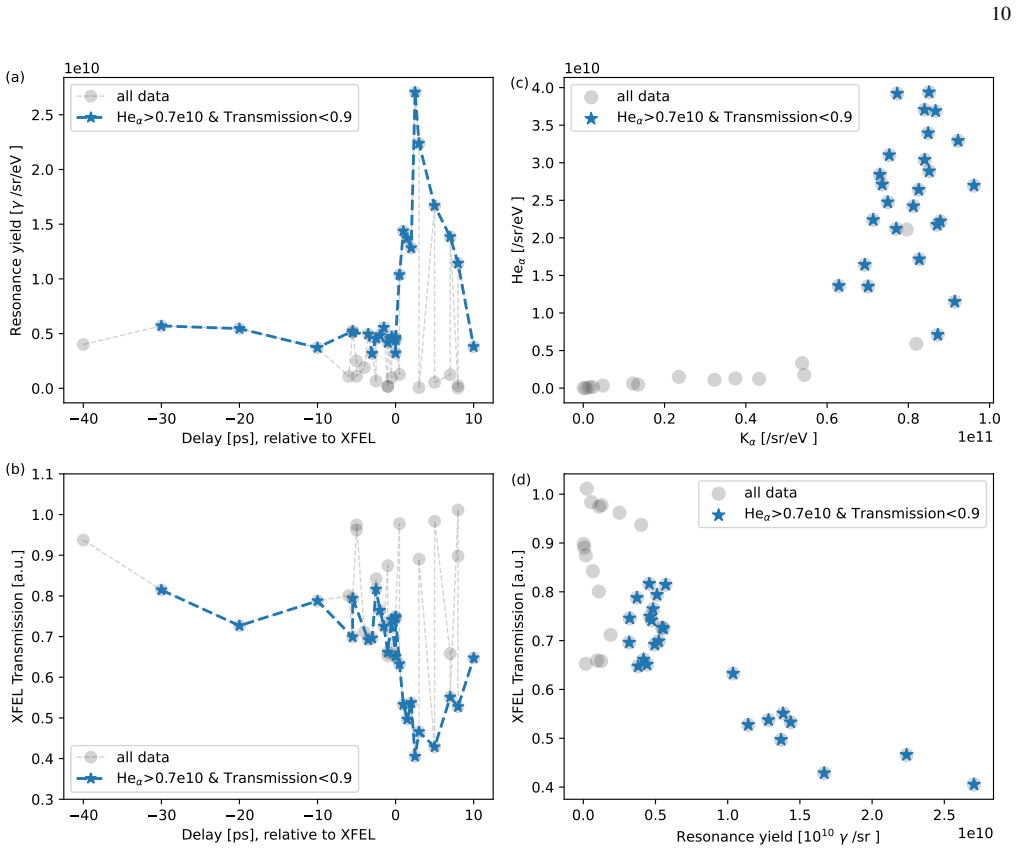
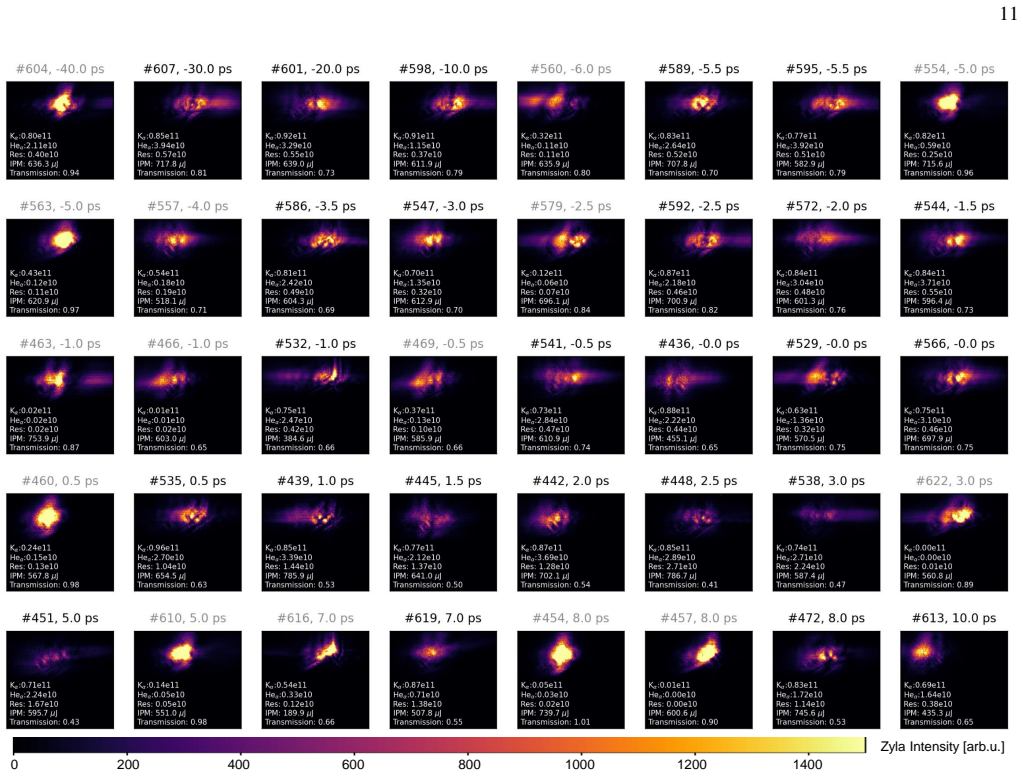
read the original abstract
Heating and ionization are among the most fundamental processes in relativistic laser--solid interactions; however, their spatiotemporal evolution remains challenging to capture experimentally. Here we present detailed diagnosis of high-intensity laser interactions with wire targets, leveraging the extreme spectral brightness of an X-ray free-electron laser in sub-picosecond time-resolved resonant X-ray emission spectroscopy and absorption imaging. Experimental results are compared with comprehensive simulations using atomic collisional--radiative models, particle-in-cell, and magnetohydrodynamics codes to elucidate the underlying physics. These multi-scale simulations reveal extreme sensitivity of basic plasma parameters with widely used models, such as temperature and ionization depth, which are able to be constrained by incorporating a detailed accounting of laser spatial profiles, pre-plasma conditions, and collisional processes. These results provide new insights into heating and ionization dynamics in the high-energy-density regime relevant to inertial fusion energy research, both as an experimental platform for accessing theoretically challenging conditions and as a benchmark for improving models of high-power laser--plasma interactions.
Editorial analysis
A structured set of objections, weighed in public.
Referee Report
Summary. The manuscript reports time-resolved resonant X-ray emission spectroscopy and absorption imaging experiments on wire targets driven by high-intensity lasers, using an XFEL to diagnose ultrafast heating and ionization in solid-density plasmas. Experimental results are compared against multi-scale simulations that couple atomic collisional-radiative models, particle-in-cell, and magnetohydrodynamics codes. The central claim is that these simulations exhibit extreme sensitivity of plasma temperature and ionization depth to laser spatial profiles, pre-plasma conditions, and collisional processes, enabling these quantities to be constrained and yielding new insights into high-energy-density laser-plasma interactions relevant to inertial fusion energy.
Significance. If the experimental-simulation comparisons are robust, the work supplies a useful diagnostic platform for accessing and benchmarking theoretically difficult conditions in the solid-density regime. The emphasis on multi-scale modeling to expose parameter sensitivities is a constructive contribution, especially if the simulations include reproducible elements or falsifiable predictions that can be tested by other groups.
major comments (2)
- [Results] Results section (comparison of measured and simulated X-ray spectra and ionization profiles): the manuscript states that the multi-scale simulations reveal extreme sensitivity allowing constraints on temperature and ionization depth, yet provides no quantitative validation metrics such as reduced chi-squared values, residual plots, or reported uncertainties on the fitted parameters. Without these, it is unclear whether the data genuinely constrain the models or whether the apparent sensitivity arises from unquantified model discrepancies.
- [Methods/Simulations] Simulation methodology (description of CR/PIC/MHD coupling): the central claim that detailed accounting of laser spatial profiles, pre-plasma, and collisional processes constrains basic plasma parameters assumes the chosen atomic collisional-radiative, particle-in-cell, and MHD implementations faithfully capture the underlying physics. In solid-density non-LTE regimes, known variations in opacity and ionization treatments across codes could produce model-specific sensitivities; the paper does not report cross-code benchmarks or analytic-limit tests that would rule out this possibility.
minor comments (2)
- [Abstract] Abstract: the phrase 'extreme sensitivity of basic plasma parameters with widely used models' is ambiguous; clarify whether this refers to sensitivity across different models or sensitivity within the chosen models to input parameters.
- [Figures] Figure captions (e.g., those showing time-resolved spectra): ensure all panels include explicit labels for experimental data points versus simulation curves and state the temporal resolution or binning used.
Simulated Author's Rebuttal
We thank the referee for their constructive and detailed review. We have addressed the concerns regarding quantitative validation of the simulation-experiment comparisons and the assumptions underlying the multi-scale modeling approach. The revisions clarify the strength of the constraints derived from the observed sensitivities while acknowledging methodological limitations.
read point-by-point responses
-
Referee: [Results] Results section (comparison of measured and simulated X-ray spectra and ionization profiles): the manuscript states that the multi-scale simulations reveal extreme sensitivity allowing constraints on temperature and ionization depth, yet provides no quantitative validation metrics such as reduced chi-squared values, residual plots, or reported uncertainties on the fitted parameters. Without these, it is unclear whether the data genuinely constrain the models or whether the apparent sensitivity arises from unquantified model discrepancies.
Authors: We agree that quantitative metrics improve the rigor of the claims. In the revised manuscript we have added reduced chi-squared values for the spectral and ionization profile comparisons, included residual plots in the supplementary material, and reported uncertainties on the derived temperature and ionization depth. These metrics support that the data constrain the explored parameter space, although we note that the primary evidence remains the demonstrated extreme sensitivity to input conditions. revision: yes
-
Referee: [Methods/Simulations] Simulation methodology (description of CR/PIC/MHD coupling): the central claim that detailed accounting of laser spatial profiles, pre-plasma, and collisional processes constrains basic plasma parameters assumes the chosen atomic collisional-radiative, particle-in-cell, and MHD implementations faithfully capture the underlying physics. In solid-density non-LTE regimes, known variations in opacity and ionization treatments across codes could produce model-specific sensitivities; the paper does not report cross-code benchmarks or analytic-limit tests that would rule out this possibility.
Authors: We acknowledge that model-to-model variations exist in the solid-density non-LTE regime. Our analysis is performed within a single consistent framework using standard implementations of the collisional-radiative, PIC, and MHD components. We have added a paragraph discussing these limitations, referencing prior validation studies of the individual codes, and clarifying that the reported constraints derive from the sensitivity to laser and pre-plasma inputs rather than from absolute model fidelity. Comprehensive cross-code benchmarks lie outside the scope of the present work. revision: partial
Circularity Check
No significant circularity; experimental X-ray data compared to independent multi-scale simulations
full rationale
The paper's central claim rests on comparing time-resolved resonant X-ray emission and absorption measurements from wire targets to multi-scale simulations (atomic collisional-radiative models, PIC, and MHD codes). These simulations are presented as revealing sensitivity of temperature and ionization depth to laser profiles, pre-plasma, and collisions, thereby constraining parameters. No quoted derivation, equation, or self-citation reduces a claimed prediction to a fitted input or prior result by construction. The analysis treats the codes as external tools whose fidelity is an assumption (not a self-defined loop), and the experimental data serve as an independent benchmark. This matches the default expectation of self-contained work against external measurements, warranting a low score of 2 with no load-bearing circular steps.
Axiom & Free-Parameter Ledger
axioms (1)
- domain assumption Atomic collisional-radiative models, particle-in-cell codes, and magnetohydrodynamics codes together accurately represent the heating and ionization physics.
Lean theorems connected to this paper
-
IndisputableMonolith/Foundation/RealityFromDistinction.leanreality_from_one_distinction unclear?
unclearRelation between the paper passage and the cited Recognition theorem.
multi-scale simulations reveal extreme sensitivity of basic plasma parameters such as temperature and ionization depth... incorporating a detailed accounting of laser spatial profiles, pre-plasma conditions, and collisional processes
-
IndisputableMonolith/Cost/FunctionalEquation.leanwashburn_uniqueness_aczel unclear?
unclearRelation between the paper passage and the cited Recognition theorem.
atomic collisional-radiative models, particle-in-cell, and magnetohydrodynamics codes
What do these tags mean?
- matches
- The paper's claim is directly supported by a theorem in the formal canon.
- supports
- The theorem supports part of the paper's argument, but the paper may add assumptions or extra steps.
- extends
- The paper goes beyond the formal theorem; the theorem is a base layer rather than the whole result.
- uses
- The paper appears to rely on the theorem as machinery.
- contradicts
- The paper's claim conflicts with a theorem or certificate in the canon.
- unclear
- Pith found a possible connection, but the passage is too broad, indirect, or ambiguous to say the theorem truly supports the claim.
Reference graph
Works this paper leans on
-
[1]
Helmholtz-Zentrum Dresden-Rossendorf, 01328 Dresden, Germany
-
[2]
European XFEL, 22869 Schenefeld, Germany
-
[3]
Technische Universit ¨at Bergakademie Freiberg, 09599 Freiberg, Germany
-
[4]
Technische Universit ¨at Dresden, 01062 Dresden, Germany
-
[5]
Center for X-ray and Nano Science CXNS, Deutsches Elektronen-Synchrotron DESY, Notkestraße 85, 22607 Hamburg, Germany
-
[6]
Universit ¨at Siegen, 57072 Siegen, Germany
-
[7]
The Extreme Light Infrastructure ERIC, ELI Beamlines Facility, Za Radnic ´ı 835, 25241 Doln ´ı Bˇreˇzany, Czech Republic
-
[8]
National Institute for Fusion Sciences, 509-5292, Toki, Japan (Dated: August 30, 2025) Heating and ionization are among the most fundamental processes in ultra-short, relativistic laser–solid inter- actions. However, capturing their spatiotemporal evolution experimentally is challenging due to the inherently transient and non-local thermodynamic equilibri...
work page internal anchor Pith review Pith/arXiv arXiv 2025
-
[9]
L. G. Huang, T. Kluge, and T. E. Cowan, Dynamics of bulk electron heating and ionization in solid density plasmas driven by ultra-short relativistic laser pulses, Physics of Plasmas 23, 10.1063/1.4953891 (2016)
- [10]
-
[11]
R. P. Drake, Perspectives on high-energy-density physics, Physics of Plasmas 16, 10.1063/1.3078101 (2009)
-
[12]
J. NUCKOLLS, L. WOOD, A. THIESSEN, and G. ZIMMER- MAN, Laser compression of matter to super-high densities: Thermonuclear (CTR) applications, Nature 239, 139 (1972)
work page 1972
-
[13]
R. Kodama, P. A. Norreys, K. Mima, A. E. Dangor, R. G. Evans, H. Fujita, Y . Kitagawa, K. Krushelnick, T. Miyakoshi, N. Miyanaga, T. Norimatsu, S. J. Rose, T. Shozaki, K. Shige- mori, A. Sunahara, M. Tampo, K. A. Tanaka, Y . Toyama, T. Ya- manaka, and M. Zepf, Fast heating of ultrahigh-density plasma as a step towards laser fusion ignition, Nature 412, 798 (2001)
work page 2001
-
[14]
A. J. Kemp, Y . Sentoku, V . Sotnikov, and S. C. Wilks, Colli- sional relaxation of superthermal electrons generated by rela- tivistic laser pulses in dense plasma, Physical Review Letters 97, 235001 (2006)
work page 2006
-
[15]
J. Davis and G. M. Petrov, Modelling of non-lte atomic physics processes in hot dense plasmas during the interaction with an intense short pulse laser, Journal of Physics B: Atomic, Molec- ular and Optical Physics 47, 095402 (2014)
work page 2014
-
[16]
L. G. Huang, H. P. Schlenvoigt, H. Takabe, and T. E. Cowan, Ionization and reflux dependence of magnetic instability gener- ation and probing inside laser-irradiated solid thin foils, Physics of Plasmas 24, 103115 (2017)
work page 2017
-
[17]
Wang, Physical Review B94, 10.1103/phys- revb.94.195105 (2016)
S. Morris, D. O. Gericke, S. Fritzsche, J. Machado, J. P. Santos, and M. Afshari, Recombination effects in laser-driven accel- eration of heavy ions, Physical Review E 111, 10.1103/phys- reve.111.065209 (2025)
-
[18]
O. N. Rosmej, Z. Samsonova, S. H ¨ofer, D. Kartashov, C. Arda, D. Khaghani, A. Schoenlein, S. Z ¨ahter, A. Hoffmann, R. Loet- zsch, A. Saevert, I. Uschmann, M. E. Povarnitsyn, N. E. An- dreev, L. P. Pugachev, M. C. Kaluza, and C. Spielmann, Gener- ation of kev hot near-solid density plasma states at high contrast laser-matter interaction, Physics of Plasm...
work page 2018
-
[19]
O. Renner and F. B. Rosmej, Challenges of x-ray spectroscopy in investigations of matter under extreme conditions, Matter and Radiation at Extremes 4, 10.1063/1.5086344 (2019)
-
[20]
N. F. Beier, H. Allison, P. Efthimion, K. A. Flippo, L. Gao, S. B. Hansen, K. Hill, R. Hollinger, M. Logantha, Y . Musthafa, R. Nedbailo, V . Senthilkumaran, R. Shepherd, V . N. Shlyapt- sev, H. Song, S. Wang, F. Dollar, J. J. Rocca, and A. E. Hussein, Homogeneous, micron-scale high-energy-density matter gener- ated by relativistic laser-solid interaction...
work page 2022
-
[21]
X. Pan, M. ˇSm´ıd, L. G. Huang, T. Kluge, V . Bagnoud, E. Bram- brink, T. E. Cowan, J. Colgan, T. Ebert, D. Hartnagel, M. Hesse, J. Hornung, A. Kleinschmidt, P. Perez-Martin, A. Neukirch, K. Philipp, S. Sander, G. Schaumann, A. Tebartz, B. Zielbauer, M. Roth, and K. Falk, Investigation on laser absorption and x-ray radiation in microstructured titanium ta...
-
[22]
O. S. Humphries, P. Allan, C. R. D. Brown, L. M. R. Hobbs, S. F. James, M. G. Ramsay, B. Williams, D. J. Hoarty, M. P. Hill, and S. M. Vinko, Time evolution of transient plasma states from nanowire arrays irradiated at relativistic intensities, Com- munications Physics 3, 10.1038/s42005-020-00438-7 (2020)
-
[23]
U. Zastrau, P. Audebert, V . Bernshtam, E. Brambrink, T. K¨ampfer, E. Kroupp, R. Loetzsch, Y . Maron, Y . Ralchenko, H. Reinholz, G. R ¨opke, A. Sengebusch, E. Stambulchik, I. Uschmann, L. Weingarten, and E. F ¨orster, Temperature and kα-yield radial distributions in laser-produced solid-density plasmas imaged with ultrahigh-resolution x-ray spectroscopy,...
work page 2010
-
[24]
H. Sawada, Y . Sentoku, T. Yabuuchi, U. Zastrau, E. F ¨orster, F. Beg, H. Chen, A. Kemp, H. McLean, P. Patel, and Y . Ping, Monochromatic 2d k α emission images revealing short-pulse laser isochoric heating mechanism, Physical Review Letters 122, 10.1103/PhysRevLett.122.155002 (2019)
-
[25]
U. Zastrau, K. Appel, C. Baehtz, O. Baehr, L. Batche- lor, A. Bergh ¨auser, M. Banjafar, E. Brambrink, V . Ceran- tola, T. E. Cowan, H. Damker, S. Dietrich, S. D. D. Cafiso, J. Dreyer, H.-O. Engel, T. Feldmann, S. Findeisen, M. Foese, D. Fulla-Marsa, S. G ¨ode, M. Hassan, J. Hauser, T. Her- rmannsd¨orfer, H. H ¨oppner, J. Kaa, P. Kaever, K. Kn ¨ofel, Z. K...
work page 2021
-
[26]
T. Kluge, M. R ¨odel, J. Metzkes-Ng, A. Pelka, A. L. Garcia, I. Prencipe, M. Rehwald, M. Nakatsutsumi, E. E. McBride, T. Sch¨onherr, M. Garten, N. J. Hartley, M. Zacharias, J. Gren- zer, A. Erbe, Y . M. Georgiev, E. Galtier, I. Nam, H. J. Lee, S. Glenzer, M. Bussmann, C. Gutt, K. Zeil, C. R ¨odel, U. H ¨ubner, U. Schramm, and T. E. Cowan, Observation of 1...
work page 2018
-
[27]
L. Huang, M. ˇSm´ıd, L. Yang, O. Humphries, J. Hagemann, T. Engler, X. Pan, Y . Cui, T. Kluge, R. Aguilar, C. Bae- htz, E. Brambrink, E. Eren, K. Falk, A. L. Garcia, S. G ¨ode, C. Gutt, M. Hassan, P. Heuser, H. H¨oppner, M. Kozlova, W. Lu, J. Metzkes-Ng, M. Masruri, M. Mishchenko, M. Nakatsutsumi, M. Ota, ¨Ozg¨ul ¨Ozt¨urk, A. Pelka, I. Prencipe, T. R. Pre...
-
[28]
T. Kluge, M. Bussmann, E. Galtier, S. Glenzer, J. Grenzer, C. Gutt, N. J. Hartley, L. Huang, A. L. Garcia, H. J. Lee, E. E. McBride, J. Metzkes-Ng, M. Nakatsutsumi, I. Nam, A. Pelka, I. Prencipe, L. Randolph, M. Rehwald, C. R ¨odel, M. R ¨odel, T. Toncian, L. Yang, K. Zeil, U. Schramm, and T. E. Cowan, Probing shock dynamics inside micro-wire targets afte...
work page 2023
-
[29]
P. Ordyna, C. B¨ahtz, E. Brambrink, M. Bussmann, A. Laso Gar- cia, M. Garten, L. Gaus, S. G ¨ode, J. Grenzer, C. Gutt, H. H¨oppner, L. Huang, U. H¨ubner, O. Humphries, B. E. Marr´e, J. Metzkes-Ng, T. Miethlinger, M. Nakatsutsumi, O. ¨Ozt¨urk, X. Pan, F. Paschke-Br ¨uhl, A. Pelka, I. Prencipe, T. R. Pre- ston, L. Randolph, H.-P. Schlenvoigt, J.-P. Schwinke...
-
[30]
A. Laso Garcia, L. Yang, V . Bouffetier, K. Appel, C. Bae- htz, J. Hagemann, H. H ¨oppner, O. Humphries, T. Kluge, M. Mishchenko, M. Nakatsutsumi, A. Pelka, T. R. Preston, L. Randolph, U. Zastrau, T. E. Cowan, L. Huang, and T. Ton- cian, Cylindrical compression of thin wires by irradiation with a joule-class short-pulse laser, Nature Communications 15, 10...
-
[31]
T. Kluge, M. Bussmann, H.-K. Chung, C. Gutt, L. G. Huang, M. Zacharias, U. Schramm, and T. E. Cowan, Nanoscale fem- tosecond imaging of transient hot solid density plasmas with elemental and charge state sensitivity using resonant coherent diffraction, Physics of Plasmas 23, 033103 (2016)
work page 2016
-
[32]
L. Gaus, L. Bischoff, M. Bussmann, E. Cunningham, C. B. Curry, J. E, E. Galtier, M. Gauthier, A. Laso Garc´ıa, M. Garten, S. Glenzer, J. Grenzer, C. Gutt, N. J. Hartley, L. Huang, U. H ¨ubner, D. Kraus, H. J. Lee, E. E. McBride, J. Metzkes- Ng, B. Nagler, M. Nakatsutsumi, J. Nikl, M. Ota, A. Pelka, I. Prencipe, L. Randolph, M. R ¨odel, Y . Sakawa, H.-P. S...
-
[33]
H. Sawada, T. Yabuuchi, N. Higashi, T. Iwasaki, K. Kawasaki, Y . Maeda, T. Izumi, Y . Nakagawa, K. Shigemori, Y . Sakawa, C. B. Curry, M. Frost, N. Iwata, T. Ogitsu, K. Sueda, T. To- gashi, S. X. Hu, S. H. Glenzer, A. J. Kemp, Y . Ping, and Y . Sentoku, Spatiotemporal dynamics of fast electron heating in solid-density matter via xfel, Nature Communication...
-
[34]
M. D. Mishchenko, A. L. Garcia, O. S. Humphries, L. Huang, T. Kluge, M. Smid, V . Bouffetier, E. Brambrink, S. Goede, M. Nakatsutsumi, T. R. Preston, L. Randolph, D. Bespalov, M. Tang, D. Kraus, C. Baehtz, S. D. D. Cafiso, H. Hoeppner, M. Masruri, A. Pelka, I. Prencipe, J.-P. Schwinkendorf, M. Ton- cian, P. B. Neumayer, S. Pikuz, B.-I. Cho, G. Lee, J. H. ...
work page 2025
-
[35]
Q. Y . van den Berg, E. V . Fernandez-Tello, T. Burian, J. Chalupsk ´y, H.-K. Chung, O. Ciricosta, G. L. Dakovski, V . H´ajkov´a, P. Hollebon, L. Juha, J. Krzywinski, R. W. Lee, M. P. Minitti, T. R. Preston, A. G. de la Varga, V . V ozda, U. Za- strau, J. S. Wark, P. Velarde, and S. M. Vinko, Clocking fem- tosecond collisional dynamics via resonant x-ray ...
work page 2018
-
[36]
A. Laso Garcia, H. H ¨oppner, A. Pelka, C. B¨ahtz, E. Brambrink, S. Di Dio Cafiso, J. Dreyer, S. G ¨ode, M. Hassan, T. Kluge, and et al., Relax: the helmholtz international beamline for ex- treme fields high-intensity short-pulse laser driver for relativis- tic laser–matter interaction and strong-field science using the high energy density instrument at t...
work page 2021
-
[37]
T. Preston, S. G ¨ode, J.-P. Schwinkendorf, K. Appel, E. Bram- brink, V . Cerantola, H. H ¨oppner, M. Makita, A. Pelka, C. Prescher, K. Sukharnikov, A. Schmidt, I. Thorpe, T. Toncian, A. Amouretti, D. Chekrygina, R. Falcone, K. Falk, L. Fletcher, E. Galtier, M. Harmand, N. Hartley, S. Hau-Riege, P. Heimann, L. Huang, O. Humphries, O. Karnbach, D. Kraus, H...
- [38]
-
[39]
N. Rohringer, D. Ryan, R. A. London, M. Purvis, F. Albert, J. Dunn, J. D. Bozek, C. Bostedt, A. Graf, R. Hill, S. P. Hau- Riege, and J. J. Rocca, Atomic inner-shell x-ray laser at 1.46 nanometres pumped by an x-ray free-electron laser, Nature481, 488–491 (2012)
work page 2012
- [40]
-
[41]
T. M. Linker, A. Halavanau, T. Kroll, A. Benediktovitch, Y . Zhang, Y . Michine, S. Chuchurka, Z. Abhari, D. Ronchetti, T. Fransson, C. Weninger, F. D. Fuller, A. Aquila, R. Alonso- Mori, S. Boutet, M. W. Guetg, A. Marinelli, A. A. Lutman, M. Yabashi, I. Inoue, T. Osaka, J. Yamada, Y . Inubushi, G. Ya- maguchi, T. Hara, G. Babu, D. Salpekar, F. N. Sayed, ...
work page 2025
- [42]
-
[43]
H.-S. Park, D. M. Chambers, H.-K. Chung, R. J. Clarke, R. Ea- gleton, E. Giraldez, T. Goldsack, R. Heathcote, N. Izumi, M. H. Key, J. A. King, J. A. Koch, O. L. Landen, A. Nikroo, P. K. Patel, D. F. Price, B. A. Remington, H. F. Robey, R. A. Snavely, D. A. Steinman, R. B. Stephens, C. Stoeckl, M. Storm, M. Tabak, W. Theobald, R. P. J. Town, J. E. Wickersh...
work page 2006
-
[44]
M. ˇSmıd, O. Humphries, C. Baehtz, E. Brambrink, T. Burian, M. S. Cho, T. E. Cowan, L. Gaus, M. F. Gu, V . H ´ajkov´a, L. Juha, Z. Konopkova, H. P. Le, M. Makita, X. Pan, T. Preston, A. Schropp, H. A. Scott, R.ˇStefanıkov´a, J. V orberger, W. Wang, U. Zastrau, and K. Falk, Plasma screening in mid-charged ions observed by k-shell line emission (2024), arXi...
-
[45]
Y . Sentoku and A. Kemp, Numerical methods for particle sim- ulations at extreme densities and temperatures: Weighted par- ticles, relativistic collisions and reduced currents, Journal of Computational Physics 227, 6846 (2008)
work page 2008
- [46]
-
[47]
B. Fryxell, K. Olson, P. Ricker, F. X. Timmes, M. Zingale, D. Q. Lamb, P. MacNeice, R. Rosner, J. W. Truran, and H. Tufo, Flash: An adaptive mesh hydrodynamics code for modeling as- trophysical thermonuclear flashes, The Astrophysical Journal Supplement Series 131, 273–334 (2000)
work page 2000
-
[48]
L. Yang, M. L. Herbert, C. B ¨ahtz, V . Bouffetier, E. Bram- brink, T. Dornheim, N. Fefeu, T. Gawne, S. G ¨ode, J. Hage- mann, H. H ¨oeppner, L. G. Huang, O. S. Humphries, T. Kluge, D. Kraus, J. L ¨utgert, J. P. Naedler, M. Nakatsutsumi, A. Pelka, T. R. Preston, C. Qu, S. V . Rahul, R. Redmer, M. Rehwald, L. Randolph, J. J. Santos, M.ˇSm´ıd, U. Schramm, J...
-
[49]
L. Yang, L. Huang, S. Assenbaum, T. E. Cowan, I. Goethel, S. G ¨ode, T. Kluge, M. Rehwald, X. Pan, U. Schramm, J. V or- berger, K. Zeil, T. Ziegler, and C. Bernert, Time-resolved opti- cal shadowgraphy of solid hydrogen jets as a testbed to bench- mark particle-in-cell simulations, Communications Physics 6, 368 (2023)
work page 2023
-
[50]
W. Lotz, Electron-impact ionization cross-sections for atoms up to z=108, Zeitschrift f ¨ur Physik A Hadrons and nuclei 232, 101–107 (1970)
work page 1970
-
[51]
E. Galtier, H. J. Lee, D. Khaghani, N. Boiadjieva, P. McGe- hee, A. Arnott, B. Arnold, M. Berboucha, E. Cunningham, N. Czapla, G. Dyer, R. Ettelbrick, P. Hart, P. Heimann, M. Welch, M. Makita, A. E. Gleason, S. Pandolfi, A. Sakdi- nawat, Y . Liu, M. J. Wojcik, D. Hodge, R. Sandberg, M. P. Val- divia, V . Bouffetier, G. P´erez-Callejo, F. Seiboth, and B. N...
-
[52]
L. A. Pickworth, B. A. Hammel, V . A. Smalyuk, H. F. Robey, R. Tommasini, L. R. Benedetti, L. Berzak Hopkins, D. K. Bradley, M. Dayton, S. Felker, J. E. Field, S. W. Haan, B. Haid, R. Hatarik, E. Hartouni, D. Holunga, M. Hoppe, N. Izumi, S. Johnson, S. Khan, T. Kohut, B. Lahmann, O. L. Lan- den, S. LePape, A. G. MacPhee, E. Marley, N. B. Meezan, J. Milovi...
-
[53]
E. L. Dewald, O. L. Landen, J. Salmonson, L. Masse, M. Tabak, V . A. Smalyuk, S. Schiaffino, R. Heredia, M. Schneider, and A. Nikroo, First study of hohlraum x-ray preheat asymmetry in- side an icf capsule, Physics of Plasmas 27, 10.1063/5.0027467 (2020)
-
[54]
C. R. Weber, D. S. Clark, A. Pak, N. Alfonso, B. Bachmann, L. F. Berzak Hopkins, T. Bunn, J. Crippen, L. Divol, T. Dit- trich, A. L. Kritcher, O. L. Landen, S. Le Pape, A. G. MacPhee, E. Marley, L. P. Masse, J. L. Milovich, A. Nikroo, P. K. Patel, L. A. Pickworth, N. Rice, V . A. Smalyuk, and M. Stadermann, Mixing in icf implosions on the national ignitio...
-
[55]
https://in.xfel.eu/metadata/doi/10.22003/XFEL.EU DATA- 003129-00, Probing the lateral transport of hot electrons in relativistic laser solid wire target interactions (2022)
-
[56]
N. Kujala, W. Freund, J. Liu, A. Koch, T. Falk, M. Planas, F. Di- etrich, J. Laksman, T. Maltezopoulos, J. Risch, F. Dall’Antonia, and J. Gr¨unert, Hard x-ray single-shot spectrometer at the euro- pean x-ray free-electron laser, Review of Scientific Instruments 91, 10.1063/5.0019935 (2020)
-
[57]
T. Maltezopoulos, F. Dietrich, W. Freund, U. F. Jastrow, A. Koch, J. Laksman, J. Liu, M. Planas, A. A. Sorokin, K. Tiedtke, and J. Gr ¨unert, Operation of x-ray gas monitors at the european xfel, Journal of Synchrotron Radiation 26, 1045–1051 (2019)
work page 2019
-
[58]
H. J. Kirkwood, R. Letrun, T. Tanikawa, J. Liu, M. Nakat- sutsumi, M. Emons, T. Jezynski, G. Palmer, M. Lederer, R. Bean, J. Buck, S. Di Dio Cafisio, R. Graceffa, J. Gr ¨unert, S. G ¨ode, H. H ¨oppner, Y . Kim, Z. Konopkova, G. Mills, M. Makita, A. Pelka, T. R. Preston, M. Sikorski, C. M. S. Takem, K. Giewekemeyer, M. Chollet, P. Vagovic, H. N. Chap- man,...
work page 2019
-
[59]
Johnson, The SESAME database , Tech
J. Johnson, The SESAME database , Tech. Rep. (Los Alamos National Lab.(LANL), Los Alamos, NM (United States), 1994)
work page 1994
discussion (0)
Sign in with ORCID, Apple, or X to comment. Anyone can read and Pith papers without signing in.