Simulation Studies of Resonant Excitation of Electron Bernstein Waves in Capacitive Discharges
Pith reviewed 2026-05-21 23:39 UTC · model grok-4.3
The pith
In mildly magnetized capacitive discharges, asymmetry along density gradients excites propagating electron Bernstein waves that aid energy transport.
A machine-rendered reading of the paper's core claim, the machinery that carries it, and where it could break.
Core claim
In the regime 1 ≤ f_ce/f_rf < 2, increasing magnetic field strength drives a transition to an asymmetric density profile that correlates with the excitation and propagation of electron Bernstein waves along localized electron density gradients; the waves facilitate energy transport and electron heating, as shown by PIC-MCC simulations that incorporate kinetic electron and ion behavior plus sheath dynamics.
What carries the argument
The correlation between discharge asymmetry, localized density gradients, and resonant excitation of electron Bernstein waves, tracked through particle-in-cell Monte Carlo collision simulations.
If this is right
- Magnetic field strength within the defined range can toggle the discharge between symmetric and asymmetric states.
- Electron Bernstein waves become a significant channel for energy transport in the plasma bulk.
- Electron heating in mildly magnetized capacitive discharges involves wave-particle interactions beyond standard sheath heating.
- The return to symmetry at higher field strengths suppresses the waves once gradients flatten.
Where Pith is reading between the lines
- Similar asymmetry-driven wave excitation could appear in other weakly magnetized plasma sources used for materials processing.
- Controlling density gradients experimentally might offer a way to tune wave activity and heating without changing the magnetic field.
- The observed transition back to symmetry suggests an optimal field range for maximizing wave-mediated heating effects.
Load-bearing premise
The particle-in-cell Monte Carlo collision simulations correctly capture the collisionless effects and sheath dynamics that produce the electron Bernstein wave excitation.
What would settle it
An experiment or simulation that finds electron Bernstein waves propagating without accompanying discharge asymmetry or steep density gradients would disprove the central correlation.
Figures



read the original abstract
The behavior of capacitive coupled plasma (CCP) discharges is investigated in a mildly magnetized regime, defined by the condition 1 $\leq$ $f_{ce}/f_{rf}$ $\lt$ 2, where $f_{ce}$ and $f_{rf}$ are the cyclotron and radio-frequencies (RF), respectively. This regime exhibits complex and distinctive plasma dynamics due to the interplay between RF fields and the externally applied magnetic field. Two prominent phenomena are observed in this regime. First, the plasma density profile becomes asymmetric across the discharge, deviating from the typical symmetric distribution seen in unmagnetized CCPs. Second, electron Bernstein waves (EBWs), high-frequency electrostatic waves, are excited and propagate within the bulk plasma, particularly along steep electron density gradients. As the strength of the magnetic field increases within this regime, the CCP discharge undergoes a transition from a symmetric configuration to an asymmetric one, and then returns to a symmetric profile at higher field strengths. Notably, the excitation and propagation of EBWs are strongly correlated with the presence of discharge asymmetry and localized density gradients. These waves play a significant role in energy transport and electron heating under mildly magnetized conditions. To gain deeper insight into the underlying physics, detailed numerical simulations are carried out using the particle-in-cell Monte Carlo collision (PIC-MCC) technique. These simulations capture the kinetic behavior of electrons and ions, including the collisionless effects and sheath dynamics essential to understanding the excitation of EBWs and the evolution of discharge symmetry. The study thus sheds light on the role of weak magnetic fields in shaping plasma behavior and highlights the importance of wave-particle interactions in magnetized CCPs.
Editorial analysis
A structured set of objections, weighed in public.
Referee Report
Summary. The paper investigates capacitively coupled plasma (CCP) discharges in the mildly magnetized regime 1 ≤ f_ce/f_rf < 2 using particle-in-cell Monte Carlo collision (PIC-MCC) simulations. It reports the emergence of asymmetric plasma density profiles that transition back to symmetry at higher field strengths, the excitation of electron Bernstein waves (EBWs) propagating along steep density gradients, and a strong correlation between EBW activity, discharge asymmetry, and their contribution to energy transport and electron heating.
Significance. If the wave mode identification and the inferred role in transport hold after verification, the work would provide useful kinetic insights into wave-particle interactions in weakly magnetized CCPs, relevant to industrial plasma processing where modest magnetic fields are employed to control uniformity and heating.
major comments (2)
- [Results] Results section (description of wave observations): The central claim that the high-frequency electrostatic fluctuations are electron Bernstein waves whose excitation and propagation are tied to asymmetry and contribute to energy transport requires explicit verification. The manuscript describes propagation along density gradients and correlation with asymmetry but provides no indication that k-ω spectra were extracted from the simulations or compared against the EBW dispersion relation ω² ≈ ω_ce² + 3k²v_th² (or appropriate harmonic branch) evaluated at the local n_e and B values in the 1 ≤ f_ce/f_rf < 2 regime. Without this step the fluctuations could be upper-hybrid or other electrostatic modes, weakening both the mode identification and the conclusions on heating/transport.
- [Methods and Results] Simulation methods and results: The abstract states that the simulations capture collisionless effects and sheath dynamics, yet no quantitative validation (e.g., comparison of simulated wave frequencies or growth rates to linear theory, or error bars on the reported asymmetry-EBW correlation) is described. This absence makes it difficult to assess whether the observed correlation is robust or an artifact of numerical parameters.
minor comments (2)
- [Abstract] Abstract: The phrase 'mildly magnetized conditions' is used without a precise definition beyond the frequency ratio; a short parenthetical reminder of the exact range would improve clarity.
- [Throughout] Notation: Ensure consistent use of subscripts (f_ce, f_rf) and symbols for thermal velocity throughout the text and figures.
Simulated Author's Rebuttal
We thank the referee for the constructive and detailed review of our manuscript on simulation studies of resonant excitation of electron Bernstein waves in mildly magnetized capacitive discharges. We address each major comment below and will revise the manuscript accordingly to strengthen the wave identification and validation.
read point-by-point responses
-
Referee: [Results] Results section (description of wave observations): The central claim that the high-frequency electrostatic fluctuations are electron Bernstein waves whose excitation and propagation are tied to asymmetry and contribute to energy transport requires explicit verification. The manuscript describes propagation along density gradients and correlation with asymmetry but provides no indication that k-ω spectra were extracted from the simulations or compared against the EBW dispersion relation ω² ≈ ω_ce² + 3k²v_th² (or appropriate harmonic branch) evaluated at the local n_e and B values in the 1 ≤ f_ce/f_rf < 2 regime. Without this step the fluctuations could be upper-hybrid or other electrostatic modes, weakening both the mode identification and the conclusions on heating/transport.
Authors: We agree that direct spectral verification is required for unambiguous identification. The revised manuscript will include k-ω spectra extracted from the PIC-MCC data at relevant times and locations. These will be compared quantitatively to the EBW dispersion relation ω² ≈ ω_ce² + 3k²v_th² (and the appropriate harmonic branch) evaluated using the local electron density and magnetic field values in the 1 ≤ f_ce/f_rf < 2 regime. This addition will confirm the mode as electron Bernstein waves and reinforce the reported links to asymmetry, density gradients, and energy transport. revision: yes
-
Referee: [Methods and Results] Simulation methods and results: The abstract states that the simulations capture collisionless effects and sheath dynamics, yet no quantitative validation (e.g., comparison of simulated wave frequencies or growth rates to linear theory, or error bars on the reported asymmetry-EBW correlation) is described. This absence makes it difficult to assess whether the observed correlation is robust or an artifact of numerical parameters.
Authors: We acknowledge the value of explicit quantitative checks. The revised manuscript will add direct comparisons of the observed wave frequencies against linear-theory predictions for EBWs at the simulated plasma parameters. We will also report statistical measures of the asymmetry-EBW correlation, including error bars or uncertainties derived from multiple simulation runs or time windows, to demonstrate robustness against numerical parameters. revision: yes
Circularity Check
No circularity detected; results are direct outputs from numerical simulations
full rationale
The paper reports observations from PIC-MCC simulations of CCP discharges in the 1 ≤ f_ce/f_rf < 2 regime, describing asymmetry transitions and EBW excitation along density gradients as emergent behaviors captured by the kinetic model. No analytical derivation chain, fitted-parameter predictions, or self-citation load-bearing steps are present in the provided text. Claims rest on simulation outputs rather than any reduction of results to inputs by construction, satisfying the criteria for a self-contained numerical study.
Axiom & Free-Parameter Ledger
axioms (1)
- domain assumption PIC-MCC simulations accurately capture collisionless effects and sheath dynamics in the stated regime.
Lean theorems connected to this paper
-
IndisputableMonolith/Foundation/AbsoluteFloorClosure.lean, IndisputableMonolith/Cost/FunctionalEquation.leanreality_from_one_distinction unclear?
unclearRelation between the paper passage and the cited Recognition theorem.
detailed numerical simulations are carried out using the particle-in-cell Monte Carlo collision (PIC-MCC) technique... 2D FFT analysis... dispersion relation... ω²/ω_ce² = 5 + α/2 − 1/2 √(9 + 10α + α² − 16β)
-
IndisputableMonolith/Foundation/AlexanderDuality.leanalexander_duality_circle_linking unclear?
unclearRelation between the paper passage and the cited Recognition theorem.
The observed frequency components... consistent with the propagation of electrostatic waves... fundamental EBW mode... in excellent agreement with the analytical curve
What do these tags mean?
- matches
- The paper's claim is directly supported by a theorem in the formal canon.
- supports
- The theorem supports part of the paper's argument, but the paper may add assumptions or extra steps.
- extends
- The paper goes beyond the formal theorem; the theorem is a base layer rather than the whole result.
- uses
- The paper appears to rely on the theorem as machinery.
- contradicts
- The paper's claim conflicts with a theorem or certificate in the canon.
- unclear
- Pith found a possible connection, but the passage is too broad, indirect, or ambiguous to say the theorem truly supports the claim.
Forward citations
Cited by 1 Pith paper
-
Resonantly Driven Electron Bernstein Waves in Magnetized Low-Pressure Capacitive Discharges
PIC-MCC simulations show resonant excitation and propagation of electron Bernstein waves along density gradients in low-pressure CCPs for 1 ≤ f_ce/f_rf < 2.
Reference graph
Works this paper leans on
-
[1]
Simulation Studies of Resonant Excitation of Electron Bernstein Waves in Capacitive Discharges
INTRODUCTION Low-pressure radio-frequency (RF) capacitive coupled plasma (CCP) discharges are foundational to a wide range of advanced technologies with significant societal and industrial applications[1–3]. These discharges are ex- tensively employed in fields such as semiconductor man- ufacturing, surface coating, biomedical engineering and environmenta...
work page internal anchor Pith review Pith/arXiv arXiv 2025
-
[2]
Com- prehensive information and the EDIPIC source code can be accessed via GitHub [89]
SIMULATION TECHNIQUE AND PARAMETERS In this study, we employ the well-established and ex- tensively validated 1D-3V electrostatic Direct Implicit Particle-in-Cell (EDIPIC) code[61, 71, 72, 83–88]. Com- prehensive information and the EDIPIC source code can be accessed via GitHub [89]. While EDIPIC is capable of operating in both explicit and implicit modes...
-
[3]
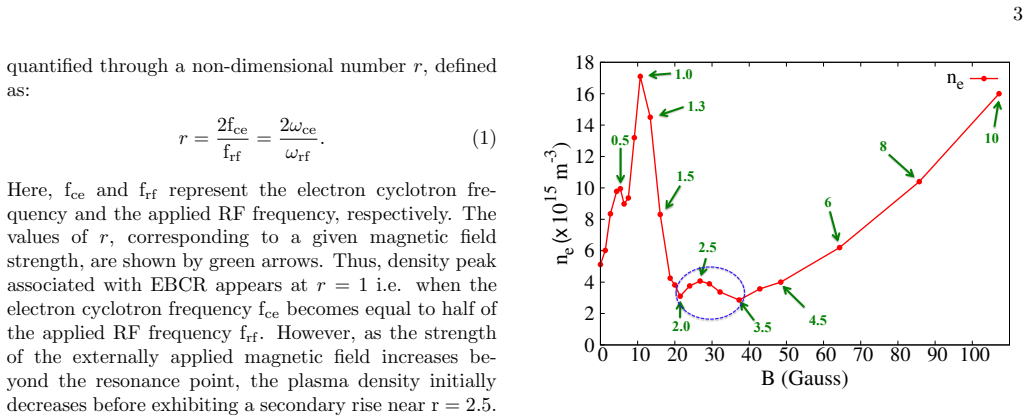
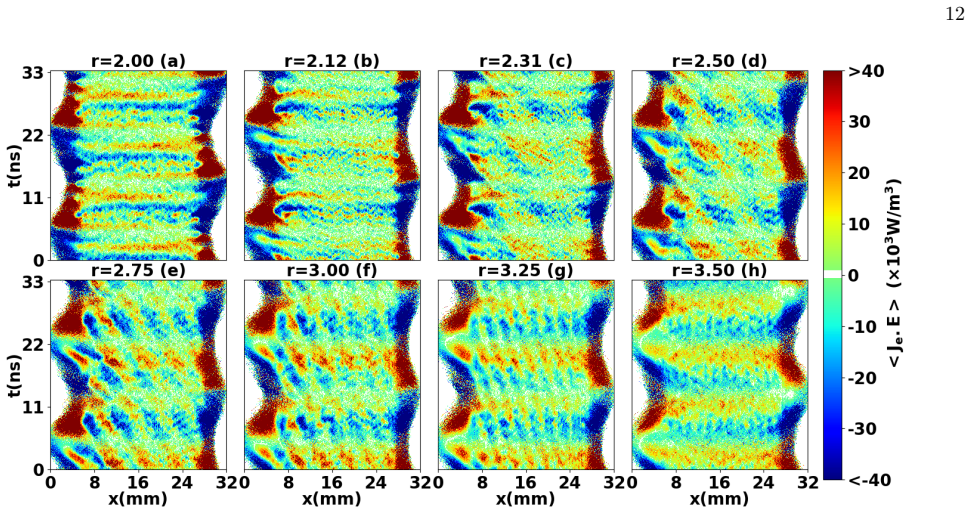
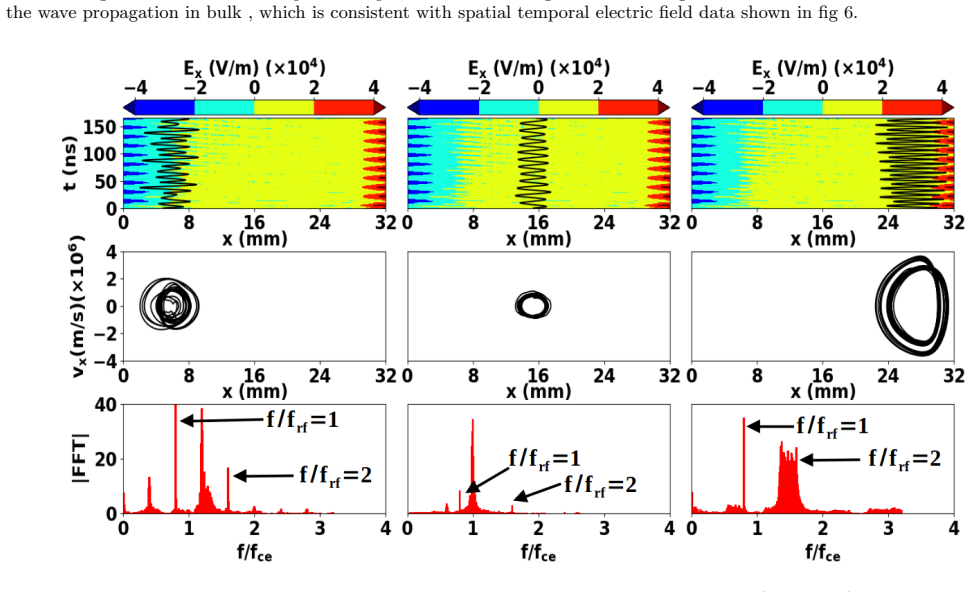
RESULTS AND DISCUSSION Recalling that in magnetized CCP discharges the first density enhancement appears for EBCR [77, 78] which corresponds to r = 1 i.e. f ce = frf /2. Physically, this means that for r = 1, the electrons complete a half-gyro- rotation during one RF cycle. As a result, electrons re- peatedly gain energy by interacting with the oscillatin...
-
[4]
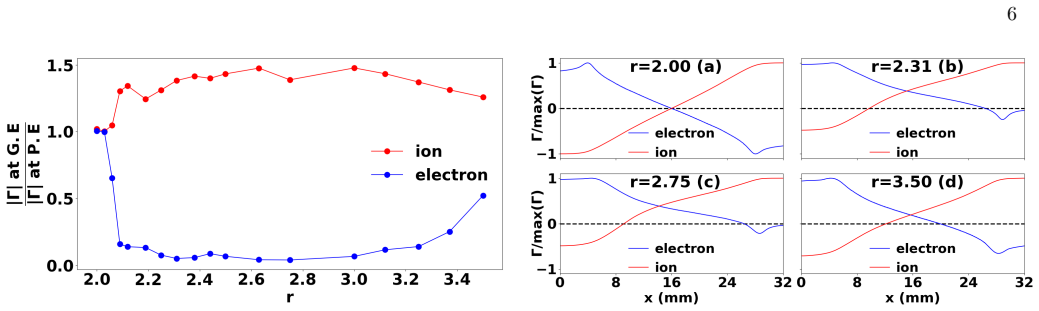
CONCLUSION Previous studies have demonstrated that magnetized CCP discharges can effectively enhance plasma density, particularly near the condition f ce = 2 frf [78]. In this work, we have investigated the origin of asymmetry in plasma density and ionization across the range r = 2.0 to r = 3.5. Our results show that the ion flux is maximized at the groun...
-
[5]
M. Lieberman and A. Lichtenberg, Principles of Plasma Discharges and Materials Processing, 2nd Edition, by Michael A. Lieberman, Alan J. Lichtenberg, pp. 800. ISBN 0-471-72001-1. Wiley-VCH , September 2003. 30 (2003)
work page 2003
-
[6]
P. Chabert and N. Braithwaite, Physics of radio- frequency plasmas (Cambridge University Press, 2011)
work page 2011
-
[7]
T. Makabe and Z. Petrovi´ c,Plasma electronics: Applica- tions in microelectronic device fabrication, second edition (2014) pp. 1–369
work page 2014
-
[8]
J. W. Coburn and H. F. Winters, Journal of Applied physics 50, 3189 (1979)
work page 1979
-
[9]
R. A. Gottscho, C. W. Jurgensen, and D. Vitkavage, Journal of Vacuum Science & Technology B: Microelec- tronics and Nanometer Structures Processing, Measure- ment, and Phenomena 10, 2133 (1992)
work page 1992
-
[10]
Hopwood, Plasma Sources Science and Technology 1, 109 (1992)
J. Hopwood, Plasma Sources Science and Technology 1, 109 (1992)
work page 1992
-
[11]
M. G. Kong, G. Kroesen, G. Morfill, T. Nosenko, T. Shimizu, J. Van Dijk, and J. Zimmermann, new Jour- nal of Physics 11, 115012 (2009)
work page 2009
-
[12]
M. J. Madou, Manufacturing techniques for microfabri- cation and nanotechnology (CRC press, 2011)
work page 2011
-
[13]
Laermer, United States Patent 5,501,893 (1996)
F. Laermer, United States Patent 5,501,893 (1996)
work page 1996
-
[14]
M. E. Hoenk, P. J. Grunthaner, F. J. Grunthaner, R. Ter- hune, M. Fattahi, and H.-F. Tseng, Applied Physics Let- ters 61, 1084 (1992)
work page 1992
-
[15]
M. A. Lieberman and A. J. Lichtenberg, MRS Bulletin 30, 899 (1994)
work page 1994
-
[16]
T. Makabe and Z. L. Petrovic, Plasma electronics: appli- cations in microelectronic device fabrication (CRC Press, 2006)
work page 2006
-
[17]
B. G. Heil, U. Czarnetzki, R. P. Brinkmann, and T. Mussenbrock, Journal of Physics D: Applied Physics 41, 165202 (2008)
work page 2008
-
[18]
M. M. Turner and P. Chabert, Physical review letters96, 205001 (2006)
work page 2006
-
[19]
T. Yamaguchi, T. Komuro, C. Koshimizu, S. Takashima, K. Takeda, H. Kondo, K. Ishikawa, M. Sekine, and M. Hori, Journal of Physics D: Applied Physics 45, 025203 (2011)
work page 2011
- [20]
-
[21]
M. A. Lieberman, IEEE Transactions on Plasma Science 16, 638 (1988)
work page 1988
- [22]
-
[23]
I. D. Kaganovich, Physical review letters 89, 265006 (2002)
work page 2002
-
[24]
I. D. Kaganovich, O. V. Polomarov, and C. E. Theo- dosiou, IEEE transactions on plasma science 34, 696 14 (2006)
work page 2006
-
[25]
E. Kawamura, M. Lieberman, and A. Lichtenberg, Physics of Plasmas 13, 053506 (2006)
work page 2006
- [26]
-
[27]
S. Sharma and M. M. Turner, Plasma Sources Science and Technology 22, 035014 (2013)
work page 2013
- [28]
-
[29]
H. H. Goto, H.-D. Lowe, and T. Ohmi, IEEE transactions on semiconductor manufacturing 6, 58 (1993)
work page 1993
-
[30]
J. Robiche, P. Boyle, M. Turner, and A. Ellingboe, Jour- nal of Physics D: Applied Physics 36, 1810 (2003)
work page 2003
-
[31]
H. Kim, J. Lee, and J. Shon, Physics of Plasmas 10, 4545 (2003)
work page 2003
- [32]
-
[33]
S. Karkari, A. Ellingboe, and C. Gaman, Applied Physics Letters 93, 071501 (2008)
work page 2008
-
[34]
S. Sharma and M. Turner, Journal of Physics D: Applied Physics 46, 285203 (2013)
work page 2013
-
[35]
S. Sharma and M. Turner, Journal of Physics D: Applied Physics 47, 285201 (2014)
work page 2014
-
[36]
S. Sharma, Investigation of ion and electron kinetic phe- nomena in capacitively coupled radio-frequency plasma sheaths: A simulation study , Ph.D. thesis, Dublin City University (2013)
work page 2013
-
[37]
T. Gans, J. Schulze, D. O’connell, U. Czarnetzki, R. Faulkner, A. Ellingboe, and M. Turner, Applied physics letters 89 (2006)
work page 2006
-
[38]
J. Schulze, T. Gans, D. O’Connell, U. Czarnetzki, A. Ellingboe, and M. Turner, Journal of Physics D: Ap- plied Physics 40, 7008 (2007)
work page 2007
- [39]
-
[40]
D. J. Economou, Journal of Vacuum Science & Technol- ogy A 31, 050823 (2013)
work page 2013
-
[41]
Lafleur, Plasma Sources Science and Technology 25, 013001 (2015)
T. Lafleur, Plasma Sources Science and Technology 25, 013001 (2015)
work page 2015
-
[42]
X. Qin, Y. Ting, and A. Wendt, Plasma Sources Science and Technology 19, 065014 (2010)
work page 2010
-
[43]
H. Shin, W. Zhu, L. Xu, V. M. Donnelly, and D. J. Economou, Plasma Sources Science and Technology 20, 055001 (2011)
work page 2011
- [44]
- [45]
-
[46]
E. Sch¨ ungel, Z. Donk´ o, P. Hartmann, A. Derzsi, I. Ko- rolov, and J. Schulze, Plasma Sources Science and Tech- nology 24, 045013 (2015)
work page 2015
- [47]
- [48]
- [49]
- [50]
- [51]
- [52]
-
[53]
J. Upadhyay, D. Im, S. Popovi´ c, L. Vuˇ skovi´ c, A.-M. Valente-Feliciano, and L. Phillips, Journal of Vacuum Science & Technology A 33, 061309 (2015)
work page 2015
-
[54]
S. Rauf, K. Bera, and K. Collins, Plasma Sources Science and Technology 19, 015014 (2009)
work page 2009
-
[55]
S. Wilczek, J. Trieschmann, J. Schulze, E. Schuengel, R. P. Brinkmann, A. Derzsi, I. Korolov, Z. Donk´ o, and T. Mussenbrock, Plasma Sources Science and Technology 24, 024002 (2015)
work page 2015
- [56]
-
[57]
R. Upadhyay, I. Sawada, P. Ventzek, and L. Raja, Jour- nal of Physics D: Applied Physics 46, 472001 (2013)
work page 2013
- [58]
- [59]
-
[60]
P. A. Miller, E. V. Barnat, G. A. Hebner, A. M. Pa- terson, and J. P. Holland, Plasma Sources Science and Technology 15, 889 (2006)
work page 2006
- [61]
-
[62]
S. Wilczek, J. Trieschmann, J. Schulze, Z. Donko, R. P. Brinkmann, and T. Mussenbrock, Plasma Sources Sci- ence and Technology 27, 125010 (2018)
work page 2018
- [63]
- [64]
- [65]
-
[66]
K. M¨ uller, F. Heinrich, and H. Mader, Microelectronic engineering 10, 55 (1989)
work page 1989
-
[67]
M. A. Lieberman, A. J. Lichtenberg, and S. Savas, IEEE transactions on plasma science 19, 189 (1991)
work page 1991
-
[68]
D. Hutchinson, M. Turner, R. Doyle, and M. Hopkins, IEEE transactions on plasma science 23, 636 (1995)
work page 1995
-
[69]
J.-C. Park and B. Kang, IEEE transactions on plasma science 25, 499 (1997)
work page 1997
-
[70]
M. J. Kushner, Journal of applied physics 94, 1436 (2003)
work page 2003
-
[71]
A. V. Vasenkov and M. J. Kushner, Journal of applied physics 95, 834 (2004)
work page 2004
-
[72]
S. You, T. Hai, M. Park, D. Kim, J. Kim, D. Seong, Y. Shin, S. Lee, G. Park, J. Lee, et al., Thin Solid Films 519, 6981 (2011)
work page 2011
-
[73]
S. Yang, Y. Zhang, H. Wang, J. Cui, and W. Jiang, Plasma Processes and Polymers 14, 1700087 (2017)
work page 2017
-
[74]
S. Yang, L. Chang, Y. Zhang, and W. Jiang, Plasma Sources Science and Technology 27, 035008 (2018)
work page 2018
- [75]
-
[76]
D. Sydorenko, Particle-in-cell simulations of electron dy- namics in low pressure discharges with magnetic fields , Ph.D. thesis, University of Saskatchewan (2006)
work page 2006
- [77]
-
[78]
Y. Fan, Y. Zou, J. Sun, T. Stirner, and D. Wang, Physics of Plasmas 20, 103507 (2013)
work page 2013
-
[79]
J. Preinhaelter and V. Kopeck` y, Journal of Plasma Physics 10, 1 (1973)
work page 1973
-
[80]
Sugai, Physical review letters 47, 1899 (1981)
H. Sugai, Physical review letters 47, 1899 (1981). 15
work page 1981
discussion (0)
Sign in with ORCID, Apple, or X to comment. Anyone can read and Pith papers without signing in.