Berry Curvature Dipole-Induced Chiral Terahertz Gain and Lasing Threshold in Bulk Tellurium
Pith reviewed 2026-05-18 21:46 UTC · model grok-4.3
The pith
Applying a DC electric field to n-doped tellurium creates chiral terahertz gain from the Berry curvature dipole, enabling polarization-selective amplification and lasing below breakdown.
A machine-rendered reading of the paper's core claim, the machinery that carries it, and where it could break.
Core claim
When the electrical bias and wave vector are aligned along the trigonal c-axis in n-doped Tellurium, the right-handed circularly polarized mode experiences amplification at relatively low bias, while the left-handed mode is attenuated. When the electrical bias and wave vector are orthogonal to the c-axis, the structure supports elliptically polarized eigenmodes that also exhibit gain under suitable bias conditions, with the degree of ellipticity tunable by the applied bias. Lasing conditions for a Fabry-Perot cavity show discrete intervals due to resonance in the dielectric permittivity, with lasing achievable at bias fields below the material's breakdown threshold.
What carries the argument
The Berry curvature dipole in the band structure of tellurium, which under DC bias produces a net chiral response that transfers power preferentially to one circular polarization.
If this is right
- Right-handed circular polarization is amplified while left-handed is attenuated along the c-axis.
- Elliptically polarized modes with bias-tunable ellipticity exhibit gain when bias is orthogonal to c-axis.
- Discrete lasing thresholds occur in Fabry-Perot cavities due to permittivity resonances.
- Micrometer-scale terahertz lasing is possible below breakdown bias fields.
- Electrically tunable and polarization-selective gain for new THz devices.
Where Pith is reading between the lines
- The mechanism might extend to other chiral crystals for THz applications at different frequencies.
- Tunable ellipticity could enable dynamic polarization control in THz systems without additional optics.
- Integration into microscale cavities could lead to on-chip THz sources.
- Similar Berry curvature effects in other materials might be optimized for lower thresholds.
Load-bearing premise
The semiclassical transport model that converts the Berry curvature dipole directly into net power transfer to one circular polarization remains valid at the carrier densities and bias fields considered, without additional scattering or heating channels that would quench the gain.
What would settle it
Observation of differential gain between right and left circularly polarized terahertz waves propagating through electrically biased tellurium samples at the predicted low bias fields, with one polarization showing positive gain and the other loss.
Figures


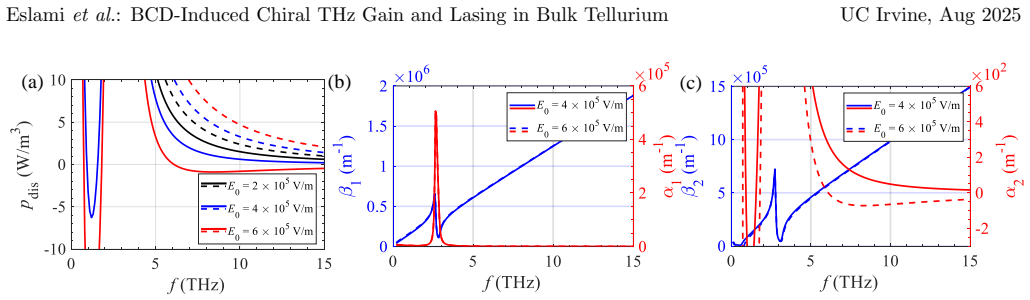


read the original abstract
We investigate the use of Berry curvature dipole in $n$-doped Tellurium as a mechanism for achieving terahertz amplification and lasing by applying a DC electric field. When the electrical bias and wave vector are aligned along the trigonal $c$-axis, the right-handed circularly polarized mode experiences amplification at relatively low bias, while the left-handed mode is attenuated. Furthermore, when the electrical bias and wave vector are orthogonal to the $c$-axis, the structure supports elliptically polarized eigenmodes that also exhibit gain under suitable bias conditions, where the degree of ellipticity is tunable by the applied bias. We also investigate lasing conditions for a Fabry-Perot cavity incorporating biased Te as an active medium. Due to the resonance in the dielectric permittivity of Tellurium, there are discrete lasing intervals. Our results show that bulk chiral Tellurium could be used as an electrically tunable, polarization-selective gain medium for micrometer-scale terahertz lasers, with lasing achievable at bias fields below the material's breakdown threshold, paving the way towards new terahertz devices.
Editorial analysis
A structured set of objections, weighed in public.
Referee Report
Summary. The manuscript investigates Berry curvature dipole effects in n-doped bulk Tellurium under DC bias, claiming that alignment of bias and wavevector along the trigonal c-axis produces chiral THz gain with right-circular polarization amplified and left-circular attenuated, while orthogonal alignment yields tunable elliptically polarized modes with gain. It further models lasing thresholds in a Fabry-Perot cavity, identifying discrete intervals due to dielectric permittivity resonances, and concludes that bulk chiral Te can serve as an electrically tunable, polarization-selective gain medium for micrometer-scale THz lasers at bias fields below breakdown.
Significance. If the semiclassical transport model remains valid, the work identifies an intrinsic mechanism for electrically controlled chiral THz amplification in a bulk chiral crystal without external fields or nanostructures. The bias-tunable ellipticity and discrete lasing windows arising from permittivity resonance represent concrete, testable predictions that could inform compact THz source design.
major comments (2)
- [§III, Eqs. (3)–(5)] §III, Eqs. (3)–(5): The net power transfer to one circular polarization is derived within the relaxation-time semiclassical Boltzmann response. At the quoted n ~ 10^18 cm^{-3} and bias fields of order kV/cm, the manuscript provides no estimate of Joule heating, intervalley scattering rates, or quantum corrections that could equalize the two circular channels or suppress the gain coefficient; this assumption is load-bearing for the central claim of net chiral amplification.
- [§IV] §IV: The Fabry-Perot threshold calculation directly inherits the gain coefficient from the transport model without incorporating additional THz loss channels (free-carrier absorption, phonon-assisted processes) that are expected to be significant in doped Te; any reduction in the effective gain would push the required bias above the breakdown field cited in the abstract.
minor comments (3)
- [Figure 2] Figure 2 and associated text: the plotted gain spectra would benefit from explicit indication of the bias-field values used for each curve and a direct overlay of the two circular polarizations for comparison.
- [§II] The definition of the Berry curvature dipole tensor and its projection onto the c-axis should be restated explicitly in §II to avoid ambiguity when the bias direction is rotated.
- Add a brief comparison of the predicted threshold fields to those of established THz gain media (e.g., quantum-cascade lasers or graphene-based devices) to place the numerical results in context.
Simulated Author's Rebuttal
We thank the referee for their careful reading of the manuscript and for identifying these important points regarding the validity of our transport model and the completeness of the loss analysis. We address each comment below and indicate the revisions we will make to strengthen the presentation.
read point-by-point responses
-
Referee: [§III, Eqs. (3)–(5)] §III, Eqs. (3)–(5): The net power transfer to one circular polarization is derived within the relaxation-time semiclassical Boltzmann response. At the quoted n ~ 10^18 cm^{-3} and bias fields of order kV/cm, the manuscript provides no estimate of Joule heating, intervalley scattering rates, or quantum corrections that could equalize the two circular channels or suppress the gain coefficient; this assumption is load-bearing for the central claim of net chiral amplification.
Authors: We agree that explicit estimates would better support the applicability of the semiclassical relaxation-time approximation. In the revised manuscript we will add a dedicated paragraph in §III that quantifies these effects using parameters consistent with the existing transport calculation. Joule heating is estimated from the product of current density and bias field; for a micrometer-scale device with typical thermal boundary conditions the resulting temperature rise remains below 10 K. Intervalley scattering is suppressed near the conduction-band edge of Te because of the large valley separation, and the quoted doping places the Fermi level well within a single valley. Quantum corrections (Landau quantization or interband coherence) are negligible because the cyclotron energy at the cited fields is much smaller than the Fermi energy. These additions will be presented without changing the central gain expressions or the reported thresholds. revision: yes
-
Referee: [§IV] §IV: The Fabry-Perot threshold calculation directly inherits the gain coefficient from the transport model without incorporating additional THz loss channels (free-carrier absorption, phonon-assisted processes) that are expected to be significant in doped Te; any reduction in the effective gain would push the required bias above the breakdown field cited in the abstract.
Authors: We accept that a quantitative treatment of additional loss channels is necessary for a realistic threshold estimate. In the revised §IV we will include a Drude-model calculation of free-carrier absorption using the same relaxation time that enters the Berry-curvature-dipole response, together with a brief discussion of phonon-assisted THz absorption in Te. Our preliminary evaluation shows that the polarization-selective chiral gain remains larger than the isotropic losses over the bias window below breakdown, preserving discrete lasing intervals. Updated net-gain spectra and revised threshold curves will be added to the section. We would welcome any specific references the referee may have for loss rates in doped tellurium. revision: yes
Circularity Check
Standard semiclassical model with external Berry dipole input; no reduction to self-fit or self-citation
full rationale
The derivation applies the known Berry curvature dipole of chiral Te (from prior band-structure literature) inside a standard relaxation-time Boltzmann transport model to obtain the chiral conductivity and gain coefficient. The Fabry-Perot threshold then follows directly from that gain. No equation is shown to be identical to a fitted parameter by construction, and no load-bearing step rests solely on a self-citation whose validity is unverified outside the present work. The model remains falsifiable against independent transport or optical measurements at the quoted doping and field values.
Axiom & Free-Parameter Ledger
free parameters (2)
- carrier density
- DC bias field strength
axioms (1)
- domain assumption Semiclassical transport theory accurately captures the power transfer from electrons to THz field via Berry curvature dipole
Lean theorems connected to this paper
-
IndisputableMonolith/Cost/FunctionalEquation.leanwashburn_uniqueness_aczel unclear?
unclearRelation between the paper passage and the cited Recognition theorem.
σ_EO(ω) = −τ e³/ℏ² (E0 · D) × 1 + … (Eq. 1); ε_EO,xy = ω_c,z/ω (2 + ζ) … (Eq. 5); p_dis = ½ ω E* · ε'' · E (Eq. 12)
-
IndisputableMonolith/Foundation/RealityFromDistinction.leanreality_from_one_distinction unclear?
unclearRelation between the paper passage and the cited Recognition theorem.
dispersion det(… k² − k0² ε …) = 0 (Eq. 11); lasing condition Re^{-2αL} e^{i(2βL−ϕ)} = −1 (Eq. 24)
What do these tags mean?
- matches
- The paper's claim is directly supported by a theorem in the formal canon.
- supports
- The theorem supports part of the paper's argument, but the paper may add assumptions or extra steps.
- extends
- The paper goes beyond the formal theorem; the theorem is a base layer rather than the whole result.
- uses
- The paper appears to rely on the theorem as machinery.
- contradicts
- The paper's claim conflicts with a theorem or certificate in the canon.
- unclear
- Pith found a possible connection, but the passage is too broad, indirect, or ambiguous to say the theorem truly supports the claim.
Reference graph
Works this paper leans on
-
[1]
for three-dimensional (3D) Tellurium exhibiting a non-Hermitian linear EO effect to investigate how differ- ent configurations of static electric field and wave prop- agation direction can be exploited to realize tunable op- tical gain in n-doped Tellurium. Our results demon- strate that Tellurium can serve as an active medium for micrometer-scale teraher...
work page internal anchor Pith review Pith/arXiv arXiv 2025
-
[2]
exhibits linear polarization aligned along the z-axis. elliptical polarization. The degree of ellipticity depends on the applied DC bias. The energy transfer from the material to each polar- ization eigenstate is evaluated using the dissipated power density, pdis = 1 2 ε0 ωε ′′ d,⊥ + Γω2 p,⊥ ω2 + Γ2 ! |Ey|2 + 1 2 ε0 ωε ′′ d,|| + Γω2 p,|| ω2 + Γ2 ! |Ez|2 +...
work page 2025
-
[3]
This condition is obtained through complex frequency analysis, with Figs. 8(b) and (c) illustrating the lasing regions as functions of static electric field bias and cavity length, respectively. The zero crossings of ℑ(ω) for each length in Fig. 8(b) correspond to the fundamental oscil- lation frequencies obtained in Fig. 8(a). For instance, in Fig. 8(b),...
work page 2025
-
[4]
Berry phase effects on electronic properties,
D. Xiao, M.-C. Chang, and Q. Niu, “Berry phase effects on electronic properties,” Reviews of Modern Physics , vol. 82, no. 3, pp. 1959–2007, 2010
work page 1959
-
[5]
N. Nagaosa, J. Sinova, S. Onoda, A. H. MacDonald, and N. P. Ong, “Anomalous Hall effect,” Reviews of Modern Physics, vol. 82, no. 2, pp. 1539–1592, 2010
work page 2010
-
[6]
Quantized Hall conductance in a two- dimensional periodic potential,
D. J. Thouless, M. Kohmoto, M. P. Nightingale, and M. den Nijs, “Quantized Hall conductance in a two- dimensional periodic potential,” Physical Review Letters, vol. 49, pp. 405–408, 1982
work page 1982
-
[7]
Quantal phase factors accompanying adia- batic changes,
M. V. Berry, “Quantal phase factors accompanying adia- batic changes,” Proc. Roy. Soc. Lond. A, vol. 392, pp. 45– 57, 1984
work page 1984
-
[8]
Colloquium: Topological band theory,
A. Bansil, H. Lin, and T. Das, “Colloquium: Topological band theory,” Reviews of Modern Physics , vol. 88, no. 2, p. 021004, 2016
work page 2016
-
[9]
The topology of electronic band structures,
P. Narang, C. A. Garcia, and C. Felser, “The topology of electronic band structures,” Nature Materials, vol. 20, no. 3, pp. 293–300, 2021
work page 2021
-
[10]
I. Sodemann and L. Fu, “Quantum nonlinear Hall effect induced by Berry curvature dipole in time-reversal invari- ant materials,” Physical Review Letters , vol. 115, no. 21, p. 216806, 2015
work page 2015
-
[11]
Band signatures for strong nonlinear Hall effect in bilayer WTe2,
Z. Du, C. Wang, H.-Z. Lu, and X. Xie, “Band signatures for strong nonlinear Hall effect in bilayer WTe2,”Physical Review Letters, vol. 121, no. 26, p. 266601, 2018
work page 2018
-
[12]
Observation of the nonlinear Hall effect under time-reversal-symmetric conditions,
Q. Ma, S.-Y. Xu, H. Shen, D. MacNeill, V. Fatemi, T.-R. Chang, A. M. Mier Valdivia, S. Wu, Z. Du, C.-H. Hsu, et al. , “Observation of the nonlinear Hall effect under time-reversal-symmetric conditions,” Nature, vol. 565, no. 7739, pp. 337–342, 2019
work page 2019
-
[13]
Field-induced Berry connection and anomalous planar Hall effect in tilted Weyl semimetals,
Y. Wang, Z.-G. Zhu, and G. Su, “Field-induced Berry connection and anomalous planar Hall effect in tilted Weyl semimetals,” Physical Review Research , vol. 5, no. 4, p. 043156, 2023
work page 2023
-
[14]
Anomalous planar Hall effect in two-dimensional trigonal crystals,
R. Battilomo, N. Scopigno, and C. Ortix, “Anomalous planar Hall effect in two-dimensional trigonal crystals,” Physical Review Research, vol. 3, no. 1, p. L012006, 2021
work page 2021
-
[15]
Quantized circular photogalvanic effect in Weyl semimetals,
F. De Juan, A. G. Grushin, T. Morimoto, and J. E. Moore, “Quantized circular photogalvanic effect in Weyl semimetals,” Nature Communications , vol. 8, no. 1, p. 15995, 2017
work page 2017
-
[16]
Helicity-dependent photocurrents in the chiral Weyl semimetal RhSi,
D. Rees, K. Manna, B. Lu, T. Morimoto, H. Borrmann, C. Felser, J. Moore, D. H. Torchinsky, and J. Oren- stein, “Helicity-dependent photocurrents in the chiral Weyl semimetal RhSi,” Science advances, vol. 6, no. 29, p. eaba0509, 2020
work page 2020
-
[17]
Design principles for shift current photo- voltaics,
A. M. Cook, B. M. Fregoso, F. De Juan, S. Coh, and J. E. Moore, “Design principles for shift current photo- voltaics,” Nature Communications, vol. 8, no. 1, p. 14176, 2017
work page 2017
-
[18]
Enhanced intrinsic photovoltaic effect in tungsten disulfide nanotubes,
Y. Zhang, T. Ideue, M. Onga, F. Qin, R. Suzuki, A. Zak, R. Tenne, J. Smet, and Y. Iwasa, “Enhanced intrinsic photovoltaic effect in tungsten disulfide nanotubes,” Na- ture, vol. 570, no. 7761, pp. 349–353, 2019
work page 2019
-
[19]
Colossal mid-infrared bulk photovoltaic effect in a type-I Weyl semimetal,
G. B. Osterhoudt, L. K. Diebel, M. J. Gray, X. Yang, J. Stanco, X. Huang, B. Shen, N. Ni, P. J. Moll, Y. Ran, et al., “Colossal mid-infrared bulk photovoltaic effect in a type-I Weyl semimetal,” Nature Materials, vol. 18, no. 5, pp. 471–475, 2019
work page 2019
-
[20]
T. Akamatsu, T. Ideue, L. Zhou, Y. Dong, S. Kitamura, M. Yoshii, D. Yang, M. Onga, Y. Nakagawa, K. Watan- abe, et al. , “A van der Waals interface that creates in- plane polarization and a spontaneous photovoltaic ef- fect,” Science, vol. 372, no. 6537, pp. 68–72, 2021
work page 2021
-
[21]
T. Holder, D. Kaplan, and B. Yan, “Consequences of time-reversal-symmetry breaking in the light-matter in- teraction: Berry curvature, quantum metric, and dia- batic motion,” Physical Review Research , vol. 2, no. 3, p. 033100, 2020
work page 2020
-
[22]
D. Kumar, C.-H. Hsu, R. Sharma, T.-R. Chang, P. Yu, J. Wang, G. Eda, G. Liang, and H. Yang, “Room- temperature nonlinear Hall effect and wireless radiofre- quency rectification in Weyl semimetal TaIrTe4,” Nature Nanotechnology, vol. 16, no. 4, pp. 421–425, 2021
work page 2021
-
[23]
Z. Hu, L. Zhang, A. Chakraborty, G. D’Olimpio, J. Fu- jii, A. Ge, Y. Zhou, C. Liu, A. Agarwal, I. Vobornik, et al. , “Terahertz nonlinear Hall rectifiers based on spin- polarized topological electronic states in 1T-CoTe2,” Ad- vanced Materials, vol. 35, no. 10, p. 2209557, 2023. 10 Eslami et al. : BCD-Induced Chiral THz Gain and Lasing in Bulk Tellurium U...
work page 2023
-
[24]
Nonlin- ear transport and radio frequency rectification in BiTeBr at room temperature,
X. F. Lu, C.-P. Zhang, N. Wang, D. Zhao, X. Zhou, W. Gao, X. H. Chen, K. Law, and K. P. Loh, “Nonlin- ear transport and radio frequency rectification in BiTeBr at room temperature,” Nature Communications, vol. 15, no. 1, p. 245, 2024
work page 2024
-
[25]
Berry curvature dipole senses topological transition in a moir´ e superlattice,
S. Sinha, P. C. Adak, A. Chakraborty, K. Das, K. Deb- nath, L. V. Sangani, K. Watanabe, T. Taniguchi, U. V. Waghmare, A. Agarwal, et al. , “Berry curvature dipole senses topological transition in a moir´ e superlattice,”Na- ture Physics, vol. 18, no. 7, pp. 765–770, 2022
work page 2022
-
[26]
Q. Fu, X. Cong, X. Xu, S. Zhu, X. Zhao, S. Liu, B. Yao, M. Xu, Y. Deng, C. Zhu, et al. , “Berry curvature dipole induced giant mid-infrared second-harmonic generation in 2D Weyl semiconductor,” Advanced Materials, vol. 35, no. 46, p. 2306330, 2023
work page 2023
-
[27]
Engineering transistorlike optical gain in two-dimensional materials with Berry curva- ture dipoles,
T. G. Rappoport, T. A. Morgado, S. Lanneb` ere, and M. G. Silveirinha, “Engineering transistorlike optical gain in two-dimensional materials with Berry curva- ture dipoles,” Physical Review Letters , vol. 130, no. 7, p. 076901, 2023
work page 2023
-
[28]
Chiral terahertz lasing with Berry-curvature dipoles,
A. Hakimi, K. Rouhi, T. G. Rappoport, M. G. Sil- veirinha, and F. Capolino, “Chiral terahertz lasing with Berry-curvature dipoles,” Physical Review Applied , vol. 22, no. 4, p. L041003, 2024
work page 2024
-
[29]
Symmetry analysis of the non- hermitian electro-optic effect in crystals,
S. Lanneb` ere, T. G. Rappoport, T. A. Morgado, I. Souza, and M. G. Silveirinha, “Symmetry analysis of the non- hermitian electro-optic effect in crystals,” arXiv preprint arXiv:2502.03399, 2025
-
[30]
Non-hermitian linear electro-optic effect in three-dimensional materi- als,
T. A. Morgado, T. G. Rappoport, S. S. Tsirkin, S. Lan- neb` ere, I. Souza, and M. G. Silveirinha, “Non-hermitian linear electro-optic effect in three-dimensional materi- als,” Physical Review B, vol. 109, no. 24, p. 245126, 2024
work page 2024
-
[31]
Anomalous circularly polarized light emission induced by the optical Berry curvature dipole,
Y. Liu and B. Yan, “Anomalous circularly polarized light emission induced by the optical Berry curvature dipole,” Physical Review B , vol. 109, no. 3, p. 035142, 2024
work page 2024
-
[32]
Berry curvature dipole in Weyl semimetal materials: an ab initio study,
Y. Zhang, Y. Sun, and B. Yan, “Berry curvature dipole in Weyl semimetal materials: an ab initio study,” Physical Review B, vol. 97, no. 4, p. 041101, 2018
work page 2018
-
[33]
Optical activity in tellurium induced by a current,
L. Vorob’Ev, “Optical activity in tellurium induced by a current,” JETP Lett, vol. 29, p. 441, 1979
work page 1979
-
[34]
Gyrotropic effects in trigonal tellurium studied from first principles,
S. S. Tsirkin, P. A. Puente, and I. Souza, “Gyrotropic effects in trigonal tellurium studied from first principles,” Physical Review B , vol. 97, no. 3, p. 035158, 2018
work page 2018
-
[35]
Topological chiral-gain in a Berry dipole material,
F. R. Prudˆ encio and M. G. Silveirinha, “Topological chiral-gain in a Berry dipole material,” Nanophotonics, no. 0, 2025
work page 2025
-
[36]
Space group of tellurium and selenium,
R. H. Asendorf, “Space group of tellurium and selenium,” The Journal of chemical physics , vol. 27, no. 1, pp. 11–16, 1957
work page 1957
-
[37]
Tunable chirality- dependent nonlinear electrical responses in 2D tel- lurium,
C. Niu, G. Qiu, Y. Wang, P. Tan, M. Wang, J. Jian, H. Wang, W. Wu, and P. D. Ye, “Tunable chirality- dependent nonlinear electrical responses in 2D tel- lurium,” Nano letters , vol. 23, no. 18, pp. 8445–8453, 2023
work page 2023
-
[38]
Chirality-tunable nonlinear Hall effect,
N. B. Joseph, A. Bandyopadhyay, and A. Narayan, “Chirality-tunable nonlinear Hall effect,” Chemistry of Materials, vol. 36, no. 18, pp. 8602–8612, 2024
work page 2024
-
[39]
B. Cheng, Y. Gao, Z. Zheng, S. Chen, Z. Liu, L. Zhang, Q. Zhu, H. Li, L. Li, and C. Zeng, “Giant nonlinear Hall and wireless rectification effects at room temperature in the elemental semiconductor tellurium,” Nature Commu- nications, vol. 15, no. 1, p. 5513, 2024
work page 2024
-
[40]
High-frequency rectifica- tion via chiral bloch electrons,
H. Isobe, S.-Y. Xu, and L. Fu, “High-frequency rectifica- tion via chiral bloch electrons,” Science advances, vol. 6, no. 13, p. eaay2497, 2020
work page 2020
-
[41]
A gyrotropic medium is characterized by dielectric ten- sors with antisymmetric imaginary off-diagonal compo- nents
-
[42]
L. D. Landau, L. P. Pitaevskii, and E. M. Lifshitz, Electrodynamics of continuous media . Pergamon Press, 2nd ed., 1984. Translated by J. B. Sykes, J. S. Bell, and M. J. Kearsley
work page 1984
-
[43]
E. D. Palik, Handbook of optical constants of solids . Aca- demic press, 1998
work page 1998
-
[44]
Y. Amnon and P. Yeh, Optical waves in crystals: prop- agation and control of laser radiation . New York City, NY: Wiley, 1984
work page 1984
-
[45]
L. B. Felsen and N. Marcuvitz, Radiation and scattering of waves . Prentice-Hall, Englewood Cliffs, NJ, 1973
work page 1973
-
[46]
Versatile and active THz wave polarization modulators using metama- terial/graphene resonators,
A. M. Zaman, Y. Lu, N. W. Almond, O. J. Burton, J. Alexander-Webber, S. Hofmann, T. Mitchell, J. D. Griffiths, H. E. Beere, D. A. Ritchie,et al., “Versatile and active THz wave polarization modulators using metama- terial/graphene resonators,” Frontiers in Nanotechnol- ogy, vol. 5, p. 1057422, 2023
work page 2023
-
[47]
Polar- ization modulation for wireless communications based on metasurfaces,
C. X. Huang, J. Zhang, Q. Cheng, and T. J. Cui, “Polar- ization modulation for wireless communications based on metasurfaces,” Advanced Functional Materials , vol. 31, no. 36, p. 2103379, 2021
work page 2021
-
[48]
Opportunities and challenges in twisted bilayer graphene: a review,
A. Nimbalkar and H. Kim, “Opportunities and challenges in twisted bilayer graphene: a review,” Nano-Micro Let- ters, vol. 12, pp. 1–20, 2020
work page 2020
-
[49]
Metasurfaces-based ab- sorption and reflection control: perfect absorbers and reflectors,
T. Badloe, J. Mun, and J. Rho, “Metasurfaces-based ab- sorption and reflection control: perfect absorbers and reflectors,” Journal of Nanomaterials , vol. 2017, no. 1, p. 2361042, 2017
work page 2017
-
[50]
Switchable polarization-independent THz reflector/absorber,
M. Yan, Q. Liu, D. Zhou, and Z. Wang, “Switchable polarization-independent THz reflector/absorber,” Jour- nal of the Optical Society of America B , vol. 40, no. 11, pp. 2751–2757, 2023
work page 2023
-
[51]
Relationship between intrinsic breakdown field and bandgap of materials,
L.-M. Wang, “Relationship between intrinsic breakdown field and bandgap of materials,” in 2006 25th Inter- national Conference on Microelectronics , pp. 576–579, IEEE, 2006
work page 2006
-
[52]
Negative differential con- ductivity of p-tellurium,
A. Rudolph and A. Dargys, “Negative differential con- ductivity of p-tellurium,” physica status solidi (a) , vol. 6, no. 2, pp. K93–K95, 1971
work page 1971
-
[53]
Current-induced spin polarization of holes in tellurium,
V. Shalygin, A. Sofronov, L. Vorob’ev, and I. Farbshtein, “Current-induced spin polarization of holes in tellurium,” Physics of the Solid State , vol. 54, pp. 2362–2373, 2012
work page 2012
-
[54]
High-field transport and low-field mobility in tellurium single crys- tals,
W. Hoerstel, D. Kusnick, and M. Spitzer, “High-field transport and low-field mobility in tellurium single crys- tals,” physica status solidi (b) , vol. 60, no. 1, pp. 213–221, 1973. 11
work page 1973
discussion (0)
Sign in with ORCID, Apple, or X to comment. Anyone can read and Pith papers without signing in.