REVIEW 3 major objections 3 minor 1 cited by
The Post-Silicon Semiconductor Era: A Review of Physics, Synthesis, and Architectural Integration of Carbon Nanotube Field-Effect Transistors
T0 review · 3 major / 3 minor · reviewed 2026-08-05 · deepseek-v4-flash
Pith's one-line read A review claims exact 1D/2D quantum-capacitance equivalence, implying packed nanotube arrays still lose to 2D materials; the supplied text omits the derivation.
desk verdict The abstract advertises a physics paper with derivations and a 5 nm benchmark; the full text is an undergraduate survey with no equations and a 78-person survey, so the submission is internally inconsistent. read the letter →
The pith
A machine-rendered reading of the paper's core claim, the machinery that carries it, and where it could break.
The reading
What carries the argument
The announced load-bearing object is the equivalence between the areal quantum capacitance of a one-dimensional nanotube array and that of a two-dimensional sheet. Quantum capacitance is the extra capacitance that comes from the finite number of electronic states available to store charge; the claimed identity would fix, under the paper's assumptions (graphene zone-folding, which obtains nanotube bands by folding graphene's bands along the chiral vector C = n a1 + m a2, and the Landauer-Buttiker transport formula, which counts current through quantized conducting channels), how much of the 2D areal capacitance a packed array can recover. If it held, it would separate what nanotubes can gain
What would settle it
As a textual test, open Section II and locate the derivation of the areal 1D/2D quantum-capacitance equivalence and the comparison with published 5 nm data; their absence falsifies the abstract's claim as stated. As a scientific test, compute the areal quantum capacitance of a close-packed nanotube array and a 2D sheet from the same zone-folding/Landauer assumptions and check whether the claimed irreducible gap actually appears at realistic pitch.
Extended reading notes
Core claim
The paper's central claim, as announced in the abstract, is that a continuous derivation from graphene zone-folding and the Landauer-Buttiker formalism yields the SWCNT bandgap, near-ballistic transport limits, and an exact equivalence between the areal quantum capacitance of a 1D nanotube array and a 2D sheet; this equivalence is then said to show that even close-packed arrays suffer an irreducible dimensional penalty, so CNTFETs must rely on higher carrier velocity and better electrostatics. The same abstract asserts that comparing this framework with published 5 nm data exposes source-to-drain tunneling as the dominant subthreshold degradation mechanism. The body text supplied for review
Load-bearing premise
The central claims assume the supplied full text is the manuscript described by the abstract; in the text as given, the promised derivations are absent.
Editorial extensions
If this is right
- If the abstract's derivation holds, CNTFET logic cannot close the electrostatic gap to 2D materials by packing alone; device performance will hinge on contact engineering, gate geometry, and carrier velocity.
- The body's 32 nm inverter comparisons imply an order-of-magnitude advantage in power-delay product and leakage for CNTFETs over MOSFETs at a mature node, which would translate to lower-energy computation if the devices can be manufactured with controlled chirality and purity.
- Chirality-controlled CVD (60-90% semiconducting yield) and post-growth purification are presented as necessary process steps; if scaled, they would make semiconducting-enriched CNT feedstock available for logic fabrication.
- 3D stacking of CNT layers is proposed as a density lever that avoids aggressive per-transistor scaling, with added thermal pathway benefits.
- The named remaining barriers—materials purification, contact reliability, and bias-temperature instability—are the concrete targets that a commercial CNTFET program would have to retire.
Reading between the lines
- If the promised capacitance equivalence were actually derived, a direct design-rule follow-up would be the pitch-to-diameter ratio at which a 1D array reaches a chosen fraction (say 90%) of the 2D sheet's areal quantum capacitance; that number is not in the paper.
- The survey evidence (78 respondents, mostly students) cannot by itself establish market demand, so the commercial-feasibility conclusion in the body would need to be tested against manufacturer cost data and roadmap projections, not opinion data.
- The circuit-level PDP and leakage figures are cited from simulation at 32 nm; a natural extension would rerun the same comparisons against 3 nm/2 nm gate-all-around silicon, where the short-channel effects driving silicon's limits are already partially mitigated.
- The abstract's 'exact' equivalence is checkable numerically: a Poisson-Schrödinger calculation of C_Q for a single tube, a periodic tube array, and a 2D sheet would show whether the areal gap closes at realistic pitches, and so would settle the practical force of the claim.
Editorial analysis
A structured set of objections, weighed in public.
Referee Report
Summary. The paper is presented as a review of carbon nanotube field-effect transistors (CNTFETs) as a post-silicon technology. The body covers purification and chirality control of CNTs, synthesis methods (laser ablation, CVD, arc discharge), dielectric deposition, CNTFET design, doping and annealing for complementary logic, and a comparison of CNTFET and MOSFET inverter performance. It also reports a 78-response opinion survey on public awareness and willingness to pay for CNT-based devices. The abstract promises substantially more: exact derivations of zone-folding bandgaps, Landauer-Buttiker transport limits, an exact areal-density equivalence between 1D and 2D quantum capacitance, a benchmark against published 5 nm experimental data, and an IRDS-linked techno-economic analysis. None of these promised derivations, benchmarks, or analyses appear in the submitted full text.
Significance. The abstract's promised technical results—especially the exact 1D/2D quantum-capacitance equivalence and the 5 nm benchmark—would be useful contributions if present and correct. However, the manuscript as submitted does not contain these results. The literature survey and survey analysis are clearly organized and the limitations are stated honestly (Section I.D), but the work does not offer an independently verifiable scientific contribution. The mismatch between the abstract and the body is decisive: the paper's stated central claims are unsupported by the submitted text. For a research journal, the significance is therefore low unless the missing content is provided.
major comments (3)
- [Abstract and Sections II.A, II.C, IV] The abstract claims that the paper 'derives' zone-folding bandgaps, Landauer-Buttiker limits, an 'exact areal-density equivalence between 1D and 2D quantum capacitance,' benchmarks against published 5 nm experimental data, and an IRDS techno-economic analysis. The full text contains no equations beyond the chiral vector C = n a1 + m a2 (Section II.A.2), no Landauer-Buttiker expression, no quantum-capacitance calculation, no 5 nm comparison, and no IRDS analysis. These are the paper's stated central scientific contributions, and their absence makes the abstract-body mismatch load-bearing. As submitted, the manuscript is not evaluable as a research paper.
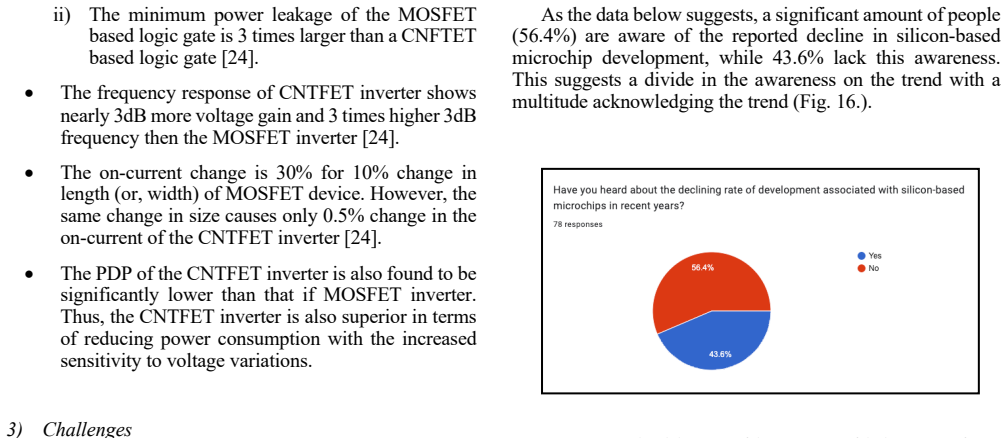
- [Sections I.D, II.D, IV] Section I.D explicitly states that the survey received only 78 responses, was targeted at college students aged 18–22, drew from a small number of institutions, and that 'due to the lack of technical knowledge and the complex nature of certain topics, the scope of the research had to be minimized.' Despite this, Section IV uses the survey to conclude that 'there is a market for these devices at present,' and the abstract uses 'the evidence points to...' language. A non-representative convenience sample of 78 respondents cannot ground these claims. This is a methodological limitation that affects the paper's main conclusions, not merely a caveat.
- [Section II.C.2] The PVT comparison between CNTFET and MOSFET inverters reports quantitative results—PDP 100 times lower, maximum power leakage 75 times higher for MOSFET, 3 dB higher voltage gain, and so on—without providing simulation parameters, error bars, or data tables. The source is cited as [24], which is a general paper on energy-performance optimization rather than the attributed Northeastern University study. This prevents the reader from verifying the stated numbers and undermines the strength of the comparative conclusion.
minor comments (3)
- [Throughout] The manuscript contains numerous typos and inconsistent spelling: 'Pottassium' (Fig. 13 caption), 'integarion' (Section II.C.3), 'transistion' (Fig. 18), 'CNFTET' for CNTFET, and 'MOFSET' for MOSFET.
- [Section II.A.3] The list of mass-production techniques is misnumbered: after items i)–v) under Lithography, the next item is labeled 'vi) Stack Engineering,' but the preceding list already ended at v). The figure numbering and caption formatting are also inconsistent (e.g., Fig. 13 caption lacks a period, several figures are not referenced in the text).
- [References] Reference formatting is inconsistent and some entries are incomplete. Examples: '[M2 16]', '[M1 17]', and '[M3 18]' are used in the text, but the reference list has no such labels; reference [7] is missing page numbers/chapter details; several sources are non-archival web pages (Wikipedia, Investopedia). The quality of the bibliography does not meet typical journal standards.
Circularity Check
No circular derivation chain is present; the abstract's promised derivations are absent from the body, but absence is not circularity.
full rationale
The paper consists of an abstract claiming exact derivations (zone-folding bandgaps, Landauer-Buttiker limits, 1D/2D quantum-capacitance equivalence, 5 nm benchmarking, IRDS analysis) and a body that is a survey-based literature review with no equations beyond the chiral vector C=na1+ma2 (Section II.A.2) and no quantitative derivation. Because the derivation chain is entirely missing, there is no step that reduces to its own inputs. The body's limitations explicitly state 'Due to the lack of technical knowledge and the complex nature of certain topics, the scope of the research had to be minimized' (Section I.D), confirming the absence of the promised technical content. The recommendation section uses the survey results (Section II.D) to infer market demand, but this is an empirical claim, not a derivation, and the survey is acknowledged as skewed. No self-citations are load-bearing; citations are external. The abstract-body mismatch is a completeness and consistency concern, not a circularity concern. Therefore, circularity score is 0.
Assumptions & free parameters
assumptions (5)
- domain assumption Zone-folding bandgap model of SWCNTs from graphene
- standard math Landauer-Buttiker formalism for ballistic transport
- domain assumption Quantum capacitance normalization to areal density
- domain assumption Ideal coaxial electrostatic gate as upper bound
- domain assumption Source-to-drain tunneling dominates subthreshold degradation at 5 nm
Cite this review
Pith. "Pith review of The Post-Silicon Semiconductor Era: A Review of Physics, Synthesis, and Architectural Integration of Carbon Nanotube Field-Effect Transistors." pith.science (2026). https://pith.science/paper/7GS4NIDP
@misc{pith2026250900947,
  author       = {Pith},
  title        = {Pith review of: The Post-Silicon Semiconductor Era: A Review of Physics, Synthesis, and Architectural Integration of Carbon Nanotube Field-Effect Transistors},
  year         = {2026},
  howpublished = {\url{https://pith.science/paper/7GS4NIDP}},
  note         = {Machine review of arXiv:2509.00947}
}
read the original abstract
Silicon CMOS scaling is approaching a set of hard physical limits. Direct source-to-drain quantum tunneling, an unscalable subthreshold swing, and the thermal ceiling known as Dark Silicon motivate the search for a new channel material that can carry logic scaling forward. This review builds the case for single-walled carbon nanotubes (SWCNTs) as that material. We follow a continuous narrative from electronic-structure theory through synthesis to integration. The SWCNT bandgap and its near-ballistic transport limits are derived from the graphene zone-folding framework and the Landauer-Buttiker formalism. We benchmark these theoretical limits against ideal coaxial electrostatic bounds to evaluate how well the geometry suppresses short-channel effects before quantum tunneling takes over. Comparing this analytical framework against published 5 nm experimental data illustrates the aggressive subthreshold degradation driven by source-to-drain tunneling. Furthermore, we derive the exact areal-density equivalence between 1D and 2D quantum capacitance. This demonstrates that even close-packed arrays cannot fully close the dimensional gap to 2D materials, underscoring why superior carrier velocity and electrostatics must carry the CNTFET advantage. Next, we examine CoMoCAT growth and aqueous two-phase extraction against the semiconducting-purity demands of logic fabrication, alongside contact engineering and reversible chemical doping. A closing techno-economic analysis weighs this physics and process picture against IEEE IRDS roadmap projections and environmental health constraints. Taken together, the evidence points to materials purification, contact reliability, and bias temperature instability as the remaining practical barriers to commercial CNTFET adoption.
Figures


Figures from the paper (9 more)




Forward citations
Cited by 1 Pith paper
-
Mesoscopic Modeling of Structure-Transport Relationships in Dense CNT Films Containing Amorphous Carbon
In simulated dense CNT films, electrical current is highest when nanotubes are strongly bent and buckled, weakly bundled, and well connected; amorphous carbon changes morphology and current in a nonmonotonic way.
Reference graph
Works this paper leans on
-
[24]
Farmer and Roy G
Damon B. Farmer and Roy G. Gordon , title =. Nano Letters , volume =. 2006 , doi =
2006
-
[1]
Brattain , title =
John Bardeen and Walter H. Brattain , title =. Physical Review , volume =. 1948 , publisher =
1948
-
[2]
Silicon Transistors Offer Superior Operating Characteristics , author =
-
[3]
Moore , title =
Gordon E. Moore , title =. Electronics , volume =
-
[4]
Dennard and Fritz H
Robert H. Dennard and Fritz H. Gaensslen and Hwa-Nien Yu and Leo Rideout and Ernest Bassous and Andre R. LeBlanc , title =. IEEE Journal of Solid-State Circuits , volume =. 1974 , publisher =
1974
-
[5]
Ning , title =
Yuan Taur and Tak H. Ning , title =
-
[6]
Sze and Kwok K
Simon M. Sze and Kwok K. Ng , title =
-
[7]
Physica B: Condensed Matter , volume =
Phaedon Avouris and Richard Martel and Volkmar Derycke and Joerg Appenzeller , title =. Physica B: Condensed Matter , volume =. 2002 , publisher =
2002
Show all 110 references
-
[8]
Supriyo Datta , title =
-
[9]
Franklin and M
Aaron D. Franklin and M. Luisier and S.-J. Han and G. Tulevski and C. M. Breslin and L. Gignac and M. S. Lundstrom and W. Haensch , title =. Nano Letters , volume =. 2012 , publisher =
2012
-
[10]
Dresselhaus , title =
Riichiro Saito and Gene Dresselhaus and Mildred S. Dresselhaus , title =
-
[11]
Journal of the Physical Society of Japan , volume =
Tsuneya Ando , title =. Journal of the Physical Society of Japan , volume =. 2005 , publisher =
2005
-
[12]
W. E. Alvarez and B. Kuperman and A. Cavallo and D. E. Resasco , title =. Carbon , volume =. 2001 , publisher =
2001
-
[13]
Arnold and Alexander A
Michael S. Arnold and Alexander A. Green and James F. Hulvat and Samuel I. Stupp and Mark C. Hersam , title =. Nature Nanotechnology , volume =. 2006 , publisher =
2006
-
[14]
Li and M
H. Li and M. Zheng and J. A. Fagan , title =. ACS Nano , volume =. 2025 , publisher =
2025
-
[15]
Nature , volume =
Ali Javey and Jing Guo and Qian Wang and Mark Lundstrom and Hongjie Dai , title =. Nature , volume =. 2003 , publisher =
2003
-
[16]
Collins and Keith Bradley and Masa Ishigami and Alex Zettl , title =
Philip G. Collins and Keith Bradley and Masa Ishigami and Alex Zettl , title =. Science , volume =. 2000 , publisher =
2000
-
[17]
G. U. Sumanasekera and C. K. W. Adu and S. Fang and P. C. Eklund , title =. Physical Review Letters , volume =. 2000 , publisher =
2000
-
[18]
The chips are down for
Waldrop, M Mitchell , journal=. The chips are down for
-
[19]
2022 , publisher=
International Roadmap for Devices and Systems (. 2022 , publisher=
2022
-
[20]
Franklin and Yu Zhu and Zhen Zhang and George S
Qing Cao and Shu-Jen Han and Jerry Tersoff and Aaron D. Franklin and Yu Zhu and Zhen Zhang and George S. Tulevski and Jianshi Tang and Wilfried Haensch , title =. Science , volume =. 2015 , publisher =
2015
-
[21]
Nature Electronics , volume=
Fabrication of carbon nanotube field-effect transistors in commercial silicon manufacturing facilities , author=. Nature Electronics , volume=. 2020 , publisher=
2020
-
[22]
Myers and Hyunchul Wei and Arash Badmaev and Chongwu Zhou and H.-S
Nishant Patil and Albert Lin and Eric R. Myers and Hyunchul Wei and Arash Badmaev and Chongwu Zhou and H.-S. Philip Wong and Subhasish Mitra , title =. IEEE Transactions on Very Large Scale Integration (VLSI) Systems , volume =. 2009 , publisher =
2009
-
[23]
Goodson and Hongjie Dai , title =
Eric Pop and David Mann and Qian Wang and Kenneth E. Goodson and Hongjie Dai , title =. Nano Letters , volume =. 2006 , doi =
2006
-
[25]
Shulaker and Gage Hills and Nishant Patil and Hai Wei and Hong-Yu Chen and H.-S
Max M. Shulaker and Gage Hills and Nishant Patil and Hai Wei and Hong-Yu Chen and H.-S. Philip Wong and Subhasish Mitra , title =. Nature , volume =. 2013 , publisher =
2013
-
[26]
Colbert and Richard E
Ting Guo and Paul Nikolaev and Andreas Thess and Daniel T. Colbert and Richard E. Smalley , title =. Chemical Physics Letters , volume =. 1995 , publisher =
1995
-
[27]
Surface Science , volume =
Hongjie Dai , title =. Surface Science , volume =. 2001 , publisher =
2001
-
[28]
Bronikowski and R
Paul Nikolaev and Michael J. Bronikowski and R. Kelley Bradley and Frank Rohmund and Daniel T. Colbert and K. A. Smith and Richard E. Smalley , title =. Chemical Physics Letters , volume =. 1999 , publisher =
1999
-
[29]
P. C. Sims and M. Zheng and J. A. Fagan , title =. Chemical Communications , volume =. 2024 , publisher =
2024
-
[30]
P. R. Wallace , title =. Physical Review , volume =. 1947 , publisher =
1947
-
[31]
C. L. Kane and E. J. Mele , title =. Physical Review Letters , volume =. 1997 , publisher =
1997
-
[32]
J. W. Mintmire and B. I. Dunlap and C. T. White , title =. Physical Review Letters , volume =. 1992 , publisher =
1992
-
[33]
C. T. White and T. N. Todorov , title =. Nature , volume =. 1998 , publisher =
1998
-
[34]
Physical Review B , volume =
Hidekatsu Suzuura and Tsuneya Ando , title =. Physical Review B , volume =. 2002 , publisher =
2002
-
[35]
Zhen Yao and C. L. Kane and Cees Dekker , title =. Physical Review Letters , volume =. 2000 , publisher =
2000
-
[36]
Shahal Ilani and L. A. K. Donev and Markus Kindermann and Paul L. McEuen , title =. Nature Physics , volume =. 2006 , publisher =
2006
-
[37]
Ralph Krupke and Frank Hennrich and Hilbert v. L. Separation of metallic from semiconducting single-walled carbon nanotubes , journal =. 2003 , publisher =
2003
-
[38]
Small , volume =
Dong-Ming Sun and Chang Liu and Wen-Cai Ren and Hui-Ming Cheng , title =. Small , volume =. 2013 , publisher =
2013
-
[39]
Nano Letters , volume =
Zhiyong Zhang and Sheng Wang and Zexiang Ding and Zhongxun Pei and Chenguang Peng and Xiaoliang Liang and Jianping Qiao and Qing Chen and Lianmao Peng , title =. Nano Letters , volume =. 2007 , publisher =
2007
-
[40]
Applied Physics Letters , volume =
Chenguang Lu and Qiang Fu and Shaoming Huang and Jie Liu , title =. Applied Physics Letters , volume =. 2006 , publisher =
2006
-
[41]
B. T. Murphy , title =. Proceedings of the IEEE , volume =. 1964 , publisher =
1964
-
[42]
Mack , title =
Chris A. Mack , title =. IEEE Transactions on Semiconductor Manufacturing , volume =. 2011 , publisher =
2011
-
[43]
Nature , volume =
Sumio Iijima , title =. Nature , volume =. 1991 , publisher =
1991
-
[44]
Bishop and Tathagata Srimani and Pritpal Kanhaiya and Rebecca Ho and Aya Amer and Yosi Stein and Denis Murphy and Arvind and Anantha Chandrakasan and Max M
Gage Hills and Christian Lau and Andrew Wright and Samuel Fuller and Mindy D. Bishop and Tathagata Srimani and Pritpal Kanhaiya and Rebecca Ho and Aya Amer and Yosi Stein and Denis Murphy and Arvind and Anantha Chandrakasan and Max M. Shulaker , title =. Nature , volume =. 201...
2019
-
[45]
Dark silicon and the end of multicore scaling , booktitle =
Hadi Esmaeilzadeh and Emily Blem and Ren. Dark silicon and the end of multicore scaling , booktitle =. 2011 , publisher =
2011
-
[46]
Derycke and R
V. Derycke and R. Martel and J. Appenzeller and Ph. Avouris , title =. Nano Letters , volume =. 2001 , publisher =
2001
-
[47]
Science , volume =
Liu, Lijun and Han, Jie and Xu, Li and Zhou, Jianping and Zhao, Chen and Ding, Shiqi and Shi, Hao and Xiao, Mengmeng and Ding, Li and Ma, Zhongying and others , title =. Science , volume =. 2020 , publisher =
2020
-
[48]
Science , volume =
Qiu, Chenguang and Zhang, Zhiyong and Xiao, Mengmeng and Yang, Yingjun and Zhong, Donglai and Peng, Lian-Mao , title =. Science , volume =. 2017 , publisher =
2017
-
[49]
Advanced Electronic Materials , volume =
Yifu Sun and Peng Lu and Lingyu Zhang and Yu Cao and Lan Bai and Li Ding and Jie Han and Chiyu Zhang and Maguang Zhu and Zhiyong Zhang , title =. Advanced Electronic Materials , volume =. 2025 , doi =
2025
-
[50]
Nature , volume =
Franklin, Aaron D , title =. Nature , volume =. 2013 , publisher =
2013
-
[51]
Nature Nanotechnology , volume =
Chris Rutherglen and Daihua Jaiswal and Peter Burke , title =. Nature Nanotechnology , volume =. 2009 , publisher =
2009
-
[52]
Franklin , title =
Aaron D. Franklin , title =. Science , volume =. 2015 , publisher =
2015
-
[53]
M. S. Dresselhaus and G. Dresselhaus and R. Saito and A. Jorio , title =. Physics Reports , volume =. 2005 , publisher =
2005
-
[54]
Journal of Applied Physics , volume =
Wang, Jing and Polizzi, Eric and Lundstrom, Mark , title =. Journal of Applied Physics , volume =. 2004 , publisher =
2004
-
[55]
Chan and Jerry Tersoff and Phaedon Avouris , title =
Richard Martel and Vito Derycke and Christofer Lavoie and Joerg Appenzeller and Kevin K. Chan and Jerry Tersoff and Phaedon Avouris , title =. Physical Review Letters , volume =. 2001 , publisher =
2001
-
[56]
Nature Electronics , volume =
Donglai Zhong and Mengmeng Xiao and Zhiyong Zhang and Li Ding and Yingjun Yang and Fanqi Wu and Lian-Mao Peng , title =. Nature Electronics , volume =. 2018 , doi =
2018
-
[57]
Nature Electronics , volume =
Lei Xie and Chuanxin Liang and Jing Yang and Mengmeng Xiao and Ye Yuan and Yinghui Sun and Lian-Mao Peng and Zhiyong Zhang , title =. Nature Electronics , volume =. 2023 , publisher =
2023
-
[58]
Bishop and Max M
Tathagata Srimani and Gage Hills and Mindy D. Bishop and Max M. Shulaker , title =. ACS Nano , volume =. 2019 , publisher =
2019
-
[59]
Nature Electronics , volume =
Ye Yuan and Lei Xie and Chuanxin Liang and Shuang Li and Yinghui Sun and Jing Yang and Mengmeng Xiao and Zhiyong Zhang and Lian-Mao Peng , title =. Nature Electronics , volume =. 2023 , publisher =
2023
-
[60]
Perebeinos and J
V. Perebeinos and J. Tersoff and Ph. Avouris , title =. Phys.\ Rev.\ Lett. , volume =. 2005 , doi =
2005
-
[61]
S. M. Bachilo and L. Balzano and J. E. Herrera and F. Pompeo and D. E. Resasco and R. B. Weisman , title =. Journal of the American Chemical Society , volume =. 2003 , doi =
2003
-
[62]
Jones, Thomas B. , year=. Electromechanics of Particles , publisher=
-
[63]
Stapper, C. H. , journal=. Modeling of Integrated Circuit Defect Sensitivities , year=
-
[64]
Stefan Frank and Philippe Poncharal and Z. L. Wang and Walt A. de Heer , title =. Science , volume =. 1998 , doi =
1998
-
[65]
Marchi and E
A. Marchi and E. Gnani and S. Reggiani and M. Rudan and G. Baccarani , title =. Solid-State Electronics , volume =. 2006 , doi =
2006
-
[66]
Rahman and J
A. Rahman and J. Wang and J. Guo and S. Datta and M. Lundstrom , title =. IEEE Transactions on Electron Devices , volume =. 2003 , publisher =
2003
-
[67]
Density of states and quasiparticle energy of carbon nanotubes , journal =
Jiang, Jie and Saito, Riichiro and Gr. Density of states and quasiparticle energy of carbon nanotubes , journal =. 2007 , publisher =
2007
-
[68]
2008 , month =
Pop, Eric , title =. 2008 , month =. doi:10.1088/0957-4484/19/29/295202 , url =
2008 doi
-
[69]
and Yamamoto, Namiko and Panzer, Matthew A
Marconnet, Amy M. and Yamamoto, Namiko and Panzer, Matthew A. and Wardle, Brian L. and Goodson, Kenneth E. , title =. ACS Nano , volume =. 2011 , doi =
2011
-
[70]
Wei, B. Q. and Vajtai, R. and Ajayan, P. M. , title =. Applied Physics Letters , volume =. 2001 , publisher =
2001
-
[71]
and Guo, Jing and Javey, Ali , title =
Chuang, Steven and Gao, Qun and Kapadia, Rehan and Ford, Alexandra C. and Guo, Jing and Javey, Ali , title =. Nano Letters , volume =. 2013 , doi =
2013
-
[72]
Nature Nanotechnology , volume =
Branimir Radisavljevic and Aleksandra Radenovic and Jacopo Brivio and Valentina Giacometti and Andras Kis , title =. Nature Nanotechnology , volume =. 2011 , publisher =
2011
-
[73]
English and Kirby K
Christopher D. English and Kirby K. H. Smithe and Ryan L. Xu and Eric Pop , title =. 2016. 2016 , organization =
2016
-
[74]
L. A. Girifalco and Miroslav Hodak and Roland S. Lee , title =. Physical Review B , volume =. 2000 , publisher =
2000
-
[75]
Franklin and Zhihong Chen , title =
Aaron D. Franklin and Zhihong Chen , title =. Nature Nanotechnology , volume =. 2010 , publisher =
2010
-
[76]
Jorio and R
A. Jorio and R. Saito and J. H. Hafner and C. M. Lieber and M. Hunter and T. McClure and G. Dresselhaus and M. S. Dresselhaus , title =. Physical Review Letters , volume =. 2001 , publisher =
2001
-
[77]
Nature Reviews Materials , volume=
Two-dimensional transition metal dichalcogenides for next-generation electronics , author=. Nature Reviews Materials , volume=. 2016 , publisher=
2016
-
[78]
and Madhvapathy, Surabhi R
Desai, Sujay B. and Madhvapathy, Surabhi R. and Sachid, A. B. and Llinas, Juan Pablo and Wang, Qingxiao and Ahn, Geun Ho and Javey, Ali , journal=. 2016 , publisher=
2016
-
[79]
Nature Materials , volume=
Electrical contacts to two-dimensional semiconductors , author=. Nature Materials , volume=. 2015 , publisher=
2015
-
[80]
J. A. Nanometre-scale electronics with. Nature , volume =. 2011 , doi =
2011
-
[81]
Nature , volume=
Ultrathin compound semiconductor on insulator layers for high-performance nanoscale transistors , author=. Nature , volume=. 2010 , publisher=
2010
-
[82]
and others , booktitle=
Loubet, N. and others , booktitle=. Stacked nanosheet gate-all-around transistor to enable scaling beyond. 2017 , organization=
2017
-
[83]
Nature , volume=
Multigate transistors as the future of classical metal-oxide-semiconductor field-effect transistors , author=. Nature , volume=. 2011 , publisher=
2011
-
[84]
Nature Nanotechnology , volume=
High-density integration of carbon nanotubes via chemical self-assembly , author=. Nature Nanotechnology , volume=. 2012 , publisher=
2012
-
[85]
Science , volume=
Logic circuits with carbon nanotube transistors , author=. Science , volume=. 2001 , publisher=
2001
-
[86]
Science , volume=
An integrated logic circuit assembled on a single carbon nanotube , author=. Science , volume=. 2006 , publisher=
2006
-
[87]
Nature Materials , volume=
High- dielectrics for advanced carbon-nanotube transistors and logic gates , author=. Nature Materials , volume=. 2002 , publisher=
2002
-
[88]
Y-contacted high-performance
Ding, Li and Wang, Sheng and Zhang, Zhiyong and Zeng, Qingsheng and Wang, Zhuo and Pei, Tian and Peng, Lian-Mao , journal=. Y-contacted high-performance. 2009 , publisher=
2009
-
[89]
Science , volume=
Dirac-source field-effect transistors as energy-efficient, high-performance electronic switches , author=. Science , volume=. 2018 , publisher=
2018
-
[90]
and others , booktitle=
Batude, P. and others , booktitle=. 2011 , organization=
2011
-
[91]
Nature , volume=
Three-dimensional integration of nanotechnologies for computing and data storage on a single chip , author=. Nature , volume=. 2017 , publisher=
2017
-
[92]
Novel Length Scales in Nanotube Devices , journal =
Fran. Novel Length Scales in Nanotube Devices , journal =. 1999 , doi =
1999
-
[93]
P. J. Burke , title =. Solid-State Electronics , volume =. 2004 , doi =
2004
-
[94]
Kane and Philbert F
Christopher Rutherglen and Alexander A. Kane and Philbert F. Marsh and Tyler A. Cain and Basem I. Hassan and Mohammed R. AlShareef and Chongwu Zhou and Kosmas Galatsis , title =. Nature Electronics , volume =. 2019 , publisher =
2019
-
[95]
Mintmire, J. W. and White, C. T. , title =. Physical Review Letters , volume =. 1998 , publisher =
1998
-
[96]
Troutman, R. R. , title =. IEEE J. Solid-State Circuits , volume =
-
[97]
and Ichihashi, T
Iijima, S. and Ichihashi, T. , title =. Nature , volume =
-
[98]
Bethune, D. S. and Kiang, C. H. and de Vries, M. S. and Gorman, G. and Savoy, R. and Vazquez, J. and Beyers, R. , title =. Nature , volume =
-
[99]
Proceedings of the IEEE , volume =
Joerg Appenzeller , title =. Proceedings of the IEEE , volume =
-
[100]
Nature Electronics , volume =
Zhiyong Zhang and Lian-Mao Peng , title =. Nature Electronics , volume =
-
[101]
Burke , title =
Peter J. Burke , title =. IEEE Transactions on Nanotechnology , volume =. 2002 , publisher =
2002
-
[102]
Avouris and J
Ph. Avouris and J. Appenzeller and R. Martel and D. Wind , title =. Proceedings of the IEEE , volume =
-
[103]
ACS Nano , volume =
Lian-Mao Peng , title =. ACS Nano , volume =. 2023 , doi =
2023
-
[104]
Shulaker , title =
Andrew Yu and Tathagata Srimani and Max M. Shulaker , title =. arXiv preprint arXiv:2409.11297 , year =
-
[105]
Wang and Eric Pop and Lian-Mao Peng and Youfan Hu , title =
Fan Xia and Tian Xia and Haotian Su and Lanyue Gan and Qianlan Hu and Wanyi Wang and Ruyi Huang and Tianshun Bai and Yufan Chen and Chao Ma and Guanhua Long and Shan X. Wang and Eric Pop and Lian-Mao Peng and Youfan Hu , title =. arXiv preprint arXiv:2502.02485 , year =
-
[106]
Auth and others , title =
C. Auth and others , title =. 2012 Symposium on VLSI Technology (VLSIT) , pages =. 2012 , organization =
2012
-
[107]
Poland and others , title =
Craig A. Poland and others , title =. Nature Nanotechnology , volume =. 2008 , publisher =
2008
-
[108]
Derycke and R
V. Derycke and R. Martel and J. Appenzeller and Ph. Avouris , title =. Applied Physics Letters , volume =. 2002 , doi =
2002
-
[109]
Physical Review Letters , volume =
Stefan Heinze and others , title =. Physical Review Letters , volume =. 2002 , publisher =
2002
-
[110]
Philip Wong and Subhasish Mitra , title =
Nishant Patil and Jie Zhang and Albert Lin and H.-S. Philip Wong and Subhasish Mitra , title =. 45th ACM/IEEE Design Automation Conference , pages =. 2008 , organization =
2008
Reviewed August 5, 2026 · model on record in the stance chip above.
Discussion (0). Continue with ORCID to comment.