REVIEW 3 major objections 6 minor 1 cited by
Entanglement Purification With Finite Latency Classical Communication in Quantum Networks
T0 review · 3 major / 6 minor · reviewed 2026-08-05 · deepseek-v4-flash
Pith's one-line read Classical signaling latency decides whether entanglement purification helps or hurts.
desk verdict Solid systems-level modeling paper with new break-even and throughput maps for purification under real latency, but all headline thresholds rest on a single arbitrarily chosen F0=0.75, so treat the numbers as conditional. read the letter →
The pith
A machine-rendered reading of the paper's core claim, the machinery that carries it, and where it could break.
The reading
What carries the argument
The load-bearing object is the break-even iso-fidelity contour in the plane of classical latency versus expected pair consumption: a curve along which the final fidelity after purification equals the starting fidelity F0, separating configurations where purification helps from those where it actively hurts. Inside the model, continuous-time decoherence of idling qubits is captured by a Lindblad master equation with amplitude-damping and dephasing rates derived from measured T1 and T2 times, and the multi-round resource cost is the product E(F_th) = prod_i 2/p(F_i) of inverse success probabilities. The steady-state distillable rate R(F_th) = R_pair/E(F_th) turns that cost into the throughput
What would settle it
Re-run the heatmaps and rate calculations with F0 = 0.70 and F0 = 0.85 for the 40Ca+ platform and check whether the DEJMPS QKD break-even latency moves outside the 20–25 ms band. Alternatively, a laboratory demonstration of repeated DEJMPS rounds at 20 ms one-way classical latency on a 40Ca+ memory starting from fidelity 0.75 would either reach or miss F >= 0.81 and settle the viability claim directly.
Extended reading notes
Core claim
Treating purification as a race between fidelity gained per successful round and fidelity lost while qubits idle during classical signaling, the paper finds sharp operational boundaries. For the two-pair protocols BBPSSW and DEJMPS, starting from a conservative initial fidelity F0 = 0.75 and propagating states under Lindblad dynamics during control-plane waits on a metro IP network, purification either lifts fidelity to high plateaus, flattens below application thresholds, or collapses toward the maximally mixed state F = 1/4. The break-even iso-fidelity contour F = F0 divides the regime where purification pays from a no-gain region where consuming more pairs is worse than doing nothing. The
Load-bearing premise
Every quantitative boundary in the paper is computed at a single initial fidelity F0 = 0.75; if the real starting fidelity of deployed entangled pairs differs, all latency cutoffs and rate curves shift, and the paper does not quantify that sensitivity.
Editorial extensions
If this is right
- Network architects receive quantitative latency budgets: for 40Ca+ memories with F0 = 0.75, DEJMPS sustains QKD-grade fidelity up to roughly 20–25 ms one-way latency, while DQC-grade fidelity demands the 0–5 ms band.
- There is a well-defined no-gain region below the F = F0 break-even contour, where purification degrades fidelity toward 1/4 and operators should use pairs directly rather than purify.
- DEJMPS is the more reliable protocol in practice: its small per-round advantages compound, yielding steady-state distillable rates often orders of magnitude above BBPSSW in the latency range where purification works.
- Longer-coherence memories shift the positive-rate region to higher latencies; for rare-earth-ion memories, DEJMPS keeps QKD-grade fidelity across the full 0–50 ms range studied.
- High-fidelity thresholds are exponentially expensive in pair consumption, so even a theoretically attainable threshold can be operationally infeasible.
Reading between the lines
- Because F0 = 0.75 is a single fixed worst-case input, the specific latency cutoffs are point estimates; if real initial fidelities are higher, viable latency windows widen and pair-consumption costs drop, and a sensitivity sweep over F0 would quantify that shift.
- The model assumes symmetric one-way latency and conservatively takes the higher of the two directions; real asymmetric or bursty IP delays could make purification success heterogeneous across rounds and alter the break-even contours.
- The resource metric E(F_th) assumes symmetric scheduling that only pairs states of matching fidelity; a scheduler that pools unequal-fidelity pairs, or exploits DEJMPS's tolerance for non-Werner input states, could lower consumption at a given latency.
- The same latency-versus-coherence race applies to other feedback-based quantum network operations, such as entanglement swapping and repeater chains, so the break-even-contour methodology transfers beyond purification.
Signed reviews
Editorial analysis
A structured set of objections, weighed in public.
Referee Report
Summary. The paper studies whether entanglement purification (BBPSSW and DEJMPS) is practically beneficial in quantum networks when the classical coordination channel has realistic, finite latency. The authors model qubit storage decoherence with a Lindblad master equation parameterized by T1 and T2 times of several quantum memory platforms, and use measured metropolitan IP network latency statistics. They derive an expected pair-consumption formula E(Fth) = ∏ 2/p(F_i) and a steady-state distillable rate R(Fth) = R_pair/E(Fth). They then numerically map fidelity evolution over purification rounds, break-even iso-fidelity contours (F = F0), and rate curves versus latency for QKD and DQC thresholds. The central quantitative results are all computed for a single initial fidelity F0 = 0.75.
Significance. If the numerical results are correct and robust, the paper provides a useful engineering methodology for assessing whether purification can run over real control-plane latencies, and for setting latency and memory-coherence budgets. Its strengths are that the forward model is standard, the memory parameters and latency data come from external sources, and the main formulas are derived rather than fitted. The paper also clearly identifies that DEJMPS can outperform BBPSSW by orders of magnitude in steady-state rate, and that sharp break-even boundaries exist. The contribution is significant for quantum network systems engineering, though the lack of sensitivity analysis and a likely sign error in Eq. (20) currently limit confidence in the specific quantitative thresholds.
major comments (3)
- [Section III-C1, Eq. (20)] Eq. (20) appears to have a sign error: the numerator should be F^2 + (1-F)^2/9, not F^2 − (1-F)^2/9. With the printed minus sign, F'(0.6) = 0.562 < 0.6, contradicting the claim in Section III-C3 and Fig. 3 that all protocols give F' > F for F > 1/2. The correct plus-sign formula crosses break-even at F = 1/2 as stated. This needs to be fixed and the numerical results checked to ensure they use the correct expression.
- [Section IV, Figs. 4–6] All quantitative maps, break-even contours, latency budgets, and rate curves are computed for a single initial fidelity F0 = 0.75. The break-even contour in Fig. 5 is explicitly F = F0, so F0 is not a nuisance parameter but the reference level of the central output. Since the paper advertises concrete design rules (e.g., DEJMPS viable up to 20–25 ms for 40Ca+), a sensitivity analysis over a plausible F0 range (e.g., 0.60–0.85) is necessary. Without it, the reported latency thresholds and rate comparisons are conditional on an arbitrary input.
- [Section III-D, Eq. (25)] The rate expression R(Fth) = R_pair/E(Fth) assumes that purification is initiated immediately once two base pairs are available, so no storage decoherence is incurred while waiting for the second pair during finite-rate generation. This idealization is not stated as a limitation and can affect the quantitative rate curves, especially at low R_pair. The authors should either incorporate a waiting-time degradation term or explicitly bound the error introduced by this assumption.
minor comments (6)
- [Section II-A] Typo: 'invesitgates' should be 'investigates'.
- [Section III-C] Typo: 'environmengtal' should be 'environmental'.
- [Section IV-C, Fig. 6 caption] Panel (b) caption says 'Fth = 0.81 required for DQC' but the DQC threshold used throughout the paper is 0.98. Please correct.
- [Section IV-A] The text says latencies are 'sampled from the empirical distribution' and the Introduction claims capture of the 'full stochastic impact' of the control plane, but the results are deterministic per fixed T_C. Please clarify that the latency PDF is used as a source of representative fixed values, not propagated through the model.
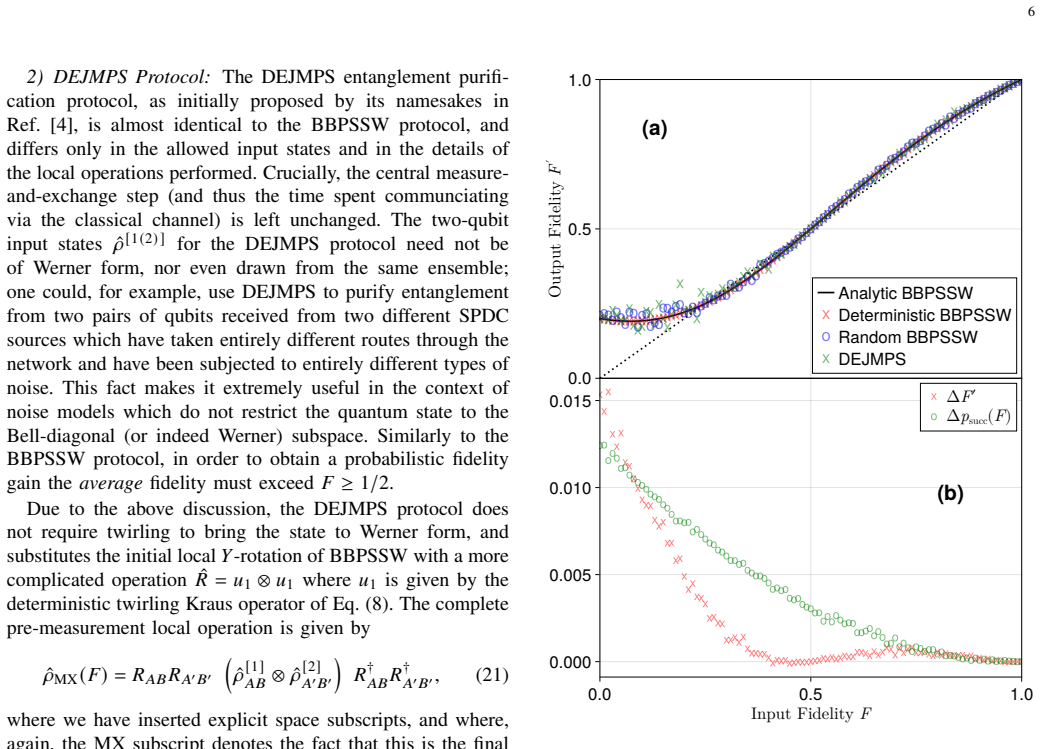
- [Section III-C3, Eqs. (22)–(23)] The notation ΔF' and Δp'_{succ}(F) is inconsistent; in Eq. (22) ΔF' is the fidelity difference, while Eq. (23) defines Δp'_{succ} with a prime. Consider using distinct symbols, e.g., ΔF and Δp_succ.
- [General] Figures 5 and 6 report averages over 1024 random initial states but no error bars. Please add error bars or state explicitly that they are smaller than the marker size.
Circularity Check
No significant circularity: all central inputs are external measurements or literature protocol maps; F0=0.75 is an assumed scenario, not a fitted or predicted quantity.
full rationale
The derivation chain is self-contained and externally benchmarked. The Lindblad master equation (Eq. 2) is parameterized by T1 and T2 values in Table I taken from external experimental references; the network latency distribution is taken from Ookla's open Dublin-metro dataset; the BBPSSW fidelity map is the analytic expression of Ref. [3] (Eq. 20) and DEJMPS is computed from the standard protocol of Ref. [4]. The resource metric E(F_th)=∏2/p(F_i) and throughput R(F_th)=R_pair/E(F_th) are definitional rate bookkeeping, not predictions derived from fitted parameters. The chosen F0=0.75 is stated as a 'highly conservative worst-case scenario' input, not a parameter fitted to the break-even or rate outputs; no equation in the paper reduces to F0 by construction. The break-even contour F=F0 in Fig. 5 is the declared definition of break-even rather than a derived result, and the absence of an F0 sensitivity sweep is a robustness limitation, not a circular one. Self-citations [9] and [24] supply prior modeling context and loss figures but are not used to forbid alternatives or to supply a uniqueness theorem; the central claims (DEJMPS > BBPSSW, latency thresholds) follow from forward simulation of literature protocols over external latency and memory data.
Assumptions & free parameters
free parameters (1)
- Initial fidelity F0 =
0.75
assumptions (5)
- domain assumption Lindblad master equation with amplitude damping and dephasing models memory decoherence during latency
- domain assumption Initial entangled states can be represented by a single fidelity F with a Werner-like or explicitly constructed random mixture
- domain assumption The classical communication latency T_C equals the idle time of the source qubits in each purification round
- domain assumption The expectation formula E(Fth)=prod_i 2/p(F_i) holds under symmetric scheduling with immediate retries
- standard math Single-step fourth-order Runge-Kutta integration is accurate for the used parameters
Cite this review
Pith. "Pith review of Entanglement Purification With Finite Latency Classical Communication in Quantum Networks." pith.science (2026). https://pith.science/paper/MQUAHXME
@misc{pith2026250903667,
  author       = {Pith},
  title        = {Pith review of: Entanglement Purification With Finite Latency Classical Communication in Quantum Networks},
  year         = {2026},
  howpublished = {\url{https://pith.science/paper/MQUAHXME}},
  note         = {Machine review of arXiv:2509.03667}
}
read the original abstract
Quantum networks rely on high fidelity entangled pairs distributed to nodes, but maintaining their fidelity is challenged by environmental decoherence during storage. Entanglement purification is used to restore fidelity, but the idle periods imposed by the associated classical communication delays counteract this goal by exposing the states to further decoherence. In this work, we analyze the practical viability of entanglement purification protocols (BBPSSW, DEJMPS), under non-instantaneous classical coordination over Internet protocol (IP) communications networks. We present a comprehensive performance evaluation of these protocols in various network conditions for a range of quantum memory technologies. We employ a microscopic Lindblad treatment of the underlying quantum dynamics, and use current-generation metropolitan IP network latency statistics and parameters drawn from quantum memory testbeds. In doing so we identify the regions in which entanglement purification succeeds and fails, delineated by break-even iso-fidelity contours in the phase space. We then determine the total number of entangled pairs required to complete a multi-round purification protocol, and the steady-state throughput of entangled pairs with purified fidelities that exceed application-specific thresholds. This provides latency budgets, memory quality targets, and resource-overhead estimates for deploying purification on current and near-future networks.
Figures


Figures from the paper (6 more)


Forward citations
Cited by 1 Pith paper
-
Latency-Constrained Encoded Quantum Teleportation with Punctured Codes
Under latency constraints, longer quantum error-correcting codes can reduce teleportation reliability because acquiring more entangled pairs delays and degrades them; adaptive puncturing of a base code selects the bes...
Reference graph
Works this paper leans on
-
[1]
R. Van Meter, Quantum Networking. Hoboken, NJ, USA: Wiley, 2014
work page 2014
-
[2]
Entanglement purification and quantum error correction,
W. Dür and H. Briegel, “Entanglement purification and quantum error correction,” Rep. Prog. Phys. , vol. 70, no. 8, p. 1381, 2007
work page 2007
-
[3]
Purification of noisy entanglement and faithful teleportation via noisy channels,
C. H. Bennett, G. Brassard, S. Popescu, B. Schumacher, J. A. Smolin, and W. K. Wootters, “Purification of noisy entanglement and faithful teleportation via noisy channels,” Phys. Rev. Lett. , vol. 76, no. 5, p. 722, 1996
work page 1996
-
[4]
Quantum privacy amplification and the security of quantum cryptography over noisy channels,
D. Deutsch, A. Ekert, R. Jozsa, C. Macchiavello, S. Popescu, and A. Sanpera, “Quantum privacy amplification and the security of quantum cryptography over noisy channels,” Phys. Rev. Lett., vol. 77, no. 13, p. 2818, 1996
work page 1996
-
[5]
Efficient computation of the waiting time and fidelity in quantum repeater chains,
S. Brand, T. Coopmans, and D. Elkouss, “Efficient computation of the waiting time and fidelity in quantum repeater chains,” IEEE J. Sel. Areas Commun., vol. 38, no. 3, pp. 619–639, 2020
work page 2020
-
[6]
Efficient optimization of cutoffs in quantum repeater chains,
B. Li, T. Coopmans, and D. Elkouss, “Efficient optimization of cutoffs in quantum repeater chains,” IEEE Trans. Quantum Eng. , vol. 2, pp. 1–15, 2021
work page 2021
-
[7]
Entanglement purification on quantum networks,
M. Victora, S. Tserkis, S. Krastanov, A. S. de la Cerda, S. Willis, and P. Narang, “Entanglement purification on quantum networks,” Phys. Rev. Res., vol. 5, no. 3, p. 033171, 2023
work page 2023
-
[8]
En- tanglement purification in quantum networks: Guaranteed improvement and optimal time,
A. Zang, X.-A. Chen, E. Chitambar, M. Suchara, and T. Zhong, “En- tanglement purification in quantum networks: Guaranteed improvement and optimal time,” arXiv:2505.02286 [quant-ph], 2025
arXiv 2025
Show all 26 references
-
[9]
Control protocol for entangled pair verification in quantum optical networks,
V . Vasan, A. Agrawal, A. Nico-Katz, J. Horgan, B. A. Bash, D. C. Kilper, and M. Ruffini, “Control protocol for entangled pair verification in quantum optical networks,” arXiv preprint arXiv:2411.07410 , 2024
2024 arXiv
-
[10]
Speedtest by ookla global fixed network performance—2024- 01-01 fixed tiles data,
Ookla, “Speedtest by ookla global fixed network performance—2024- 01-01 fixed tiles data,” 2024, accessed Nov. 4, 2024. [Online]. Available: https://registry.opendata.aws/speedtest-global-performance
2024
-
[11]
An entanglement-based wavelength-multiplexed quantum communica- tion network,
S. Wengerowsky, S. K. Joshi, F. Steinlechner, H. Hübel, and R. Ursin, “An entanglement-based wavelength-multiplexed quantum communica- tion network,” Nature, vol. 564, no. 7735, pp. 225–228, 2018
2018
-
[12]
Network requirements for distributed quantum computation,
H. Jacinto, É. Gouzien, and N. Sangouard, “Network requirements for distributed quantum computation,” arXiv preprint arXiv:2504.08891 , 2025
2025
-
[13]
Experimental and theoretical study of the 3d d 2-level lifetimes of 40ca+,
A. Kreuter, C. Becher, G. P. T. Lancaster, A. B. Mundt, C. Russo, H. Häffner et al., “Experimental and theoretical study of the 3d d 2-level lifetimes of 40ca+,” Phys. Rev. A, vol. 71, no. 3, p. 032504, 2005
2005
-
[14]
Single ion qubit with estimated coherence time exceeding one hour,
P. Wang, C.-Y . Luan, M. Qiao, M. Um, J. Zhang et al., “Single ion qubit with estimated coherence time exceeding one hour,” Nat. Commun. , vol. 12, no. 1, p. 233, 2021
2021
-
[15]
Coherence time of over a second in a telecom-compatible quantum memory storage material,
M. Ran ˇci´c, M. P. Hedges, R. L. Ahlefeldt, and M. J. Sellars, “Coherence time of over a second in a telecom-compatible quantum memory storage material,” Nat. Phys., vol. 14, no. 1, pp. 50–54, 2018
2018
-
[16]
Room- temperature quantum bit memory exceeding one second,
P. C. Maurer, G. Kucsko, C. Latta, L. Jiang, N. Y . Yao et al., “Room- temperature quantum bit memory exceeding one second,” Science, vol. 336, no. 6086, pp. 1283–1286, 2012
2012
-
[17]
Superconducting cavity qubit with tens of milliseconds single-photon coherence time,
O. Milul, B. Guttel, U. Goldblatt, S. Hazanov, L. M. Joshi et al. , “Superconducting cavity qubit with tens of milliseconds single-photon coherence time,” PRX Quantum, vol. 4, no. 3, p. 030336, 2023
2023
-
[18]
Quantum memory with millisecond coherence in circuit qed,
M. Reagor, W. Pfaff, C. Axline, R. W. Heeres, N. Ofek et al., “Quantum memory with millisecond coherence in circuit qed,” Phys. Rev. B , vol. 94, no. 1, p. 014506, 2016
2016
-
[19]
Using a lindbladian approach to model decoherence in two coupled nuclear spins via correlated phase damping and amplitude damping noise channels,
H. Singh, Arvind, and K. Dorai, “Using a lindbladian approach to model decoherence in two coupled nuclear spins via correlated phase damping and amplitude damping noise channels,” Pramana – J. Phys. , vol. 94, pp. 1–10, 2020
2020
-
[20]
Breuer and F
H.-P. Breuer and F. Petruccione, The Theory of Open Quantum Systems . Oxford, U.K.: Oxford Univ. Press, 2002
2002
-
[21]
Barchielli and M
A. Barchielli and M. Gregoratti, Quantum Trajectories and Measure- ments in Continuous Time: The Diffusive Case . Berlin, Germany: Springer, 2009, vol. 782. 13 Purification Round 0 10 20 30 F 0.7 0.8 0.9 1.0 BBPSSW (a) 5ms 10ms 15ms 20ms 25ms 30ms 35ms 40ms 45ms 50ms Purificat...
2009
-
[22]
Mixed-state entanglement and quantum error correction,
C. H. Bennett, D. P. DiVincenzo, J. A. Smolin, and W. K. Wootters, “Mixed-state entanglement and quantum error correction,” Phys. Rev. A, vol. 54, no. 5, p. 3824, 1996
1996
-
[23]
System design for a long-line quantum repeater,
R. Van Meter, T. D. Ladd, W. J. Munro, and K. Nemoto, “System design for a long-line quantum repeater,” IEEE/ACM Trans. Netw. , vol. 17, no. 3, pp. 1002–1013, 2008
2008
-
[24]
Routing and spectrum allocation in broadband quantum entanglement distribution,
R. Bali, A. N. Tittelbaugh, S. L. Jenkins, A. Agrawal, J. Horgan, M. Ruffini, D. C. Kilper, and B. A. Bash, “Routing and spectrum allocation in broadband quantum entanglement distribution,” IEEE J. Sel. Areas Commun. , 2025
2025
-
[25]
Visible- wavelength polarization-entangled photon source for quantum commu- nication and imaging,
A. Sansa Perna, E. Ortega, M. Gräfe, and F. Steinlechner, “Visible- wavelength polarization-entangled photon source for quantum commu- nication and imaging,” Appl. Phys. Lett. , vol. 120, no. 7, p. 071102, 2022
2022
-
[26]
Robustness of hashing protocols for entanglement purification,
M. Zwerger, H. Briegel, and W. Dür, “Robustness of hashing protocols for entanglement purification,” Phys. Rev. A , vol. 90, no. 1, p. 012314, 2014
2014
Reviewed August 5, 2026 · model on record in the stance chip above.
Discussion (0). Continue with ORCID to comment.