REVIEW 3 major objections 5 minor 52 references
Periodic orbits underlying spatiotemporal chaos in the Lugiato-Lefever model
T0 review · 3 major / 5 minor · reviewed 2026-08-04 · deepseek-v4-flash
Pith's one-line read Unstable periodic orbits, computed as exact solutions of the Lugiato–Lefever equation, organize the chaotic dynamics of optical cavities: chaos is a walk that intermittently shadows these oscillating Turing rolls.
desk verdict Solid new OTR existence and bifurcation results, but the large-domain shadowing claim leans on fitted domain sizes and a 2D projection; worth serious refereeing with a focus on that evidence. read the letter →
The pith
A machine-rendered reading of the paper's core claim, the machinery that carries it, and where it could break.
The reading
What carries the argument
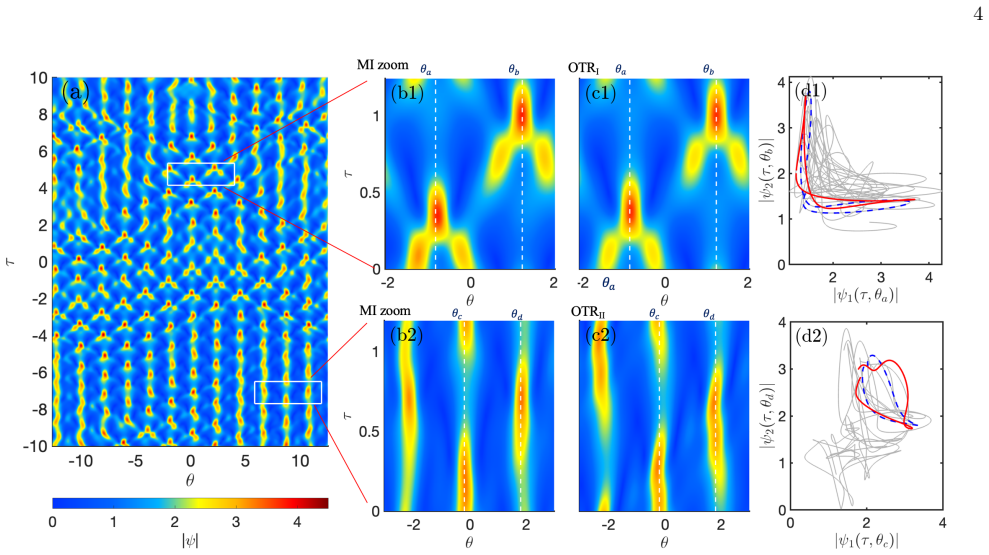
The central object is the OTR (oscillating Turing roll): a time-periodic solution of the LLE in which adjacent rolls oscillate in anti-phase, defined as a fixed point x* of the return map F^T(x*) − x* = 0 over the temporal period T. The authors compute these solutions with a Jacobian-free Newton–Krylov solver in a truncated Fourier basis, continue the branches in detuning and pump parameters, and characterize stability both on the full cavity domain L and on the reduced domain L0 = 2L/N (or 3L/N for the relative orbit OTR II). The shadowing mechanism is demonstrated by comparing spatiotemporal intensity portraits and two-dimensional phase-space projections of chaotic simulations with the exa
What would settle it
Directly measure the state-space distance between the chaotic LLE trajectory and the OTR I/II solutions over time in the regime of Figure 5 (f^2=16, ζ0=0.45). If the minimal distance does not approach the solver tolerance for intervals of order one OTR period, or if shifting the fitted domain by ±1% destroys the agreement in the spatiotemporal portraits, the shadowing claim fails. A complementary check is to perform a recurrence analysis: count near-returns of the chaotic trajectory to the same point in the Poincaré section and compare the associated periods with the OTR periods.
Extended reading notes
Core claim
The central claim is that unstable periodic orbit solutions, called oscillating Turing rolls (OTR), are exact invariant solutions of the Lugiato–Lefever equation and that they serve as the elementary building blocks of both temporal and spatiotemporal chaos in the modulation-instability regime. The authors report three OTR families, follow their solution branches by numerical continuation, and connect them to continuous-wave, Turing-roll, soliton, and breather branches, completing the classical phase diagram. In small cavities, the chaotic field spontaneously switches between OTR I and OTR III patterns. In large cavities, localized patches of anti-phase and drifting roll oscillations match O
Load-bearing premise
The load-bearing premise is that the OTRs computed on the fitted periods 0.988 L0,I and 0.970 L0,II actually represent the coherent structures observed in the chaotic field; if the pattern size in the cavity is merely an artifact of measuring roll-maxima distances while interacting waves distort the structure, the shadowing match in Figure 5 is a fitting product rather than evidence that the chaotic trajectory visits exact solutions.
Editorial extensions
If this is right
- The OTR solution branches complete the phase diagram of the LLE by connecting continuous waves, Turing rolls, solitons, and breathers through bifurcations.
- The L0-stable OTRs (stable on their own period but not on the full cavity) can be observed directly in microresonators as spontaneous temporal switching of intracavity power.
- The unstable OTRs provide a language for describing optical turbulence: a chaotic state is a concatenation of visits to different exact periodic solutions.
- Additional OTR families are expected, which would further refine the description of spatiotemporal patterns.
- The approach extends to dispersion-engineered and coupled resonators, since the OTRs are solutions of the LLE, the universal mean-field model for these systems.
Reading between the lines
- If the shadowing picture holds, statistical properties of the chaotic field (such as residence times and transition rates between patterns) could be computed from the Floquet multipliers and stable/unstable manifolds of the OTRs using periodic-orbit theory, though the paper does not attempt this.
- The sensitivity of the OTR profile to a few percent change in domain size, shown in the supplementary materials, suggests that in larger cavities pattern interactions will distort the embedded periodic orbits; a quantitative theory of this distortion would be needed to make shadowing predictive rather than post hoc.
- The relative periodic orbit OTR II (periodic in a moving frame) hints that drift-type symmetries matter in optical cavities; tracking such relative orbits in other driven-dissipative systems may reveal similar organizing states.
- Because the OTRs exist on domains that are rational fractions of the cavity, they may correspond to rational harmonic combs in the frequency domain; an experimental check is whether the corresponding comb teeth show the predicted phase and amplitude oscillations.
Editorial analysis
A structured set of objections, weighed in public.
Referee Report
Summary. The paper computes unstable time-periodic invariant solutions—'oscillating Turing rolls' (OTRs)—of the Lugiato–Lefever equation (LLE) using Newton–Krylov continuation and arclength continuation. It traces OTR branches from Turing-roll Hopf bifurcations, identifies three families (OTR I, II, III), characterizes their stability on the full cavity domain and on reduced L0 domains, and connects them to continuous waves, Turing rolls, solitons, and breathers. The central claim is that chaotic LLE dynamics in small and large cavities transiently shadow these OTR periodic orbits, making them the 'fundamental building blocks' of both temporal and spatiotemporal chaos.
Significance. If substantiated, the result would be a significant transfer of the exact-coherent-states framework from fluid dynamics to nonlinear optics: optical turbulence in a Kerr cavity would be described as a chaotic walk among exact invariant solutions. The existence, continuation, and stability analysis of the OTR branches is a credible numerical contribution, and the methods are modern and appear internally consistent. The paper also offers a potentially testable prediction in the form of L0-stable OTRs that could be observed in microresonators. However, the manuscript's strongest claim—that chaotic trajectories shadow OTRs in large domains—rests on qualitative visual and low-dimensional evidence, and one part of that evidence is obtained by fitting the OTR spatial period to the chaotic pattern size. The significance therefore depends on closing this gap.
major comments (3)
- [Fig. 5 and surrounding text (p. 5)] The large-domain shadowing evidence is partly circular. The text states that the OTR solutions in Fig. 5(c1,c2) are computed on domains 0.988L0,I and 0.970L0,II, 'chosen according to the size of the MI patterns from (b1,b2)'. Supplementary Fig. 7 explicitly shows that even a few percent change in domain size significantly modifies the OTR profile and amplitude. Thus matching the chaotic pattern's wavelength and amplitude is to a considerable degree enforced by construction. The authors should either determine the OTR periods independently (e.g., from the continuation branch structure or from a symmetry argument) or quantify how the shadowing comparison degrades as the domain size is varied within the plausible range.
- [Fig. 5(d), phase-space projection] No quantitative shadowing statistic is provided. The confirmation of shadowing in Fig. 5(d) is a two-dimensional projection of |ψ| at two fixed θ positions. A chaotic trajectory can appear recurrent in such a low-dimensional projection even when its full state-space distance to the OTR is not small. The authors should report a normalized L2 (or equivalent) distance between the chaotic segments and the corresponding OTR solutions, minimized over allowed phase shifts, time shifts, and, for OTR II, frame drift. Without this, the assertion that 'spatiotemporal chaos as a chaotic trajectory in state space transiently shadows the OTR periodic orbits' is not quantitatively supported.
- [Abstract and Fig. 1] The claim that the results 'complete the classical phase diagram of the optical cavity' is stronger than the evidence presented. The continuation covers sixteen OTR I branches with N=8–12 and specific pump values (f^2=4, 8, 16 are used in figures), plus OTR II and OTR III for selected N. This is not a systematic exploration of the full parameter space, and the phrase 'completes' overreaches. I recommend either tempering the claim to 'connects the main dynamical regimes' or providing a systematic coverage map, e.g., in the (ζ0, f) plane, showing which branches have been tracked.
minor comments (5)
- [Introduction, sentence after Eq. (1)] The sentence 'where the two control parameters are the pump-cavity detuning ζ0 is and pump laser strength f' contains a grammatical error ('ζ0 is').
- [Abstract and main text] The word 'intermittancy' should be 'intermittency'.
- [Fig. 4 caption] The caption says panels (d1,d2) show OTR I and OTR III solutions 'which fit the observed MI patterns'; this wording assumes the conclusion. It would be clearer to say 'computed for comparison'.
- [Supplementary Materials, Fig. 8] Fig. 8(b) shows the OTR III bifurcation diagram for N=10 at f^2=8, while Fig. 4 uses N=11 at f^2=8. Please clarify whether the OTR III solution used in Fig. 4 is on the N=11 branch and whether the bifurcation structure is representative.
- [General] The manuscript would benefit from a data-availability statement indicating whether the continuation code and solution branches will be made publicly available, given the reproducibility-oriented methods.
Circularity Check
Large-domain shadowing claim is partly built from fitted OTR domain sizes; OTR existence and small-domain switching remain independent.
-
fitted input called prediction
[Main text, paragraph describing Figure 5 (Section 'Spatiotemporal chaos emerges in large cavities'), p. 4–5; see also Figure 5 caption (c1,c2)]
"In order to provide a fair comparison of the observed MI patterns shown in Figure 5(b1,b2) with the OTR periodic orbits, we measure the size of the patterns based on the distance between roll maxima, that gives us values 0.988L0,I and 0.970L0,II respectively. Then we compute OTR I and OTR II solutions on these domains, which results in an accurate fit of the MI patterns by the periodic orbits in terms of both spatiotemporal periods and intracavity field amplitudes, see Figure 5(b,c)."
The spatial periods of the OTRs used for the shadowing comparison are not taken from the OTR branch itself; they are measured from the chaotic MI patterns (0.988 L0,I and 0.970 L0,II). Computing an OTR on a domain equal to the measured pattern size forces its spatial period to match the chaotic pattern's wavelength by construction. The subsequent agreement in panel (b)/(c) is therefore partly guaranteed by the fitting step, not an independent confirmation of shadowing. This is amplified by Supplementary Figure 7, which states that 'even a few percent variations of the domain size significantly modify the spatio-temporal profile' — so the fitted domain is a strong tuning parameter. To demonstrate shadowing independently one would need a quantitative state-space distance comparison, ideally
full rationale
The OTR solutions themselves are computed by solving Eq. (2) with Newton-Krylov methods and continuation; their existence and bifurcation structure do not depend on the chaotic trajectories and are credible. The small-domain temporal switching demonstrated in Figure 4 also does not involve domain-size fitting, and the self-citation to [37] for numerical methods is not load-bearing. The only genuinely circular step is in the large-domain shadowing evidence of Figure 5: the OTR spatial periods are fitted to the measured chaotic pattern sizes, and this fitted agreement is then presented as confirmation that the chaotic trajectory 'transiently shadows the OTR periodic orbits.' Since Supplementary Figure 7 shows the strong sensitivity of OTR profiles to few-percent domain-size changes, the fitted domain choice has substantial leverage over the match. Thus part of the central claim — that OTRs are fundamental building blocks of spatiotemporal chaos — reduces by construction for the large-domain case. Score 6 reflects this partial circularity; it is not higher because the OTR existence, bifurcation analysis, and the small-domain temporal switching remain independent, and because the paper does not rely on a self-citation chain to force its conclusions.
Assumptions & free parameters
free parameters (1)
- Pattern-domain size multipliers =
0.988 L0,I and 0.970 L0,II
assumptions (4)
- domain assumption The Lugiato-Lefever equation (1) correctly models dissipative Kerr cavity dynamics
- standard math The flow map F^T of the LLE is smooth and the return map fixed-point condition (2) is solvable by Newton-Krylov methods
- domain assumption The truncated Fourier basis (512 modes for L=8π, 128 modes for L0) is sufficient for converged solutions
- domain assumption L0-stability, i.e. stability in a discrete N-fold translational symmetry subspace, is the relevant stability for observability in the full cavity
invented entities (3)
-
OTR I (oscillating Turing roll) solution family
independent evidence
-
OTR II relative periodic orbit family
-
OTR III periodic orbit family
Cite this review
Pith. "Pith review of Periodic orbits underlying spatiotemporal chaos in the Lugiato-Lefever model." pith.science (2026). https://pith.science/paper/Z2IILGEQ
@misc{pith2026250910283,
  author       = {Pith},
  title        = {Pith review of: Periodic orbits underlying spatiotemporal chaos in the Lugiato-Lefever model},
  year         = {2026},
  howpublished = {\url{https://pith.science/paper/Z2IILGEQ}},
  note         = {Machine review of arXiv:2509.10283}
}
read the original abstract
We obtain and investigate theoretically a broad family of stable and unstable time-periodic orbits-oscillating Turing rolls (OTR)-in the Lugiato-Lefever model of optical cavities. Using the dynamical systems tools developed in fluid dynamics, we access the OTR solution branches in parameter space and elucidate their bifurcation structure. By tracking these exact invariant solutions deeply into the chaotic region of the modulation instability, we connect the main dynamical regimes of the Lugiato-Lefever model: continuous waves, Turing rolls, solitons, and breathers, which completes the classical phase diagram of the optical cavity. We then demonstrate that the OTR periodic orbits play a fundamental role as elementary building blocks in the regime of the intracavity field transition from stable Turing rolls to fully developed turbulent regimes. Depending on the cavity size, we observe that the chaotic intracavity field driven by modulation instability displays either spatiotemporal or purely temporal intermittancy between chaotic dynamics and different families of the OTR solutions, exhibiting locally the distinctive wave patterns and large amplitude peaks. This opens avenues for a theoretical description of optical turbulence within the dynamical systems framework.
Figures


Figures from the paper (4 more)


Reference graph
Works this paper leans on
-
[1]
L. A. Lugiato and R. Lefever, Physical review letters58, 2209 (1987)
1987
-
[2]
Within the whole domainL, theL 0-stable OTRI solu- tions correspond to the OTR solutions that are stable in a discreteN−fold translational symmetry subspace of the intracavity fields. Since the long wavelength instabilities are suppressed within this symmetry subspace, the OTRs in the symmetry subspace lose stability at large detuning compared to theL-sta...
2020
-
[3]
Grelu,Nonlinear optical cavity dynamics: from mi- croresonators to fiber lasers(John Wiley & Sons, 2015)
P. Grelu,Nonlinear optical cavity dynamics: from mi- croresonators to fiber lasers(John Wiley & Sons, 2015)
2015
-
[4]
Matsko, A
A. Matsko, A. Savchenkov, W. Liang, V. Ilchenko, D. Sei- del, and L. Maleki, Optics letters36, 2845 (2011)
2011
-
[5]
Barashenkov and Y
I. Barashenkov and Y. S. Smirnov, Physical Review E 54, 5707 (1996)
1996
-
[6]
in combination with perturbation theoretical argu- ments valid for small damping and forcing [7–10]. In gen- eral, the nonlinear partial differential equation (1) can, however, only be solved numerically. Depending on the values of the control parameters (ζ0, f), several dynamical regimes have been character- ized and are reliably observed in many optical...
arXiv 2025
-
[7]
Kippenberg, A
T. Kippenberg, A. Gaeta, M. Lipson, and M. Gorodet- sky, Science361, eaan8083 (2018)
2018
-
[8]
V. E. Zakharov and A. B. Shabat, Sov. Phys. JETP34, 62 (1972)
1972
Show all 52 references
-
[9]
D. J. Kaup and A. C. Newell, Proceedings of the Royal Society of London. A. Mathematical and Physical Sci- ences361, 413 (1978)
1978
-
[10]
Nozaki and N
K. Nozaki and N. Bekki, Physica D: Nonlinear Phenom- ena21, 381 (1986)
1986
-
[11]
Wabnitz, Journal of the Optical Society of America B 13, 2739 (1996)
S. Wabnitz, Journal of the Optical Society of America B 13, 2739 (1996)
1996
-
[12]
Coppini and P
F. Coppini and P. Santini, Physical Review E102, 062207 (2020)
2020
-
[13]
T. Herr, V. Brasch, J. D. Jost, C. Y. Wang, N. M. Kon- dratiev, M. L. Gorodetsky, and T. J. Kippenberg, Nature Photonics8, 145 (2014)
2014
-
[14]
F. Leo, S. Coen, P. Kockaert, S.-P. Gorza, P. Emplit, and M. Haelterman, Nature Photonics4, 471 (2010)
2010
-
[15]
F. Leo, L. Gelens, P. Emplit, M. Haelterman, and S. Coen, Optics Express21, 9180 (2013)
2013
-
[16]
Lucas, M
E. Lucas, M. Karpov, H. Guo, M. Gorodetsky, and T. J. Kippenberg, Nature communications8, 736 (2017)
2017
-
[17]
Godey, I
C. Godey, I. V. Balakireva, A. Coillet, and Y. K. 6 Chembo, Physical Review A89, 063814 (2014)
2014
-
[18]
Parra-Rivas, D
P. Parra-Rivas, D. Gomila, L. Gelens, and E. Knobloch, Physical Review E98, 042212 (2018)
2018
-
[19]
Z. Qi, S. Wang, J. Jaramillo-Villegas, M. Qi, A. M. Weiner, G. D’Aguanno, T. F. Carruthers, and C. R. Menyuk, Optica6, 1220 (2019)
2019
-
[20]
Parra-Rivas, D
P. Parra-Rivas, D. Gomila, L. Gelens, and E. Knobloch, Physical Review E97, 042204 (2018)
2018
-
[21]
Haelterman, S
M. Haelterman, S. Trillo, and S. Wabnitz, Optics com- munications91, 401 (1992)
1992
-
[22]
Haelterman, S
M. Haelterman, S. Trillo, and S. Wabnitz, Optics com- munications93, 343 (1992)
1992
-
[23]
T. Herr, K. Hartinger, J. Riemensberger, C. Y. Wang, E. Gavartin, R. Holzwarth, M. L. Gorodetsky, and T. J. Kippenberg, Nature photonics6, 480 (2012)
2012
-
[24]
Coillet, Z
A. Coillet, Z. Qi, I. V. Balakireva, G. Lin, C. R. Menyuk, and Y. K. Chembo, Optics letters44, 3078 (2019)
2019
-
[25]
Gomila, P
D. Gomila, P. Parra-Rivas, P. Colet, A. Coillet, G. Lin, T. Daugey, S. Diallo, J.-M. Merolla, and Y. K. Chembo, Physical Review A106, 053518 (2022)
2022
-
[26]
Coillet and Y
A. Coillet and Y. K. Chembo, Chaos: An Interdisci- plinary Journal of Nonlinear Science24(2014)
2014
-
[27]
Panajotov, M
K. Panajotov, M. G. Clerc, and M. Tlidi, The European Physical Journal D71, 1 (2017)
2017
-
[28]
Cheng and X
G. Cheng and X. Yao, Optics Communications , 132170 (2025)
2025
-
[29]
Coulibaly, M
S. Coulibaly, M. Taki, A. Bendahmane, G. Millot, B. Ki- bler, and M. G. Clerc, Physical Review X9, 011054 (2019)
2019
-
[30]
Lukashchuk, J
A. Lukashchuk, J. Riemensberger, A. Tusnin, J. Liu, and T. J. Kippenberg, Nature Photonics17, 814 (2023)
2023
-
[31]
Z. Wang, K. Zhu, F. Zhang, Q. Gong, and Q.-F. Yang, Science Advances11, 9422 (2025)
2025
-
[32]
Hopf, Communications on Pure and Applied Mathe- matics1, 303 (1948)
E. Hopf, Communications on Pure and Applied Mathe- matics1, 303 (1948)
1948
-
[33]
Nagata, Journal of Fluid Mechanics217, 519 (1990)
M. Nagata, Journal of Fluid Mechanics217, 519 (1990)
1990
-
[34]
R. R. Kerswell, Nonlinearity18, R17 (2005)
2005
-
[35]
J. F. Gibson, J. Halcrow, and P. Cvitanovi´ c, Journal of Fluid Mechanics611, 107 (2008)
2008
-
[36]
B. Suri, J. Tithof, R. O. Grigoriev, and M. F. Schatz, Physical review letters118, 114501 (2017)
2017
-
[37]
Reetz, T
F. Reetz, T. Kreilos, and T. M. Schneider, Nature Com- munications10, 2277 (2019)
2019
-
[38]
M. D. Graham and D. Floryan, Annu. Rev. Fluid Mech. 53, 227 (2021)
2021
-
[39]
Deshmukh, A
S. Deshmukh, A. Tusnin, A. Tikan, T. J. Kippenberg, and T. M. Schneider, (2025),arXiv:2508.09921
2025 arXiv
-
[40]
Skryabin, Z
D. Skryabin, Z. Fan, A. Villois, and D. Puzyrev, Physical Review A103, L011502 (2021)
2021
-
[41]
D. C. Cole, E. S. Lamb, P. Del’Haye, S. A. Diddams, and S. B. Papp, Nature Photonics11, 671 (2017)
2017
-
[42]
Avila, F
M. Avila, F. Mellibovsky, N. Roland, and B. Hof, Phys. Rev. Lett.110, 224502 (2013)
2013
-
[43]
Haelterman, S
M. Haelterman, S. Trillo, and S. Wabnitz, Physical Re- view A47, 2344 (1993)
1993
-
[44]
Villois, D
A. Villois, D. Puzyrev, D. Skryabin, and M. Onorato, Physical Review A108, 013520 (2023)
2023
-
[45]
Tikan, J
A. Tikan, J. Riemensberger, K. Komagata, S. H¨ onl, M. Churaev, C. Skehan, H. Guo, R. N. Wang, J. Liu, P. Seidler,et al., Nature Physics17, 604 (2021)
2021
-
[46]
M. H. Anderson, A. Tikan, A. Tusnin, J. Riemensberger, A. Davydova, R. N. Wang, and T. J. Kippenberg, Phys- ical Review X13, 011040 (2023)
2023
-
[47]
Lucas, S.-P
E. Lucas, S.-P. Yu, T. C. Briles, D. R. Carlson, and S. B. Papp, Nature Photonics17, 943 (2023)
2023
-
[48]
A. K. Tusnin, A. M. Tikan, and T. J. Kippenberg, Phys- ical Review A102, 023518 (2020)
2020
-
[49]
Englebert, N
N. Englebert, N. Goldman, M. Erkintalo, N. Mostaan, S.-P. Gorza, F. Leo, and J. Fatome, Nature Physics19, 1014 (2023)
2023
-
[50]
Sun, W.-C
W.-R. Sun, W.-C. Ma, and B. A. Malomed, Physical Review A112, 013501 (2025)
2025
-
[51]
Saad and M
Y. Saad and M. H. Schultz, SIAM Journal on scientific and statistical computing7, 856 (1986)
1986
-
[52]
Viswanath, Journal of Fluid Mechanics580, 339 (2007)
D. Viswanath, Journal of Fluid Mechanics580, 339 (2007). 7 SUPPLEMENT AR Y MA TERIALS NUMERICAL METHODS Newton-Krylov Solver Periodic orbit solutions underlying OTRs, correspond- ing to fixed pointsx ∗ of the return map (2) are com- puted using Jacobian-free Newton-Krylov algo...
2007
Reviewed August 4, 2026 · model on record in the stance chip above.
Discussion (0). Sign in to comment.