Robust Superradiance and Spontaneous Spin Ordering in Disordered Waveguide Quantum Electrodynamics
Pith reviewed 2026-05-18 07:06 UTC · model grok-4.3
The pith
The hallmark N squared scaling of superradiant emission remains asymptotically robust to strong spatial and spectral disorder in a one-dimensional waveguide.
A machine-rendered reading of the paper's core claim, the machinery that carries it, and where it could break.
Core claim
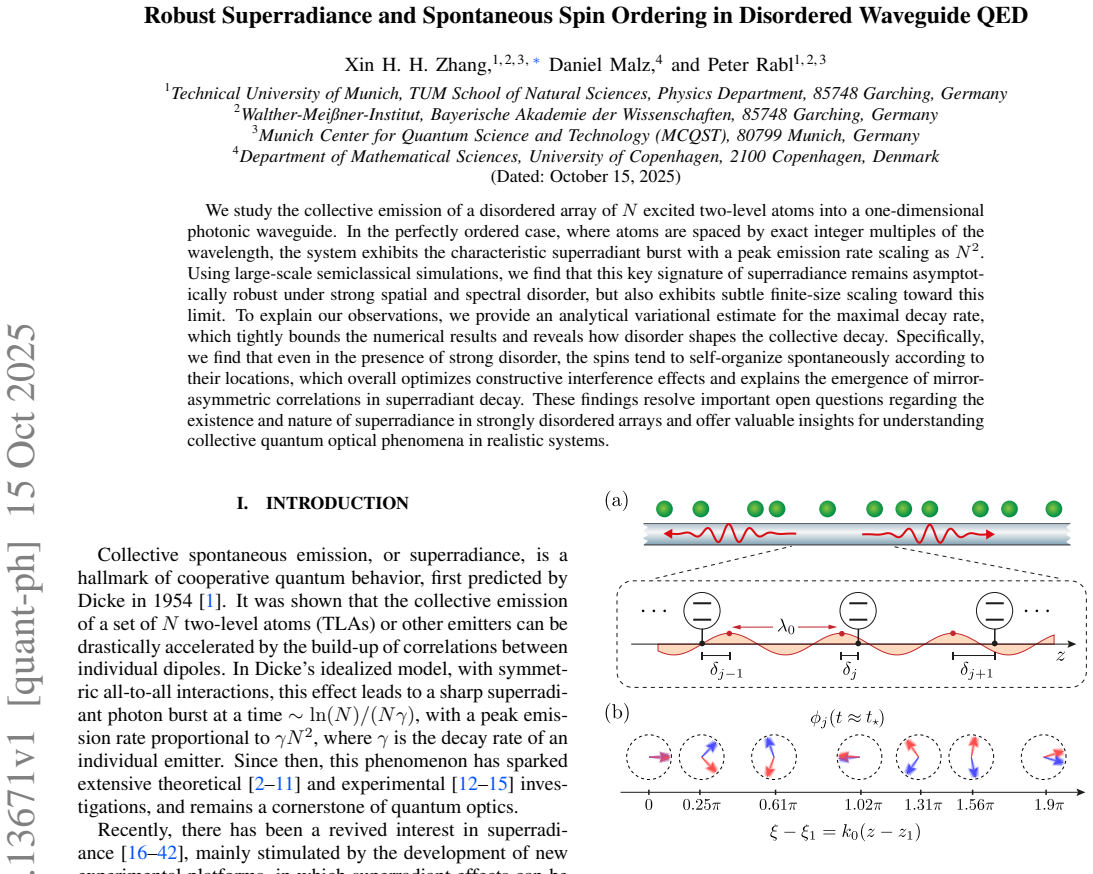
In a disordered array of excited two-level atoms coupled to a 1D waveguide, the characteristic superradiant burst with peak emission rate scaling as N squared remains asymptotically robust under strong spatial and spectral disorder, as shown by semiclassical simulations of large systems. The spins spontaneously self-organize according to their spatial locations to optimize constructive interference, which also produces mirror-asymmetric correlations during decay. A variational upper bound on the maximal decay rate explains the observed robustness and the role of disorder.
What carries the argument
Spontaneous self-organization of the atomic spins according to their spatial locations, which optimizes constructive interference in the emitted light.
If this is right
- The peak emission rate approaches N squared scaling for sufficiently large N regardless of disorder strength.
- Subtle finite-size scaling governs how quickly the system approaches the asymptotic superradiant limit.
- Mirror-asymmetric correlations between atoms emerge naturally during the superradiant decay process.
- The variational estimate provides a configuration-dependent upper bound that matches the numerically observed maximal decay rates.
Where Pith is reading between the lines
- The same self-organization principle may enable robust collective emission in other disordered settings such as photonic-crystal waveguides or free-space atomic arrays.
- This robustness suggests that fabrication imperfections in real devices need not destroy superradiant effects for large enough ensembles.
- Quantum corrections beyond the semiclassical treatment could become visible at moderate N or for particular disorder realizations and would be testable by exact diagonalization on smaller systems.
Load-bearing premise
The semiclassical approximation used for large-scale simulations accurately captures the collective decay dynamics even under strong disorder without significant quantum corrections.
What would settle it
An observation, in simulation or experiment, that the peak collective emission rate scales slower than N squared for large N at fixed strong disorder strength.
Figures


read the original abstract
We study the collective emission of a disordered array of $N$ excited two-level atoms into a one-dimensional photonic waveguide. In the perfectly ordered case, where atoms are spaced by exact integer multiples of the wavelength, the system exhibits the characteristic superradiant burst with a peak emission rate scaling as $N^2$. Using large-scale semiclassical simulations, we find that this key signature of superradiance remains asymptotically robust under strong spatial and spectral disorder, but also exhibits subtle finite-size scaling toward this limit. To explain our observations, we provide an analytical variational estimate for the maximal decay rate, which tightly bounds the numerical results and reveals how disorder shapes the collective decay. Specifically, we find that even in the presence of strong disorder, the spins tend to self-organize spontaneously according to their locations, which overall optimizes constructive interference effects and explains the emergence of mirror-asymmetric correlations in superradiant decay. These findings resolve important open questions regarding the existence and nature of superradiance in strongly disordered arrays and offer valuable insights for understanding collective quantum optical phenomena in realistic systems.
Editorial analysis
A structured set of objections, weighed in public.
Referee Report
Summary. The paper studies collective emission from a disordered array of N excited two-level atoms into a 1D photonic waveguide. It claims that the N² superradiant burst remains asymptotically robust under strong spatial and spectral disorder, supported by large-scale semiclassical simulations that also reveal subtle finite-size scaling; an analytical variational estimate tightly bounds the numerics and attributes the behavior to spontaneous self-organization of spins by location, optimizing constructive interference and producing mirror-asymmetric correlations.
Significance. If the central claim holds, the work resolves open questions on the existence and character of superradiance in realistic disordered waveguide QED systems. Strengths include the large-scale semiclassical simulations and the variational bound that provides a parameter-free explanation via location-dependent interference; these elements offer falsifiable predictions for finite-size scaling and correlation asymmetry.
major comments (2)
- [Numerical methods and large-scale simulations] The central claim that N² scaling remains asymptotically robust requires that the semiclassical (mean-field/Bloch) dynamics accurately capture the many-body quantum evolution even under strong disorder. The manuscript should supply direct comparisons between semiclassical results and exact quantum dynamics (or at least entanglement measures) for moderate N and increasing disorder strength to rule out fluctuation corrections that could suppress the observed robustness.
- [Analytical variational estimate] The variational estimate is presented as bounding the numerics and explaining self-organization, yet it appears constructed to reproduce the same semiclassical trajectories. Clarify whether this bound is derived independently of the simulation data (e.g., from a variational ansatz on the master equation) or whether it reduces to a post-hoc fit; if the latter, it does not independently certify the absence of quantum corrections.
minor comments (2)
- [Results and figures] Specify the precise ranges of spatial and spectral disorder strengths (e.g., standard deviations in position and detuning) used to generate the finite-size scaling plots, and report the number of disorder realizations and convergence criteria for the large-N simulations.
- [Abstract and variational section] The abstract states that the variational estimate 'tightly bounds' the numerics; add a quantitative measure (e.g., relative error or bound tightness as a function of N and disorder) in the main text or supplementary material.
Simulated Author's Rebuttal
We thank the referee for the careful reading and constructive comments on our manuscript. We address each major comment point by point below.
read point-by-point responses
-
Referee: [Numerical methods and large-scale simulations] The central claim that N² scaling remains asymptotically robust requires that the semiclassical (mean-field/Bloch) dynamics accurately capture the many-body quantum evolution even under strong disorder. The manuscript should supply direct comparisons between semiclassical results and exact quantum dynamics (or at least entanglement measures) for moderate N and increasing disorder strength to rule out fluctuation corrections that could suppress the observed robustness.
Authors: We agree that direct comparisons between semiclassical and exact quantum dynamics for moderate N would strengthen the justification for the large-N results. We will add such benchmarks in the revised manuscript, including emission-rate comparisons and entanglement measures (e.g., von Neumann entropy) for N up to 12 across a range of disorder strengths. These will demonstrate that fluctuation corrections remain small and do not suppress the observed robustness. revision: yes
-
Referee: [Analytical variational estimate] The variational estimate is presented as bounding the numerics and explaining self-organization, yet it appears constructed to reproduce the same semiclassical trajectories. Clarify whether this bound is derived independently of the simulation data (e.g., from a variational ansatz on the master equation) or whether it reduces to a post-hoc fit; if the latter, it does not independently certify the absence of quantum corrections.
Authors: The variational estimate is derived independently via a variational ansatz applied directly to the master equation: we maximize the instantaneous collective decay rate over a parameterized family of spin configurations that incorporate the position-dependent phases induced by disorder. The resulting analytical upper bound is obtained without reference to the numerical trajectories and naturally yields the location-dependent self-organization that explains the mirror-asymmetric correlations. We will expand the derivation section in the revised manuscript to emphasize this independence. revision: partial
Circularity Check
No significant circularity; claims rest on independent numerics and variational bounds
full rationale
The paper's derivation chain consists of large-scale semiclassical simulations that directly observe the N² scaling robustness under disorder, followed by an independent analytical variational estimate for the maximal decay rate that provides tight bounds and explains spontaneous self-organization via location-dependent interference. These steps are not equivalent to their inputs by construction: the simulations generate the data, and the variational analysis is derived separately to bound and interpret those results without fitting parameters to the target superradiance signature or relying on self-citations for load-bearing uniqueness. The approach is self-contained against the numerical benchmarks and does not reduce predictions to fitted quantities or rename known results.
Axiom & Free-Parameter Ledger
axioms (1)
- domain assumption Semiclassical treatment of atomic dipoles and photon field is sufficient to capture the leading collective decay dynamics
Lean theorems connected to this paper
-
IndisputableMonolith/Cost/FunctionalEquation.leanwashburn_uniqueness_aczel unclear?
unclearRelation between the paper passage and the cited Recognition theorem.
we provide an analytical variational estimate for the maximal decay rate... spins tend to self-organize spontaneously according to their locations, which overall optimizes constructive interference effects
-
IndisputableMonolith/Foundation/BranchSelection.leanbranch_selection unclear?
unclearRelation between the paper passage and the cited Recognition theorem.
R⋆ ≤ R = max{ϕj} ∑i,j γ/4 cos(ξi−ξj) cos(ϕi−ϕj)
What do these tags mean?
- matches
- The paper's claim is directly supported by a theorem in the formal canon.
- supports
- The theorem supports part of the paper's argument, but the paper may add assumptions or extra steps.
- extends
- The paper goes beyond the formal theorem; the theorem is a base layer rather than the whole result.
- uses
- The paper appears to rely on the theorem as machinery.
- contradicts
- The paper's claim conflicts with a theorem or certificate in the canon.
- unclear
- Pith found a possible connection, but the passage is too broad, indirect, or ambiguous to say the theorem truly supports the claim.
Forward citations
Cited by 1 Pith paper
-
Quantum to classical relaxation dynamics of the dissipative Rydberg gas
Using the truncated Wigner approximation on large 1D and 2D systems, the authors find a pronounced slowdown in magnetization relaxation and transient signatures of quantum kinetically constrained dynamics starting fro...
Reference graph
Works this paper leans on
-
[1]
Reduction of the SDE By settingα R/L =α (0) R/L +α (1) R/L, the stochastic differential equation (SDE) in Eq. (10) can be separated into a stochastic part dα(0) R/L =− κ 2 α(0) R/Ldt+ r κ 2 dWR/L, (B1) and a deterministic part d dt α(1) R/L =− κ 2 α(1) R/L + g√ 2 ˜JR/L. (B2) For the initial state, we can letα (0) R/L(0) =α R/L(0)and α(1) R/L(0) = 0. The s...
-
[2]
Adiabatic Elimination In the Markovian limit, where the bosonic modes are heav- ily damped withκ≫γN, we can adiabatically elimi- nate the dynamics ofα R(t)andα L(t)to derive a set of re- duced stochastic equations for the spin variables only. With κ/(γN)≫1, Eq. (9) can be formally integrated as αR/L(t) = r γ 2κ ˜JR/L(t) + r 2 κ dWR/L/dt. (B3) This tells u...
-
[3]
FromTr( ˆR1) =γN, we know−Tr( ˆR2)< γN, which bounds maximal eigenvalue of− ˆR2 byγNfrom above. That is, we can further have [64] λmax( ˆR2)≤6λ prod,max( ˆR2).(F8) We then have an upper bound ofλ max( ˆR2)given by λmax( ˆR)≤γN+ 6λ prod,max( ˆR2).(F9) Combining Eq. (F7) and (F9), we have λmax( ˆR)≤ 3 2ΓmaxN− 1 2 γN→ 3γ 4 N2(1 + sin Θ Θ ), (F10) of which th...
-
[4]
Simulations useN= 400 atoms and10 3 trajectories
for results on other lattice constants. Simulations useN= 400 atoms and10 3 trajectories. Appendix H: Spontaneous Spin Ordering in a Regular Lattice Here, besides the disordered case considered in Sec. V B, we would like to show that the spontaneous spin ordering sim- ilarly exists for a regular lattice with a lattice constantd. The upper bound can be wri...
-
[5]
R. H. Dicke, Coherence in spontaneous radiation processes, Phys. Rev.93, 99 (1954)
work page 1954
-
[6]
N. E. Rehler and J. H. Eberly, Superradiance, Phys. Rev. A3, 1735 (1971)
work page 1971
-
[7]
R. Bonifacio, P. Schwendimann, and F. Haake, Quantum statis- tical theory of superradiance. i, Phys. Rev. A4, 302 (1971)
work page 1971
-
[8]
R. Bonifacio, P. Schwendimann, and F. Haake, Quantum statis- tical theory of superradiance. ii, Phys. Rev. A4, 854 (1971)
work page 1971
-
[9]
Degiorgio, Statistical properties of superradiant pulses, Op- tics Communications2, 362 (1971)
V . Degiorgio, Statistical properties of superradiant pulses, Op- tics Communications2, 362 (1971)
work page 1971
-
[10]
V . Degiorgio and F. Ghielmetti, Approximate solution to the superradiance master equation, Phys. Rev. A4, 2415 (1971)
work page 1971
-
[11]
F. Haake and R. J. Glauber, Quantum statistics of superradiant pulses, Phys. Rev. A5, 1457 (1972)
work page 1972
-
[12]
L. M. Narducci, C. A. Coulter, and C. M. Bowden, Exact diffu- sion equation for a model for superradiant emission, Phys. Rev. A9, 829 (1974)
work page 1974
-
[13]
G. S. Agarwal, Quantum statistical theories of spontaneous emission and their relation to other approaches, inQuantum Optics, edited by G. H ¨ohler (Springer, Berlin, Heidelberg,
-
[14]
R. Bonifacio and L. A. Lugiato, Cooperative radiation pro- cesses in two-level systems: Superfluorescence, Phys. Rev. A 11, 1507 (1975)
work page 1975
-
[15]
M. Gross and S. Haroche, Superradiance: An essay on the the- ory of collective spontaneous emission, Physics Reports93, 301 (1982)
work page 1982
-
[16]
N. Skribanowitz, I. P. Herman, J. C. MacGillivray, and M. S. Feld, Observation of dicke superradiance in optically pumped hf gas, Phys. Rev. Lett.30, 309 (1973)
work page 1973
- [17]
-
[18]
Q. H. F. Vrehen, H. M. J. Hikspoors, and H. M. Gibbs, Quantum beats in superfluorescence in atomic cesium, Phys. Rev. Lett. 38, 764 (1977)
work page 1977
-
[19]
J. M. Raimond, P. Goy, M. Gross, C. Fabre, and S. Haroche, Statistics of millimeter-wave photons emitted by a rydberg- atom maser: An experimental study of fluctuations in single- mode superradiance, Phys. Rev. Lett.49, 1924 (1982)
work page 1924
-
[20]
A. Goban, C.-L. Hung, J. D. Hood, S.-P. Yu, J. A. Mu- niz, O. Painter, and H. J. Kimble, Superradiance for atoms 18 trapped along a photonic crystal waveguide, Phys. Rev. Lett. 115, 063601 (2015)
work page 2015
-
[21]
B. Zhu, J. Schachenmayer, M. Xu, F. Herrera, J. G. Restrepo, M. J. Holland, and A. M. Rey, Synchronization of interacting quantum dipoles, New Journal of Physics17, 083063 (2015)
work page 2015
-
[22]
A. Asenjo-Garcia, M. Moreno-Cardoner, A. Albrecht, H. J. Kimble, and D. E. Chang, Exponential improvement in photon storage fidelities using subradiance and “selective radiance” in atomic arrays, Phys. Rev. X7, 031024 (2017)
work page 2017
-
[23]
Z. Wang, T. Jaako, P. Kirton, and P. Rabl, Supercorrelated ra- diance in nonlinear photonic waveguides, Phys. Rev. Lett.124, 213601 (2020)
work page 2020
-
[24]
A. Pi ˜neiro Orioli, J. K. Thompson, and A. M. Rey, Emergent dark states from superradiant dynamics in multilevel atoms in a cavity, Phys. Rev. X12, 011054 (2022)
work page 2022
-
[25]
S. J. Masson and A. Asenjo-Garcia, Universality of dicke su- perradiance in arrays of quantum emitters, Nature Communica- tions13, 1 (2022)
work page 2022
-
[26]
D. Malz, R. Trivedi, and J. I. Cirac, Large-nlimit of dicke su- perradiance, Phys. Rev. A106, 013716 (2022)
work page 2022
- [27]
-
[28]
O. Rubies-Bigorda, S. Ostermann, and S. F. Yelin, Character- izing superradiant dynamics in atomic arrays via a cumulant expansion approach, Phys. Rev. Res.5, 013091 (2023)
work page 2023
-
[29]
W.-K. Mok, A. Asenjo-Garcia, T. C. Sum, and L.-C. Kwek, Dicke superradiance requires interactions beyond nearest neighbors, Phys. Rev. Lett.130, 213605 (2023)
work page 2023
-
[30]
G. Ferioli, A. Glicenstein, I. Ferrier-Barbut, and A. Browaeys, A non-equilibrium superradiant phase transition in free space, Nature Physics19, 1345 (2023), publisher: Nature Publishing Group
work page 2023
-
[31]
C. D. Mink and M. Fleischhauer, Collective radiative interac- tions in the discrete truncated Wigner approximation, SciPost Phys.15, 233 (2023)
work page 2023
-
[32]
S. Cardenas-Lopez, S. J. Masson, Z. Zager, and A. Asenjo- Garcia, Many-body superradiance and dynamical mirror sym- metry breaking in waveguide qed, Phys. Rev. Lett.131, 033605 (2023)
work page 2023
-
[33]
A. Tiranov, V . Angelopoulou, C. J. van Diepen, B. Schrinski, O. A. D. Sandberg, Y . Wang, L. Midolo, S. Scholz, A. D. Wieck, A. Ludwig, A. S. Sørensen, and P. Lodahl, Collective super- and subradiant dynamics between distant optical quan- tum emitters, Science379, 389 (2023)
work page 2023
- [34]
- [35]
-
[36]
F. Tebbenjohanns, C. D. Mink, C. Bach, A. Rauschenbeutel, and M. Fleischhauer, Predicting correlations in superradiant emission from a cascaded quantum system, Phys. Rev. A110, 043713 (2024)
work page 2024
- [37]
- [38]
-
[39]
W.-K. Mok, S. J. Masson, D. M. Stamper-Kurn, T. Zelevinsky, and A. Asenjo-Garcia, Ground-state selection via many-body superradiant decay, Phys. Rev. Res.7, L022015 (2025)
work page 2025
-
[40]
X. H. H. Zhang, D. Malz, and P. Rabl, Unraveling superradi- ance: Entanglement and mutual information in collective decay, Phys. Rev. Lett.135, 033602 (2025)
work page 2025
- [41]
- [42]
- [43]
-
[44]
R. Holzinger and S. F. Yelin, Analytical prediction of the su- perradiant emission peak and timing in fully excited quantum emitter ensembles (2025), arXiv:2504.09985 [quant-ph]
- [45]
-
[46]
P. Rosario, L. O. R. Solak, A. Cidrim, R. Bachelard, and J. Schachenmayer, Unraveling dicke superradiant decay with separable coherent spin states, Phys. Rev. Lett.135, 133602 (2025)
work page 2025
- [47]
-
[48]
J. G. Bohnet, Z. Chen, J. M. Weiner, D. Meiser, M. J. Holland, and J. K. Thompson, A steady-state superradiant laser with less than one intracavity photon, Nature484, 78 (2012)
work page 2012
-
[49]
M. A. Norcia, M. N. Winchester, J. R. K. Cline, and J. K. Thompson, Superradiance on the millihertz linewidth strontium clock transition, Science Advances2, e1601231 (2016)
work page 2016
-
[50]
V . Paulisch, M. Perarnau-Llobet, A. Gonz´alez-Tudela, and J. I. Cirac, Quantum metrology with one-dimensional superradiant photonic states, Phys. Rev. A99, 043807 (2019)
work page 2019
-
[51]
M. Perarnau-Llobet, A. Gonz ´alez-Tudela, and J. I. Cirac, Mul- timode fock states with large photon number: effective descrip- tions and applications in quantum metrology, Quantum Science and Technology5, 025003 (2020)
work page 2020
-
[52]
D. Roy, C. M. Wilson, and O. Firstenberg, Colloquium: Strongly interacting photons in one-dimensional continuum, Rev. Mod. Phys.89, 021001 (2017)
work page 2017
-
[53]
D. E. Chang, J. S. Douglas, A. Gonz ´alez-Tudela, C.-L. Hung, and H. J. Kimble, Colloquium: Quantum matter built from nanoscopic lattices of atoms and photons, Rev. Mod. Phys.90, 031002 (2018)
work page 2018
-
[54]
A. S. Sheremet, M. I. Petrov, I. V . Iorsh, A. V . Poshakinskiy, and A. N. Poddubny, Waveguide quantum electrodynamics: Collec- tive radiance and photon-photon correlations, Rev. Mod. Phys. 95, 015002 (2023)
work page 2023
-
[55]
J. Schachenmayer, A. Pikovski, and A. M. Rey, Many-body quantum spin dynamics with monte carlo trajectories on a dis- crete phase space, Phys. Rev. X5, 011022 (2015)
work page 2015
- [56]
-
[57]
N. Gisin and I. C. Percival, The quantum-state diffusion model applied to open systems, Journal of Physics A: Mathematical and General25, 5677 (1992)
work page 1992
-
[58]
Carmichael,An Open Systems Approach to Quantum Optics (Springer Berlin Heidelberg, 1993)
H. Carmichael,An Open Systems Approach to Quantum Optics (Springer Berlin Heidelberg, 1993). 19
work page 1993
-
[59]
D. Dzsotjan, A. S. Sørensen, and M. Fleischhauer, Quantum emitters coupled to surface plasmons of a nanowire: A green’s function approach, Phys. Rev. B82, 075427 (2010)
work page 2010
-
[60]
K. Lalumi `ere, B. C. Sanders, A. F. van Loo, A. Fedorov, A. Wallraff, and A. Blais, Input-output theory for waveguide qed with an ensemble of inhomogeneous atoms, Phys. Rev. A 88, 043806 (2013)
work page 2013
-
[61]
Note that for a chiral waveguide, the spatial dependence can be removed with a phase transformation for the spin operators
-
[62]
H. Hosseinabadi, O. Chelpanova, and J. Marino, User-friendly truncated wigner approximation for dissipative spin dynamics, PRX Quantum6, 030344 (2025)
work page 2025
-
[63]
W. Verstraelen, D. Huybrechts, T. Roscilde, and M. Wouters, Quantum and classical correlations in open quantum spin lat- tices via truncated-cumulant trajectories, PRX Quantum4, 030304 (2023)
work page 2023
-
[64]
Z. Li, A. Delmonte, X. Turkeshi, and R. Fazio, Monitored long- range interacting systems: spin-wave theory for quantum trajec- tories, Nature Communications16, 4329 (2025)
work page 2025
-
[65]
Kubo, Generalized cumulant expansion method, Journal of the Physical Society of Japan17, 1100 (1962)
R. Kubo, Generalized cumulant expansion method, Journal of the Physical Society of Japan17, 1100 (1962)
work page 1962
-
[66]
D. Plankensteiner, C. Hotter, and H. Ritsch, QuantumCumu- lants.jl: A Julia framework for generalized mean-field equa- tions in open quantum systems, Quantum6, 617 (2022)
work page 2022
-
[67]
E. H. Lieb, The classical limit of quantum spin systems, Com- munications in Mathematical Physics31, 327 (1973)
work page 1973
- [68]
-
[69]
See Supplemental Material for (i) a proof of irrelevance of de- tuning in the DTW A formalism, (ii) the smooth crossover be- tween weak (Θ =π/4) and strong disorders (Θ = 2π), (iii) plots of spin ordering for regular lattice withk 0d= 2π/3and 2π/N, (iv) the distributions of the propagating phases∆ξand the relative spin angles∆ϕ, and (v) the error of DTW A...
-
[70]
H.-P. Breuer, E.-M. Laine, J. Piilo, and B. Vacchini, Collo- quium: Non-markovian dynamics in open quantum systems, Rev. Mod. Phys.88, 021002 (2016)
work page 2016
-
[71]
I. de Vega and D. Alonso, Dynamics of non-markovian open quantum systems, Rev. Mod. Phys.89, 015001 (2017)
work page 2017
-
[72]
H. J. Carmichael, Quantum trajectory theory for cascaded open systems, Phys. Rev. Lett.70, 2273 (1993)
work page 1993
-
[73]
C. W. Gardiner, Driving a quantum system with the output field from another driven quantum system, Phys. Rev. Lett.70, 2269 (1993)
work page 1993
-
[74]
S. Cardenas-Lopez, E. Guardiola-Navarrete, and A. Asenjo- Garcia, (to appear)
-
[75]
https://doi.org/10.5281/zenodo.14235279
-
[76]
W. K. Wootters, A wigner-function formulation of finite-state quantum mechanics, Annals of Physics176, 1 (1987)
work page 1987
-
[77]
Wigner, On the quantum correction for thermodynamic equi- librium, Phys
E. Wigner, On the quantum correction for thermodynamic equi- librium, Phys. Rev.40, 749 (1932)
work page 1932
-
[78]
Robust Superradiance and Spontaneous Spin Ordering in Disordered Waveguide QED
C. W. Gardiner,Handbook of stochastic methods for physics, chemistry, and the natural sciences, 3rd ed., Springer series in synergetics (Springer-Verlag, Berlin ; New York, 2004). 1 Supplemental Material for “Robust Superradiance and Spontaneous Spin Ordering in Disordered Waveguide QED” Xin H. H. Zhang,1,2,3 Daniel Malz4 and Peter Rabl1,2,3 1Technical Un...
work page 2004
discussion (0)
Sign in with ORCID, Apple, or X to comment. Anyone can read and Pith papers without signing in.