The Quantum Origin of Diffraction from Bright and Dark States
Pith reviewed 2026-05-18 06:50 UTC · model grok-4.3
The pith
Diffraction patterns arise because photons project onto one bright mode while occupying an infinite dark subspace at minima.
A machine-rendered reading of the paper's core claim, the machinery that carries it, and where it could break.
Core claim
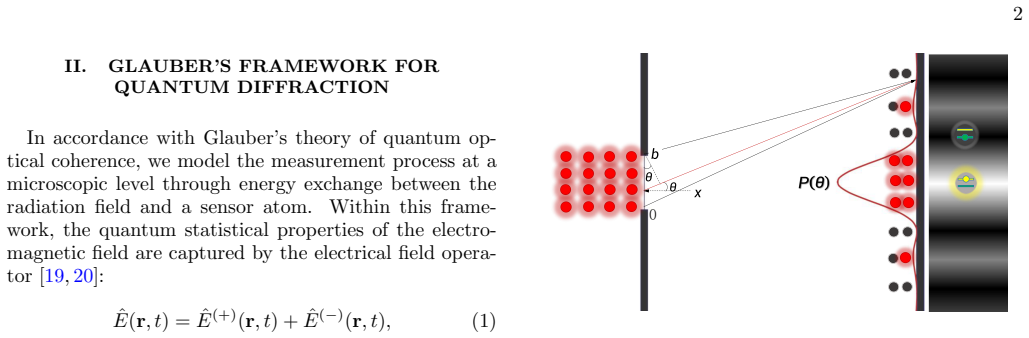
Building upon the recently introduced particle interpretation of the double-slit experiment which attributes interference phenomena to detector-coupled (bright) and detector-uncoupled (dark) states of light, the continuous-mode extension constructs a complete detector-oriented basis for single-slit diffraction. The observed diffraction pattern arises from projection of the photon state onto a single bright mode by identifying the detectable and undetectable modes, with photons detected at intensity minima having zero probability, as they reside in modes spanning an infinite-dimensional dark subspace. This provides a unified particle-based explanation of diffraction that connects quantum and
What carries the argument
The complete detector-oriented basis that partitions the photon modes of the single-slit setup into one bright, detector-coupled mode and an infinite-dimensional set of dark, undetectable modes.
If this is right
- Intensity minima correspond exactly to positions where only dark modes exist, so detection probability is identically zero.
- Higher-order photon correlation functions exhibit quantum signatures that differ from classical wave predictions.
- The same bright-dark partition accounts for both finite-path interference and continuous-mode diffraction.
- Classical diffraction patterns emerge as the observable limit of these quantum mode projections.
Where Pith is reading between the lines
- The same basis construction could be applied to other aperture geometries to test whether diffraction from arbitrary shapes follows the same bright-mode projection rule.
- Precision counting experiments at predicted minima could directly verify the absence of photons rather than a low but nonzero rate.
- Varying the spatial response of the detector might shift the apparent locations of minima, offering a testable signature of the mode decomposition.
Load-bearing premise
The bright and dark distinction developed for a finite number of discrete paths extends without further postulates to a complete orthonormal detector-oriented basis for the continuous single-slit case.
What would settle it
Any detection of photons at the classical intensity minima of a single-slit diffraction pattern would falsify the claim that those locations are spanned solely by the infinite dark subspace with zero detection probability.
Figures
read the original abstract
Building upon the recently introduced particle interpretation of the double-slit experiment [Phys. Rev. Lett. 134, 133603 (2025)] which attributes interference phenomena to detector-coupled (bright) and detector-uncoupled (dark) states of light, we develop a continuous-mode extension of the bright- and dark-state framework. This extension addresses a conceptual distinction between interference and diffraction, that is, the transition from a finite set of discrete paths to a continuum of modes. Through the construction of a complete detector-oriented basis for single-slit diffraction, we demonstrate that the observed diffraction pattern arises from projection of the photon state onto a single bright mode by identifying the detectable and undetectable modes, with photons detected at intensity minima having zero probability, as they reside in modes spanning an infinite-dimensional dark subspace. Our approach thus provides a unified particle-based explanation of diffraction that connects quantum and classical wave optics, and reveals distinctive quantum signatures in higher-order correlations.
Editorial analysis
A structured set of objections, weighed in public.
Referee Report
Summary. The manuscript extends the bright/dark-state framework introduced in the authors' prior PRL on the double-slit experiment to a continuous-mode treatment of single-slit diffraction. It claims to construct a complete detector-oriented basis in which the photon state projects onto a single bright mode that reproduces the observed sinc² intensity pattern, while all intensity minima are accounted for by an infinite-dimensional dark subspace in which detection probability is identically zero. This is presented as a unified particle-based explanation that connects quantum mechanics to classical wave optics and predicts distinctive signatures in higher-order correlations.
Significance. If the claimed construction of the orthonormal detector-oriented basis and the explicit projection rule can be demonstrated, the result would supply a conceptually distinct quantum account of diffraction that separates it from interference via the bright/dark distinction. The approach could open avenues for analyzing higher-order photon statistics in diffraction setups. At present, however, the significance is constrained by the absence of the detailed derivations needed to substantiate the central extension from the discrete to the continuous case.
major comments (2)
- [§2–3] §2–3: The manuscript asserts that a complete detector-oriented basis has been constructed for the continuous single-slit case, yet provides neither the explicit orthonormalization procedure, the overlap integrals between candidate modes, nor a completeness proof. Because the central claim—that projection onto one bright mode exactly recovers the sinc² pattern while the dark subspace enforces zero probability at minima—rests on this unshown construction, the extension from the finite-path PRL remains an assumption rather than a derived result.
- [Abstract and §3] Abstract and §3: The reproduction of the classical diffraction pattern is attributed to the detector-coupling rule applied in the enlarged space, but no derivation is given showing how the bright-mode projection quantitatively matches the sinc² form or why the infinite-dimensional dark subspace is orthogonal to all detectable amplitudes at the intensity minima. This step is load-bearing for the claim that photons detected at minima have zero probability.
minor comments (2)
- Notation for the continuous-mode bright and dark states should be introduced with explicit comparison to the discrete-path definitions in the cited PRL to avoid ambiguity when taking the continuum limit.
- The manuscript would benefit from a short appendix or subsection that lists the inner-product relations used to establish orthonormality of the detector-oriented basis.
Simulated Author's Rebuttal
We thank the referee for their careful reading of the manuscript and for identifying the points where additional detail is required to substantiate the extension of the bright/dark-state framework to the continuous single-slit case. We address each major comment below and will revise the manuscript accordingly.
read point-by-point responses
-
Referee: [§2–3] §2–3: The manuscript asserts that a complete detector-oriented basis has been constructed for the continuous single-slit case, yet provides neither the explicit orthonormalization procedure, the overlap integrals between candidate modes, nor a completeness proof. Because the central claim—that projection onto one bright mode exactly recovers the sinc² pattern while the dark subspace enforces zero probability at minima—rests on this unshown construction, the extension from the finite-path PRL remains an assumption rather than a derived result.
Authors: We agree that the explicit orthonormalization procedure, overlap integrals, and completeness proof were not presented with sufficient detail in the main text. In the revised manuscript we will insert a new subsection in §2 that (i) specifies the Gram-Schmidt procedure applied to the candidate detector modes in the continuous limit, (ii) evaluates the relevant overlap integrals, and (iii) supplies a completeness argument based on the completeness of the Fourier basis on the detection screen. These additions will make the transition from the discrete-path PRL to the continuous case fully derived rather than asserted. revision: yes
-
Referee: [Abstract and §3] Abstract and §3: The reproduction of the classical diffraction pattern is attributed to the detector-coupling rule applied in the enlarged space, but no derivation is given showing how the bright-mode projection quantitatively matches the sinc² form or why the infinite-dimensional dark subspace is orthogonal to all detectable amplitudes at the intensity minima. This step is load-bearing for the claim that photons detected at minima have zero probability.
Authors: We acknowledge that a quantitative derivation linking the bright-mode projection to the sinc² intensity distribution and an explicit demonstration of the dark-subspace orthogonality at the minima were omitted. In the revision we will add to §3 an explicit calculation showing that the inner product of the incident photon state with the single bright mode reproduces the classical sinc² pattern, together with a proof that every dark mode is orthogonal to the detection amplitude at each intensity minimum. This will directly establish that the detection probability vanishes at those locations. revision: yes
Circularity Check
Central claim reduces to extension of authors' prior bright/dark definition without independent continuum construction
specific steps
-
self citation load bearing
[Abstract]
"Building upon the recently introduced particle interpretation of the double-slit experiment [Phys. Rev. Lett. 134, 133603 (2025)] which attributes interference phenomena to detector-coupled (bright) and detector-uncoupled (dark) states of light, we develop a continuous-mode extension of the bright- and dark-state framework. This extension addresses a conceptual distinction between interference and diffraction, that is, the transition from a finite set of discrete paths to a continuum of modes. Through the construction of a complete detector-oriented basis for single-slit diffraction, we show a"
The diffraction pattern is recovered by projecting the photon state onto a single bright mode after identifying detectable and undetectable modes in the continuous case. This identification is obtained by extending the bright/dark distinction defined in the authors' prior PRL; the finite discrete-path construction does not automatically guarantee the required orthonormal complete basis or exclusive detector coupling to the bright mode in the continuum limit, so the zero-probability claim at minima is enforced by the same definitional rule rather than derived independently.
full rationale
The paper builds its unified particle explanation of diffraction explicitly on the bright/dark states introduced in the authors' own cited PRL (134, 133603). The key step is asserting a complete detector-oriented orthonormal basis for the continuous single-slit case such that exactly one bright mode captures all detectable amplitude while an infinite dark subspace enforces zero probability at intensity minima. This reproduces the known sinc² pattern by re-expressing the same detector-coupling rule in the enlarged space. Because the finite-path PRL construction supplies neither an explicit completeness proof nor a demonstration that the continuum limit preserves exclusive bright-mode coupling and orthogonality at minima, the separation of detectable/undetectable modes functions as a definitional extension rather than an independent derivation. The result is therefore a re-coordinatization of the prior framework.
Axiom & Free-Parameter Ledger
axioms (1)
- domain assumption Light fields admit a detector-oriented decomposition into bright (detector-coupled) and dark (detector-uncoupled) states that remains valid when the set of paths is enlarged from discrete to continuous.
invented entities (1)
-
infinite-dimensional dark subspace
no independent evidence
Lean theorems connected to this paper
-
IndisputableMonolith/Foundation/AbsoluteFloorClosure.leanreality_from_one_distinction unclear?
unclearRelation between the paper passage and the cited Recognition theorem.
Through the construction of a complete detector-oriented basis for single-slit diffraction, we demonstrate that the observed diffraction pattern arises from projection of the photon state onto a single bright mode... infinite-dimensional dark subspace.
-
IndisputableMonolith/Cost/FunctionalEquation.leanwashburn_uniqueness_aczel unclear?
unclearRelation between the paper passage and the cited Recognition theorem.
The detection probability |c_0|² = [sin(β)/β]² exactly reproduces the classical single-slit diffraction profile
What do these tags mean?
- matches
- The paper's claim is directly supported by a theorem in the formal canon.
- supports
- The theorem supports part of the paper's argument, but the paper may add assumptions or extra steps.
- extends
- The paper goes beyond the formal theorem; the theorem is a base layer rather than the whole result.
- uses
- The paper appears to rely on the theorem as machinery.
- contradicts
- The paper's claim conflicts with a theorem or certificate in the canon.
- unclear
- Pith found a possible connection, but the passage is too broad, indirect, or ambiguous to say the theorem truly supports the claim.
Forward citations
Cited by 1 Pith paper
-
Measurement-defined control of single-particle interference
Single-particle interference is governed by the relative phase between the prepared quantum state and the detector-defined measurement basis, with equivalent sinusoidal fringes produced by independent scans of pump, s...
Reference graph
Works this paper leans on
-
[1]
L. Mandel and E. Wolf,Optical Coherence and Quantum Optics(Cambridge University Press, Cambridge, 1995)
work page 1995
-
[2]
M. O. Scully and M. S. Zubairy,Quantum Optics(Cam- bridge University Press, Cambridge, 1997)
work page 1997
-
[3]
R. S. Aspden, M. J. Padgett, and G. C. Spalding, Video recording true single-photon double-slit interference, Am. J. Phys.84, 671 (2016)
work page 2016
-
[4]
Rubinowicz, Thomas Young and the theory of diffrac- tion, Nature180, 160 (1957)
A. Rubinowicz, Thomas Young and the theory of diffrac- tion, Nature180, 160 (1957)
work page 1957
-
[5]
P. S. Epstein and P. Ehrenfest, The quantum theory of the Fraunhofer diffraction, Proc. Nat. Acad. Sci. USA 10, 133 (1924)
work page 1924
-
[6]
Huygens,Treatise on Light(Dover, New York, 1962)
C. Huygens,Treatise on Light(Dover, New York, 1962)
work page 1962
-
[7]
P. Grangier, G. Roger, and A. Aspect, Experimental evi- dence for a photon anticorrelation effect on a beam split- ter: a new light on single-photon interferences, Europhys. Lett.1, 173 (1986)
work page 1986
-
[8]
A. B. Arons and M. B. Peppard, Einstein’s proposal of the photon concept—a translation of the Annalen der Physik paper of 1905, Am. J. Phys.33, 367 (1965)
work page 1905
-
[9]
N. Somaschi, V. Giesz, L. De Santis, J. C. Loredo, M. P. Almeida, G. Hornecker, S. L. Portalupi, T. Grange, C. Ant´ on, J. Demory, C. G´ omez, I. Sagnes, N. D. Lanzillotti-Kimura, A. Lemaitre, A. Auffeves, A. G. White, L. Lanco, and P. Senellart, Near-optimal single- photon sources in the solid state, Nat. Photonics10, 340 (2016)
work page 2016
-
[10]
Loudon,The Quantum Theory of Light(Oxford Uni- versity Press, Oxford, 2000)
R. Loudon,The Quantum Theory of Light(Oxford Uni- versity Press, Oxford, 2000)
work page 2000
-
[11]
A. Zavatta, S. Viciani, and M. Bellini, Quantum-to- classical transition with single-photon-added coherent states of light, Science306, 660 (2004)
work page 2004
-
[12]
W. Rueckner and J. Peidle, Young’s double-slit experi- ment with single photons and quantum eraser, Am. J. Phys.81, 951 (2013)
work page 2013
- [13]
-
[14]
B. J. Luo, L. Francis, V. Rodr´ ıguez-Fajardo, E. J. Galvez, and F. Khoshnoud, Young’s double-slit interfer- ence demonstration with single photons, Am. J. Phys. 92, 308 (2024)
work page 2024
-
[15]
Gibney, What does quantum mechanics say about re- ality?, Nature643, 1175 (2025)
E. Gibney, What does quantum mechanics say about re- ality?, Nature643, 1175 (2025)
work page 2025
-
[16]
V. Fedoseev, H. Lin, Y.-K. Lu, Y. K. Lee, J. Lyu, and W. Ketterle, Coherent and incoherent light scattering by single-atom wave packets, Phys. Rev. Lett.135, 043601 (2025)
work page 2025
-
[17]
C. J. Villas-Boas, C. E. M´ aximo, P. J. Paulino, R. P. Bachelardo, and G. Rempe, Bright and dark states of light: the quantum origin of classical interference, Phys. Rev. Lett.134, 133603 (2025)
work page 2025
- [18]
-
[19]
R. J. Glauber, The quantum theory of optical coherence, Phys. Rev.130, 2529 (1963)
work page 1963
-
[20]
R. J. Glauber, Nobel Lecture: one hundred years of light quanta, Rev. Mod. Phys.78, 1267 (2006)
work page 2006
-
[21]
R. H. Dicke, Coherence in spontaneous radiation pro- cesses, Phys. Rev.93, 99 (1954)
work page 1954
-
[22]
P. M. Alsing, D. A. Cardimona, and H. J. Carmichael, Suppression of fluorescence in a lossless cavity, Phys. Rev. A45, 1793 (1992)
work page 1992
-
[23]
M. Hiekkam¨ aki and R. Fickler, High-dimensional two- photon interference effects in spatial modes, Phys. Rev. Lett.126, 123601 (2021)
work page 2021
-
[24]
G. Bj¨ ork, L. L. S´ anchez-Soto, and J. S¨ oderholm, Entan- gled state lithography: tailoring any pattern with a single state, Phys. Rev. Lett.86, 4516 (2001)
work page 2001
-
[25]
A. V. Dodonov, S. S. Mizrahi, and V. V. Dodonov, In- clusion of nonidealities in the continuous photodetection model, Phys. Rev. A75, 013806 (2007)
work page 2007
-
[26]
D. Tommasini and H. Michinel, Light by light diffraction in vacuum, Phys. Rev. A82, 011803 (2010)
work page 2010
-
[27]
Steuernagel, Quantum statistics can suppress classical interference, Phys
O. Steuernagel, Quantum statistics can suppress classical interference, Phys. Rev. A65, 013809 (2001)
work page 2001
-
[28]
J. H. Phay and S. Robin, Theory of X-ray diffraction from laser-aligned symmetric-top molecules, Phys. Rev. A78, 053409 (2008)
work page 2008
- [29]
-
[30]
K. Murr, P. Maunz, P. W. H. Pinkse, T. Puppe, I. Schus- ter, D. Vitali, and G. Rempe, Momentum diffusion for coupled atom-cavity oscillators, Phys. Rev. A74, 043412 (2006). 8
work page 2006
- [31]
-
[32]
J. J. Cheng and L. Zhang, Implementing conventional and unconventional nonadiabatic geometric quantum gates via SU(2) transformations, Phys. Rev. A103, 032616 (2021)
work page 2021
-
[33]
M. L. Hu, X. Hu, J. Wang, Y. Peng, Y. R. Zhang, and H. Fan, Quantum coherence and geometric quantum dis- cord, Phys. Rep.762–764, 1 (2018)
work page 2018
-
[34]
M. Brekenfeld, D. Niemietz, J. D. Christesen, and G. Rempe, A quantum network node with crossed optical fibre cavities, Nat. Phys.16, 647 (2020)
work page 2020
- [35]
-
[36]
J. J. Cheng and L. Zhang, Unveiling hidden geometric phase of neutron spin rotation in the Bitter–Dubbers ex- periment, New J. Phys.27, 023005 (2025)
work page 2025
discussion (0)
Sign in with ORCID, Apple, or X to comment. Anyone can read and Pith papers without signing in.