Ferroelectric Switchable Topological Magnon Hall Effect in Type-I Multiferroics
Pith reviewed 2026-05-17 20:45 UTC · model grok-4.3
The pith
Reversing ferroelectric polarization in monolayer Ti2F3 reverses the sign of magnon Berry curvature to control Hall responses.
A machine-rendered reading of the paper's core claim, the machinery that carries it, and where it could break.
Core claim
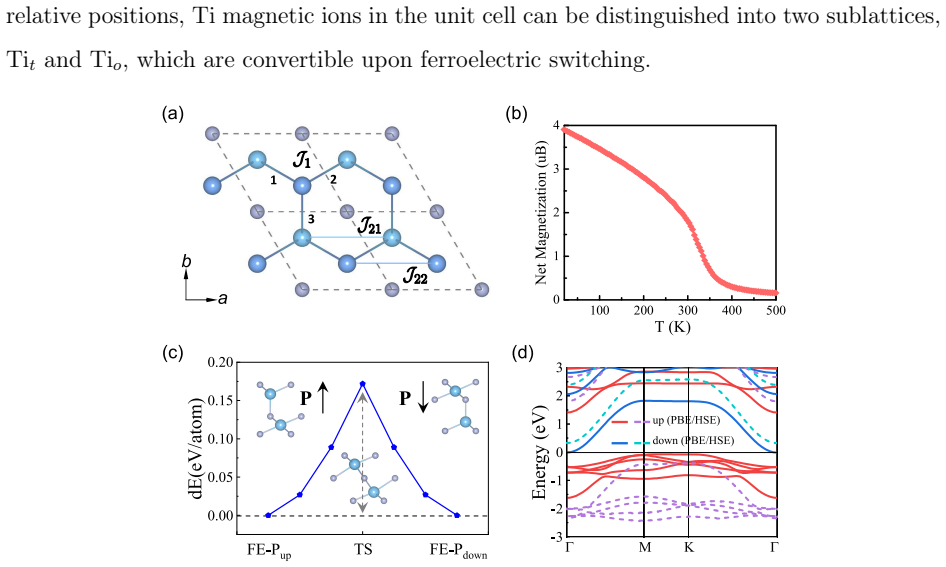
In monolayer Ti2F3, reversal of the ferroelectric polarization modulates the spin-exchange parameters and produces a sign change in the Berry curvature of magnons. This sign change directly reverses the magnon valley Hall effect and modifies the nonlinear Hall response, furnishing nonvolatile electric control over magnon transport while the magnetic structure remains fixed.
What carries the argument
Ferroelectric polarization switching that modulates spin exchanges and reverses the sign of magnon Berry curvature
If this is right
- The direction of the magnon valley Hall effect can be reversed by an applied electric field alone.
- Nonlinear magnon Hall responses become electrically tunable without external magnetic fields.
- Magnonic transport in the material acquires nonvolatile memory of the ferroelectric state.
- Low-power magnonic logic elements can be realized by combining ferroelectric gates with magnon channels.
Where Pith is reading between the lines
- Analogous sign-reversal control may appear in other type-I multiferroic monolayers that possess similar lattice symmetries.
- Device layouts could integrate this effect with ferroelectric domain walls to create reconfigurable magnon waveguides.
- If the effect persists to higher temperatures, it would supply a materials platform for room-temperature magnonic circuits.
Load-bearing premise
Ferroelectric switching significantly modulates spin exchanges in monolayer Ti2F3 while preserving the type-I multiferroic character and enabling Berry curvature reversal.
What would settle it
An experimental measurement that finds no reversal in the sign of magnon Hall conductivity after an electric field has switched the ferroelectric polarization in Ti2F3 would falsify the central claim.
Figures



read the original abstract
Electric control of magnetism at room temperature is crucial for developing next-generation, low-power spintronic devices. However, the intrinsic incompatibility between ferroelectricity and magnetism in crystal symmetry, along with the absence of strong magnetoelectric coupling mechanisms, continues to pose major challenges. In this work, we propose a general theoretical framework for magnon manipulation based on ferroelectric polarization switching in two-dimensional multiferroics. Taking monolayer multiferroics $\mbox{Ti}_{2}\mbox{F}_{3}$ as an example, our calculations demonstrate that ferroelectric switching can significantly modulate spin exchanges, thereby enabling nonvolatile and reversible electric control of the magnons. More importantly, the ferroelectric polarization reversal leads to a sign change in the Berry curvature, ensuring effective control over the valley Hall and nonlinear Hall response of magnons. This study provides a new way for realizing low-power and electrically controllable magnonic devices.
Editorial analysis
A structured set of objections, weighed in public.
Referee Report
Summary. The manuscript proposes a general theoretical framework for electrically controlling magnons via ferroelectric polarization switching in two-dimensional type-I multiferroics. Using monolayer Ti2F3 as an example, the central claim is that reversing the ferroelectric polarization significantly modulates the spin-exchange parameters (including nearest-neighbor, next-nearest-neighbor, and Dzyaloshinskii-Moriya interactions), which in turn produces a sign reversal in the magnon Berry curvature. This reversal is asserted to enable nonvolatile control over the magnon valley Hall effect and nonlinear Hall response while preserving the underlying magnetic order.
Significance. If the computed modulation of exchanges and the resulting Berry-curvature sign change are robust, the work would provide a concrete mechanism for room-temperature, low-power electric control of topological magnon transport in type-I multiferroics, a class where magnetoelectric coupling is typically weak. The approach is conceptually attractive because it avoids the need for strong intrinsic magnetoelectric coupling and instead exploits polarization-induced changes in the magnetic Hamiltonian.
major comments (2)
- [Computational details and Results sections (around the discussion of spin exchanges and Berry curvature)] The central claim that polarization reversal produces a sign change in the magnon Berry curvature rests on the DFT-derived spin-exchange parameters J_ij changing in a manner that flips the curvature without destabilizing the magnetic ground state. However, the manuscript provides no explicit tabulation or comparison of the exchange values (nearest-neighbor J1, next-nearest J2, and DM vectors) for the two polarization directions, nor any error estimates or convergence checks on these parameters. Without this quantitative mapping, it is impossible to verify whether the sign reversal is a genuine physical effect or an artifact of the computational protocol.
- [Section discussing magnetic ground state stability under ferroelectric switching] The abstract and main text assert that the type-I multiferroic character is preserved under switching, yet no data are shown confirming that the magnetic anisotropy or ordering temperature remains sufficient to maintain the assumed spin configuration after polarization reversal. A modest change in the relative magnitudes of J_ij could reorient the ground state and eliminate the claimed topological response.
minor comments (2)
- [Figure captions] Figure captions should explicitly state the polarization direction corresponding to each panel and include the computed Berry curvature sign for clarity.
- [Methods paragraph] The manuscript would benefit from a brief statement of the DFT functional, k-point mesh, and Hubbard U value used to extract the exchange parameters.
Simulated Author's Rebuttal
We thank the referee for the constructive and detailed comments, which help improve the clarity and rigor of our work. We address each major comment below and will incorporate the suggested additions into the revised manuscript.
read point-by-point responses
-
Referee: [Computational details and Results sections (around the discussion of spin exchanges and Berry curvature)] The central claim that polarization reversal produces a sign change in the magnon Berry curvature rests on the DFT-derived spin-exchange parameters J_ij changing in a manner that flips the curvature without destabilizing the magnetic ground state. However, the manuscript provides no explicit tabulation or comparison of the exchange values (nearest-neighbor J1, next-nearest J2, and DM vectors) for the two polarization directions, nor any error estimates or convergence checks on these parameters. Without this quantitative mapping, it is impossible to verify whether the sign reversal is a genuine physical effect or an artifact of the computational protocol.
Authors: We agree that explicit tabulation of the exchange parameters is essential for verification. In the revised manuscript we will add a dedicated table in the Results section (or as a new subsection in Computational Details) that reports the nearest-neighbor J1, next-nearest-neighbor J2, and Dzyaloshinskii-Moriya vectors for both ferroelectric polarization directions, obtained from the same DFT mapping procedure. We will also include a brief description of convergence tests with respect to k-point sampling density and plane-wave cutoff energy, confirming that the extracted J_ij values are stable within the reported precision. The sign reversal of the magnon Berry curvature follows directly from the computed changes in these parameters, particularly the relative strengthening of the next-nearest-neighbor antiferromagnetic exchange and the DM term under one polarization direction. revision: yes
-
Referee: [Section discussing magnetic ground state stability under ferroelectric switching] The abstract and main text assert that the type-I multiferroic character is preserved under switching, yet no data are shown confirming that the magnetic anisotropy or ordering temperature remains sufficient to maintain the assumed spin configuration after polarization reversal. A modest change in the relative magnitudes of J_ij could reorient the ground state and eliminate the claimed topological response.
Authors: We acknowledge that explicit confirmation of magnetic stability is valuable. Our calculations show that the magnetic anisotropy energy remains positive and comparable in magnitude for both polarization states, and mean-field estimates of the ordering temperature stay well above room temperature. To address the concern directly, the revised manuscript will include additional data (either in the main text or Supplementary Information) reporting the magnetic anisotropy energies and the energy differences between the assumed spin configuration and alternative orientations for both polarization directions. These results confirm that the ground-state spin order is preserved and that the topological magnon response remains accessible. revision: yes
Circularity Check
No significant circularity; derivation relies on explicit first-principles computations
full rationale
The paper computes spin-exchange parameters J_ij via DFT for opposite ferroelectric polarization directions in monolayer Ti2F3, constructs the magnon Hamiltonian, and evaluates Berry curvature and Hall responses directly from those inputs. This chain is self-contained against external benchmarks (DFT total energies and spin-wave spectra) and does not reduce any prediction to a fitted parameter or self-referential definition. No load-bearing self-citations, uniqueness theorems imported from prior author work, or ansatz smuggling appear in the derivation; the sign change in Berry curvature emerges from the computed modulation of exchanges rather than by construction.
Axiom & Free-Parameter Ledger
axioms (1)
- domain assumption Monolayer Ti2F3 exists as a stable type-I multiferroic with switchable ferroelectric polarization that modulates spin exchanges.
Lean theorems connected to this paper
-
IndisputableMonolith/Foundation/AlexanderDuality.leanalexander_duality_circle_linking unclear?
unclearRelation between the paper passage and the cited Recognition theorem.
ferroelectric polarization reversal leads to a sign change in the Berry curvature... J21−J22 can be reversed through ferroelectric switching
-
IndisputableMonolith/Cost/FunctionalEquation.leanwashburn_uniqueness_aczel unclear?
unclearRelation between the paper passage and the cited Recognition theorem.
Heisenberg model... Ĥ = J1 ∑ Si·Sj + J21 ∑ + J22 ∑; Ωz±(k) = ∓ hz/2 (∇hx × ∇hy)
What do these tags mean?
- matches
- The paper's claim is directly supported by a theorem in the formal canon.
- supports
- The theorem supports part of the paper's argument, but the paper may add assumptions or extra steps.
- extends
- The paper goes beyond the formal theorem; the theorem is a base layer rather than the whole result.
- uses
- The paper appears to rely on the theorem as machinery.
- contradicts
- The paper's claim conflicts with a theorem or certificate in the canon.
- unclear
- Pith found a possible connection, but the passage is too broad, indirect, or ambiguous to say the theorem truly supports the claim.
Forward citations
Cited by 1 Pith paper
-
Symmetry-dictated switching of antiferromagnetic magnon transport in 2D multiferroics
Ferroelectric reversal inverts magnon Berry curvature and anomalous thermal Hall conductivity in 2D multiferroics by inducing tunable sublattice asymmetry.
Reference graph
Works this paper leans on
-
[1]
Ramesh, R.; Spaldin, N. A. Multiferroics: progress and prospects in thin films. Nat. Mater. 2007, 6, 21--29
work page 2007
-
[2]
The evolution of multiferroics
Fiebig, M.; Lottermoser, T.; Meier, D.; Trassin, M. The evolution of multiferroics. Nat. Rev. Mater. 2016, 1, 1--14
work page 2016
-
[3]
Multi-ferroic magnetoelectrics
Schmid, H. Multi-ferroic magnetoelectrics. Ferroelectrics 1994, 162, 317--338
work page 1994
-
[4]
Spaldin, N. A.; Cheong, S.-W.; Ramesh, R. Multiferroics: Past, present, and future. Phys. Today 2010, 63, 38--43
work page 2010
-
[5]
Electric-field switching of magnetic topological charge in type-I multiferroics
Xu, C.; Chen, P.; Tan, H.; Yang, Y.; Xiang, H.; Bellaiche, L. Electric-field switching of magnetic topological charge in type-I multiferroics. Phys. Rev. Lett. 2020, 125, 037203
work page 2020
-
[6]
Van Aken, B. B.; Palstra, T. T.; Filippetti, A.; Spaldin, N. A. The origin of ferroelectricity in magnetoelectric YMnO_3 . Nat. Mater. 2004, 3, 164--170
work page 2004
-
[7]
Magnetic control of ferroelectric polarization
Kimura, T.; Goto, T.; Shintani, H.; Ishizaka, K.; Arima, T.-h.; Tokura, Y. Magnetic control of ferroelectric polarization. Nature 2003, 426, 55--58
work page 2003
-
[8]
Song, Q.; Occhialini, C. A.; Erge c en, E.; Ilyas, B.; Amoroso, D.; Barone, P.; Kapeghian, J.; Watanabe, K.; Taniguchi, T.; Botana, A. S.; Picozzi, S.; Gedik, N.; Comin, R. Evidence for a single-layer van der Waals multiferroic. Nature 2022, 602, 601--605
work page 2022
-
[9]
Topologically protected magnetoelectric switching in a multiferroic
Ponet, L.; Artyukhin, S.; Kain, T.; Wettstein, J.; Pimenov, A.; Shuvaev, A.; Wang, X.; Cheong, S.-W.; Mostovoy, M.; Pimenov, A. Topologically protected magnetoelectric switching in a multiferroic. Nature 2022, 607, 81--85
work page 2022
-
[10]
Magnetoelectricity in multiferroics: a theoretical perspective
Dong, S.; Xiang, H.; Dagotto, E. Magnetoelectricity in multiferroics: a theoretical perspective. Nat. Sci. Rev. 2019, 6, 629--641
work page 2019
-
[11]
First principles study of improper ferroelectricity in TbMnO _ 3
Malashevich, A.; Vanderbilt, D. First principles study of improper ferroelectricity in TbMnO _ 3 . Phys. Rev. Lett. 2008, 101, 037210
work page 2008
-
[12]
J.; Wei, S.-H.; Whangbo, M.-H.; Da Silva, J
Xiang, H. J.; Wei, S.-H.; Whangbo, M.-H.; Da Silva, J. L. F. Spin-orbit coupling and ion displacements in multiferroic TbMnO _ 3 . Phys. Rev. Lett. 2008, 101, 037209
work page 2008
-
[13]
B.; Zheng, H.; Nagarajan, V.; Ogale, S
Wang, J.; Neaton, J. B.; Zheng, H.; Nagarajan, V.; Ogale, S. B.; Liu, B.; Viehland, D.; Vaithyanathan, V.; Schlom, D. G.; Waghmare, U. V.; Spaldin, N. A.; Rabe, K. M.; Wuttig, M.; R., R. Epitaxial BiFeO _ 3 multiferroic thin film heterostructures. Science 2003, 299, 1719--1722
work page 2003
-
[14]
Ni, J. Y.; Wang, P. S.; Lu, J. L.; Xiang, H. J. Realizing magnetoelectric coupling with hydrogen intercalation. Phys. Rev. Lett. 2019, 122, 117601
work page 2019
-
[15]
Chumak, A. V.; Vasyuchka, V. I.; Serga, A. A.; Hillebrands, B. Magnon spintronics. Nat. Phys. 2015, 11, 453--461
work page 2015
-
[16]
The building blocks of magnonics
Lenk, B.; Ulrichs, H.; Garbs, F.; M \"u nzenberg, M. The building blocks of magnonics. Phys. Rep. 2011, 507, 107--136
work page 2011
-
[17]
Observation of the magnon Hall effect
Onose, Y.; Ideue, T.; Katsura, H.; Shiomi, Y.; Nagaosa, N.; Tokura, Y. Observation of the magnon Hall effect. Science 2010, 329, 297--299
work page 2010
-
[18]
Nonvolatile magnonics in bilayer magnetic insulators
Ni, J.; Zhang, Z.; Lu, J.; Du, Q.; Jiang, Z.; Bellaiche, L. Nonvolatile magnonics in bilayer magnetic insulators. Nano Lett. 2025, 25, 1207--1213
work page 2025
-
[19]
Topological switching in bilayer magnons via electrical control
Wan, X.; Du, Q.; Lu, J.; Zhang, Z.; Ni, J.; Zhang, L.; Jiang, Z.; Bellaiche, L. Topological switching in bilayer magnons via electrical control. Phys. Rev. B 2025, 112, L100404
work page 2025
-
[20]
Predictable gate-field Control of spin in altermagnets with spin-layer coupling
Zhang, R.-W.; Cui, C.; Li, R.; Duan, J.; Li, L.; Yu, Z.-M.; Yao, Y. Predictable gate-field Control of spin in altermagnets with spin-layer coupling. Phys. Rev. Lett. 2024, 133, 056401
work page 2024
-
[21]
Spin-layer coupling in an altermagnetic multilayer: A design principle for spintronics
Tian, J.; Li, J.; Liu, H.; Li, Y.; Liu, Z.; Li, L.; Li, J.; Liu, G.; Shi, J. Spin-layer coupling in an altermagnetic multilayer: A design principle for spintronics. Phys. Rev. B 2025, 111, 035437
work page 2025
-
[22]
Zhang, Y.; Chen, J.; Ye, H.; Wu, Z.; Zhang, G.; Gu, M.; Wang, J. Electric field tunable magnetic phase transition and magneto-optical effects in two-dimensional multiferroic Ti_2F_3 semiconductor. Appl. Phys. Lett. 2025, 127, 152904
work page 2025
-
[23]
Anomalous valley Hall effect in two-dimensional multiferroic V_2N_2O semiconductor
Sun, C.; Sun, Y.; Ye, H.; Zhu, Y.; Chen, L.; Li, H.; Zhang, G.; Wang, J. Anomalous valley Hall effect in two-dimensional multiferroic V_2N_2O semiconductor. Appl. Phys. Lett. 2025, 127, 142903
work page 2025
-
[24]
DFT calculations and Monte Carlo simulations on monolayer Ti_2F_3 ; II
I. DFT calculations and Monte Carlo simulations on monolayer Ti_2F_3 ; II. Topological geometry of magnons in monolayer Ti _ 2 F _ 3
-
[25]
Sheppard, D.; Xiao, P.; Chemelewski, W.; Johnson, D. D.; Henkelman, G. A generalized solid-state nudged elastic band method. J. Chem. Phys. 2012, 136
work page 2012
-
[26]
I.; Katsnelson, M.; Antropov, V.; Gubanov, V
Liechtenstein, A. I.; Katsnelson, M.; Antropov, V.; Gubanov, V. Local spin density functional approach to the theory of exchange interactions in ferromagnetic metals and alloys. J. Magn. Magn. Mater. 1987, 67, 65--74
work page 1987
-
[27]
Fast ab initio methods for the calculation of adiabatic spin wave spectra in complex systems
Grotheer, O.; Ederer, C.; F \"a hnle, M. Fast ab initio methods for the calculation of adiabatic spin wave spectra in complex systems. Phys. Rev. B 2001, 63, 100401
work page 2001
-
[28]
He, X.; Helbig, N.; Verstraete, M. J.; Bousquet, E. TB2J : A python package for computing magnetic interaction parameters. Comput. Phys. Commun. 2021, 264, 107938
work page 2021
-
[29]
Field dependence of the intrinsic domain magnetization of a ferromagnet
Holstein, T.; Primakoff, H. Field dependence of the intrinsic domain magnetization of a ferromagnet. Phys. Rev. 1940, 58, 1098
work page 1940
-
[30]
Interaction-stabilized topological magnon insulator in ferromagnets
Mook, A.; Plekhanov, K.; Klinovaja, J.; Loss, D. Interaction-stabilized topological magnon insulator in ferromagnets. Phys. Rev. X 2021, 11, 021061
work page 2021
-
[31]
Berry phase effects on electronic properties
Xiao, D.; Chang, M.-C.; Niu, Q. Berry phase effects on electronic properties. Rev. Mod. Phys. 2010, 82, 1959--2007
work page 2010
-
[32]
R.; Mook, A.; Henk, J.; Mertig, I
Neumann, R. R.; Mook, A.; Henk, J.; Mertig, I. Orbital magnetic moment of magnons. Phys. Rev. Lett. 2020, 125, 117209
work page 2020
-
[33]
Fishman, R. S.; Gardner, J. S.; Okamoto, S. Orbital angular momentum of magnons in collinear magnets. Phys. Rev. Lett. 2022, 129, 167202
work page 2022
-
[34]
Go, G.; An, D.; Lee, H.-W.; Kim, S. K. Magnon orbital Nernst effect in honeycomb antiferromagnets without spin--orbit coupling. Nano Lett. 2024, 24, 5968--5974
work page 2024
-
[35]
Chang, M.-C.; Niu, Q. Berry phase, hyperorbits, and the Hofstadter spectrum: Semiclassical dynamics in magnetic Bloch bands. Phys. Rev. B 1996, 53, 7010
work page 1996
-
[36]
Valley-contrasting physics in graphene: magnetic moment and topological transport
Xiao, D.; Yao, W.; Niu, Q. Valley-contrasting physics in graphene: magnetic moment and topological transport. Phys. Rev. Lett. 2007, 99, 236809
work page 2007
-
[37]
Orbital Hall effect as an alternative to valley Hall effect in gapped graphene
Bhowal, S.; Vignale, G. Orbital Hall effect as an alternative to valley Hall effect in gapped graphene. Phys. Rev. B 2021, 103, 195309
work page 2021
-
[38]
Zhai, X.; Blanter, Y. M. Topological valley transport of gapped Dirac magnons in bilayer ferromagnetic insulators. Phys. Rev. B 2020, 102, 075407
work page 2020
-
[39]
Magnon nonlinear Hall effect in two-dimensional antiferromagnetic insulators
Ni, J.; Jin, Y.; Du, Q.; Chang, G. Magnon nonlinear Hall effect in two-dimensional antiferromagnetic insulators. Phys. Rev. B 2025, 112, 054424
work page 2025
-
[40]
Nonlinear magnon transport in bilayer van der Waals antiferromagnets
Mukherjee, R.; Verma, S.; Kundu, A. Nonlinear magnon transport in bilayer van der Waals antiferromagnets. Phys. Rev. B 2023, 107, 245426
work page 2023
-
[41]
Nonlinear magnon spin N ernst effect in antiferromagnets and strain-tunable pure spin current
Kondo, H.; Akagi, Y. Nonlinear magnon spin N ernst effect in antiferromagnets and strain-tunable pure spin current. Phys. Rev. Res. 2022, 4, 013186
work page 2022
-
[42]
Katsura, H.; Nagaosa, N.; Lee, P. A. Theory of the thermal Hall effect in quantum magnets. Phys. Rev. Lett. 2010, 104, 066403
work page 2010
-
[43]
Zhang, X. T.; Gao, Y. H.; Chen, G. Thermal Hall effects in quantum magnets. Phys. Rep. 2024, 1070, 1--59
work page 2024
-
[44]
Owerre, S. A first theoretical realization of honeycomb topological magnon insulator. J. Phys. Condens. Matter 2016, 28, 386001 mcitethebibliography Main.bib0000664000000000000000000004666515110052403011130 0ustar rootroot@article onose_science_2010_329, title= Observation of the magnon Hall effect , author= Onose, Y and Ideue, T and Katsura, H and Shiomi...
discussion (0)
Sign in with ORCID, Apple, or X to comment. Anyone can read and Pith papers without signing in.