REVIEW 3 major objections 4 minor 1 cited by
This paper reports a non-monotonic mixing rate in Faraday-wave-driven stratified fluids: entrainment first accelerates as homogenization lowers the interfacial density jump, then decelerates as the deepening interface receives exponentially
Reviewed by Pith at T0; open to challenge. T0 means a machine referee read the full paper against a public rubric. the ladder, T0–T4 →
Faraday surface waves produce a non-monotonic mixing rate across a weak density interface: mixing accelerates as the interfacial barrier drops, then decelerates as wave energy decays with depth.
T0 review reviewed 2026-08-03 challenge →
load-bearing objection The non-monotonic entrainment looks real, but the causal mechanism is supported more by a tuned 1D closure than by direct experiments. the 3 major comments →
Mixing induced by Faraday surface waves
The pith
A machine-rendered reading of the paper's core claim, the machinery that carries it, and where it could break.
The reading
Core claim
The central finding is that Faraday-wave-driven entrainment is controlled by a competition between barrier reduction and energy decay. As long as the density interface is close to the free surface, breaking crests and collapsing cavities inject turbulent energy that homogenizes the upper layer; this lowers the Atwood number and the potential energy cost of mixing, so the entrainment rate accelerates. Once the interface has been pushed deeper, the exponentially decaying wave-induced velocity field (scaling as e^{-kz}) delivers less energy than the weakened but still present barrier demands, and the interface decouples from the surface forcing and stalls. In the authors' words, the mixing rate
What carries the argument
The key machinery is the one-dimensional diffusion equation for the horizontally averaged concentration, closed by a turbulent eddy diffusivity D_turb = l_turb u_turb C_D, with u_turb decaying exponentially with depth. The dimensionless coefficient C_D takes a constant value C_tracer in the mixed layer and drops inside the interface via the attenuation function f(Ri_inside) = 1 / (1 + C_barrier (Ri_inside / Ri_crit)^n), where Ri_inside is a modified Richardson number built on the local gradient thickness L' of the interface rather than the mixed-layer scale. This modified Richardson number is what allows the model to feel the difference between a thin, sharp interface and a thick, diffuse on
Load-bearing premise
The explanation rests on a turbulent-flux closure whose constants (C_tracer=4, C_barrier=0.1, n=4) and the threshold Ri_crit are chosen to make the 1D model match the experiments and DNS; without a parameter-free derivation, the agreement is consistent with, but does not independently prove, the barrier-versus-energy mechanism.
What would settle it
Measure the entrainment velocity d hmixed/dt and the interfacial density jump continuously in one experimental series with varying initial interface depth. If the mixing rate never accelerates before it decays—or if the measured turbulent kinetic energy flux at the interface does not decay exponentially with interface depth—the barrier-reduction/energy-decay explanation is falsified. A cleaner variant: the passive-tracer case without stratification shows no rise phase; any equivalent configuration in which the active-scalar entrainment curve matches the passive-scalar one would rule out the ba
If this is right
- The mixed-layer depth in such systems saturates at a finite value rather than growing indefinitely; the saturating value is set by the balance between barrier cost and depth-decaying energy input.
- Entrainment rate is not a monotonic function of initial stratification depth: intermediate initial depths can produce the deepest final mixed layers for a fixed forcing.
- Weak forcing still produces mixing bursts once the Faraday wave reaches finite amplitude, because the secondary parametric instability and interfacial breaking persist even at small forcing intensities.
- The qualitative dynamics—acceleration, peak, stall—can be captured without resolving three-dimensional turbulence, using a 1D model with two fitted constants and one threshold.
- The model's asymmetry (constant diffusivity above the interface, attenuating diffusivity inside) predicts that mixing is mostly one-sided: the upper layer homogenizes while the lower layer remains nearly unmixed, consistent with the measured density profiles.
Where Pith is reading between the lines
- If the barrier-versus-energy balance is generic, the same non-monotonicity should appear in other surface-forced stratified systems, for instance wind-wave-driven mixing layers or sloshing tanks under changing fill levels; the 1D model could be adapted by rescaling the energy-decay law.
- The model's threshold Ri_crit, left numerically unspecified, could be pinned down experimentally by measuring the interface depth at which the turbulent flux vanishes; identifying Ri_crit with a standard critical Richardson number would make the model closer to parameter-free.
- A testable extension is to follow the scalar dissipation rate: the model implies that the peak in diapycnal mixing should lag the peak in surface kinetic energy by an amount that grows with initial interface depth, which the authors observe in DNS and which could be verified in experiments.
- The exponential decay of u_turb with depth is the load-bearing ingredient for the stall; if instead the energy decay were algebraic or if a secondary instability kept injecting energy at depth, the non-monotonicity would be attenuated or lost.
Editorial analysis
A structured set of objections, weighed in public.
Referee Report
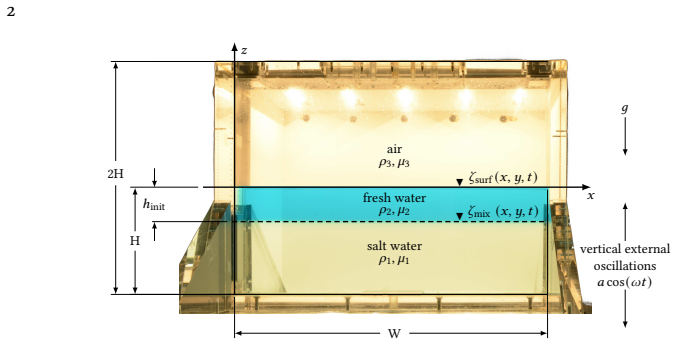
Summary. The paper studies mixing across a miscible density interface driven by Faraday surface waves, using laboratory experiments, 3D DNS, linear stability analysis, and a 1D turbulent-diffusion model. The central empirical claim is that the long-term entrainment of the interface is non-monotonic in the initial interface depth: for shallow (or very deep) interfaces the mixed layer deepens more than for intermediate depths. The authors interpret this as a competition between two effects: progressive lowering of the interfacial energy barrier as the upper layer homogenizes, and exponential decay of the wave-induced energy flux with depth. A 1D model with a Richardson-number-dependent turbulent diffusivity (Eqs. 6.1–6.7) is shown to reproduce the qualitative non-monotonic behavior.
Significance. If the mechanism is established, the work would provide a new physical picture for wave-driven mixing of stratified systems: a barrier-reduction/energy-input balance. The experimental dataset is substantial, the DNS code is openly available, the measured Faraday growth rates agree with linear theory (Fig. 11b), and the energy diagnostics are carefully constructed. However, the causal explanation is not independently tested. The 1D model's non-monotonic curve is obtained with parameters (C_barrier=0.1, n=4, and an unassigned Ri_crit) that are explicitly chosen to mimic the experiments, so the model agreement does not validate the mechanism. The experimental evidence itself, while suggestive, lacks error bars and does not isolate the two proposed factors. The paper's main contribution is therefore an important experimental observation with a plausible but under-supported interpretation.
major comments (3)
- [§6.1.2, Eqs. (6.6)–(6.7) and Fig. 28(f)] The central mechanism—non-monotonic mixing due to competition between barrier lowering and depth-decaying energy input—is supported by a 1D model whose closure is calibrated to reproduce the target behavior. C_barrier=0.1 and n=4 in f(Ri_inside) are explicitly 'chosen to mimic the trends observed in the experiments', and Ri_crit is never assigned a numerical value. Thus Fig. 28(f) cannot serve as independent evidence for the causal explanation. Please provide a sensitivity analysis over the full parameter set and/or calibrate the constants from DNS diagnostics (e.g., a flux–Richardson relation) without directly targeting the non-monotonic h_mixed(h_init) curve. Alternatively, the abstract and conclusions should soften the causal claim to a plausible interpretation.
- [§5.2, Fig. 24(e), Table 2] The experimental demonstration of non-monotonic entrainment rests on h∞ versus h_init for the large-forcing series (F≈0.49). No repeats or error bars are reported, and the h_init sweep simultaneously changes the energy reaching the interface and the initial barrier. The passive-tracer DNS in §6.1.1 (Fig. 27) is a single case (h_init=10 cm, F=0.49), not a sweep, so it cannot show that removing the barrier eliminates the non-monotonicity. A controlled test—e.g., varying the Atwood number or initial interface thickness at fixed h_init, or a DNS sweep with a passive scalar—is needed to isolate the proposed effects.
- [§5.3, Fig. 26(c) and §7] The DNS quantitatively overpredicts entrainment relative to experiments (Fig. 26c), and the paper attributes this to Sc=1. Since the DNS is used to support the qualitative mechanisms and to motivate the 1D model, this discrepancy should be explicitly discussed in terms of its impact on the central claim. If the non-monotonicity is not reproduced in DNS at Sc=1 (or only weakly), the experimental result is the sole evidence; the manuscript should state this and consider Sc-sensitivity tests.
minor comments (4)
- [Fig. 10 caption] The caption contains blank placeholders: 'indicates L_sat from (4.11), while corresponds to the wave model...' The marker symbols are missing from the rendered text.
- [Table 2] Several entries in Table 2 are missing or misaligned (e.g., runs 29 and 27 lack values for some columns). Please reformat the table so all quantities are clearly associated with the correct runs.
- [§6.1.1] The phrase 'turbulence intensity to 10%' should specify whether this is relative to the surface wave orbital velocity or to the turbulent velocity scale u_turb, to avoid ambiguity.
- [Abstract/Conclusions] The abstract states the mechanism as a finding ('revealing a balance'), while the conclusion more cautiously says the model provides 'a simple way to contextualize the competing dynamics'. Please align the wording with the level of support.
Circularity Check
The 1D model's reproduction of non-monotonic mixing is a tuned closure, not an independent test of the barrier-vs-energy mechanism.
specific steps
-
fitted input called prediction
[§6.1.2, Eqs. (6.6)–(6.7), Fig. 28]
"the parameters C_barrier =0.1 and n=4, which control the attenuation intensity where chosen to mimic the trends observed in the experiments. ... This approach recovers the main features of the entrainment process observed in both experiments and simulations. The model captures the non-monotonic behaviour discussed earlier, where cases with shallower initial stratification may exhibit higher entrainment rates and push the interface deeper than those with deeper initial stratification (Figure 28d-f)."
The model's non-monotonic h_mixed(h_init) response is produced by the Richardson-number-dependent closure f(Ri_inside), with C_barrier and n explicitly chosen to reproduce experimental trends and with Ri_crit never assigned a numerical value. Thus the model's 'capture' of the non-monotonic behaviour is a consequence of the fitted closure, not a parameter-free prediction that independently validates the causal 'barrier reduction vs energy input' explanation. The empirical observation itself remains independent, so the circularity is partial: the mechanism is illustrated by a closure tuned to the target behaviour.
full rationale
The central empirical result — a non-monotonic mixing rate depending on stratification depth — comes from independent laboratory experiments and DNS, and is not itself circular. The linear-stability analysis, energy-budget estimates, and POD/energy diagnostics are also self-contained. The circularity concern is confined to §6: the 1D turbulent-diffusivity model is introduced 'Based on these observations' and its constants are explicitly calibrated (C_tracer=4 'simply chosen to approximate the DNS results'; C_barrier=0.1 and n=4 'chosen to mimic the trends observed in the experiments'). The model's reproduction of the non-monotonic entrainment curve is therefore a consistency check of the assumed closure, not an independent derivation of the competing-mechanism interpretation. Self-citations to prior work by the same group are used for specific quantitative estimates (e.g., saturation widths) and are compared against data, not invoked as uniqueness theorems, so they are not load-bearing in a circular way. Overall score 5: partial circularity in the model-based support for the causal story, while the empirical and theoretical components outside the fitted closure are independent.
Axiom & Free-Parameter Ledger
free parameters (6)
- C_tracer =
4
- C_barrier =
0.1
- n =
4
- Ri_crit =
not specified
- l_turb =
1 cm
- turbulence intensity =
10% of wave velocity scale
axioms (6)
- standard math Incompressible two-phase Navier-Stokes with VOF captures the relevant interfacial dynamics
- domain assumption Miscible interface can be treated as a sharp interface in the linear stability analysis
- domain assumption Wave energy injected at the surface decays exponentially with depth, following exp(-2kz)
- ad hoc to paper Turbulent flux is diffusive: u'_z c' = -D_turb ∂c/∂z with D_turb = l_turb u_turb C_D
- ad hoc to paper The Richardson-number suppression function f(Ri_inside) given by (6.7) describes the barrier effect
- domain assumption Piecewise-constant density profiles for energy estimates (Appendix C)
Cite this review
Pith. "Pith review of Mixing induced by Faraday surface waves." pith.science (2026). https://pith.science/paper/3346AA6L
@misc{pith2026251215536,
  author       = {Pith},
  title        = {Pith review of: Mixing induced by Faraday surface waves},
  year         = {2026},
  howpublished = {\url{https://pith.science/paper/3346AA6L}},
  note         = {Machine review of arXiv:2512.15536}
}
read the original abstract
We investigate how surface waves enhance mixing across the interface between two miscible fluids with a small density contrast. Imposing a vertical, time-periodic acceleration, we excite Faraday waves both experimentally and numerically. In systems with a shallow density gradient, these standing waves advect the interface and can trigger secondary instabilities. When driven beyond the linear regime, large Faraday crests collapse to form cavities, injecting bubbles and lighter fluid deep into the heavier layer. Together, these mechanisms gradually homogenize the upper layer, diminish the interfacial density jump, and drive the interface downward until it decouples from surface forcing. We report a non-monotonic mixing rate -- first increasing as the interfacial energy barrier lowers, then decreasing as less energy is injected into the weakened surface -- revealing a balance between barrier reduction and energy input. Based on these observations, we introduce a one-dimensional model incorporating a turbulent diffusivity coefficient that depends on depth and the internal Richardson number, which captures the qualitative evolution of the system.
Figures


Forward citations
Cited by 1 Pith paper
-
Coupled Rayleigh--Taylor and Faraday instabilities in vertically vibrated cylindrical containers
A Floquet stability analysis predicts coupled Rayleigh-Taylor and Faraday instability onset and mode structure in vibrated cylinders, including hybrid modes when the contact line is pinned.
Reference graph
Works this paper leans on
-
[1]
, " * write output.state after.block = add.period write newline
ENTRY address author booktitle chapter edition editor howpublished institution journal key month note number organization pages publisher school series title type volume year eprint label extra.label sort.label short.list INTEGERS output.state before.all mid.sentence after.sentence after.block FUNCTION init.state.consts #0 'before.all := #1 'mid.sentence ...
-
[2]
write newline
" write newline "" before.all 'output.state := FUNCTION n.dashify 't := "" t empty not t #1 #1 substring "-" = t #1 #2 substring "--" = not "--" * t #2 global.max substring 't := t #1 #1 substring "-" = "-" * t #2 global.max substring 't := while if t #1 #1 substring * t #2 global.max substring 't := if while FUNCTION word.in bbl.in capitalize " " * FUNCT...
-
[3]
Andrews, M. J. & Spalding, D. B. 1990 A simple experiment to investigate two-dimensional mixing by Rayleigh–Taylor instability . Phys. Fluids A 2 (6), 922--927
1990
-
[4]
Bazilevskii, A. V. , Kalinichenko, V. A. & Rozhkov, A. N. 2018 Effect of fluid viscosity on the faraday surface waves . Fluid Dynam+.+ 53 (6), 750--761
2018
-
[5]
, Gaulke, D
Behruzi, P. , Gaulke, D. , Haake, D. & Brosset, L. 2017 Modeling of impact waves in LNG ship tanks . Int. J. Offshore Polar 27 (1), 18--26
2017
-
[6]
With 83 illustrations
Bender, Carl M. & Orszag, Steven A. 1999 Advanced Mathematical Methods for Scientists and Engineers I\/ . Applied Mathematical Sciences Ser.\/ v.114. New York: Springer New York , includes bibliographical references and index. Description based on print version record. "With 83 illustrations."
1999
-
[7]
& Sommeria, J
Benielli, D. & Sommeria, J. 1998 Excitation and breaking of internal gravity waves by parametric instability . J. Fluid Mech. 374 , 117--144
1998
-
[8]
Benjamin, T. B. & Ursell, F. 1954 The stability of the plane free surface of a liquid in vertical periodic motion . Proceedings of the Royal Society of London. Series A. Mathematical and Physical Sciences 225 (1163), 505--515
1954
-
[9]
, Deike, L
Berny, A. , Deike, L. , Séon, T. & Popinet, S. 2020 Role of all jet drops in mass transfer from bursting bubbles . Phys. Rev. Fluids 5 (3), 033605
2020
-
[10]
& Pototsky, A
Bestehorn, M. & Pototsky, A. 2016 Faraday instability and nonlinear pattern formation of a two-layer system: A reduced model . Phys. Rev. Fluids 1 (6), 063905
2016
-
[11]
Brainerd, K. E. & Gregg, M. C. 1995 Surface mixed and mixing layer depths . Deep Sea Res. Part I 42 (9), 1521--1543
1995
-
[12]
, Gostiaux, L
Briard, A. , Gostiaux, L. & Gr \' e a, B-J. 2020 The turbulent Faraday instability in miscible fluids . J. Fluid Mech. 883
2020
-
[13]
, Gr \' e a, B-J
Briard, A. , Gr \' e a, B-J. & Gostiaux, L. 2019 Harmonic to subharmonic transition of the Faraday instability in miscible fluids . Phys. Rev. Fluids 4 (4), 044502
2019
-
[14]
part i: One-point closure model-momentum and heat vertical diffusivities
Canuto, V , Howard, A , Cheng, Y & Dubovikov, MS 2001 Ocean turbulence. part i: One-point closure model-momentum and heat vertical diffusivities . J. Phys. Oceanogr
2001
-
[15]
2025 Code repository
Castillo-Castellanos, A. 2025 Code repository. http://basilisk.fr/sandbox/acastillo/faraday\_waves\_mixing/
2025
-
[16]
, Gréa, B-J
Castillo-Castellanos, A. , Gréa, B-J. , Briard, A. & Gostiaux, L. 2023 Video: Faramix: Mixing induced by surface waves in stratified fluids. In 76th Annual Meeting of the APS Division of Fluid Dynamics - Gallery of Fluid Motion\/ , DFD 2023\/ 0070. American Physical Society
2023
-
[17]
, Gréa, B-J
Cavelier, M. , Gréa, B-J. , Briard, A. & Gostiaux, L. 2022 The subcritical transition to turbulence of Faraday waves in miscible fluids . J. Fluid Mech. 934
2022
-
[18]
, Villermaux, E
Chaté, H. , Villermaux, E. & Chomaz, J-M. , ed. 1999 Mixing: Chaos and Turbulence\/ . Springer US
1999
-
[19]
& Gollub, J.P
Ciliberto, S. & Gollub, J.P. 1985 Chaotic mode competition in parametrically forced surface waves . J. Fluid Mech. 158 , 381--398
1985
-
[20]
& Breidenthal, R.E
Cotel, A.J. & Breidenthal, R.E. 1996 A model of stratified entrainment using vortex persistence . Appl. Sci. Res. 57 (3–4), 349--366
1996
-
[21]
, Le Gal, P
Dorel, V. , Le Gal, P. & Le Bars, M. 2023 Experimental study of the penetrative convection in gases . Phys. Rev. Fluids 8 (10), 103501
2023
-
[22]
1990 Experimental study of the faraday instability
Douady, S. 1990 Experimental study of the faraday instability . J. Fluid Mech. 221 , 383--409
1990
-
[23]
1831 On a peculiar class of acoustical figures; and on certain forms assumed by groups of particles upon vibrating elastic surfaces
Faraday, M. 1831 On a peculiar class of acoustical figures; and on certain forms assumed by groups of particles upon vibrating elastic surfaces . Philos. Trans. Roy. Soc. London 121 , 299--340
-
[24]
Farsoiya, P. K. , Popinet, S. & Deike, L. 2021 Bubble-mediated transfer of dilute gas in turbulence . J. Fluid Mech. 920
2021
-
[25]
Fernando, HJS & Hunt, JCR 1997 Turbulence, waves and mixing at shear-free density interfaces. part 1. a theoretical model . J. Fluid Mech. 347 , 197--234
1997
-
[26]
Fernando, H J S 1991 Turbulent mixing in stratified fluids . Annu. Rev. Fluid Mech. 23 (1), 455--493
1991
-
[27]
Nonlinear Proc
Ghantous, M & Babanin, AV 2014 One-dimensional modelling of upper ocean mixing by turbulence due to wave orbital motion . Nonlinear Proc. Geoph. 21 (1), 325--338
2014
-
[28]
Glasbey, C. A. 1993 An analysis of histogram-based thresholding algorithms . CVGIP : Graphical Models and Image Processing 55 (6), 532--537
1993
-
[29]
& Ebo Adou, A
Gréa, B.-J. & Ebo Adou, A. 2018 What is the final size of turbulent mixing zones driven by the faraday instability? J. Fluid Mech. 837 , 293--319
2018
-
[30]
, Legendre, D
Haroun, Y. , Legendre, D. & Raynal, L. 2010 Volume of fluid method for interfacial reactive mass transfer: Application to stable liquid film . Chem. Eng. Sci. 65 (10), 2896--2909
2010
-
[31]
, Facchini, G
Herault, J. , Facchini, G. & Le Bars, M. 2018 Erosion of a sharp density interface by a turbulent jet at moderate Froude and Reynolds numbers . J. Fluid Mech. 838 , 631--657
2018
-
[32]
, Rowley, C
Holmes, P. , Rowley, C. W. , Berkooz, G. & Lumley, J. L. 2012 Turbulence, Coherent Structures, Dynamical Systems and Symmetry\/ , second edition edn., chap. Proper orthogonal decomposition, pp. 86--128 . Cambridge monographs on mechanics\/ 1. Cambridge, UK: Cambridge University Press
2012
-
[33]
van Hooft, J. A. , Popinet, S. , van Heerwaarden, C. C. , van der Linden, S. J. A. , de Roode, S. R. & van de Wiel, B. J. H. 2018 Towards adaptive grids for atmospheric boundary-layer simulations . Bound.-Layer Meteorol. 167 (3), 421--443
2018
-
[34]
& Toly, J-A
Hopfinger, E.J. & Toly, J-A. 1976 Spatially decaying turbulence and its relation to mixing across density interfaces . J. Fluid Mech. 78 (1), 155--175
1976
-
[35]
, Zhuo, R.-L
Huang, Y.-F. , Zhuo, R.-L. , Yang, J.-C. & Ni, M.-J. 2024 Interface coupling effect and multi-mode Faraday instabilities in a three-layer fluid system . J. Fluid Mech. 982
2024
-
[36]
2005 Liquid Sloshing Dynamics: Theory and Applications\/
Ibrahim, R.A. 2005 Liquid Sloshing Dynamics: Theory and Applications\/ . Cambridge University Press
2005
-
[37]
& Dalziel, S.B
Jacobs, J.W. & Dalziel, S.B. 2005 Rayleigh–Taylor instability in complex stratifications . J. Fluid Mech. 542 (1), 251
2005
-
[38]
, Perlin, M
Jiang, L. , Perlin, M. & Schultz, W. W. 1998 Period tripling and energy dissipation of breaking standing waves . J. Fluid Mech. 369 , 273--299
1998
-
[39]
, Ting, C.-L
Jiang, L. , Ting, C.-L. , Perlin, M. & Schultz, W. W. 1996 Moderate and steep Faraday waves: instabilities, modulation and temporal asymmetries . J. Fluid Mech. 329 , 275--307
1996
-
[40]
Kalinichenko, V. A. 2019 Regularization of barotropic gravity waves in a two-layer fluid . Fluid Dynam+.+ 54 (6), 761--773
2019
-
[41]
Kalinichenko, V. A. 2020 Suppression of intense fluid oscillations by a floating particle layer . Fluid Dynam+.+ 55 (6), 804--816
2020
-
[42]
Keulegan, GH 1959 Energy dissipation in standing waves in rectangular basins . J. Fluid Mech. 6 (1), 33--50
1959
-
[43]
& Cole, J
Kevorkian, J. & Cole, J. D. 1996 Multiple Scale and Singular Perturbation Methods\/ . Springer New York
1996
-
[44]
, Rand, R
Kovacic, I. , Rand, R. & Sah, S. 2018 Mathieu's equation and its generalizations: Overview of stability charts and their features . Tech. Rep.\/ Denmark,
2018
-
[45]
& Tuckerman, L
Kumar, K. & Tuckerman, L. S. 1994 Parametric instability of the interface between two fluids . J. Fluid Mech. 279 , 49--68
1994
-
[46]
, Salgado Sánchez, P
Labrador, E. , Salgado Sánchez, P. , Porter, J. & Shevtsova, V. 2021 Secondary Faraday waves in microgravity . Journal of Physics: Conference Series 2090 (1), 012088
2021
-
[47]
1973 The interaction of a vortex ring with a sharp density interface: a model for turbulent entrainment
Linden, P.F. 1973 The interaction of a vortex ring with a sharp density interface: a model for turbulent entrainment . J. Fluid Mech. 60 (03), 467
1973
-
[48]
1975 The deepening of a mixed layer in a stratified fluid
Linden, P.F. 1975 The deepening of a mixed layer in a stratified fluid . J. Fluid Mech. 71 (2), 385--405
1975
-
[49]
& Lin, P
Liu, D. & Lin, P. 2022 Interface instabilities in faraday waves of two-layer liquids with free surface . J. Fluid Mech. 941
2022
-
[50]
, Hinterberger, K
Marschall, H. , Hinterberger, K. , Schüler, C. , Habla, F. & Hinrichsen, O. 2012 Numerical simulation of species transfer across fluid interfaces in free-surface flows using openfoam . Chem. Eng. Sci. 78 , 111--127
2012
-
[51]
1984 Nonlinear Faraday resonance
Miles, J. 1984 Nonlinear Faraday resonance . J. Fluid Mech. 146 , 285--302
1984
-
[52]
Miles, J. W. 1967 Surface-wave damping in closed basins . Proceedings of the Royal Society of London. Series A. Mathematical and Physical Sciences 297 (1451), 459--475
1967
-
[53]
, Taylor, G.I
Morton, B.R. , Taylor, G.I. & Turner, J.S. 1956 Turbulent gravitational convection from maintained and instantaneous sources . Proc. R. Soc. A 234 (1196), 1--23
1956
-
[54]
, Popinet, S
Mostert, W. , Popinet, S. & Deike, L. 2022 High-resolution direct simulation of deep water breaking waves: transition to turbulence, bubbles and droplets production . J. Fluid Mech. 942
2022
-
[55]
1989 Nonlinear faraday resonance in a box with a square base
Nagata, M. 1989 Nonlinear faraday resonance in a box with a square base . J. Fluid Mech. 209 , 265--284
1989
-
[56]
Nesterov, S. V. 1969 Parametric excitation of waves on the surface of a heavy liquid, morskie gidrofiz
1969
-
[57]
Nesterov, S. V. 1995 The Cauchy-Poisson problem for forced waves of finite amplitude . Fluid Dynam+.+ 30 (4), 586--591
1995
-
[58]
Ockendon, J. R. & Ockendon, H. 1973 Resonant surface waves . J. Fluid Mech. 59 (2), 397--413
1973
-
[59]
Peltier, WR & Caulfield, CP 2003 Mixing efficiency in stratified shear flows . Annu. Rev. Fluid Mech. 35 (1), 135--167
2003
-
[60]
2009 An accurate adaptive solver for surface-tension-driven interfacial flows
Popinet, S. 2009 An accurate adaptive solver for surface-tension-driven interfacial flows . J. Comput. Phys. 228 (16), 5838--5866
2009
-
[61]
2015 A quadtree-adaptive multigrid solver for the serre green naghdi equations
Popinet, S. 2015 A quadtree-adaptive multigrid solver for the serre green naghdi equations . J. Comput. Phys. 302 , 336--358
2015
-
[62]
& Bestehorn, M
Pototsky, A. & Bestehorn, M. 2016 Faraday instability of a two-layer liquid film with a free upper surface . Phys. Rev. Fluids 1 (2), 023901
2016
-
[63]
, Mercier, M.J
Poulain-Zarcos, M. , Mercier, M.J. & ter Halle, A. 2022 Global characterization of oscillating grid turbulence in homogeneous and two-layer fluids, and its implication for mixing at high peclet number . Phys. Rev. Fluids 7 (5), 054606
2022
-
[64]
Qiao, F , Yuan, Y , Yang, Y , Zheng, Q , Xia, C & Ma, J 2004 Wave‐induced mixing in the upper ocean: Distribution and application to a global ocean circulation model . Geophys. Res. Lett. 31 (11)
2004
-
[65]
& Clamond, D
Rajchenbach, J. & Clamond, D. 2015 Faraday waves: their dispersion relation, nature of bifurcation and wavenumber selection revisited . J. Fluid Mech. 777
2015
-
[66]
, Mostert, W
Rivière, A. , Mostert, W. , Perrard, S. & Deike, L. 2021 Sub-hinze scale bubble production in turbulent bubble break-up . J. Fluid Mech. 917
2021
-
[67]
& Dodu, J
Rouse, H. & Dodu, J. 1955 Diffusion turbulente à travers une discontinuité de densité . La Houille Blanche 41 (4), 522--532
1955
-
[68]
2016 The Rollover Sequence of Events, Starting with Stratification\/ , pp
Scurlock, R.G. 2016 The Rollover Sequence of Events, Starting with Stratification\/ , pp. 63--83 . Springer International Publishing
2016
-
[69]
Singh, N & Pal, A 2024 Quantifying the turbulent mixing driven by the faraday instability in rotating miscible fluids . Phys. Fluids 36 (2)
2024
-
[70]
Cambridge University Press
Sutherland, BR 2010 Internal Gravity Waves\/ . Cambridge University Press
2010
-
[71]
& Keller, J
Tadjbakhsh, I. & Keller, J. B. 1960 Standing surface waves of finite amplitude . Journal of Fluid Mechanics 8 (03), 442
1960
-
[72]
, Josserand, C
Tavares, M. , Josserand, C. , Limare, A. , Lopez-Herrera, J. M. & Popinet, S. 2024 A coupled vof/embedded boundary method to model two-phase flows on arbitrary solid surfaces . Comput. Fluids 278 , 106317
2024
-
[73]
Thorpe, S. A. 1968 On standing internal gravity waves of finite amplitude . J. Fluid Mech. 32 (3), 489--528
1968
-
[74]
Thorpe, S. A. 2005 The Turbulent Ocean\/ . Cambridge University Press
2005
-
[75]
2011 Direct Numerical Simulations of Gas–Liquid Multiphase Flows.\/
Tryggvason, G. 2011 Direct Numerical Simulations of Gas–Liquid Multiphase Flows.\/ . Cambridge: Cambridge University Press , description based on publisher supplied metadata and other sources
2011
-
[76]
, Yue, D
Tsai, W.-T. , Yue, D. K. P. & Yip, K. M. K. 1990 Resonantly excited regular and chaotic motions in a rectangular wave tank . J. Fluid Mech. 216 , 343--380
1990
-
[77]
& Ferziger, J
Tseng, Y.-H. & Ferziger, J. H. 2001 Mixing and available potential energy in stratified flows . Phys. Fluids 13 (5), 1281--1293
2001
-
[78]
1965 The coupled turbulent transports of salt and and heat across a sharp density interface
Turner, J.S. 1965 The coupled turbulent transports of salt and and heat across a sharp density interface . Int. J. Heat Mass Transfer 8 (5), 759--767
1965
-
[79]
, Mehaddi, R
Vaux, S. , Mehaddi, R. , Collin, A. & Boulet, P. 2021 Fire plume in a sharply stratified ambient fluid . Fire Technol. 57 (4), 1969--1986
2021
-
[80]
Veletsos, A. S. & Shivakumar, P. 1993 Sloshing response of layered liquids in rigid tanks . Earthquake Eng. Struc. 22 (9), 801--821
1993
This paper was first reviewed by deepseek-v4-flash on August 3, 2026.
discussion (0)
Sign in with ORCID, Apple, or X to comment. Anyone can read and Pith papers without signing in.