Singular Fluctuation as Specific Heat in Bayesian Learning
Pith reviewed 2026-05-16 19:20 UTC · model grok-4.3
The pith
Singular fluctuation equals the curvature of Bayesian free energy with respect to inverse temperature.
A machine-rendered reading of the paper's core claim, the machinery that carries it, and where it could break.
Core claim
Under a tempered (Gibbs) posterior, singular fluctuation is exactly the curvature of the Bayesian free energy with respect to inverse temperature; equivalently, the variance of the log-likelihood observable. In this sense, singular fluctuation is the statistical analogue of specific heat. This clarifies why singular fluctuation governs the equation of state between training and generalization error and why WAIC succeeds on singular models by estimating a fluctuation coefficient rather than a parameter dimension.
What carries the argument
The curvature of the Bayesian free energy with respect to inverse temperature, which equals the variance of the log-likelihood observable under the tempered posterior.
If this is right
- Singular fluctuation controls the equation of state relating training and generalization error.
- WAIC estimates a fluctuation coefficient rather than a parameter dimension.
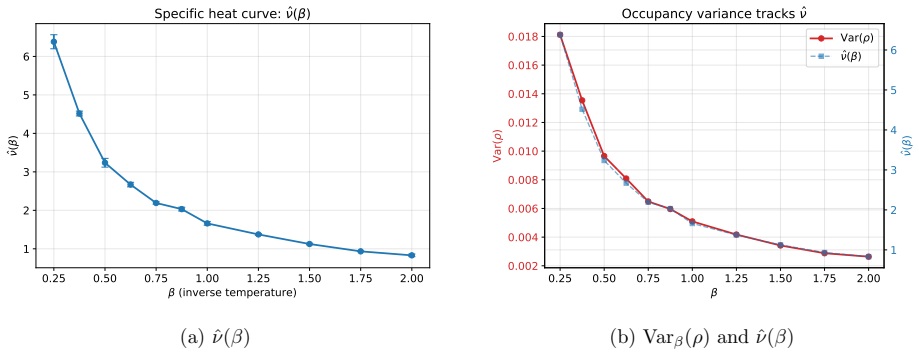
- As temperature decreases, posterior reorganization suppresses fluctuation directions that affect predictive performance.
- Model-specific geometric observables track the decay of singular fluctuation.
Where Pith is reading between the lines
- The thermodynamic view suggests estimating singular fluctuation from response functions computed during posterior sampling rather than direct variance estimation.
- The same curvature identity may extend to other information criteria that involve second derivatives of free energies in non-identifiable models.
- Numerical checks of the identity in finite samples could quantify how quickly the asymptotic equality is approached as data size grows.
Load-bearing premise
The identity is derived within the existing asymptotic framework of singular learning theory and tempered posteriors, inheriting all regularity conditions already required by the RLCT and WAIC literature.
What would settle it
Numerical evaluation in a low-dimensional Gaussian mixture model where the sample variance of the log-likelihood under the tempered posterior fails to equal the finite-difference curvature of the free energy with respect to inverse temperature.
Figures


read the original abstract
Singular learning theory characterizes Bayesian models with non-identifiable parameterizations through two central quantities: the real log canonical threshold (RLCT), which governs marginal likelihood asymptotics, and the singular fluctuation, which determines second-order generalization behavior and the complexity term in WAIC. While the geometric meaning of the RLCT is well understood, the interpretation of singular fluctuation has remained comparatively opaque. We show that singular fluctuation admits a precise thermodynamic interpretation. Under a tempered (Gibbs) posterior, it is exactly the curvature of the Bayesian free energy with respect to inverse temperature; equivalently, the variance of the log-likelihood observable. In this sense, singular fluctuation is the statistical analogue of specific heat. This identity clarifies why singular fluctuation controls the equation of state relating training and generalization error and explains the success of WAIC in singular models: WAIC estimates a fluctuation coefficient rather than a parameter dimension. Across Gaussian mixture models and reduced-rank regression, we demonstrate that singular fluctuation behaves as a thermodynamic response coefficient. As temperature decreases, posterior reorganization suppresses fluctuation directions that affect predictive performance, and model-specific geometric observables track the decay of singular fluctuation. Rather than introducing new asymptotic expansions, this work unifies existing variance identities, equation-of-state results, and WAIC complexity corrections under a single free-energy curvature framework.
Editorial analysis
A structured set of objections, weighed in public.
Referee Report
Summary. The manuscript claims that, under a tempered (Gibbs) posterior, the singular fluctuation of singular learning theory equals the second derivative of the Bayesian free energy with respect to inverse temperature; equivalently, it is the variance of the log-likelihood observable. This supplies a thermodynamic interpretation of singular fluctuation as specific heat, unifies existing variance identities and equation-of-state relations already present in the RLCT/WAIC literature, and explains why WAIC estimates a fluctuation coefficient rather than a parameter dimension. The identity is demonstrated numerically on Gaussian mixture models and reduced-rank regression, where posterior reorganization at low temperature suppresses fluctuation directions that affect predictive performance.
Significance. If the central identity holds, the work supplies a physically transparent account of why singular fluctuation governs the training-generalization relation and why WAIC succeeds for non-identifiable models. Because the argument re-derives no new asymptotic expansions and inherits the regularity conditions already required for the RLCT and WAIC, its contribution is primarily conceptual unification rather than technical extension. The numerical checks on two standard singular model classes provide direct verification of the thermodynamic response coefficient, though they remain qualitative.
minor comments (4)
- Abstract: the numerical demonstrations on Gaussian mixture models and reduced-rank regression are mentioned without any quantitative metrics, error bars, or controls; a single sentence summarizing the observed decay rates or agreement with the curvature identity would improve the abstract.
- §3 (presumed derivation section): although the identity is stated precisely and linked to prior variance results, the manuscript should include an explicit, self-contained derivation from the definition of the tempered posterior and free energy to the variance expression, even if it follows standard steps; this would make the unification transparent to readers unfamiliar with the earlier literature.
- §4: the figures tracking singular fluctuation versus temperature should report statistical variability (e.g., standard errors across independent runs) and indicate the temperature range over which the RLCT/WAIC regularity conditions remain valid.
- Notation: the symbol for inverse temperature and the precise definition of the tempered posterior should be restated once in the main text before the central identity, rather than relying solely on references to earlier papers.
Simulated Author's Rebuttal
We thank the referee for the positive and accurate summary of our manuscript, which correctly identifies the central result as the thermodynamic interpretation of singular fluctuation as specific heat under the tempered posterior. We appreciate the recognition that the work provides conceptual unification of existing variance identities and WAIC results without new asymptotic expansions. The recommendation for minor revision is noted; since no specific major comments were raised in the report, we have no point-by-point responses to address.
Circularity Check
No significant circularity; unification of prior identities
full rationale
The paper explicitly states that it unifies existing variance identities, equation-of-state results, and WAIC corrections under a free-energy curvature framework without introducing new asymptotic expansions. The central claim equates singular fluctuation to the second derivative of the Bayesian free energy (or variance of the log-likelihood) within the established singular learning theory setting. This equivalence is derived from the pre-existing regularity conditions of the RLCT/WAIC literature rather than reducing any prediction to a fitted input or self-citation by construction. No load-bearing step exhibits the enumerated circular patterns.
Axiom & Free-Parameter Ledger
axioms (2)
- domain assumption The model belongs to the singular regime where the parameter space is non-identifiable and the RLCT governs asymptotics.
- domain assumption The tempered (Gibbs) posterior is well-defined and the free-energy curvature exists.
Forward citations
Cited by 1 Pith paper
-
Using Statistical Mechanics to Improve Real-World Bayesian Inference: A New Method Combining Tempered Posteriors and Wang-Landau Sampling
Tempered posteriors combined with Wang-Landau sampling identify transition temperatures that optimize predictive performance in Bayesian inference for real-world problems.
Reference graph
Works this paper leans on
-
[1]
Cambridge University Press, 2009
Sumio Watanabe.Algebraic Geometry and Statistical Learning Theory. Cambridge University Press, 2009. Sumio Watanabe. Asymptotic equivalence of bayes cross validation and widely applicable information criterion in singular learning theory.Journal of Machine Learning Research, 11:3571–3594, 2010. Sumio Watanabe. A widely applicable bayesian information crit...
work page 2009
discussion (0)
Sign in with ORCID, Apple, or X to comment. Anyone can read and Pith papers without signing in.